by Tom Gurney
Tom Gurney BSc (Hons) is an art history expert with over 20 years experience
Published on June 19, 2020 / Updated on October 11, 2026
Email: tomgurney1@gmail.com / Phone: +44 7429 011000
Black on Maroon: Introduction
Tate's Black on Maroon of 1958 is a large oil painting on canvas, approximately 266.7 × 381.2 cm, made in relation to Rothko's Seagram commission and given to Tate in 1968.[1] It is the specific canvas associated with the 2012 vandalism and subsequent conservation discussion, accession T01170. Rothko made another work called Black on Maroon in 1959; facts about that canvas must not be transferred to this one simply because the title is shared.[2]
At a Glance
- ArtistMark Rothko
- Date1958 [1]
- MediumOil on canvas [1]
- Dimensions266.7 × 381.2 cm [1]
- CollectionTate, T01170 [1]
This work in Rothko’s career
Contents
- A painting from the Seagram project
- Dark area and surrounding colour
- The 2012 damage and conservation
- Tate and reproduction
- Looking questions
A painting from the Seagram project
In 1958 Rothko accepted a commission for the Four Seasons restaurant in New York's Seagram Building. He worked on more than thirty canvases, then withdrew from the arrangement.[3] Tate identifies its 1958 Black on Maroon as part of the group originally connected with that commission.[1] The work's dark central area and maroon surroundings belong to the more architectural, enveloping direction of Rothko's late-1950s work. It should be considered with the commission's intended setting, though its present identity is as an individual Tate object.
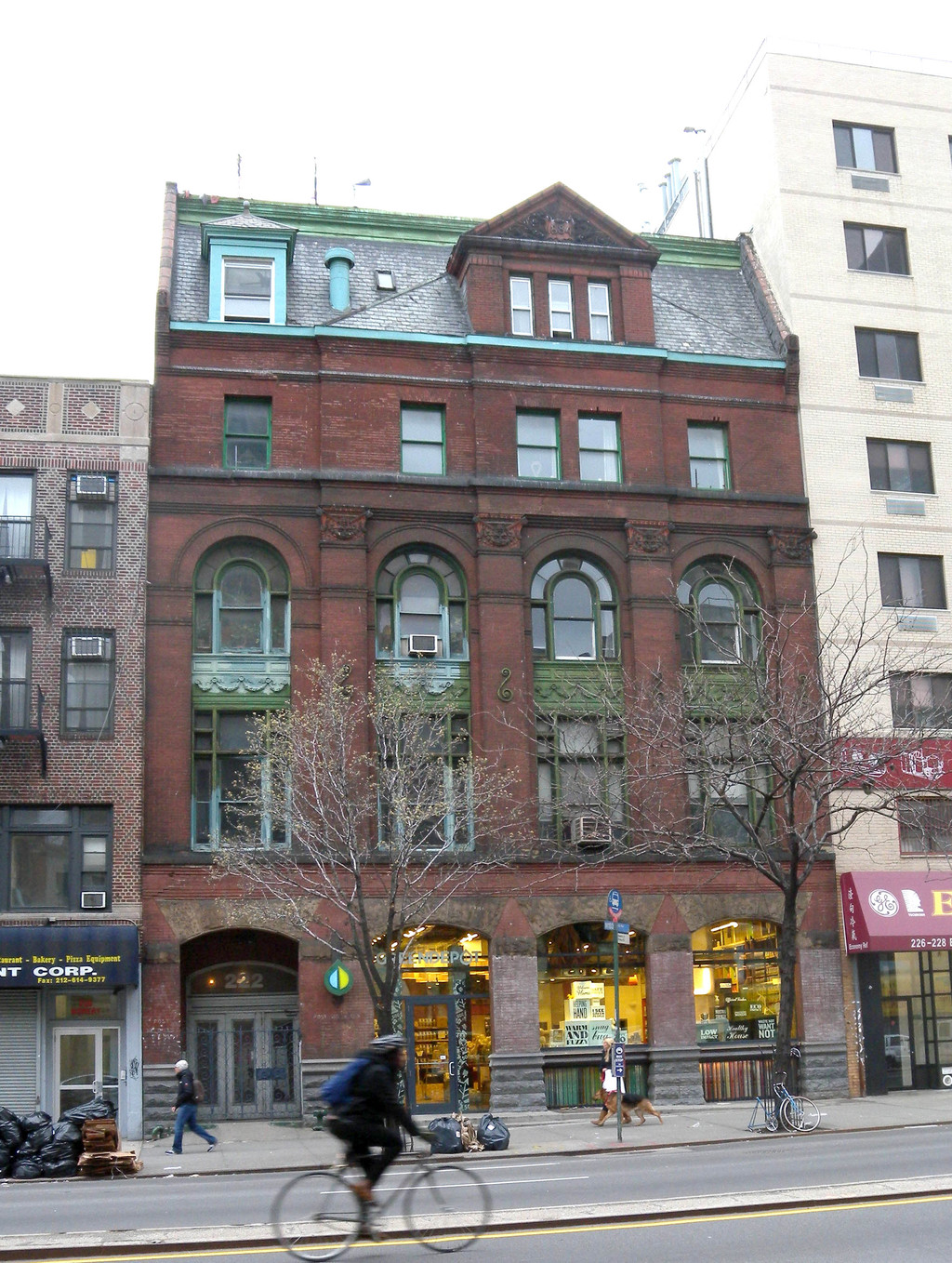
222 Bowery, photographed in 2009. Rothko used the former YMCA building as a studio while working on the Seagram commission.
Photograph: Jim.henderson; released into the public domain by the photographer. [8]
The Seagram story is often reduced to a single dramatic anecdote. The secure outline is the commission, the production of a substantial group, Rothko's decision not to install the works at the restaurant, and the later dispersal of paintings into different collections.[3] Claims about a particular dinner conversation or the artist's exact motives need carefully documented sources. Tate's account notes Rothko's later comparison with Michelangelo's library in Florence, but the architectural relationship is not proof of a literal design copied from that building.[1] The Seagram Murals guide treats the broader project and its sources in more detail.
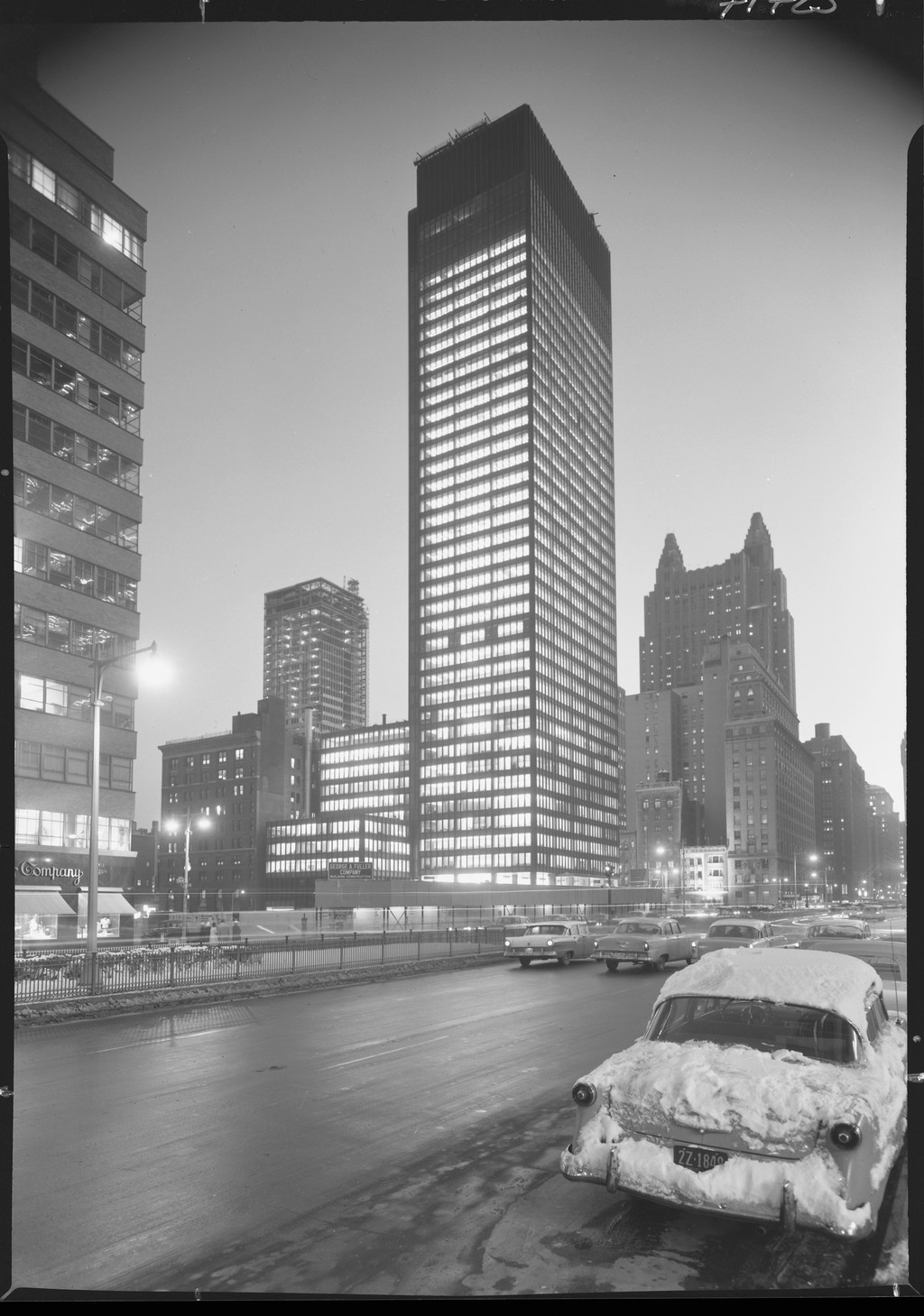
Seagram Building, night view, 3 January 1958. The Four Seasons restaurant in this building became the intended setting for Rothko’s mural commission later that year.
Library of Congress, Prints & Photographs Division, Gottscho-Schleisner Collection; LC-G612-71723; LC-DIG-gsc-5a16908. Resized without cropping. [9]
Dark area and surrounding colour
The title seems to name a simple two-colour division, yet the actual visual relation depends on edges, density and scale. A black field can feel like a barrier or an opening as the maroon around it changes in intensity. The canvas is nearly 3.8 metres wide, so the relation cannot be reduced to a small thumbnail. At a greater distance, the large arrangement asserts itself; closer up, tonal differences and transitions in the paint become more apparent. Neither view alone is the whole painting.
This guide does not assign a single emotional message to the dark palette. Rothko's works are often approached through tragedy, but a specific canvas deserves attention to its form and documented context before a biographical explanation. The Seagram paintings were made for a place, then withheld from it. Their relation to architectural space is important, but the Tate canvas now encounters viewers under different conditions.
The 2012 damage and conservation
The 1958 canvas was damaged by graffiti ink in 2012. Tate's published conservation account describes the construction of a representative sample and tests to remove the ink.[4] This makes conservation an object-specific part of Black on Maroon's recent history. A treatment must balance removal of the added material against the vulnerability of Rothko's original paint; a simple “cleaning” description would obscure that work. The full technical paper should be consulted for the exact solvents, sequence and outcome rather than inferred from news summaries.
Tate's paper is more specific about the problem and the solution. It identifies 7 October 2012 as the date of the ink attack on accession T01170 and reports that the highly fluid black material entered a surface that could not safely be treated as a uniform modern paint film.[4] The conservation team researched both the original paint and the added ink, then constructed a representative test sample to evaluate possible cleaning systems before using them on the painting. That sequence matters: they did not simply choose a solvent that dissolved black ink, because the same action could alter Rothko's thin, sensitive surface. The research was directed toward a treatment that removed the added material while limiting change to the original.
The paper records the painting's return to public display in 2014.[4] It is therefore more accurate to say the work was conserved and displayed again than to say that the attack left it permanently unviewable. Conservation does not make the incident disappear from the object's history, and a restoration report should not be converted into a claim that every microscopic trace vanished. Tate's documented treatment is valuable precisely because it shows how much information about materials and method can be needed to care for a painting whose broad shapes can seem deceptively simple in reproduction.
A later peer-reviewed study by members of the research team identifies a second conservation question: what might residual ink do to the cotton-duck canvas support after visible surface treatment?[7] The researchers analysed the unfamiliar proprietary ink with several complementary laboratory methods, studied its solubility and tested mock-up canvas at different ink levels for changes in mechanical strength. Their results informed both removal and longer-term care. This is object-specific science about T01170 and the 2012 added material. It should not be converted into a claim that all Rothko paintings share the same support, paint recipe or conservation risk. For a visitor, the research explains why apparently broad, quiet fields may demand highly differentiated treatment at the level of layers and fibres.
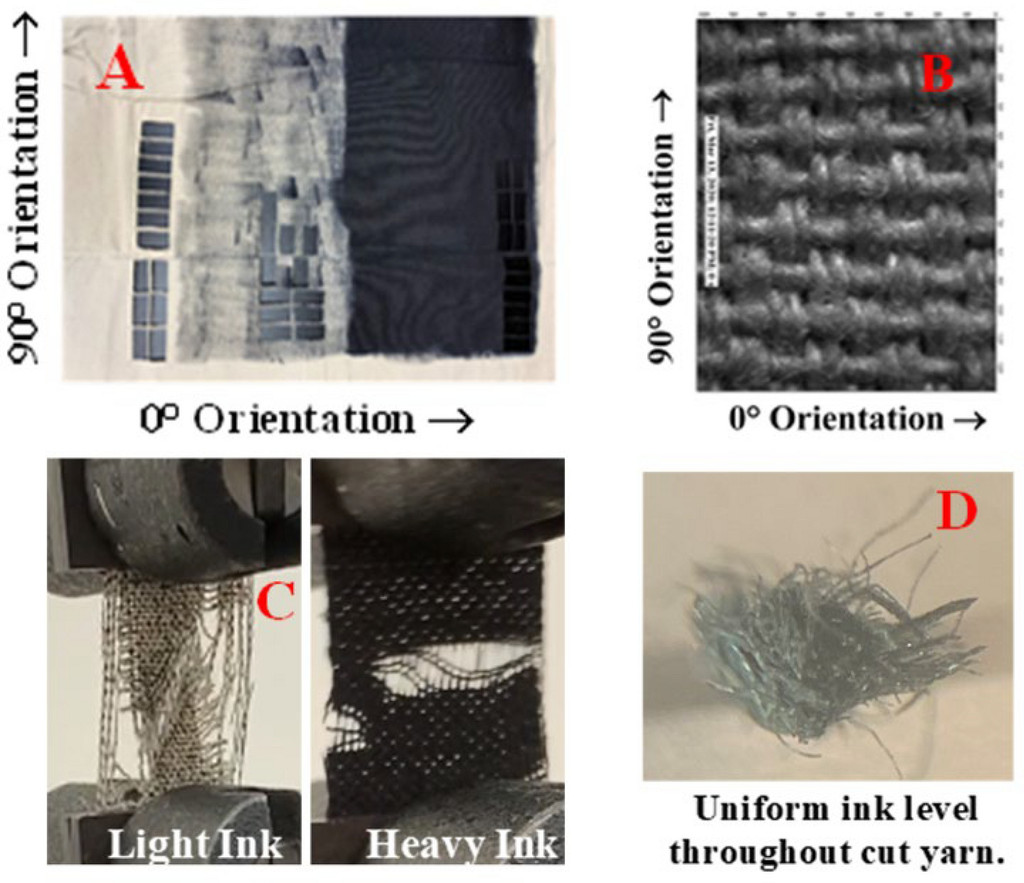
Experimental cotton-duck canvas and inked fibres from the 2022 conservation study, Figure 2. These laboratory samples helped investigate the material added during the 2012 attack.
Scott T. Wills, Bronwyn A. Ormsby, Melinda H. Keefe and Robert L. Sammler, 2022, Figure 2, DOI: 10.1186/s40494-022-00770-x. Resized without cropping. [10]
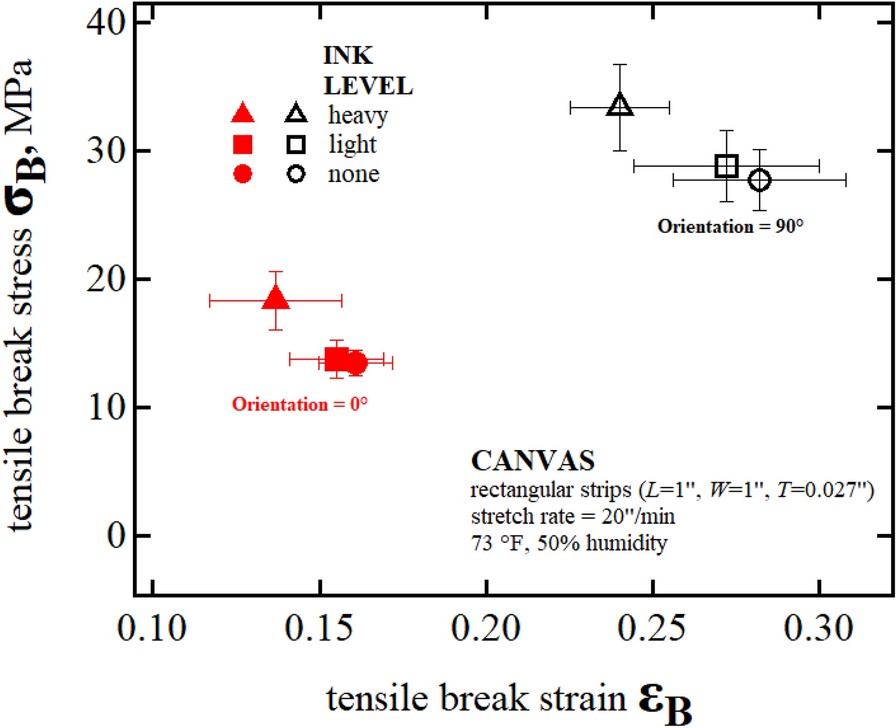
Figure 12 from the same study compares tensile break stress and strain in experimental canvas at different ink levels and fibre orientations. The plotted results concern mock-up samples, rather than direct tensile testing of Rothko’s painting.
Wills, Ormsby, Keefe and Sammler, 2022, Figure 12; DOI: 10.1186/s40494-022-00770-x. Resized without cropping. [11]
The damage history helps identify this particular Black on Maroon. Tate's separate 1959 namesake has its own catalogue and material features.[2] It is easy for captions and image-search results to drift between the two. The date, dimensions, Tate accession and conservation history are the cross-checks that keep this page tied to T01170. This is also why the visual description here avoids claims drawn from a technical study of the 1959 canvas.
Tate's public listings make the title problem more concrete. Its 1958 work is catalogued as oil on canvas, 266.7 × 381.2 cm, while a 1959 Black on Maroon is catalogued as mixed media on canvas, 266.7 × 228.6 cm.[1][2] A further 1959 canvas with the same short title is listed at 266.7 × 457.2 cm; Tate notes evidence on its reverse that makes its intended orientation a subject of debate.[6] These are three distinct original works, not different sizes of one image or print. The shop offers reproductions of each, which adds another layer of objects with the same label. Date, medium, measurements and accession should accompany any claim about an individual painting.
Tate and reproduction
Tate says Rothko gave the 1958 work to the collection in 1968.[1] A Tate shop listing contains object information and offers reproductions for sale, but it does not grant a new publisher rights to reuse the artwork image. The painting is still under copyright through the Rothko heirs. This guide therefore links to Tate's own record and uses no unlicensed reproduction.
David Anfam's 1998 catalogue raisonné is the major reference for works on canvas and should eventually be checked for this painting's entry, title variants and complete exhibition history.[5] The facts above come from Tate's public object and conservation material and the National Gallery's Seagram account. A catalogue number has deliberately not been invented.
Looking questions
Look first at the relation between the dark area and maroon ground. Where does the dark field seem most contained, and where does it seem to press outward? Then consider the size of the canvas and the distance you need to take in its width. Finally compare it with Four Darks in Red at the Whitney. The works share a late-1950s interest in dark over red, but have different dimensions, collection histories and project contexts.
Related works
- The Seagram Murals sets out the commission and its dispersal.
- Four Darks in Red is a distinct 1958 Whitney painting.
- Light Red over Black is a separate 1957 Tate painting.
Rothko works in this guide
| Name | Date | Medium |
|---|---|---|
| Entrance to Subway | 1938 | Painting |
| Hierarchical Birds | 1944 | Painting |
| Slow Swirl at the Edge of the Sea | 1944 | Painting |
| No. 3/No. 13 | 1949 | Painting |
| Untitled (Violet, Black, Orange, Yellow on White and Red) | 1949 | Painting |
| White Center | 1950 | Painting |
| No. 10 | 1950 | Painting |
| No. 6 (Violet, Green and Red) | 1951 | Painting |
| Untitled | 1952 | Painting |
| No. 61 (Rust and Blue) | 1953 | Painting |
| No. 1 (Royal Red and Blue) | 1954 | Painting |
| Untitled (Yellow and Blue) | 1954 | Painting |
| Orange and Yellow | 1956 | Painting |
| Light Red over Black | 1957 | Painting |
| Four Darks in Red | 1958 | Painting |
| Black on Maroon | 1958 | Painting |
| No. 14 | 1960 | Painting |
| Orange, Red, Yellow | 1961 | Painting |
| Untitled (brown and gray) | 1969 | Painting |
| Untitled (Red on Red) | 1969 | Painting |
| Untitled (Black and Gray) | 1970 | Painting |
| Tentacles of Memory | 1945–46 | Drawing |
Frequently Asked Questions
This is Tate’s 1958 oil canvas, accession T01170, approximately 266.7 × 381.2 cm. It belongs to the Seagram project and is the painting associated with the 2012 vandalism. Tate also holds distinct 1959 works carrying the same title.[1][2][6]
No. Rothko withdrew the Seagram commission before the intended restaurant installation took place. This canvas’s relationship to the project should be distinguished from its later Tate history and museum displays.[3]
Discussion
What changes when you look at Black on Maroon as a physical painting rather than a small reproduction?
Use the questions below to compare the work with its neighbours in Rothko’s career.
Reader Insights
Which edge or interval asks you to slow down?
How does this painting differ from the earlier and later works linked here?
What remains uncertain after reading the museum record and looking closely?
Join the Conversation
Share an observation grounded in the work or its documented history.
References
- Tate, Black on Maroon, 1958, object information.
- Tate, separate Black on Maroon, 1959.
- National Gallery of Art, “Mark Rothko: Seagram Murals”.
- Tate Papers, “Conserving Mark Rothko's Black on Maroon (1958): The Construction of a Representative Sample and the Removal of Graffiti Ink”.
- David Anfam, Mark Rothko: The Works on Canvas: A Catalogue Raisonné (National Gallery of Art and Yale University Press, 1998), bibliography at NGA; entry not directly verified.
- Tate, separate wider Black on Maroon, 1959, 266.7 × 457.2 cm, including orientation note.
- Scott T. Wills, Bronwyn A. Ormsby, Melinda H. Keefe and Robert L. Sammler, “Key characterization efforts to support the graffiti ink removal and care of Mark Rothko's painting ‘Black on Maroon’ 1958,” Heritage Science 10 (2022), article 143, on ink analysis and tests of the cotton-duck support.
- YMCA 222 Bowery jeh.JPG. Photograph: Jim.henderson; released into the public domain by the photographer. Source · Public-domain dedication.
- Seagram Building, night view. Library of Congress, Prints & Photographs Division, Gottscho-Schleisner Collection; LC-G612-71723; LC-DIG-gsc-5a16908. Resized without cropping. Source · Public domain; heirs’ release.
- Conservation study Figure 2. Scott T. Wills, Bronwyn A. Ormsby, Melinda H. Keefe and Robert L. Sammler, 2022, Figure 2, DOI: 10.1186/s40494-022-00770-x. Resized without cropping. Source · CC BY 4.0.
- Experimental cotton-duck canvas tensile break properties, Figure 12. Wills, Ormsby, Keefe and Sammler, 2022, Figure 12; DOI: 10.1186/s40494-022-00770-x. Resized without cropping. Source · CC BY 4.0.