 by Tom Gurney
Tom Gurney BSc (Hons) is an art history expert with over 20 years experience
Published on June 19, 2020 / Updated on October 11, 2026
Email: tomgurney1@gmail.com / Phone: +44 7429 011000
Untitled (brown and gray): Introduction
The National Gallery of Art identifies Untitled (brown and gray) as a 1969 acrylic painting on paper, accession 1986.43.286, given by the Mark Rothko Foundation.[1] That medium is central to the work's identity. An older version of this guide described a large canvas, but the museum's current record is unambiguous: this is a paper work. It should also be kept distinct from the Museum of Contemporary Art, Los Angeles's 1970 Untitled (Black and Gray), which is acrylic on canvas and has a separate accession number.[2]
At a Glance
- ArtistMark Rothko
- Date1969 [1]
- MediumAcrylic on paper [1]
- CollectionNational Gallery of Art, 1986.43.286 [1]
This work in Rothko’s career
No. 3/No. 13
1949Contents
- Two fields on paper
- Why paper matters
- A late work without a single biographical explanation
- Collection and reading trail
Two fields on paper
NGA's object record describes two horizontal areas separated by a softened boundary, with a deeper brown above and a lighter brown-gray below.[1] Its short visual description is automatically generated and should be treated as an aid to looking rather than as an expert technical report. The useful question is how the two areas meet. Their dividing line is not a perfectly ruled bar; the change in tone and paint density makes it seem to breathe. The exposed or bounded paper around the painted zones also participates in the image rather than serving as an invisible support.
The title names the broad colour family but leaves open the more subtle shifts between brown and gray. Viewers sometimes read such horizontal arrangements as landscapes. That may be a personal response, but no museum evidence here identifies a depicted sky or terrain. Rothko's late works invite attention to weight, interval, surface and scale without requiring a hidden scene. The placement of a dark upper area over a paler lower one may affect how the sheet feels, even when both fields remain abstract.
The NGA collection itself contains several 1969 sheets catalogued as Untitled (brown and gray). Its artist list shows distinct accession numbers and noticeably different images under that short descriptive title.[7] This page concerns only 1986.43.286. A search result that supplies the title and year without an accession may lead to a different sheet; a comparison of palette or dimensions should always begin with the museum object number. This is especially important for late works in which repeated colour descriptions and broad horizontal divisions can make separate objects sound identical in text. The NGA records another 1969 Untitled (brown and gray) as accession 1986.43.291.[9] Its online image and record should not be used as evidence for the appearance or exhibition history of 1986.43.286: the latter has a Houston 2015–16 exhibition entry, while the former page does not list one. The paired museum records give a concrete example of why the title alone cannot identify a paper work.
Why paper matters
Rothko's work on paper was extensive. The National Gallery reports more than 1,000 paintings on paper and notes that the artist considered many of them finished works worthy of exhibition and sale.[3] Paper could be mounted to board or linen; it could also remain a loose sheet. A museum image cannot always disclose those support decisions, which are part of the work's physical history. The NGA's conservators have examined taped edges, staple holes, brushwork and mounting choices in documented examples, showing that “on paper” is not shorthand for a preliminary sketch.[3]
The same NGA article explains an experiment within the Brown and Gray group: on one early sheet, Rothko left masking tape at the edges; later works used a hard-edged border of exposed white paper.[3] That is evidence for a development in the series, not a licence to state that the tape survives on accession 1986.43.286. Its own record gives acrylic on paper, with no tape in the medium line.[1] The specific sheet should be examined or documented technically before attributing a procedure to it. This distinction prevents a general account of method from becoming a false object fact.
A late work without a single biographical explanation
The National Gallery's artist chronology notes Rothko's increasing use of acrylic on both canvas and paper from 1968.[4] This 1969 object sits within that shift. The material change does not by itself explain the subdued palette, and the date should not make the work an automatic illustration of Rothko's final illness or death. Museum records establish the work's date and materials; a psychological interpretation would require a different kind of evidence and still could not close down the viewer's response.
Compare the NGA paper work with MOCA's Untitled (Black and Gray). The latter is dated 1970, made on canvas and substantially different as an object even though its title also names dark and gray colours.[2] The two sites' records use distinct mediums and accessions. Their coexistence makes precise object identification especially important in links, captions and search results.
Collection and reading trail
NGA lists a 2015–16 Houston retrospective in the object's exhibition history. Its bibliography also cites Bonnie Clearwater's Mark Rothko: Works on Paper under catalogue number 71.[1] That is a useful scholarly lead, although the book itself has not been checked for this guide. David Anfam's catalogue raisonné is specifically of works on canvas, so it should not be offered as a direct catalogue entry for this paper work.[5] The newer NGA works-on-paper catalogue is the more appropriate evolving reference for paper objects; its project description says it is still being compiled.[6]
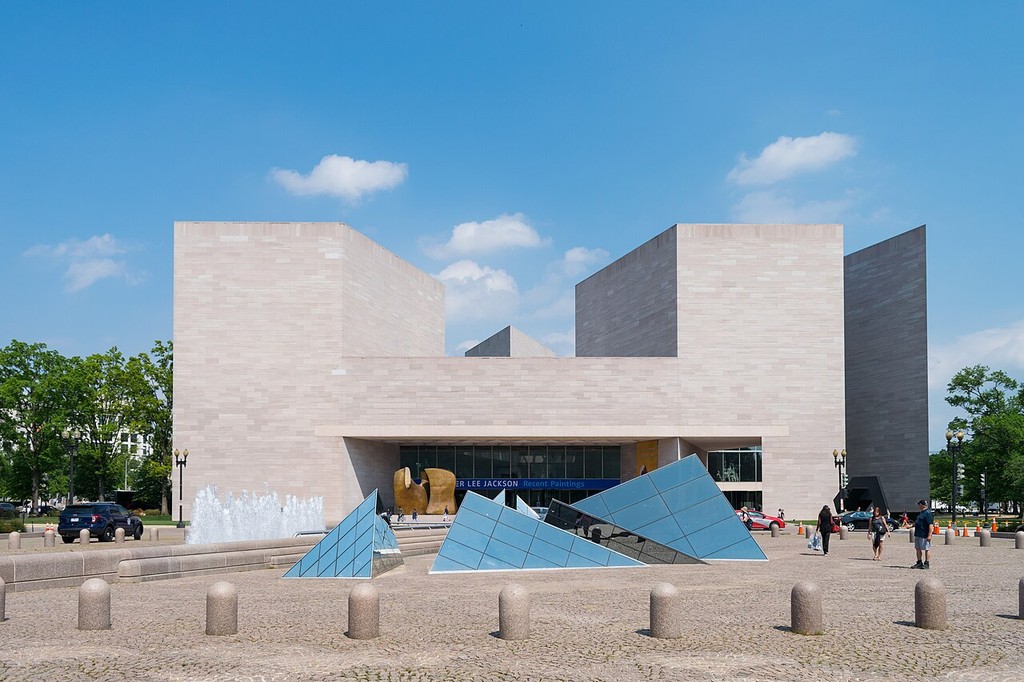
The National Gallery of Art’s East Building in 2019. Its Rothko holdings include the 1969 paper painting Untitled (brown and gray), accession 1986.43.286.
Photograph: Difference engine. Photograph remains CC BY-SA 4.0. Resized without cropping. [10]
The Clearwater reference matters because it places this exact accession in a study devoted to the medium decades before the NGA's 2023 exhibition. The Houston retrospective later integrated it into a broader account of Rothko's career.[1] Those two curatorial settings ask different questions: one follows paintings on paper as a body of work, while the other asks how a late sheet stands beside canvases and earlier subjects. The exhibition entries establish inclusion, not that the work occupied a particular wall or that its visual effect was identical in each venue. A photograph or checklist from each installation would be needed to pursue those details.
NGA's account of Rothko's late work offers a useful corrective to an overly simple dark-period narrative. It identifies the Brown and Grays on paper alongside Black on Grays on canvas in 1969, while also documenting late sheets in mauve, lavender, pale pink and light blue.[8] This does not make the present brown-and-gray sheet cheerful; it shows that Rothko was testing more than one palette at the same time. A reading based solely on the year 1969 would miss that parallel work and the material difference between the two named groups.
NGA marks the work as not on view in its current record and restricts image downloading.[1] This page therefore links to the museum's object record for the image and current information rather than reproducing it. When looking at that record, compare the density of the upper and lower areas, the character of their boundary and the role of the paper border. Those observations yield more than simply calling the work “dark.”
Related works
- Rothko's drawings considers another part of his paper practice.
- Rothko's paintings covers canvas and paper paintings.
- Untitled (Black and Gray) is the distinct 1970 MOCA canvas.
Rothko works in this guide
| Name | Date | Medium |
|---|---|---|
| Entrance to Subway | 1938 | Painting |
| Hierarchical Birds | 1944 | Painting |
| Slow Swirl at the Edge of the Sea | 1944 | Painting |
| No. 3/No. 13 | 1949 | Painting |
| Untitled (Violet, Black, Orange, Yellow on White and Red) | 1949 | Painting |
| White Center | 1950 | Painting |
| No. 10 | 1950 | Painting |
| No. 6 (Violet, Green and Red) | 1951 | Painting |
| Untitled | 1952 | Painting |
| No. 61 (Rust and Blue) | 1953 | Painting |
| No. 1 (Royal Red and Blue) | 1954 | Painting |
| Untitled (Yellow and Blue) | 1954 | Painting |
| Orange and Yellow | 1956 | Painting |
| Light Red over Black | 1957 | Painting |
| Four Darks in Red | 1958 | Painting |
| Black on Maroon | 1958 | Painting |
| No. 14 | 1960 | Painting |
| Orange, Red, Yellow | 1961 | Painting |
| Untitled (brown and gray) | 1969 | Painting |
| Untitled (Red on Red) | 1969 | Painting |
| Untitled (Black and Gray) | 1970 | Painting |
| Tentacles of Memory | 1945–46 | Drawing |
Frequently Asked Questions
The NGA’s 1969 work, accession 1986.43.286, is an acrylic painting on paper. It was given by the Mark Rothko Foundation. Paper is the painted support, so describing this object as a large canvas would confuse its identity.[1]
No. MOCA’s work is a separate 1970 acrylic painting on canvas, accession 85.27. The NGA’s paper painting differs in date, support and object number even though both belong to Rothko’s late dark work.[1][2]
Discussion
What changes when you look at Untitled (brown and gray) as a physical painting rather than a small reproduction?
Use the questions below to compare the work with its neighbours in Rothko’s career.
Reader Insights
Which edge or interval asks you to slow down?
How does this painting differ from the earlier and later works linked here?
What remains uncertain after reading the museum record and looking closely?
Join the Conversation
Share an observation grounded in the work or its documented history.
References
- National Gallery of Art, Untitled (brown and gray), accession 1986.43.286.
- The Museum of Contemporary Art, Los Angeles, Untitled (Black and Gray), accession 85.27.
- Michaela Milgrom, “How Mark Rothko Made Paintings on Paper,” National Gallery of Art, 2023.
- National Gallery of Art, “Mark Rothko,” artist chronology.
- David Anfam, Mark Rothko: The Works on Canvas: A Catalogue Raisonné (National Gallery of Art and Yale University Press, 1998); scope recorded in the NGA Rothko bibliography.
- National Gallery of Art, Mark Rothko: Works on Paper catalogue project.
- National Gallery of Art, Rothko collection list, showing multiple 1969 sheets with the same descriptive title and different accessions.
- National Gallery of Art, “Who Is Mark Rothko? 9 Things to Know”, on the parallel late series and lighter paper palette.
- National Gallery of Art, separate Untitled (brown and gray), accession 1986.43.291.
- East Building of the National Gallery of Art, 2019.jpg. Photograph: Difference engine. Photograph remains CC BY-SA 4.0. Resized without cropping. Source · CC BY-SA 4.0.