


 by Tom Gurney
Tom Gurney BSc (Hons) is an art history expert with over 20 years experience
Published on June 19, 2020 / Updated on October 28, 2026
Email: tomgurney1@gmail.com / Phone: +44 7429 011000
American artists: an introduction
American art includes presidential portraits, expansive landscapes, photographs of working lives, experiments in colour and moving images. Its makers have worked in cities and rural communities, on Indigenous homelands, in immigrant neighbourhoods and in studios far beyond the United States. A national category brings these histories into conversation; it cannot give them one appearance or one point of view.
Major artists: places to begin
A selection across different periods. The complete directory below includes every American artist guide on this site.
Some familiar pictures make a useful beginning. Gilbert Stuart helped establish Washington’s public likeness. Thomas Cole made landscape a setting for questions about human ambition. Mary Cassatt developed her American career through a sustained life in France. Later, Georgia O’Keeffe, Jackson Pollock and Jean-Michel Basquiat found very different ways to connect personal experience with a changing visual culture. Their differences are part of the subject, alongside the achievements they share.
The emphasis here is art associated with the United States. Indigenous nations have their own histories and sovereignties, extending across borders that changed around them. Artists who emigrated, lived abroad or moved between countries also complicate a simple division by birthplace. Benjamin West, born in Pennsylvania and established in London, belongs in American and British accounts. Max Ernst, born in Germany, became an American citizen during his years in the United States and later a French citizen. These connections help explain the art rather than diminish its place in a national history. [1] [2] [3]
Watch: selected American artists
A brief introduction to selected nineteenth- and twentieth-century American painters. The wider guide below also explores earlier art, photography, sculpture and other traditions.
TheHistoryOfArt. TheHistoryOfArt’s selection features Grant Wood, Georgia O’Keeffe, Edward Hopper, Norman Rockwell, Mary Cassatt, Jackson Pollock and Jean-Michel Basquiat. Watch on YouTube.
Explore this guide
Portraits, patrons and a new republic
Portrait painting gave early American artists a practical profession. A successful likeness could secure another commission, introduce a painter to a family’s circle and preserve the standing of a merchant, officeholder or relative. Decisions about clothing, scale, furniture and pose were therefore consequential. They placed a particular person within a social world, whether the painting was intended for a home, an institution or a public room.
West’s early portraits of Samuel and Mary Bethel Boude belong to this economy of likenesses. His subsequent training in Italy and move to London enlarged his ambitions to include classical history, religious drama and recent warfare. His career also made London an important destination for younger Americans. Stuart, John Trumbull and Thomas Sully each encountered West’s guidance, although their eventual practices differed substantially. These careers place exchange across the Atlantic alongside the search for local patrons. [1] [4] [5] [6]
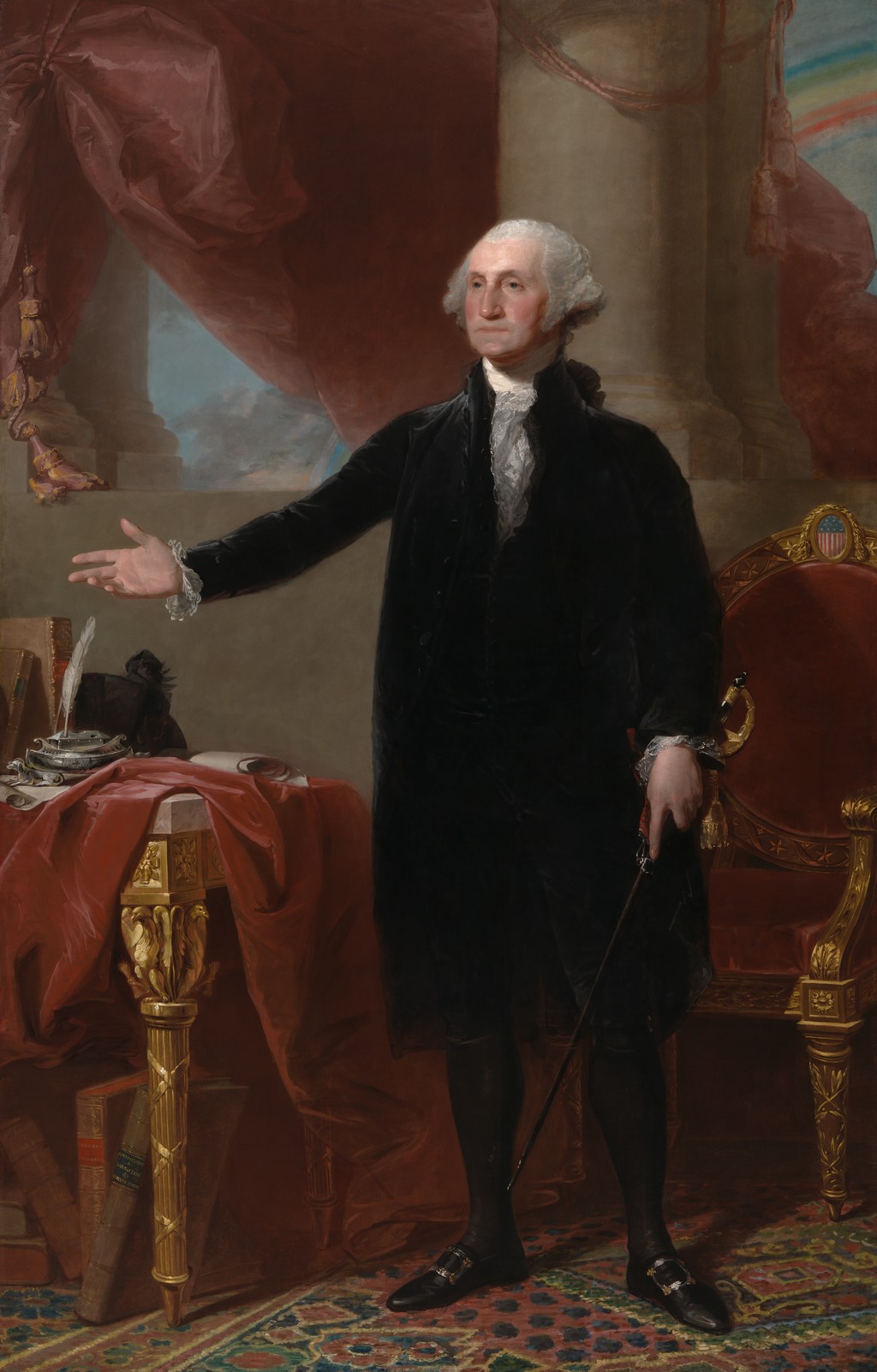
Stuart’s Washington portraits show how a sitting could generate a lasting public image. His Vaughan, Athenaeum and Lansdowne types are distinct compositions, subsequently repeated in other canvases and reproduced in prints. The unfinished Athenaeum likeness supplied the face familiar from the dollar bill. In the full-length Lansdowne portrait, the surrounding architecture, books, furniture and gesture turn a likeness into an account of presidential authority. Studying the versions separately restores the artist’s choices behind a face that reproduction has made almost automatic. [5]
His less ceremonial pictures are equally revealing. In Catherine Brass Yates, the act of sewing gives the sitter’s hands a purpose and establishes a rhythm below the face. A portrait of an artist, a merchant or a woman at work need not use the same means as a presidential commission. Stuart’s range becomes clearer when these encounters are placed beside the Washington images: public recognition was one purpose of portraiture, intimate attention another. [7]
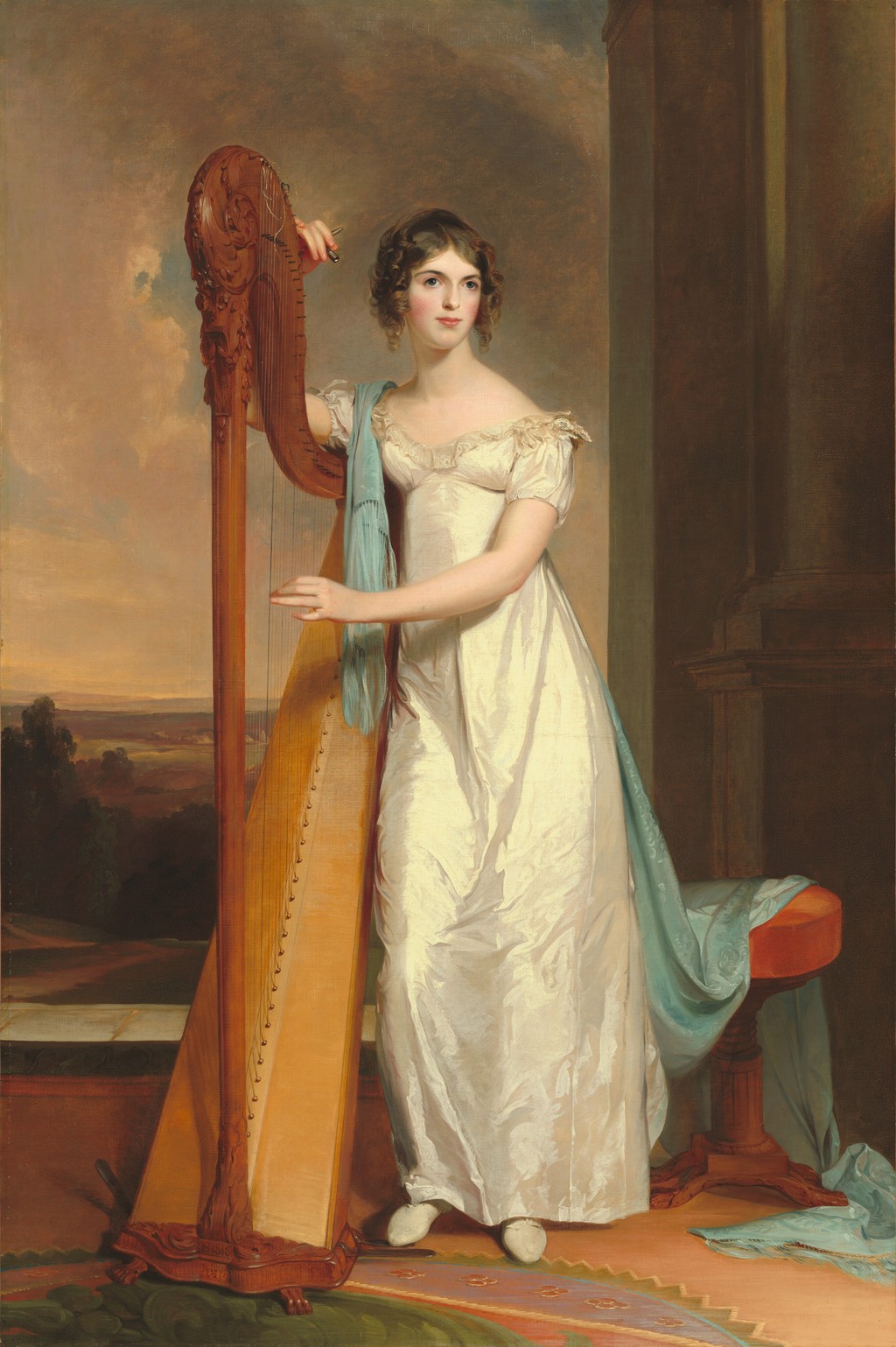
Thomas Sully extended the profession through a long career centred in Philadelphia. Theatre connections, family networks and travel all helped him find sitters. In Lady with a Harp, the instrument connects Eliza Ridgely’s raised hand with the whole standing figure. His studies for Queen Victoria reveal another scale of work, in which access to a royal sitter had to be translated into a much larger ceremonial painting. Portraiture joined an artist’s handling of paint to the practical circumstances of a commission. [6] [8] [9]
Painting the Revolution and remembering history
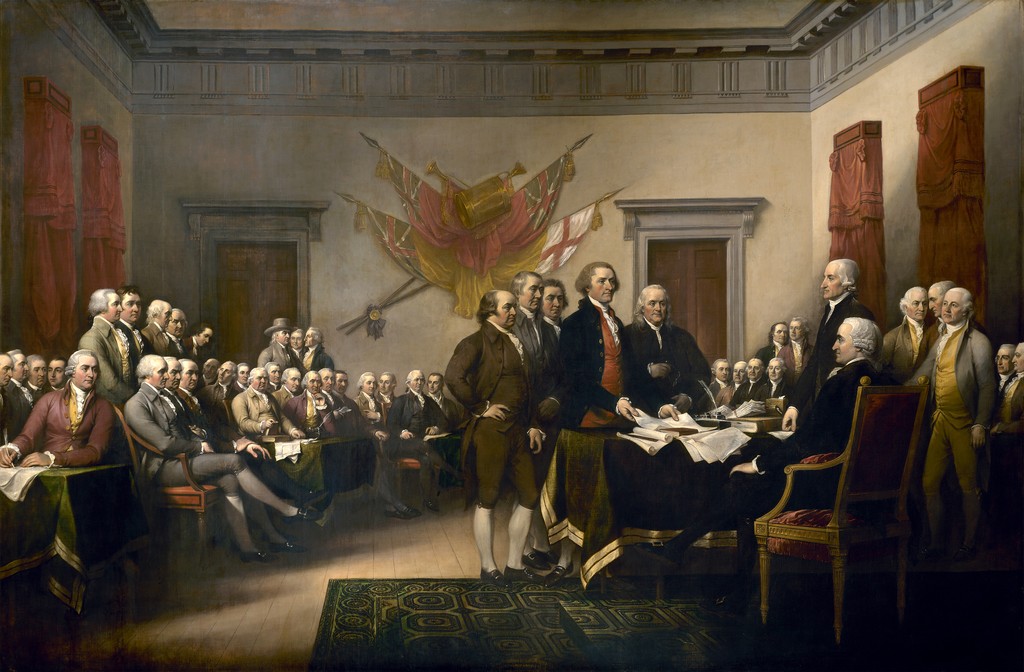
John Trumbull made the Revolution the subject of an extended historical project. Military service gave him experience of the conflict and access to some of its participants. Portrait studies helped him preserve identifiable faces. Yet the finished paintings also depended on later reconstruction: arrangements of people, selected gestures and a concentrated incident through which a complicated event could become legible. Historical knowledge and pictorial invention worked together. [10] [11]
His Declaration of Independence is frequently misunderstood as a picture of all the signers signing at once. It represents the presentation of the draft to Congress. The difference changes how the scene should be read. A committee moves towards a seated official while the surrounding assembly gives the action its public significance. Trumbull’s smaller Yale painting and the much larger Capitol version also have separate histories. Reproductions can obscure both the actual incident represented and the physical scale of the original. [12] [13]
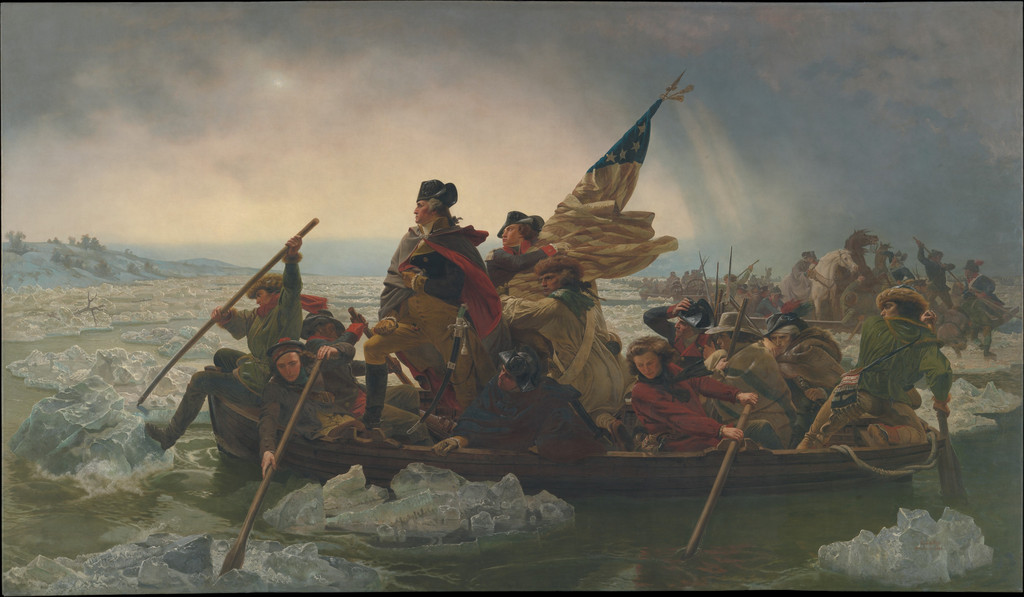
Emanuel Leutze approached revolutionary memory from a different generation and a German-American career. The Metropolitan Museum’s Washington Crossing the Delaware was painted in Düsseldorf in 1851, long after the crossing of December 1776. Washington’s upright figure, the workers propelling the boat and the struggle through ice make collective effort visible. Its authority comes from the force of that arrangement, supported by historical reference, rather than from the painter having witnessed the event. [14]
This is why the dedicated article on the painting gives substantial attention to versions, objects, historical discrepancies and later reception. A national icon accumulates uses beyond its original commission. It can inspire patriotic identification, invite criticism or supply a composition that later artists transform. Keeping the event, the nineteenth-century painting and its subsequent reproductions separate allows each stage of that history to be understood.
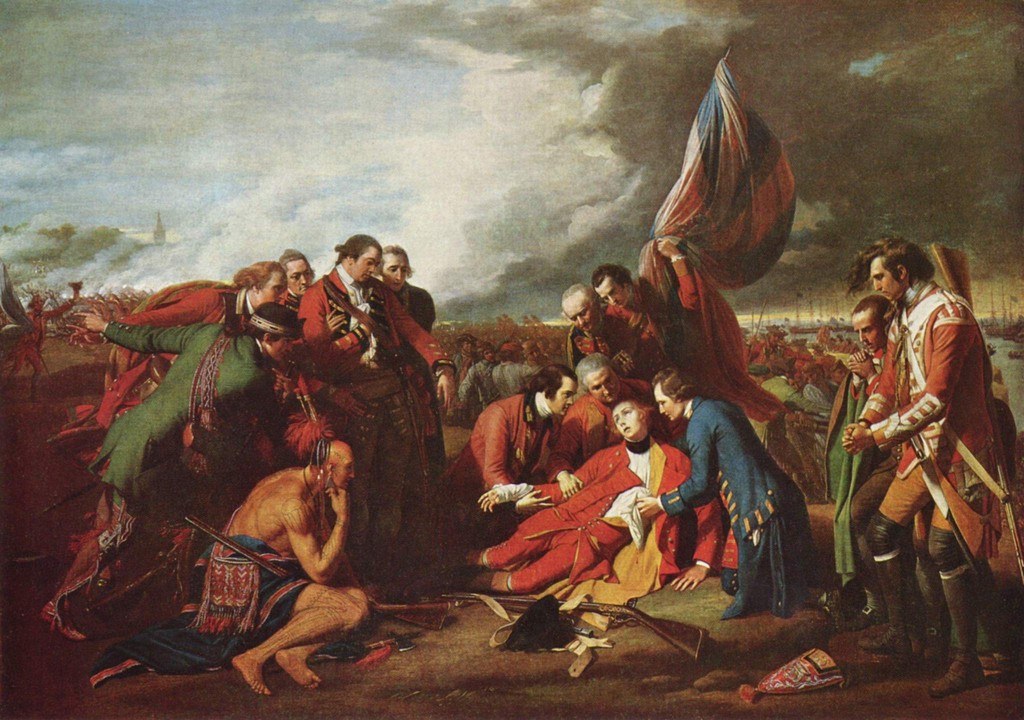
West’s The Death of General Wolfe offers an illuminating comparison. It presents a death in the British campaign at Quebec, not an American revolutionary episode, yet its painter’s American origins and transatlantic influence make it relevant here. A recent military event becomes a solemn group gathered around a dying commander. West and Trumbull show how the conventions of history painting could shape modern public memory; Leutze demonstrates their continuing force in the following century. [15]
Landscape becomes a public art
The Hudson River School helped establish landscape as a major field of American painting. The name describes connected artists, professional institutions and shared subjects, rather than a single classroom or an agreed manifesto. New York exhibitions and studios brought the painters together. Their journeys took them along the Hudson, into New England and eventually much farther afield. The category is useful when these relationships remain visible within it. [16]
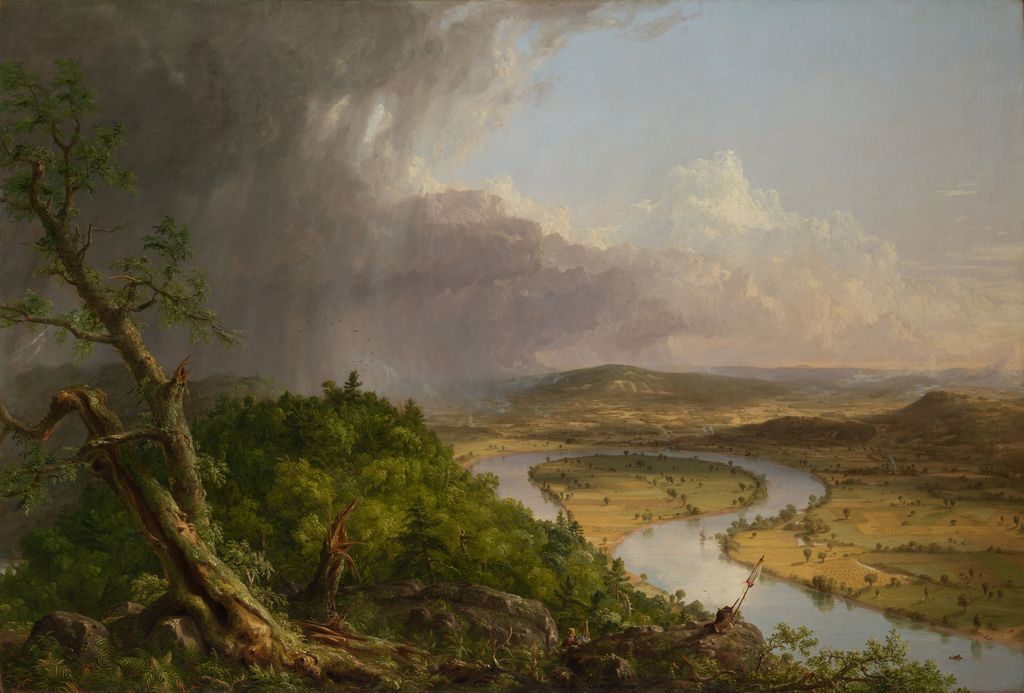
Cole’s development was itself international. Born in England, he brought experience of industrial change to an American landscape that he studied closely and transformed imaginatively. In The Oxbow, storm-darkened wooded heights meet the cultivated valley of the Connecticut River. Elsewhere, the five canvases of The Course of Empire make a changing landscape carry an invented history of growth and destruction. A place could become the setting for reflection on the direction of a society. [17]
Asher Brown Durand arrived at landscape through engraving and portraiture. His detailed studies of trees and rocks demonstrate the attention to particular natural forms that supported his larger pictures. His published Letters on Landscape Painting encouraged study from nature, while finished compositions organised that study for an audience. The relationship between the small outdoor observation and the ambitious studio canvas is central to understanding the school’s work. [18] [19]
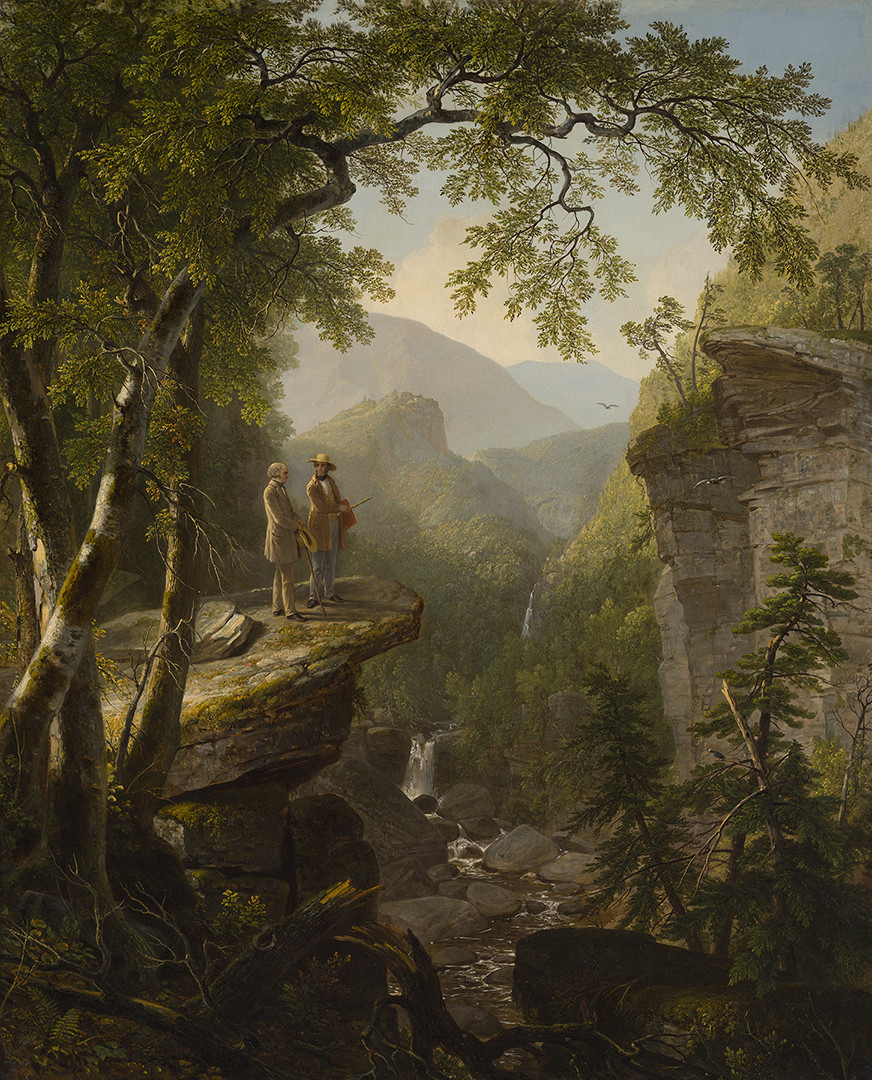
Kindred Spirits brings Cole and the poet William Cullen Bryant into an invented mountain setting. It commemorates a friendship and an artistic ideal, joining identifiable people to a landscape whose arrangement serves remembrance. The picture is therefore a useful companion to a presidential portrait or a historical gathering. Landscape had acquired the capacity to honour individuals and express cultural values without abandoning trees, water and rock as its principal visual language. [20]
Such paintings also need to be considered against the land’s existing histories. A composition that appears remote from human activity can still depict a region shaped by Indigenous communities, trade, settlement or resource extraction. The artist’s decision to show a clearing, a felled tree or a distant building affects the account. Looking for those details adds historical substance to admiration for the scenery, especially when an image has long circulated as an apparently timeless wilderness.
Church, Bierstadt and Moran: travel and spectacle
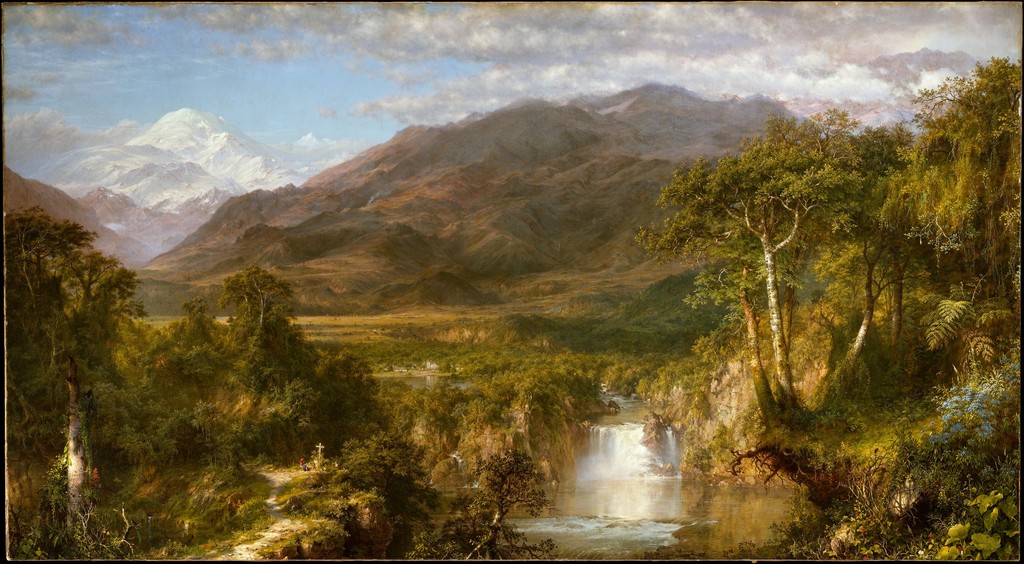
Frederic Edwin Church expanded the geographical and intellectual range of landscape painting. His South American journeys and interest in Alexander von Humboldt connected observation of plants, mountains and climate with ambitious studio compositions. The Heart of the Andes gathers a great variety of natural forms into an extensive view. Its small details reward prolonged inspection, while the whole painting supplies an experience that a sketchbook page or a travel report could not. [21]
The painting’s public exhibition mattered to its effect. Viewers encountered a large, carefully presented work whose apparent abundance invited close scrutiny. Church’s travels supplied observations, but the canvas was also an organised display made for people elsewhere. Its connection with scientific curiosity does not turn it into a neutral chart. Selecting, joining and illuminating the visible world remained acts of painting. [22]
Albert Bierstadt brought similarly ambitious means to western subjects. His travels and studio practice transformed studies into expansive mountain landscapes for an international audience. The scale of those pictures and the organisation of light could make a distant region seem immediately available to viewers in a gallery. That encounter belongs to the history of exhibition and collecting as well as to the history of travel. [16]
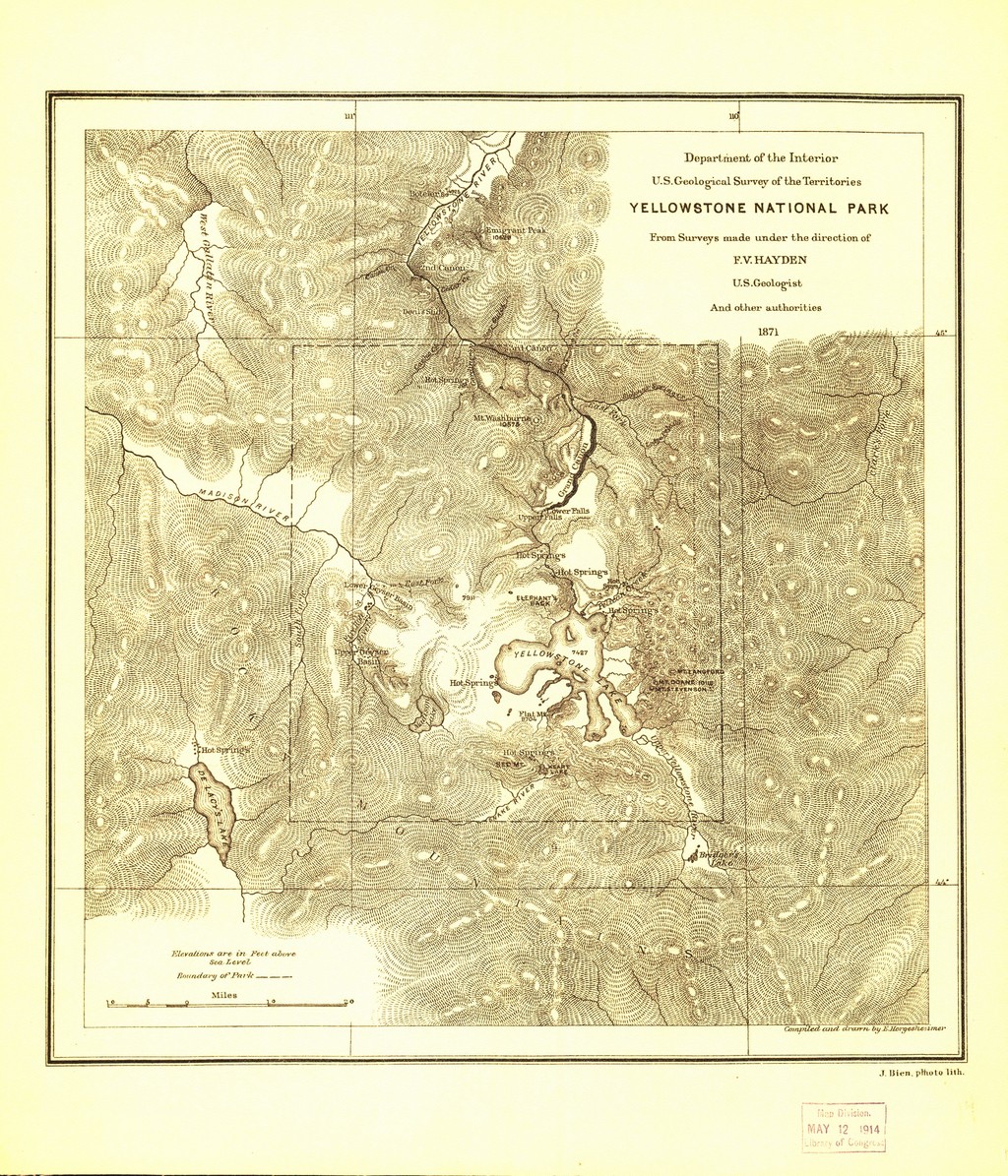
Thomas Moran travelled with the 1871 Hayden survey to Yellowstone. Watercolours, drawings, photographs and scientific work formed part of the expedition’s varied record. His large paintings developed through a further process of selection and composition. They should be read alongside, rather than confused with, survey photographs and maps: each medium offered a different way to organise a viewer’s knowledge of a place. [23]
Moran’s Yellowstone imagery became associated with the campaign for the national park. Its contribution is best understood within a larger history of expedition reports, political decisions, photography and competing interests in the region. The landscape was already inhabited and known before a federal survey represented it to eastern audiences. Describing a painting as helping make a place famous is therefore more accurate than implying that its maker discovered an unknown country. [23]
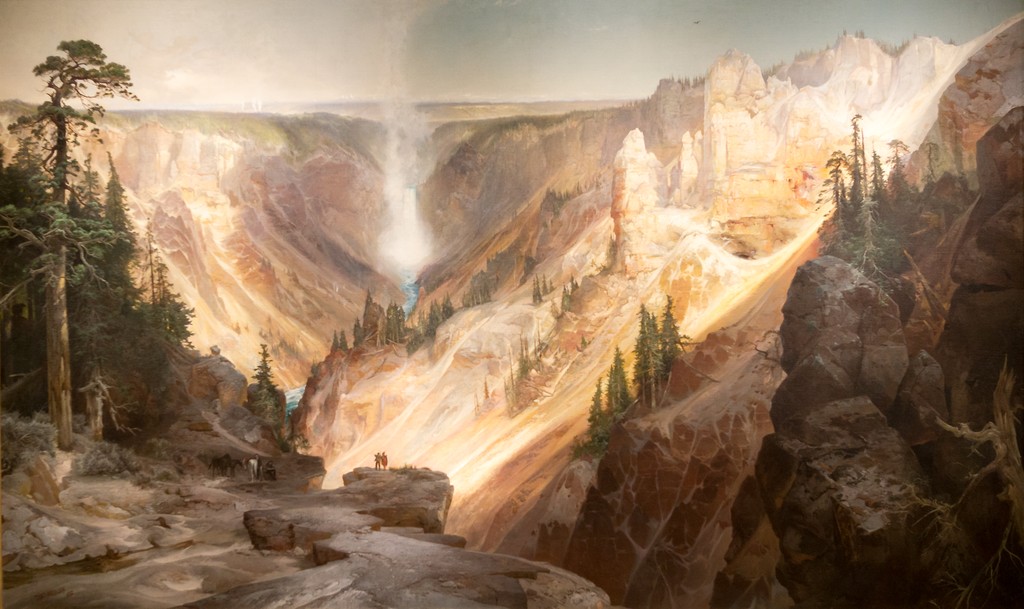
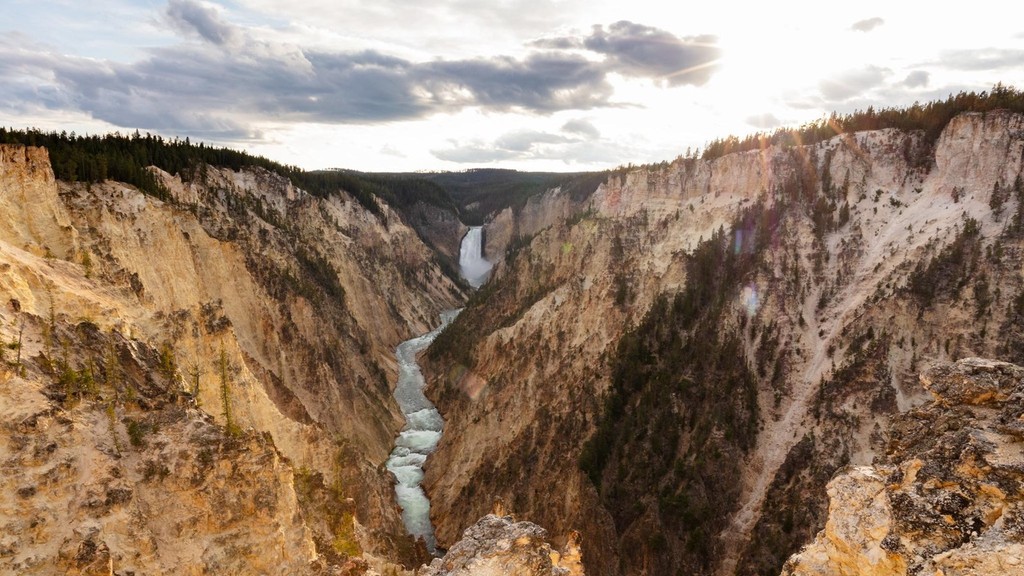
The documentary photographs and maps accompanying these histories provide valuable comparisons. A map records named routes and a particular state of geographical knowledge; a modern park photograph shows a place under different conditions of access and management. Neither should be presented as an interchangeable replacement for the painter’s own view. Their dates, purposes and makers help explain what each can contribute.
Autumn colour, light and changing atmosphere
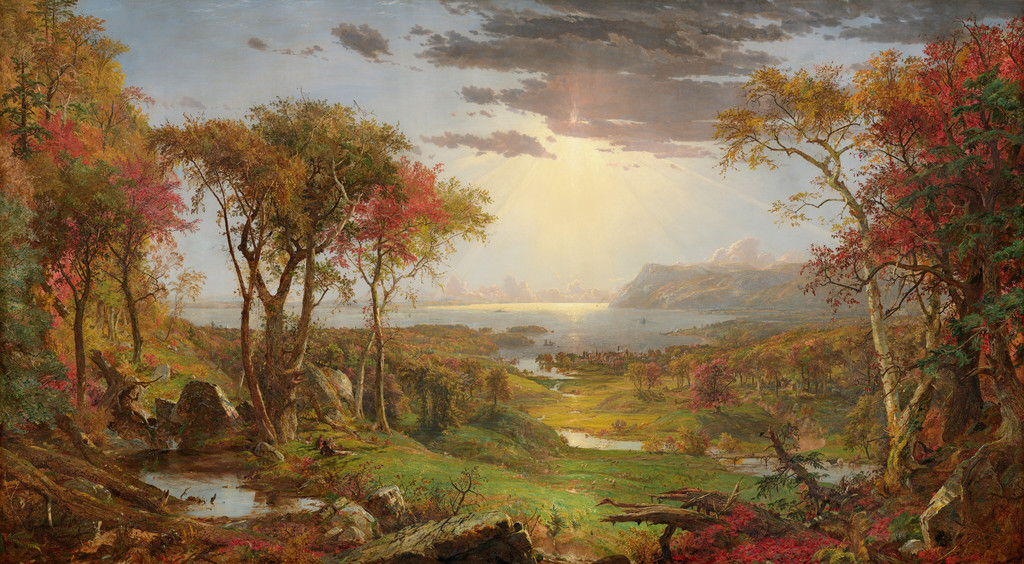
Jasper Cropsey made autumn a particularly important subject. In Autumn—On the Hudson River, colour spreads through a broad view organised by water, hills and small signs of habitation. His architectural training and sustained attention to familiar places complicate the idea of a landscape artist simply finding a spectacular scene. Buildings, bridges and the changing seasons gave him material through which to organise an inhabited region. [24] [25]
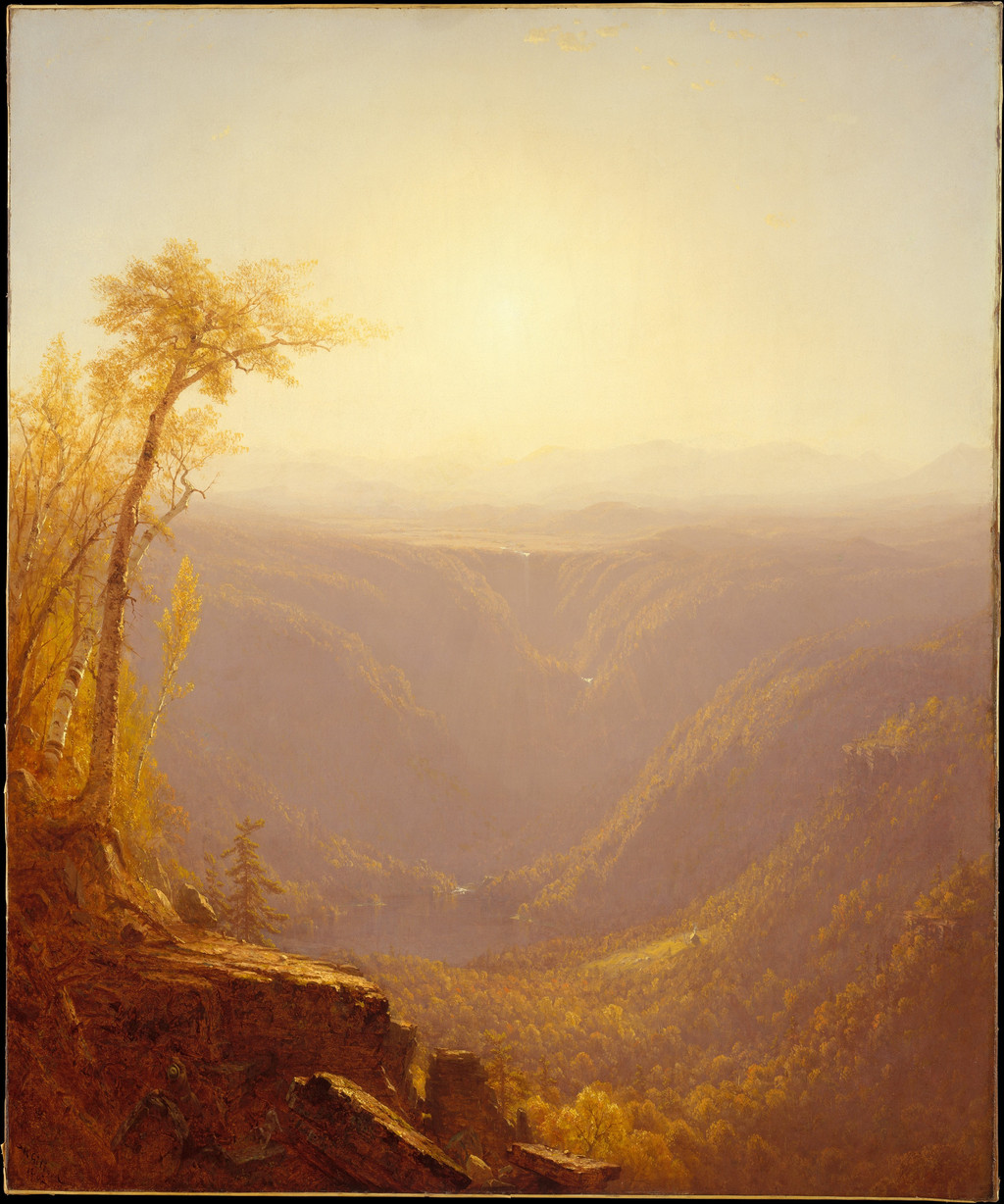
Sanford Robinson Gifford often made atmosphere the means of holding a composition together. Haze, reflected light and distant forms can matter as much as the recognisable site. His travels through American and European landscapes show that this attention was portable. A mountain clove, an Italian lake or a view towards Constantinople could become a different study of the relationship between illumination and space. [26]
Gifford is often discussed through Luminism, a name applied retrospectively to qualities in nineteenth-century American painting. It does not identify a society whose members all declared allegiance to a programme. Martin Johnson Heade likewise appears in that discussion, although his marshes, storm scenes, flowers and tropical birds resist a single narrow description. The label can help compare paintings if it remains a way of looking rather than a substitute for their individual histories. [27] [28]
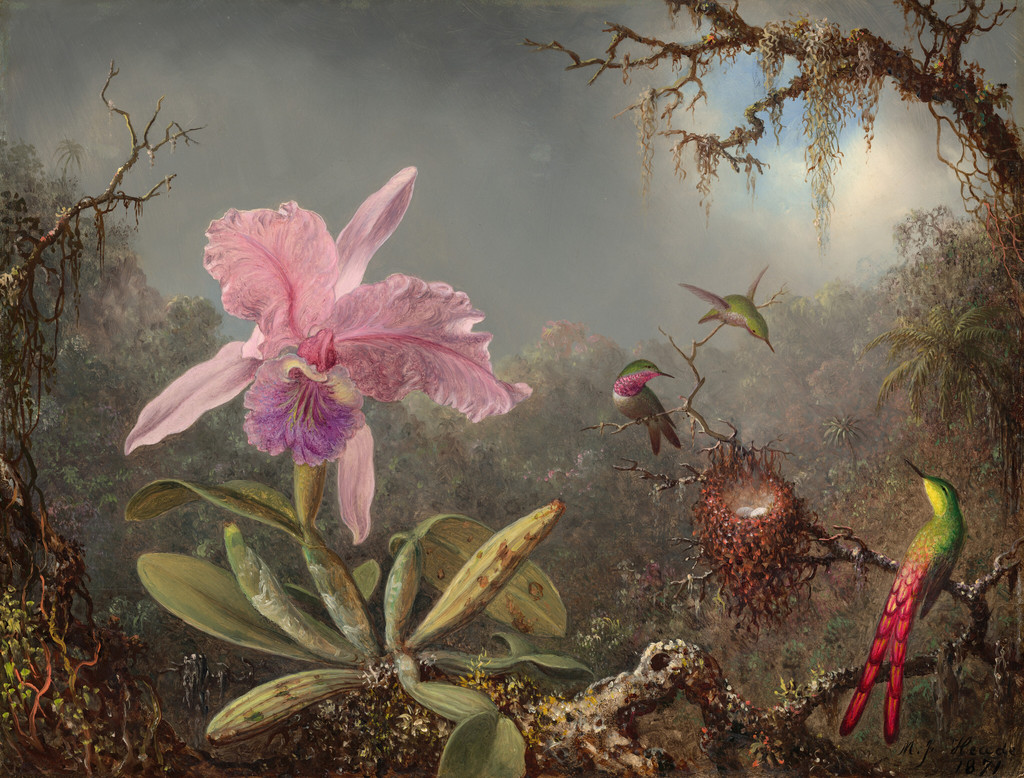
Heade’s subject range gives scale a special importance. A distant marsh places haystacks and workers beneath a large sky; a flower or hummingbird brings attention much closer. His tropical journeys and botanical interests did not make every canvas an illustration for science. The pictures organise colour, setting and relationships between forms, allowing a small natural subject to sustain an independent painting. [29] [30]
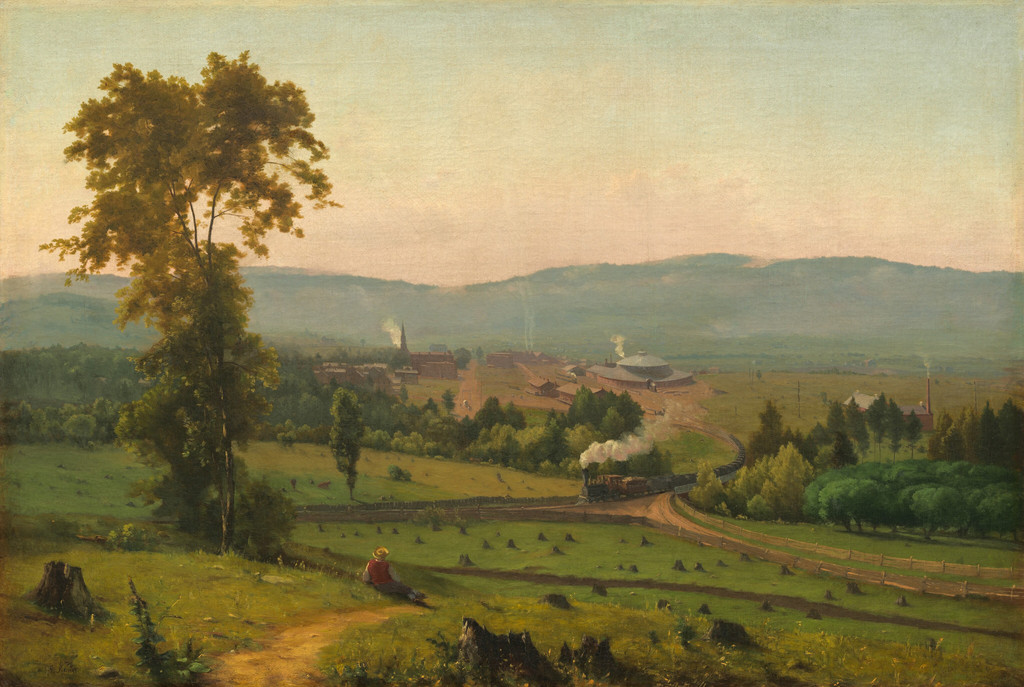
George Inness developed another approach through changing relations with European landscape painting and his own spiritual interests. His later works often soften the boundaries between trees, figures and the surrounding air. A recognisable place can become the occasion for an encompassing mood. Comparing these paintings with his earlier The Lackawanna Valley, where railway development and felled trees remain conspicuous, reveals a career whose changing means deserve attention. [31]
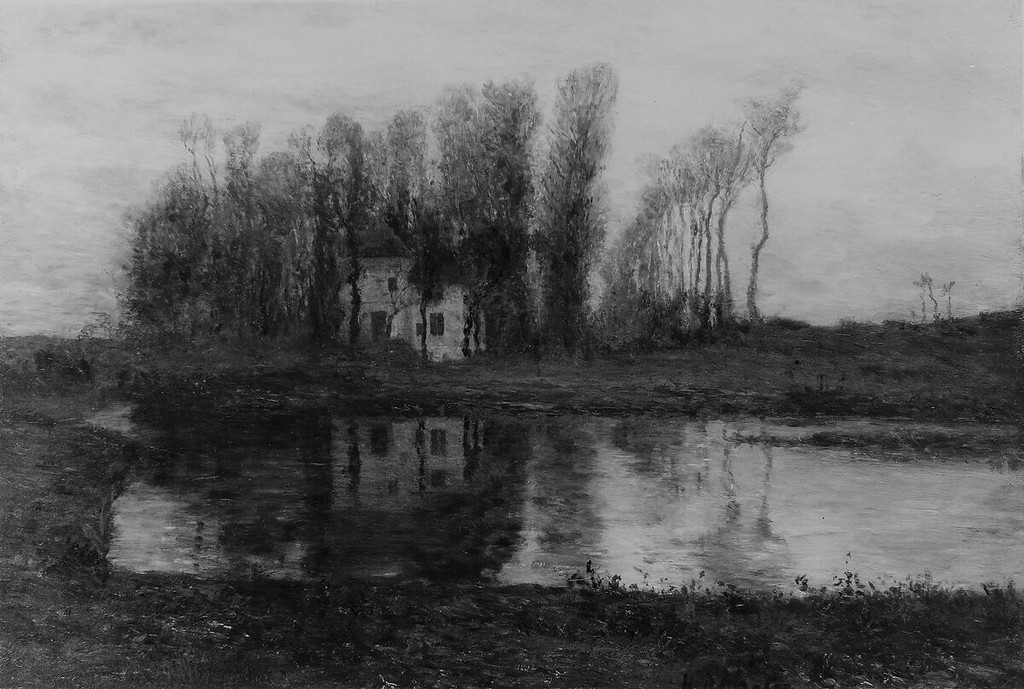
Homer Dodge Martin also worked across American and European settings. Observation, recollection and studio revision shaped landscapes in which atmosphere could outlast the immediate experience of a site. Tonalism supplies a useful later context for such work, provided it does not flatten the differences between Martin, Inness and other painters. A restrained range of colour may support very different ideas about memory, place or spiritual experience. [32] [33]
Work, politics and everyday life
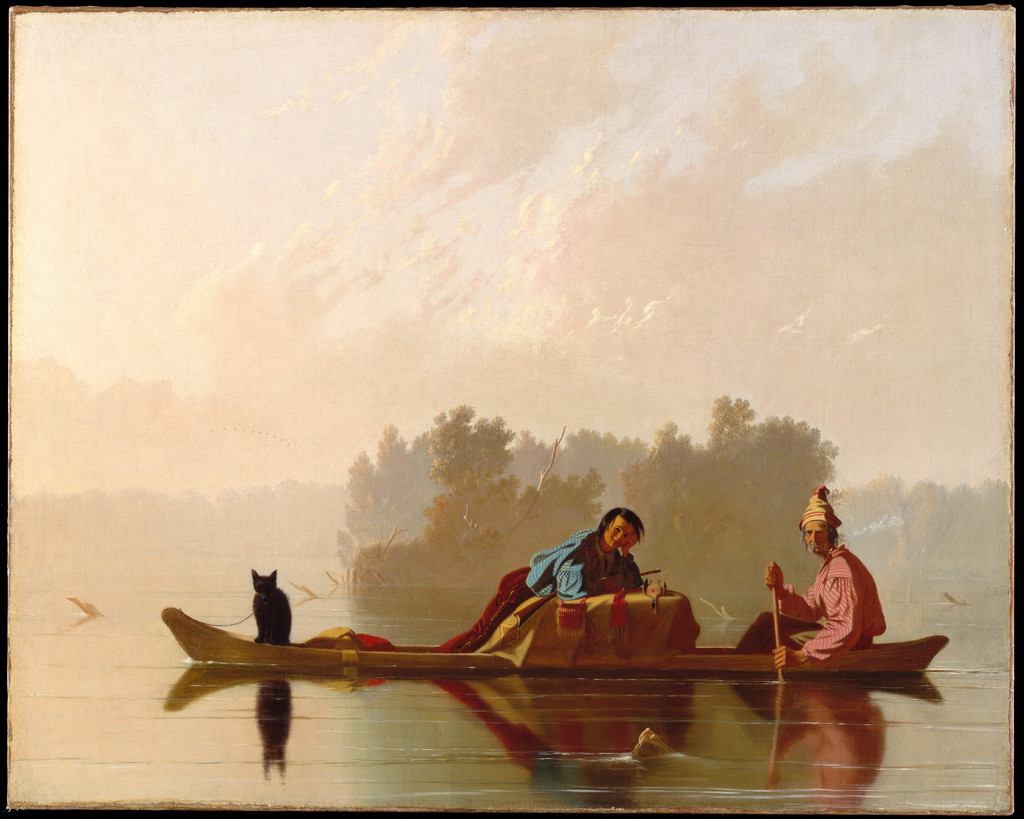
George Caleb Bingham made river labour and public gatherings central subjects. His boatmen, traders and election scenes organise groups of people through gestures, intervals and carefully directed attention. They are composed pictures of activity, capable of appealing to distant audiences, rather than unmediated glimpses of a community. His political life also makes the connection between representation and public participation especially relevant. [34] [35]
The election pictures invite questions about who is allowed into the public gathering and who has power within it. The language of democracy should not erase the restrictions on voting, the presence of slavery or the divisions of nineteenth-century Missouri. Bingham’s arrangements can be studied for their visual wit and their accounts of behaviour while those limits remain in view. The represented crowd is evidence of a particular political world, rather than a complete image of all its inhabitants. [36]
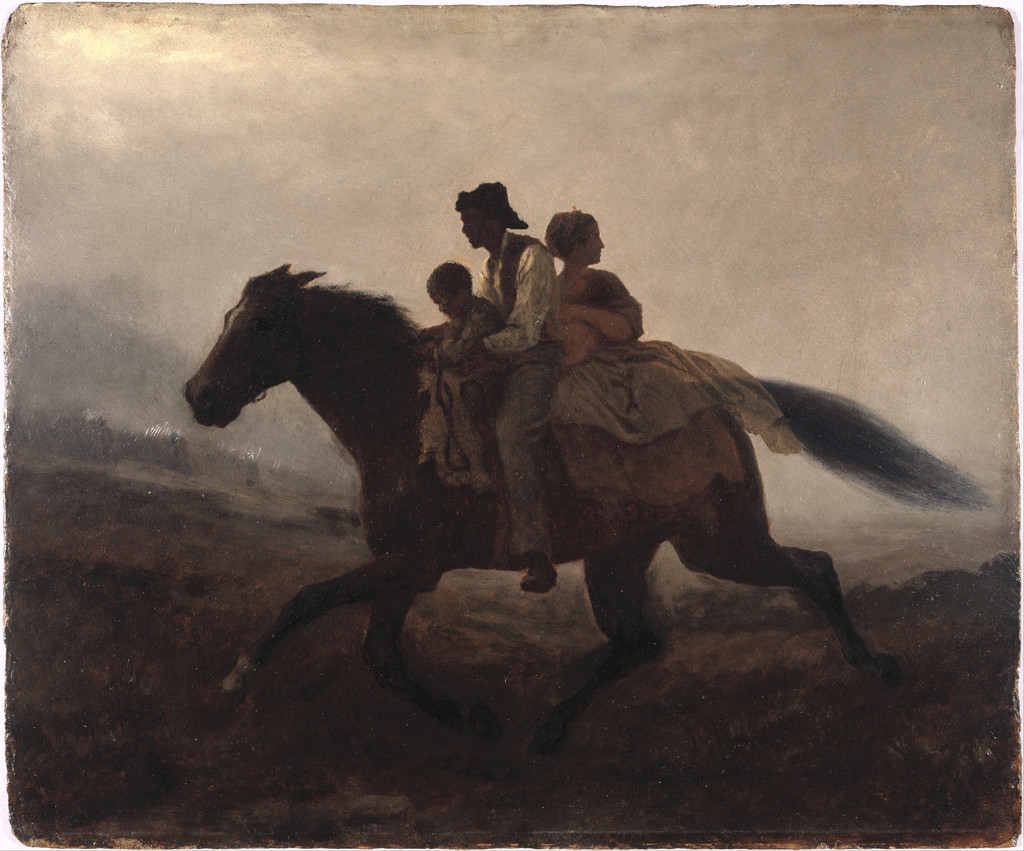
Eastman Johnson brought sustained attention to family groups, labour, leisure and the experience of African Americans before and after the Civil War. His A Ride for Liberty—The Fugitive Slaves gives an escaping family the active centre of the scene. His own later account connects the subject with an encounter during the war. The surviving Brooklyn and Virginia paintings require separate identification; their related subject does not make them a single interchangeable object. [37] [38]
Other Johnson pictures turn towards maple-sugar camps, cranberry harvesting, children or interiors. A scene of ordinary work can organise attention as deliberately as a battle picture. The painter chooses which gestures become visible, how figures relate to their setting and what kind of audience will encounter them. American Realism offers a wider context for these subjects, with room for differences in purpose and technique. [37]
Conrad Wise Chapman presents a different challenge. His Charleston fortification pictures grew from Confederate service and a particular military assignment. Their close attention to structures, guns and coastal positions makes them historically useful, but their circumstances should remain explicit. Some finished works in the wider Charleston group are by his father, John Gadsby Chapman. Accurate attribution and recognition of the Confederate viewpoint belong together when these images are used as documents of the war. [39] [40] [41]
Chapman’s later Mexican landscapes and his family’s long association with Italy also extend the geographical account. An American artist’s career might be shaped by war and displacement while producing work in several countries. Looking beyond the most familiar historical series reveals the sustained profession, journeys and family collaboration that made the pictures possible. [42] [43]
The figure, the sea and close observation
Thomas Eakins placed the human body, work and knowledge at the centre of his practice. Philadelphia provided many of his subjects: physicians, musicians, athletes and acquaintances. His European study and interest in anatomy contributed to pictures in which a person’s activity and the arrangement of a body could carry considerable meaning. A portrait might situate achievement in a professional setting, or concentrate attention within a much smaller field. [44]
Photography formed part of Eakins’s investigations of anatomy and movement. It gave him another means of studying bodies, alongside drawing, painting and teaching. His practice is a reminder that the history of American painting cannot be isolated from other technologies of seeing. The camera could serve a painter’s enquiry while also developing its own artistic and documentary possibilities. The relationship depended on the particular artist and the purpose for which an image was made. [44]
Winslow Homer offers another sustained encounter with people and their environments. His reputation encompasses figures at work, children, watercolours and powerful marine subjects. The sea pictures make the scale and force of water palpable through a painting’s structure: the direction of a wave, a sloping horizon or the exposed position of a body. Attention to these relationships gives the human subject its particular situation. [45]
Homer’s career also makes reproduction relevant. Work for an illustrated audience and the production of independent paintings belong to different forms of circulation. A viewer encountering an image in print meets a different size, surface and material from someone standing before an oil painting. Remembering that difference helps explain why an apparently familiar subject can become newly demanding when its original format is considered. [45]
Natural-history imagery provides another connection between close observation and reproduction. John James Audubon is associated with a vast project of bird images whose publication depended on the work of printmakers as well as the artist. A museum record for an engraving can therefore identify Robert Havell as its maker and Audubon as the artist after whom it was produced. Naming both preserves the collaborative process through which the image reached readers. [46]
Americans abroad and the painted surface
American art did not develop through a simple separation from Europe. Training, collecting, exhibitions and artists’ colonies kept people moving across the Atlantic. Some artists returned to work in the United States; others built careers abroad. These patterns also shaped what American audiences encountered at home, as paintings and new approaches to painting circulated with collectors, dealers and teachers. [47]
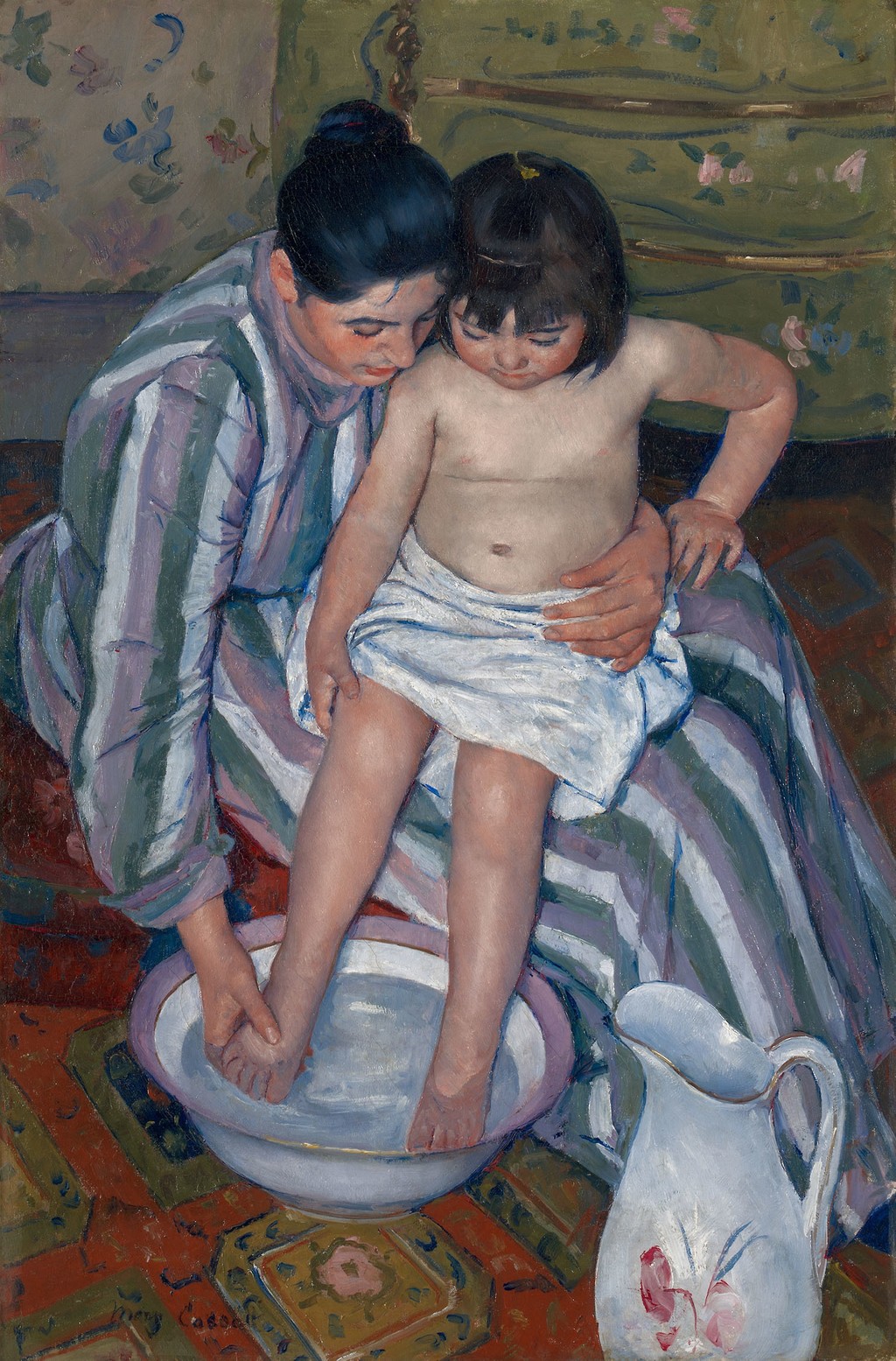
Cassatt’s participation in the French Impressionist exhibitions places her within that international history. Her images of women and children give considerable weight to looking, touch and the organisation of private space. The subject can appear intimate while the composition remains experimental. Her American identity and sustained Parisian practice are compatible parts of the career, rather than competing explanations for where she belongs. [47] [48]
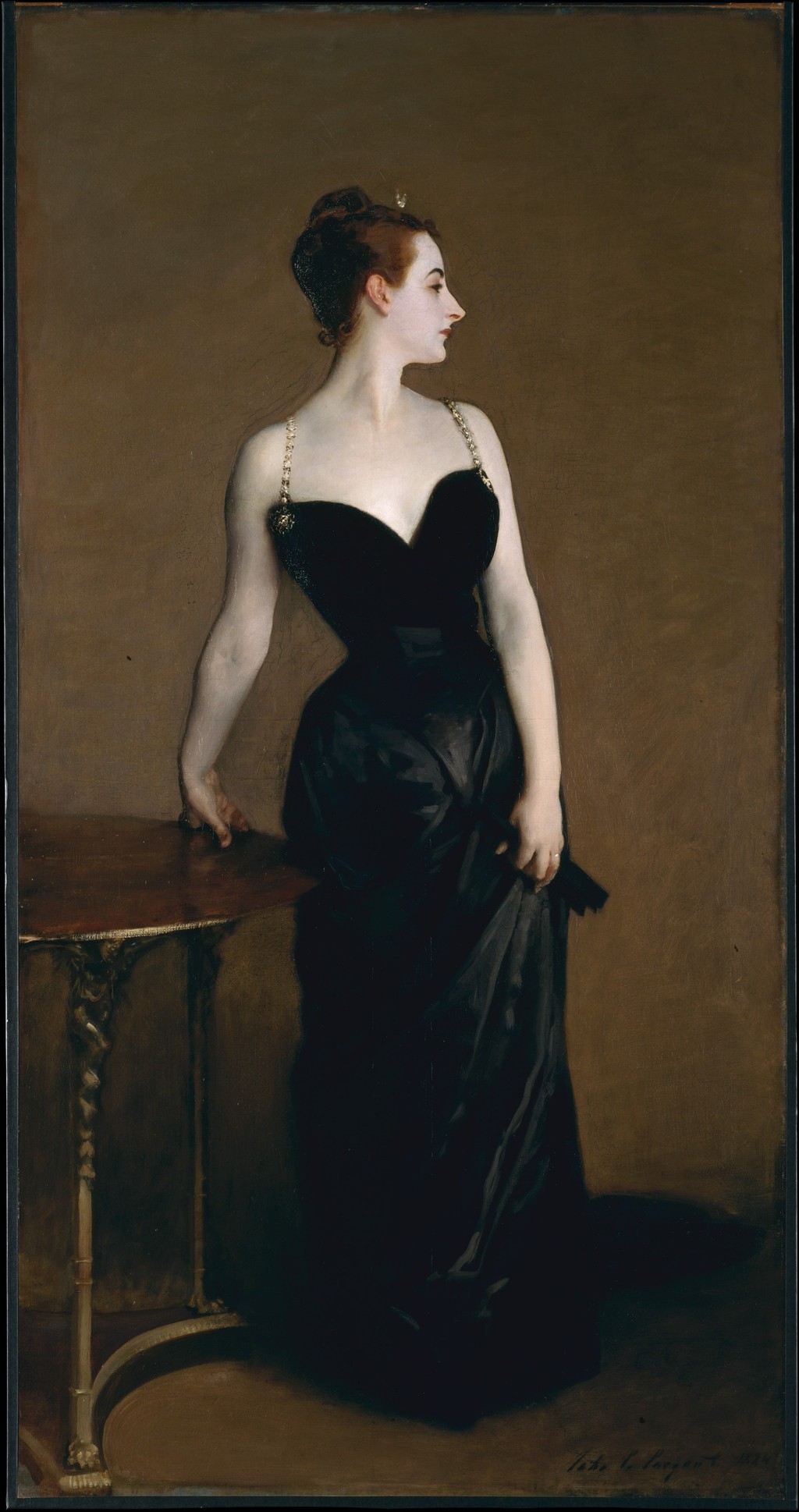
John Singer Sargent was born in Florence to American parents and worked extensively in Europe. His portraits brought formidable control of paint to the demands of a sitter and a social setting. Landscape and informal figure subjects offered other possibilities. Reading his career alongside Cassatt’s brings two internationally situated American artists into view without implying that their audiences, subjects or professional choices were the same. [49]
James McNeill Whistler likewise belongs to an American history whose principal studios were sometimes elsewhere. His attention to arrangement, colour and tonal relationships encouraged viewers to think about a picture beyond the identity of its subject. London, Paris and connections with Japanese art all enter that account. A national directory is most useful when it leads readers into those specific histories, rather than suggesting that every listed artist worked mainly in the United States. [50]
William Merritt Chase and Childe Hassam connect overseas experience with an American practice of modern-life subjects and outdoor painting. Parks, streets, resorts and rural retreats could all supply motifs. Teachers and summer classes helped approaches travel between artists as well as between countries. The American Impressionism page provides a route into this network, including the relationship between modern brushwork and the kinds of leisure that patrons wanted to see. [47] [51]
These careers also make a simple sequence of national styles misleading. An artist could retain academic skills, experiment with outdoor colour and continue to paint formal portraits. Different approaches coexisted within one working life. Looking at the date, commission and circumstances of an individual picture often explains more than assigning the artist one permanent label.
Modern cities and regional identities
George Bellows found forceful subjects in New York’s crowds, boxing clubs and building sites. His training with Robert Henri connected him with a network later described as the Ashcan School. The energetic handling of paint gives physical presence to bodies and streets. His later landscapes, seascapes and portraits also show why the early urban pictures should introduce a varied career rather than define its entire extent. [52] [53]
The Ashcan artists’ enthusiasm for city life did not make every painting an investigation of poverty or a programme of social reform. They selected aspects of their environment and brought their own positions to the encounter. The comparison with reform photography is instructive: two images of a street can pursue quite different purposes. Subject matter alone does not establish the politics of a picture. [53]
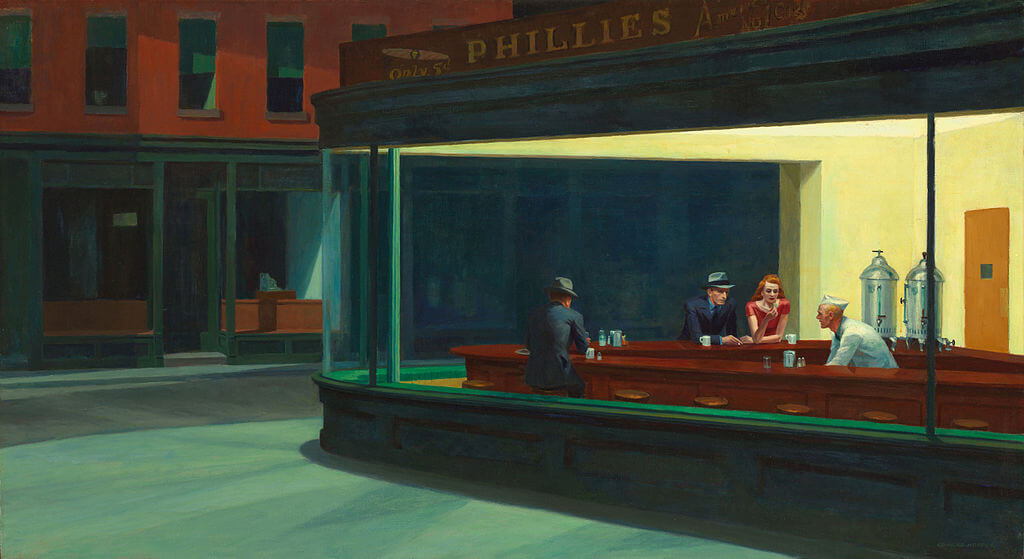
Edward Hopper developed a different account of modern experience. Born in Nyack, trained in New York and familiar with Paris, he later worked between the city and Cape Cod. His career connects metropolitan life with quieter settings. The relationship of a figure to an interior, a building to light or an open space to its boundaries can make an ordinary situation feel unusually concentrated. [54]
O’Keeffe’s early abstract drawings, enlarged flowers, New York architecture and New Mexico subjects show another way to approach modern art. Her work changed through teaching, experiment and sustained attention to place. The photographer and gallery director Alfred Stieglitz helped bring it before an audience, but her career extends far beyond that association. Her eventual move to New Mexico belongs to the history of a working artist making choices about where and how to see. [55]
Grant Wood and John Steuart Curry are central to American Regionalism, alongside Thomas Hart Benton. Their work gave rural communities, local histories and familiar activities a substantial public presence during the interwar years. Their regional subjects did not exclude international experience: Wood’s time in Germany contributed to the stylised realism for which he became known. Regional identity was something artists fashioned through choices, as well as something they inherited. [56]
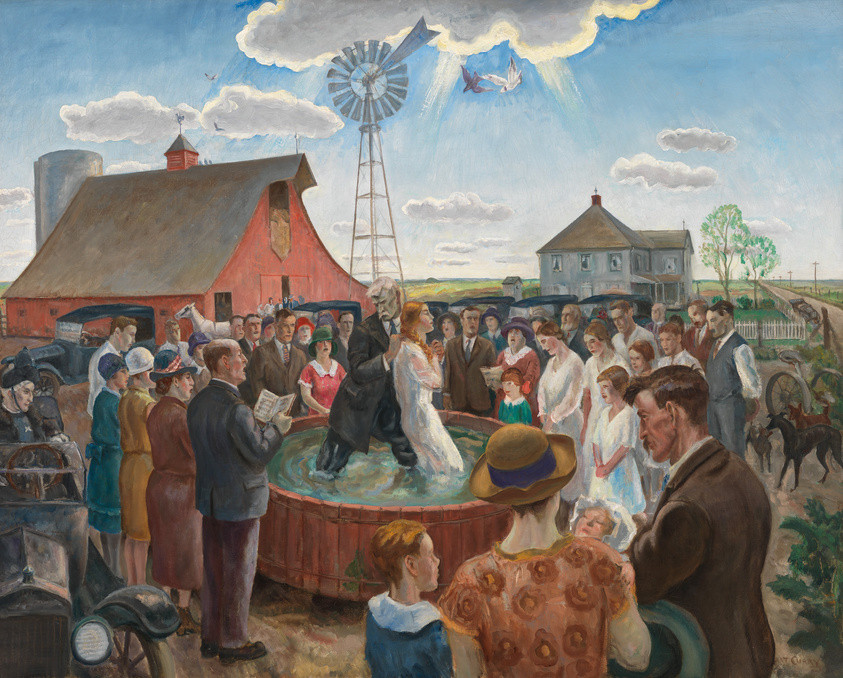
Curry’s Baptism in Kansas turns a familiar religious practice into a strongly organised group scene. His mural commissions and Wisconsin residency placed art within public institutions and everyday access. Other works, including The Fugitive, confront violence and racial persecution. These differences matter when Regionalism is described as an art of belonging. An artist could invest in a region while also picturing the fears and conflicts within a society. [57] [58]
Photography, evidence and the person pictured
Photographs contribute more than illustrations of a painter’s life. They have their own makers, formats, audiences and histories. The Smithsonian’s photography collection includes studio portraits, western survey images, vernacular objects, documentary projects and contemporary work. Its holdings by early African American photographers James P. Ball, Glenalvin Goodridge and Augustus Washington make clear that the history of the medium extends beyond the handful of names most often repeated in surveys. [59]
The passage from a painted miniature to a small cased photograph also changes the kinds of objects through which a likeness could be kept. A photograph might be worn, placed in a family album, distributed in print or encountered at an exhibition. Its meaning depended partly on those circumstances. Recognising the photographer and the person pictured helps restore particular human relationships to objects that can otherwise appear merely representative of an era. [59]
Dorothea Lange’s Migrant Mother provides a demanding example. The familiar image represents Florence Owens Thompson with her children at Nipomo, California, in March 1936. It belongs to a series made during Lange’s work for the Resettlement Administration. The Library of Congress cautions that the negative numbers, assigned later, do not establish the order in which the photographs were taken. The surviving sequence invites comparison without supporting an invented account of every moment of the encounter. [60]
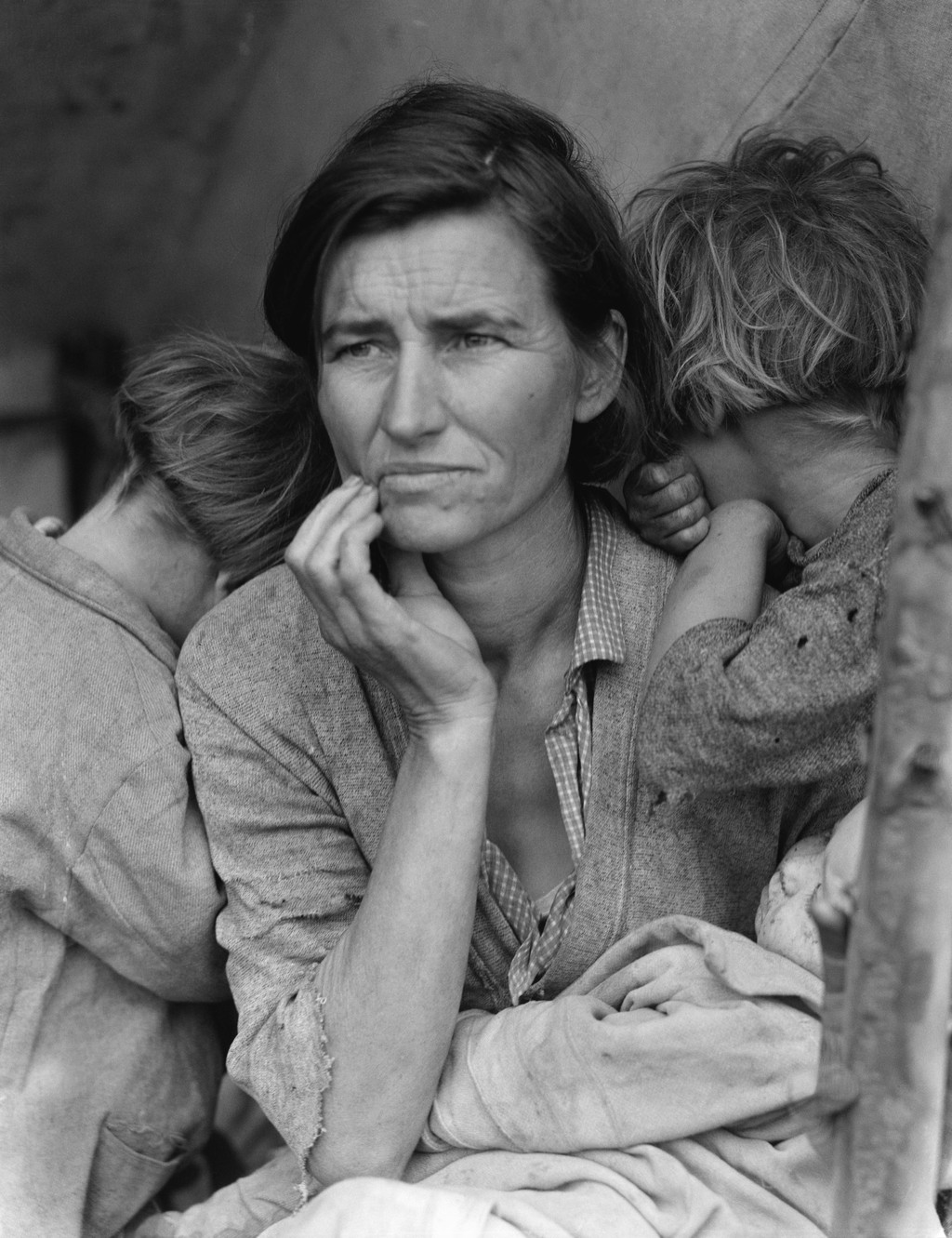
Lange’s much later recollection is also a source with a date and a point of view. Separating the original photographs, their captions and subsequent accounts allows the image’s force to coexist with questions about documentary authority. The mother pictured was a person with a name and a life, not only a symbol of the Depression. That distinction remains valuable whenever a work becomes famous enough for its title to eclipse its subject. [60]
Black artists, education and cultural institutions
The history of Black American art crosses portraiture, landscape, sculpture, abstraction, photography and new media. It cannot be confined to pictures of a single theme or to one period of social change. The Smithsonian’s collection places nineteenth-century artists beside twentieth-century experimentation and contemporary practice, allowing both continuities and differences to remain visible. A wider history also needs to attend to who could obtain training, enter exhibitions and build institutions. [61]
Edmonia Lewis’s career connects these questions with sculpture. Of African American and Native American ancestry, she established a professional practice in Boston before moving to Rome in 1865. Portraits of antislavery figures, biblical subjects and works concerned with her heritage formed part of her production. Her practice in marble belongs within the transatlantic history of American art, alongside the painters who sought training or patrons in Europe. Different artists met very different obstacles within those shared geographical networks. [62]
Her The Death of Cleopatra, carved in 1876, brings the aftermath of the queen’s death into the physical space of sculpture. The seated body rests on a throne, while the marble’s weight and the extended figure make the subject difficult to reduce to a distant emblem. The sculpture appeared at the Philadelphia Centennial Exhibition before passing through a complicated subsequent history. Its survival and conservation are part of the work’s story, alongside its original public reception. [63]
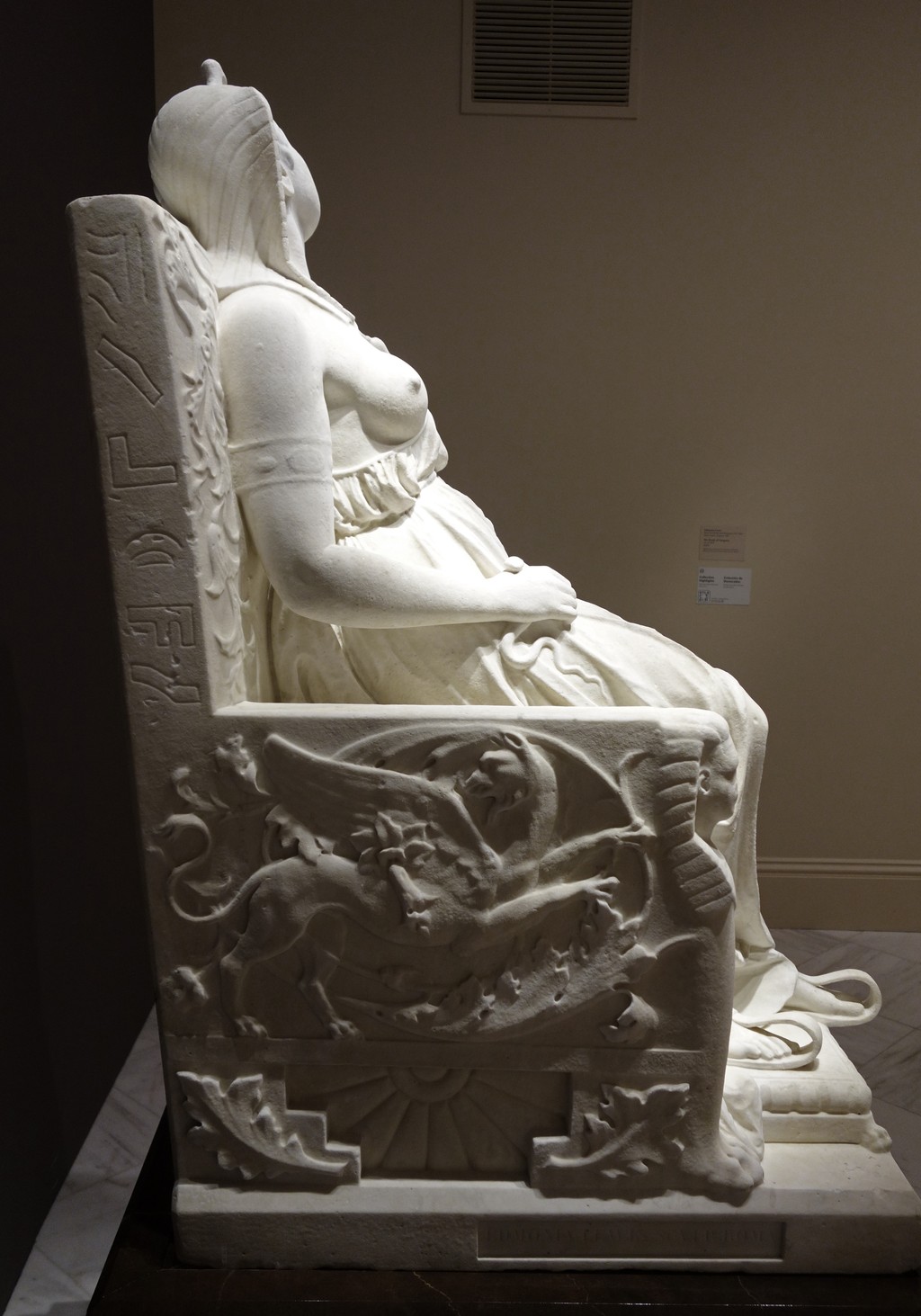
New research also changes the account of how Lewis made her art. A 2026 museum study using technical examination and three-dimensional scans describes a workshop with assistants, models and casts, challenging the familiar picture of an artist carving every sculpture entirely alone. Recognising that collaboration preserves Lewis’s artistic authority while placing her within the practical systems of nineteenth-century sculpture. A work’s material evidence can revise a biography as well as deepen the experience of looking. [64]
Jacob Lawrence developed through the cultural and educational life of Harlem. Charles Alston recognised his abilities at the Utopia Children’s Center, and Lawrence later worked in the orbit of Augusta Savage’s Harlem Community Art Center. His narrative series address figures including Harriet Tubman and Frederick Douglass, alongside life in Harlem and the broader experience of African Americans. The story is therefore also one of teachers, community organisations and access to a sustained artistic practice. [65]
Alma Thomas brings another institutional history into focus. A Howard University fine-arts graduate and a long-serving schoolteacher in Washington, she developed her best-known abstract paintings after retirement. Small areas of vivid colour create rhythmic structures connected with nature and, in some works, the new perspectives of space exploration. Her contribution to the Barnett Aden Gallery also places her within the work of building an art community. Abstraction and cultural participation were connected aspects of her life. [66]
These careers suggest different routes into the Harlem Renaissance, Social Realism and abstract art. Such categories overlap without becoming interchangeable. Lawrence’s historical narratives and Thomas’s later colour patterns require different kinds of attention. Each enlarges what a history of American art can include, while the artists’ own aims remain specific.
Indigenous art across time
Indigenous art belongs throughout the history considered here. Its forms include painting and sculpture as well as weaving, pottery, beadwork, basketry, photography and time-based work. The materials and meanings of a particular object depend on the artist, community and circumstances. Treating every object as anonymous evidence of a whole culture hides individual invention and the relationships through which knowledge is sustained.
Hearts of Our People: Native Women Artists, organised by the Minneapolis Institute of Art and shown at the Smithsonian’s Renwick Gallery in 2020, addressed that problem directly. Curators Jill Ahlberg Yohe and Teri Greeves, who is Kiowa, worked with an advisory panel that brought varied Native perspectives to the project. Historical and contemporary works appeared together, and interpretation included artists’ Native American or First Nations languages alongside English. [67]
The accompanying catalogue offers further routes into particular makers and traditions, including Pueblo pottery, Tlingit weaving, basketry and contemporary painting. Its range is a reason to move beyond a story that places Indigenous art only before European settlement. An inherited practice can remain active through experiment, teaching and changed circumstances. Naming the maker and community, when known, makes that continuing history more precise. [68]
This perspective also changes how nineteenth-century landscape and history paintings are encountered. An Indigenous figure painted by West or Cole belongs to that painter’s composition and historical circumstances. It does not stand in for the artistic production or self-understanding of the people represented. Placing those pictures beside Indigenous artists’ own work creates a fuller enquiry into whose experience an image makes visible.
Migration, identity and multiple traditions
The term Asian American brings together varied experiences and remains a changing field of study. The Smithsonian traces its political use to activists in 1968, while collecting art made both before and after that moment. Painting, sculpture, craft, photography, animation and electronic media all belong within the account. A shared category can make neglected histories visible without requiring its artists to share a style. [69]
Chiura Obata, born in Japan and in the United States from 1903, developed a long West Coast career. His California landscapes drew on techniques and traditions that resist a simple division into eastern and western art. Teaching at the University of California, Berkeley, and helping establish art schools during the wartime incarceration of Japanese Americans were consequential parts of his life. Landscape painting here connects beauty and sustained practice with the historical conditions under which an artist was allowed to live and work. [70]
Latino art likewise crosses media, regions and artistic approaches. The Smithsonian’s Our America exhibition brought abstraction, activism, performance, portraiture and other subjects into one account of work made in the United States since the mid-twentieth century. Mexican, Puerto Rican, Cuban, Dominican and other histories contributed to the project. Artists could engage with community identity or concentrate on formal experiment; these possibilities were not mutually exclusive. [71]
Migration and settlement also change the questions asked of familiar genres. A landscape can be a remembered home, a contested territory or a setting transformed by movement between countries. A portrait can address who is entitled to visibility and how a community represents itself. These questions connect newer practices with earlier painting, while preserving the different political and personal circumstances from which each work emerged.
Abstraction and the postwar art world
Mark Rothko arrived in the United States as a child from the Russian Empire, in a region now within Latvia. His early subjects included figures and city scenes before his work developed through mythic and surreal imagery towards the soft-edged colour fields for which he is best known. The later format was the result of a changing practice. Its apparent simplicity should not obscure the decisions about proportion, edges, colour and the viewer’s encounter with a painted surface. [72]
Pollock’s poured paintings offer a different physical experience. Lines pass over and between one another, creating relationships across the canvas. The best-known works of the late 1940s and early 1950s emerged within a longer career that included other kinds of imagery and experiments. Describing him as the inventor of every form of dripping paint would obscure the wider artistic resources and precedents involved. [73]
His development also continued after the familiar all-over paintings. In 1951 he made black poured works whose lines could evoke figures and earlier imagery. MoMA’s account of these paintings makes a useful correction to the claim that he permanently abandoned all reference to the figure. An artist’s reputation often rests on a recognisable phase; a history of the work needs to leave room for what came before and after it. [74]
Ernst’s American years add another kind of movement to this account. Exile brought a major European Surrealist into the United States, where New York and Arizona supplied different settings for his work. His subsequent American citizenship is relevant to the directory, while his German origins and later French life remain essential to the biography. American art developed through such exchanges, involving displacement as well as opportunity. [3]
The abstract and Surrealist routes therefore lead into connected histories without collapsing them into one movement. Galleries, exhibitions, teaching and migration brought artists into contact, while their paintings pursued different experiences. A dense network of poured lines, a luminous field of colour and an imagined landscape each asks the viewer to engage in a different way.
Basquiat and an expanding field
Basquiat brought words, figures, drawing and emphatic colour into paintings associated with New York’s Downtown art world. Text within a picture can interrupt an image, suggest an association or demand that the viewer read while looking. His work resists an easy division between the verbal and the visual. That relationship offers a route into its complexity beyond the rapid recognition of a signature motif. [75]
In Hollywood Africans, the Whitney identifies Basquiat with fellow artists Toxic and Rammellzee during their 1983 visit to Los Angeles. The painting’s references to Hollywood open questions about Black representation and stereotype. Its particular figures and context matter: the work is more than a general emblem of an energetic decade. Reading its words alongside its pictured people gives the encounter greater specificity. [76]
Later American art also extends beyond painting. The Smithsonian’s Asian American holdings include Nam June Paik’s electronic media and archives, while its broader collections encompass installation, photography and mixed materials. The development of new forms does not make older ones disappear. A contemporary artist can work with a television, textile, photograph or painted surface, and the material chosen helps determine how an audience encounters the subject. [69] [61]
There is consequently no single final style towards which the earlier history has been moving. Portraits, landscapes and public narratives continue to supply material for reconsideration. Contemporary work can make their assumptions newly visible, while historical works retain details that later summaries overlook. Comparing particular objects, with their dates, makers and circumstances intact, offers a productive way to move between them.
All American artists on this site
Search all 31 artist guides or filter by movement and century. Movement labels are starting points for comparison; the biographies explain qualifications, travel and changes in style. Ernst’s transnational career and Sargent’s American identity are retained in their individual accounts.
Showing 31 of 31 artists.
Frequently Asked Questions
Stuart, Cole, Church, Cassatt, Sargent, O’Keeffe, Pollock, Rothko and Basquiat offer different starting points. Their reputations come from different kinds of work; this page’s complete directory links to 31 existing artist guides rather than ranking artists by importance.
No. Migration and expatriate careers are central to the history. Sargent was born in Florence to American parents. Ernst was born in Germany and later held American and French citizenship. The individual biographies explain these connections more precisely than birthplace alone.
Its artists and associated landscape traditions extended well beyond the valley. Church travelled to South America, while Moran developed subjects from the American West. Professional networks, institutions and approaches to landscape help explain the group alongside its name.
Both are later art-historical categories. Luminism is often used to compare luminous space and carefully controlled light in nineteenth-century painting. Tonalism helps discuss atmospheric relationships and restrained colour. Neither label describes every work by an artist associated with it.
Painting is a major part of this site’s existing artist guides, but the wider history includes sculpture, photography, textiles, prints, performance and electronic media. Lewis, Lange, Native women artists and the museum collections linked here provide routes beyond the canvas.
Choose a major artist above, follow the historical sections, or use the searchable directory below. The books offer longer reading routes, while the film gallery provides close looking, conversations and conservation studies.
Discussion
Look again at the works and ideas explored in American art. These editorial prompts invite your observations and comparisons.
Reader Insights
Compare Trumbull’s presentation of a document with Leutze’s crossing. Which gestures make the historical action visible?
Place a landscape painting beside the dated map or modern place photograph. What does each image allow you to see, and what remains outside it?
How does the experience change between Cassatt’s painted figures, Lange’s photograph and Lewis’s marble sculpture?
Join the Conversation
Share a detail, comparison or question about American art below.
References
- Smithsonian American Art Museum, Benjamin West. View source
- MoMA: Max Ernst. View source
- Moderna Museet: Max Ernst in America, The Years in Exile. View source
- National Gallery of Art, Dr. Samuel Boude, 1755–1756. View source
- Barratt and Miles, Gilbert Stuart, 2004, selected career sections; Ellen G. Miles, The Portraits of George Washington, in Gilbert Stuart, 2004, pp.133–158. View source
- Caldwell, Rodriguez Roque and Johnson, American Paintings, vol.I, 1994, Sully biography. View source
- Ellen G. Miles, American Paintings of the Eighteenth Century, 1995, pp.193–194. View source
- National Gallery of Art, Lady with a Harp: Eliza Ridgely, 1818. View source
- Metropolitan Museum of Art, Queen Victoria, 1838. View source
- Architect of the Capitol, John Trumbull. View source
- John Trumbull, Autobiography, Reminiscences and Letters, 1841, selected passages. View source
- Architect of the Capitol, Declaration of Independence. View source
- Yale, The Declaration of Independence, July4, 1776, 1786–1820. View source
- Metropolitan Museum of Art, Washington Crossing the Delaware, 1851. View source
- National Gallery of Canada, The Death of General Wolfe, 1770. View source
- Met: The Hudson River School. View source
- Tim Barringer, Thomas Cole’s Atlantic Crossings, in Thomas Cole’s Journey, 2018, pp.19–62. View source
- Kevin J. Avery, Asher Brown Durand(1796–1886), Metropolitan Museum of Art, 2009. View source
- John Durand, The Life and Times of A. B.Durand, 1894, selected chapters and AppendixI. View source
- Crystal Bridges Museum of American Art, Kindred Spirits, museum-authored object account. View source
- Franklin Kelly, Frederic Edwin Church, 1989, pp.32–68; Stephen Jay Gould, Church, Humboldt, and Darwin, 1989, pp.94–100. View source
- Kevin J. Avery, Church’s Great Picture:The Heart of the Andes, 1993, selected passages. View source
- Nancy K. Anderson and contributors, Thomas Moran, 1997, selected expedition and painting discussions. View source
- Deborah Chotner, Cropsey biography and entries, American Paintings of the Nineteenth Century, I, 1996, pp.109–122. View source
- Kenneth W. Maddox, A Forgotten Mountain:Jasper F.Cropsey’s Paintings of Sugar Loaf, 2000, pp.221–236. View source
- Avery and Kelly, Hudson River School Visions:The Landscapes of Sanford R.Gifford, 2003, selected passages. View source
- Grove Art/Oxford University Press, Luminism. View source
- Diana J. Strazdes, Heade entries, American Paradise, 1987, pp.163–178. View source
- Franklin Kelly, Heade biography and entries, American Paintings of the Nineteenth Century, I, 1996, pp.287–298. View source
- Charlotte M.Porter, Florida Museum, Visual Interests. View source
- Adrienne Baxter Bell, George Inness(1825–1894), Metropolitan Museum of Art, 2012. View source
- Smithsonian American Art Museum, Homer Dodge Martin. View source
- Natalie Spassky and colleagues, American Paintings, vol.II, 1985, Martin, pp.420–430. View source
- State Historical Society of Missouri, George Caleb Bingham. View source
- Metropolitan Museum of Art, Navigating the West, 2015, exhibition labels. View source
- Saint Louis Art Museum, The County Election, 1851–52. View source
- Patricia Hills and Abigael MacGibeny, About Eastman Johnson. View source
- Eastman Johnson Catalogue Raisonné, A Ride for Liberty, Brooklyn version. View source
- Library of Virginia, Father and Son:The Works of John Gadsby Chapman and Conrad Wise Chapman, 1998–99. View source
- American Civil War Museum, About the Artists, archived Chapman exhibition. View source
- American Civil War Museum, Charleston Bay and City, attribution to John Gadsby Chapman. View source
- Mary K.McGuigan, Scenery Found, in American Latium, 2023, pp.160–163. View source
- Colección Patricia Phelps de Cisneros, Valle de México, 1870. View source
- SAAM: Thomas Eakins. View source
- Met: Winslow Homer (1836–1910). View source
- NGA: Louisiana Heron, Robert Havell after Audubon. View source
- The Metropolitan Museum: American Impressionism. View source
- Met: Mary Stevenson Cassatt (1844–1926). View source
- National Gallery of Art: John Singer Sargent. View source
- Met: James McNeill Whistler (1834–1903). View source
- The Metropolitan Museum: William Merritt Chase1849–1916. View source
- National Gallery of Art: George Bellows. View source
- Met: The Ashcan School. View source
- National Gallery of Art: Edward Hopper. View source
- National Gallery of Art: Georgia O’Keeffe. View source
- National Gallery of Art: Grant Wood. View source
- Smithsonian American Art Museum, Oh Freedom! John Steuart Curry. View source
- Whitney Museum of American Art, Baptism in Kansas. View source
- SAAM: Photography. View source
- Library of Congress: Migrant Mother research guide. View source
- SAAM: African American Art. View source
- SAAM: Edmonia Lewis. View source
- SAAM: The Death of Cleopatra. View source
- Jeffrey Richmond-Moll:3D Scans of Sculptures by Edmonia Lewis. View source
- SAAM: Jacob Lawrence. View source
- SAAM: Alma Thomas. View source
- SAAM: Hearts of Our People, Native Women Artists. View source
- Whitney Library: Hearts of Our People. View source
- SAAM: Asian American Art. View source
- SAAM: Chiura Obata. View source
- SAAM: Our America, The Latino Presence in American Art. View source
- National Gallery of Art: Mark Rothko. View source
- National Gallery of Art: Jackson Pollock. View source
- MoMA: Pollock, The Black Paintings. View source
- MoMA: Jean-Michel Basquiat. View source
- Whitney: Jean-Michel Basquiat. View source
- Splash image: Edward Hopper, Nighthawks, 1942. Art Institute of Chicago, Friends of American Art Collection, accession 1942.51. View source