


 by Tom Gurney
Tom Gurney BSc (Hons) is an art history expert with over 20 years experience
Email: tomgurney1@gmail.com / Phone: +44 7429 011000
George Inness: Introduction
George Inness (1825–1894) painted landscapes in which a mill, train, harvest field or small bird could become part of a larger experience of place. Born in Newburgh, New York, he died in Bridge of Allan, Scotland.[1] Across his career, recognisable countryside developed alongside an increasing interest in atmosphere and spiritual meaning. The paintings retain considerable variety: broad fields, closely enclosing woods, Italian trees and Florida groves ask the viewer to look in different ways.
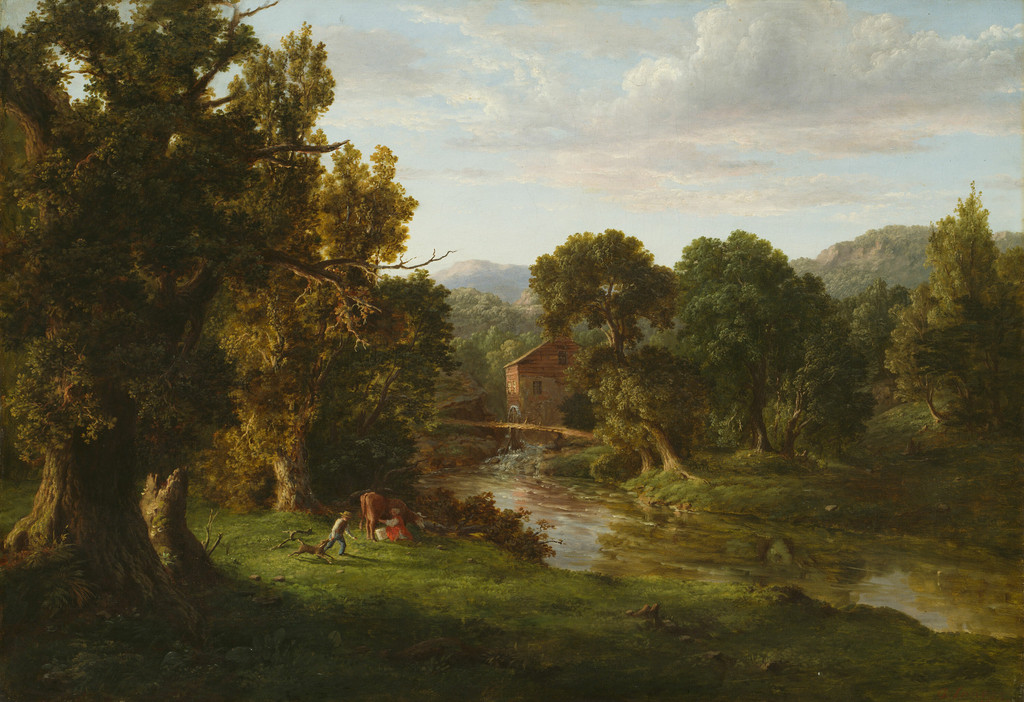
Two works provide a useful entrance. Chicago’s The Old Mill, dated 1849, arranges buildings, people, a path and vegetation within a carefully articulated landscape.[2] Its The Home of the Heron, dated 1893, makes recognition more gradual through softly connected colour, slender trees and a small bird.[3] The difference spans more than four decades of work. It offers a starting comparison, while the intervening paintings reveal how many subjects and arrangements lie between them.
At a Glance
- Life1825–1894; born Newburgh, New York; died Bridge of Allan, Scotland
- Principal fieldLandscape painting, alongside works on paper
- Early comparisonThe Old Mill (1849)
- Railway landscapeThe Lackawanna Valley (c. 1856)
- Major placesNew York and New Jersey, Massachusetts, Italy and Tarpon Springs
- Later comparisonChicago’s The Home of the Heron (1893)
- Further routesBiography, paintings, drawings and watercolours, quotes, Italy, Montclair, style and technique
George Inness in context
Bars show approximate historical periods. c. means circa (about).
Hudson River School
c. 1825–1880 [19]Barbizon School
c. 1830–1870 [20]Notes and sources
Hudson River School. Cole’s arrival in New York and decline around the Centennial frame this broad comparison. Metropolitan Museum of Art
Barbizon School. An approximate period for the French landscape circle whose work Inness encountered. National Gallery of Art, Picturing France, p. 37
Each bar runs from the artist’s birth to their death.
Asher Brown Durand
1796–1886 · Birth–death [21]Thomas Cole
1801–1848 · Birth–death [22]George Inness
1825–1894 · Birth–death [23]Frederic Edwin Church
1826–1900 · Birth–death [24]Notes and sources
Asher Brown Durand. The surrounding lifespans provide a calendar comparison. Metropolitan Museum of Art.
Autumn Oaks by George Inness
ca. 1878Contents
- Two different ways of entering a landscape
- Training, prints and European encounters
- Inhabited nature and the railway valley
- Harvest, spiritual purpose and a damaged commission
- Italy on paper and on a large canvas
- Montclair: snow, blossom and reflections
- Florida and the varied late landscape
- Reading the surface carefully
- Where to look next
Two different ways of entering a landscape
In The Old Mill, the viewer can move from a near path towards buildings and then the distant land. Individual forms remain available to recognition. Their connections make the scene a place where people live and work, with the mill positioned within a broader prospect.
The near and far do not have identical clarity, but the movement between them is sustained by things the eye can name. A building, a person and a hill take different positions within the composition. Their scale and spacing organise the view before any broader label is applied to its style.
Chicago’s The Home of the Heron offers another experience. Upright trunks pass through warmer and cooler colour, while a small bird occupies the lower landscape. The image’s broad relationships can register before every form becomes clear. Returning to the bird after looking through the trees makes its modest scale more apparent.
The comparison raises questions that will recur across the cluster. What becomes clear first? How much does a small figure or animal contribute to a large space? Where does a path, river or interval between trees carry attention? Inness’s paintings offer different answers, so a single description of atmosphere cannot replace looking at each work.
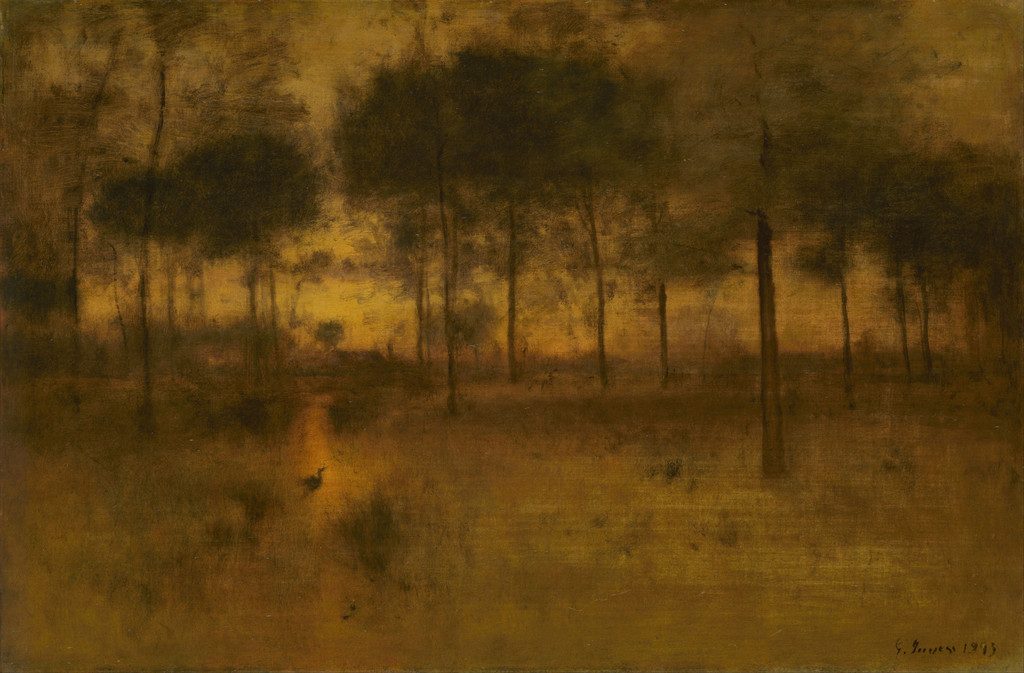
George Inness, The Home of the Heron, 1893. Oil on canvas. Art Institute of Chicago, 1911.31. Edward B. Butler Collection; Art Institute of Chicago. Image source. Public domain.
Four stages of George Inness’s career
These periods group related developments; painting, travel and local work overlap across their boundaries.
Prints, instruction and cultivated landscapes
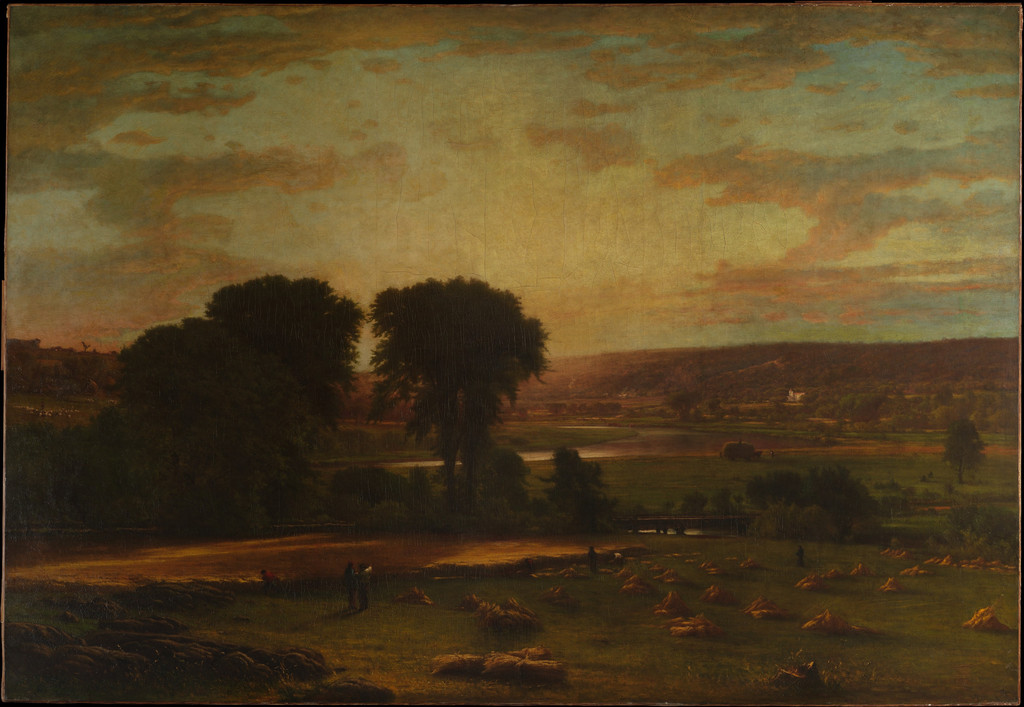
Brief instruction, engraving work and European encounters preceded the railway commission and other inhabited landscapes. [4]
Teaching, harvest and spiritual purpose
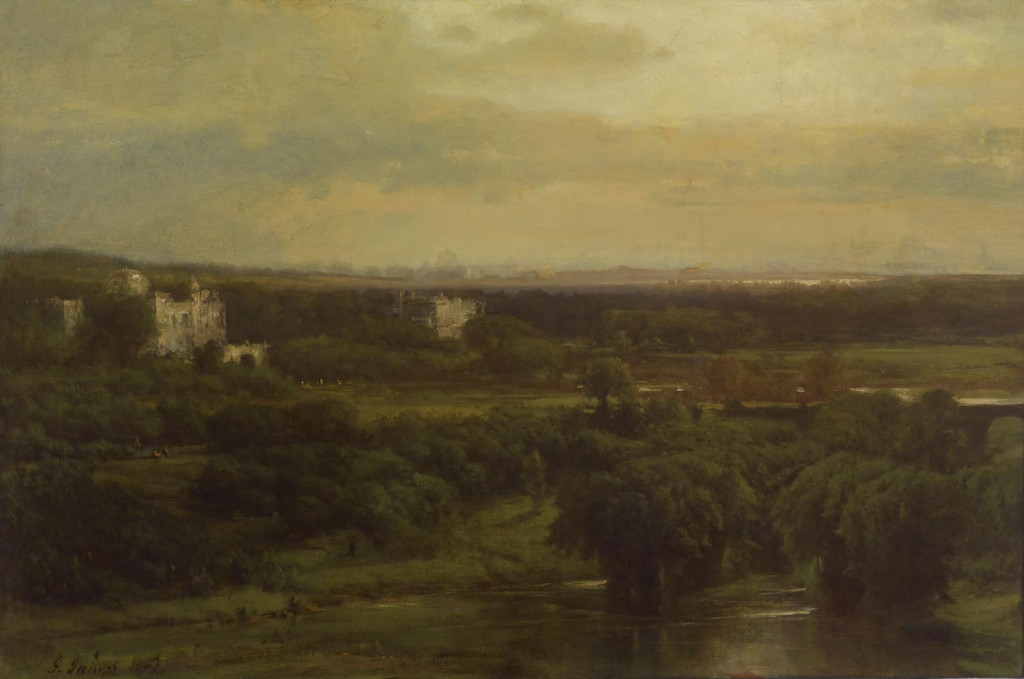
Medfield and Eagleswood brought teaching, Civil War activity and the Triumph of the Cross commission into the career. [4]
Small sheets and monumental trees
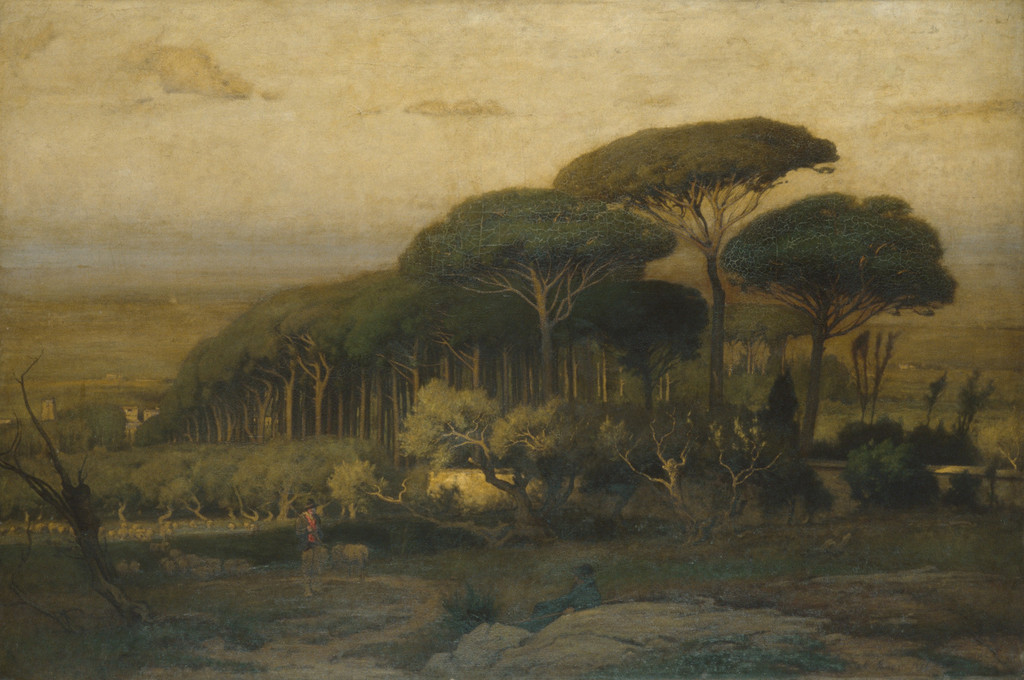
The longer European residence of 1870–74 supplied works on paper and subjects reconsidered after the return, including Pine Grove of the Barberini Villa. [4]
Winter ground, woods and Florida groves
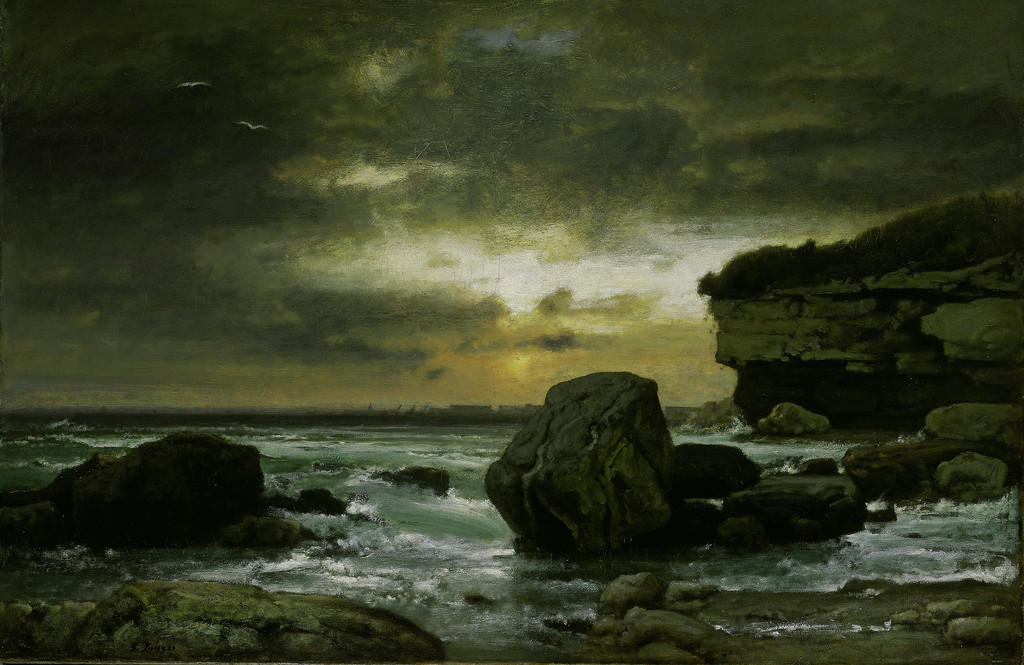
Rental in Montclair began in 1878; purchase and permanent residence followed. Florida journeys and other travel continued alongside the late local landscapes. [4]
Training, prints and European encounters
Adrienne Baxter Bell’s specialist chronology describes brief instruction, work in engraving establishments and study of old-master compositions through reproductions. It also traces Inness’s early encounters with the work of Cole and Durand, followed by European travel.[4] The young artist’s landscape practice developed through several kinds of example.
The biography follows those events in greater detail. For the paintings, the importance of prints is that a composition could become available independently of direct access to its original canvas. Relationships among large forms, distance and foreground could be studied through a reproduced image.
George Inness Jr.’s 1917 memoir recalls his father’s interest in prints after Claude Lorrain and Salvator Rosa. It also preserves statements about art and thought, including the phrase “the cultivation of our own spiritual nature,” reproduced on printed page 17.[5] The book supplies valuable primary material through a son’s later publication; remembered speech and reproduced statements require their own dates and context.
Inness travelled to Rome and Florence in 1851–52 and encountered William Page. Bell also describes his attention to French Barbizon painting.[4] These contacts belong to an unfolding practice. They should not make every Italian subject identical in handling, or every later painting a direct imitation of one European model.
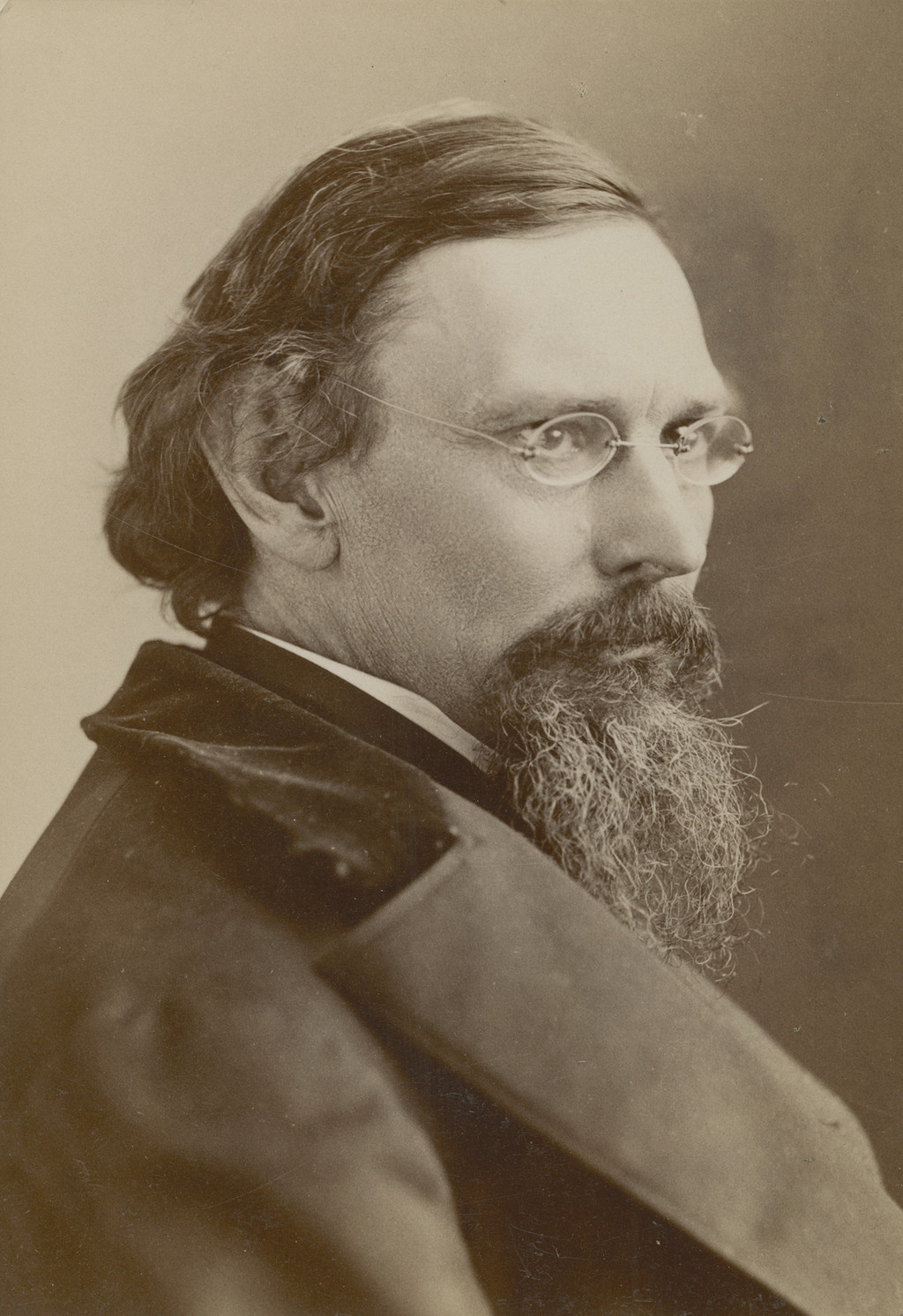
Napoleon Sarony, George Inness, after 1875. Albumen cabinet photograph. National Gallery of Art Library, as stated in the Commons file record; public-domain photograph by Napoleon Sarony. Image source. Public domain.
Inhabited nature and the railway valley
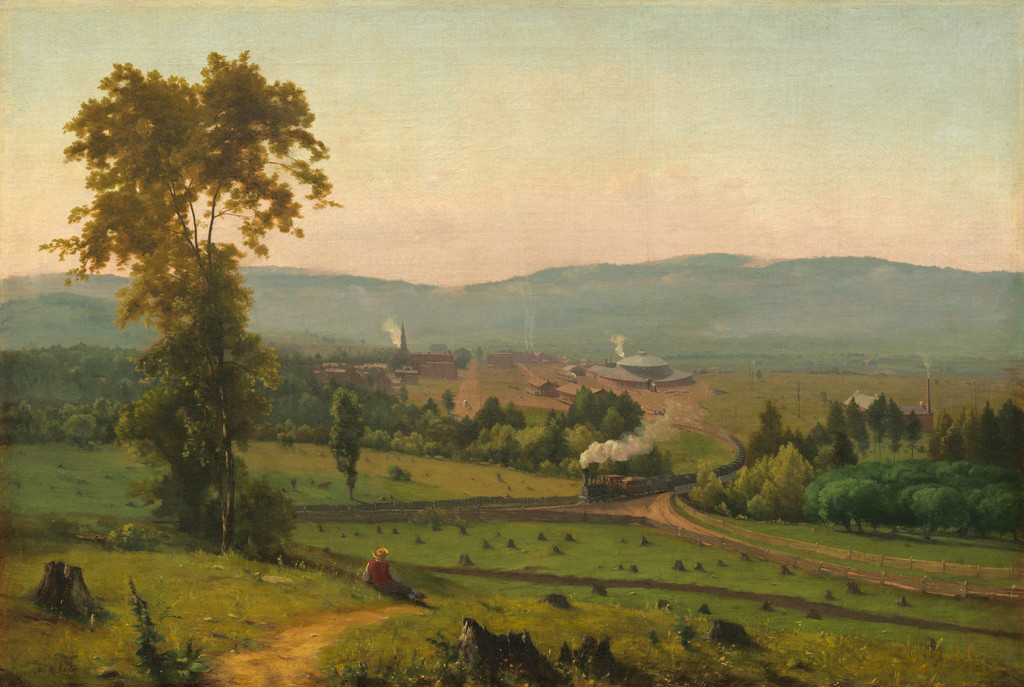
The Lackawanna Valley makes human alteration of the land conspicuous. The National Gallery of Art dates the painting circa 1856 and records the 1855 commission from John Jay Phelps for the Delaware, Lackawanna and Western Railroad.[6] A curving railway connects the near valley with distant buildings and the roundhouse.
The foreground stumps are particularly striking beside the intact tree at the left. A reclining person lies above the railway prospect. Train, settlement, remaining trees and cut wood become parts of the same view. The picture can sustain questions about industry and land without a viewer needing to assign a single documented thought to that person.
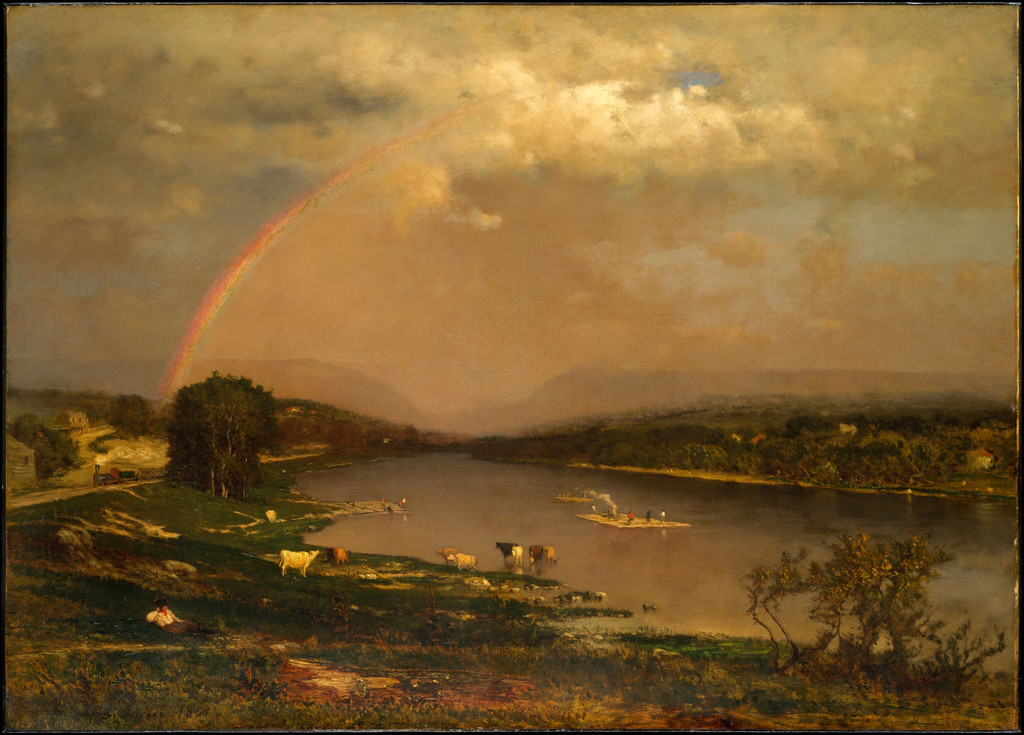
Delaware Water Gap, 1861, extends the comparison to river commerce. The Met’s record identifies this broad landscape, accession 32.151.[7] A rainbow crosses the sky above mountains, while a train follows the river and loaded vessels occupy its water. Work and transport remain visible within the expansive prospect.
Late Montclair offers another industrial subject. Mia’s The Mill Stream, circa 1888, includes the tower and chimney of Samuel Crump’s printing company.[8] Thin trees partly screen the building, and reflected light spreads along the water. Its architecture has a different presence from the more open railway valley.
Together, those works give human activity several forms: travelling through land, moving along a river and occupying a local site. They also show why a late atmospheric landscape should remain available to concrete observation. Softer relationships can coexist with an identifiable building and a small human gesture.
Harvest, spiritual purpose and a damaged commission
Peace and Plenty, dated 1865 by the Met, places field workers and harvest bundles beneath a broad golden sky.[9] Its large scale allows the eye to move between near labour and a far-reaching countryside. The companion article considers postwar optimism alongside other attributed scholarly readings of its social context.
For a first encounter, the visible relation between work and abundance matters. The bundles, bodies and cart do not disappear into a general statement about peace. They give the title a material setting. Looking closely at those elements can precede reading the different historical interpretations.
An explicitly religious commission provides a more direct connection between landscape and spiritual narrative. The three-part Triumph of the Cross was commissioned in 1866 and completed in 1867. The Walters connects it with Bunyan and Swedenborg, and explains the later discovery of pieces of its New Jerusalem painting.[10]
The New Jerusalem article follows the original work’s damage in 1880, division and reworking. Three present landscapes were subsequently connected with that earlier painting through scholarship and conservation. Their history requires attention to physical evidence as well as to what the current images seem to show.
Spiritual purpose consequently has more than one evidential form across Inness’s work. A documented narrative commission differs from a viewer’s interpretation of an atmospheric grove. His published words add another kind of evidence. The quotes guide keeps the source and circumstances of each selected statement visible, including the limits of retrospective recollection.
Watch: George Inness
Choose a film to explore the artist’s work, its interpretation and its wider setting.
The Montclair Art Museum's George Inness Gallery
Visit the George Inness Gallery at the Montclair Art Museum in this State of the Arts feature.
Watch on YouTubeItaly on paper and on a large canvas
The Italy guide distinguishes Inness’s early visit from the extended residence of 1870–74. Two Met sheets help introduce that later period. Across the Campagna, 1872, combines watercolour, gouache and graphite on off-white wove paper.[11] Its broad sky stands above a low, compressed landscape.
Olive Trees at Tivoli, 1873, uses gouache, watercolour and graphite on blue wove paper with coloured fibres.[12] Darker near forms and a more open distance give this small work another arrangement. The support and medium provide useful information alongside the subject.
The drawings and watercolours article uses those exact sheets to consider line, opaque colour and different papers. Their modest dimensions invite close comparison with the large oils, but their records do not make them automatically preparatory studies for every later Italian picture.
Pine Grove of the Barberini Villa, 1876, is a large Met canvas painted after the Italian residence.[13] Umbrella-shaped crowns repeat above narrow trunks, while seated figures and a standing red-accented figure occupy different distances. Italian subjects remained available after the journeys themselves.
Try moving between a near figure and the repeated trees, then towards the pale distance on the left. That sequence differs from the expansive sky of Across the Campagna. The comparison concerns scale and arrangement as well as a shared association with Italy.
Montclair: snow, blossom and reflections
Bell distinguishes rental in Montclair from June 1878, purchase in December 1884 and permanent residence from February 1885. Inness retained a New York studio.[4] The Montclair guide keeps those dates separate while examining varied local pictures.
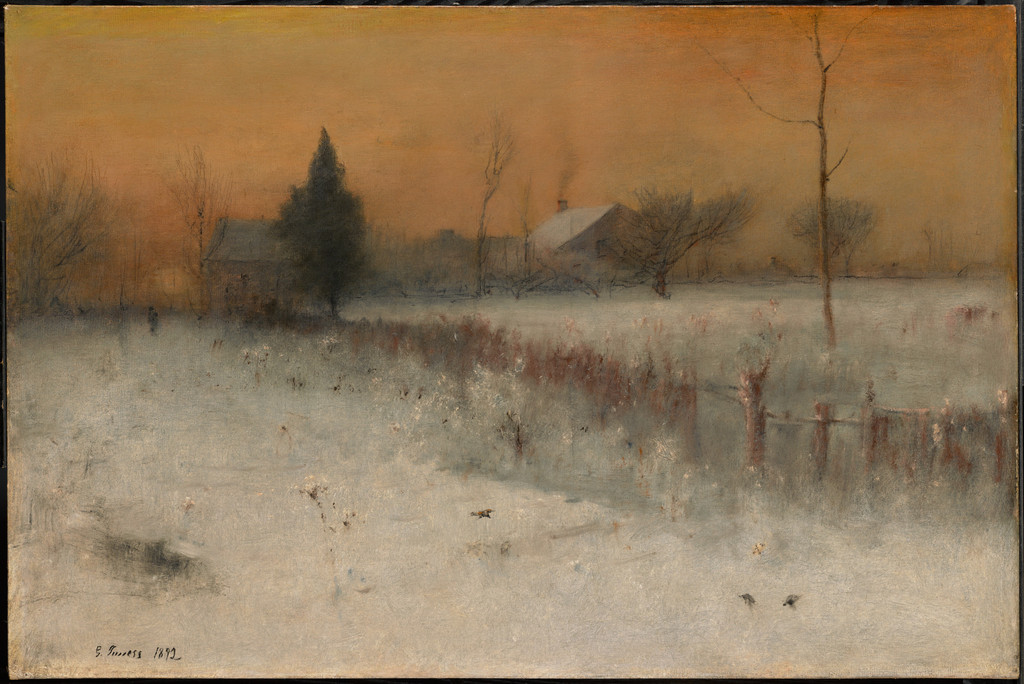
The Clark’s Home at Montclair is dated 1892. Its current account describes winter twilight and thinly applied paint.[14] A wide cool snowfield lies under a warm sky, with small birds on the ground and houses along the low horizon. The openness of the field has its own substantial role.
The Met’s Spring Blossoms, circa 1891, records oil with crayon or charcoal on canvas.[15] Pale blossom crosses a green field, with dark branching still visible inside it. A small light-clad figure gives the flowering forms another scale.
Compare the positions of pale light in those two works and in The Mill Stream. It lies on the winter ground, among spring branches and within reflected water. Familiarity with one locality supports varied compositions, rather than a single pattern applied to all its views.
Florida and the varied late landscape
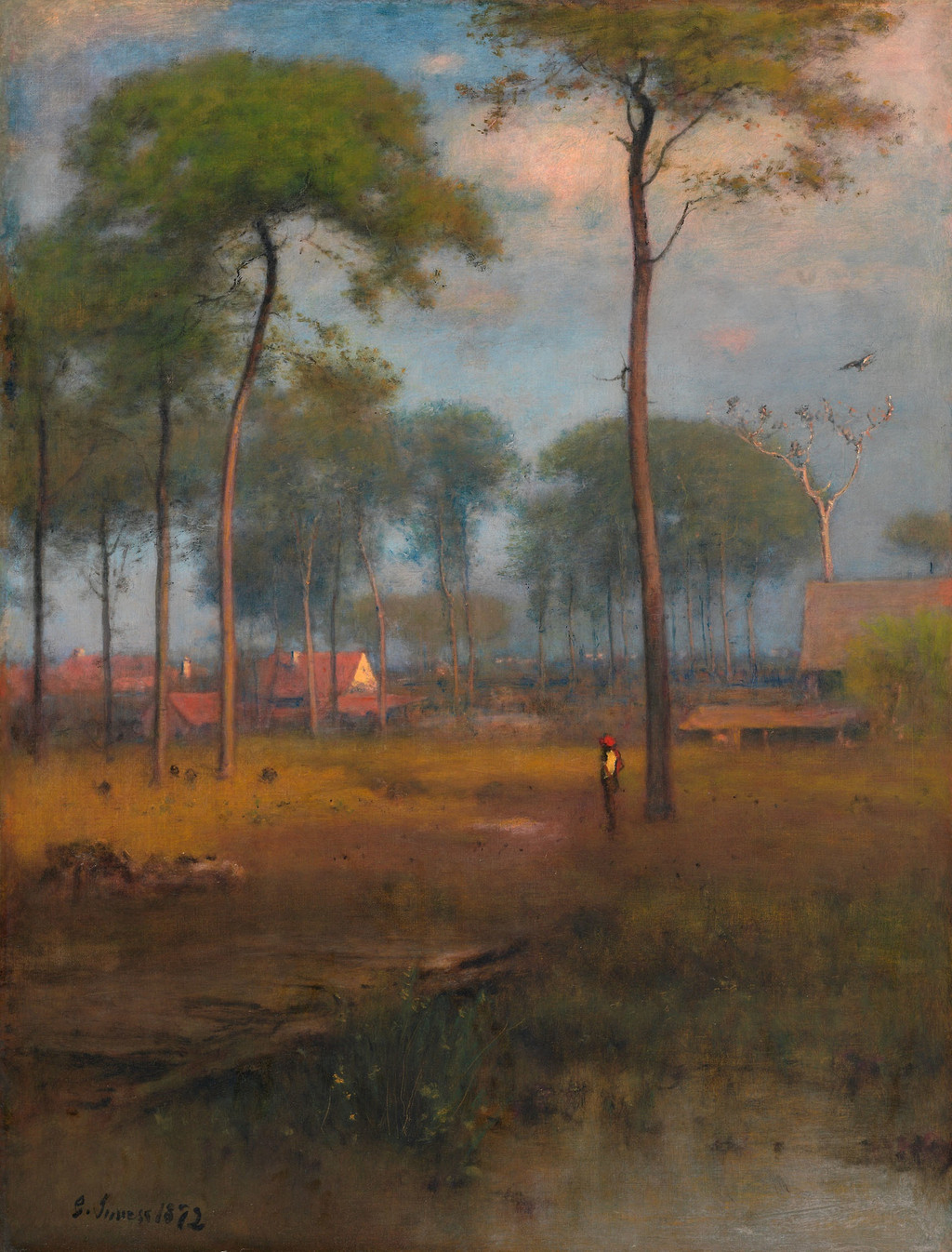
Late travel continued alongside the Montclair home. Chicago’s Early Morning, Tarpon Springs, dated 1892, puts a small red-hatted figure beneath tall trees in an upright composition.[16] The trunks carry attention upward into the pink-blue sky.
Set its format beside the horizontal Home at Montclair. Trees occupy a different proportion of each image, and the small living forms have different surroundings. The late paintings can share an interest in atmospheric relationships while changing the viewer’s route through the scene.
The Montclair Art Museum’s accessible gallery commentary by Bell offers a further introduction through its collection and Inness’s local association.[17] The collected museum links in this cluster also provide routes to individual objects elsewhere. Collection ownership and current display remain separate questions when planning a visit.
Reading the surface carefully
A reproduction can show the distribution of light, the visibility of branches and the relation between a figure and its surroundings. It cannot by itself identify every pigment or establish the order in which the artist applied his materials. The Met’s alternative crayon-or-charcoal description of Spring Blossoms demonstrates why the documented medium deserves careful wording.[15]
The same care makes visual comparison more useful. Notice which edges remain distinct and which join their surroundings; then ask how those differences affect recognition. A thin-looking passage in one picture need not establish the method used in another. The style guide keeps specific museum observations attached to their objects while considering the broader language used for Inness’s practice.
Where to look next
The paintings guide gives a cross-period selection and helps distinguish repeated titles. Start there for an object-led route. Choose the biography for the full sequence of places, relationships and career events, or style and technique for the evidence behind different descriptions of handling.
Individual artwork articles slow the process down. A rainbow, chimney, bird or seated figure can have a particular place within one composition without becoming a universal symbol across the career. Their exact records, visual readings and attributed interpretations allow those differences to remain clear as the wider development comes into view.
Essential George Inness works
The Lackawanna Valley by George Inness
c.1856 · A railway commission joining cut stumps, a spectator and a changing valley.
The Home of the Heron by George Inness
1893 · Chicago’s horizontal 1893 landscape of trees, connected colour and a small bird.
Peace and Plenty by George Inness
1865 · Harvest labour and abundance arranged beneath an expansive golden sky.
Sunset in the Woods by George Inness
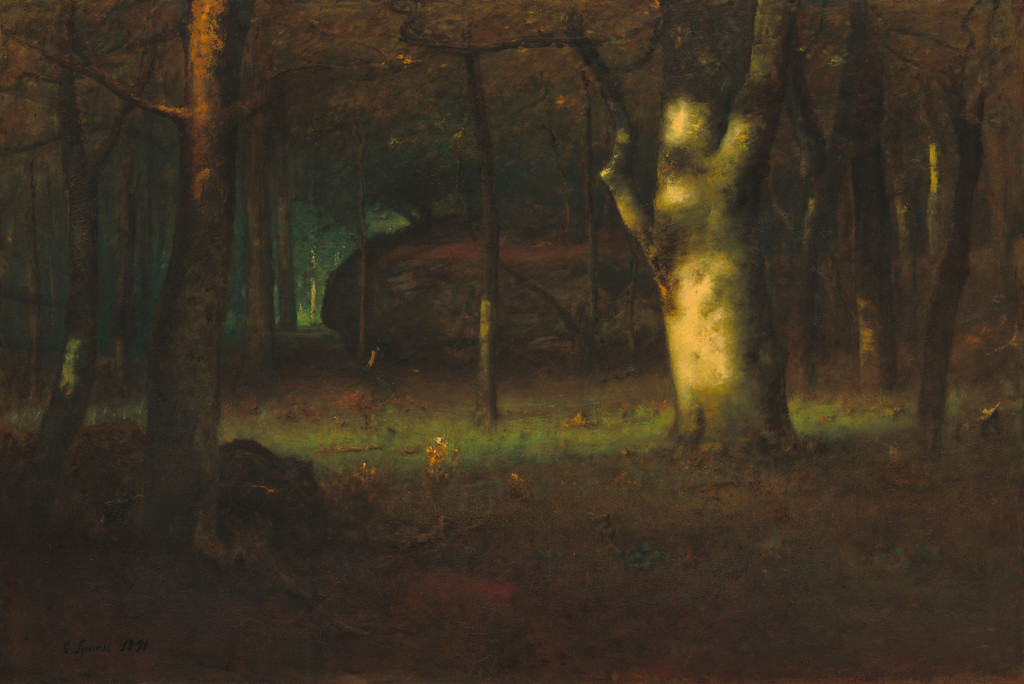
1891 · A woodland shaped over time through observation, memory and imagination.
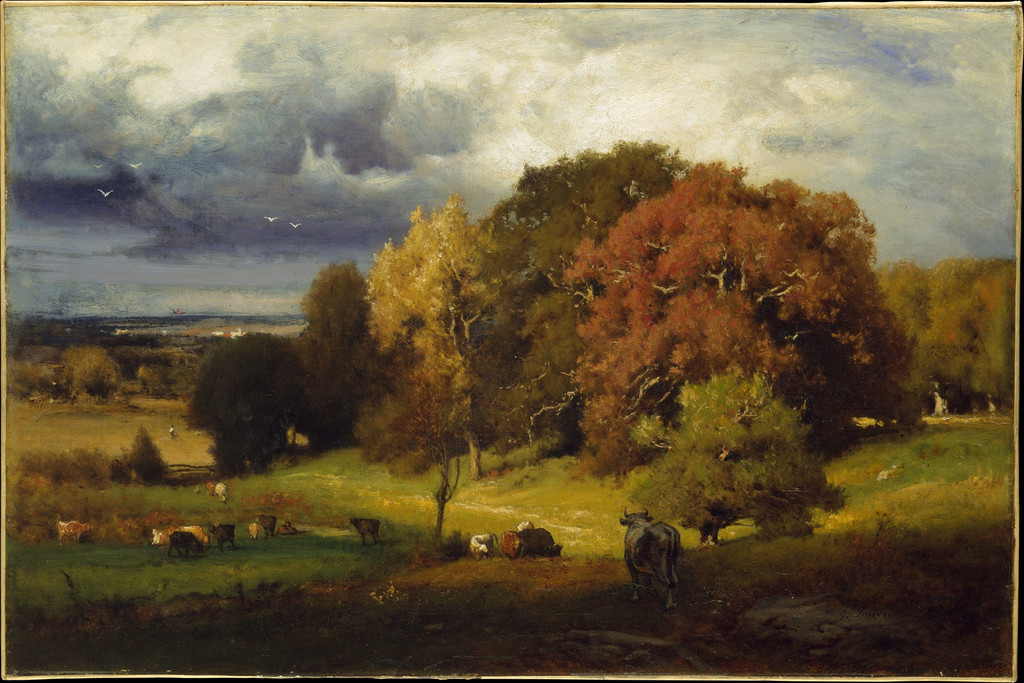
Autumn Oaks by George Inness
ca. 1878 · Near trees and an opening where light changes the enclosed landscape.
Delaware Water Gap by George Inness
1861 · Rainbow, river commerce and a railway within an extensive mountain prospect.
Home at Montclair by George Inness
1892 · A broad snowfield and low houses in the warm light of winter twilight.
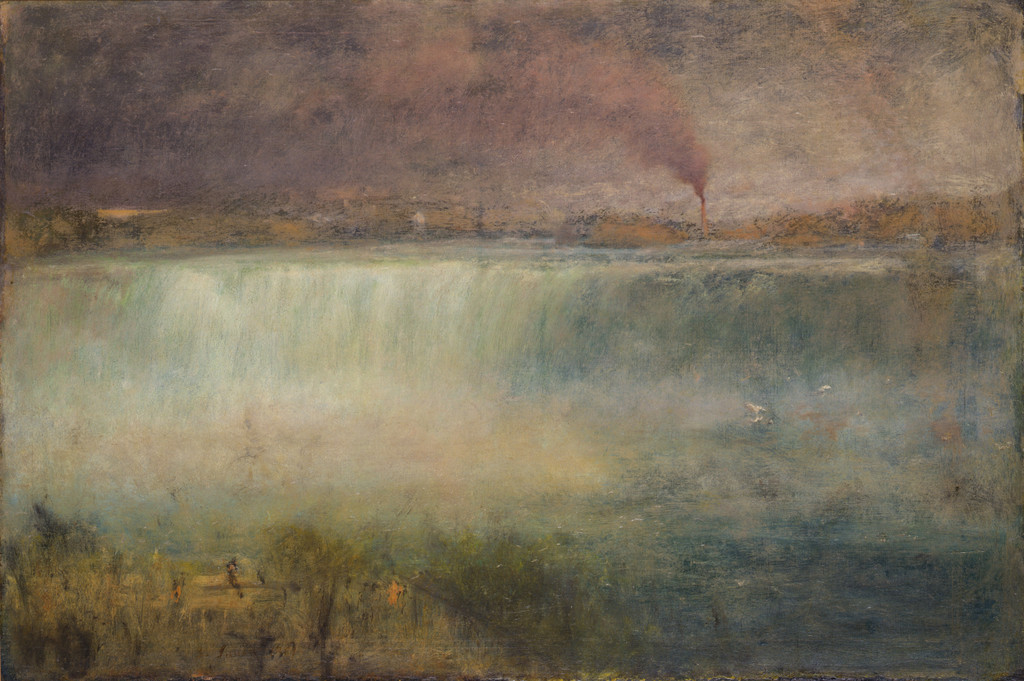
Niagara by George Inness
1889 · The Smithsonian’s 1889 canvas, distinct from its separate 1885 wood panel.
Pine Grove of the Barberini Villa by George Inness
1876 · Repeated umbrella crowns, small figures and a pale Italian distance.
Early Morning, Tarpon Springs by George Inness
1892 · An upright Florida grove with tall trunks and a red-hatted figure.
Artworks directory
A collected selection of 46 individually identified museum objects: 43 paintings and three watercolours. This is not a complete catalogue raisonné. Repeated titles identify separate objects where their institutions or accessions differ. Links lead to a companion article where available, otherwise to the museum record. Unillustrated entries remain included; the original lost New Jerusalem is represented by its three transformed survivors.
| Name | Date | Medium |
|---|---|---|
| Crossing the Ford | 1848 | Oil on canvas |
| The Old Mill | 1849 | Oil on canvas |
| The Lackawanna Valley by George Inness | c. 1856 | oil on canvas |
| Delaware Water Gap | 1861 | Oil on canvas |
| Delaware Valley | c. 1865–75 | Oil on artist's board |
| Peace and Plenty | 1865 | Oil on canvas |
| Evening Landscape | 1867; later reworked | Oil on canvas |
| Summer in the Catskills | 1867 | Oil on canvas |
| The Valley of the Olives | 1867; reworked after 1880 | Oil on canvas |
| The Valley of the Shadow of Death | 1867 | Oil on canvas |
| Visionary Landscape | 1867/1880 | Oil on canvas |
| Catskill Mountains | 1870 | Oil on canvas |
| Across the Campagna | 1872 | Watercolor, gouache, and graphite on off-white wove paper |
| Olive Trees at Tivoli | 1873 | Gouache, watercolor, and graphite on blue wove paper with colored fibers |
| A Marine | c. 1874–75 | Oil on canvas |
| Twilight in Italy — Art Institute of Chicago (1911.44) | 1874 | Oil on panel |
| Pine Grove of the Barberini Villa | 1876 | Oil on canvas |
| The Storm | 1876 | Oil on canvas |
| Autumn Oaks | ca. 1878 | Oil on canvas |
| The Sisters | 1882 | Oil on millboard |
| Harvest, Montclair, New Jersey | 1884 | Oil on canvas |
| Niagara Falls | 1885 | Oil on wood |
| A Silver Morning | 1886 | Oil on canvas |
| Landscape, Sunset | 1887–89 | Oil on canvas |
| September Afternoon | 1887 | Oil on canvas |
| Sunrise | 1887 | Oil on canvas |
| The Mill Stream, Montclair, New Jersey by George Inness | c. 1888 | Oil on canvas |
| Niagara by George Inness | 1889 | oil on canvas |
| The Mill Pond | 1889 | Oil on canvas |
| Sunset in the Valley | 1890 | Oil on canvas |
| The Moon at Night | 1890 | Oil on canvas |
| Twilight in Italy — Art Institute of Chicago (1911.42) | 1890 | Oil on canvas |
| Autumn Woods | 1891–94 | Oil on canvas |
| Moonrise | 1891 | Oil on canvas |
| Spring Blossoms, Montclair, New Jersey | ca. 1891 | Oil and crayon or charcoal on canvas |
| Sunset in the Woods by George Inness | 1891 | oil on canvas |
| The Home of the Heron — Princeton University Art Museum (y1943-93) | 1891 | Oil on canvas |
| Threatening | 1891 | Oil on canvas |
| Early Morning, Tarpon Springs | 1892 | Oil on canvas |
| Home at Montclair by George Inness | 1892 | oil on canvas |
| The Lonely Farm, Nantucket | 1892 | Oil on canvas |
| Afterglow | 1893 | Oil on canvas |
| Sunlit Valley | 1893 | Oil on canvas |
| The Home of the Heron — Art Institute of Chicago (1911.31) | 1893 | Oil on canvas |
| After a Summer Shower | 1894 | Oil on canvas |
| Landscape | n.d. | Watercolor with scraping on ivory wove paper |
Frequently Asked Questions
He lived from 1825 to 1894, born in Newburgh, New York, and dying in Bridge of Allan, Scotland.[1]
Compare The Old Mill of 1849 with Chicago’s The Home of the Heron of 1893, then explore the railway, harvest and Italian landscapes between them.
No. His paintings include mills, a railway valley, cultivated fields, houses and a printing plant, alongside trees, rivers and changing light.
The style and technique guide distinguishes museum documentation, published artist statements and what can be observed in a reproduction.
Discussion
Look again at the images and ideas explored in George Inness. These editorial prompts invite your observations.
Begin with the mill and the late heron landscape. Which forms become clear first in each painting, and what changes when you return to the smallest signs of life?
Reader Insights
What becomes clear first in the early mill and the late heron landscape?
How does the small human presence change between the railway valley and the harvest field?
Which painted place would you follow into the biography?
Join the Conversation
Share a detail, comparison or question about George Inness below.
Explore the wider art history
Explore the wider history of American artists, with portraits, landscapes and changing approaches to modern art.
Tonalism provides a later context for comparing Inness’s atmospheric landscapes; it does not describe every phase of his career.
References
- Princeton University Art Museum, George Inness biography in The Home of the Heron record.
- Art Institute of Chicago, The Old Mill, accession 1939.388.
- Art Institute of Chicago, The Home of the Heron, accession 1911.31.
- Adrienne Baxter Bell, “George Inness (1825–1894),” Metropolitan Museum of Art (2012).
- George Inness Jr., Life, Art, and Letters of George Inness (1917), printed pp. 13–14 and 17. Selected original pages examined; retrospective memoir distinguished.
- National Gallery of Art, The Lackawanna Valley, accession 1945.4.1.
- Metropolitan Museum of Art, Delaware Water Gap, accession 32.151.
- Minneapolis Institute of Art, The Mill Stream, Montclair, New Jersey, accession 2000.236.
- Metropolitan Museum of Art, Peace and Plenty, accession 94.27.
- Walters Art Museum, “George Inness’s New Jerusalem: Lost and Found” (2004).
- Metropolitan Museum of Art, Across the Campagna, accession 67.55.145.
- Metropolitan Museum of Art, Olive Trees at Tivoli, accession 1989.287.
- Metropolitan Museum of Art, Pine Grove of the Barberini Villa, accession 98.16.
- Clark Art Institute, Home at Montclair, accession 1955.10.
- Metropolitan Museum of Art, Spring Blossoms, Montclair, New Jersey, accession 11.116.4.
- Art Institute of Chicago, Early Morning, Tarpon Springs, accession 1911.32.
- Adrienne Baxter Bell, George Inness gallery commentary, Montclair Art Museum. Accessible transcript examined.
- Splash image source.
George Inness, The Old Mill, 1849. Oil on canvas. Art Institute of Chicago, 1939.388. William Owen Goodman and Erna Sawyer Goodman Collection; Art Institute of Chicago. Image source. Public domain.
- Kevin J. Avery, “The Hudson River School”, Metropolitan Museum of Art (2004). Origins in 1825 and decline in the 1870s–1880s; c. 1825–1880 is an approximate comparative range. Source
- National Gallery of Art, Picturing France, p. 37: the Barbizon school between about 1830 and 1870. Source
- Smithsonian American Art Museum, Asher Brown Durand: 1796–1886. Artist life dates. Source
- Smithsonian American Art Museum, Thomas Cole: 1801–1848. Artist life dates. Source
- National Gallery of Art, George Inness: 1825–1894. Artist life dates. Source
- Amon Carter Museum of American Art, Frederic Edwin Church: 1826–1900. Artist life dates. Source