 by Tom Gurney
Tom Gurney BSc (Hons) is an art history expert with over 20 years experience
Email: tomgurney1@gmail.com / Phone: +44 7429 011000
Peace and Plenty by George Inness: Introduction
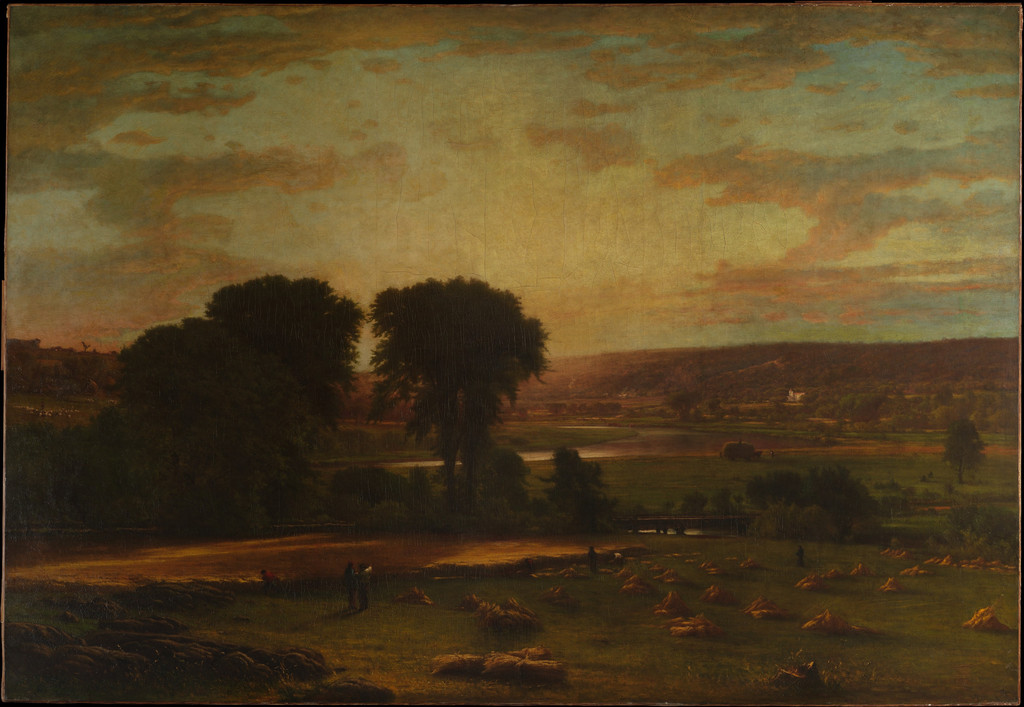
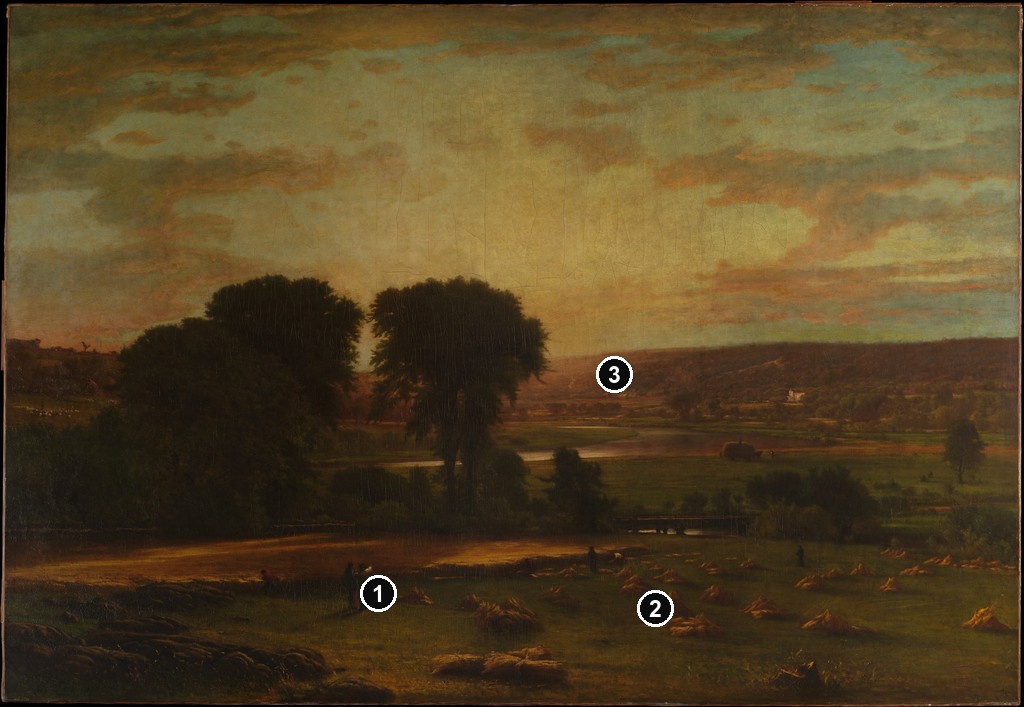
Harvest bundles and workers spread across the foreground of George Inness’s Peace and Plenty, beneath a broad golden sky. Dark tree groups interrupt the horizon, while a river and cultivated ground extend into the distance. The title gives this fertile landscape a larger claim: work and abundance are connected with peace. The Metropolitan Museum of Art dates the large oil canvas to 1865 and records George A. Hearn’s gift in 1894.[1]
At a Glance
- ArtistGeorge Inness (1825–1894)
- TitlePeace and Plenty
- Date1865
- MediumOil on canvas
- Dimensions197.2 × 285.4 cm
- CollectionMetropolitan Museum of Art, New York
- CreditGift of George A. Hearn, 1894
- Accession94.27
This work across George Inness’s career
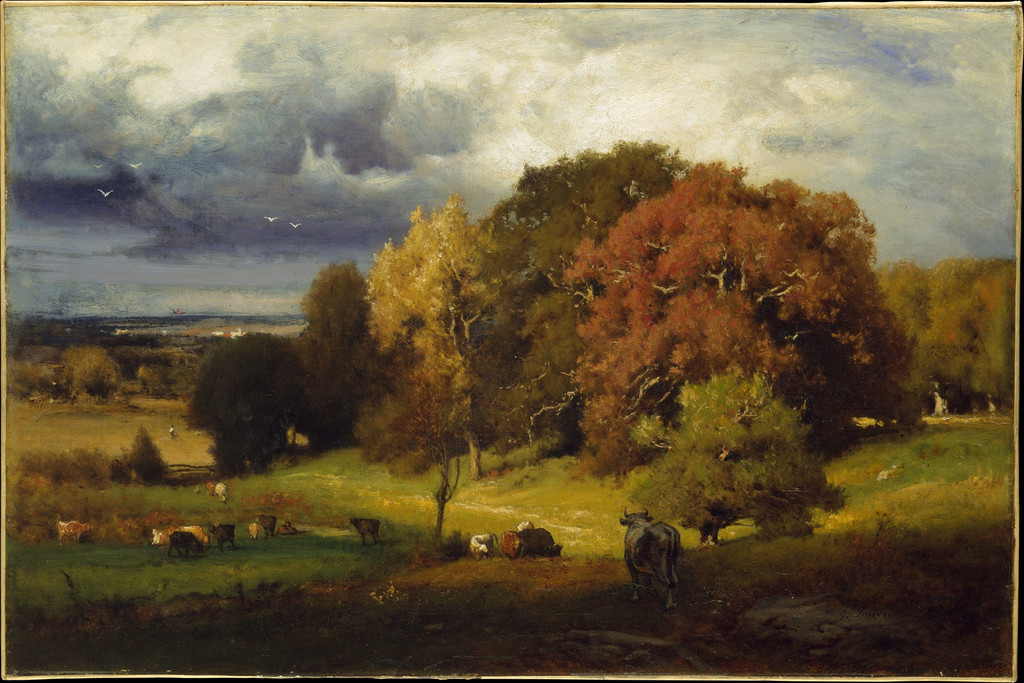
Autumn Oaks by George Inness
ca. 1878Contents
- Harvest under an expansive sky
- What the harvest bundles make visible
- Workers at different distances
- A cart and the quieter right side
- Trees between the foreground and distance
- Water and the receding fields
- 1865, the Civil War and the title
- Social harmony as a specialist interpretation
- Monumental scale and expressive handling
- Annotated details
Harvest under an expansive sky
The sky occupies a large share of the composition. Warm yellow and orange spread through it, with darker cloud near the upper edge and cooler passages remaining between the warmer forms. Its breadth gives the scene an atmosphere that can be experienced before any worker or bundle is individually found.
Below it, the cultivated foreground contains many smaller forms. The repeated bundles produce a rhythm across the field, while people stand at unequal intervals among them. The difference in scale between sky and harvest is essential: broad light holds together a ground that is much more varied in its contents.
The middle distance provides a transition between those areas. Trees, water and more distant fields occupy a comparatively narrow band, but their changing forms make the landscape seem extensive. The foreground does not meet the remote hills in a single unbroken step.
Begin by looking at the whole canvas, then at the harvest bundles nearest the lower edge. Returning to the sky after that close attention changes its scale. The painting makes everyday work available within a prospect whose width and light give it a more expansive character.
Annotated Details from Peace and Plenty
The numbered points identify visible features discussed in this article. Return from each detail to the whole composition. George Inness, Peace and Plenty, 1865. Oil on canvas, 197.2 × 285.4 cm. Met, 94.27. Gift of George A. Hearn, 1894; Metropolitan Museum of Art. Image source. Public domain.
Details from PEACE AND PLENTY
Compare the cropped details with the complete images above. Notice how their colours, shapes and positions contribute to the larger compositions.
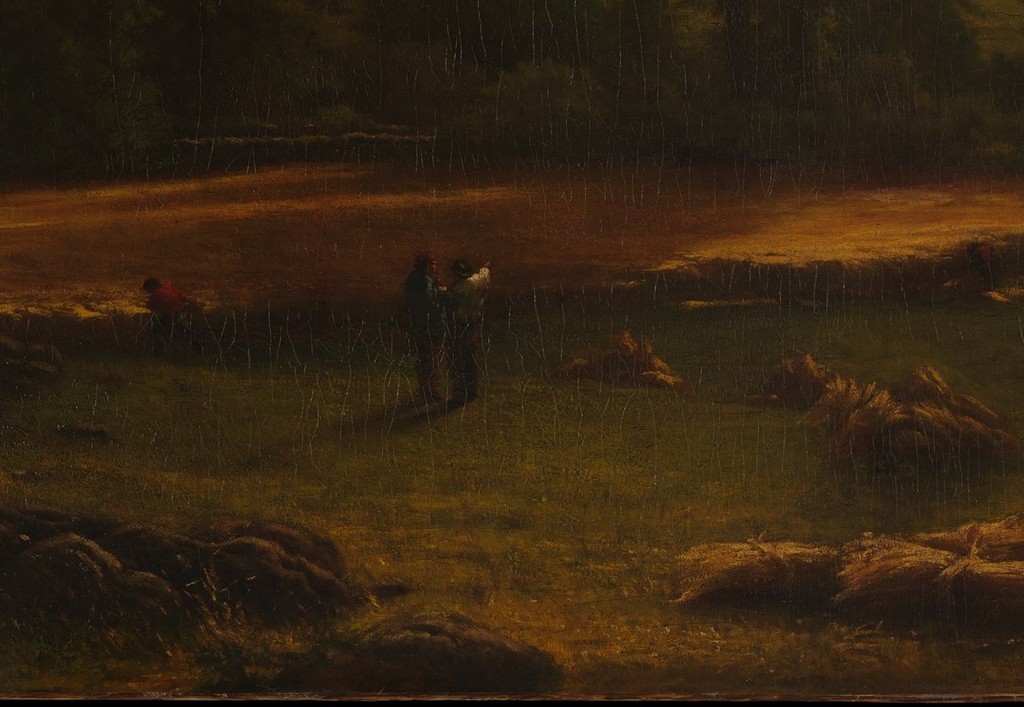
Harvest workers
Small workers occupy the nearer field. Their positions and different gestures give the harvest a human scale.
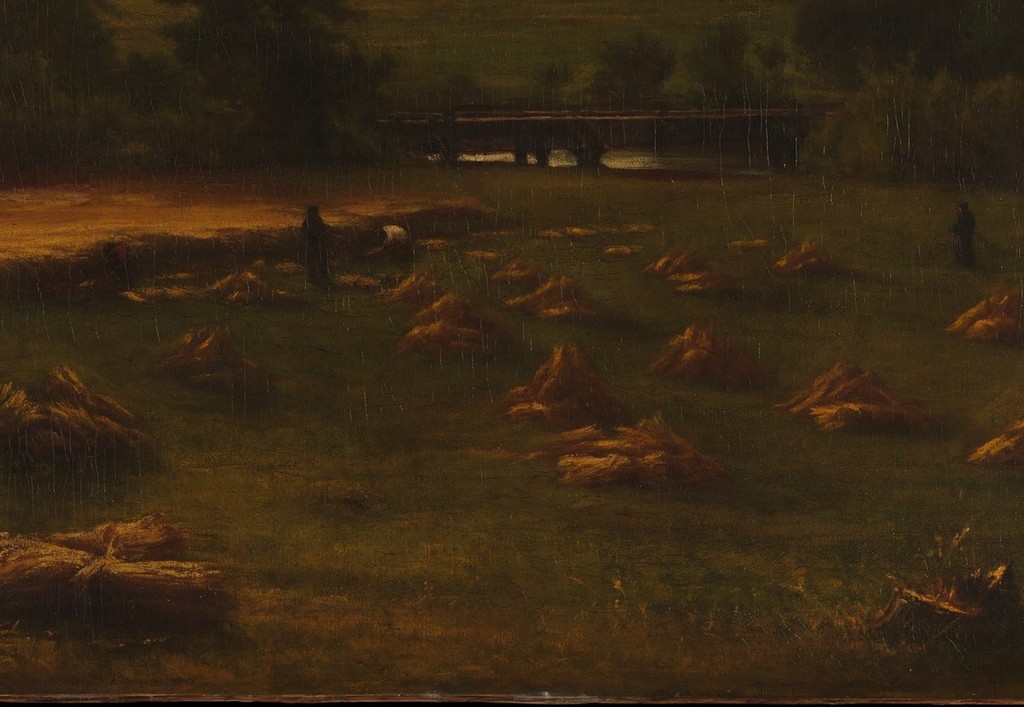
Bundles across the field
Repeated bundles mark the cut ground. Their spacing carries attention across the broad field towards the distance.
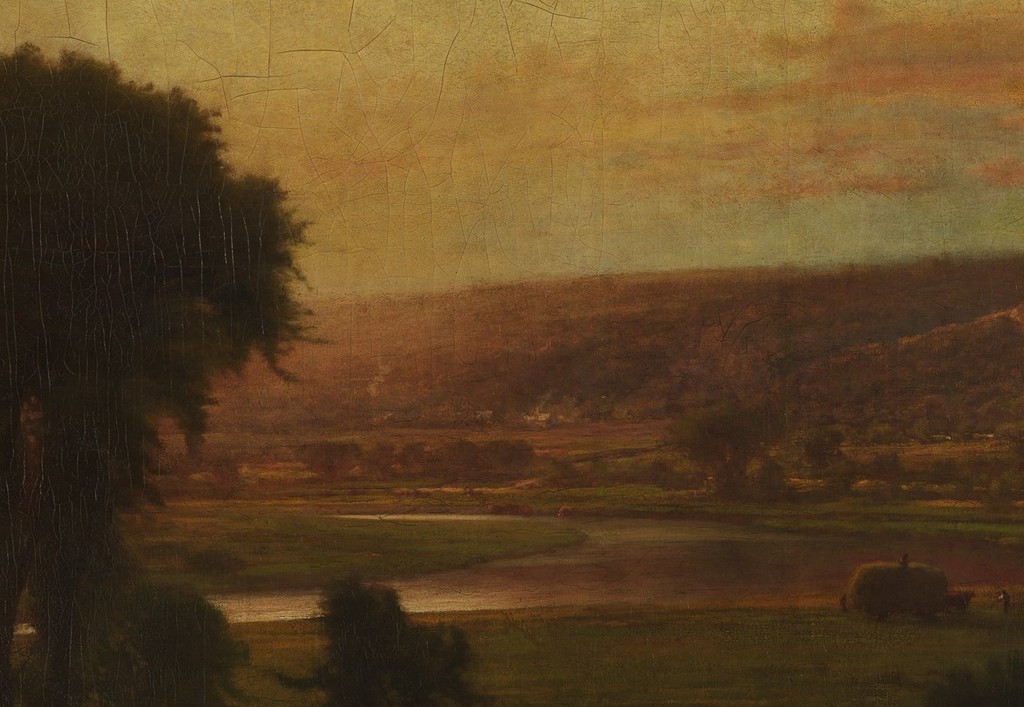
Far settlement
Buildings and worked fields extend beyond the nearer trees. The compressed distant forms place the harvest within a wider inhabited landscape.
What the harvest bundles make visible
The bundles vary in size and position across the foreground. Some occupy more open intervals of field, while others gather closer to workers or the lower edge. Their warm colour catches light differently from the surrounding darker ground.
Repetition establishes abundance, but the forms are not arranged as a rigid pattern. Their intervals change, and their orientation differs. This variation makes the crop feel distributed across a worked field rather than displayed as a row of matching objects.
The nearer bundles are larger and more available to the eye. Farther ones become smaller and less emphatic, helping the ground recede. Their scale therefore contributes to the picture’s depth as well as to the title’s suggestion of plenty.
The cut crop also gives the field a particular stage of activity. The scene contains the results of work alongside people still present within it. That relation makes abundance visibly dependent on human action, even though the panorama’s atmosphere remains quiet.
Workers at different distances
Several people occupy the near field, with smaller figures continuing towards the right and farther into the landscape. Their positions create more than one centre of activity. The scene does not gather everyone around a single event in the immediate foreground.
Light and dark clothing help distinguish the people from the crop and ground. Small colour accents can draw attention to a person who would otherwise remain closely joined to the field. The figures establish a human scale within a canvas nearly three metres wide.
Their separation also makes the land feel extended. The viewer can move from a near worker towards a smaller person beyond, then towards the cart and more distant fields. Human presence becomes one of the means through which the panorama acquires depth.
The reproduction supports an account of harvest activity and placement. It does not independently identify each person’s name, social position or exact role. Those distinctions should remain open unless supported by documentary evidence. The visible relation between people and worked land already contributes a substantial part of the painting’s argument.
A cart and the quieter right side
A loaded cart appears farther into the scene towards the right. Its compact, rounded load contrasts with the more scattered bundles in front. The difference links several stages of agricultural work within the same landscape, from cut crop in the field to material gathered for movement.
The cart remains small relative to the whole prospect. It can be found within the middle distance without becoming the picture’s central spectacle. Its placement helps connect the nearer harvest with the cultivated ground beyond.
The right side is more open than the large tree group towards the left. Smaller upright forms and field divisions occupy it, allowing the eye to move farther across the land. This openness gives the crop and cart a setting different from the shadow near the nearer trees.
The inequality of the sides helps the canvas sustain its width. A more enclosed, darker area balances a broader view through fields and water. The painting offers several routes through the land rather than forcing attention along one central path.
Trees between the foreground and distance
The large tree groups rise into the sky left of centre. Their dark crowns have a substantial presence against the warm light, and an interval between them allows a brighter passage to remain visible. They interrupt the horizon without closing the entire distance.
Their trunks and lower vegetation are quieter within the shadowed ground. The crowns therefore register first as broad masses, while the structure below takes more time to follow. That difference changes the speed of looking across different parts of the scene.
The trees give the luminous sky something darker to stand against. They also separate parts of the nearer field from the water and cultivated areas beyond. Their role combines contrast and depth, making them essential to the panorama’s organisation rather than merely decorative foliage.
Follow the tree group downward, then move laterally into the nearest field. The strong mass gives way to scattered bundles and small people. The change makes the painting’s variety more apparent: substantial natural forms and modest signs of work occupy the same continuous land.
Water and the receding fields
The river forms a pale horizontal passage through the middle distance. Its light contrasts with the darker tree bases and the warmer field. Where the water is partly interrupted, the eye must find the continuation through other visible intervals.
This partial visibility gives the scene depth. Vegetation stands in front of the water, while land continues beyond it. The picture is experienced through overlapping spaces rather than a complete, map-like account of every shore.
Farther fields and low hills carry warmer and more muted colours. Small pale buildings can be found within them, adding another scale of habitation. The landscape extends beyond the immediate harvest without leaving the settled world behind.
The water’s quieter surface also offers a different rhythm from the repeated crop bundles. One spreads as an extended light passage; the other produces many smaller interruptions. Their relation helps hold together a panorama that includes several kinds of land use and visual movement.
Watch: George Inness
Choose a film to explore the artist’s work, its interpretation and its wider setting.
The Montclair Art Museum's George Inness Gallery
Visit the George Inness Gallery at the Montclair Art Museum in this State of the Arts feature.
Watch on YouTube1865, the Civil War and the title
The Met interprets the title and bountiful harvest, alongside wartime statements associated with Inness’s work, as suggestive of confidence in Union victory and prosperity. It places completion towards the end of the Civil War.[1] This is an attributed museum argument connecting the landscape with a larger historical moment.
Adrienne Baxter Bell records that the painting was first exhibited in 1866. She also describes Inness’s abolitionist commitments, attempted enlistment and efforts to encourage donations and volunteers during the war.[2] The date of completion and the date of first exhibition should remain separate.
The title provides a framework through which to consider the visible harvest. Plenty can be found in repeated bundles, fertile ground and continued activity. Peace is less directly represented as a single object; it is approached through the scene’s overall relations and through the historical interpretations attached to it.
That difference makes the title more than a factual caption. It encourages the viewer to connect a particular landscape with an aspiration. The painting’s fields and people remain important to that connection, because abundance has been given a visible setting shaped by work.
An optimistic interpretation also needs to retain the difference between a hopeful picture and the complete history of a country emerging from war. The canvas can articulate prosperity without supplying an account of every conflict or inequality. Its title and scene invite a substantial reading, while the limits of the image remain part of that reading.
Social harmony as a specialist interpretation
Bell reports Leo Mazow’s interpretation in relation to original owners Marcus and Rebecca Spring, founders of Eagleswood. In her account, the people walking and working in the landscape can be read alongside the Springs’ social-reform interests and an aspiration towards harmony among classes. Bell also reports his discussion of several models of history.[2]
This article uses Bell’s account of that argument; Mazow’s complete original study has not been examined here. The distinction preserves the source route and keeps the interpretation separate from a securely identified social position for every tiny painted figure.
The reading is useful because it returns attention to the distribution of people. Some figures appear nearer the labour of harvest; others occupy different parts of the land. Their coexistence within the panorama can be considered without reducing the scene to a single named narrative.
The painting remains available through both historical and visual questions. How do its forms create an experience of abundance? How might that experience relate to reform, peace or social harmony? The specialist framework gives those questions context, while the canvas supplies the particular arrangement through which to examine them.
Monumental scale and expressive handling
The Met presents Peace and Plenty as a challenge to the grand, literal landscape approach of Frederic Edwin Church and Albert Bierstadt, emphasising Inness’s expressive treatment of fertile farmland.[1] The comparison concerns approach and subject; Inness himself chose a very large canvas.
That scale makes the modest harvest subject more consequential. Workers and bundles occupy a setting broad enough to sustain an extended panorama, while light supplies a unifying atmosphere. An ordinary field is given a substantial pictorial presence.
The visible details are unevenly emphatic. A dark tree crown can act as a broad mass, while a small worker requires closer attention. The image therefore distributes recognition across different scales, letting the whole landscape carry feeling beyond any one object.
Oil on canvas is the documented medium. Fine cracks appear in the reproduction, but no object-specific scientific paint study or complete treatment history has been examined here. The museum’s account of expressive handling is a critical description, rather than a basis for inventing named pigments or reconstructing every layer.
The Hearn gift and useful comparisons
George A. Hearn gave this canvas to the Met in 1894.[1] Accession 94.27 distinguishes it from other Hearn gifts with different dates or memorial credits. A fuller earlier ownership chain would require direct examination of further provenance records.
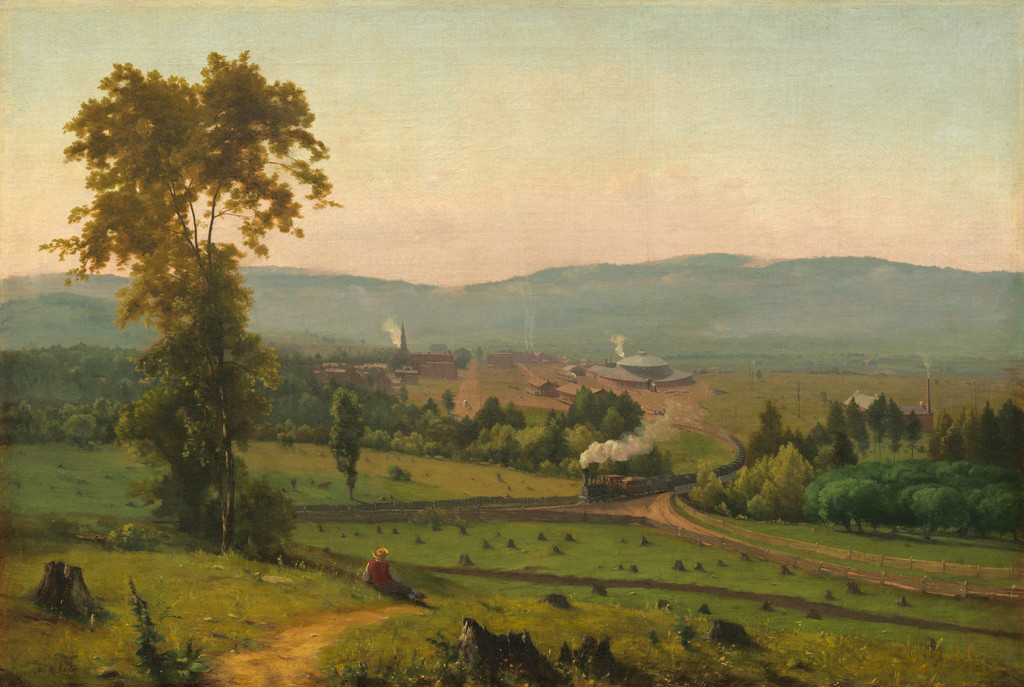
The Lackawanna Valley, circa 1856, offers a very different landscape of work. The National Gallery of Art records its railway commission.[3] A train, roundhouse and stumps occupy that prospect, while this canvas makes harvest bundles, workers and cultivated ground central to its foreground.
Catskill Mountains, 1870, in the Art Institute of Chicago, includes a church, fields and a hayrick beneath broad atmospheric light.[4] Compare the smaller agricultural forms there with the more prominent crop and labour here. Each joins habitation with an expansive landscape, while distributing emphasis differently.
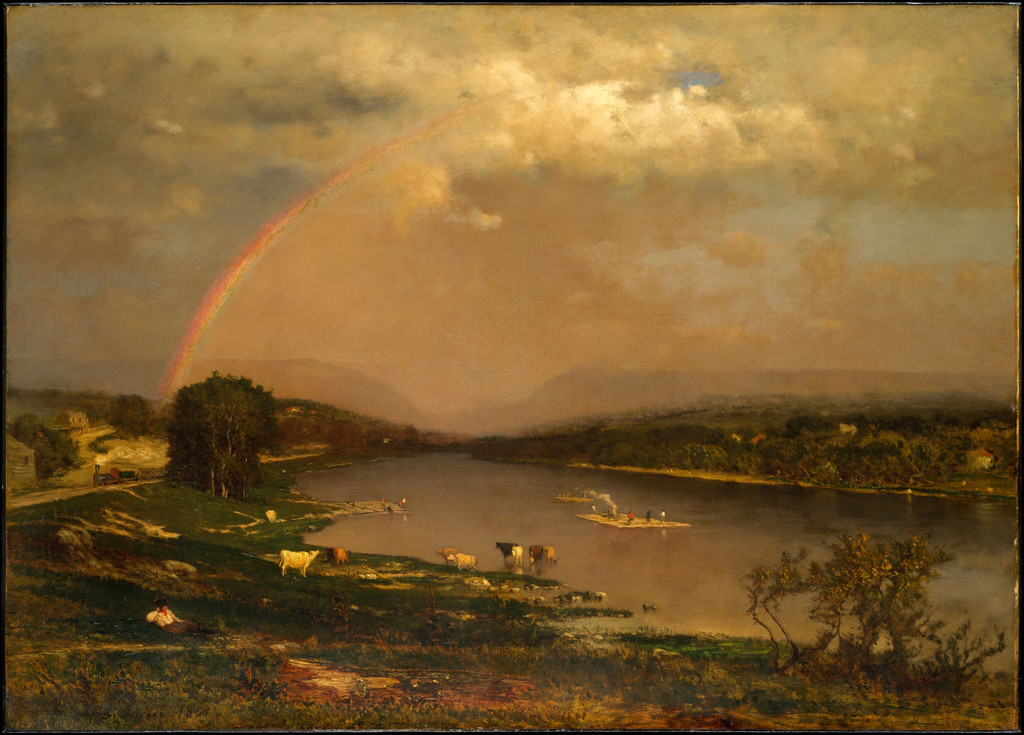
Delaware Water Gap, the Met’s 1861 canvas, contains a train and loaded river craft within a pastoral panorama.[5] Its water supplies a major route into the distance. In Peace and Plenty, a more lateral river passage connects areas behind the foreground harvest.
These comparisons help bring the title back to the visible scene. Inness could include many kinds of work within landscape, but the particular objects and their placement change the result. Here, repeated crop bundles and dispersed people make abundance a substantial foreground presence, while the wide light gives that presence a broader emotional setting.
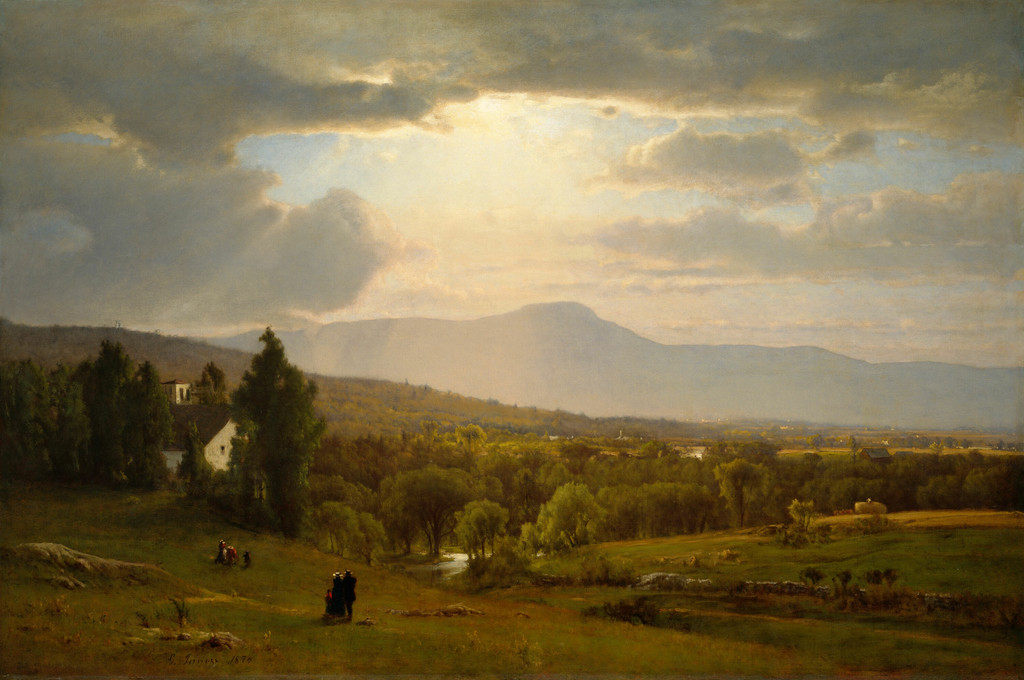
George Inness, Catskill Mountains, 1870. Oil on canvas. Art Institute of Chicago, 1912.1623. Edward B. Butler Collection; Art Institute of Chicago. Image source. CC0 / Public domain.
Artworks directory
A collected selection of 46 individually identified museum objects: 43 paintings and three watercolours. This is not a complete catalogue raisonné. Repeated titles identify separate objects where their institutions or accessions differ. Links lead to a companion article where available, otherwise to the museum record. Unillustrated entries remain included; the original lost New Jerusalem is represented by its three transformed survivors.
| Name | Date | Medium |
|---|---|---|
| Crossing the Ford | 1848 | Oil on canvas |
| The Old Mill | 1849 | Oil on canvas |
| The Lackawanna Valley by George Inness | c. 1856 | oil on canvas |
| Delaware Water Gap | 1861 | Oil on canvas |
| Delaware Valley | c. 1865–75 | Oil on artist's board |
| Peace and Plenty | 1865 | Oil on canvas |
| Evening Landscape | 1867; later reworked | Oil on canvas |
| Summer in the Catskills | 1867 | Oil on canvas |
| The Valley of the Olives | 1867; reworked after 1880 | Oil on canvas |
| The Valley of the Shadow of Death | 1867 | Oil on canvas |
| Visionary Landscape | 1867/1880 | Oil on canvas |
| Catskill Mountains | 1870 | Oil on canvas |
| Across the Campagna | 1872 | Watercolor, gouache, and graphite on off-white wove paper |
| Olive Trees at Tivoli | 1873 | Gouache, watercolor, and graphite on blue wove paper with colored fibers |
| A Marine | c. 1874–75 | Oil on canvas |
| Twilight in Italy — Art Institute of Chicago (1911.44) | 1874 | Oil on panel |
| Pine Grove of the Barberini Villa | 1876 | Oil on canvas |
| The Storm | 1876 | Oil on canvas |
| Autumn Oaks | ca. 1878 | Oil on canvas |
| The Sisters | 1882 | Oil on millboard |
| Harvest, Montclair, New Jersey | 1884 | Oil on canvas |
| Niagara Falls | 1885 | Oil on wood |
| A Silver Morning | 1886 | Oil on canvas |
| Landscape, Sunset | 1887–89 | Oil on canvas |
| September Afternoon | 1887 | Oil on canvas |
| Sunrise | 1887 | Oil on canvas |
| The Mill Stream, Montclair, New Jersey by George Inness | c. 1888 | Oil on canvas |
| Niagara by George Inness | 1889 | oil on canvas |
| The Mill Pond | 1889 | Oil on canvas |
| Sunset in the Valley | 1890 | Oil on canvas |
| The Moon at Night | 1890 | Oil on canvas |
| Twilight in Italy — Art Institute of Chicago (1911.42) | 1890 | Oil on canvas |
| Autumn Woods | 1891–94 | Oil on canvas |
| Moonrise | 1891 | Oil on canvas |
| Spring Blossoms, Montclair, New Jersey | ca. 1891 | Oil and crayon or charcoal on canvas |
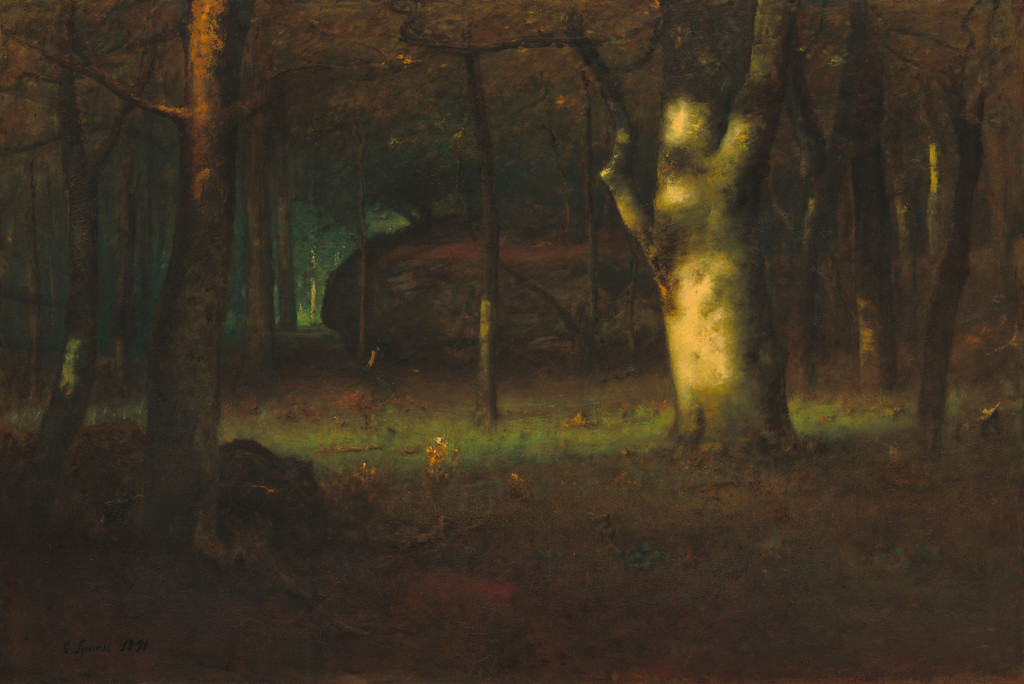
| Sunset in the Woods by George Inness | 1891 | oil on canvas |
| The Home of the Heron — Princeton University Art Museum (y1943-93) | 1891 | Oil on canvas |
| Threatening | 1891 | Oil on canvas |
| Early Morning, Tarpon Springs | 1892 | Oil on canvas |
| Home at Montclair by George Inness | 1892 | oil on canvas |
| The Lonely Farm, Nantucket | 1892 | Oil on canvas |
| Afterglow | 1893 | Oil on canvas |
| Sunlit Valley | 1893 | Oil on canvas |
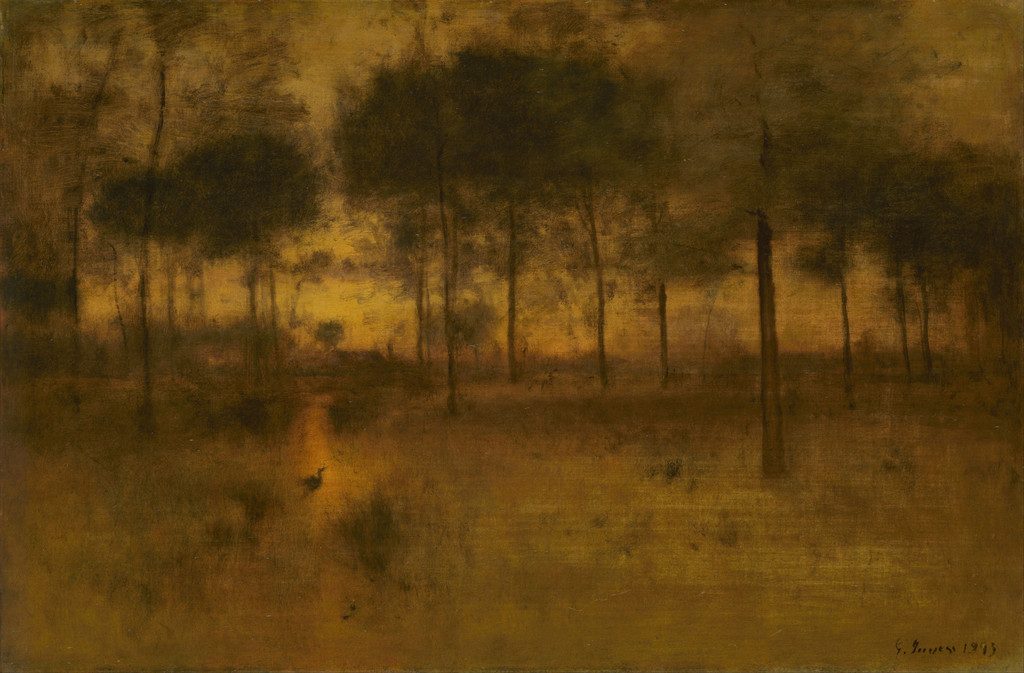
| The Home of the Heron — Art Institute of Chicago (1911.31) | 1893 | Oil on canvas |
| After a Summer Shower | 1894 | Oil on canvas |
| Landscape | n.d. | Watercolor with scraping on ivory wove paper |
Frequently Asked Questions
The Met connects the title, harvest and related wartime statements with confidence in Union victory and prosperity. The argument should remain attributed.[1]
No. Harvest activity is visible, but the reviewed evidence does not supply a name or exact social identity for every figure.
Through George A. Hearn’s gift in 1894.[1]
Discussion
Look again at the images and ideas explored in Peace and Plenty by George Inness. These editorial prompts invite your observations.
Follow the bundles and workers across the foreground, then look at the dark tree group and wide sky. Where does the painting make plenty most visible? Consider how its title changes your experience of the same forms.
Reader Insights
How do the harvest bundles direct attention through the field?
How do the workers compare with those in the Catskill landscape?
What difference do the attributed historical interpretations make to your reading?
Join the Conversation
Share a detail, comparison or question about Peace and Plenty by George Inness below.
References
- Metropolitan Museum of Art, Peace and Plenty, accession 94.27. Current identity, measurements, gift and attributed Civil War/expressive-landscape interpretation.
- Adrienne Baxter Bell, “George Inness (1825–1894),” Metropolitan Museum of Art (2012). First exhibition, wartime context and Bell’s report of Mazow’s interpretation; the complete original Mazow study is not claimed read.
- National Gallery of Art, The Lackawanna Valley, accession 1945.4.1.
- Art Institute of Chicago, Catskill Mountains, accession 1912.1623.
- Metropolitan Museum of Art, Delaware Water Gap, accession 32.151.
- Splash image source.
George Inness, Peace and Plenty, 1865. Oil on canvas, 197.2 × 285.4 cm. Met, 94.27. Gift of George A. Hearn, 1894; Metropolitan Museum of Art. Image source. Public domain.