 by Tom Gurney
Tom Gurney BSc (Hons) is an art history expert with over 20 years experience
Email: tomgurney1@gmail.com / Phone: +44 7429 011000
George Inness in Italy: Introduction
Italy remained important to George Inness beyond the dates of his journeys. Its landscapes offered subjects for small watercolour sheets and monumental oils, while its artistic traditions gave him ways to rethink composition and expression. Adrienne Baxter Bell distinguishes a first visit in 1851–52 from the longer European residence of 1870–74. Italian subjects continued after his return to America, including Pine Grove of the Barberini Villa in 1876.[1]
At a Glance
- First Italian visit1851–52
- Longer European residence1870–74
- Key localitiesRome, Florence and the surrounding Italian countryside
- Selected worksAcross the Campagna (1872), Olive Trees at Tivoli (1873), Pine Grove of the Barberini Villa (1876)
- Main questionHow did observed and remembered Italian places become different kinds of landscape?
Contents
- Two journeys with different contexts
- Old masters before and during travel
- The early Campagna and aqueduct pair
- A Roman studio and an American market
- Across the Campagna: a small sheet with a large sky
- Olive Trees at Tivoli: line, rock and open distance
- From small sheets to a monumental pine grove
- Remembered place and changed arrangement
- Italy within the wider career
- Annotated details
Two journeys with different contexts
The first visit took Inness to Rome and Florence. Bell relates the Florence encounter with William Page to his interest in Titian and Swedenborg. Her account proposes important intellectual connections; it does not supply a transcript of the artists’ conversation.[1]
The longer stay began nearly two decades later, when Inness already had a substantial American career. Bell records the 1870–74 residence, a Roman studio and time in Normandy before his return.[1] The two journeys should therefore remain separate parts of the chronology.
The difference also changes how the paintings can be approached. An early encounter with old-master landscape traditions raises questions about learning and emulation. A later Roman studio raises questions about continued experiment, production and the market for Italian subjects. Both contexts mattered, but they need not explain every work in the same way.
Annotated Details from George Inness in Italy
The numbered points identify visible features discussed in this article. Return from each detail to the whole composition. The captions keep each work’s identity, date and medium separate.
Across the Campagna (1872)
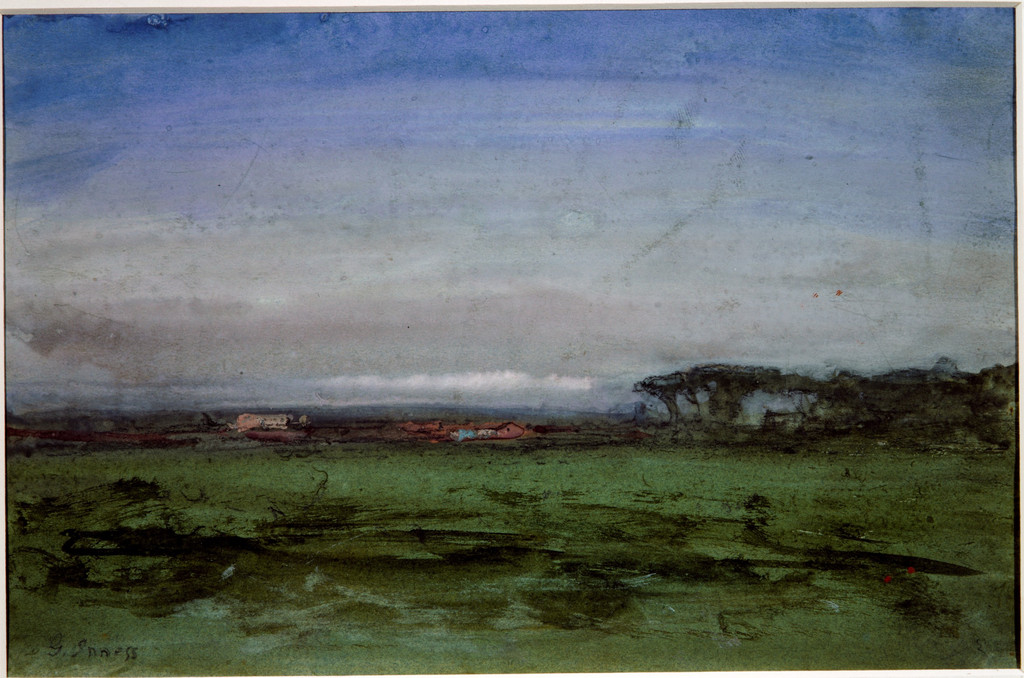
George Inness, Across the Campagna, 1872. Watercolour, gouache and graphite on off-white wove paper. Met, 67.55.145. Bequest of Susan Dwight Bliss, 1966; Metropolitan Museum of Art. Image source. Public domain.
.jpg)
Olive Trees at Tivoli (1873)
George Inness, Olive Trees at Tivoli, 1873. Gouache, watercolour and graphite on blue wove paper with coloured fibres. Met, 1989.287. Morris K. Jesup Fund, 1989; Metropolitan Museum of Art. Image source. Public domain.
.jpg)
Pine Grove of the Barberini Villa
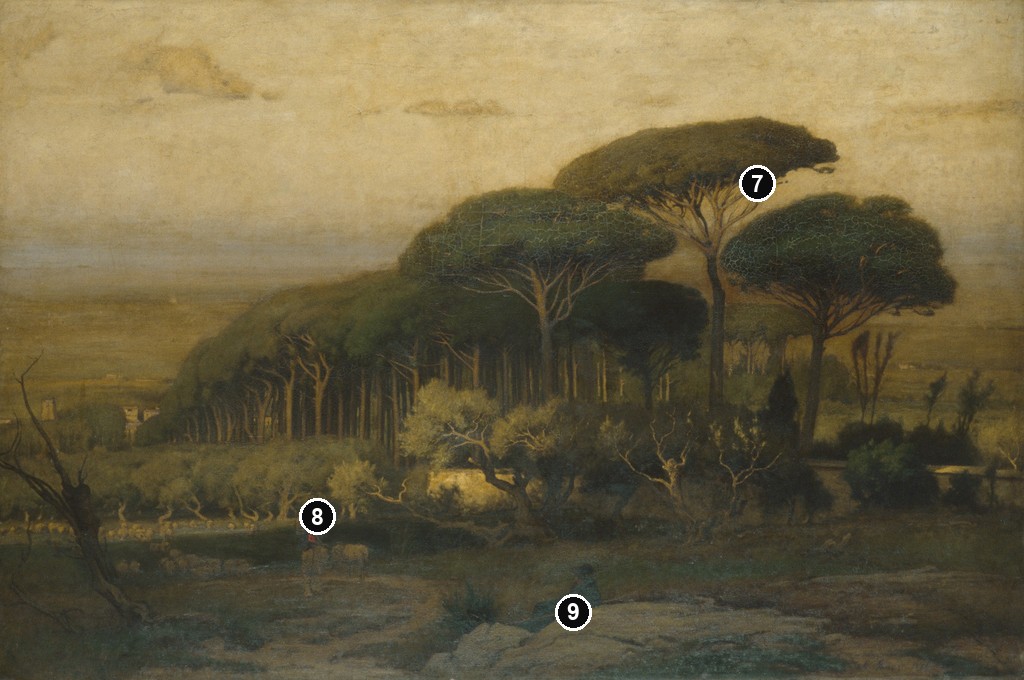
George Inness, Pine Grove of the Barberini Villa, 1876. Oil on canvas. Met, 98.16. Gift of Lyman G. Bloomingdale, 1898; Metropolitan Museum of Art. Image source. Public domain.
Details from GEORGE INNESS IN ITALY
Compare the cropped details with the complete images above. Notice how their colours, shapes and positions contribute to the larger compositions.
Across the Campagna (1872)
Broad sky
The sky occupies much of the small sheet. Its extensive washes contrast with the compressed line of land below.
 Detail 01 broad-sky.jpg)
Low buildings
Small buildings lie close to the horizon. Their limited height allows the sky and ground to remain the dominant areas.
 Detail 02 low-buildings.jpg)
Foreground divisions
Darker linear marks cross the nearer green ground. Their greater emphasis contrasts with the quieter colour and smaller forms at the horizon.
 Detail 03 foreground-divisions.jpg)
Olive Trees at Tivoli (1873)
Twisted olive trunks
Irregular trunks and branches occupy the near left landscape. Their changing direction gives the coloured forms a strong linear character.
 Detail 04 twisted-olive-trunks.jpg)
Foreground rocks
Broad rocks anchor the nearer right side. Their more continuous surfaces contrast with the complicated tree forms.
 Detail 05 foreground-rocks.jpg)
Pale route into the plain
A pale route moves through the cultivated distance. Its lighter line offers a path for attention beyond the near vegetation and rock.
 Detail 06 pale-route-into-the-plain.jpg)
Pine Grove of the Barberini Villa
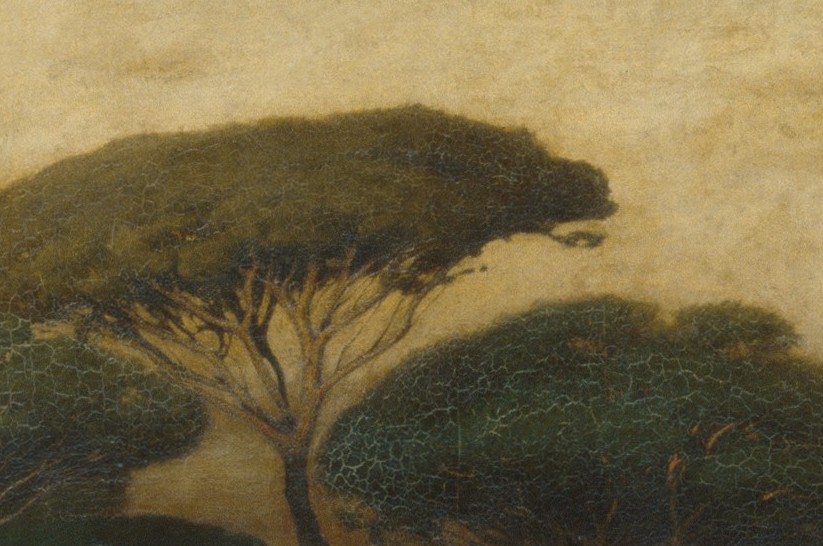
Umbrella-shaped crowns
Broad tree crowns overlap above slender trunks. Their repeated shapes organise a grove that recedes across the composition.
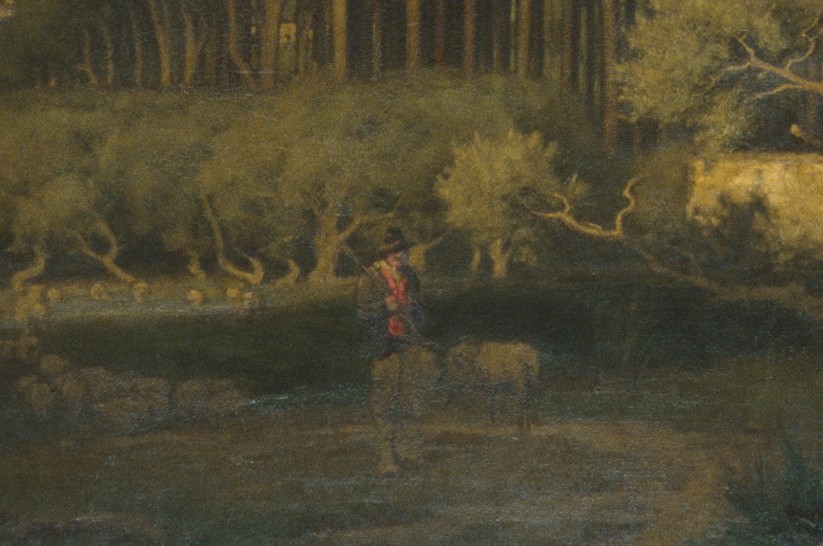
Standing figure
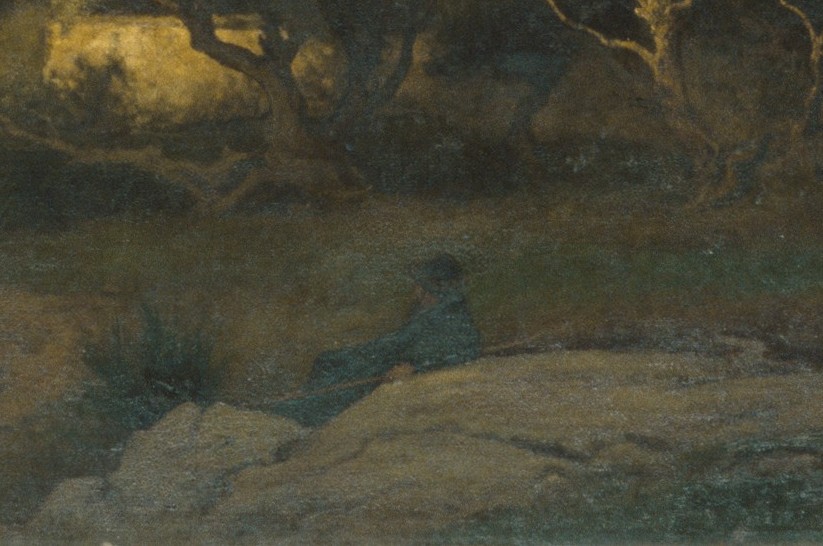
A small red-accented figure stands among the low growth. The colour makes the person noticeable within the darker lower landscape.
Seated foreground figures
Seated figures lie close to the lower edge. Their nearer scale differs from the standing person farther inside the grove.
Old masters before and during travel
In his 1917 memoir, George Inness Jr. describes his father’s early study of engravings and reproductions. The selected account connects those images with an effort to understand large compositional qualities, alongside admiration for Thomas Cole and Asher Brown Durand. It is a retrospective family source, rather than an independently dated record of each lesson.[2]
Italy consequently offered more than unfamiliar scenery. A painter who had encountered landscapes through reproductions could also encounter places associated with the artistic traditions he admired. The relation between an existing picture and an observed place became part of the question of making a new landscape.
That relation is useful when looking at Inness’s Italian subjects. A distant prospect framed by trees can be considered as a particular arrangement, rather than treated only as a record of a location. The painter chooses where the foreground begins, how the distance opens and which masses carry the scene’s emphasis.
The old-master context does not require a viewer to assign every shape to one predecessor. Its value lies in making composition more visible. The landscape can be observed and remembered while also being organised through lessons learned from other pictures.
The early Campagna and aqueduct pair
The Philadelphia Museum of Art’s 2011 exhibition labels discuss Twilight on the Campagna and A Bit of the Roman Aqueduct. They report similar canvas structures and resizing, then propose that the works may have shared an Ogden Haggerty commission. That possibility remains qualified.[3]
The relationship makes a useful distinction between subject and object. Two Italian landscapes can share a possible production context while producing different effects. A painting’s present visible dimensions may also differ from those of its earlier working state. The labels’ technical account supplies information that a general travel chronology cannot provide.
The pair belongs to the first Italian encounter, whereas the Met’s Across the Campagna dates from 1872. Similar place names should not merge an early oil painting with the later watercolour sheet. Medium, date and collection identity remain necessary whenever a particular work is discussed.
Published chronologies contain small differences. The Philadelphia labels’ introduction gives 1851–52 for the first visit, while another section gives 1850–51; its discussion of the return also uses 1875 where Bell describes the European residence ending in 1874.[1][3] The main sequence used here follows Bell and the exhibition introduction. Exact travel days would require further primary itinerary evidence, and a painting’s date should not be made to settle that question on its own.
A Roman studio and an American market
The Met’s commentary on Across the Campagna describes Boston dealers supporting Inness with a salary during his longer Italian stay. It places the work within his experiment with composition and the American demand for Italian subjects.[4] Travel, studio work and sales were connected parts of that context.
Bell’s Montclair gallery commentary likewise describes an expatriate community and the translation of countryside sketches into larger studio pictures during the 1870–74 residence.[5] Her account helps explain why an Italian subject should not automatically be called an entirely outdoor, one-session painting.
The distinction matters to looking as well as chronology. A sketch can establish a relation of forms that a larger work later changes. Memory can preserve an effect while a studio picture adjusts scale and emphasis. The finished landscape remains a made arrangement, even when its title identifies a real place.
Across the Campagna: a small sheet with a large sky
The Met records Across the Campagna, 1872, as watercolour, gouache and graphite on off-white wove paper, measuring 17.3 × 26.2 cm.[4] Its small physical size contrasts with the breadth of its apparent space.
Most of the sheet is occupied by sky. A low band of small buildings and dark trees stretches beneath it, while green ground and horizontal marks occupy the foreground. The arrangement makes the sky extensive relative to the few forms below.
The buildings remain small, yet they prevent the lower horizon from becoming an empty strip. Their unequal shapes provide a sequence through which the land can be recognised. Trees add darker interruptions, changing the rhythm of that sequence.
The foreground lines offer another kind of structure. They cross the lower area rather than leading dramatically towards a central landmark. Their horizontal movement relates to the low horizon, giving the sheet a broad organisation within its modest width.
The paper’s recorded colour and the combination of water-based media are part of this object’s identity. They should accompany the visual reading without being turned into a complete reconstruction of every mark’s material or sequence. The sheet’s relation of open sky and compressed land is already clear in the acquired image.
Watch: George Inness
Choose a film to explore the artist’s work, its interpretation and its wider setting.
The Montclair Art Museum's George Inness Gallery
Visit the George Inness Gallery at the Montclair Art Museum in this State of the Arts feature.
Watch on YouTubeOlive Trees at Tivoli: line, rock and open distance
Olive Trees at Tivoli, 1873, combines gouache, watercolour and graphite on blue wove paper with coloured fibres. The Met measures it at 17.8 × 31.4 cm and records its acquisition through the Morris K. Jesup Fund in 1989.[6] Its blue support distinguishes it from the Campagna sheet’s off-white paper.
The image places a tree group towards the left and rock forms towards the right. An opening between them allows attention to move into a paler distance. Unlike the Campagna sheet’s broadly horizontal compression, Tivoli gives the nearer forms more substantial and unequal positions.
Branches and trunks provide visible linear structure. Their relations can be followed through broader areas of colour, letting line and wash contribute differently to the landscape. The image is useful for considering how a small sheet can contain both graphic organisation and atmosphere.
The rocks introduce another rhythm. Their angular and rounded forms differ from the trees’ branching shapes, while the open distance provides room between them. The picture’s space arises from the interaction of these unlike areas.
The Met tentatively identifies a tiny distant dome as probably Saint Peter’s.[6] The qualification should remain attached to that detail. The composition can be understood through its opening and distant forms without making a tiny mark carry more topographical certainty than the record provides.
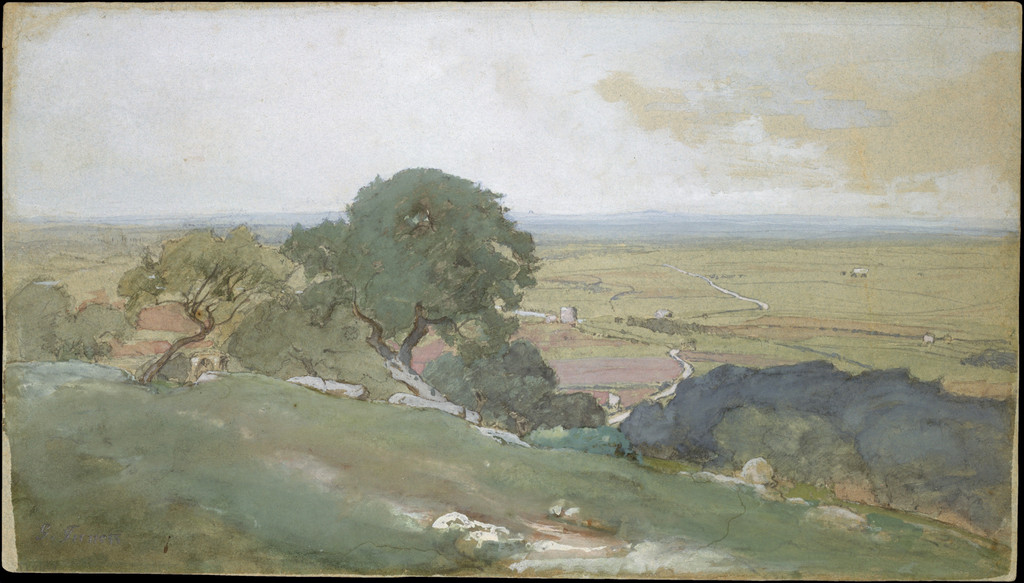
George Inness, Olive Trees at Tivoli, 1873. Gouache, watercolour and graphite on blue wove paper with coloured fibres. Met, 1989.287. Morris K. Jesup Fund, 1989; Metropolitan Museum of Art. Image source. Public domain.
From small sheets to a monumental pine grove
Pine Grove of the Barberini Villa changes the scale dramatically. The Met’s 1876 oil canvas measures 200 × 301 cm and identifies a setting near Castel Gandolfo, with Lago Albano visible through the trees.[7]
The broad crowns repeat above narrow trunks, forming a grove through which depth can be followed. Small foreground figures and animal forms give the trees a more substantial scale. The left distance opens beside a denser wooded area, allowing enclosure and outward prospect to coexist.
Compared with Across the Campagna, the pine grove gives vegetation a much larger role beneath the sky. Compared with Olive Trees at Tivoli, it develops repetition across a monumental canvas rather than organising a small sheet around unequal near masses. The Italian subjects therefore reveal variety rather than one fixed compositional formula.
The date also matters. Bell places Pine Grove among Italian subjects after Inness’s return to Boston.[1] The work’s Italian setting should remain distinct from a claim that he was newly painting on that site in 1876.
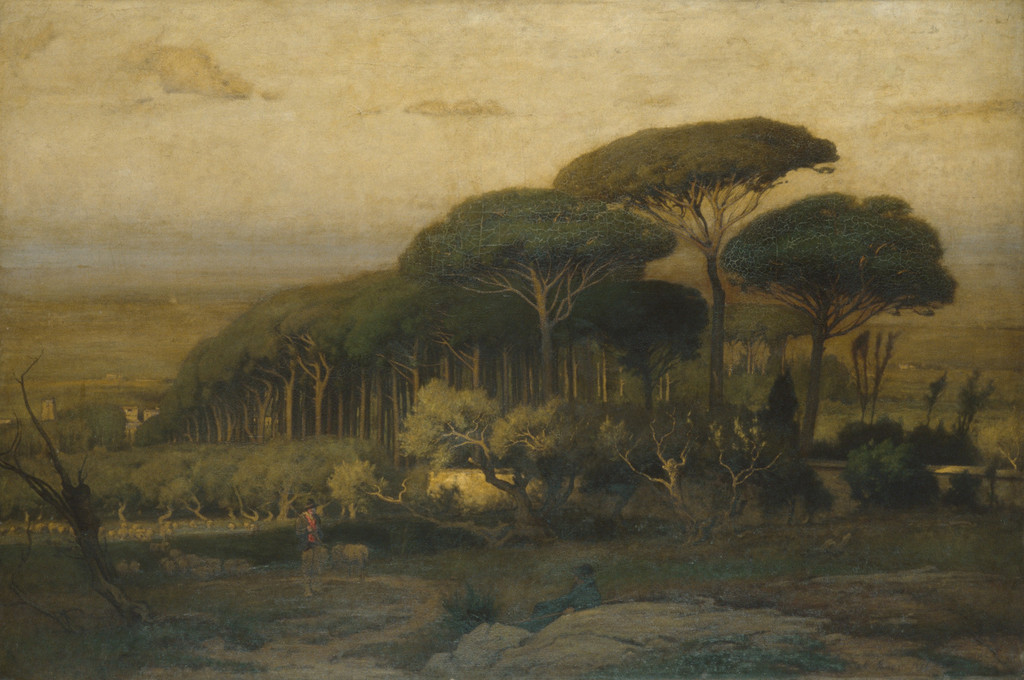
George Inness, Pine Grove of the Barberini Villa, 1876. Oil on canvas. Met, 98.16. Gift of Lyman G. Bloomingdale, 1898; Metropolitan Museum of Art. Image source. Public domain.
Remembered place and changed arrangement
The Philadelphia labels describe Near Perugia, Italy of 1879 as revisiting a view first painted in 1872. They also explain that Inness reconfigured the site in L’Ariccia, Italy of 1874, making repeated forms more emphatic.[3] These are specific examples of memory and arrangement within the exhibition’s account.
The examples help clarify why an Italian landscape should not be judged only by whether it matches a modern viewpoint. A canvas can retain a named setting while changing the relation of foreground, distance and light. The image’s subject and its compositional decisions remain connected, but they are different kinds of evidence.
The labels’ pairing of a Cadore watercolour with an oil picture adds another route: broad forms established in one medium and translated into another.[3] That reported working relationship does not prove that every small sheet was made for a corresponding oil. Each case requires its own identification.
Italy within the wider career
Italy’s relevance becomes clearer when these objects are kept distinct. Early oils can be considered through old-master models and a possible shared commission. Later sheets can be considered through paper, line and colour. A monumental canvas can carry a remembered Italian subject into work after the journey ended.
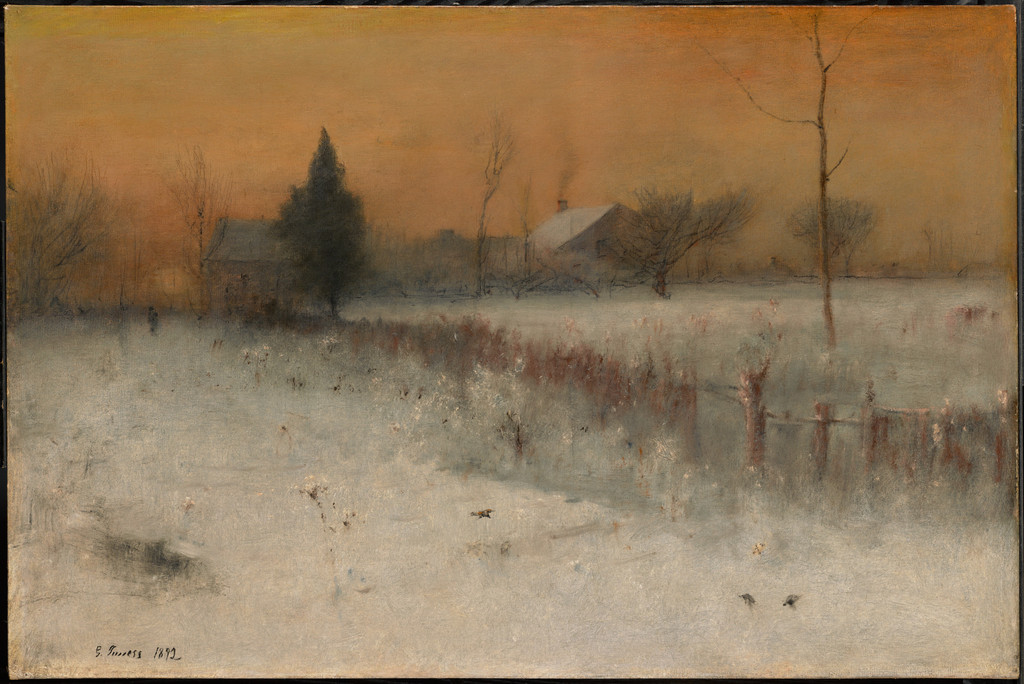
The distinction also gives a useful route into Inness’s American landscapes. Compare the pine grove’s repeated trunks with Home at Montclair, where trees and low houses stand beyond a broad winter field. The Clark dates that canvas to 1892.[8] The setting changes, but arrangement and atmosphere remain central questions.
The drawings and watercolours article examines the two Met sheets more closely, while the biography provides the fuller chronology. This Italy route brings those questions together around one enduring part of the career: how places encountered through travel, art and memory could become different kinds of landscape.
Artworks directory
A collected selection of 46 individually identified museum objects: 43 paintings and three watercolours. This is not a complete catalogue raisonné. Repeated titles identify separate objects where their institutions or accessions differ. Links lead to a companion article where available, otherwise to the museum record. Unillustrated entries remain included; the original lost New Jerusalem is represented by its three transformed survivors.
| Name | Date | Medium |
|---|---|---|
| Crossing the Ford | 1848 | Oil on canvas |
| The Old Mill | 1849 | Oil on canvas |
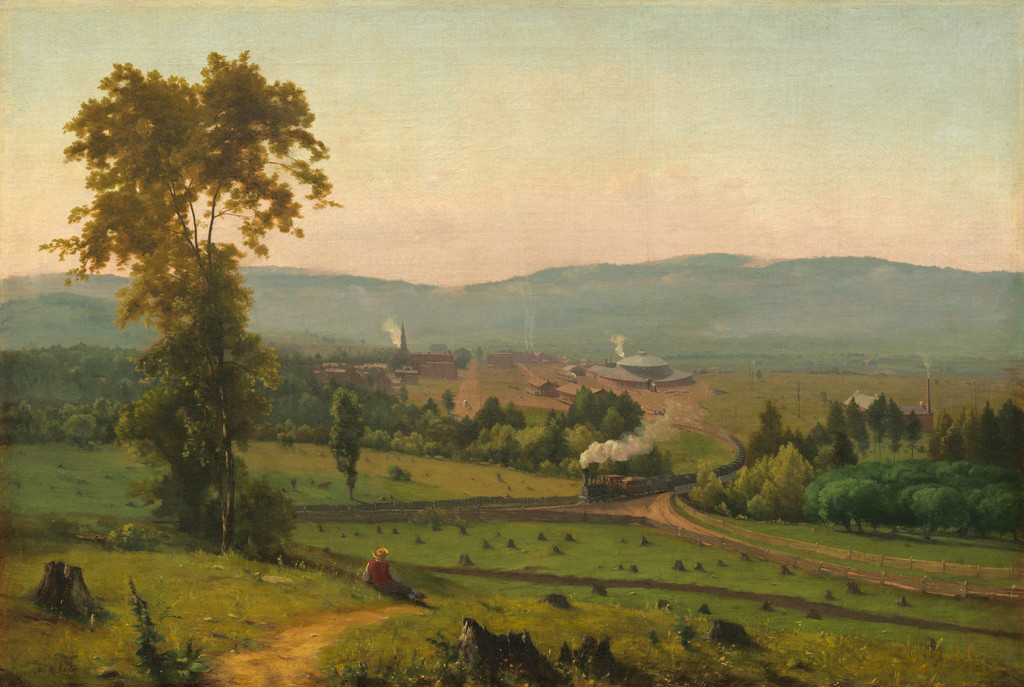
| The Lackawanna Valley by George Inness | c. 1856 | oil on canvas |
| Delaware Water Gap | 1861 | Oil on canvas |
| Delaware Valley | c. 1865–75 | Oil on artist's board |
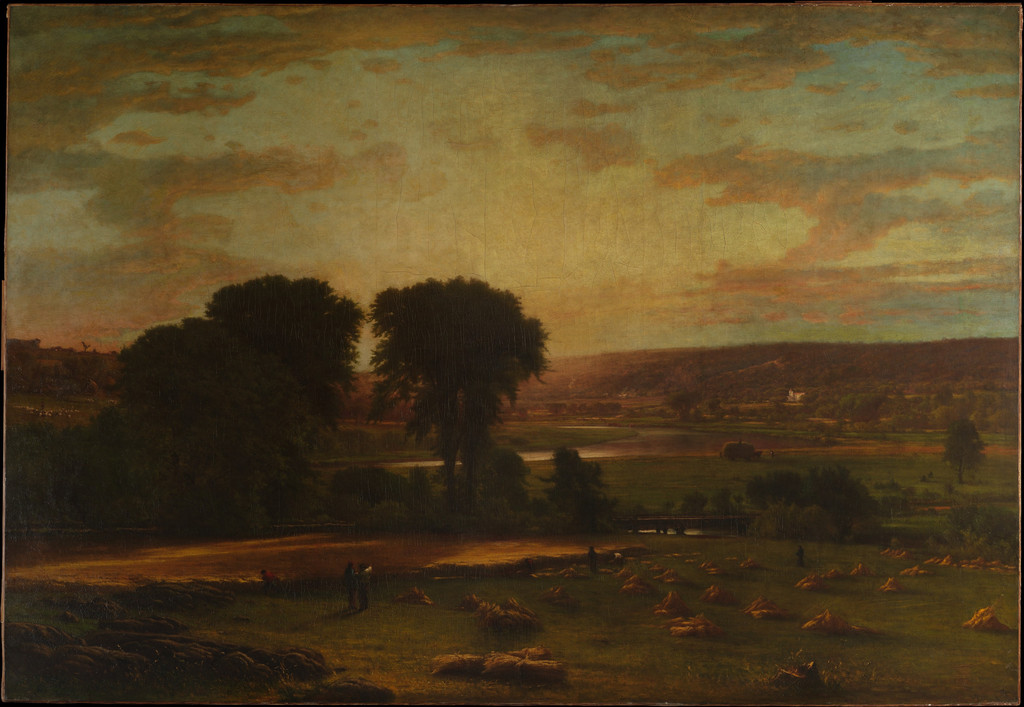
| Peace and Plenty | 1865 | Oil on canvas |
| Evening Landscape | 1867; later reworked | Oil on canvas |
| Summer in the Catskills | 1867 | Oil on canvas |
| The Valley of the Olives | 1867; reworked after 1880 | Oil on canvas |
| The Valley of the Shadow of Death | 1867 | Oil on canvas |
| Visionary Landscape | 1867/1880 | Oil on canvas |
| Catskill Mountains | 1870 | Oil on canvas |
| Across the Campagna | 1872 | Watercolor, gouache, and graphite on off-white wove paper |
| Olive Trees at Tivoli | 1873 | Gouache, watercolor, and graphite on blue wove paper with colored fibers |
| A Marine | c. 1874–75 | Oil on canvas |
| Twilight in Italy — Art Institute of Chicago (1911.44) | 1874 | Oil on panel |
| Pine Grove of the Barberini Villa | 1876 | Oil on canvas |
| The Storm | 1876 | Oil on canvas |
| Autumn Oaks | ca. 1878 | Oil on canvas |
| The Sisters | 1882 | Oil on millboard |
| Harvest, Montclair, New Jersey | 1884 | Oil on canvas |
| Niagara Falls | 1885 | Oil on wood |
| A Silver Morning | 1886 | Oil on canvas |
| Landscape, Sunset | 1887–89 | Oil on canvas |
| September Afternoon | 1887 | Oil on canvas |
| Sunrise | 1887 | Oil on canvas |
| The Mill Stream, Montclair, New Jersey by George Inness | c. 1888 | Oil on canvas |
| Niagara by George Inness | 1889 | oil on canvas |
| The Mill Pond | 1889 | Oil on canvas |
| Sunset in the Valley | 1890 | Oil on canvas |
| The Moon at Night | 1890 | Oil on canvas |
| Twilight in Italy — Art Institute of Chicago (1911.42) | 1890 | Oil on canvas |
| Autumn Woods | 1891–94 | Oil on canvas |
| Moonrise | 1891 | Oil on canvas |
| Spring Blossoms, Montclair, New Jersey | ca. 1891 | Oil and crayon or charcoal on canvas |
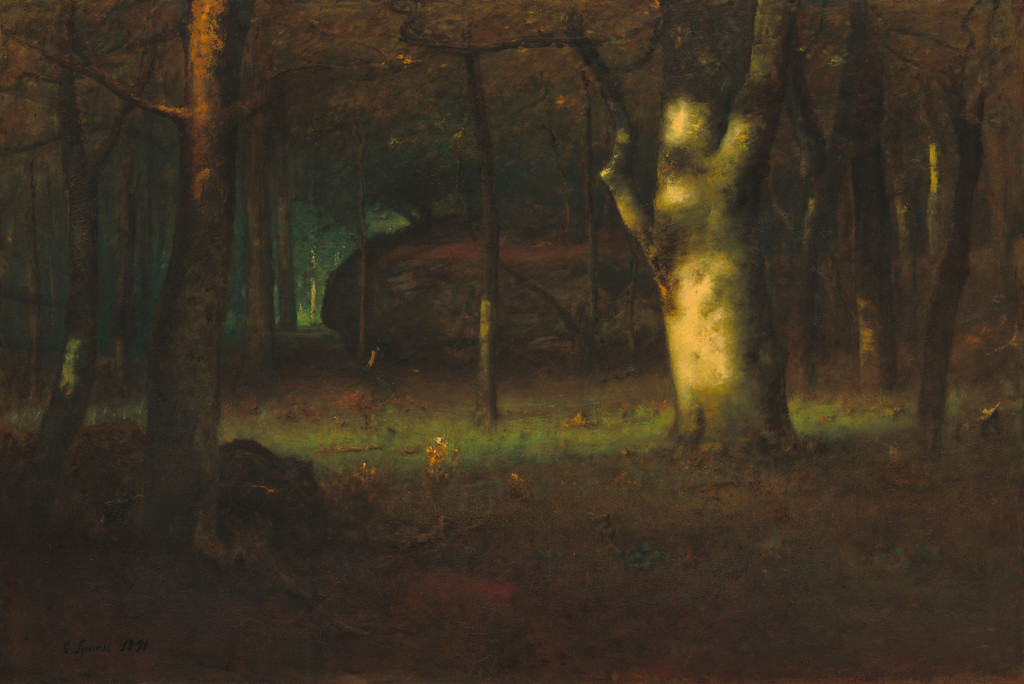
| Sunset in the Woods by George Inness | 1891 | oil on canvas |
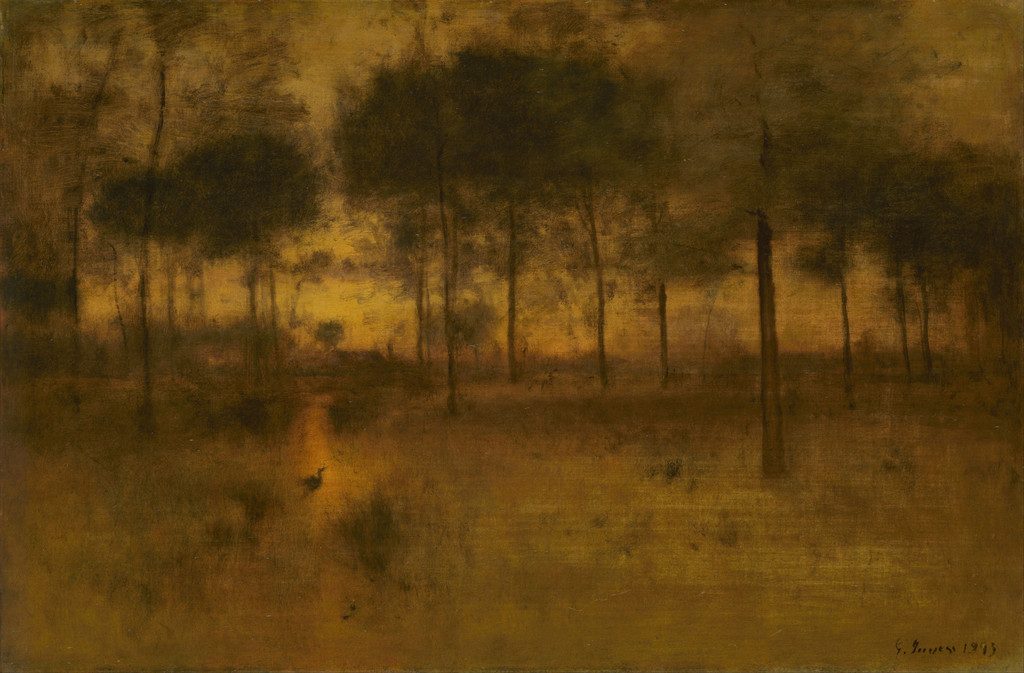
| The Home of the Heron — Princeton University Art Museum (y1943-93) | 1891 | Oil on canvas |
| Threatening | 1891 | Oil on canvas |
| Early Morning, Tarpon Springs | 1892 | Oil on canvas |
| Home at Montclair by George Inness | 1892 | oil on canvas |
| The Lonely Farm, Nantucket | 1892 | Oil on canvas |
| Afterglow | 1893 | Oil on canvas |
| Sunlit Valley | 1893 | Oil on canvas |
| The Home of the Heron — Art Institute of Chicago (1911.31) | 1893 | Oil on canvas |
| After a Summer Shower | 1894 | Oil on canvas |
| Landscape | n.d. | Watercolor with scraping on ivory wove paper |
Frequently Asked Questions
Two: 1851–52 and the longer 1870–74 European residence.[1]
It is dated 1876, and Bell places it among Italian subjects after the return to Boston.[1]
The Philadelphia labels propose it as a possibility. The qualified wording should remain.[3]
Discussion
Look again at the images and ideas explored in George Inness in Italy. These editorial prompts invite your observations.
Compare the Campagna sheet’s wide sky, the Tivoli sheet’s unequal near forms and the pine grove’s repeated crowns. Which arrangement gives you the strongest sense of distance, and how does the work’s scale affect that experience?
Reader Insights
How do the near trunks guide your eye towards the open plain at Tivoli?
What changes when a small sheet is compared with the monumental Pine Grove?
How does separating the two Italian visits clarify the dates of the works?
Join the Conversation
Share a detail, comparison or question about George Inness in Italy below.
References
- Adrienne Baxter Bell, “George Inness (1825–1894),” Metropolitan Museum of Art (2012).
- George Inness Jr., Life, Art, and Letters of George Inness (1917), selected printed pp. 13–14. Original selected pages examined; retrospective source limits retained.
- Philadelphia Museum of Art, George Inness in Italy, exhibition labels (2011). Selected labels examined; possible shared commission and specific later work relationships qualified.
- Metropolitan Museum of Art, Across the Campagna, accession 67.55.145.
- Adrienne Baxter Bell, George Inness gallery commentary, Montclair Art Museum. Accessible transcript examined.
- Metropolitan Museum of Art, Olive Trees at Tivoli, accession 1989.287.
- Metropolitan Museum of Art, Pine Grove of the Barberini Villa, accession 98.16.
- Clark Art Institute, Home at Montclair, accession 1955.10.
- Splash image source.
George Inness, Across the Campagna, 1872. Watercolour, gouache and graphite on off-white wove paper. Met, 67.55.145. Bequest of Susan Dwight Bliss, 1966; Metropolitan Museum of Art. Image source. Public domain.