 by Tom Gurney
Tom Gurney BSc (Hons) is an art history expert with over 20 years experience
Email: tomgurney1@gmail.com / Phone: +44 7429 011000
Spring Blossoms, Montclair, New Jersey by George Inness: Introduction
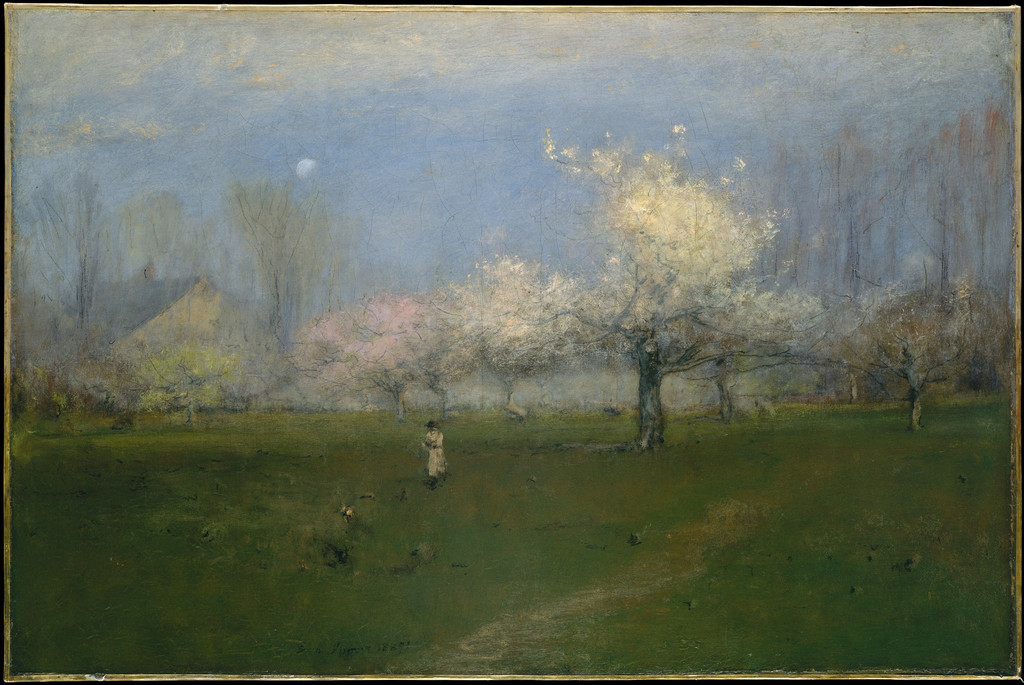
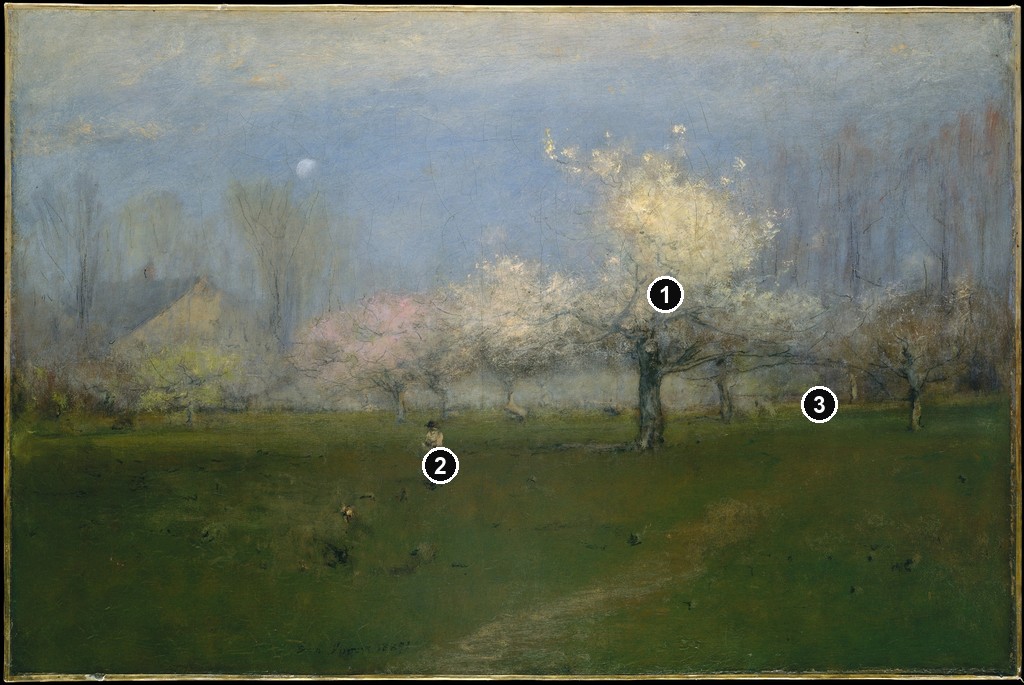
Pale blossom spreads through the trees in George Inness’s Spring Blossoms, Montclair, New Jersey. Dark branches remain visible within that soft colour, while a small light-clad figure stands in the nearer green field. The painting combines an atmospheric scene with a more insistent linear structure. The Metropolitan Museum of Art dates it circa 1891 and records an unusual mixed medium: oil and crayon or charcoal on canvas. The alternative between those drawing materials remains part of the current identification.[1]
At a Glance
- ArtistGeorge Inness (1825–1894)
- TitleSpring Blossoms, Montclair, New Jersey
- DateCirca 1891
- MediumOil and crayon or charcoal on canvas
- Dimensions73.7 × 114.9 cm
- CollectionMetropolitan Museum of Art, New York
- CreditGift of George A. Hearn, in memory of Arthur Hoppock Hearn, 1911
- Accession11.116.4
This work across George Inness’s career
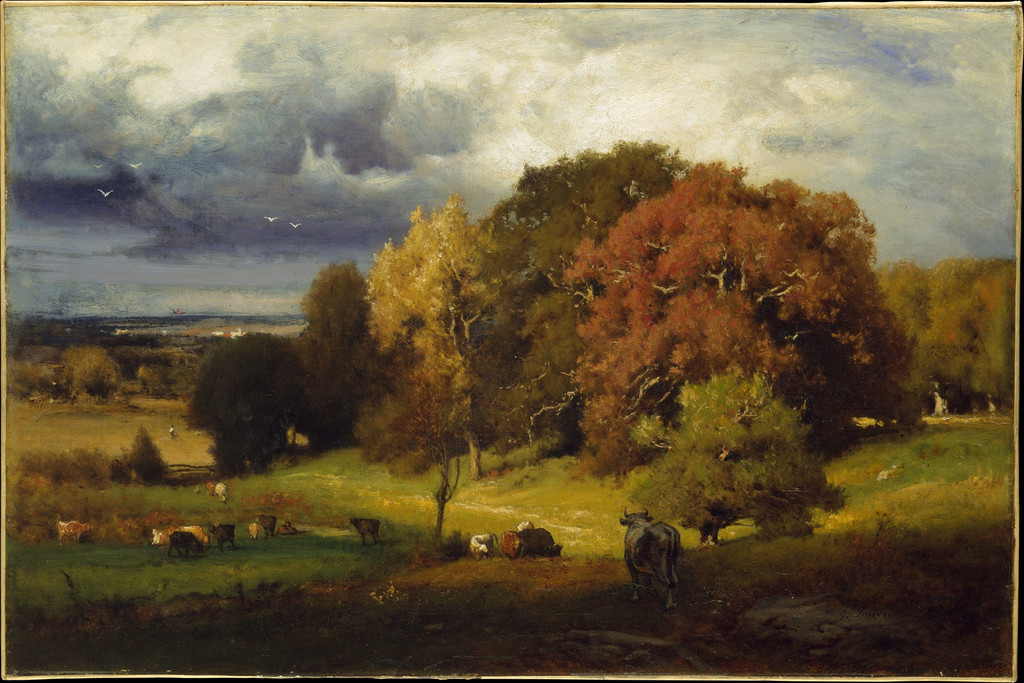
Autumn Oaks by George Inness
ca. 1878Contents
- Blossom masses and dark branches
- The green field and the foreground figure
- Houses and the space behind the blossom
- Dusk, the pale disk and quiet colour
- What the mixed medium establishes
- A late Montclair landscape
- Three useful comparisons
- Annotated details
Blossom masses and dark branches
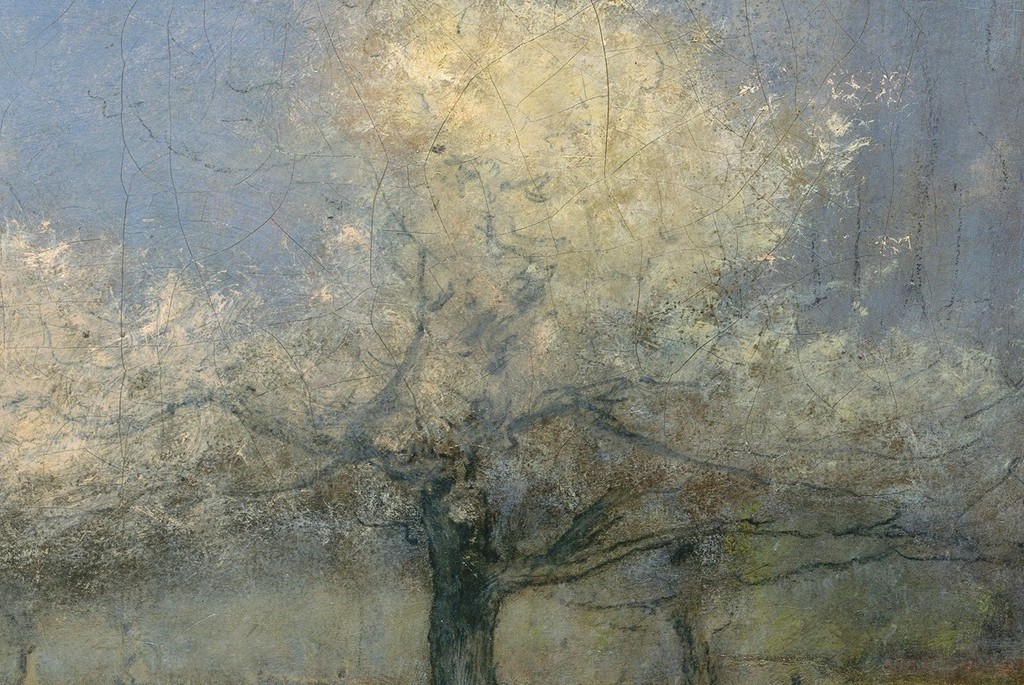
The largest flowering tree stands right of centre. Its pale canopy rises into the blue-grey sky, while its dark trunk provides a stronger upright form beneath. Branches spread laterally through the blossom, extending the tree’s structure across an area that might otherwise seem like a single soft mass.
Smaller flowering trees continue towards the left. Their colours include pink as well as cream and pale yellow, producing changes within the wider band of blossom. These trees do not have identical heights or widths. Their uneven distribution gives the scene a varied rhythm while keeping the main right-hand tree prominent.
The dark branches are especially useful for understanding that rhythm. They can be followed through the lighter canopy, then into the less emphatic trees beyond it. The image therefore offers two ways to recognise the orchard-like setting: through the broad colour of the blossom and through the lines that support it.
Look first at the pale masses without trying to separate individual branches. Then follow a dark branch from the main trunk into the canopy. The same area changes character when attention shifts between colour and line. That change is central to this painting’s particular effect.
Annotated Details from Spring Blossoms, Montclair, New Jersey
The numbered points identify visible features discussed in this article. Return from each detail to the whole composition. George Inness, Spring Blossoms, Montclair, New Jersey, c. 1891. Oil and crayon or charcoal on canvas. Met, 11.116.4. Gift of George A. Hearn, in memory of Arthur Hoppock Hearn, 1911; Metropolitan Museum of Art. Image source. Public domain.
Details from SPRING BLOSSOMS, MONTCLAIR, NEW JERSEY
Compare the cropped details with the complete images above. Notice how their colours, shapes and positions contribute to the larger compositions.
Pale blossom
Light blossom spreads around darker branching. Notice where the branch structure remains visible within the flowering mass.
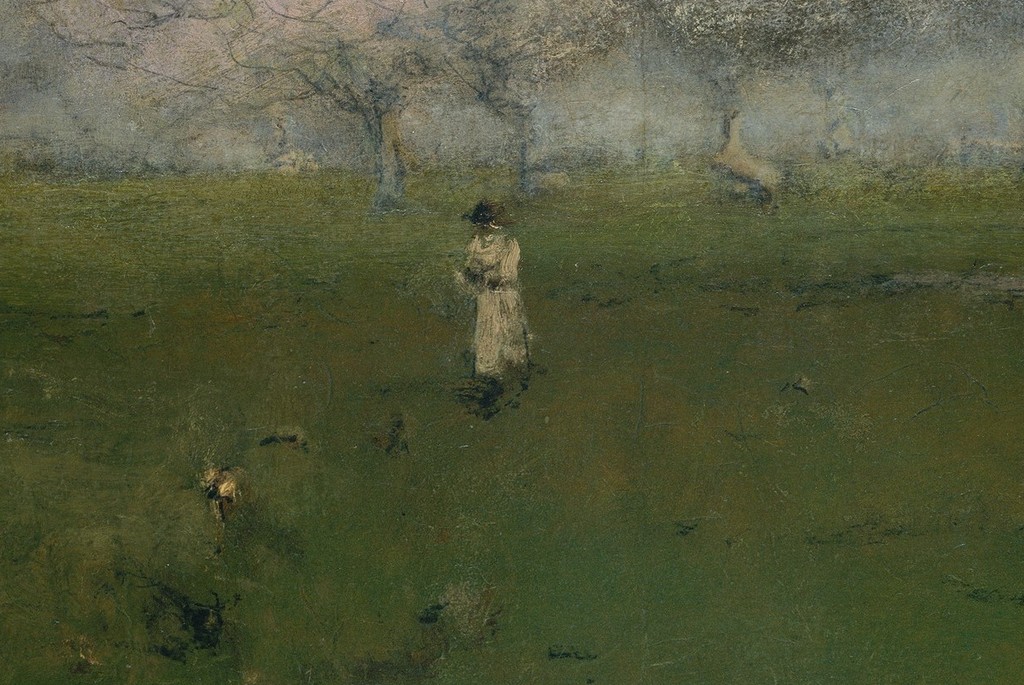
Light-clad figure
A small figure stands against the green field. Its pale clothing connects it with the blossom while preserving a separate human scale.
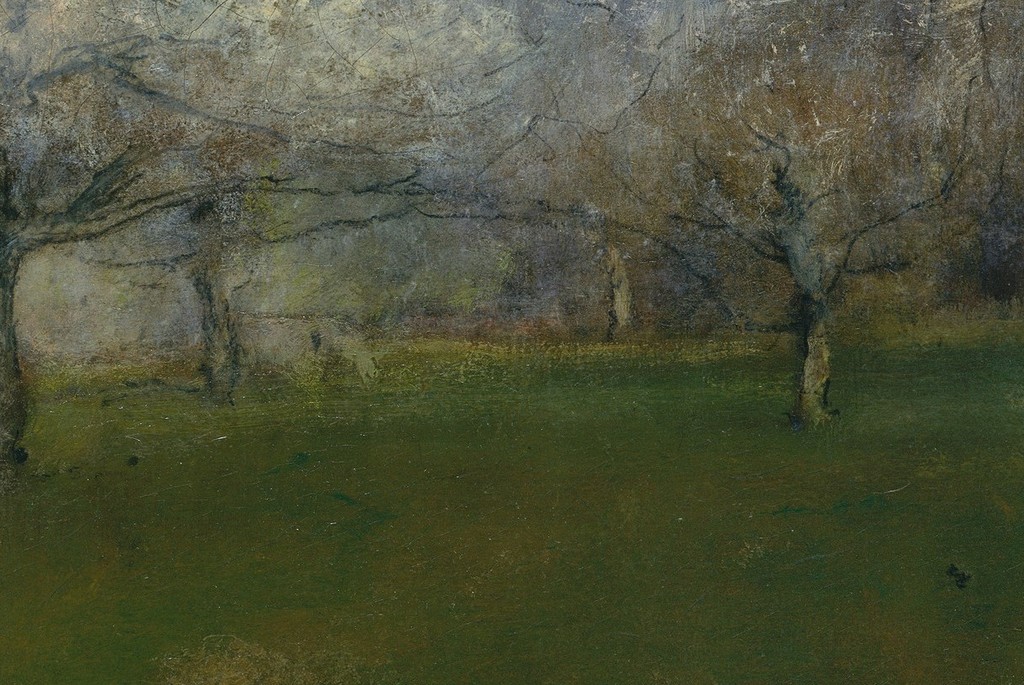
Dark orchard trunks
Dark trunks and branching punctuate the flowering forms. They keep a graphic structure visible within the softer colour.
The green field and the foreground figure
The lower area contains a broad field of green, with darker and warmer marks interrupting its surface. It gives the blossom a relatively subdued setting. The pale flowering trees become more distinct because they rise above this darker ground, rather than standing against a uniformly light background.
A small figure occupies the near field, slightly left of centre. Light clothing distinguishes the figure from the green, and a darker mark at the head helps make the upright form recognisable. The person remains tiny beside the tree canopy, establishing scale without becoming a fully described portrait.
The figure’s identity and exact activity are open. Its visible role is clearer: it introduces a human presence into the interval between the viewer and the trees. Its placement can make the field seem longer, because the ground continues beyond it towards the trunks and more distant forms.
Farther back, another small light-and-dark mark suggests a figure, though it is less securely resolved. The difference in clarity matters. The foreground person attracts attention as an individual upright form, while the smaller distant mark remains more closely joined to the atmosphere around the trees.
Houses and the space behind the blossom
A house at the left appears through slender trees. Its pale wall and dark roof supply relatively simple shapes amid the branching lines. The building helps anchor that side of the picture while remaining partly screened by vegetation.
This overlap establishes more than one depth. Nearer branches cross the house; trees and blossom continue elsewhere across the middle distance. The scene acquires space through one form being seen in relation to another. It does not depend on a single conspicuous road leading towards a remote horizon.
The main tree’s rightward branches also cross areas of sky and more distant vegetation. Where the branches meet these different surroundings, their apparent strength changes. A dark line can be emphatic against pale blossom and quieter against a darker passage nearby.
Such variations make the trees feel connected to their setting. They remain distinct forms, yet the picture does not outline each one with equal force. Looking across these changes is a useful way to understand how the scene preserves structure within an atmospheric whole.
Dusk, the pale disk and quiet colour
A pale disk appears in the sky towards the left, above the house and between slender trees. It is smaller and less brilliant than the large flowering canopy. The Met describes blossoms at dusk, directing attention towards the scene’s subdued changes of tone.[1]
The disk offers a small concentration of light within the wider blue-grey sky. Its position gives the left side an upward point of attention, balancing the more substantial pale tree to the right. The two light areas differ greatly in size, so their relation depends on placement rather than symmetry.
The sky itself has cooler and warmer passages. These modest differences prevent it from becoming a flat backdrop for the branches. Where pale blossom meets the sky, the boundary may be delicate; where a dark branch crosses the same area, the contrast becomes stronger.
The field’s green is similarly varied. Some passages appear darker or warmer, but the ground remains broadly continuous. Inness allows the trees and figure to emerge from that continuity while retaining an overall mood of quiet light. The painting’s atmosphere is built through these relations across the canvas.
Watch: George Inness
Choose a film to explore the artist’s work, its interpretation and its wider setting.
The Montclair Art Museum's George Inness Gallery
Visit the George Inness Gallery at the Montclair Art Museum in this State of the Arts feature.
Watch on YouTubeWhat the mixed medium establishes
The Met’s phrase “oil and crayon or charcoal” identifies a combination of paint and drawing material while preserving uncertainty about the latter. It should remain qualified when the work is described.[1] The dark branches invite attention to drawing, but their appearance alone cannot determine which material produced each mark.
A distinction between visible line and recorded medium makes close looking more precise. It is possible to follow the branch structure without claiming that every branch is charcoal. The image can show where a line changes the scene; the museum record supplies the broader material identification.
George Inness Jr.’s memoir remembers his father urging, “Draw, draw, draw.” The passage presents drawing as part of learning the craft, in the son’s later account of the artist’s ambitions.[2] It offers context for the importance of structure, rather than a statement made specifically about Spring Blossoms.
Fine cracks are conspicuous in the reproduction, particularly against lighter passages. Their visibility belongs to the present surface that the photograph records. An object-specific conservation examination would be needed to explain their formation or treatment; the cracks themselves do not supply the sequence of Inness’s working process.
A late Montclair landscape
Adrienne Baxter Bell distinguishes Inness’s Montclair rental in 1878, purchase in 1884 and permanent residence in 1885. She places atmospheric local subjects within his later development.[3] This circa 1891 painting belongs to that established association with the locality.
Its setting includes a house, a field and human presence, while the blossom remains the chief seasonal feature. These elements make the scene inhabited without turning it into a detailed account of property or agricultural work. The title names Montclair, but the reviewed record supplies no exact address for this canvas.
The memorial gift provides a later, separate part of its history. George A. Hearn gave the work to the Met in 1911 in memory of Arthur Hoppock Hearn.[1] That documented event should accompany this object’s accession, without being extended into an unverified earlier ownership chain.
Three useful comparisons
Home at Montclair, dated 1892 by the Clark, spreads a winter snowfield beneath a warmer sky.[4] Compare its broad pale ground with the green field here. The winter scene concentrates openness below the horizon, whereas Spring Blossoms places much of its pale colour in the branching forms above the field.
The Mill Stream, Montclair, New Jersey, circa 1888, includes a factory tower among thin trunks.[5] Its uprights produce a different structure from the flowering trees. Both pictures let small human forms enter an atmospheric local landscape, while giving architecture a different degree of prominence.
Early Morning, Tarpon Springs, dated 1892 by the Art Institute of Chicago, makes tall trunks central to a vertical canvas.[6] Against that upright scene, the spreading blossom here becomes more noticeable. Inness’s late landscapes can vary their format, locality and linear arrangement while retaining a strong interest in quiet, changing light.
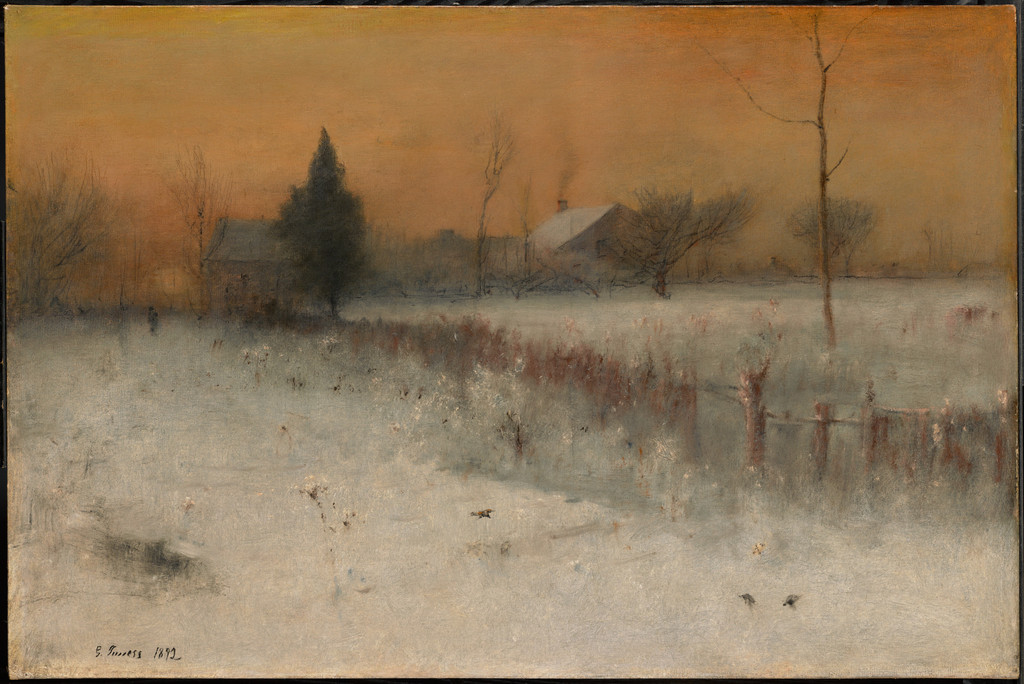
George Inness, Home at Montclair, 1892. Oil on canvas. Clark Art Institute, 1955.10. Sterling and Francine Clark Art Institute. Image source. Public domain.
Artworks directory
A collected selection of 46 individually identified museum objects: 43 paintings and three watercolours. This is not a complete catalogue raisonné. Repeated titles identify separate objects where their institutions or accessions differ. Links lead to a companion article where available, otherwise to the museum record. Unillustrated entries remain included; the original lost New Jerusalem is represented by its three transformed survivors.
| Name | Date | Medium |
|---|---|---|
| Crossing the Ford | 1848 | Oil on canvas |
| The Old Mill | 1849 | Oil on canvas |
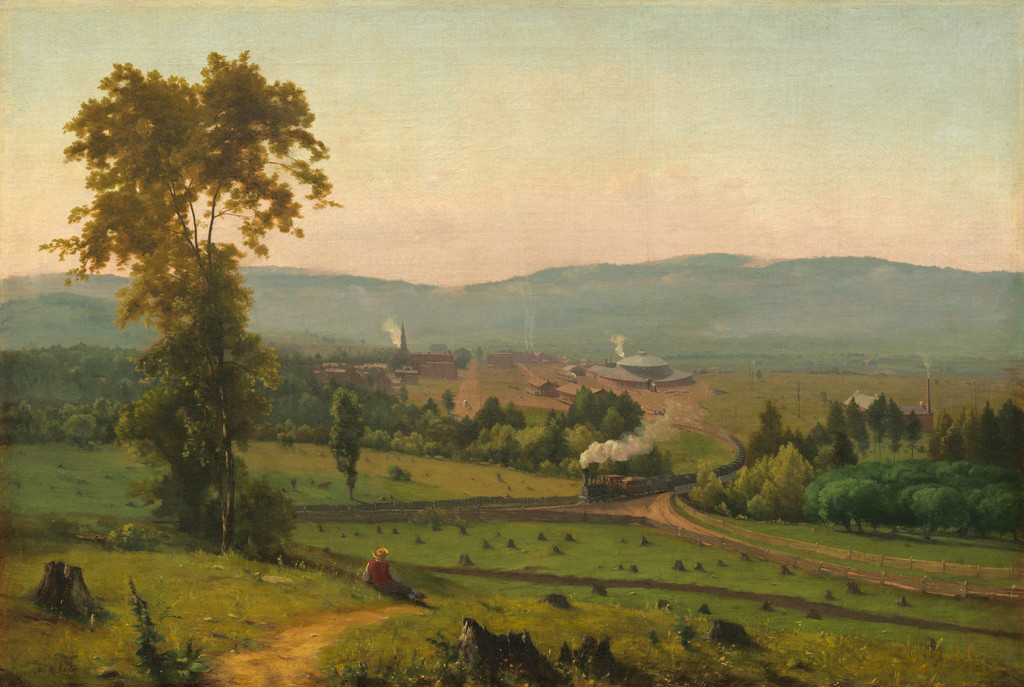
| The Lackawanna Valley by George Inness | c. 1856 | oil on canvas |
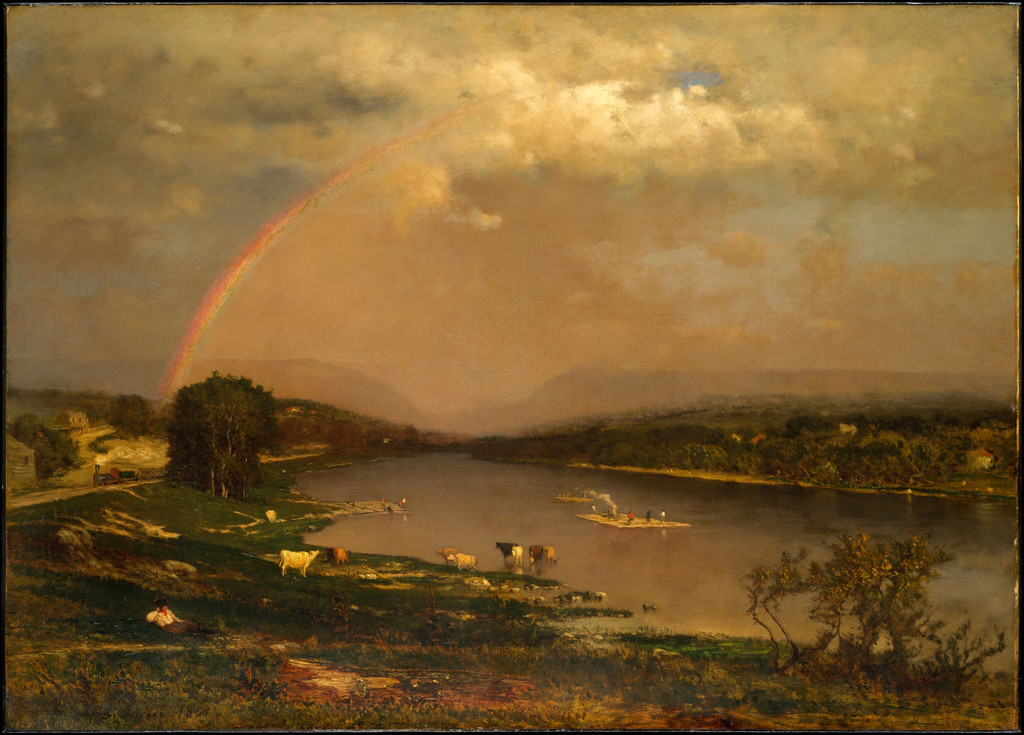
| Delaware Water Gap | 1861 | Oil on canvas |
| Delaware Valley | c. 1865–75 | Oil on artist's board |
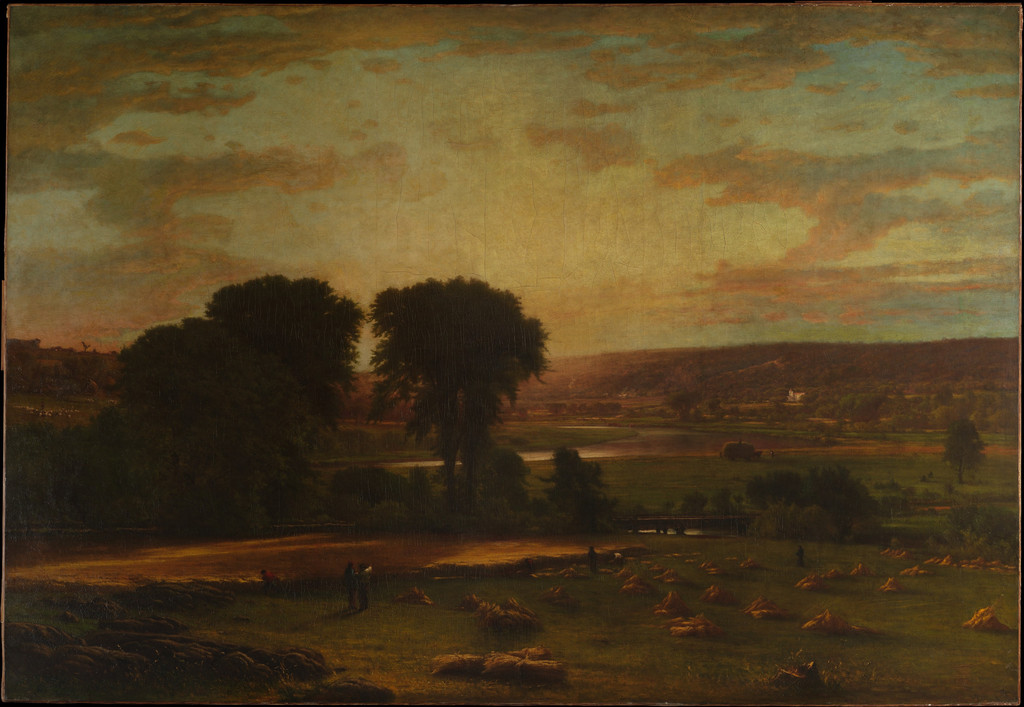
| Peace and Plenty | 1865 | Oil on canvas |
| Evening Landscape | 1867; later reworked | Oil on canvas |
| Summer in the Catskills | 1867 | Oil on canvas |
| The Valley of the Olives | 1867; reworked after 1880 | Oil on canvas |
| The Valley of the Shadow of Death | 1867 | Oil on canvas |
| Visionary Landscape | 1867/1880 | Oil on canvas |
| Catskill Mountains | 1870 | Oil on canvas |
| Across the Campagna | 1872 | Watercolor, gouache, and graphite on off-white wove paper |
| Olive Trees at Tivoli | 1873 | Gouache, watercolor, and graphite on blue wove paper with colored fibers |
| A Marine | c. 1874–75 | Oil on canvas |
| Twilight in Italy — Art Institute of Chicago (1911.44) | 1874 | Oil on panel |
| Pine Grove of the Barberini Villa | 1876 | Oil on canvas |
| The Storm | 1876 | Oil on canvas |
| Autumn Oaks | ca. 1878 | Oil on canvas |
| The Sisters | 1882 | Oil on millboard |
| Harvest, Montclair, New Jersey | 1884 | Oil on canvas |
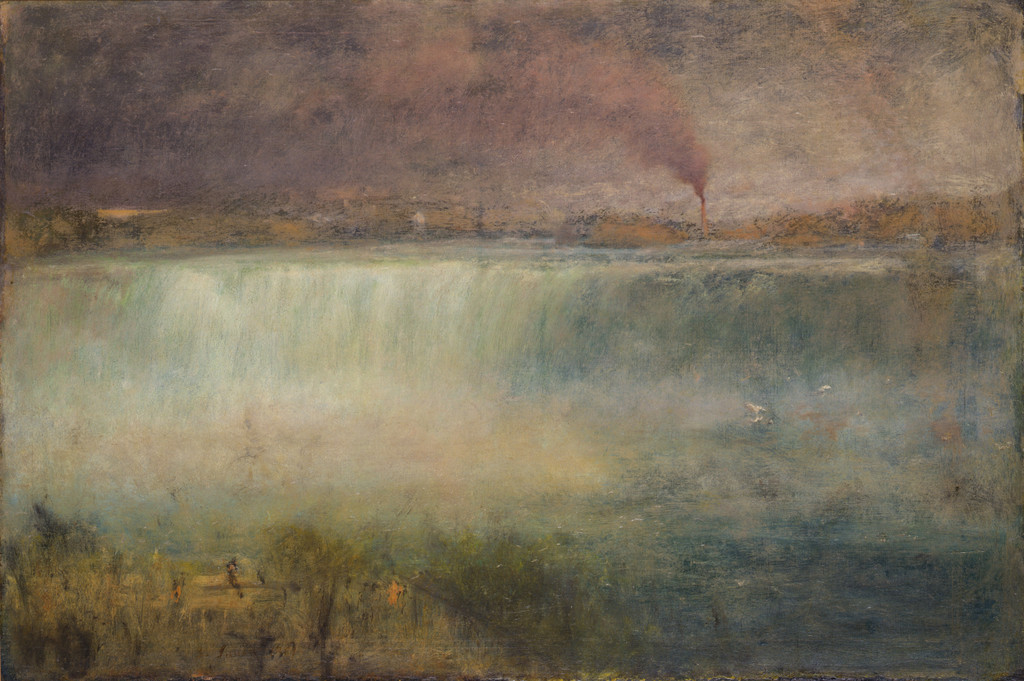
| Niagara Falls | 1885 | Oil on wood |
| A Silver Morning | 1886 | Oil on canvas |
| Landscape, Sunset | 1887–89 | Oil on canvas |
| September Afternoon | 1887 | Oil on canvas |
| Sunrise | 1887 | Oil on canvas |
| The Mill Stream, Montclair, New Jersey by George Inness | c. 1888 | Oil on canvas |
| Niagara by George Inness | 1889 | oil on canvas |
| The Mill Pond | 1889 | Oil on canvas |
| Sunset in the Valley | 1890 | Oil on canvas |
| The Moon at Night | 1890 | Oil on canvas |
| Twilight in Italy — Art Institute of Chicago (1911.42) | 1890 | Oil on canvas |
| Autumn Woods | 1891–94 | Oil on canvas |
| Moonrise | 1891 | Oil on canvas |
| Spring Blossoms, Montclair, New Jersey | ca. 1891 | Oil and crayon or charcoal on canvas |
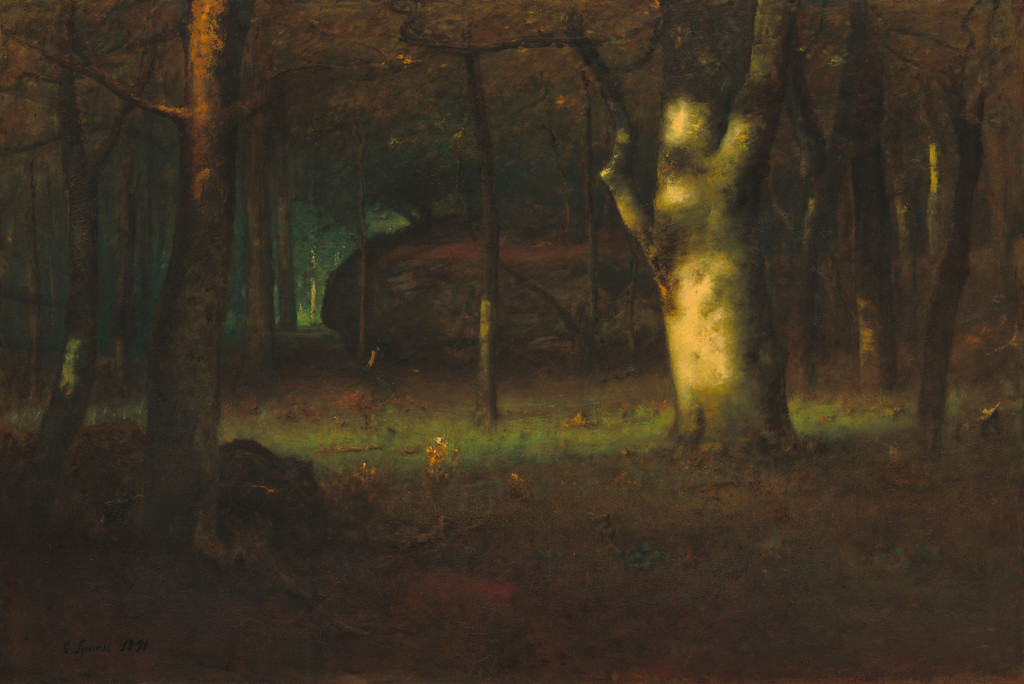
| Sunset in the Woods by George Inness | 1891 | oil on canvas |
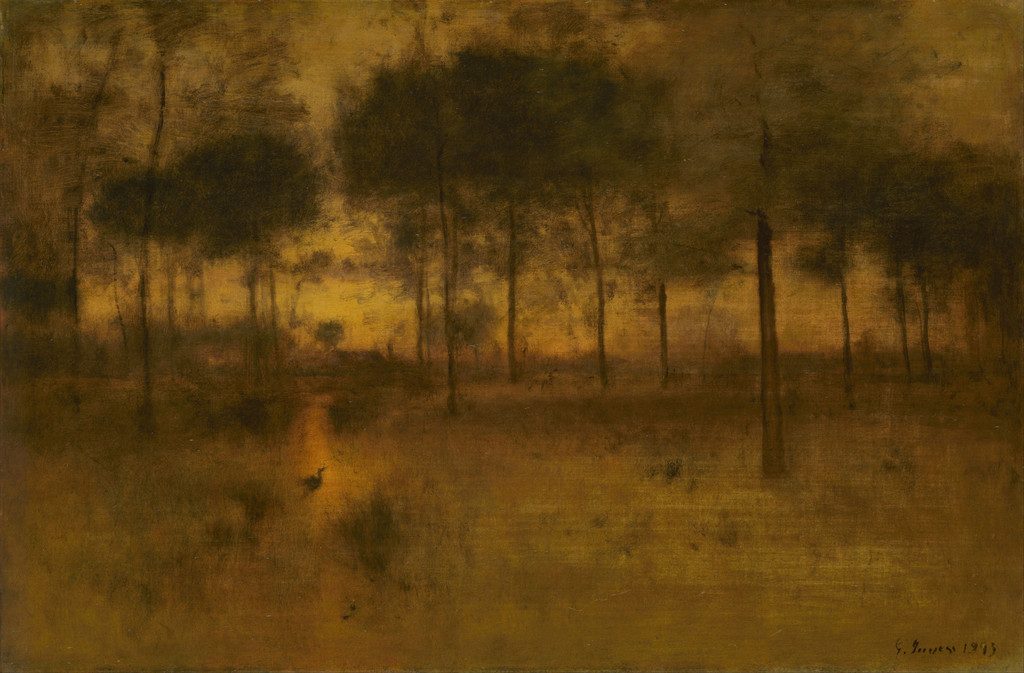
| The Home of the Heron — Princeton University Art Museum (y1943-93) | 1891 | Oil on canvas |
| Threatening | 1891 | Oil on canvas |
| Early Morning, Tarpon Springs | 1892 | Oil on canvas |
| Home at Montclair by George Inness | 1892 | oil on canvas |
| The Lonely Farm, Nantucket | 1892 | Oil on canvas |
| Afterglow | 1893 | Oil on canvas |
| Sunlit Valley | 1893 | Oil on canvas |
| The Home of the Heron — Art Institute of Chicago (1911.31) | 1893 | Oil on canvas |
| After a Summer Shower | 1894 | Oil on canvas |
| Landscape | n.d. | Watercolor with scraping on ivory wove paper |
Frequently Asked Questions
The Met records oil and crayon or charcoal on canvas. Its alternative identification of the drawing material should be retained.[1]
The Met interprets the blossoms as a scene at dusk.[1]
The reviewed sources do not identify the person. The light clothing and foreground position are visible, but a named sitter or specific activity would require further evidence.
In 1911, through George A. Hearn’s gift in memory of Arthur Hoppock Hearn.[1]
Discussion
Look again at the images and ideas explored in Spring Blossoms, Montclair, New Jersey by George Inness. These editorial prompts invite your observations.
Follow the branches inside the pale blossom, then look at the blossom as a single mass of colour. How does the scene change? Consider the different roles of the foreground figure, the house and the pale disk in the sky.
Reader Insights
Where do dark branches remain visible within pale blossom?
How does this light compare with the snowy ground of Home at Montclair?
What does the museum’s alternative crayon-or-charcoal description allow you to say?
Join the Conversation
Share a detail, comparison or question about Spring Blossoms, Montclair, New Jersey by George Inness below.
References
- Metropolitan Museum of Art, Spring Blossoms, Montclair, New Jersey, accession 11.116.4. Current object record and commentary.
- George Inness Jr., Life, Art, and Letters of George Inness (1917), printed p. 246. Selected original page examined; remembered advice explicitly attributed.
- Adrienne Baxter Bell, “George Inness (1825–1894),” Metropolitan Museum of Art (2012).
- Clark Art Institute, Home at Montclair, accession 1955.10.
- Minneapolis Institute of Art, The Mill Stream, Montclair, New Jersey, accession 2000.236.
- Art Institute of Chicago, Early Morning, Tarpon Springs, accession 1911.32.
- Splash image source.
George Inness, Spring Blossoms, Montclair, New Jersey, c. 1891. Oil and crayon or charcoal on canvas. Met, 11.116.4. Gift of George A. Hearn, in memory of Arthur Hoppock Hearn, 1911; Metropolitan Museum of Art. Image source. Public domain.