 by Tom Gurney
Tom Gurney BSc (Hons) is an art history expert with over 20 years experience
Email: tomgurney1@gmail.com / Phone: +44 7429 011000
Home at Montclair by George Inness: Introduction
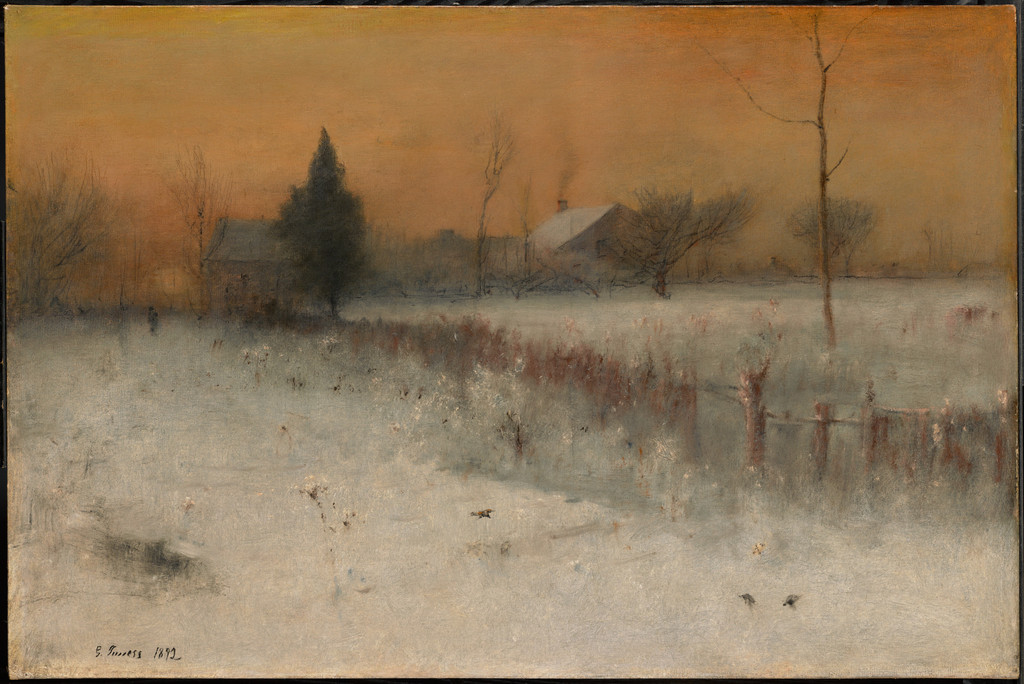
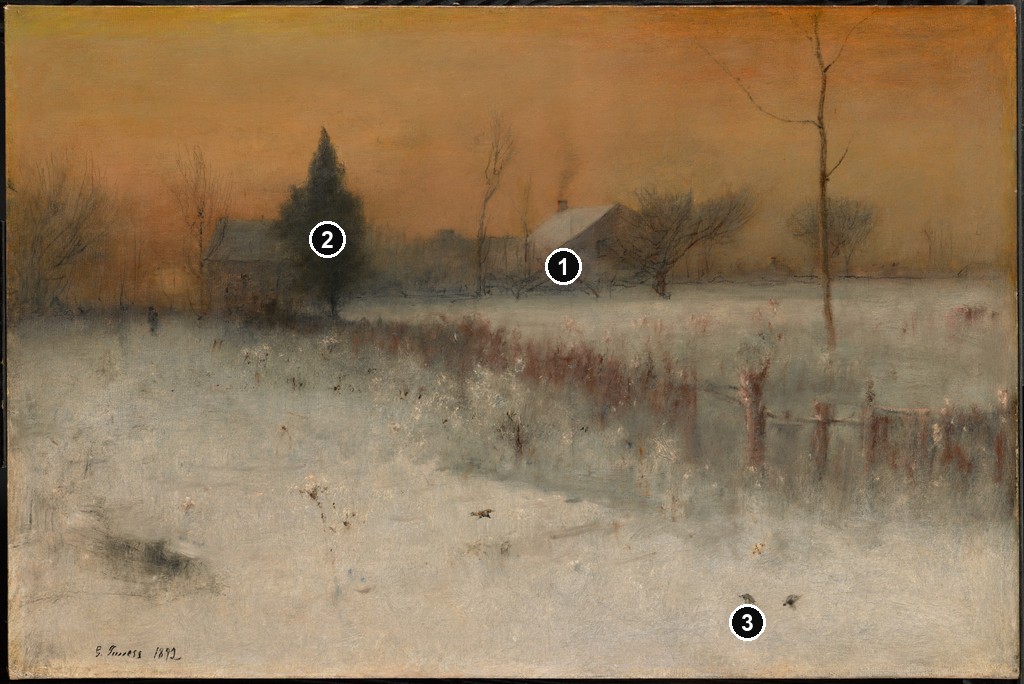
In George Inness’s Home at Montclair, a broad snowfield occupies the space below a warm evening sky. Houses and trees gather along a low horizon, while tiny dark birds make the nearer snow feel inhabited. There is no waterfall or mountain to supply an obvious spectacle. The painting instead asks how much feeling can arise from the arrangement of an ordinary local scene. The Clark Art Institute dates this oil on canvas to 1892 and identifies the setting as winter twilight.[1]
At a Glance
- ArtistGeorge Inness (1825–1894)
- TitleHome at Montclair
- Date1892
- MediumOil on canvas
- Dimensions76.5 × 114.3 cm
- CollectionClark Art Institute, Williamstown, Massachusetts
- Accession1955.10
This work across George Inness’s career
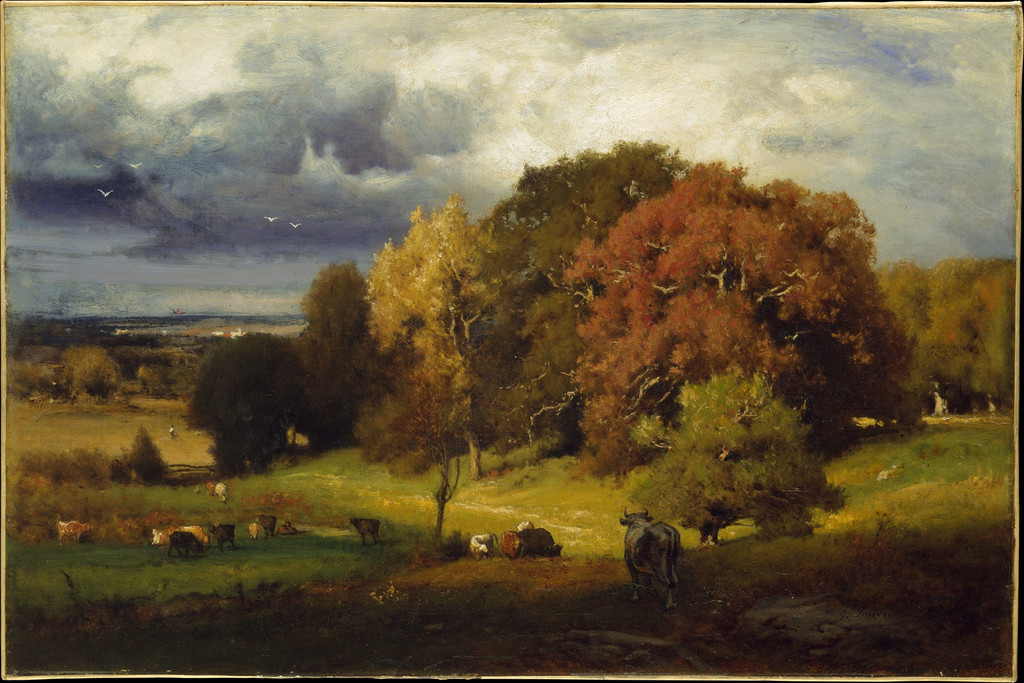
Autumn Oaks by George Inness
ca. 1878Contents
- A field with room to look
- Warm sky and cool ground
- Trees, houses and the low horizon
- Small marks within the open snow
- The son’s response to its grandeur
- Montclair dates and the collection route
- Other seasons and other local subjects
- Annotated details
A field with room to look
The snowfield provides the composition’s largest uninterrupted area. Its blue-grey colour is neither the brilliant white of a sunlit surface nor the dark tone of the trees. It gives the eye room to move across the painting before settling on a particular object. This breadth is essential to the effect: the small buildings would feel different if they were crowded by a nearer foreground mass.
The horizon stays low enough for the sky to form a second broad area. Ground and sky do not mirror each other exactly, but their open spaces establish the picture before its smaller details become clear. Begin by looking at those two areas together. Their relationship makes the scene expansive even though the subject is a field near houses.
Within the snow, cooler and paler passages prevent the surface from becoming a flat strip of colour. These variations are modest, so they work across a large area rather than demanding attention as separate objects. The field seems continuous while its light changes. That combination helps account for the painting’s sense of breadth.
The nearest snow also offers a quiet entrance to the image. No prominently placed person tells the viewer where to stand or which event to follow. The foreground is available for looking through and across. Attention can move slowly towards the houses, pause at a bird, or rise towards the sky.
Annotated Details from Home at Montclair
The numbered points identify visible features discussed in this article. Return from each detail to the whole composition. George Inness, Home at Montclair, 1892. Oil on canvas. Clark Art Institute, 1955.10. Sterling and Francine Clark Art Institute. Image source. Public domain.
Details from HOME AT MONTCLAIR
Compare the cropped details with the complete images above. Notice how their colours, shapes and positions contribute to the larger compositions.
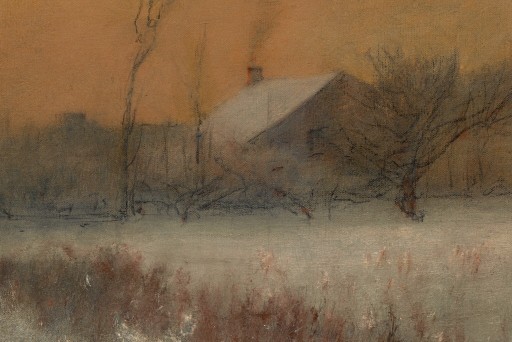
Low houses
The houses gather along a low horizon. Their warm walls and roofs remain small above the broad cool field.
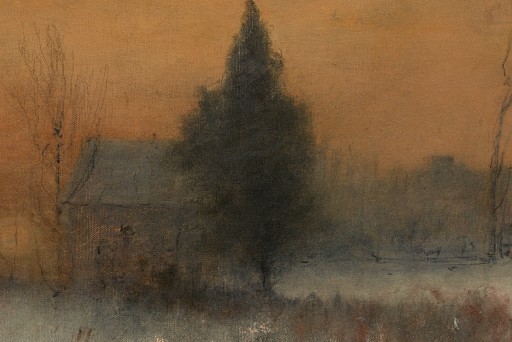
Evergreen and bare branches
A dense evergreen stands beside thin bare trees. The different kinds of silhouette organise the quiet middle distance.
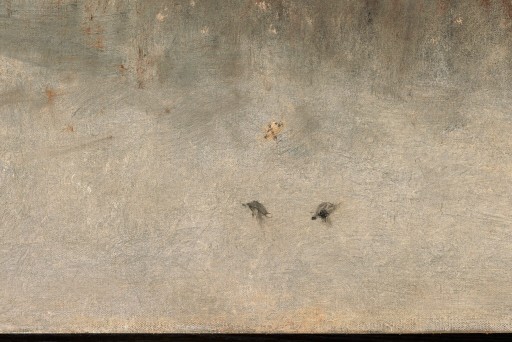
Birds on the snow
Small dark birds interrupt the pale snow. They provide points of recognition within a field that otherwise occupies a large continuous area.
Warm sky and cool ground
Orange and peach colour spreads above the low buildings. Below it, the snow retains cooler blue and grey tones. The contrast makes the sky feel luminous without requiring a sharply depicted sun. The light is distributed over an area rather than concentrated in one brilliant disk.
This division does not make two unrelated pictures. Dark vegetation interrupts the boundary between sky and field, and the roof of the larger house carries a pale surface into the middle distance. Such transitions keep the warm and cool regions connected. The picture’s atmosphere develops through their contact.
Try looking first at the orange sky and then at the snow immediately below it. The same field can appear more distinctly blue after the warmer colour has held the eye. Reverse that sequence, and the sky becomes more emphatic. This is a practical way to notice the colour relationship rather than reducing it to a list of hues.
Twilight also changes the role of detail. The houses remain visible, but windows and walls do not compete equally with the broader light. Trees register first as dark forms, then as trunks and branches. The scene allows recognition to develop at different speeds, which is part of its subdued character.
Trees, houses and the low horizon
A dark evergreen group stands left of centre. Its relatively compact mass contrasts with the taller, more open bare trees towards the right. These forms provide two different kinds of vertical structure: one gathers darkness into a solid shape, while the other lets the sky show between branches.
The contrast helps keep the picture balanced without making the two sides match. The evergreen anchors one area of the horizon. The more slender right-hand trees extend higher and occupy a wider interval of sky. Their uneven distribution gives the view the irregularity of a familiar place while still contributing to a clear arrangement.
A smaller house appears to the left of the evergreen group, while a larger pale-roofed building stands farther across the horizon. The buildings establish a scale for the trees and field. They also change the subject from an empty winter prospect into a landscape shaped by residence and daily activity.
The title directs attention towards that relationship, but it does not identify every structure. The image alone cannot supply the names of the occupants or a survey of the property. What it does show is a field whose distance includes houses, vegetation and boundaries, all held within the same winter light.
Small marks within the open snow
The birds are tiny beside the field, yet their dark forms can attract attention quickly. They interrupt the broad pale surface without enclosing it. After finding them, look back towards the buildings: the change in scale makes the interval between foreground and horizon more noticeable.
The birds do not require a detailed story to perform this role. Their species and exact actions are not securely established by the reproduction. Their positions already provide a useful measure of the snow’s openness and a small sign of life within the winter scene.
Posts, railing-like marks and low vegetation gather towards the right. They introduce a different rhythm from the more irregular birds. Their interrupted line suggests divisions in the land, while its low height leaves the broad sky and field dominant. A completely empty foreground would produce another kind of picture.
These details make the scene familiar without exhausting its meaning. It is possible to recognise signs of habitation and still attend chiefly to light and space. The painting permits both kinds of looking, moving between a field with particular things in it and a larger experience of winter twilight.
Watch: George Inness
Choose a film to explore the artist’s work, its interpretation and its wider setting.
The Montclair Art Museum's George Inness Gallery
Visit the George Inness Gallery at the Montclair Art Museum in this State of the Arts feature.
Watch on YouTubeThe son’s response to its grandeur
George Inness Jr. discusses the field behind his father’s home in his 1917 memoir. His response to Home at Montclair is striking because the subject offers so little conventional drama. He writes that there is “nothing startling” in the painting, yet describes a feeling of “bigness, grandeur.” These words record the son’s retrospective judgement, rather than a statement of intention written by the artist.[2]
The judgement suggests a useful question for the viewer. Where does that apparent grandeur come from? The broad field, low horizon and spread of warm light offer visible reasons to consider. None needs a monumental landmark. The arrangement gives importance to the space between the small objects as well as to the objects themselves.
On the following page, the son remembers his father wishing he could “paint it without paint.” The phrase is an aspiration recalled in a later memoir. It can help explain an interest in concealing effort, but it supplies no recipe for this particular canvas and should not be read as a literal absence of brushwork.[2]
The Clark describes the painting’s thin application of paint. That account concerns this work; the reproduction itself cannot establish the chemical composition or complete order of the layers.[1] For close looking, the useful point is how little the broad areas seem interrupted by insistent modelling. The houses and trees remain present within an atmosphere that holds attention beyond any single detail.
Montclair dates and the collection route
Inness began renting in Montclair in 1878, bought the property in 1884 and made it his permanent residence in 1885. Adrienne Baxter Bell distinguishes these events and notes that he retained a New York studio.[3] The 1892 painting therefore belongs to a long association with the locality, rather than marking his first arrival there.
The Clark’s detailed provenance records James W. Ellsworth, inheritance by Mrs. Bernon S. Prentice, the Prentice sale at Parke-Bernet in April 1952, Knoedler and Robert Sterling Clark’s purchase in January 1955. These entries identify this canvas’s documented collection route.[1]
The painting’s present holding institution should also be distinguished from its subject. Williamstown is where the Clark collection is based; Montclair is the locality named in the picture’s title. Current visiting arrangements may change, while accession 1955.10 remains a stable way to identify the work.
Other seasons and other local subjects
The Mill Stream, Montclair, New Jersey, dated circa 1888 by the Minneapolis Institute of Art, includes industrial buildings beside water.[4] Its tower and stream give a different structure to the local landscape. Compare that vertical architecture with the low houses here, then compare the warm reflections in the water with the cool, open snow.
Spring Blossoms, Montclair, New Jersey, circa 1891, changes the season and fills more of the scene with branches and pale blossom. The Met records oil with crayon or charcoal for that canvas.[5] Its visible drawing and blossom masses make a useful contrast with the more open field of Home at Montclair.
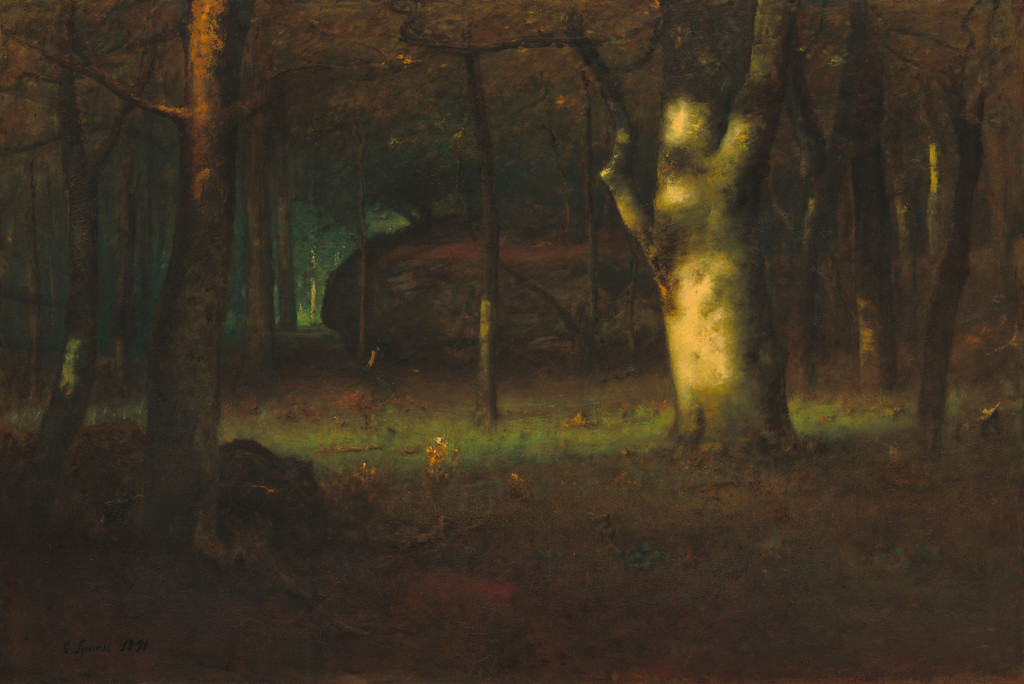
Sunset in the Woods is another late picture, dated 1891 by the National Gallery of Art.[6] Its woodland keeps the eye among trunks and shadow. Moving from that enclosure to this snowfield makes the breadth of the Montclair composition especially apparent. Both works give evening light an important role, while offering very different spaces through which to experience it.
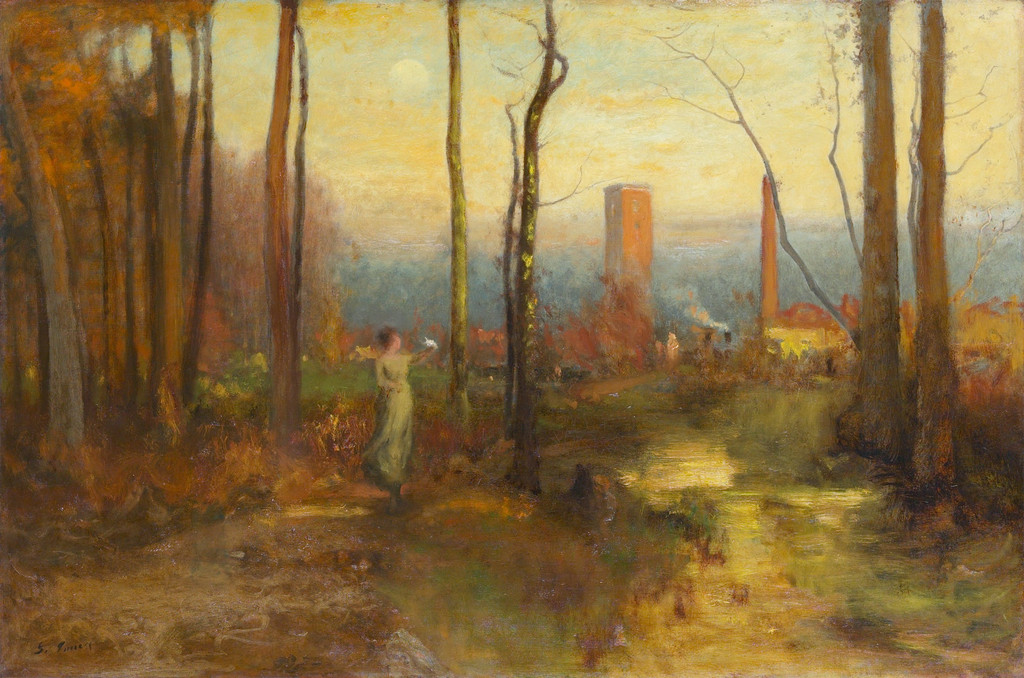
George Inness, The Mill Stream, Montclair, New Jersey, c. 1888. Oil on canvas. Minneapolis Institute of Art, 2000.236. Gift of Don and Diana Lee Lucker; Minneapolis Institute of Art. Image source. Public domain.
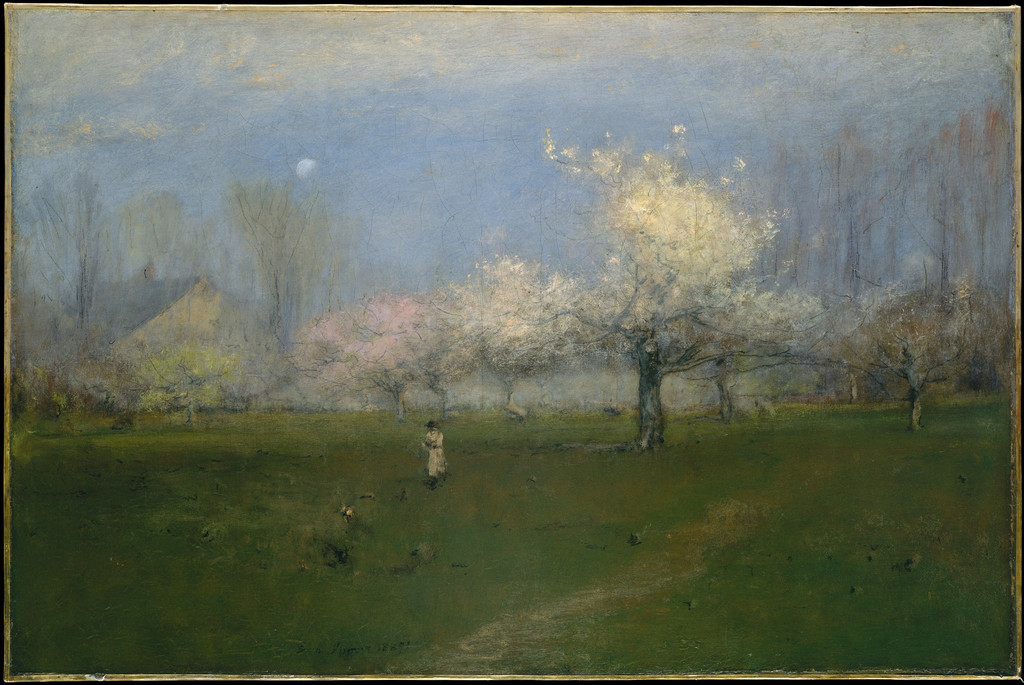
George Inness, Spring Blossoms, Montclair, New Jersey, c. 1891. Oil and crayon or charcoal on canvas. Met, 11.116.4. Gift of George A. Hearn, in memory of Arthur Hoppock Hearn, 1911; Metropolitan Museum of Art. Image source. Public domain.
Artworks directory
A collected selection of 46 individually identified museum objects: 43 paintings and three watercolours. This is not a complete catalogue raisonné. Repeated titles identify separate objects where their institutions or accessions differ. Links lead to a companion article where available, otherwise to the museum record. Unillustrated entries remain included; the original lost New Jerusalem is represented by its three transformed survivors.
| Name | Date | Medium |
|---|---|---|
| Crossing the Ford | 1848 | Oil on canvas |
| The Old Mill | 1849 | Oil on canvas |
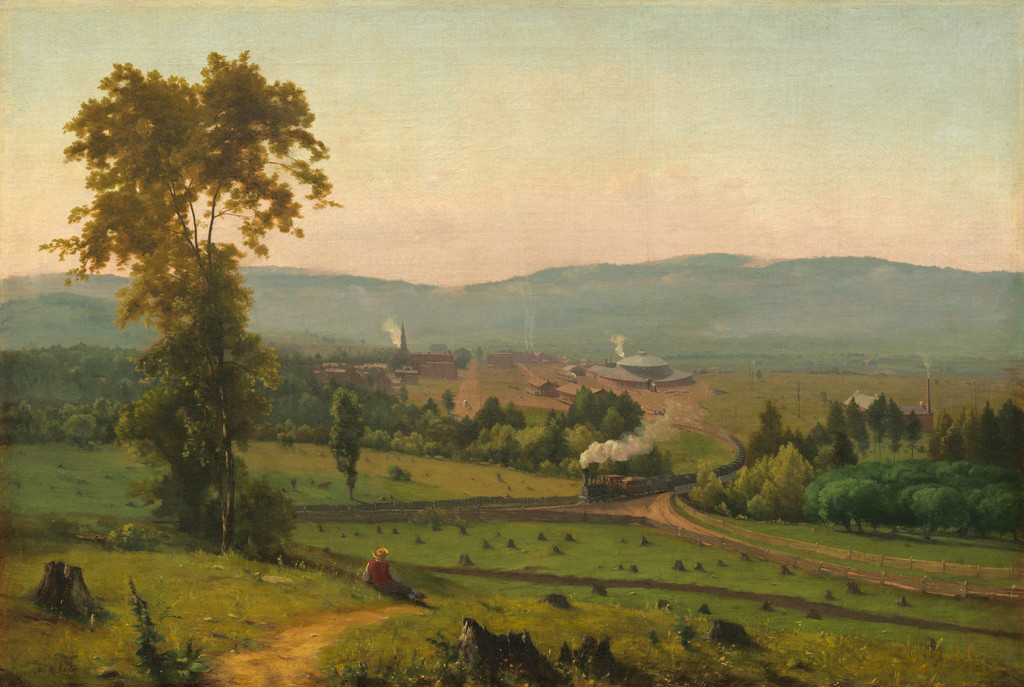
| The Lackawanna Valley by George Inness | c. 1856 | oil on canvas |
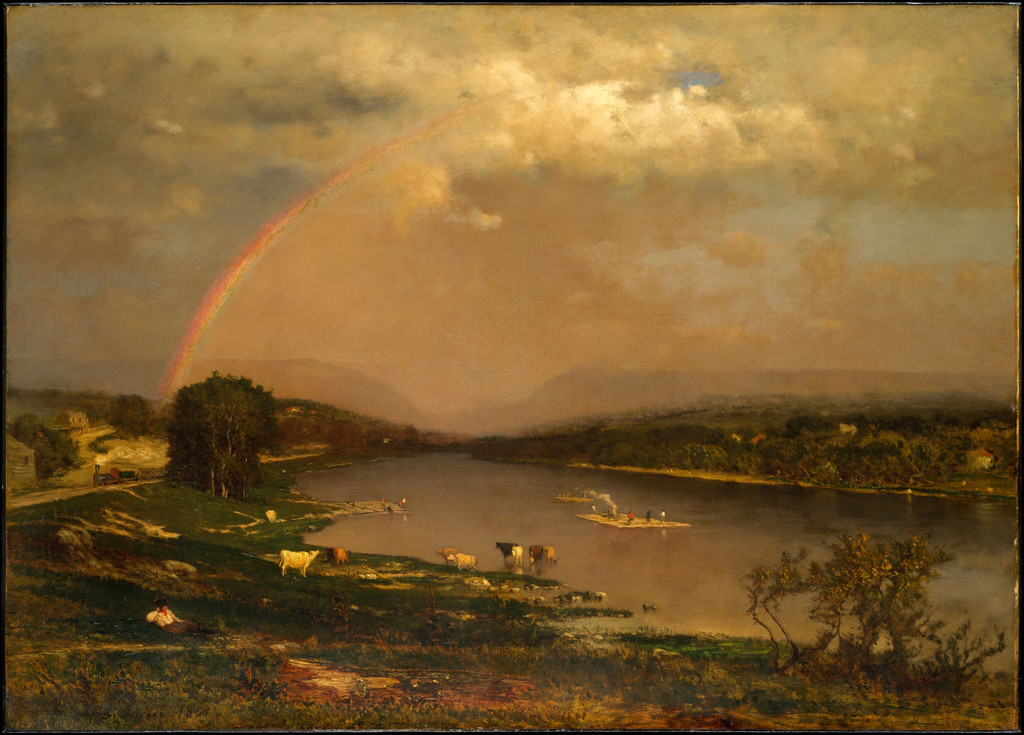
| Delaware Water Gap | 1861 | Oil on canvas |
| Delaware Valley | c. 1865–75 | Oil on artist's board |
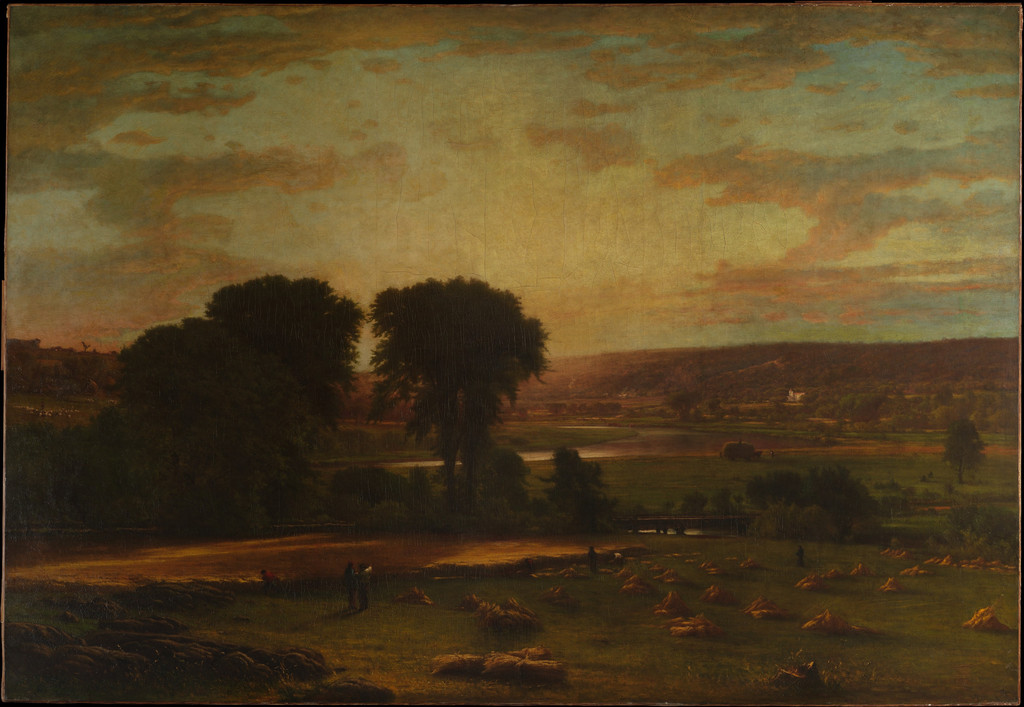
| Peace and Plenty | 1865 | Oil on canvas |
| Evening Landscape | 1867; later reworked | Oil on canvas |
| Summer in the Catskills | 1867 | Oil on canvas |
| The Valley of the Olives | 1867; reworked after 1880 | Oil on canvas |
| The Valley of the Shadow of Death | 1867 | Oil on canvas |
| Visionary Landscape | 1867/1880 | Oil on canvas |
| Catskill Mountains | 1870 | Oil on canvas |
| Across the Campagna | 1872 | Watercolor, gouache, and graphite on off-white wove paper |
| Olive Trees at Tivoli | 1873 | Gouache, watercolor, and graphite on blue wove paper with colored fibers |
| A Marine | c. 1874–75 | Oil on canvas |
| Twilight in Italy — Art Institute of Chicago (1911.44) | 1874 | Oil on panel |
| Pine Grove of the Barberini Villa | 1876 | Oil on canvas |
| The Storm | 1876 | Oil on canvas |
| Autumn Oaks | ca. 1878 | Oil on canvas |
| The Sisters | 1882 | Oil on millboard |
| Harvest, Montclair, New Jersey | 1884 | Oil on canvas |
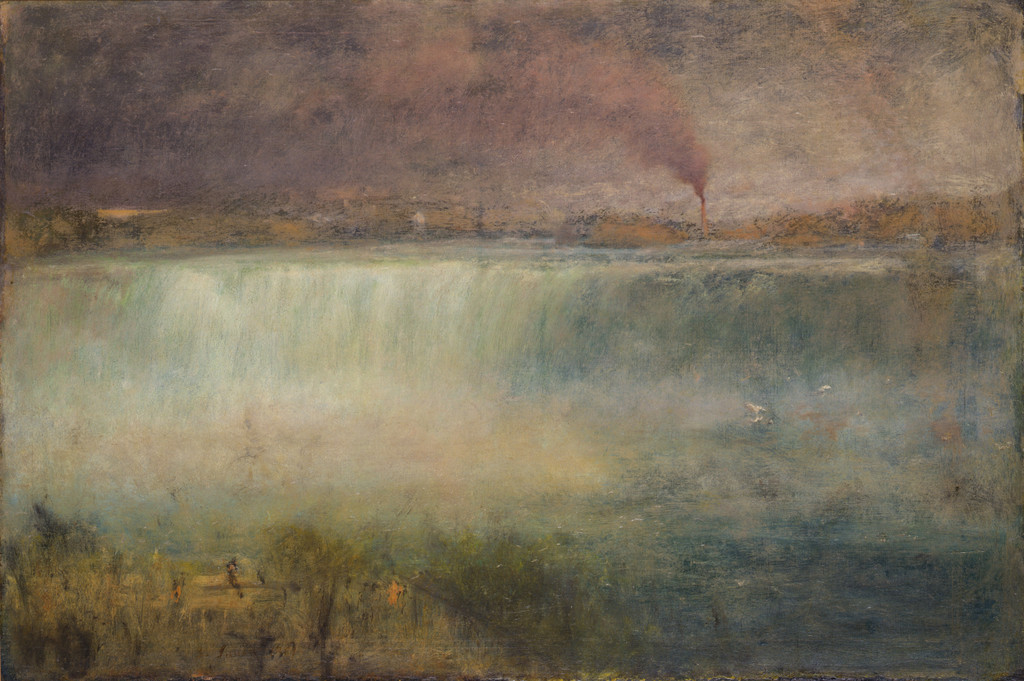
| Niagara Falls | 1885 | Oil on wood |
| A Silver Morning | 1886 | Oil on canvas |
| Landscape, Sunset | 1887–89 | Oil on canvas |
| September Afternoon | 1887 | Oil on canvas |
| Sunrise | 1887 | Oil on canvas |
| The Mill Stream, Montclair, New Jersey by George Inness | c. 1888 | Oil on canvas |
| Niagara by George Inness | 1889 | oil on canvas |
| The Mill Pond | 1889 | Oil on canvas |
| Sunset in the Valley | 1890 | Oil on canvas |
| The Moon at Night | 1890 | Oil on canvas |
| Twilight in Italy — Art Institute of Chicago (1911.42) | 1890 | Oil on canvas |
| Autumn Woods | 1891–94 | Oil on canvas |
| Moonrise | 1891 | Oil on canvas |
| Spring Blossoms, Montclair, New Jersey | ca. 1891 | Oil and crayon or charcoal on canvas |
| Sunset in the Woods by George Inness | 1891 | oil on canvas |
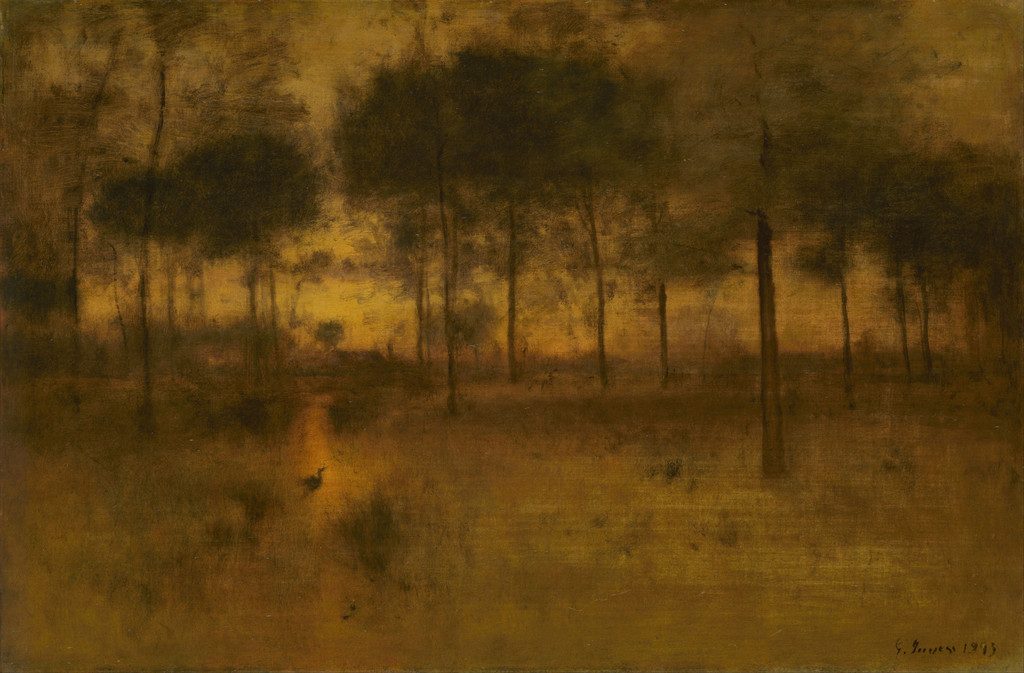
| The Home of the Heron — Princeton University Art Museum (y1943-93) | 1891 | Oil on canvas |
| Threatening | 1891 | Oil on canvas |
| Early Morning, Tarpon Springs | 1892 | Oil on canvas |
| Home at Montclair by George Inness | 1892 | oil on canvas |
| The Lonely Farm, Nantucket | 1892 | Oil on canvas |
| Afterglow | 1893 | Oil on canvas |
| Sunlit Valley | 1893 | Oil on canvas |
| The Home of the Heron — Art Institute of Chicago (1911.31) | 1893 | Oil on canvas |
| After a Summer Shower | 1894 | Oil on canvas |
| Landscape | n.d. | Watercolor with scraping on ivory wove paper |
Frequently Asked Questions
The Clark dates this canvas to 1892.[1]
Yes. The snowfield is visible, and the Clark describes winter twilight.[1]
He rented there from 1878, purchased the property in 1884 and made it his permanent residence in 1885.[3]
His son, George Inness Jr., in the 1917 memoir. The passage is the son’s later critical response.[2]
Discussion
Look again at the images and ideas explored in Home at Montclair by George Inness. These editorial prompts invite your observations.
Look at the birds, houses and two different groups of trees. Which detail first gives the snowfield its scale? Then consider how the warm sky changes your perception of the cool ground.
Reader Insights
How does the broad snowfield affect the low horizon?
Where does the pale light differ from Spring Blossoms and The Mill Stream?
What do the small birds contribute to the scale of the open ground?
Join the Conversation
Share a detail, comparison or question about Home at Montclair by George Inness below.
References
- Clark Art Institute, Home at Montclair, accession 1955.10. Current object record, commentary and detailed provenance.
- George Inness Jr., Life, Art, and Letters of George Inness (1917), printed pp. 245–246. Selected original pages examined; son’s criticism and remembered artist speech distinguished.
- Adrienne Baxter Bell, “George Inness (1825–1894),” Metropolitan Museum of Art (2012).
- Minneapolis Institute of Art, The Mill Stream, Montclair, New Jersey, accession 2000.236.
- Metropolitan Museum of Art, Spring Blossoms, Montclair, New Jersey, accession 11.116.4.
- National Gallery of Art, Sunset in the Woods, accession 2014.79.43.
- Splash image source.
George Inness, Home at Montclair, 1892. Oil on canvas. Clark Art Institute, 1955.10. Sterling and Francine Clark Art Institute. Image source. Public domain.