 by Tom Gurney
Tom Gurney BSc (Hons) is an art history expert with over 20 years experience
Email: tomgurney1@gmail.com / Phone: +44 7429 011000
Niagara by George Inness: Introduction
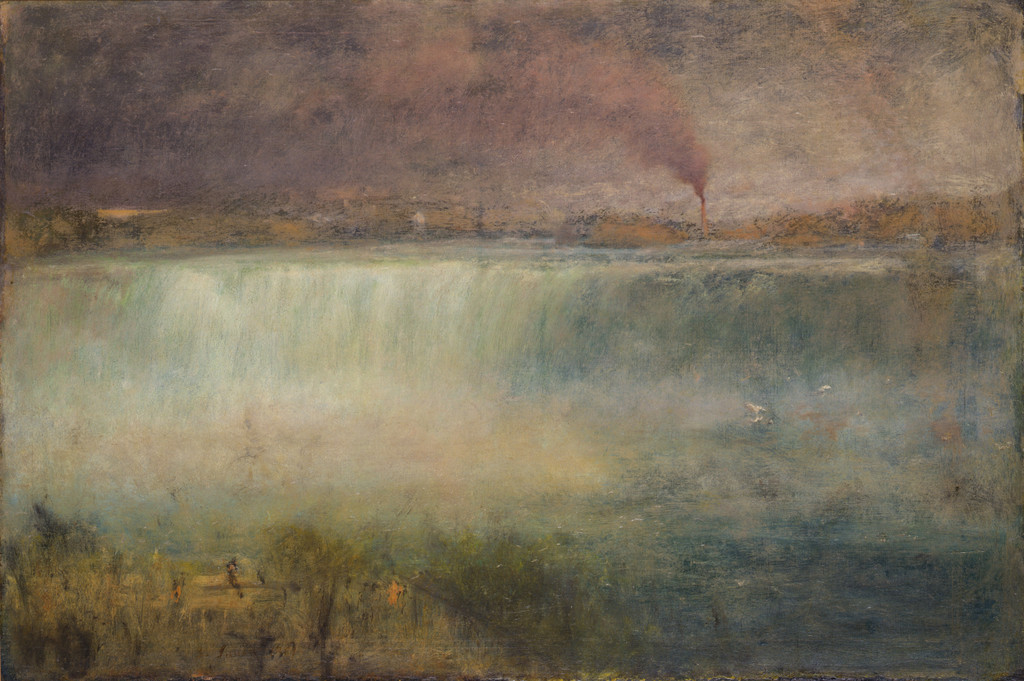
Pale water and spray spread across George Inness’s Niagara, while a thin smoking chimney rises above the distant bank. The contrast gives the familiar waterfall a more complicated atmosphere: industrial smoke remains visible within a scene whose boundaries often soften into light. The Smithsonian American Art Museum dates this oil canvas to 1889. William T. Evans gave it to the museum in 1909, and its accession is 1909.7.31.[1]
At a Glance
- ArtistGeorge Inness (1825–1894)
- TitleNiagara
- Date1889
- MediumOil on canvas
- Dimensions76.0 × 114.3 cm
- CollectionSmithsonian American Art Museum, Washington, DC
- CreditGift of William T. Evans
- Accession1909.7.31
This work across George Inness’s career
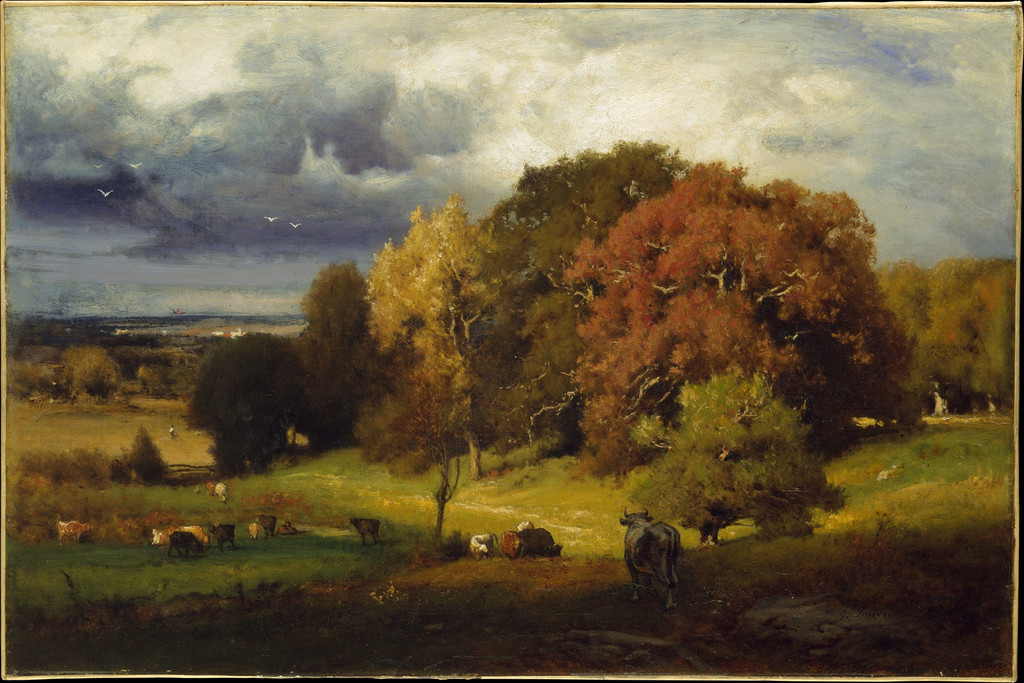
Autumn Oaks by George Inness
ca. 1878Contents
- A broad pale field of falling water
- Smoke against the cloud
- The Bath Island mill and an unsettled interpretation
- Foreground marks and the experience of distance
- Water, sky and limited boundaries
- The separate Niagara Falls panel of 1885
- Versions, dates and the scope of a count
- Other industrial landscapes
- Annotated details
A broad pale field of falling water
The waterfall begins below a low bank that crosses the upper middle of the picture. Its pale falling bands extend into a broader, less distinct area of spray. The change makes the water visible both as a definite drop and as an atmosphere spreading through the lower scene.
Green and blue remain active within that pale area. They give the water different temperatures and degrees of depth, preventing it from becoming a uniformly white surface. Darker passages at the right contrast with the brighter falling bands farther left.
The lower water is less clearly divided into individual forms. A viewer can follow colour and light without always finding a firm boundary between falling water, spray and river surface. The picture allows those aspects to approach one another, making atmosphere a major part of the subject.
The horizon supplies a comparatively stable interval above this movement. Its low, continuous forms help establish the waterfall’s position within the wider place. Even where the near scene becomes less distinct, the bank remains available as a route across the image.
Annotated Details from Niagara
The numbered points identify visible features discussed in this article. Return from each detail to the whole composition. The captions keep each work’s identity, date and medium separate.
Niagara (1889 canvas)
George Inness, Niagara, 1889. Oil on canvas. Smithsonian American Art Museum, 1909.7.31. Gift of William T. Evans; Smithsonian American Art Museum. Image source. Public domain.
.jpg)
Niagara Falls (1885 wood panel)
George Inness, Niagara Falls, 1885. Oil on wood. Smithsonian American Art Museum, 1929.6.67. Gift of John Gellatly; Smithsonian American Art Museum. Image source. CC0 / Public domain.
.jpg)
Details from NIAGARA
Compare the cropped details with the complete images above. Notice how their colours, shapes and positions contribute to the larger compositions.
Niagara (1889 canvas)
Falling sheet of water
Pale water spreads over the broad brink. Its descending direction differs from the long horizontal surface above.
 Detail 01 falling-sheet-of-water.jpg)
Mist beside the falls
Mist softens the right side of the waterfall. The transition makes the boundary between falling water and air less definite.
 Detail 02 mist-beside-the-falls.jpg)
Distant chimney
A narrow chimney rises from the distant shore. Its small but recognisable presence keeps an industrial detail within this 1889 canvas.
 Detail 03 distant-chimney.jpg)
Niagara Falls (1885 wood panel)
Curving brink
Green-blue water curves above the broad falling sheet. The arrangement belongs to this separate 1885 wood panel.
 Detail 04 curving-brink.jpg)
Spray at the right
Pale spray partly obscures the falling water. Its softness contrasts with the firmer edge of the brink.
 Detail 05 spray-at-the-right.jpg)
Near branch and bank
Dark branches and the near bank frame the lower right. Their position separates the spectator’s side of the view from the waterfall.
 Detail 06 near-branch-and-bank.jpg)
Smoke against the cloud
The chimney stands right of centre, small in width but clearly upright. Its warm tone distinguishes it from the surrounding bank, and a darker plume rises into the sky. Once noticed, the structure can become a strong point of attention within the pale scene.
The smoke has a different direction from the falling water. It moves upward and spreads into cloud, while the waterfall extends downward into spray. These opposed movements create a relation across the horizon: material activity below becomes part of the atmosphere above.
The sky is subdued, with grey, pink and warmer passages rather than one brilliant opening. The smoke meets colours already present there. It therefore remains visible while also approaching the surrounding atmosphere in tone.
This relation is especially interesting if the eye moves repeatedly between chimney and waterfall. The slender structure becomes more emphatic after looking across a broad pale area. The falling water becomes more expansive after looking at a small upright. Each gives the other a different scale.
The Bath Island mill and an unsettled interpretation
Alexander Jackson’s 2019 museum essay identifies the chimney with a Bath Island paper mill destroyed in 1882, seven years before this canvas’s date. He considers several possibilities for its continued presence: remembered place, criticism of industrial effects, or a concern with the tonal relations of smoke, cloud and spray. His argument leaves the artist’s intention open.[2]
A June 2012 SAAM research note favours an industrial-criticism reading after examining the mill’s history. It also acknowledges that no explicit statement of Inness’s intention had been found. This earlier argument should be attributed alongside Jackson’s more open discussion.[3]
The research note places the painting within efforts to change the surroundings of the falls. It discusses proposals for freely accessible public parks, legislation enacted in 1883 and plans submitted in 1887. Its account connects those efforts with criticism of industrial buildings and commercial attractions around the waterfall.[3] That historical framework supplies a reason for asking about the chimney, while preserving the distinction between a public campaign and this canvas’s unrecorded intention.
The date and the visible scene can consequently be read together without making the painting a complete inventory of the site in 1889. A landscape may bring a remembered feature into an arrangement whose light and emphasis belong to the finished picture. The smoking upright provides a concrete place to examine that possibility here. Its presence is visible even while its intended meaning remains open.
The two accounts make a productive difference to looking. The chimney is present in the image, and its relation to the water and sky can be examined. The historical interpretation asks why it remains there, a question the visible forms alone cannot settle.
The painting’s atmosphere also complicates a simple opposition between beautiful nature and a visually disruptive factory. The smoke is a darker mark, yet it approaches the sky’s subdued colours. The composition keeps industrial presence legible while giving it a tonal relation to the surrounding scene.
Foreground marks and the experience of distance
The lower left contains green scrub and small dark, pale and orange marks. Some suggest people or activity in a viewing area, but their forms remain only partly resolved. Their colour contrasts make them noticeable without giving them the clarity of detailed portraits.
This part of the image differs from what a viewer might expect of a near foreground. Proximity does not produce equal sharpness everywhere. The chimney farther away can be more securely found than an individual mark close to the lower edge.
That difference changes the experience of space. The eye moves between a more legible horizon and a less definite near area, then across the pale water. Distance is understood through relations of colour, position and scale rather than through a simple progression from sharp foreground to blurred background.
The small warm accents nevertheless have a useful role. They introduce another scale within the broad field of water and spray. The scene can contain a sense of human presence while leaving exact identities and actions uncertain.
Water, sky and limited boundaries
The upper sky and lower water share several subdued tones, but the horizon continues to divide them. That boundary gives the painting a broad structure even where spray softens forms elsewhere. The image therefore combines a clear general arrangement with less definite local passages.
The bright falling water offers another internal boundary. Its upper edge can be followed beneath the bank, then its separate bands become less distinct as they descend. Looking along that transition makes the painting’s interest in changing visibility especially apparent.
The darker right side provides a counterweight to the brighter left. These unequal areas help prevent the pale waterfall from becoming a featureless expanse. The eye can move from light to darker water, then return to the chimney and smoke above.
No object-specific scientific paint examination has been consulted here. Terms such as soft, broken or pale describe the reproduction’s visible effect. They do not independently identify pigments or reconstruct the order in which Inness made the surface.
Watch: George Inness
Choose a film to explore the artist’s work, its interpretation and its wider setting.
The Montclair Art Museum's George Inness Gallery
Visit the George Inness Gallery at the Montclair Art Museum in this State of the Arts feature.
Watch on YouTubeThe separate Niagara Falls panel of 1885
SAAM also holds Niagara Falls, an oil on wood dated 1885, measuring 40.2 × 60.9 cm. It entered through John Gellatly’s gift and has accession 1929.6.67.[4] Its smaller wooden support and separate title are essential to the comparison.
In the panel, a broad green upper edge gives way to more clearly visible falling bands. Dark rocks occupy the base towards the left, blue water spreads through the near foreground, and a large pale spray mass rises towards the right. A brown bank frames the lower-right edge.
Those forms provide a different entrance to the subject. The panel places strong blue water before the viewer and gives the nearer bank a definite edge. The 1889 canvas gathers more of its lower scene into pale spray and less distinct foreground marks.
No prominent smoking chimney is visible in the acquired reproduction of this exact 1885 panel. The difference makes object identity especially important. An account of the 1889 chimney cannot be applied indiscriminately to every Niagara picture, and a general statement that Inness removed all industry cannot explain the later canvas’s visible structure.
Compare the upper edges of the falls first, then the lower foregrounds. Both works use pale spray, but they give colour, boundaries and near forms different roles. The comparison reveals how a recurring subject can remain varied within one artist’s practice.
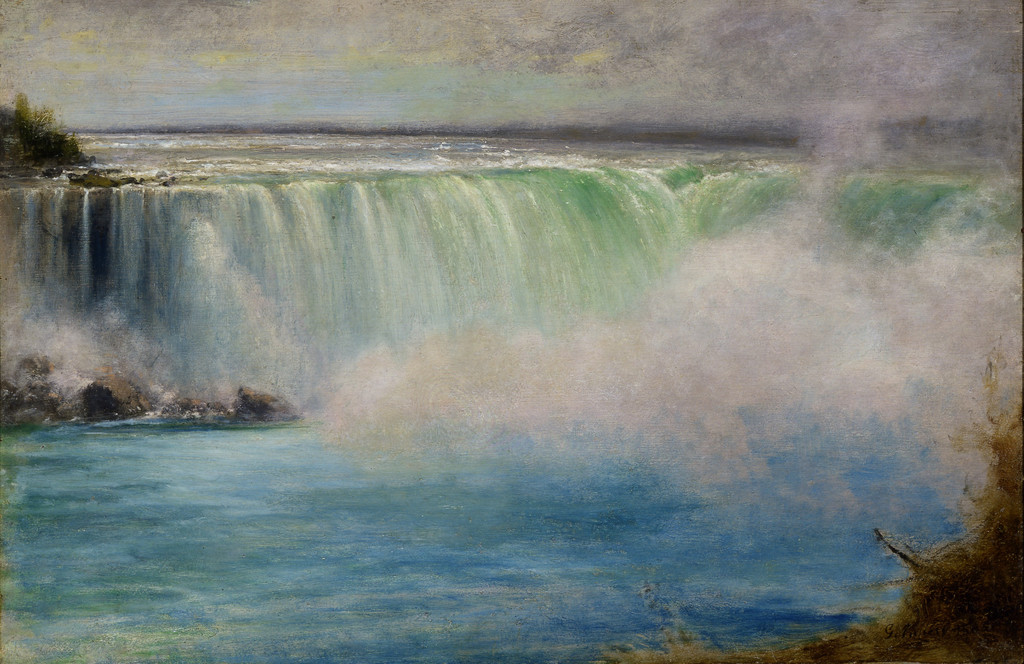
George Inness, Niagara Falls, 1885. Oil on wood, 40.2 × 60.9 cm. Smithsonian American Art Museum, 1929.6.67. Gift of John Gellatly; Smithsonian American Art Museum. Image source. CC0 / Public domain.
Versions, dates and the scope of a count
Jackson reports a first Niagara visit in 1881 and nine versions in oil and watercolour.[2] The 1885 object commentary counts seven oil paintings.[4] The different media scopes should accompany the numbers rather than being treated as one interchangeable total.
The date of a visit also differs from the date of a canvas. The 1889 work cannot be used as an exact record of every structure standing at Niagara that year. Jackson’s mill history makes that distinction particularly relevant to the smoking chimney.
This leaves room for a painting to hold remembered features and present compositional decisions together. The object record supplies the date and support; specialist interpretation raises questions about memory and meaning. The visible picture supplies the particular relations that keep those questions compelling.
Other industrial landscapes
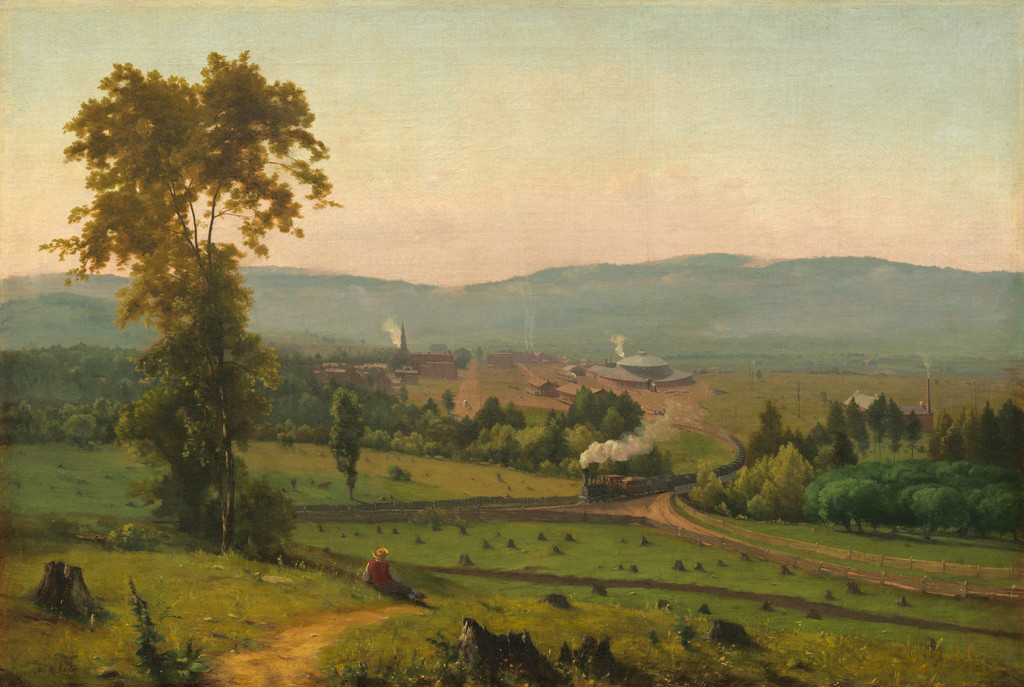
The Lackawanna Valley, circa 1856, was commissioned for the Delaware, Lackawanna and Western Railroad and is now in the National Gallery of Art.[5] Its train, roundhouse and stumps give industrial alteration a very different visual form. The small Niagara chimney stands within a broader atmospheric field.
The Mill Stream, Montclair, New Jersey, circa 1888, includes Samuel Crump’s printing company, identified by Mia.[6] Its tower is partly screened by trees, and warm reflections enter the water. Compare that integration with the smoke approaching the grey-pink sky here.
The comparisons show why an industrial reading needs to remain specific to the painting. A commissioned railway prospect, a local printing plant and a remembered Niagara mill create different documentary and visual questions. Their shared inclusion of built forms does not give them identical meanings.
Return to the 1889 canvas and follow the chimney’s narrow upright into the smoke, then move downward through the falling water. The opposing directions remain clear within the subdued colours. They give the scene an unresolved relation between industrial presence and atmospheric unity, sustained by the painting rather than settled by one label.
Artworks directory
A collected selection of 46 individually identified museum objects: 43 paintings and three watercolours. This is not a complete catalogue raisonné. Repeated titles identify separate objects where their institutions or accessions differ. Links lead to a companion article where available, otherwise to the museum record. Unillustrated entries remain included; the original lost New Jerusalem is represented by its three transformed survivors.
| Name | Date | Medium |
|---|---|---|
| Crossing the Ford | 1848 | Oil on canvas |
| The Old Mill | 1849 | Oil on canvas |
| The Lackawanna Valley by George Inness | c. 1856 | oil on canvas |
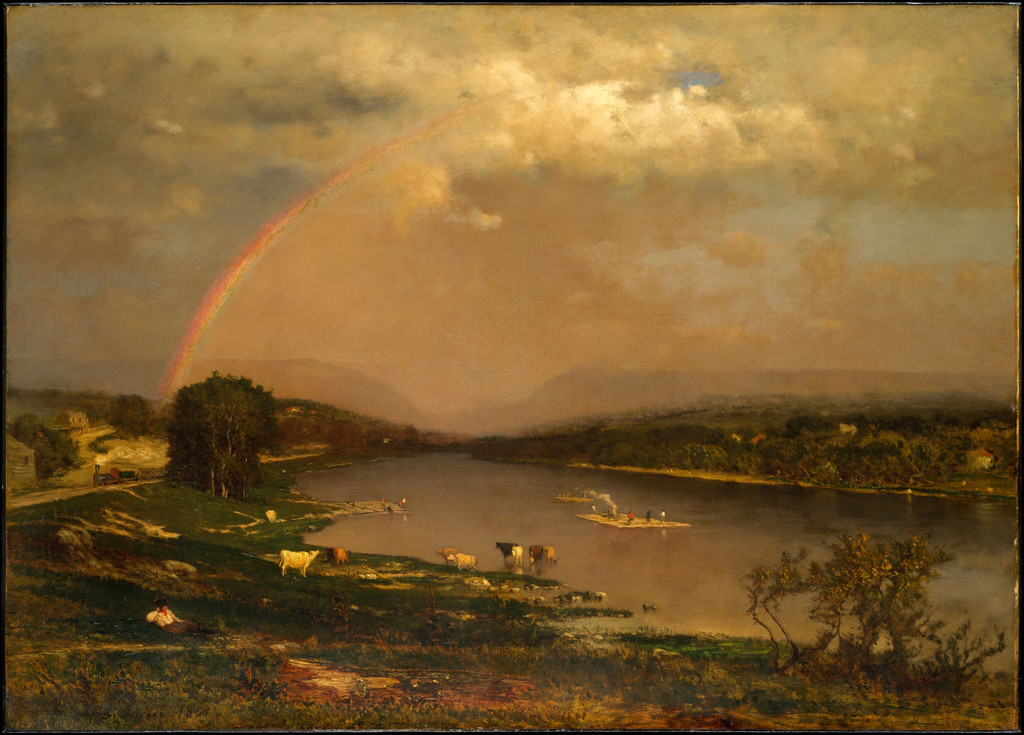
| Delaware Water Gap | 1861 | Oil on canvas |
| Delaware Valley | c. 1865–75 | Oil on artist's board |
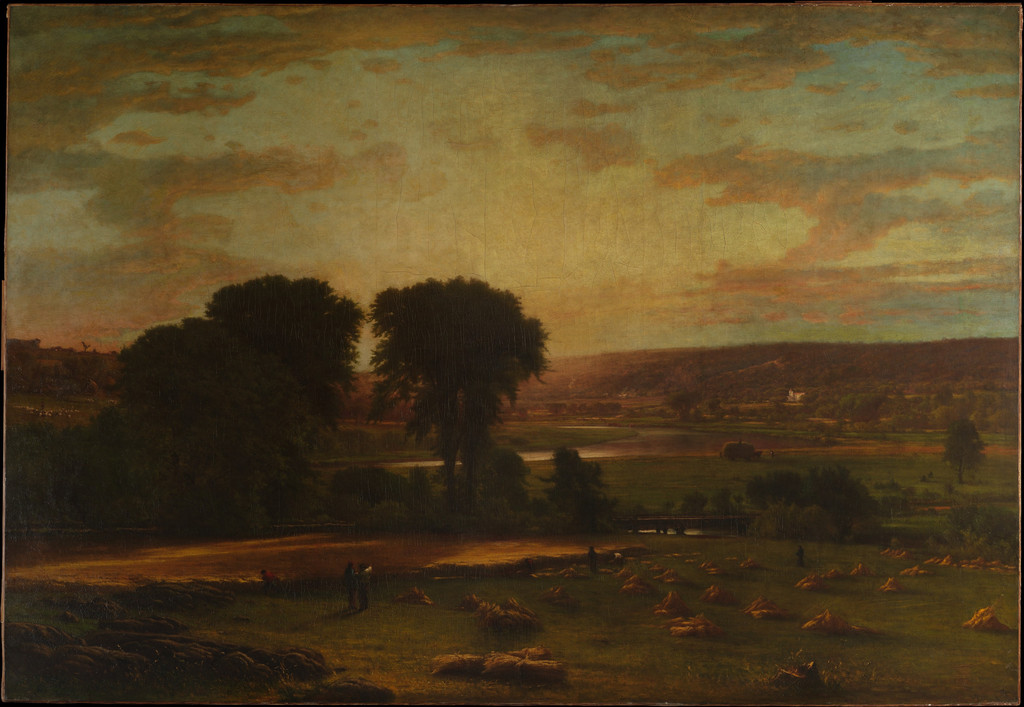
| Peace and Plenty | 1865 | Oil on canvas |
| Evening Landscape | 1867; later reworked | Oil on canvas |
| Summer in the Catskills | 1867 | Oil on canvas |
| The Valley of the Olives | 1867; reworked after 1880 | Oil on canvas |
| The Valley of the Shadow of Death | 1867 | Oil on canvas |
| Visionary Landscape | 1867/1880 | Oil on canvas |
| Catskill Mountains | 1870 | Oil on canvas |
| Across the Campagna | 1872 | Watercolor, gouache, and graphite on off-white wove paper |
| Olive Trees at Tivoli | 1873 | Gouache, watercolor, and graphite on blue wove paper with colored fibers |
| A Marine | c. 1874–75 | Oil on canvas |
| Twilight in Italy — Art Institute of Chicago (1911.44) | 1874 | Oil on panel |
| Pine Grove of the Barberini Villa | 1876 | Oil on canvas |
| The Storm | 1876 | Oil on canvas |
| Autumn Oaks | ca. 1878 | Oil on canvas |
| The Sisters | 1882 | Oil on millboard |
| Harvest, Montclair, New Jersey | 1884 | Oil on canvas |
| Niagara Falls | 1885 | Oil on wood |
| A Silver Morning | 1886 | Oil on canvas |
| Landscape, Sunset | 1887–89 | Oil on canvas |
| September Afternoon | 1887 | Oil on canvas |
| Sunrise | 1887 | Oil on canvas |
| The Mill Stream, Montclair, New Jersey by George Inness | c. 1888 | Oil on canvas |
| Niagara by George Inness | 1889 | oil on canvas |
| The Mill Pond | 1889 | Oil on canvas |
| Sunset in the Valley | 1890 | Oil on canvas |
| The Moon at Night | 1890 | Oil on canvas |
| Twilight in Italy — Art Institute of Chicago (1911.42) | 1890 | Oil on canvas |
| Autumn Woods | 1891–94 | Oil on canvas |
| Moonrise | 1891 | Oil on canvas |
| Spring Blossoms, Montclair, New Jersey | ca. 1891 | Oil and crayon or charcoal on canvas |
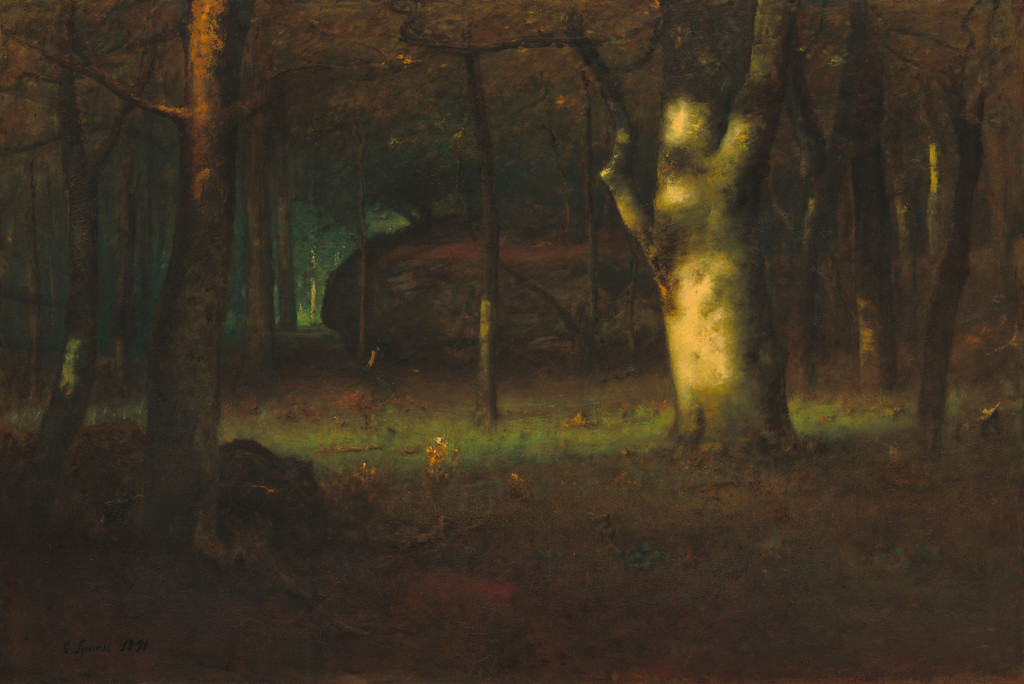
| Sunset in the Woods by George Inness | 1891 | oil on canvas |
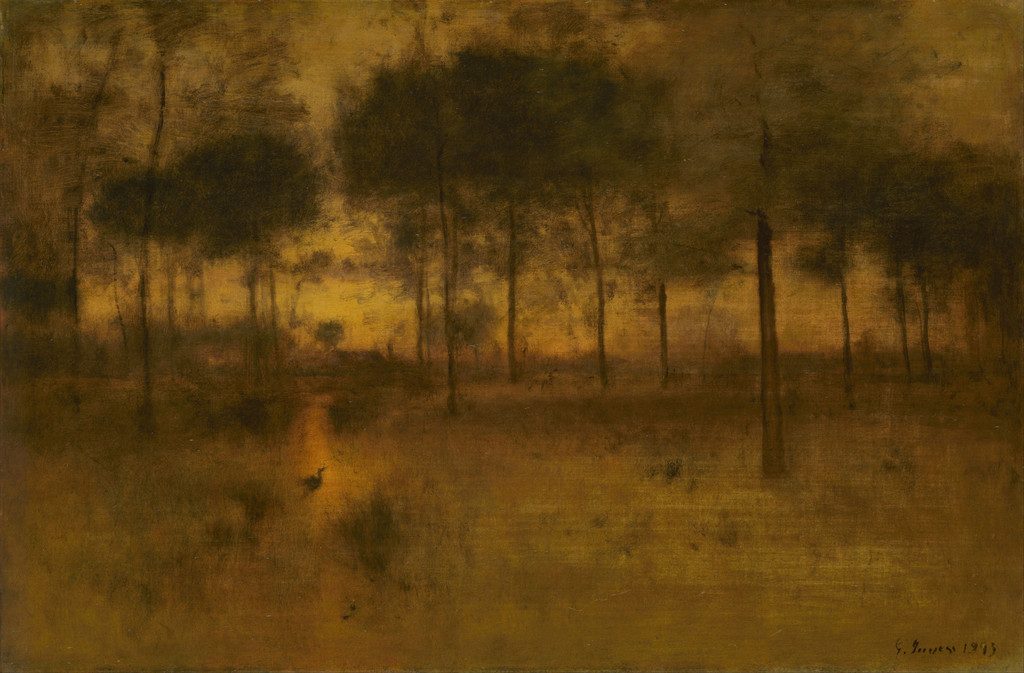
| The Home of the Heron — Princeton University Art Museum (y1943-93) | 1891 | Oil on canvas |
| Threatening | 1891 | Oil on canvas |
| Early Morning, Tarpon Springs | 1892 | Oil on canvas |
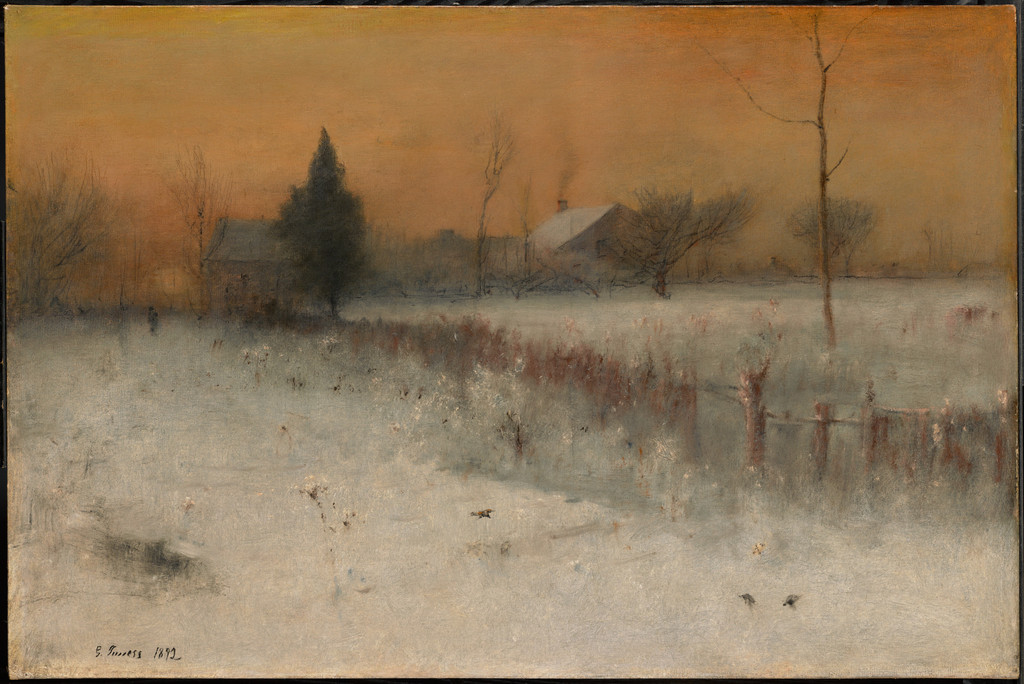
| Home at Montclair by George Inness | 1892 | oil on canvas |
| The Lonely Farm, Nantucket | 1892 | Oil on canvas |
| Afterglow | 1893 | Oil on canvas |
| Sunlit Valley | 1893 | Oil on canvas |
| The Home of the Heron — Art Institute of Chicago (1911.31) | 1893 | Oil on canvas |
| After a Summer Shower | 1894 | Oil on canvas |
| Landscape | n.d. | Watercolor with scraping on ivory wove paper |
Frequently Asked Questions
The principal work is SAAM’s 1889 oil on canvas, accession 1909.7.31, given by William T. Evans.[1]
Jackson identifies it with a Bath Island mill destroyed in 1882, making its appearance in the 1889 canvas a question of memory and interpretation.[2]
The 2012 research note favours that reading, but acknowledges the lack of explicit artist testimony. Jackson’s 2019 account considers several possibilities.[3]
No. It is a smaller oil on wood, accession 1929.6.67, from the Gellatly gift.[4]
Discussion
Look again at the images and ideas explored in Niagara by George Inness. These editorial prompts invite your observations.
Compare smoke rising above the horizon with water falling below it. Then compare the 1885 panel’s blue foreground with the 1889 canvas’s paler near scene. Which boundaries are easiest to find, and which remain open?
Reader Insights
How do the falls and nearer land organise the panorama?
What changes in the separate 1885 wood panel?
How does the visible chimney complicate a simple contrast between nature and industry?
Join the Conversation
Share a detail, comparison or question about Niagara by George Inness below.
References
- Smithsonian American Art Museum, Niagara, accession 1909.7.31. Current identity, support, dimensions and Evans gift.
- Alexander Jackson, “Niagara by George Inness: Familiar and Strange,” SAAM (2 April 2019).
- SAAM, Niagara research notes (June 2012). All three pages examined; industrial interpretation and evidence limits distinguished.
- Smithsonian American Art Museum, Niagara Falls, accession 1929.6.67. Separate 1885 panel; current record and exact public-domain image examined.
- National Gallery of Art, The Lackawanna Valley, accession 1945.4.1.
- Minneapolis Institute of Art, The Mill Stream, Montclair, New Jersey, accession 2000.236.
- Splash image source.
George Inness, Niagara, 1889. Oil on canvas. Smithsonian American Art Museum, 1909.7.31. Gift of William T. Evans; Smithsonian American Art Museum. Image source. Public domain.