 by Tom Gurney
Tom Gurney BSc (Hons) is an art history expert with over 20 years experience
Email: tomgurney1@gmail.com / Phone: +44 7429 011000
The Lackawanna Valley by George Inness: Introduction
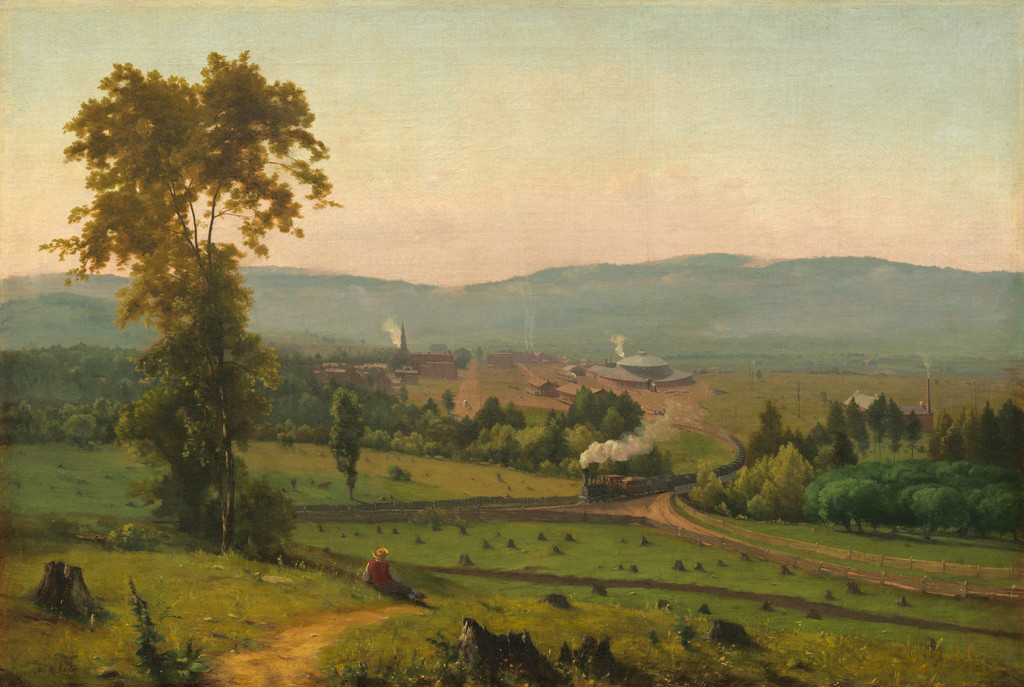
George Inness’s The Lackawanna Valley places a moving train inside a landscape where the work of clearing the ground remains conspicuous. A reclining figure looks towards the railway, while cut stumps interrupt the grassy slope around him. The picture joins the pleasure of a broad valley prospect with evidence of its transformation. Commissioned to advertise the Delaware, Lackawanna and Western Railroad, the oil painting is now dated circa 1856 by the National Gallery of Art. Its historical purpose helps explain the prominent railway buildings; the foreground keeps their relationship with the surrounding land open to interpretation.[1]
At a Glance
- ArtistGeorge Inness (1825–1894)
- TitleThe Lackawanna Valley
- DateCirca 1856
- MediumOil on canvas
- Dimensions86 × 127.5 cm
- CollectionNational Gallery of Art, Washington
- CreditGift of Mrs. Huttleston Rogers
- Accession1945.4.1
- SettingScranton, Pennsylvania
This work across George Inness’s career
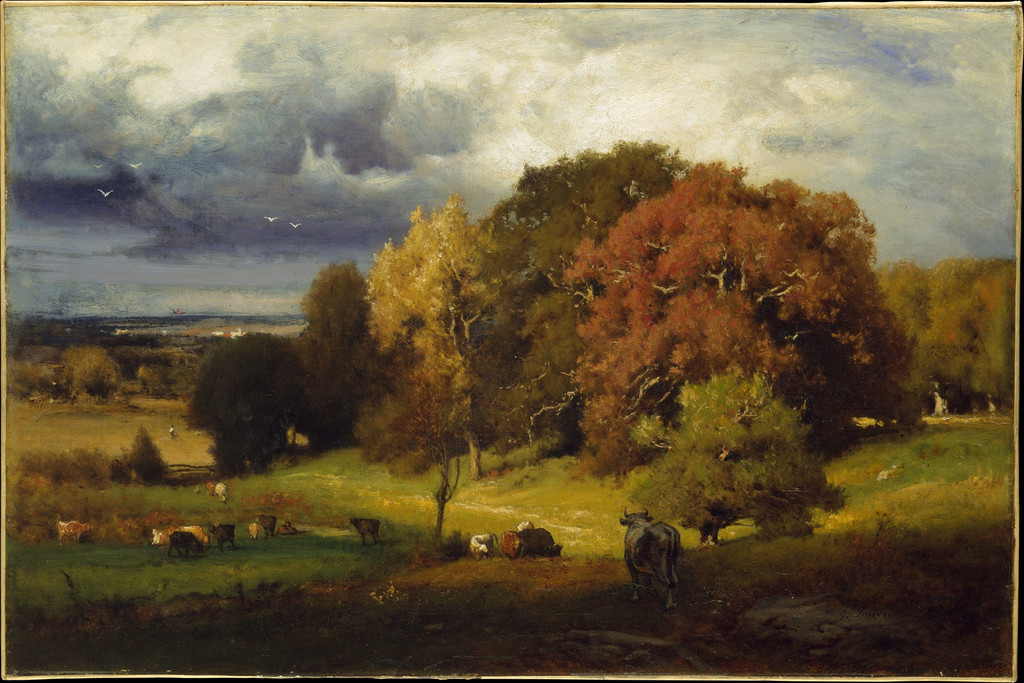
Autumn Oaks by George Inness
ca. 1878Contents
- A view with two centres of attention
- A railway commission and a September 1855 visit
- Following the train into the valley
- The reclining figure and the experience of looking
- Industry, improvement and the visible cost of clearing
- Land history beyond the painted prospect
- Rediscovery, changing titles and the National Gallery
- Comparing other inhabited landscapes
- Annotated details
A view with two centres of attention
The first encounter with the painting can feel remarkably calm. A pale sky rises above distant hills, and a large surviving tree gives the left foreground a sheltered character. The valley stretches away beneath it. The scene offers the visual pleasures of open distance, variations of green and a gradual transition from nearby objects to hazier forms.
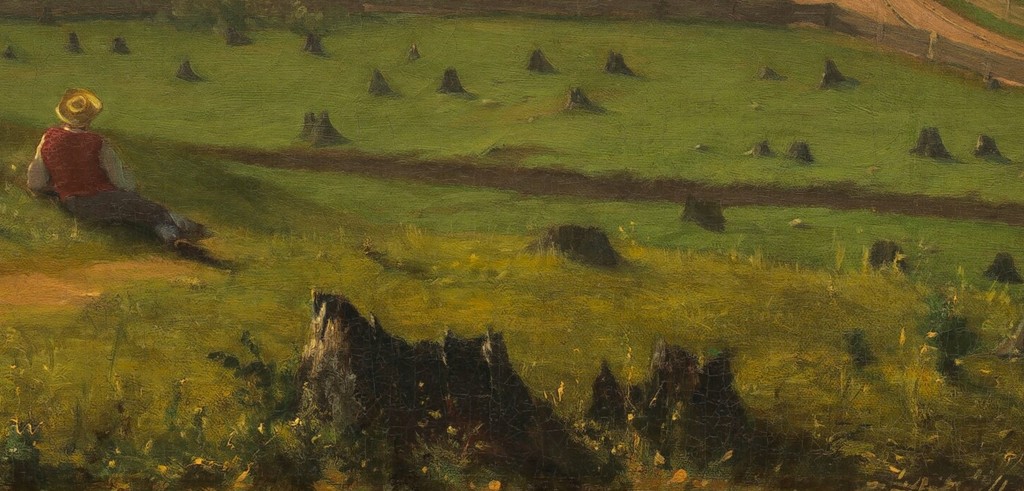
Then the foreground begins to complicate that impression. Short stumps cover the nearer slope; larger, more broken forms stand close to the bottom edge. Their repeated shapes hold the eye low in the picture, interrupting a smooth passage towards the town. They are easy to recognise separately, yet their accumulation makes them part of the scene’s structure. The land has become a field of remnants.
The train supplies a second centre of attention. Its horizontal movement contrasts with the irregular stumps and the upright tree. The curved railway route connects it to the distant buildings, so the machinery appears to belong to an organised network. A viewer can move between the nearby evidence of clearing and the more distant evidence of construction without leaving the same continuous painted space.
That relationship is more revealing than treating the canvas as two unrelated pictures. The green slope, railway, buildings and mountains share the same light. Inness makes the industrial valley visually coherent while allowing its different elements to pull attention in different directions. The scene can attract us before we decide how to judge the changes it represents.
Annotated Details from The Lackawanna Valley
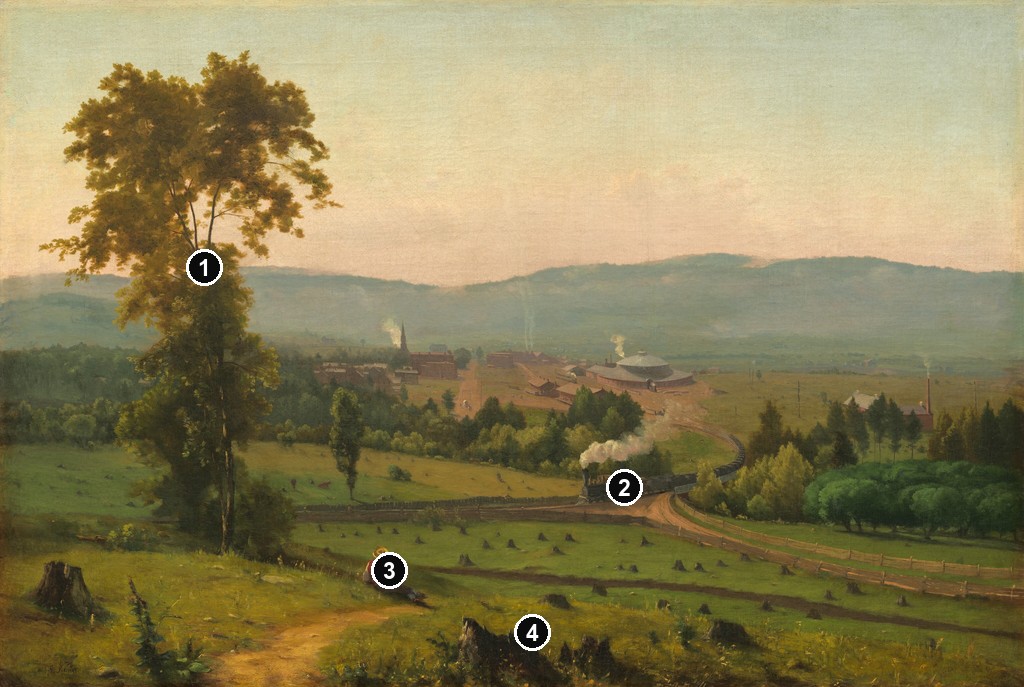
The numbered points identify visible features discussed in this article. Return from each detail to the whole composition. George Inness, The Lackawanna Valley, c. 1856. Oil on canvas. National Gallery of Art, 1945.4.1. Gift of Mrs. Huttleston Rogers; National Gallery of Art. Image source. CC0 / Public domain.
Details from THE LACKAWANNA VALLEY
Compare the cropped details with the complete images above. Notice how their colours, shapes and positions contribute to the larger compositions.
Surviving tree
The intact tree rises from the near slope into the pale sky. Compare its continuous canopy and trunk with the cut wood scattered below.
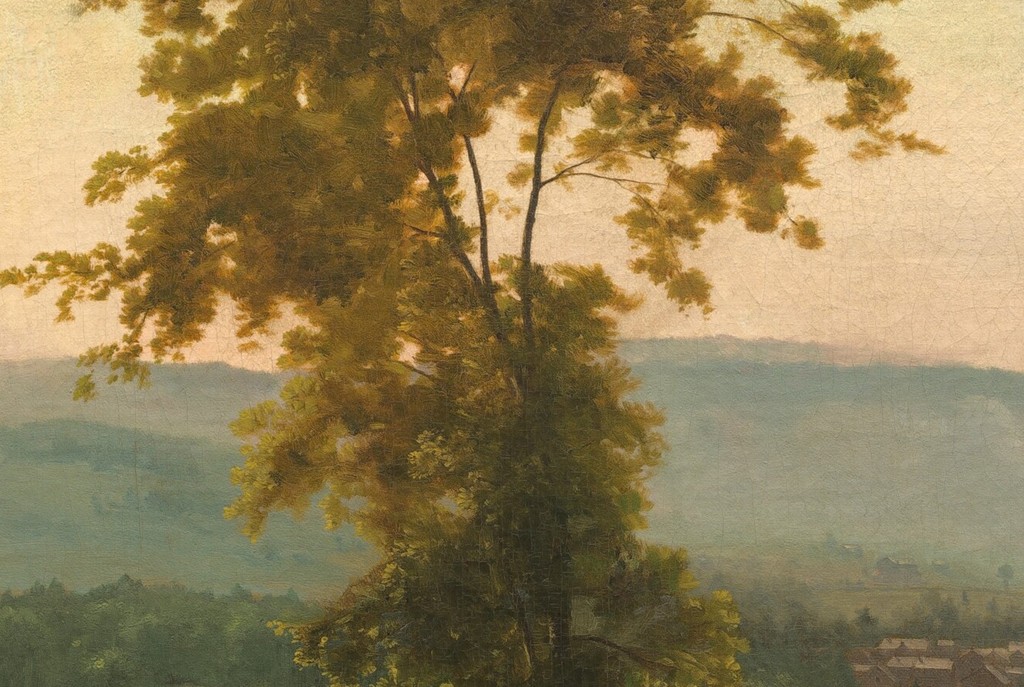
Train and curving track
The train occupies the turn of the railway. Smoke rises above it while the tracks guide attention towards the town and roundhouse.
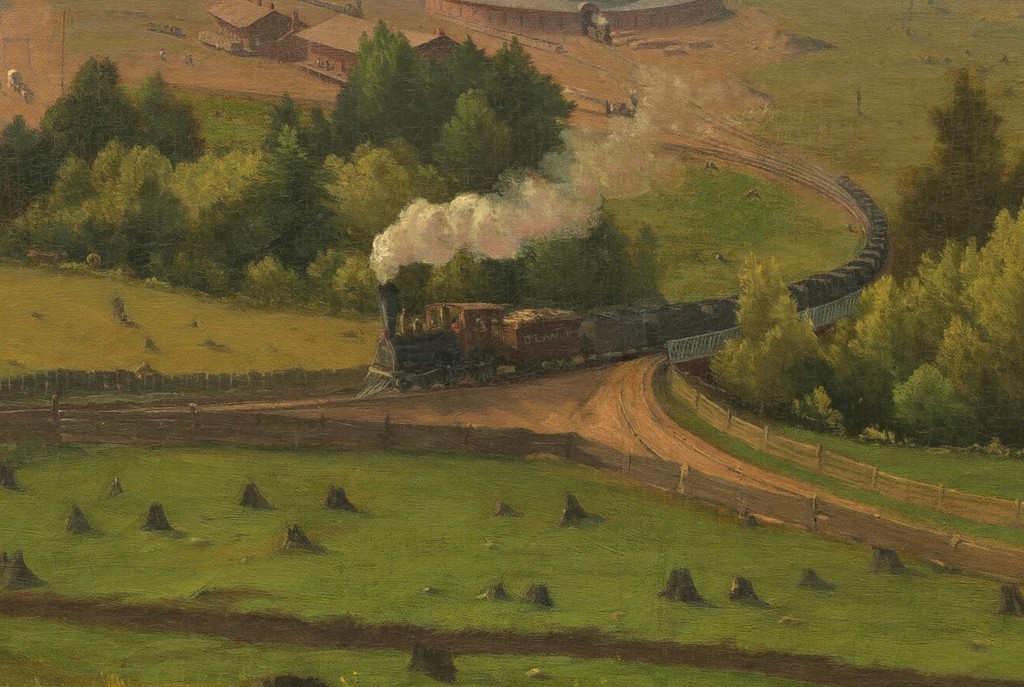
Reclining spectator
A red-clad figure with a light hat lies on the slope above the railway. The small body supplies a scale for the foreground and the distant prospect.
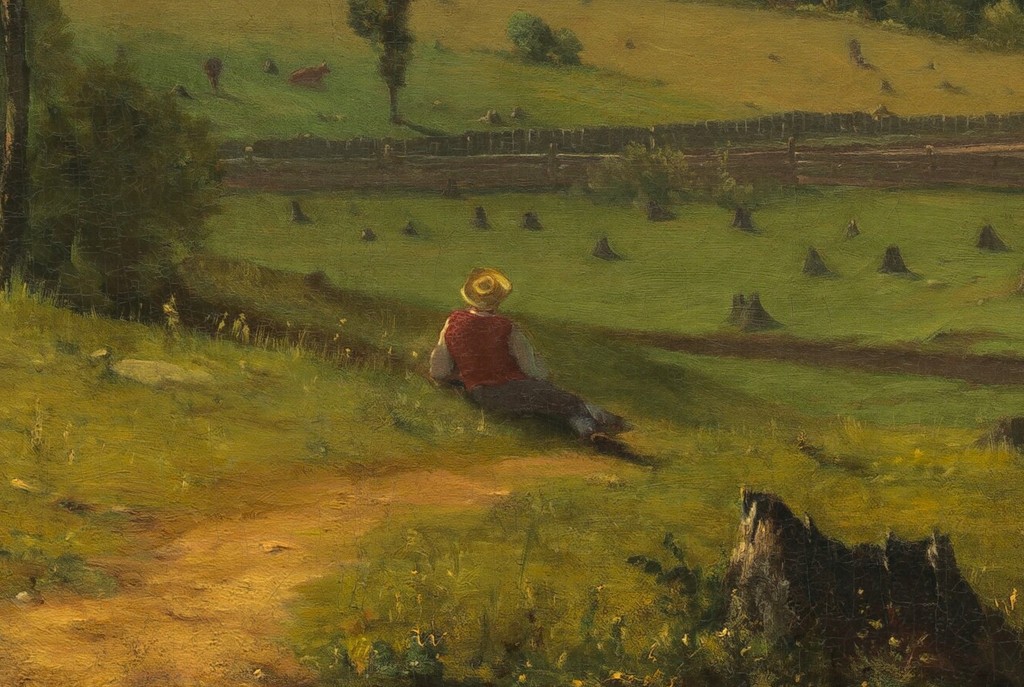
Cut foreground stumps
Dark cut stumps interrupt the nearer green ground. Their irregular silhouettes remain conspicuous below the railway view.
A railway commission and a September 1855 visit
The painting began as a commercial assignment rather than a landscape selected solely for the artist’s private exploration. In Life, Art, and Letters of George Inness, published in 1917, George Inness Jr. describes the purpose as an advertising picture of the railroad’s first roundhouse. His account places a practical need for paid work beside the artist’s difficulties with the commission. The son also reproduces a September 1855 letter written during his father’s Scranton visit.[2]
The letter and the finished object answer different historical questions. The letter documents the visit; it does not establish the exact day on which every part of the canvas was completed. That distinction explains why a familiar date of 1855 can coexist with the NGA’s present dating of circa 1856. Keeping the museum’s approximate date preserves what is known without turning preparation into a falsely precise completion date.[1][2]
The memoir gives an unusually concrete example of the client’s demands. According to the son, only one track then entered the roundhouse, but the railroad president wanted four or five represented because the company expected to build them. Inness protested and eventually complied. This is a retrospective family account, rather than a surviving written instruction from the commissioner, but it identifies an important tension between present observation and promotional expectation.[2]
The requested tracks would advertise capacity as well as describe a place. The landscape could present an anticipated railway system within the appearance of a current view. This makes the painting especially useful for thinking about images commissioned by institutions: an apparently natural prospect may incorporate the ambitions of the organisation paying for it. Careful detail does not automatically guarantee that everything depicted existed together in precisely that form.
The son’s story also complicates any interpretation of Inness as an entirely independent critic standing outside industry. Here he worked for a railroad and adjusted the picture to meet a commercial demand. The presence of stumps can still matter, but their meaning must be assessed within that commission. They cannot simply erase the circumstances under which the picture was made.
Following the train into the valley
The railway route gives the eye a path through the middle distance. It curves away from the industrial buildings and crosses the darker interruption in the ground. The train’s movement is made legible through its long shape and the light smoke behind it. Against the softer landscape, these marks create a relatively concentrated sequence of forms.
The roundhouse remains a different kind of landmark. Its rounded, elevated roof distinguishes it from the lower buildings nearby. The structure can be recognised at a distance, which suits its importance within the commission, without occupying the centre of the canvas as an isolated architectural portrait. Inness makes the building part of a wider settlement and transport system.
The mountains help hold that system in place. Their softened outlines close the far distance, while the higher sky preserves a feeling of openness. The train moves within a valley that seems visually contained. This is one reason the machinery does not immediately overwhelm the landscape: it is set against forms that extend beyond its immediate route.
Closer looking reveals a contrast in the kinds of line that organise the view. Tracks and buildings imply planned connections and measurable shapes. The surviving tree spreads irregularly; the stumps are uneven; the terrain rises and falls. These differences remain visible even where the colours bind the composition together. The picture’s order accommodates the signs of both engineering and organic growth.
The reclining figure and the experience of looking
The small figure beneath the left-hand tree gives the viewer a place from which to approach the prospect. Red clothing makes him relatively easy to locate among the subdued greens and browns. His low posture differs from the tree’s height and the distant train’s horizontal movement. He seems at rest within a scene where transport continues beyond him.
His position offers a connection without supplying an explanation. We can imagine looking from the slope with him, but the painting does not tell us his name, occupation or thoughts. A relaxed posture could accompany pleasure, fatigue, curiosity or reflection. Reading the figure as an observer is useful; assigning him a fully developed opinion requires more evidence than his painted body supplies.
The contrast in pace matters even without that invented narrative. The train suggests purposeful movement from one point to another. The figure encourages a slower attention to the space through which it passes. Inness gives the industrial prospect a spectator inside the scene, allowing the act of looking itself to become part of the composition.
The tree above him also changes the meaning of the nearer stumps. Its branches and foliage demonstrate the scale and complexity of a living tree. The cut forms around it appear reduced by comparison. Yet the standing tree remains a compositional shelter as well as a possible reminder of what has been removed. Those functions can coexist without forcing it into a single symbolic role.
Watch: George Inness
Choose a film to explore the artist’s work, its interpretation and its wider setting.
The Montclair Art Museum's George Inness Gallery
Visit the George Inness Gallery at the Montclair Art Museum in this State of the Arts feature.
Watch on YouTubeIndustry, improvement and the visible cost of clearing
The NGA’s account of the painting connects the railway with markets for Pennsylvania coal and describes the cleared ground as evidence of industrial development. Its 2023 article invites viewers to consider whether the landscape celebrates railway construction or draws attention to its losses. The museum presents that unresolved choice as one reason the work continues to engage readers and visitors.[1][3]
The painting supports the question because neither part of the scene is visually absent. The railway appears integrated into an attractive valley. The stumps remain extensive and close enough to resist being overlooked. If the artist had placed them only in the hazy distance, their disruptive effect would be weaker. Their position near the viewer makes clearing a condition of the view rather than a footnote to it.
At the same time, the scene supplies no written verdict. The train is neither painted as a monstrous intruder nor removed from the natural world by a theatrical division. The buildings and slopes participate in the same atmosphere. A reading concerned with environmental loss is persuasive when it begins with the visible contrast; it becomes less secure when it claims to recover an exact unrecorded statement by the artist.
The commission and the foreground therefore need to be considered together. The railroad wanted a useful promotional picture. Inness produced one in which industrial ambition could be seen amid the consequences of altering the land. The lasting force of the painting lies partly in that conjunction: its evidence supports questions that exceed the narrow purpose for which it was ordered.
Land history beyond the painted prospect
The NGA identifies the Lackawanna Valley as Lenni-Lenape homeland before European arrival and explains the name through a Lenape term referring to a stream that forks. This adds historical depth to a view often discussed principally through the arrival of a railway.[1]
The painting’s visible settlement and transport infrastructure represent one stage in the valley’s history. They do not make the land’s earlier occupation disappear. Recognising that longer history changes the questions a reader brings to the canvas: whose activity is visible, which histories are absent, and what does the elevated prospect encourage us to regard as the dominant story of the place?
This is a present-day historical context supplied by the museum, rather than proof that Inness intended a specific argument about Indigenous rights. Keeping that distinction clear strengthens the reading. We can consider what the painting leaves outside its chosen view while remaining precise about the evidence for the artist’s commission and the motifs he actually included.
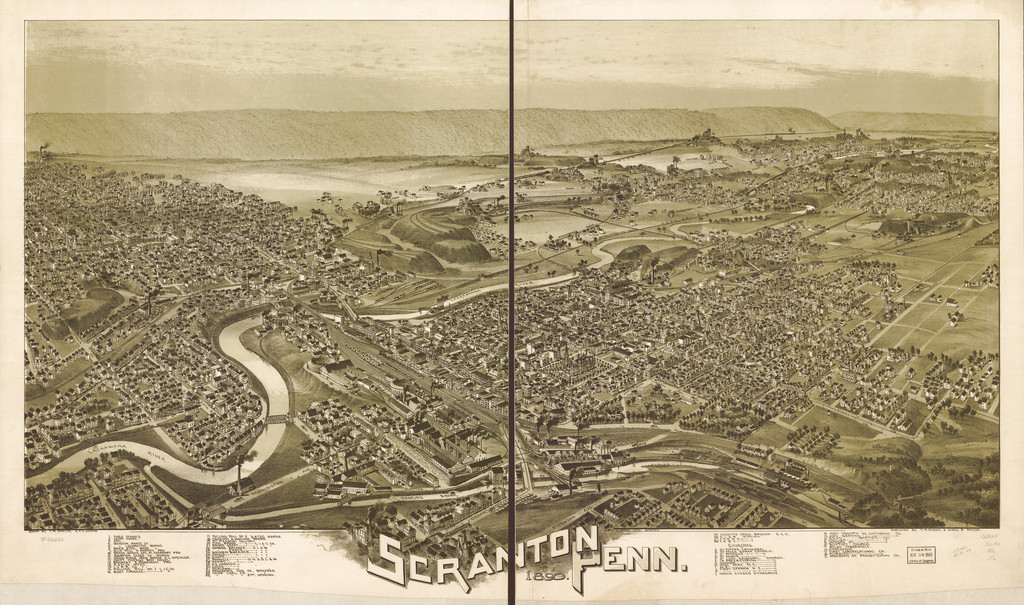
Scranton, Penn. 1890. Perspective bird’s-eye map, not drawn to scale, by T. M. Fowler, A. E. Downs and James B. Moyer. This later city view dates about 34 years after Inness’s circa 1856 painting; it does not reproduce the earlier commission site. Library of Congress, Geography and Map Division; public-domain faithful reproduction via Commons. Image source. Public domain.
Rediscovery, changing titles and the National Gallery
The son’s memoir describes a second encounter with the canvas many years after its making. Inness and his wife found it in a shop in Mexico, where it had arrived among office furnishings. The account says that he bought it back, remembering his frustration with the original commission. It does not give an exact purchase price, so the frequently retold monetary detail is unnecessary to the story.[2]
That rediscovery links two different kinds of value. What had been made to serve a company could later interest the artist as a surviving object from his earlier working life. The son’s account makes recollection central to the purchase. It also reminds us how easily a landscape can lose the institutional context that first explained its subject.
The current NGA provenance records the artist’s ownership from 1891, inheritance by his daughter in 1894 and later auction and dealer transactions. Those sale records used the descriptive title The First Roundhouse of the D. L. and W. R. R. at Scranton. The wording directs attention towards the very building that motivated the commission, rather than the broader valley named in the title now familiar to viewers.[1]
The canvas entered the National Gallery in 1945 through Millicent Rogers’s gift, recorded under the name Mrs. Huttleston Rogers. Its institutional identity now makes the object, credit and collection history available alongside the image. Readers can move from the son’s memorable account to the museum’s documented ownership sequence without treating either as a substitute for the other.[1]
Comparing other inhabited landscapes
Inness’s earlier The Old Mill, dated 1849 by the Art Institute of Chicago, places a working building, water and small figures within a wooded setting. The mill is embedded in the scene rather than presented as a separate architectural study. This comparison shows that inhabited and worked landscapes were already part of his painting before the Scranton railway assignment.[4]
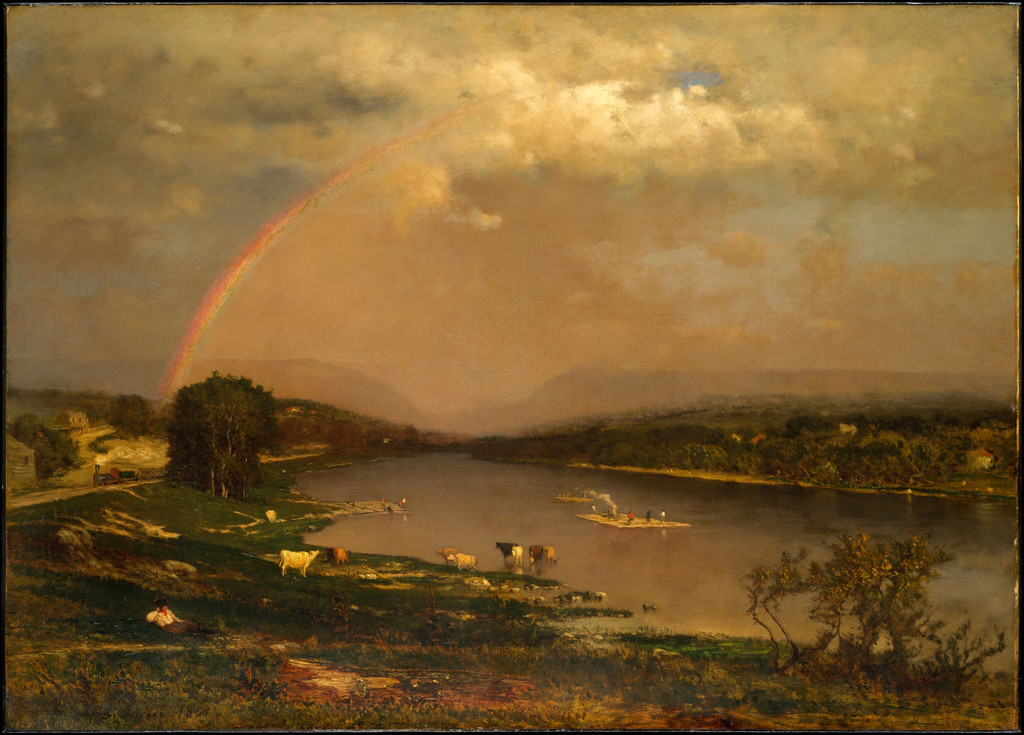
The Met’s Delaware Water Gap of 1861 offers a different prospect in which transport and cultivated life remain visible. Its train follows the river, while boats or rafts and foreground activity occupy the water and banks. Looking between the two paintings helps distinguish a shared interest in movement through landscape from a claim that every industrial detail carries an identical message.[5]
Much later, The Mill Stream, Montclair, New Jersey, circa 1888, includes an industrial tower within a more atmospheric wooded view. Minneapolis Institute of Art identifies the structure with Samuel Crump’s printing company. The warm building and luminous water remain connected by the surrounding trees, even as the overall handling differs from the clearer arrangement of the early valley.[6]
Together, these comparisons make Inness’s development easier to see. Industry persists as a possible element of landscape, but its scale, position and pictorial treatment change. The Lackawanna Valley remains distinctive because the commercial commission, anticipated railway tracks, reclining spectator and foreground stumps all converge in one view. Returning to the original image after those comparisons reveals how carefully its competing interests are held together.
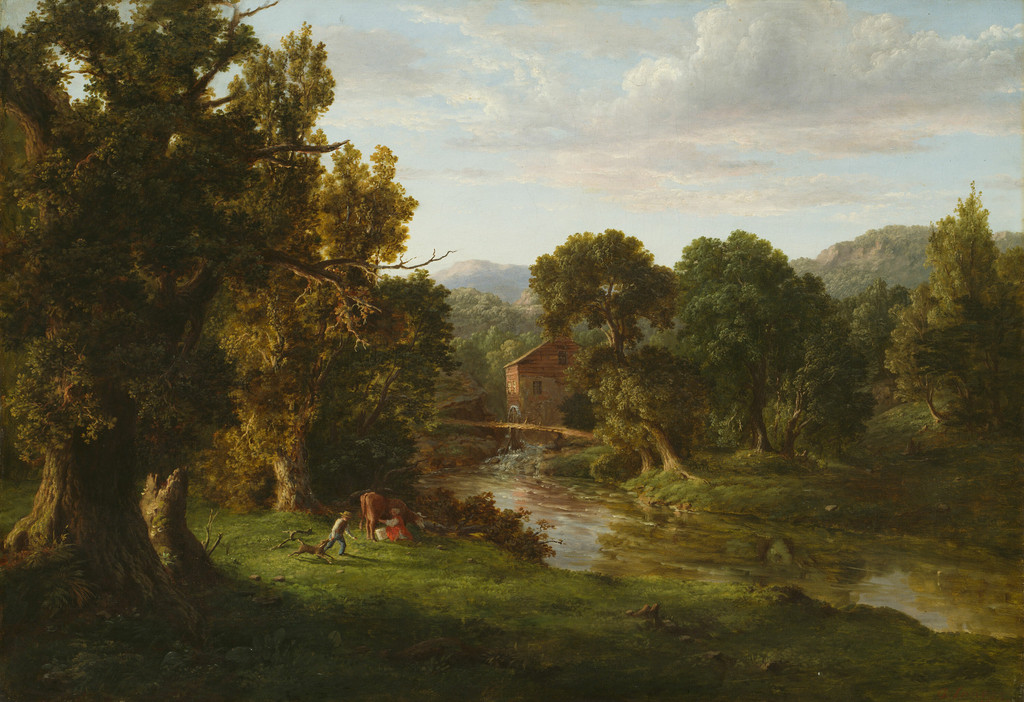
George Inness, The Old Mill, 1849. Oil on canvas. Art Institute of Chicago, 1939.388. The William Owen Goodman and Erna Sawyer Goodman Collection; Art Institute of Chicago. Image source. Public domain.
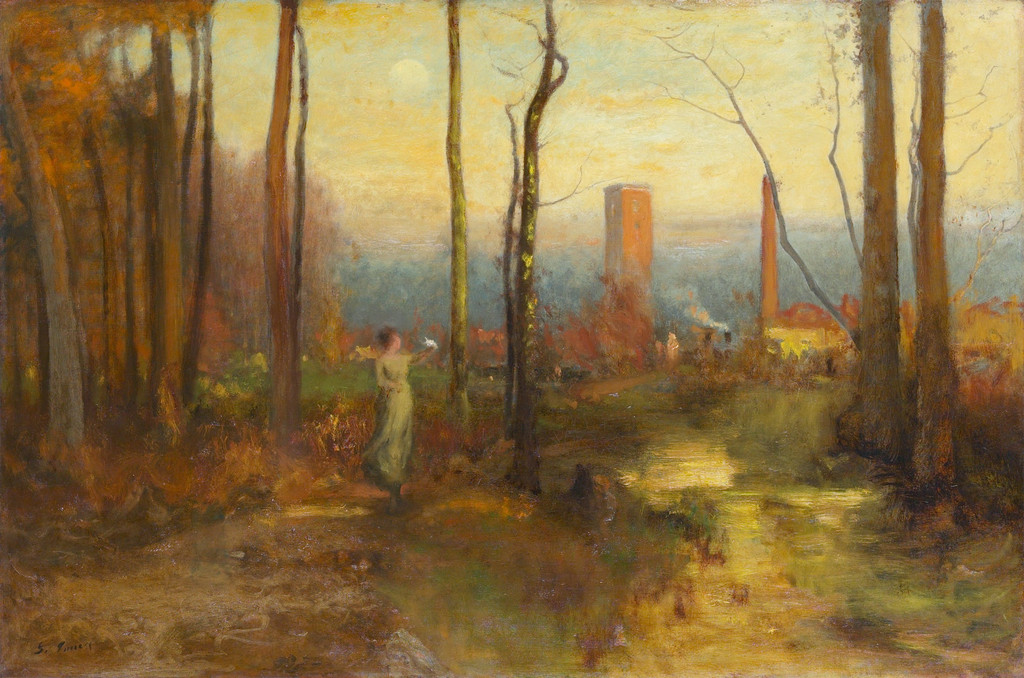
George Inness, The Mill Stream, Montclair, New Jersey, c.1888. Oil on canvas. Minneapolis Institute of Art, 2000.236. Gift of Don and Diana Lee Lucker; Minneapolis Institute of Art. Image source. Public domain.
Artworks directory
A collected selection of 46 individually identified museum objects: 43 paintings and three watercolours. This is not a complete catalogue raisonné. Repeated titles identify separate objects where their institutions or accessions differ. Links lead to a companion article where available, otherwise to the museum record. Unillustrated entries remain included; the original lost New Jerusalem is represented by its three transformed survivors.
| Name | Date | Medium |
|---|---|---|
| Crossing the Ford | 1848 | Oil on canvas |
| The Old Mill | 1849 | Oil on canvas |
| The Lackawanna Valley by George Inness | c. 1856 | oil on canvas |
| Delaware Water Gap | 1861 | Oil on canvas |
| Delaware Valley | c. 1865–75 | Oil on artist's board |
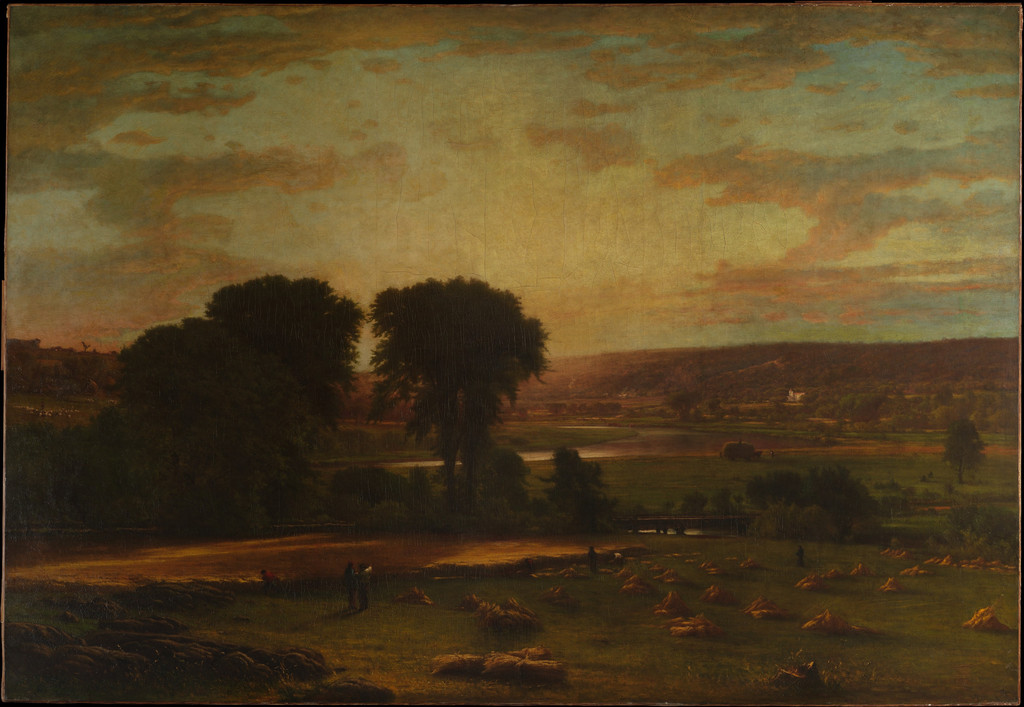
| Peace and Plenty | 1865 | Oil on canvas |
| Evening Landscape | 1867; later reworked | Oil on canvas |
| Summer in the Catskills | 1867 | Oil on canvas |
| The Valley of the Olives | 1867; reworked after 1880 | Oil on canvas |
| The Valley of the Shadow of Death | 1867 | Oil on canvas |
| Visionary Landscape | 1867/1880 | Oil on canvas |
| Catskill Mountains | 1870 | Oil on canvas |
| Across the Campagna | 1872 | Watercolor, gouache, and graphite on off-white wove paper |
| Olive Trees at Tivoli | 1873 | Gouache, watercolor, and graphite on blue wove paper with colored fibers |
| A Marine | c. 1874–75 | Oil on canvas |
| Twilight in Italy — Art Institute of Chicago (1911.44) | 1874 | Oil on panel |
| Pine Grove of the Barberini Villa | 1876 | Oil on canvas |
| The Storm | 1876 | Oil on canvas |
| Autumn Oaks | ca. 1878 | Oil on canvas |
| The Sisters | 1882 | Oil on millboard |
| Harvest, Montclair, New Jersey | 1884 | Oil on canvas |
| Niagara Falls | 1885 | Oil on wood |
| A Silver Morning | 1886 | Oil on canvas |
| Landscape, Sunset | 1887–89 | Oil on canvas |
| September Afternoon | 1887 | Oil on canvas |
| Sunrise | 1887 | Oil on canvas |
| The Mill Stream, Montclair, New Jersey by George Inness | c. 1888 | Oil on canvas |
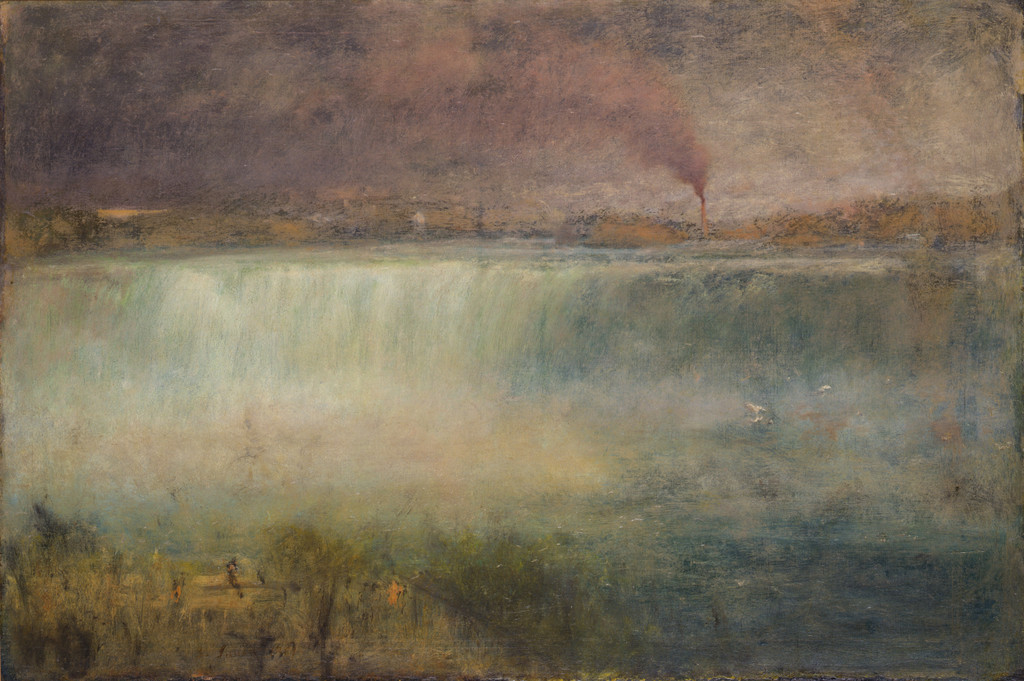
| Niagara by George Inness | 1889 | oil on canvas |
| The Mill Pond | 1889 | Oil on canvas |
| Sunset in the Valley | 1890 | Oil on canvas |
| The Moon at Night | 1890 | Oil on canvas |
| Twilight in Italy — Art Institute of Chicago (1911.42) | 1890 | Oil on canvas |
| Autumn Woods | 1891–94 | Oil on canvas |
| Moonrise | 1891 | Oil on canvas |
| Spring Blossoms, Montclair, New Jersey | ca. 1891 | Oil and crayon or charcoal on canvas |
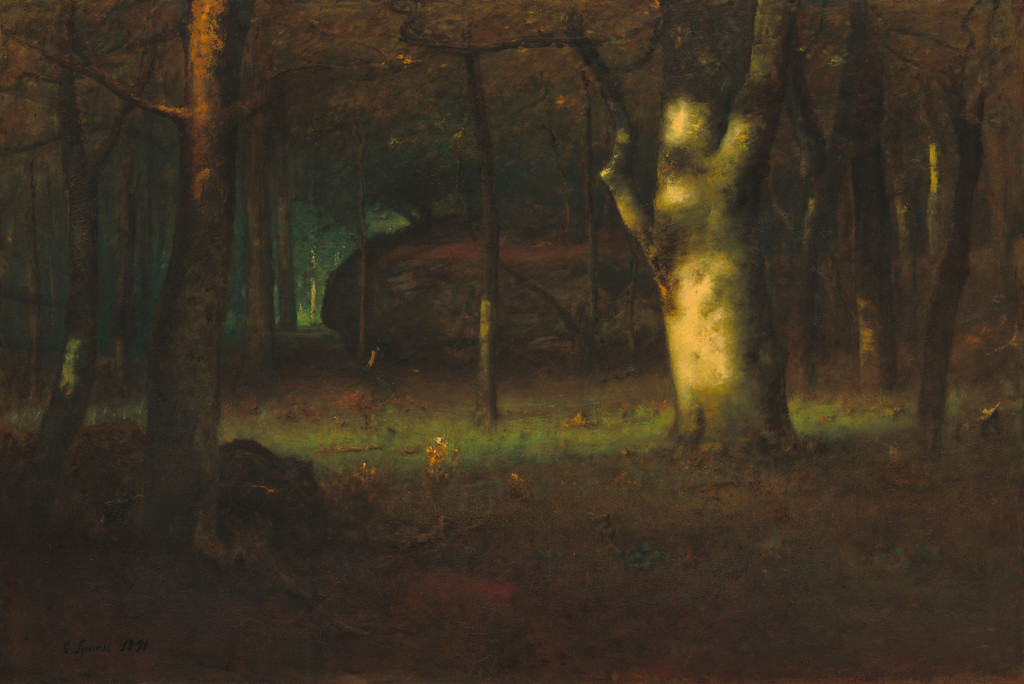
| Sunset in the Woods by George Inness | 1891 | oil on canvas |
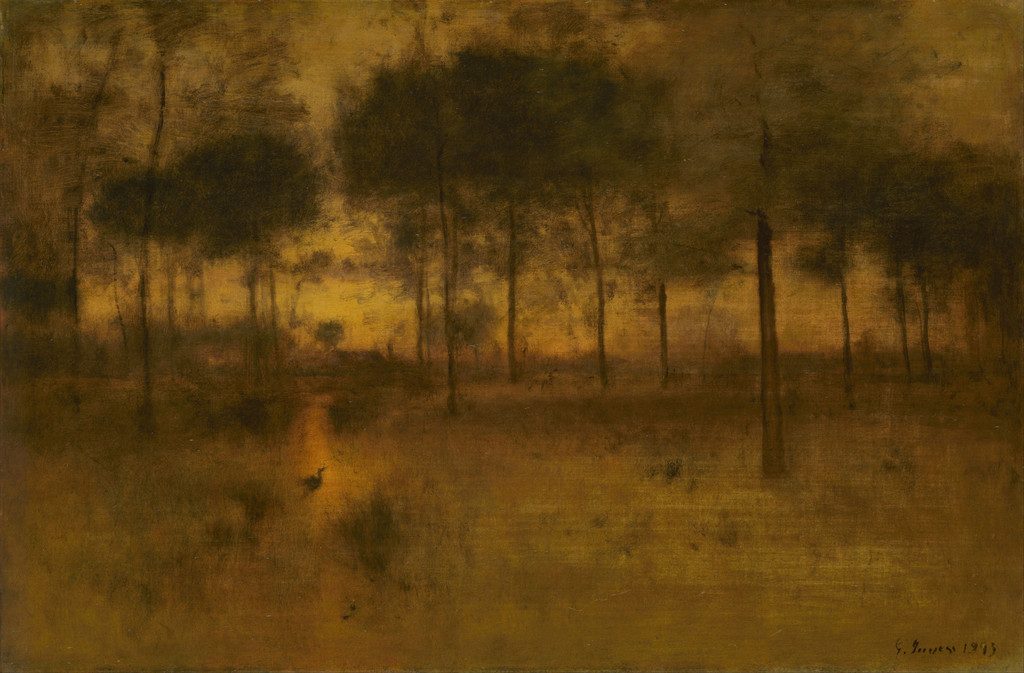
| The Home of the Heron — Princeton University Art Museum (y1943-93) | 1891 | Oil on canvas |
| Threatening | 1891 | Oil on canvas |
| Early Morning, Tarpon Springs | 1892 | Oil on canvas |
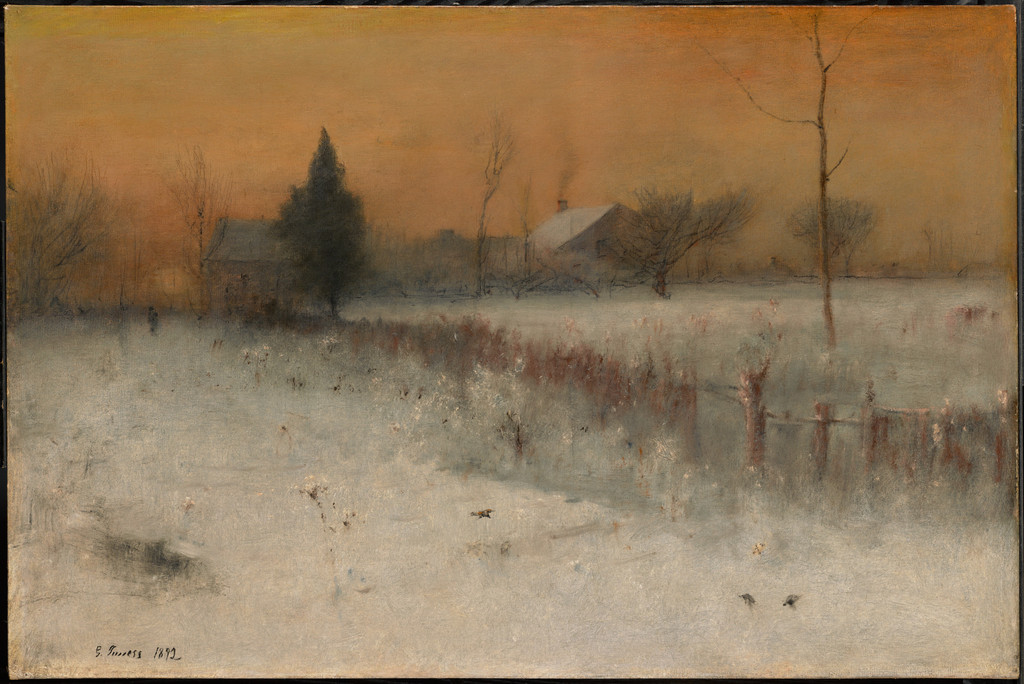
| Home at Montclair by George Inness | 1892 | oil on canvas |
| The Lonely Farm, Nantucket | 1892 | Oil on canvas |
| Afterglow | 1893 | Oil on canvas |
| Sunlit Valley | 1893 | Oil on canvas |
| The Home of the Heron — Art Institute of Chicago (1911.31) | 1893 | Oil on canvas |
| After a Summer Shower | 1894 | Oil on canvas |
| Landscape | n.d. | Watercolor with scraping on ivory wove paper |
Frequently Asked Questions
The Delaware, Lackawanna and Western Railroad commissioned an advertising landscape featuring its first roundhouse at Scranton.[2]
His identity is not established in the sources used here. His position invites viewers to look across the valley with him; his thoughts remain open to interpretation.
It belongs to the National Gallery of Art in Washington, accession 1945.4.1. Check the museum’s current record before planning a visit.[1]
Discussion
Look again at the images and ideas explored in The Lackawanna Valley by George Inness. These editorial prompts invite your observations.
Start with the foreground stumps, then follow the railway towards the roundhouse. How does that order of looking differ from beginning with the train? Consider whether the quiet figure changes your response to a view originally commissioned for advertising.
Reader Insights
How do the cut stumps and surviving tree change your route into the valley?
What changes when the later mill stream is compared with the railway prospect?
What does the 1890 map add while keeping its later date distinct?
Join the Conversation
Share a detail, comparison or question about The Lackawanna Valley by George Inness below.
References
- National Gallery of Art, The Lackawanna Valley, current object record, provenance and interpretation.
- George Inness Jr., Life, Art, and Letters of George Inness (1917), printed pp.108 and 111. The reproduced letter and the son’s retrospective commission and rediscovery accounts were checked against the printed scans.
- National Gallery of Art, “Rediscovering George Inness’s ‘The Lackawanna Valley’” (2023).
- Art Institute of Chicago, The Old Mill, accession 1939.388.
- Metropolitan Museum of Art, Delaware Water Gap, accession 32.151.
- Minneapolis Institute of Art, The Mill Stream, Montclair, New Jersey, accession 2000.236.
- Splash image source.
George Inness, The Lackawanna Valley, c.1856. Oil on canvas, 86 × 127.5 cm. National Gallery of Art, 1945.4.1. Gift of Mrs. Huttleston Rogers; National Gallery of Art. Image source. CC0 / Public domain.