 by Tom Gurney
Tom Gurney BSc (Hons) is an art history expert with over 20 years experience
Email: tomgurney1@gmail.com / Phone: +44 7429 011000
Delaware Water Gap by George Inness: Introduction
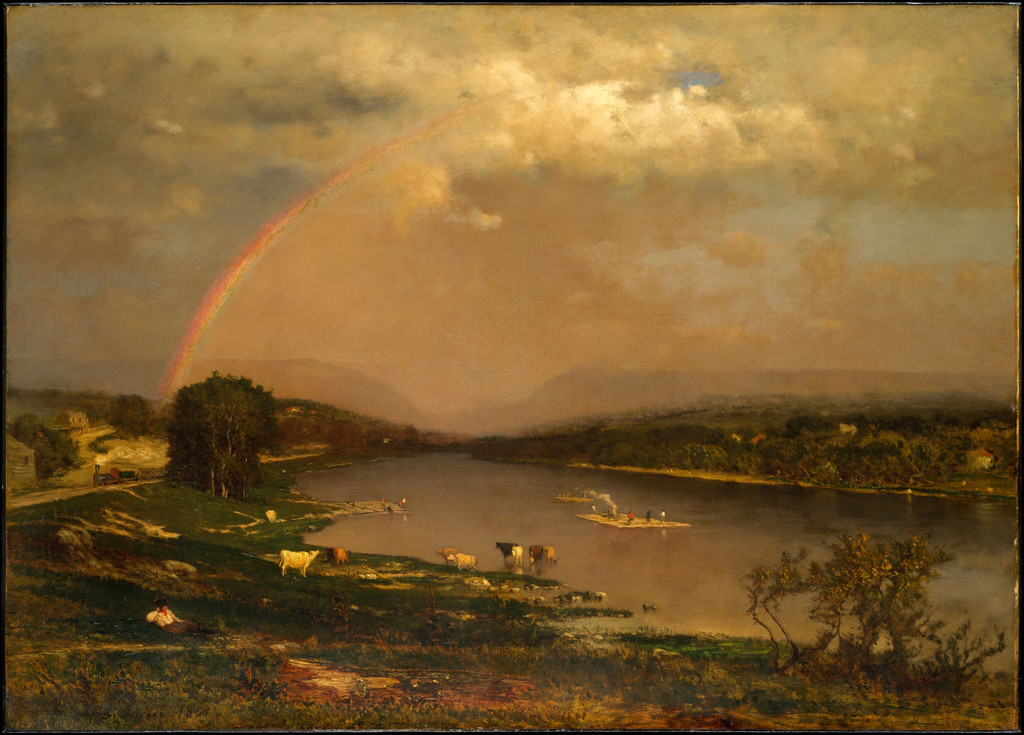
A rainbow rises above a river in George Inness’s Delaware Water Gap. Below it, cattle stand at the water’s edge, people work on loaded river craft, and a steam train follows the left bank. These small activities belong to the panorama as fully as its mountains and changing clouds. The Metropolitan Museum of Art dates this oil painting to 1861. It is accession 32.151, acquired through the Morris K. Jesup Fund in 1932.[1]
At a Glance
- ArtistGeorge Inness (1825–1894)
- TitleDelaware Water Gap
- Date1861
- MediumOil on canvas
- Dimensions91.4 × 127.6 cm
- CollectionMetropolitan Museum of Art, New York
- CreditMorris K. Jesup Fund, 1932
- Accession32.151
This work across George Inness’s career
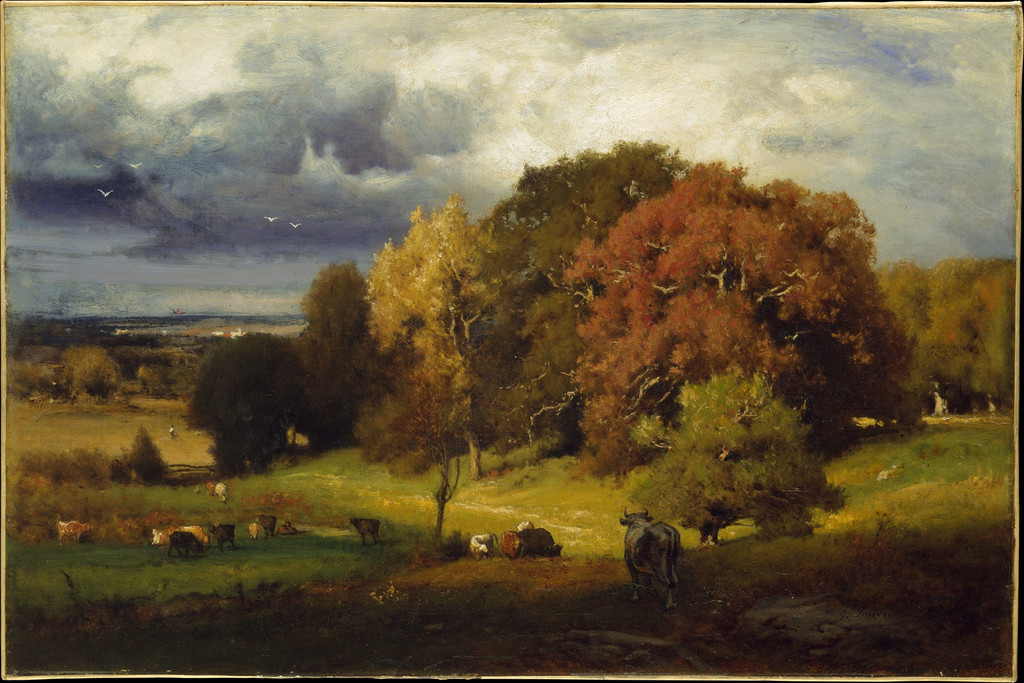
Autumn Oaks by George Inness
ca. 1878Contents
- Following the river into the distance
- Weather across an inhabited panorama
- The rainbow and the tree group
- The train at the left edge
- River work and foreground cattle
- Joe Baker’s perspective on Lenapehoking
- The 1861 canvas within Inness’s career
- Comparing railways and settled landscapes
- Annotated details
Following the river into the distance
The river opens broadly across the lower middle of the composition, then narrows towards the gap between distant mountains. Its shape provides a route into the view. The near bank curves out from the left, giving the water a definite edge before the more distant shores become less distinct.
This arrangement lets the eye move through several scales of landscape. Cattle and rough vegetation occupy the foreground. River craft lie farther into the scene. Houses and fields extend along the banks, while the mountain forms close the distance. The painting connects these intervals through the river rather than presenting each as a separate view.
The near ground is more varied than the broad water. Dark vegetation, pale paths, reddish timber and small figures interrupt its surface. These differences make the bank feel close. Across the river, the farther shore is more compressed, with buildings and vegetation gathered into a narrower band.
The mountains have a quieter presence than their size might suggest. Their outlines remain visible, but their muted tones let them recede into the atmosphere. The view therefore moves from more emphatic foreground marks towards a less sharply articulated distance. The river offers continuity through that change.
Annotated Details from Delaware Water Gap
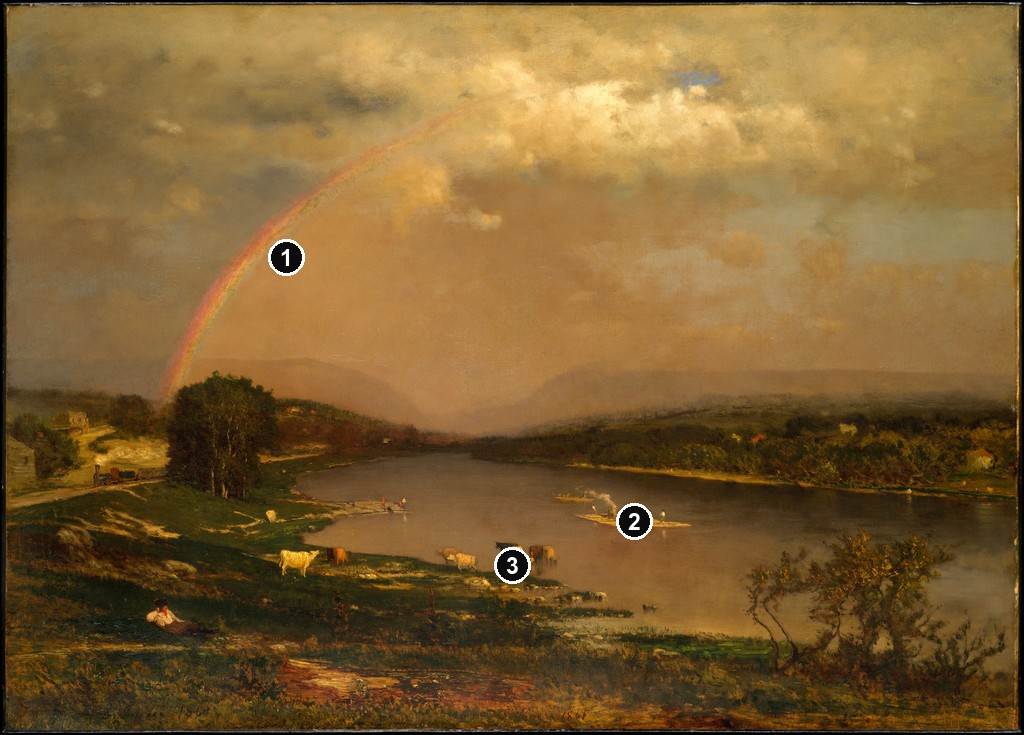
The numbered points identify visible features discussed in this article. Return from each detail to the whole composition. George Inness, Delaware Water Gap, 1861. Oil on canvas. Met, 32.151. Morris K. Jesup Fund, 1932; Metropolitan Museum of Art. Image source. Public domain.
Details from DELAWARE WATER GAP
Compare the cropped details with the complete images above. Notice how their colours, shapes and positions contribute to the larger compositions.
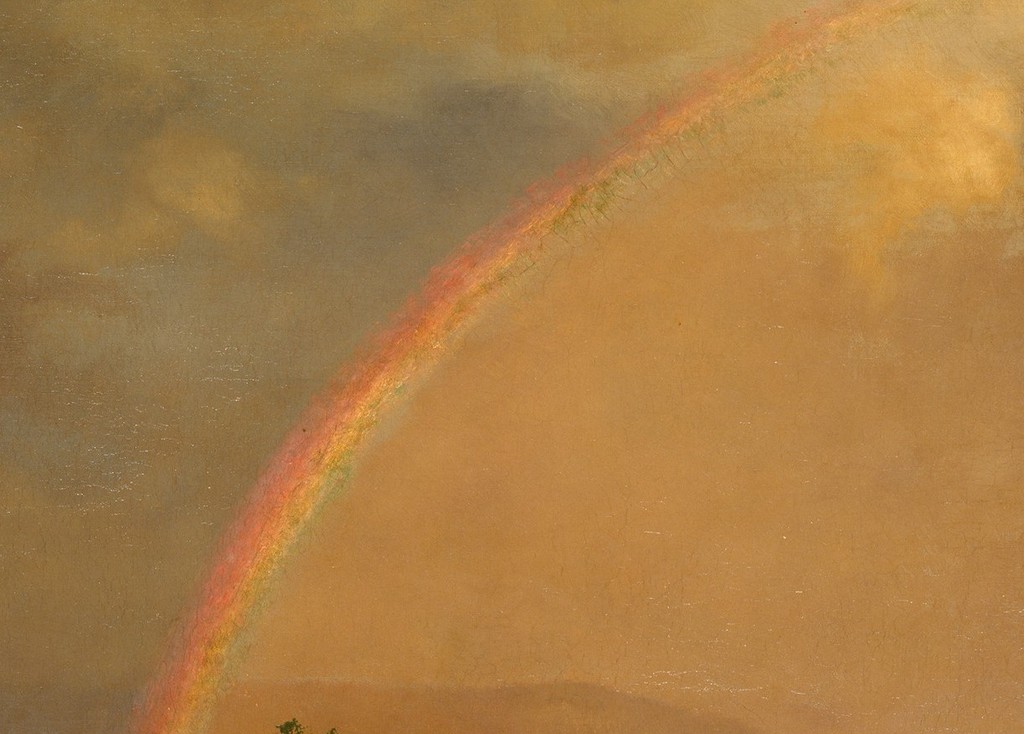
Rainbow over the valley
The coloured arc descends towards the left landscape. Its broad curve connects the sky with the land and differs from the river’s flatter movement.
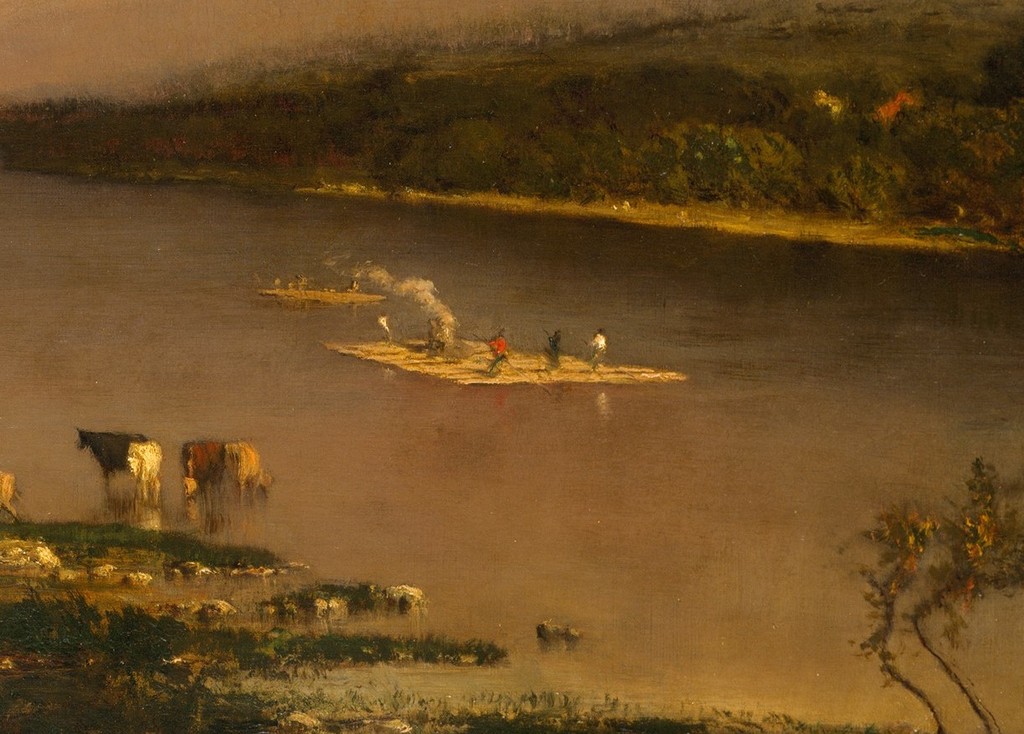
Loaded river vessels
Small vessels and their loads occupy the river. Their modest scale makes commerce part of the expansive prospect.
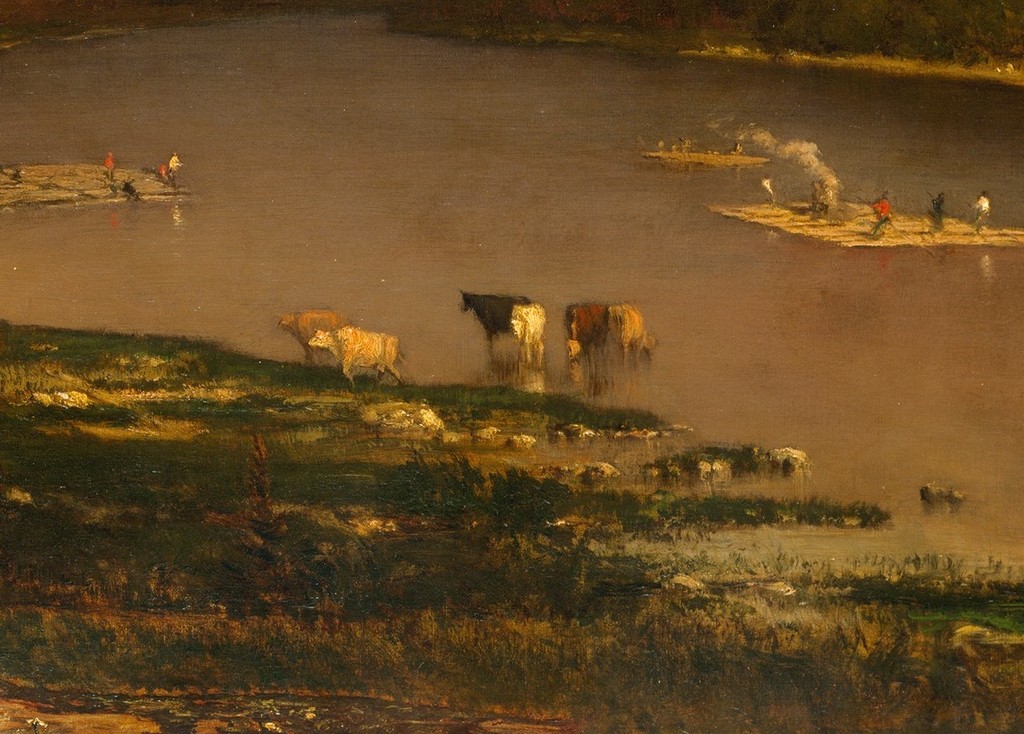
Cattle near the water
Cattle stand along the nearer bank and shallows. Their pale and dark forms distinguish this inhabited foreground from the hazier mountains.
Weather across an inhabited panorama
Cloud fills much of the upper half. A darker bank lies towards the left, while warmer, more luminous passages spread towards the centre and right. The Met describes the scene as a passing storm accompanied by a rainbow.[1] The image makes changing weather a compositional event, with unequal light across the sky and land.
The brightest cloud passage draws attention above the river’s distant narrowing. Looking between these areas links light in the sky with recession below. The painting’s most spacious interval is therefore also one of its most luminous. The effect depends on placement as much as brightness.
Darkness remains active elsewhere. Trees on the nearer left bank and vegetation along the foreground give the brighter passages something to stand against. The river also carries broad grey and brown tones rather than reflecting the sky as an evenly brilliant surface. Those differences keep the weather from becoming a uniform golden wash.
The storm’s movement cannot be reconstructed precisely from the painted cloud. Its visible consequence is a changing relation of light and shadow. For a viewer, following that relation across the width of the canvas is more useful than treating every cloud as evidence of one exact meteorological moment.
The rainbow and the tree group
The rainbow curves upward from the left side, close to a substantial group of trees, and fades as it crosses the cloud. Its colour remains relatively delicate within the broad warm sky. It can be overlooked at first, then become a major route through the composition once found.
The tree mass gives the rainbow’s lower end a darker setting. The foliage is dense enough to establish a distinct form against the atmosphere, while its individual edges remain irregular. This contrast makes the pale arc easier to follow without isolating it from the surrounding view.
The arc also redirects attention. Starting at the train, the eye can rise past the trees towards the sky, then return to the river. Starting with the light above the distant gap produces another sequence. The picture accommodates both, allowing weather and commerce to share the same field of attention.
A rainbow can invite broader associations with hope or renewal. Here, the reviewed evidence supplies no statement by Inness assigning it one exact theological meaning. The visible relation between arc, cloud, tree and river remains a strong basis for looking before any symbolic interpretation is proposed.
The train at the left edge
The steam engine is small and partly sheltered by the foreground arrangement. Its pale plume makes it easier to locate against the darker bank. Once noticed, it changes the scene: this is a landscape through which mechanical transport passes, alongside pasture and river work.
The train’s modest scale matters. It neither fills the foreground nor stands apart as the sole subject. Its route runs laterally beside the water, while the river leads into the distance. These different directions give the composition more than one kind of movement.
The nearby structures and pale ground help the engine belong to an inhabited bank. Transport appears within a network of other land uses. The view’s calm therefore does not depend on removing signs of activity. It depends on arranging them within a continuous panorama.
Look at the train after spending time with the rainbow. One is a small, material sign of movement along the bank; the other makes a broad arc across the sky. Their difference in scale and direction helps explain how the painting can sustain both a pastoral first impression and a more complicated account of the place.
River work and foreground cattle
Loaded craft cross the river’s middle area, with small standing figures visible aboard. The low platforms and cargo extend horizontally across the water. Their shape differs from the train’s more compact form, but both introduce organised movement into the scene.
The figures provide scale without becoming portraits. Their different positions and small colour accents distinguish them from the cargo and water. The reproduction supports an account of their placement; it does not identify individual workers or tell us the destination of a particular load.
Nearer the viewer, cattle stand along the bank and in shallow water. Their pale and dark coats produce a sequence of low forms across the foreground. The animals connect the more substantial near ground with the broad river, making the transition between the two less abrupt.
The cattle also create a rhythm different from the river craft. Some face one way, some another, and their grouping spreads attention along the shore. A nearby seated figure and cut timber add further signs of human use. These details make the land visibly occupied and worked, even while the weather remains the panorama’s most expansive feature.
Watch: George Inness
Choose a film to explore the artist’s work, its interpretation and its wider setting.
The Montclair Art Museum's George Inness Gallery
Visit the George Inness Gallery at the Montclair Art Museum in this State of the Arts feature.
Watch on YouTubeJoe Baker’s perspective on Lenapehoking
In the Met’s Native Perspectives programme, Joe Baker of the Delaware Tribe of Indians responds to this painting as a view of Lenapehoking, the Lenape homeland. He contrasts its peaceful commerce with the history of forced Lenape removal to Oklahoma, Wisconsin and Canada. His account describes colonial violence and exploitation, then connects those histories with continuing environmental threats.[2]
Baker’s contemporary response changes the question a viewer can ask of the scene. Alongside examining what the painting includes, it becomes necessary to consider whose history its apparent calm leaves outside the frame. This is Baker’s stated perspective on the work, rather than an 1861 declaration by Inness.[2]
The distinction allows the image and response to remain specific. The train, cattle and loaded craft are visible. Their place within a tranquil panorama can be examined directly. Baker supplies a historical and present-day framework for considering that tranquillity, extending attention beyond the activities represented on the canvas.
The seated foreground figure offers a different position from the workers aboard the river craft. Set low among vegetation, the figure seems apart from the central activity. Its light clothing catches attention against the darker bank, while its small size leaves the panorama dominant. This placement makes room for an observer within a scene that also contains work.
Cut timber extends across the lower ground in warmer red-brown tones. The horizontal marks echo the low shapes of the river cargo, making a visual connection across the foreground and water. Their proximity invites a viewer to consider land use while keeping the precise commercial transaction open: the image does not establish that these particular logs belong to a particular vessel.
The 1861 canvas within Inness’s career
Adrienne Baxter Bell places Delaware Water Gap within the period following Inness’s move to Medfield, Massachusetts, in 1860. She relates its handling to his growing interest in Dutch and Barbizon landscape painting. Her account situates the canvas within a developing practice that valued expressive painting and spiritual ideas.[3]
That context helps explain why the work is useful in a career overview. It combines an extensive, recognisable prospect with strong atmospheric relationships. The objects can still be found individually, yet the weather and distribution of light give the scene a character that exceeds an inventory of its contents.
The Met records that Inness painted views of the Delaware Water Gap between 1857 and 1891.[1] This makes the subject a recurring interest. Date, holding institution and accession are therefore essential when discussing a particular version; another canvas’s ownership or measurements cannot be transferred to this one.
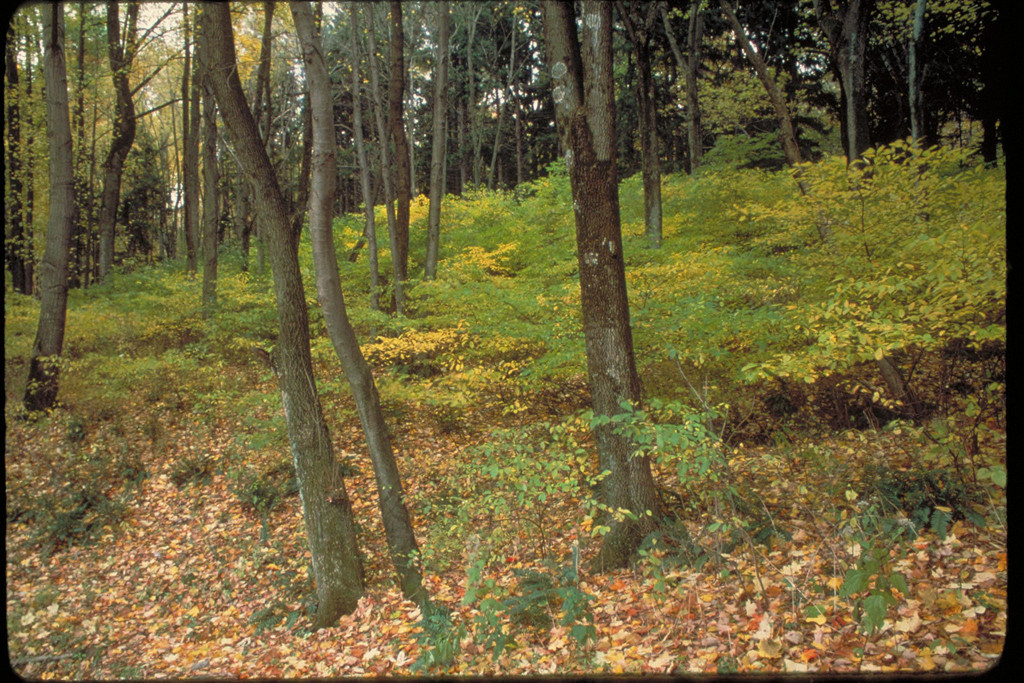
Forest undergrowth in Delaware Water Gap National Recreation Area. NPS staff photograph, content dated 1980–1999. Regional woodland context; this is not Inness’s exact 1861 river viewpoint. National Park Service, NPS staff; public domain. Image source. Public domain.
Comparing railways and settled landscapes
The Lackawanna Valley, dated circa 1856 by the National Gallery of Art, offers a railway comparison. It was commissioned for the Delaware, Lackawanna and Western Railroad.[4] Its train, roundhouse and conspicuous stumps make industrial change more prominent within the view. The railway here occupies a smaller interval along the riverbank.
The contrast is especially clear if the foregrounds are compared first. Stumps interrupt the Lackawanna field, while cattle, vegetation and cut timber spread along the Delaware bank. Both pictures contain signs of human alteration, but the distribution of those signs gives them a different force.
Catskill Mountains of 1870, in the Art Institute of Chicago, includes a church and cultivated land beneath a mountain prospect.[5] Compare those settled forms with the train and barges here. Inness’s landscape can contain buildings, work and atmospheric distance together, while each canvas gives them a particular balance.
Return finally to the rainbow and follow its relation to the river. The panorama holds weather, transport and pasture within one view. The different routes through its sky, banks and water let those activities emerge gradually.
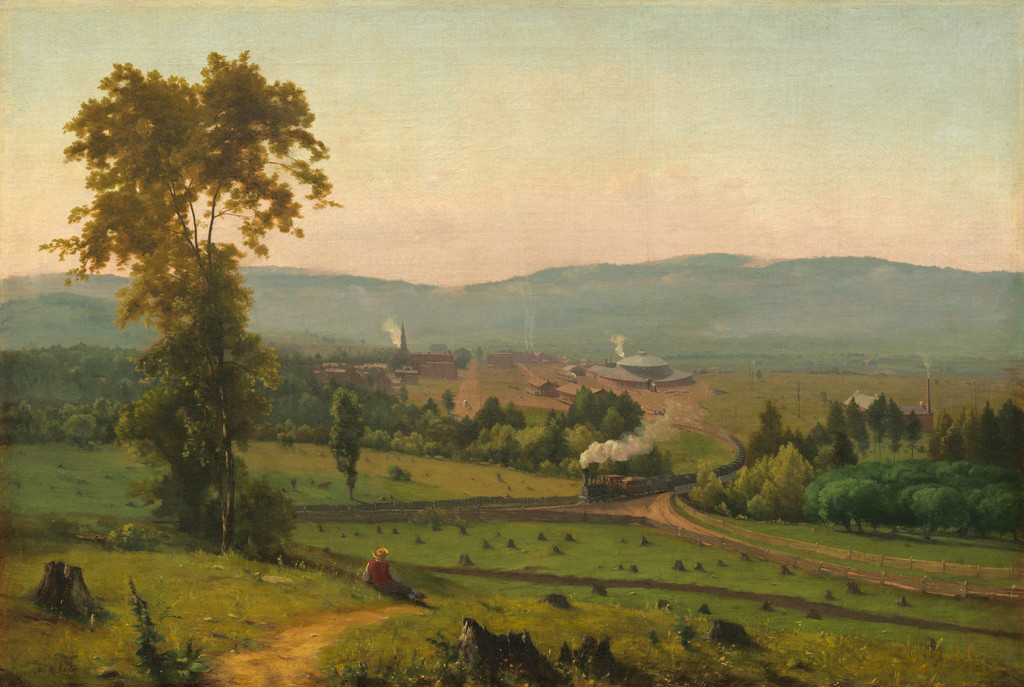
George Inness, The Lackawanna Valley, c. 1856. Oil on canvas. National Gallery of Art, 1945.4.1. Gift of Mrs. Huttleston Rogers; National Gallery of Art. Image source. CC0 / Public domain.
Artworks directory
A collected selection of 46 individually identified museum objects: 43 paintings and three watercolours. This is not a complete catalogue raisonné. Repeated titles identify separate objects where their institutions or accessions differ. Links lead to a companion article where available, otherwise to the museum record. Unillustrated entries remain included; the original lost New Jerusalem is represented by its three transformed survivors.
| Name | Date | Medium |
|---|---|---|
| Crossing the Ford | 1848 | Oil on canvas |
| The Old Mill | 1849 | Oil on canvas |
| The Lackawanna Valley by George Inness | c. 1856 | oil on canvas |
| Delaware Water Gap | 1861 | Oil on canvas |
| Delaware Valley | c. 1865–75 | Oil on artist's board |
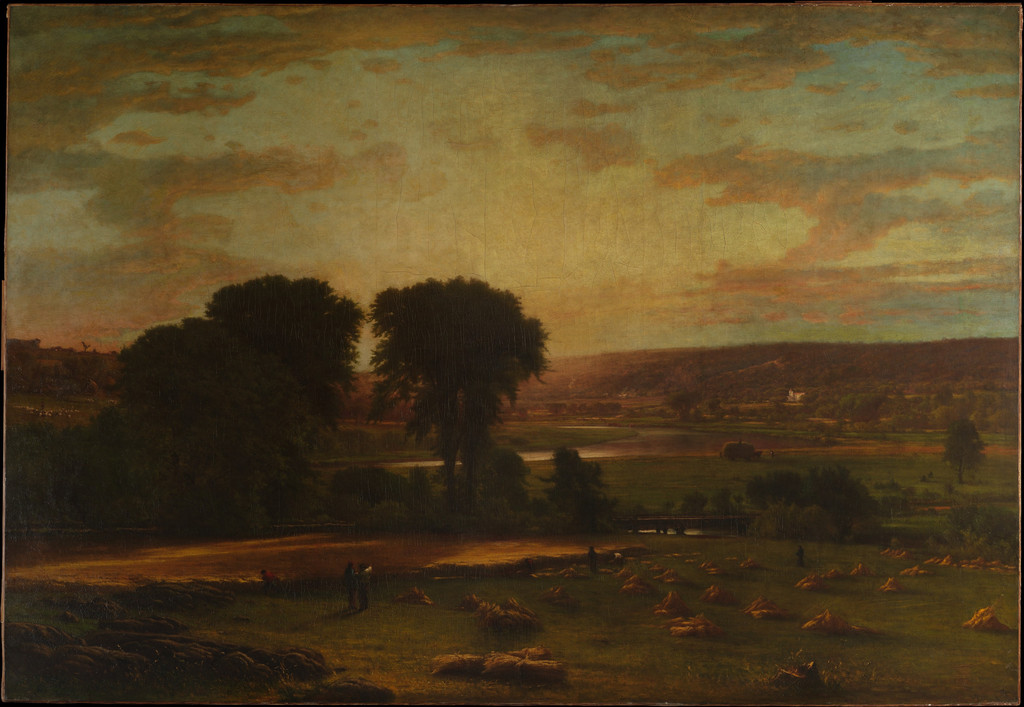
| Peace and Plenty | 1865 | Oil on canvas |
| Evening Landscape | 1867; later reworked | Oil on canvas |
| Summer in the Catskills | 1867 | Oil on canvas |
| The Valley of the Olives | 1867; reworked after 1880 | Oil on canvas |
| The Valley of the Shadow of Death | 1867 | Oil on canvas |
| Visionary Landscape | 1867/1880 | Oil on canvas |
| Catskill Mountains | 1870 | Oil on canvas |
| Across the Campagna | 1872 | Watercolor, gouache, and graphite on off-white wove paper |
| Olive Trees at Tivoli | 1873 | Gouache, watercolor, and graphite on blue wove paper with colored fibers |
| A Marine | c. 1874–75 | Oil on canvas |
| Twilight in Italy — Art Institute of Chicago (1911.44) | 1874 | Oil on panel |
| Pine Grove of the Barberini Villa | 1876 | Oil on canvas |
| The Storm | 1876 | Oil on canvas |
| Autumn Oaks | ca. 1878 | Oil on canvas |
| The Sisters | 1882 | Oil on millboard |
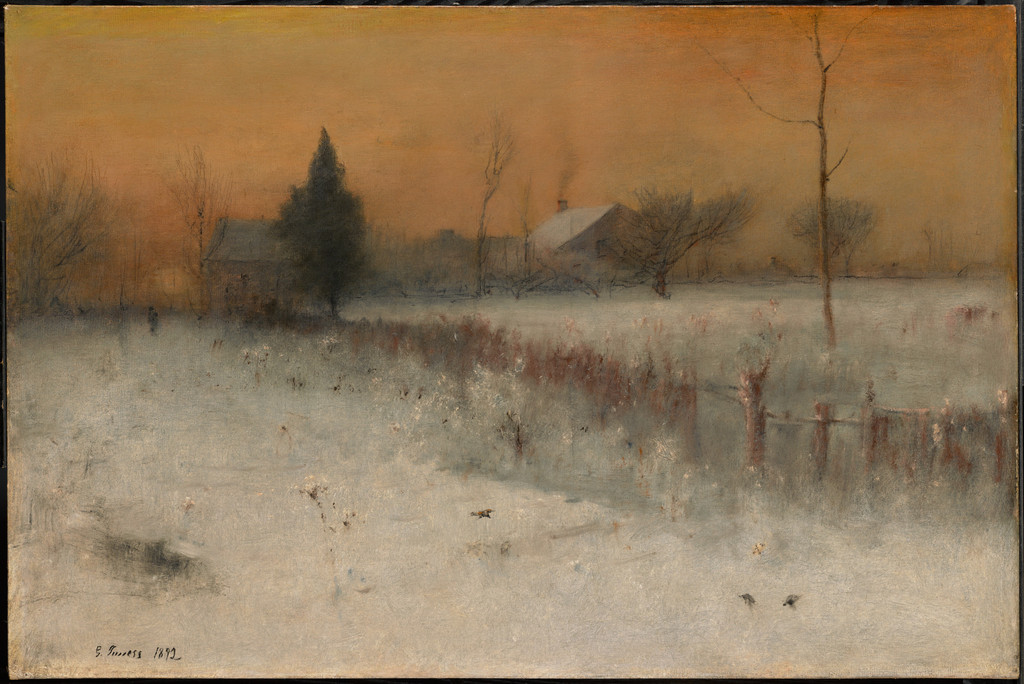
| Harvest, Montclair, New Jersey | 1884 | Oil on canvas |
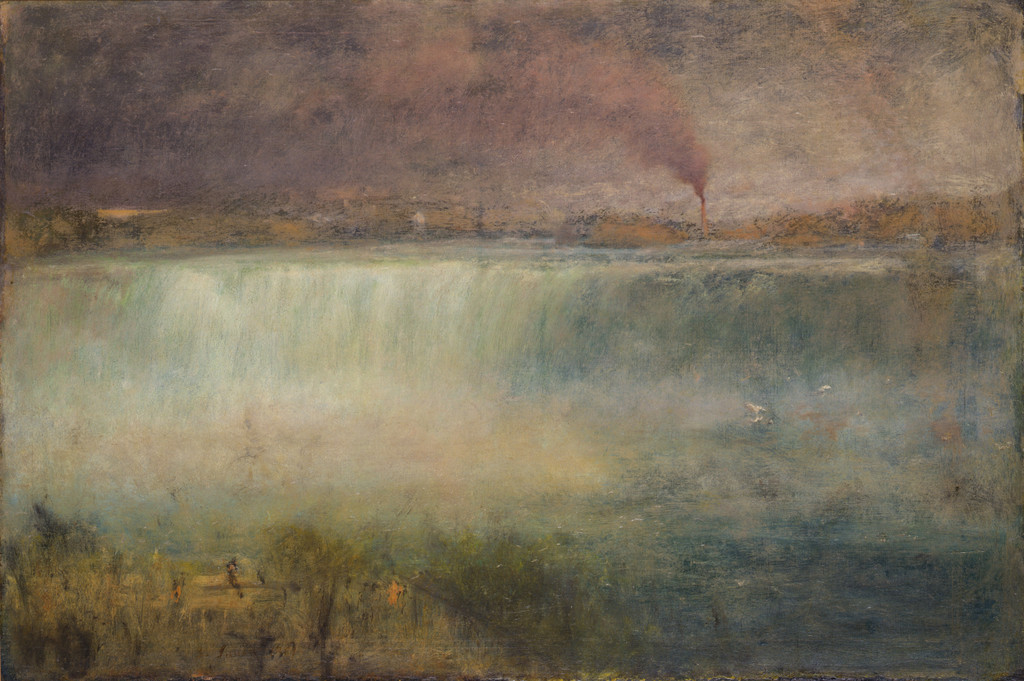
| Niagara Falls | 1885 | Oil on wood |
| A Silver Morning | 1886 | Oil on canvas |
| Landscape, Sunset | 1887–89 | Oil on canvas |
| September Afternoon | 1887 | Oil on canvas |
| Sunrise | 1887 | Oil on canvas |
| The Mill Stream, Montclair, New Jersey by George Inness | c. 1888 | Oil on canvas |
| Niagara by George Inness | 1889 | oil on canvas |
| The Mill Pond | 1889 | Oil on canvas |
| Sunset in the Valley | 1890 | Oil on canvas |
| The Moon at Night | 1890 | Oil on canvas |
| Twilight in Italy — Art Institute of Chicago (1911.42) | 1890 | Oil on canvas |
| Autumn Woods | 1891–94 | Oil on canvas |
| Moonrise | 1891 | Oil on canvas |
| Spring Blossoms, Montclair, New Jersey | ca. 1891 | Oil and crayon or charcoal on canvas |
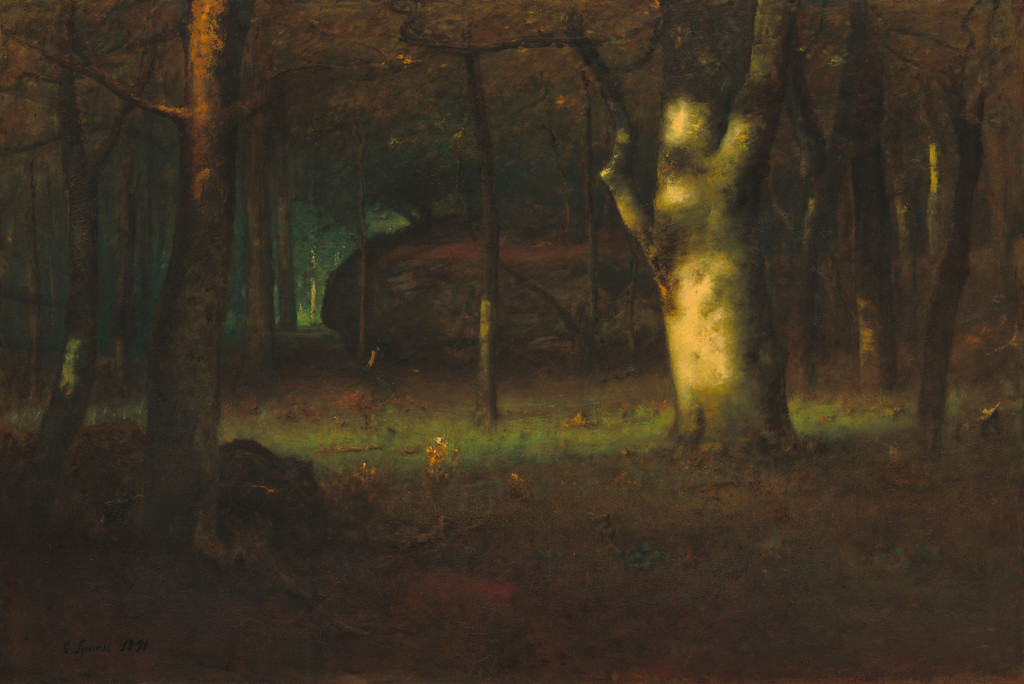
| Sunset in the Woods by George Inness | 1891 | oil on canvas |
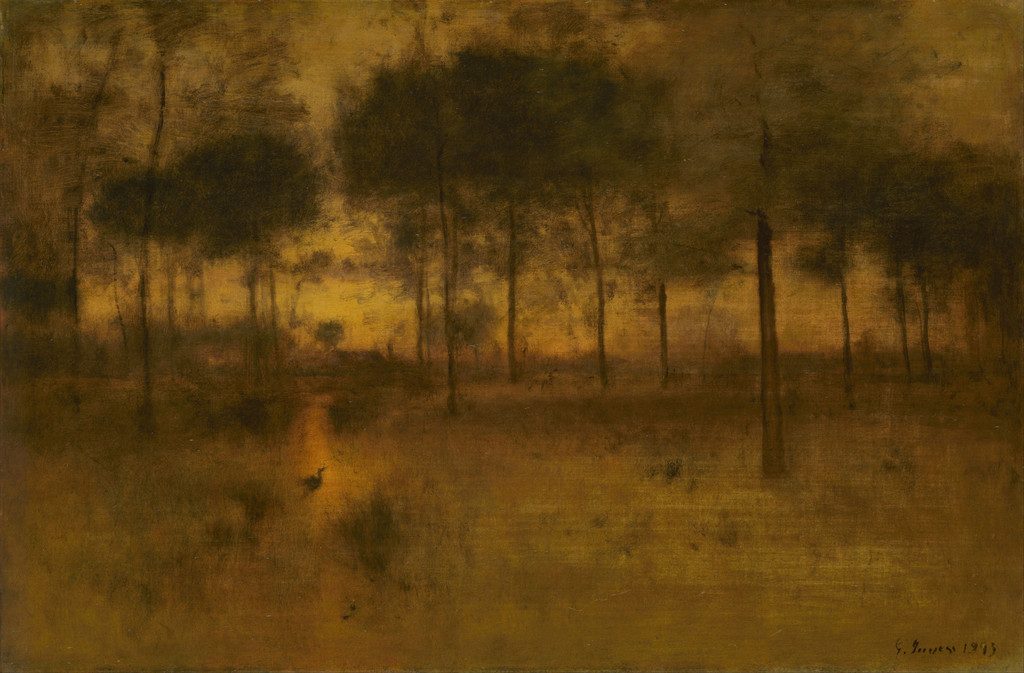
| The Home of the Heron — Princeton University Art Museum (y1943-93) | 1891 | Oil on canvas |
| Threatening | 1891 | Oil on canvas |
| Early Morning, Tarpon Springs | 1892 | Oil on canvas |
| Home at Montclair by George Inness | 1892 | oil on canvas |
| The Lonely Farm, Nantucket | 1892 | Oil on canvas |
| Afterglow | 1893 | Oil on canvas |
| Sunlit Valley | 1893 | Oil on canvas |
| The Home of the Heron — Art Institute of Chicago (1911.31) | 1893 | Oil on canvas |
| After a Summer Shower | 1894 | Oil on canvas |
| Landscape | n.d. | Watercolor with scraping on ivory wove paper |
Frequently Asked Questions
The Met’s 1861 oil on canvas, accession 32.151, measuring 91.4 × 127.6 cm.[1]
Yes. A steam engine appears on the left riverbank, near the lower end of the rainbow.[1]
Joe Baker, identified by the Met as a member of the Delaware Tribe of Indians. His contemporary response discusses Lenapehoking and forced removal.[2]
Yes. The Met records views from 1857 to 1891, so the 1861 date and accession help distinguish this canvas.[1]
Discussion
Look again at the images and ideas explored in Delaware Water Gap by George Inness. These editorial prompts invite your observations.
Find the train, river workers and cattle before looking again at the rainbow. How does that sequence change the panorama? Consider Joe Baker’s response alongside the activities visible on the canvas.
Reader Insights
How does the rainbow relate to the mountains and the river?
What changes when the railway is compared with The Lackawanna Valley?
How does the attributed Lenape perspective change the questions you bring to the scene?
Join the Conversation
Share a detail, comparison or question about Delaware Water Gap by George Inness below.
References
- Metropolitan Museum of Art, Delaware Water Gap, accession 32.151. Current object record, medium, dimensions, credit and commentary.
- Joe Baker on Delaware Water Gap, in “Native Perspectives,” Metropolitan Museum of Art (2019). Baker’s contribution, explicitly attributed.
- Adrienne Baxter Bell, “George Inness (1825–1894),” Metropolitan Museum of Art (2012).
- National Gallery of Art, The Lackawanna Valley, accession 1945.4.1.
- Art Institute of Chicago, Catskill Mountains, accession 1912.1623.
- Splash image source.
George Inness, Delaware Water Gap, 1861. Oil on canvas. Met, 32.151. Morris K. Jesup Fund, 1932; Metropolitan Museum of Art. Image source. Public domain.