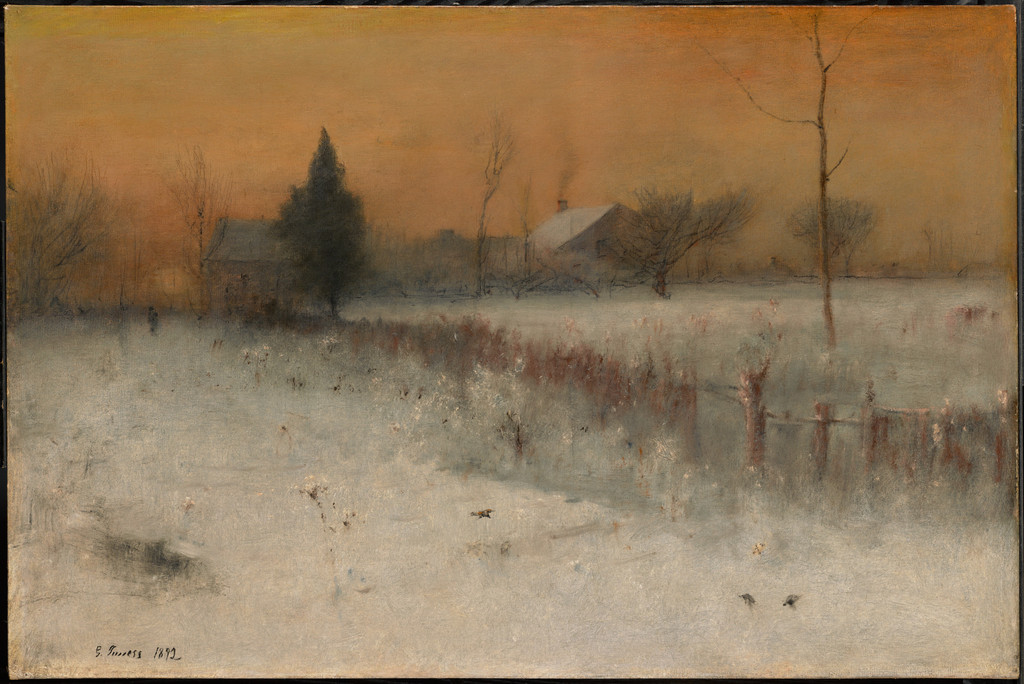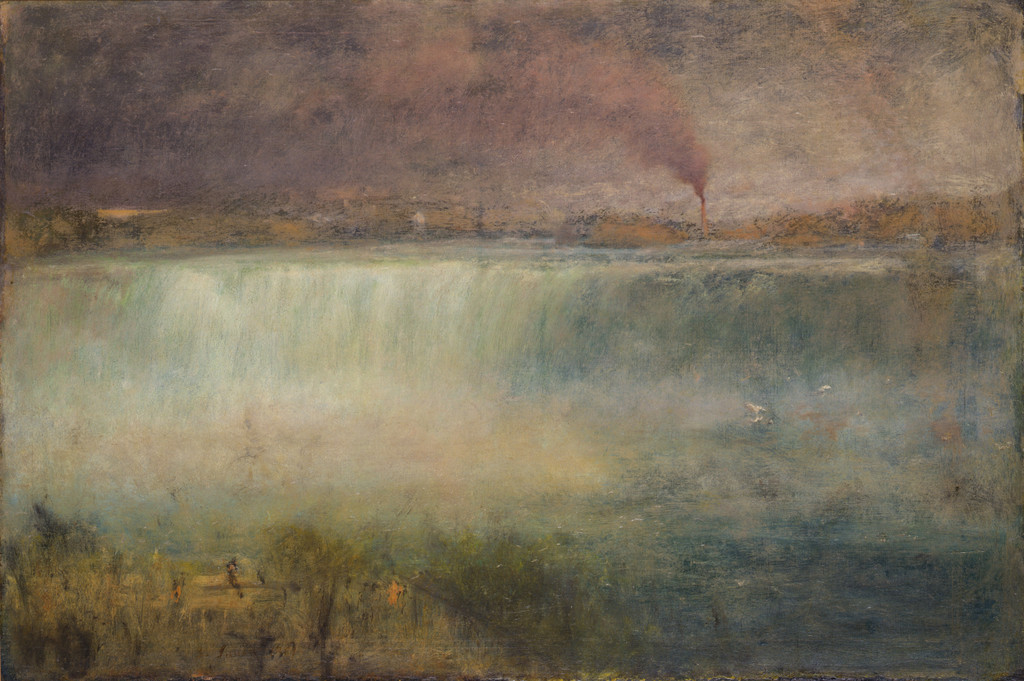
 by Tom Gurney
Tom Gurney BSc (Hons) is an art history expert with over 20 years experience
Email: tomgurney1@gmail.com / Phone: +44 7429 011000
Autumn Oaks by George Inness: Introduction
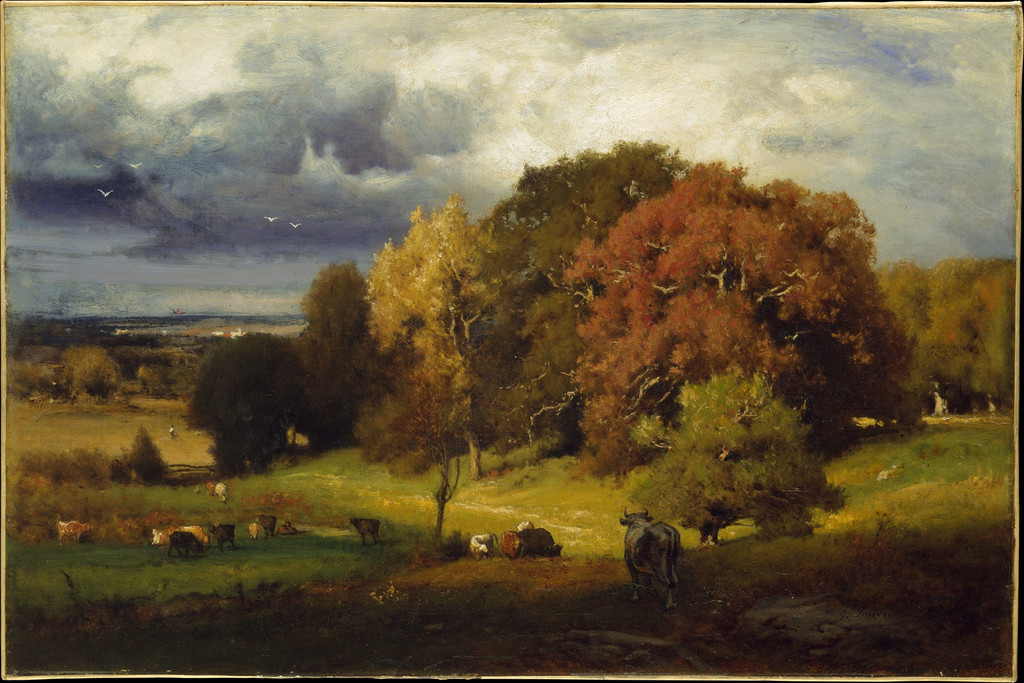
George Inness’s Autumn Oaks sets a dense group of trees against an open pasture and a large clouded sky. Cattle occupy the nearer slope, while a much smaller human figure appears farther away. The composition gives unequal spaces a continuous atmosphere: the right side feels enclosed by foliage, whereas the left offers a broader prospect. The Metropolitan Museum of Art dates the oil painting to circa 1878 and records its entry through George I. Seney’s gift in 1887.[1]
At a Glance
- ArtistGeorge Inness (1825–1894)
- TitleAutumn Oaks
- DateCirca 1878
- MediumOil on canvas
- Dimensions54.3 × 76.5 cm, as currently recorded by the Met
- CollectionMetropolitan Museum of Art, New York
- CreditGift of George I. Seney, 1887
- Accession87.8.8
This work across George Inness’s career
Contents
- Two different kinds of space
- Colour within the tree group
- Cattle, pasture and a small human presence
- The 1870s and a changing landscape practice
- Spiritual purpose and the limits of a symbolic reading
- Collection identity and useful comparisons
- Annotated details
Two different kinds of space
The trees occupy much of the right half, drawing attention towards a dense area of green, gold and warmer red. Their mass rises from the pasture and interrupts the sky. Individual trunks and branches can be found within it, but the group first acts as a substantial form within the whole landscape.
At the left, the scene opens. The ground extends towards a less emphatic distance beneath a blue-grey cloud bank. This area offers room for the eye to move away from the near trees. The painting does not divide into matching halves: one side encloses attention while the other releases it.
The difference gives the composition its energy. The trees need the open interval beside them to reveal their scale and density. The open pasture needs a more substantial near form to make its recession clear. Inness connects the spaces through the sloping ground and shared light, rather than making them entirely separate scenes.
The horizon also changes character as it crosses the picture. More open distance can be followed at the left, while foliage interrupts it at the right. That interruption makes the tree group feel present and near. Looking along the horizon is a useful way to understand the arrangement before concentrating on cattle or leaves.
Annotated Details from Autumn Oaks
The numbered points identify visible features discussed in this article. Return from each detail to the whole composition. George Inness, Autumn Oaks, c.1878. Oil on canvas. Metropolitan Museum of Art, 87.8.8. Gift of George I. Seney, 1887; Metropolitan Museum of Art. Image source. Public domain.
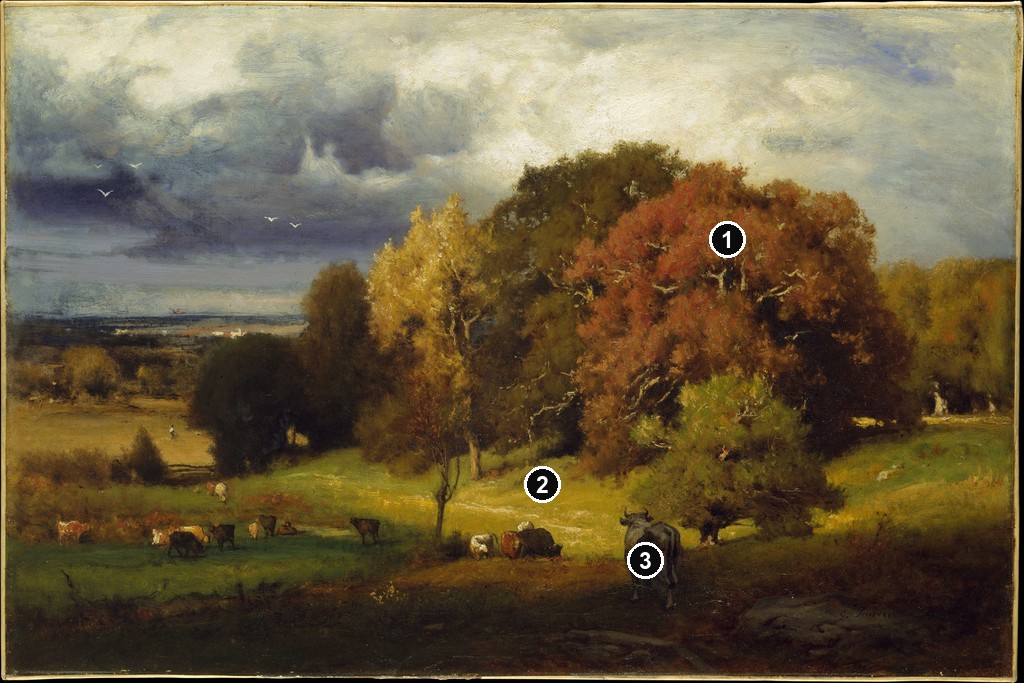
Details from AUTUMN OAKS
Compare the cropped details with the complete images above. Notice how their colours, shapes and positions contribute to the larger compositions.
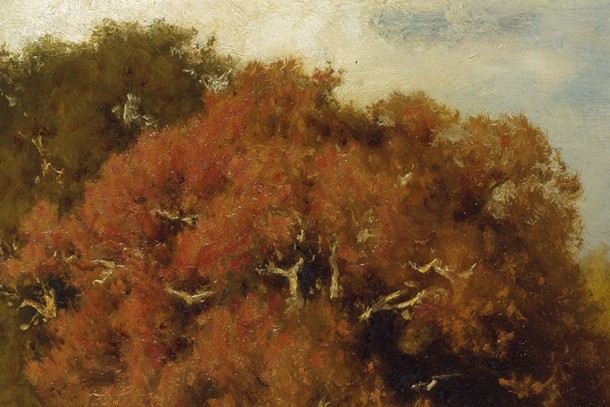
Autumn canopy
Warm foliage overlaps darker leaves and branches. The irregular canopy gives the nearby trees a substantial mass.
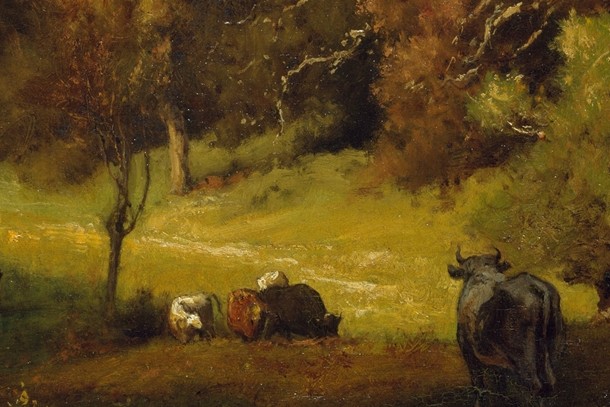
Pasture opening
Bright green ground opens between tree groups. Follow how the lighted interval connects nearer animals with the more distant field.
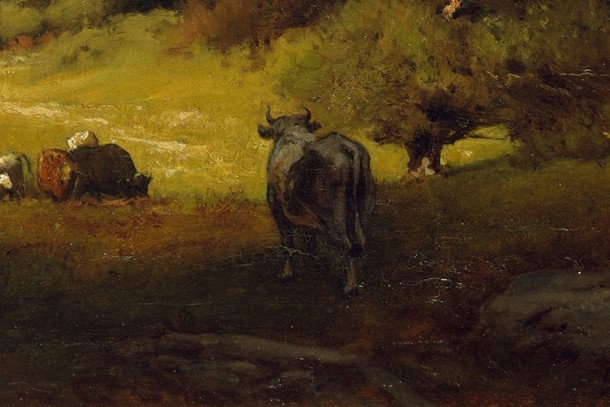
Foreground cattle
Cattle of different colours gather near the trees. Their varied sizes and positions give the pasture depth without dominating the large canopy.
Colour within the tree group
The canopy contains different kinds of colour rather than one uniformly autumnal surface. Green remains active beside warmer gold and red. Some areas appear darker and more closely joined, while lighter accents suggest foliage exposed to different light. The title helps direct attention towards seasonal change, but it does not require every leaf to be individually described.
The warmer colours gain force against the cooler sky. That relation matters more than isolating a single bright patch. Move the eye between the tree mass and the left cloud bank, and the temperature of the colours becomes easier to notice. The painting’s atmosphere depends on these relationships across its width.
The tree group also has an uneven boundary. Its shapes extend into the sky at different heights, preventing the canopy from becoming a simple rectangular block. Where foliage meets more open space, the edge can be softer or less continuous than a viewer expects. The mass remains legible without being drawn with equal precision all around.
Such visible differences should not be converted into a scientific account of the materials. Oil on canvas is documented, but no object-specific technical examination has been consulted here. A reproduction can show colour relationships and apparent clarity; it cannot independently name the pigments or establish which layers were applied first.
Cattle, pasture and a small human presence
The cattle bring a different scale of attention to the foreground. Some stand while others rest, creating varied low forms across the sloping pasture. Their light and dark markings make them recognisable within the ground, but they remain small in comparison with the dominant trees and sky.
This combination establishes a cultivated landscape. The animals occupy a field rather than an empty wilderness, and the distant human figure adds another sign of habitation. These motifs make the place available to everyday activity without turning the composition into a detailed narrative of farming.
The figure’s smallness is particularly useful for reading distance. It lies beyond the nearest cattle, so the ground seems to continue into another part of the scene. Its identity and actions cannot be securely expanded into a story from the image alone. Its visible position already contributes something specific to the composition.
The foreground remains comparatively open even beside the dense tree group. That contrast lets the animals be found without drawing the viewer immediately into the wood. The cattle, tree mass and cloud each hold attention at a different scale, allowing the scene to be read through more than one route.
Watch: George Inness
Choose a film to explore the artist’s work, its interpretation and its wider setting.
The Montclair Art Museum's George Inness Gallery
Visit the George Inness Gallery at the Montclair Art Museum in this State of the Arts feature.
Watch on YouTubeThe 1870s and a changing landscape practice
The Met places Autumn Oaks within Inness’s development after his early-1870s Italian residence, describing a move from crisp detail towards more expressive handling. Its account also connects this phase with his writing about spiritual and scientific purposes. These are museum interpretations of the work’s place in a career, rather than a precise reconstruction of its making.[1]
Adrienne Baxter Bell relates the painting to the attraction of New England’s autumn landscape during this period. Her wider chronology helps situate it among returning Italian subjects and later atmospheric pictures. Neither that context nor the approximate date establishes an exact field or viewpoint for this canvas.[2]
The distinction matters because Inness began renting in Montclair in 1878. A nearby date does not prove that every landscape of the period represents his rented property. The title identifies a season and trees, while the reviewed object record leaves the precise location open. Treating it as a specific Montclair view would add certainty the evidence does not supply.[2]
The visible arrangement nevertheless shows why the painting is useful for discussing change. Trees and animals remain recognisable, while broad masses and atmospheric relationships have considerable force. The picture does not simply abandon forms; it makes their distribution and varying clarity central to the experience of the scene.
Spiritual purpose and the limits of a symbolic reading
Bell explains the importance of Swedenborgian ideas to Inness’s understanding of landscape. Those ideas provide context for his attention to relationships between visible nature and a less tangible spiritual realm. They do not establish a fixed meaning for every oak, cow or cloud in this work.[2]
A spiritual reading is most useful when it sharpens attention to the composition. The relation between dense foliage and open sky can make a familiar pasture feel contemplative. That effect can be experienced without assigning the tree group a single coded identity or claiming that the artist intended one exact allegory.
The painting’s title remains modest beside such possibilities. It names a subject visible in the image rather than declaring a religious programme. Keeping the title, observed forms and specialist framework distinct allows them to inform one another without making any of them carry more certainty than it can support.
Collection identity and useful comparisons
The Met’s accession 87.8.8 and the Seney gift of 1887 identify this particular object. Its approximate date should remain attached to that identity.[1]
Compare the picture with Inness’s The Old Mill of 1849. The earlier Chicago canvas places a building and foreground encounter within shadowed forest. Its more articulated human activity differs from the cattle and small distant figure in Autumn Oaks, while cultivated land remains important in both.[3]
Sunset in the Woods, dated 1891, offers a later woodland contrast. It keeps the viewer inside the trees, with pale trunks and a small opening rather than a large open pasture. Looking between the canvases makes the role of the left-hand opening in Autumn Oaks especially clear.[4]
The differences make a productive final route through the image. Begin with the cattle, rise into the warm foliage and move across towards the cooler sky. Then reverse that sequence. The painting holds those unlike spaces together, allowing the familiar subject of an autumn field to sustain a more varied experience of light, enclosure and distance.
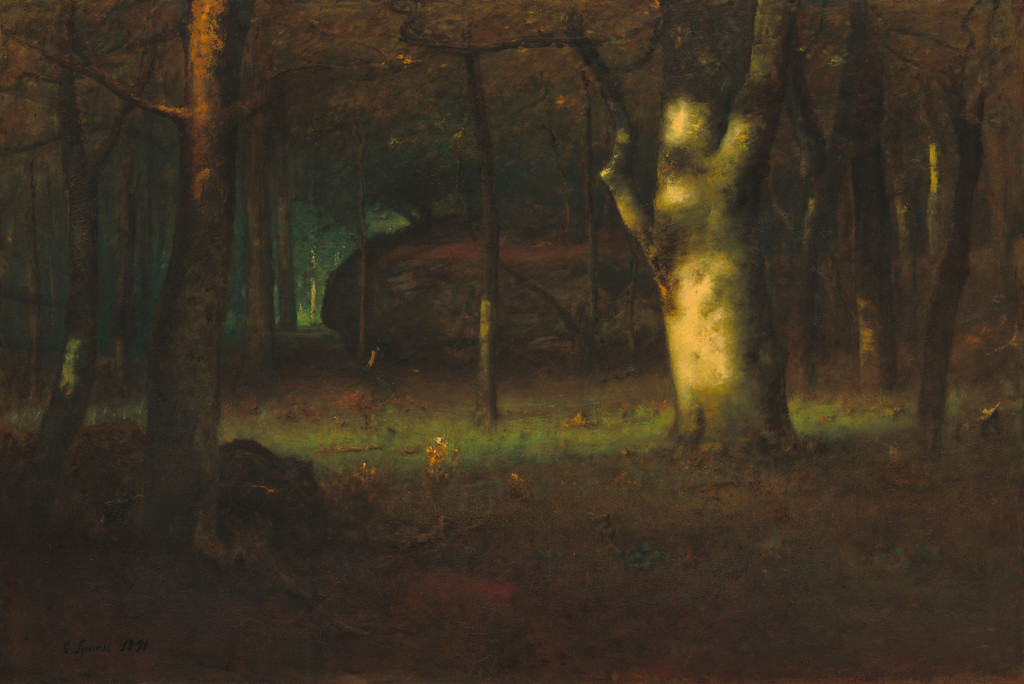
George Inness, Sunset in the Woods, 1891. Oil on canvas. National Gallery of Art, 2014.79.43. Corcoran Collection; National Gallery of Art. Image source. CC0 / Public domain.
Artworks directory
A collected selection of 46 individually identified museum objects: 43 paintings and three watercolours. This is not a complete catalogue raisonné. Repeated titles identify separate objects where their institutions or accessions differ. Links lead to a companion article where available, otherwise to the museum record. Unillustrated entries remain included; the original lost New Jerusalem is represented by its three transformed survivors.
| Name | Date | Medium |
|---|---|---|
| Crossing the Ford | 1848 | Oil on canvas |
| The Old Mill | 1849 | Oil on canvas |
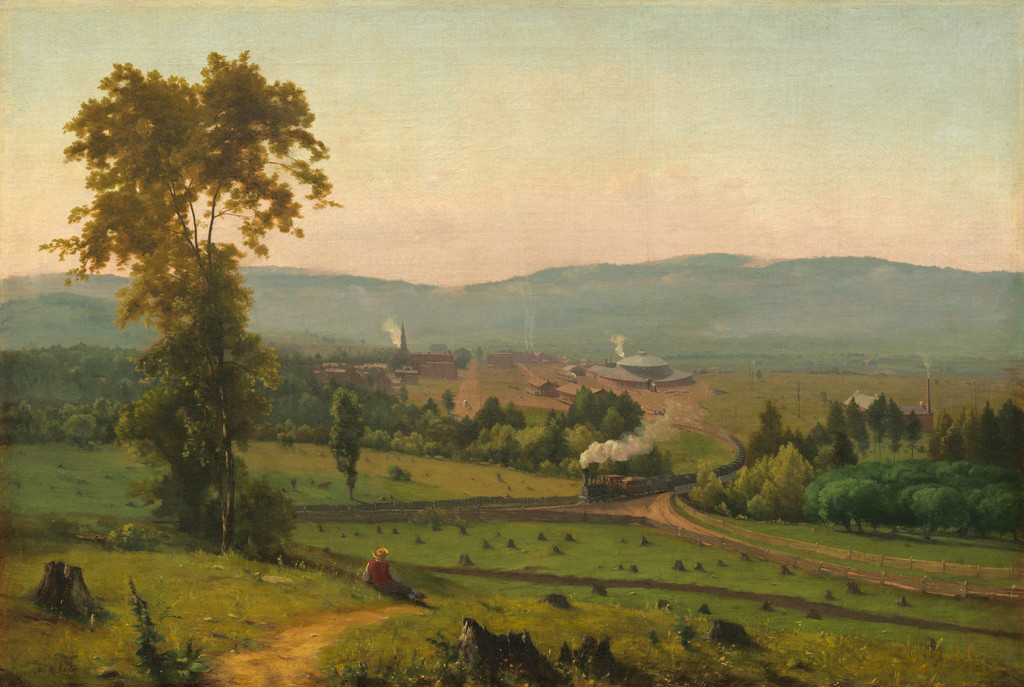
| The Lackawanna Valley by George Inness | c. 1856 | oil on canvas |
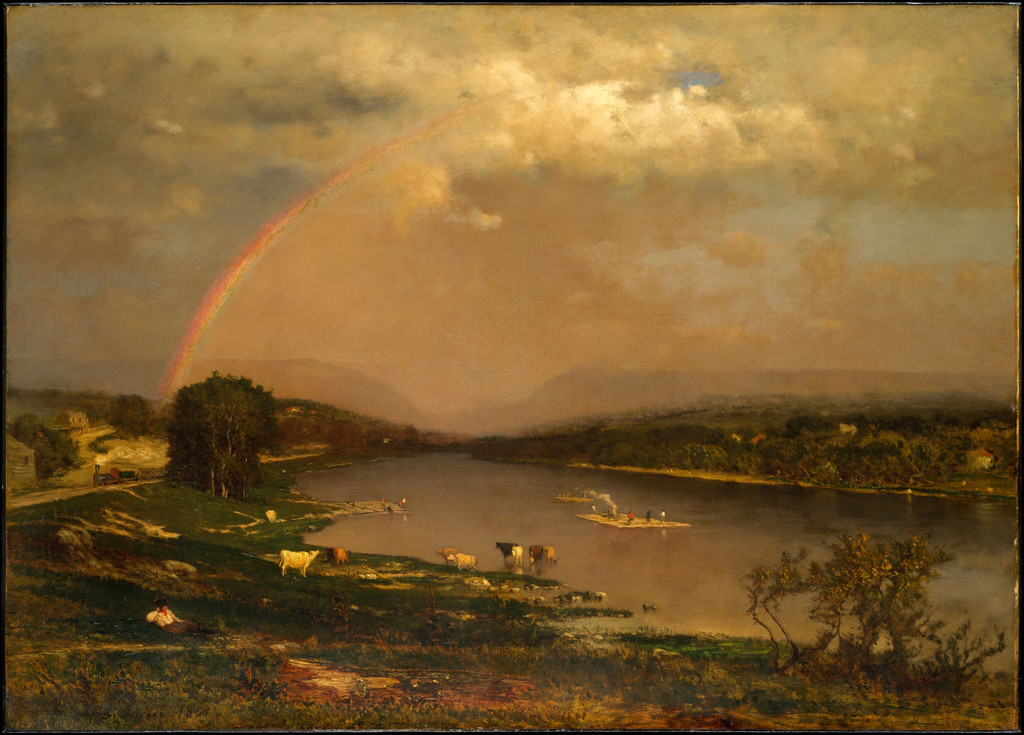
| Delaware Water Gap | 1861 | Oil on canvas |
| Delaware Valley | c. 1865–75 | Oil on artist's board |
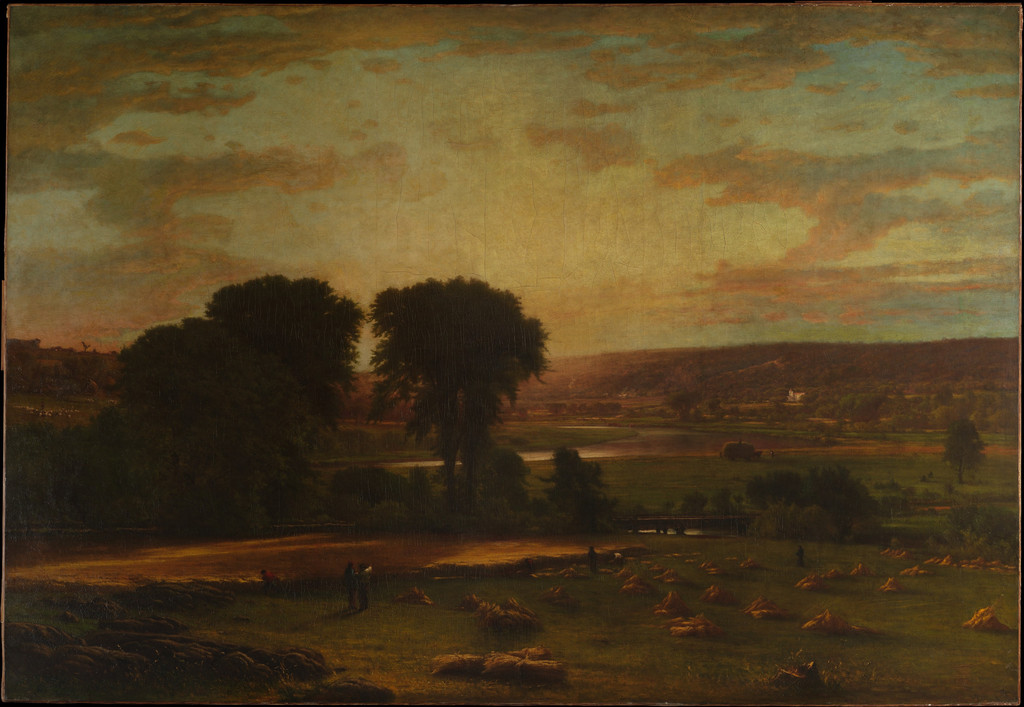
| Peace and Plenty | 1865 | Oil on canvas |
| Evening Landscape | 1867; later reworked | Oil on canvas |
| Summer in the Catskills | 1867 | Oil on canvas |
| The Valley of the Olives | 1867; reworked after 1880 | Oil on canvas |
| The Valley of the Shadow of Death | 1867 | Oil on canvas |
| Visionary Landscape | 1867/1880 | Oil on canvas |
| Catskill Mountains | 1870 | Oil on canvas |
| Across the Campagna | 1872 | Watercolor, gouache, and graphite on off-white wove paper |
| Olive Trees at Tivoli | 1873 | Gouache, watercolor, and graphite on blue wove paper with colored fibers |
| A Marine | c. 1874–75 | Oil on canvas |
| Twilight in Italy — Art Institute of Chicago (1911.44) | 1874 | Oil on panel |
| Pine Grove of the Barberini Villa | 1876 | Oil on canvas |
| The Storm | 1876 | Oil on canvas |
| Autumn Oaks | ca. 1878 | Oil on canvas |
| The Sisters | 1882 | Oil on millboard |
| Harvest, Montclair, New Jersey | 1884 | Oil on canvas |
| Niagara Falls | 1885 | Oil on wood |
| A Silver Morning | 1886 | Oil on canvas |
| Landscape, Sunset | 1887–89 | Oil on canvas |
| September Afternoon | 1887 | Oil on canvas |
| Sunrise | 1887 | Oil on canvas |
| The Mill Stream, Montclair, New Jersey by George Inness | c. 1888 | Oil on canvas |
| Niagara by George Inness | 1889 | oil on canvas |
| The Mill Pond | 1889 | Oil on canvas |
| Sunset in the Valley | 1890 | Oil on canvas |
| The Moon at Night | 1890 | Oil on canvas |
| Twilight in Italy — Art Institute of Chicago (1911.42) | 1890 | Oil on canvas |
| Autumn Woods | 1891–94 | Oil on canvas |
| Moonrise | 1891 | Oil on canvas |
| Spring Blossoms, Montclair, New Jersey | ca. 1891 | Oil and crayon or charcoal on canvas |
| Sunset in the Woods by George Inness | 1891 | oil on canvas |
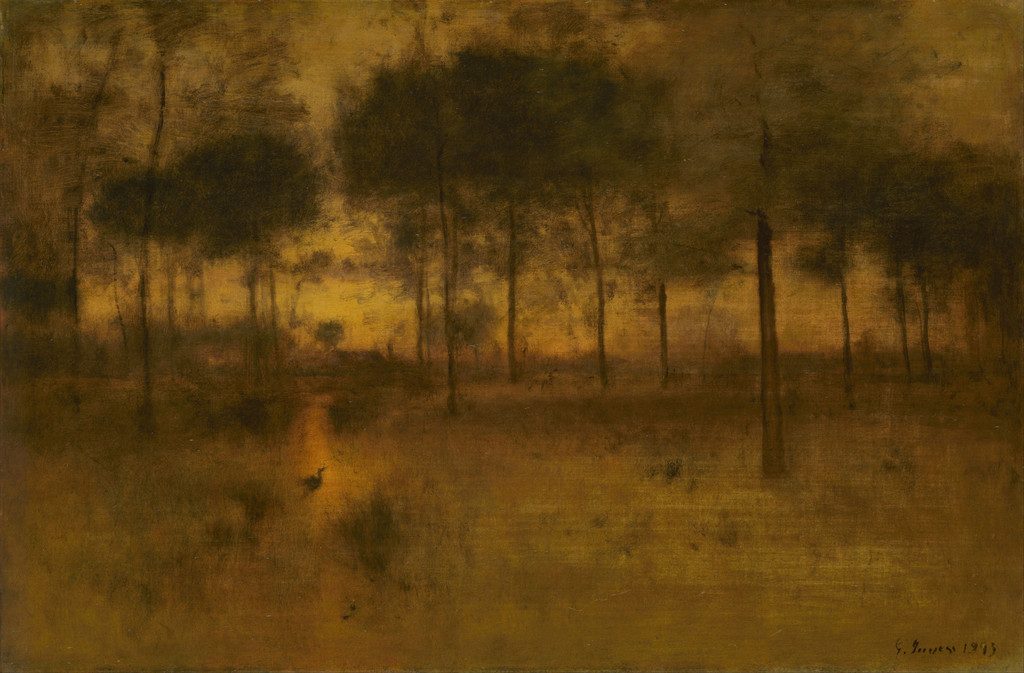
| The Home of the Heron — Princeton University Art Museum (y1943-93) | 1891 | Oil on canvas |
| Threatening | 1891 | Oil on canvas |
| Early Morning, Tarpon Springs | 1892 | Oil on canvas |
| Home at Montclair by George Inness | 1892 | oil on canvas |
| The Lonely Farm, Nantucket | 1892 | Oil on canvas |
| Afterglow | 1893 | Oil on canvas |
| Sunlit Valley | 1893 | Oil on canvas |
| The Home of the Heron — Art Institute of Chicago (1911.31) | 1893 | Oil on canvas |
| After a Summer Shower | 1894 | Oil on canvas |
| Landscape | n.d. | Watercolor with scraping on ivory wove paper |
Frequently Asked Questions
The Met dates it circa 1878. The approximate date should remain qualified.[1]
The reviewed sources do not establish one. Inness’s Montclair rental began in 1878, but the date alone does not identify the setting.[2]
They make the pasture visibly inhabited and worked. Their placement and scale can be discussed without inventing a particular farm narrative.
George I. Seney gave this canvas to the museum in 1887.[1]
Discussion
Look again at the images and ideas explored in Autumn Oaks by George Inness. These editorial prompts invite your observations.
Compare the right-hand tree group with the open left distance. Which area attracts you first? Consider how the cattle and small human figure help connect those unequal spaces.
Reader Insights
Where does the canopy first open a view towards the light?
How does the wooded space differ from Sunset in the Woods?
What role do the small living forms play within the large trees?
Join the Conversation
Share a detail, comparison or question about Autumn Oaks by George Inness below.
References
- Metropolitan Museum of Art, Autumn Oaks, accession 87.8.8. Current identity, measurements, credit and wall text.
- Adrienne Baxter Bell, “George Inness (1825–1894),” Metropolitan Museum of Art (2012).
- Art Institute of Chicago, The Old Mill, accession 1939.388.
- National Gallery of Art, Sunset in the Woods, accession 2014.79.43.
- Splash image source.
George Inness, Autumn Oaks, c.1878. Oil on canvas, 54.3 × 76.5 cm as recorded by the Met. Metropolitan Museum of Art, 87.8.8. Gift of George I. Seney, 1887; Metropolitan Museum of Art. Image source. Public domain.