 by Tom Gurney
Tom Gurney BSc (Hons) is an art history expert with over 20 years experience
Email: tomgurney1@gmail.com / Phone: +44 7429 011000
Catskill Mountains by George Inness: Introduction
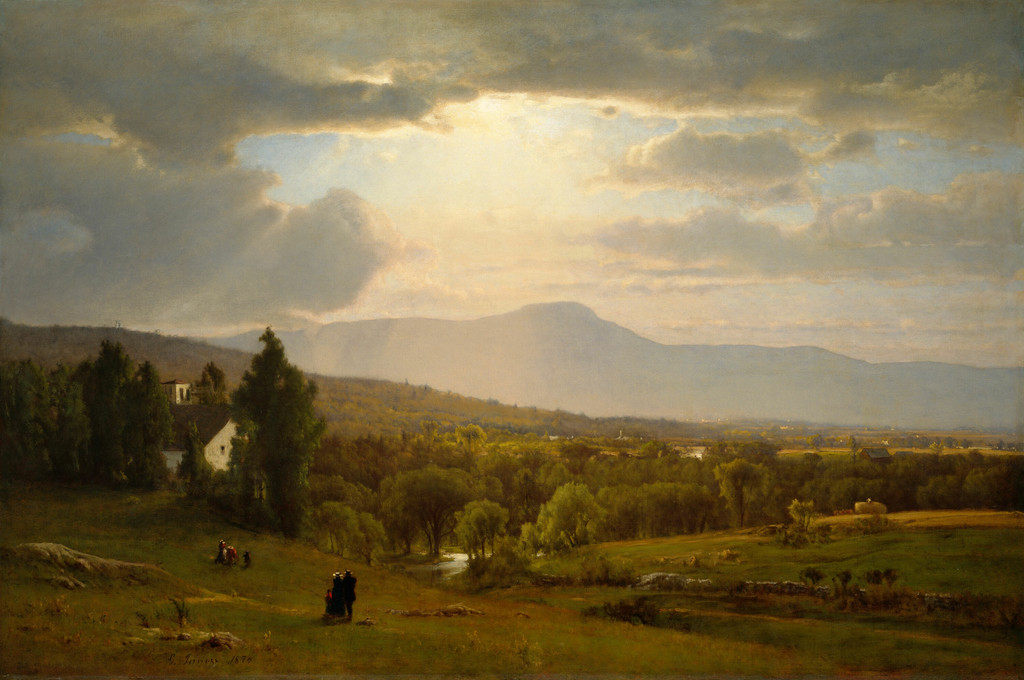
George Inness’s Catskill Mountains gives a settled valley as much attention as its distant mountain range. A pale church stands among trees at the left; figures occupy the near slope, and tended fields extend towards a hayrick at the right. Above them, a broad opening in the clouds illuminates the distance. The Art Institute of Chicago dates this oil painting to 1870 and records its entry through Edward B. Butler’s gift in 1912.[1]
At a Glance
- ArtistGeorge Inness (1825–1894)
- TitleCatskill Mountains
- Date1870
- MediumOil on canvas
- Dimensions123.8 × 184.5 cm
- CollectionArt Institute of Chicago
- CreditEdward B. Butler Collection
- Accession1912.1623
This work across George Inness’s career
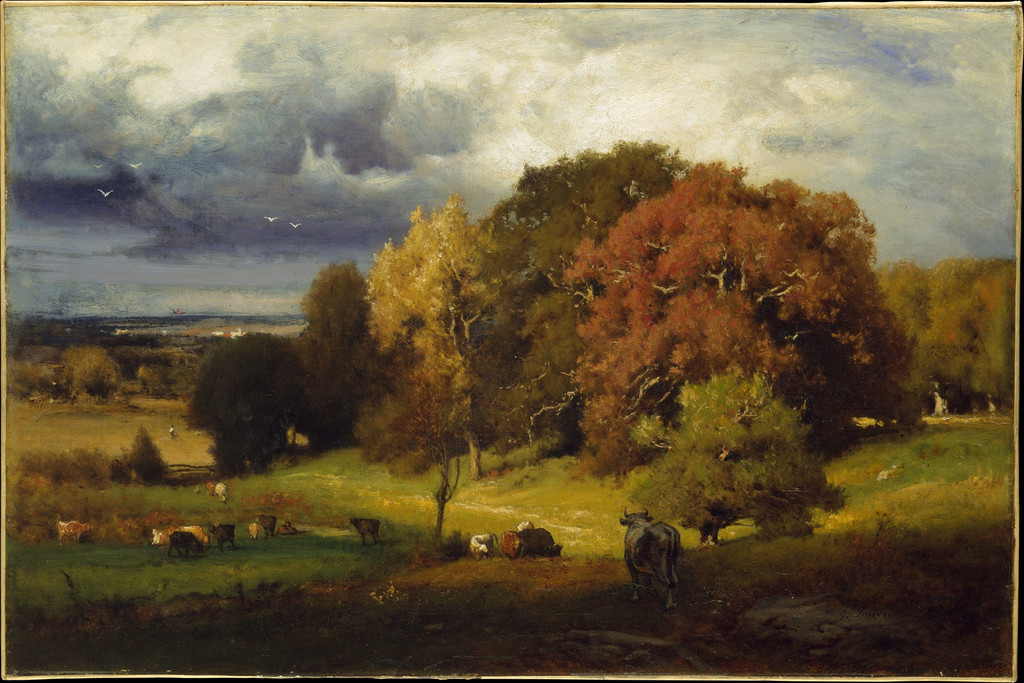
Autumn Oaks by George Inness
ca. 1878Contents
- A mountain range beyond inhabited land
- The church among the trees
- Figures on the near slope
- Fields, hayrick and the bright stream
- The opening in the cloud
- Settlement and the Catskills’ appeal
- Spiritual interpretation and observed place
- Collection history and selected exhibitions
- Other landscapes of work and distance
- Annotated details
A mountain range beyond inhabited land
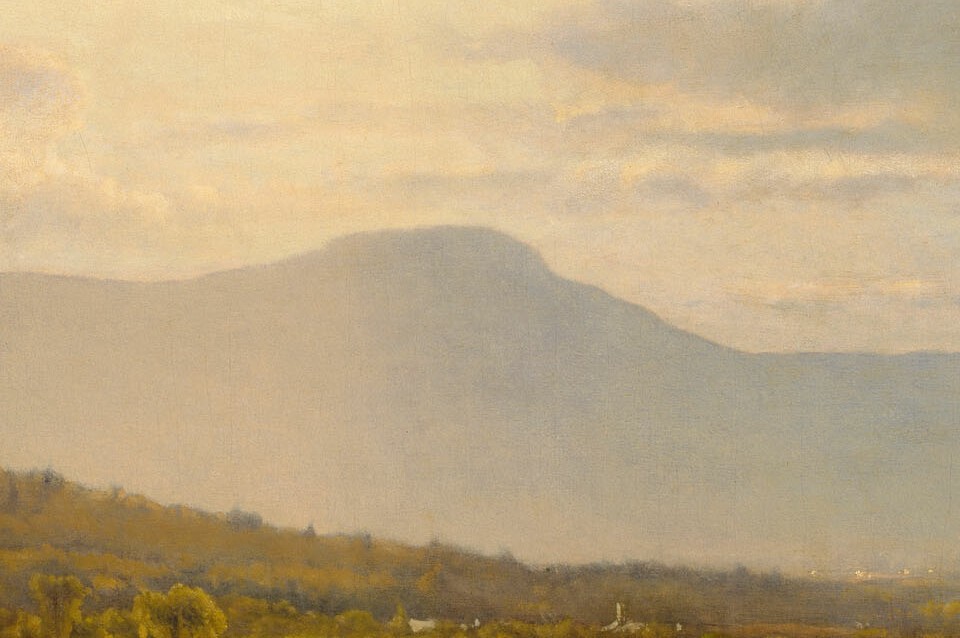
The distant range extends across much of the picture’s width. Its muted blue-grey tone gives it a substantial outline while keeping it behind the warmer foreground. The highest central form does not fill the scene; it belongs to a larger prospect of trees, fields, buildings and sky.
The valley spreads broadly before it. Nearer trees form distinct groups, while farther vegetation becomes smaller and more closely gathered. This transition gives the mountain its distance. Its scale is experienced through the inhabited ground in front of it rather than through a single dramatic cliff placed near the viewer.
The left slope descends from the church towards the foreground figures. On the right, cultivated ground occupies a more open interval. These unequal areas provide different entrances to the landscape, one through architecture and trees, the other through fields and agricultural forms.
Looking between them makes the broad valley more apparent. The mountain remains a constant distant presence, while the nearer land changes in use and structure. The title directs attention towards the range, but the painting gives equal reason to examine the spaces that lead to it.
Annotated Details from Catskill Mountains
The numbered points identify visible features discussed in this article. Return from each detail to the whole composition. George Inness, Catskill Mountains, 1870. Oil on canvas. Art Institute of Chicago, 1912.1623. Edward B. Butler Collection; Art Institute of Chicago. Image source. CC0 / Public domain.
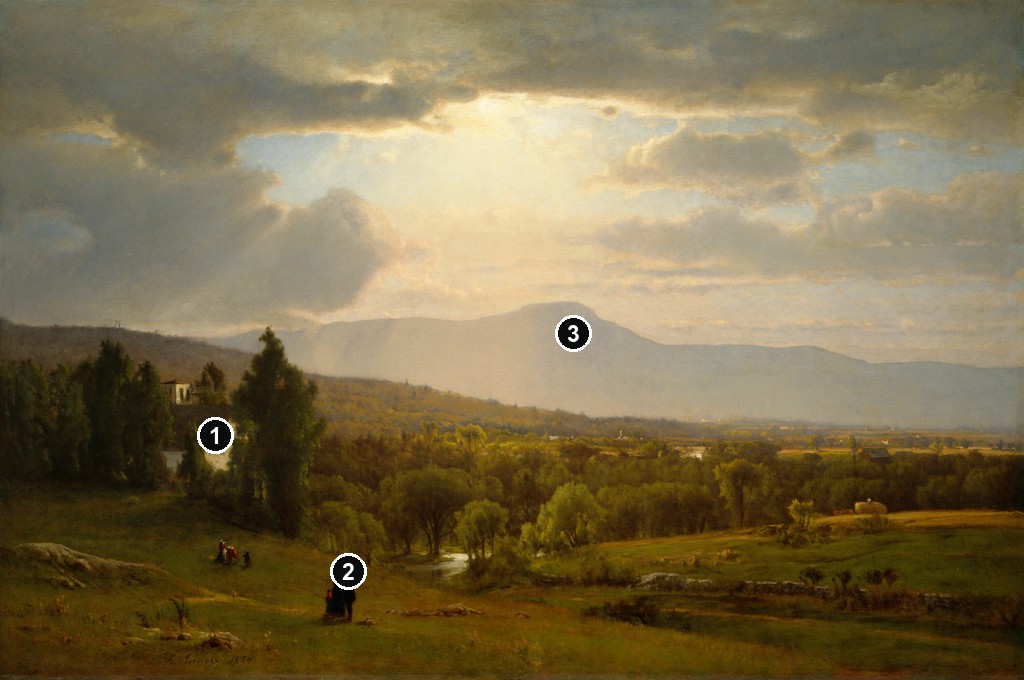
Details from CATSKILL MOUNTAINS
Compare the cropped details with the complete images above. Notice how their colours, shapes and positions contribute to the larger compositions.
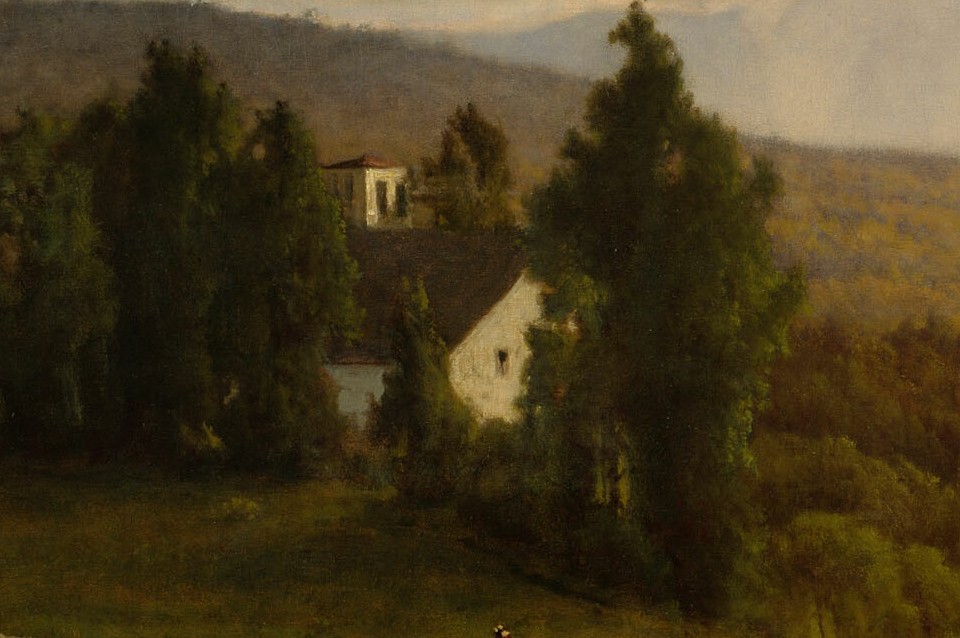
House among trees
A pale house is partly enclosed by vegetation at the left. The setting joins habitation with the larger wooded slope.
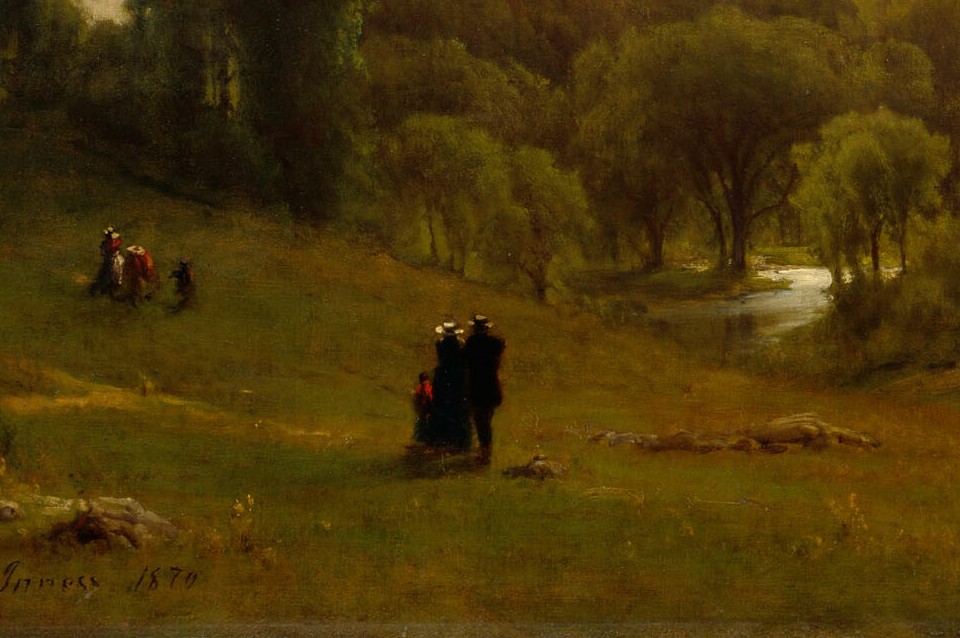
Near figures
Small figures occupy the foreground ground. Their clearer scale differs from the more compressed activity farther away.
Layered ridges
A sequence of hills extends beyond the nearer trees. Changes of colour and clarity separate the distances.
The church among the trees
The church’s pale walls and upper structure interrupt a darker group of trees at the left. Parts of the building are screened by foliage, so it is seen within the landscape rather than standing in complete isolation. Its light surfaces help make it recognisable despite that partial concealment.
The trees rise to different heights around it. Their darker masses give the architecture a setting, while also drawing the eye towards the left hillside behind. The church’s more regular forms contrast with the irregular vegetation without breaking the scene’s continuity.
Its placement creates a useful relation of scale. A building that would be substantial at close quarters becomes comparatively small within the wider valley. That smallness does not erase its importance; it reveals the amount of landscape surrounding it.
The current museum commentary identifies a church, but the reviewed evidence does not supply a secure name for the building.[1] Its visible contribution can be discussed without turning the picture into an exact architectural survey. It establishes a place shaped by community within the broader mountain prospect.
Figures on the near slope
Two groups of figures occupy the foreground slope. The nearer group includes dark clothing with small pale and red accents; another group stands farther uphill below the church. Their separation helps the viewer experience the ground as an interval rather than a flat band.
The figures are small, yet their colour contrasts can attract attention before less distinct buildings in the valley. Finding them changes the scale of the trees and church. The viewer can compare a person, a building and the distant range within the same composition.
The nearer group also offers a route into the scene. From its position, the eye can move uphill towards the church or across towards the bright stream. Those directions make the foreground feel connected to more than one part of the landscape.
The image does not securely identify the people or establish a particular occasion. Their placement already has a specific role: human presence gives the view scale and makes the near land available for movement, gathering and looking.
Fields, hayrick and the bright stream
The right side contains more open cultivated ground. Its warmer and darker bands differ from the dense trees elsewhere in the valley. AIC identifies tended fields and a hayrick as important signs of human presence in the scene.[1]
The hayrick is a small rounded form within a relatively open area. Its scale and placement make agricultural use legible without bringing harvest work into the immediate foreground. The picture can suggest a worked landscape through a few carefully placed forms.
A bright, winding stream appears among the central trees. Its light surface offers a different route through the valley from the more lateral bands of cultivated ground. The water is partly hidden, then becomes visible again, creating a sequence of openings rather than an uninterrupted line.
That interrupted visibility contributes to depth. A viewer follows the stream through vegetation, finding one bright passage after another. The trees become forms around and in front of the water, while the valley seems to continue beyond what can be seen at once.
Fields and stream also produce different kinds of order. The cultivated ground carries more regular divisions; water moves through irregular vegetation. Their coexistence gives the landscape variety while keeping both within the same light.
The opening in the cloud
The sky occupies a large part of the canvas. Darker cloud gathers near the upper edge, while a broad luminous opening lies above the central mountain. Smaller changes of light continue across the remaining cloud, giving the atmosphere a varied structure.
The central opening is important because of its position. It leads the eye towards the mountain below, then towards the valley in front. Light connects these areas across a considerable depth, even though the foreground remains warmer and more densely articulated.
The mountain’s muted colour prevents that connection from becoming too abrupt. Its form is visible beneath the brighter sky, but its surfaces do not compete with the small foreground figures or church. The picture distributes emphasis across different distances.
The brightest stream passage offers a smaller light accent lower down. Compare it with the cloud opening: one is narrow and partly enclosed by trees, the other broad and open. Their difference makes the valley’s scale more noticeable while giving the eye two related points to revisit.
Watch: George Inness
Choose a film to explore the artist’s work, its interpretation and its wider setting.
The Montclair Art Museum's George Inness Gallery
Visit the George Inness Gallery at the Montclair Art Museum in this State of the Arts feature.
Watch on YouTubeSettlement and the Catskills’ appeal
AIC’s commentary places the work within the Catskills’ nineteenth-century attraction to tourists. It relates that appeal to spectacular views and access from urban centres, while drawing attention to the painting’s church and cultivated land.[1] This museum context helps explain why a mountain subject could include an extensively inhabited valley.
The scene presents several kinds of presence together. The church suggests community, the fields agricultural use, and the small figures movement through the foreground. The mountain and luminous sky give these familiar forms a more expansive setting.
This combination makes the word landscape carry more than one meaning. It can describe a natural prospect, but also a place shaped by people and experienced through particular routes. The painting keeps those aspects connected instead of assigning all human activity to an insignificant corner.
Its 1870 date should remain precise without supplying an unverified season or exact relation to Inness’s departure for Europe that year. Bell records the longer European residence beginning in 1870.[2] The date alone does not reveal where in that travel chronology the canvas was completed.
Spiritual interpretation and observed place
AIC relates the handling of light and colour both to Inness’s Swedenborgian interests and to admiration for the particular American landscape.[1] The two contexts can coexist. A spiritual reading need not remove attention from the valley’s buildings, fields and people.
Bell’s broader account explains the importance of Swedenborg to Inness’s developing philosophy.[2] That framework does not independently assign a fixed spiritual identity to this church, stream or mountain. The specific arrangement remains essential to any interpretation of the work.
One useful way to bring these questions together is to follow the light. It opens the sky above the mountain, catches small forms in the valley and reveals part of the stream. The relations can make the place feel contemplative while remaining rooted in visible features of a settled landscape.
Collection history and selected exhibitions
The recorded provenance begins with Mrs. Henry E. Dalley in New York, followed by Knoedler in 1911–12, W. H. Dicks, W. Scott Thurber and Edward B. Butler in 1912. Butler gave the painting to AIC that year.[1] These entries belong to this canvas and its accession 1912.1623.
The museum also lists its inclusion in A Century of American Painting at Lake Forest College in 1957 and Two Centuries of American Art, 1750–1950 at AIC in 1959–60.[1] The entries document exhibition participation. They do not supply an original review or establish what every visitor thought of the painting.
Other landscapes of work and distance
Peace and Plenty, dated 1865 by the Met, provides a comparison of managed land beneath expansive light.[3] Its workers and cut wheat occupy a more prominent place in the foreground. Here, agricultural use is spread through fields and a smaller hayrick farther into the valley.
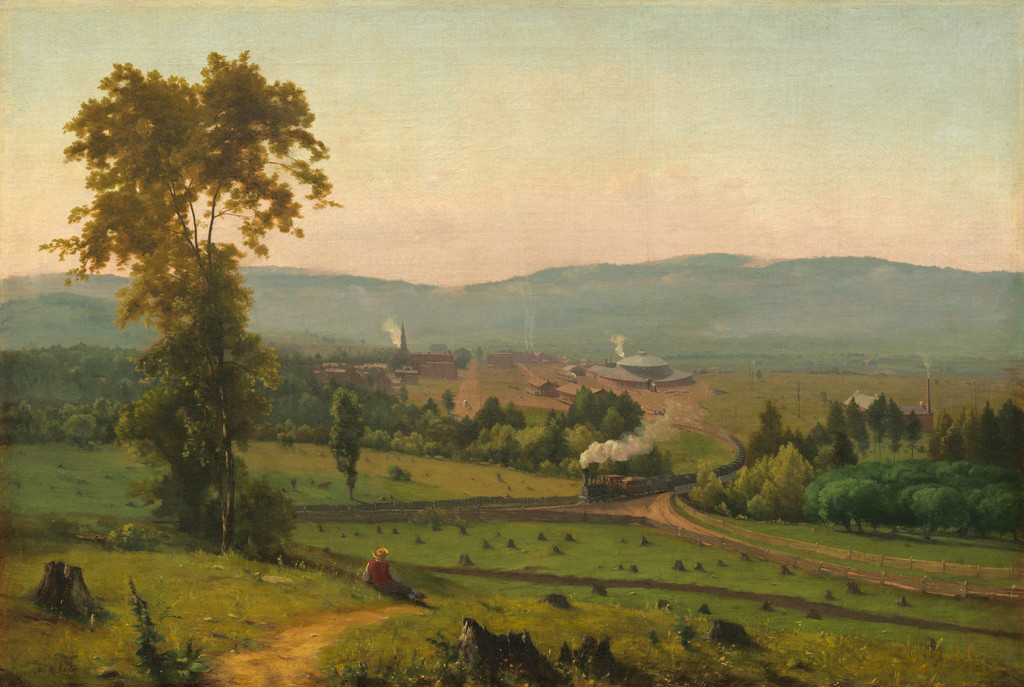
The Lackawanna Valley, circa 1856, presents a railway landscape in the National Gallery of Art.[4] Compare its stumps and roundhouse with the church and tended fields here. Both views include human alteration, but the visible forms give that alteration different kinds of emphasis.
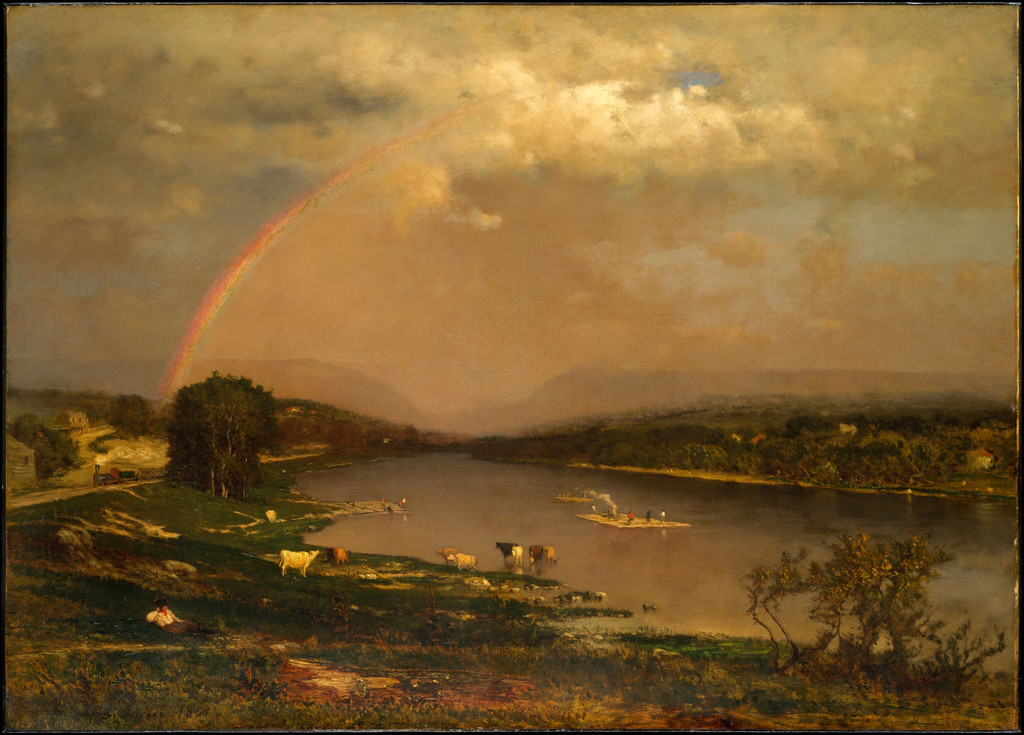
Delaware Water Gap, the Met’s 1861 canvas, connects transport and pasture with a mountain prospect.[5] Its river leads into a gap, while the Catskill stream is partly enclosed within the valley. Looking between them makes the role of the water, foreground activity and atmospheric distance more specific in each work.
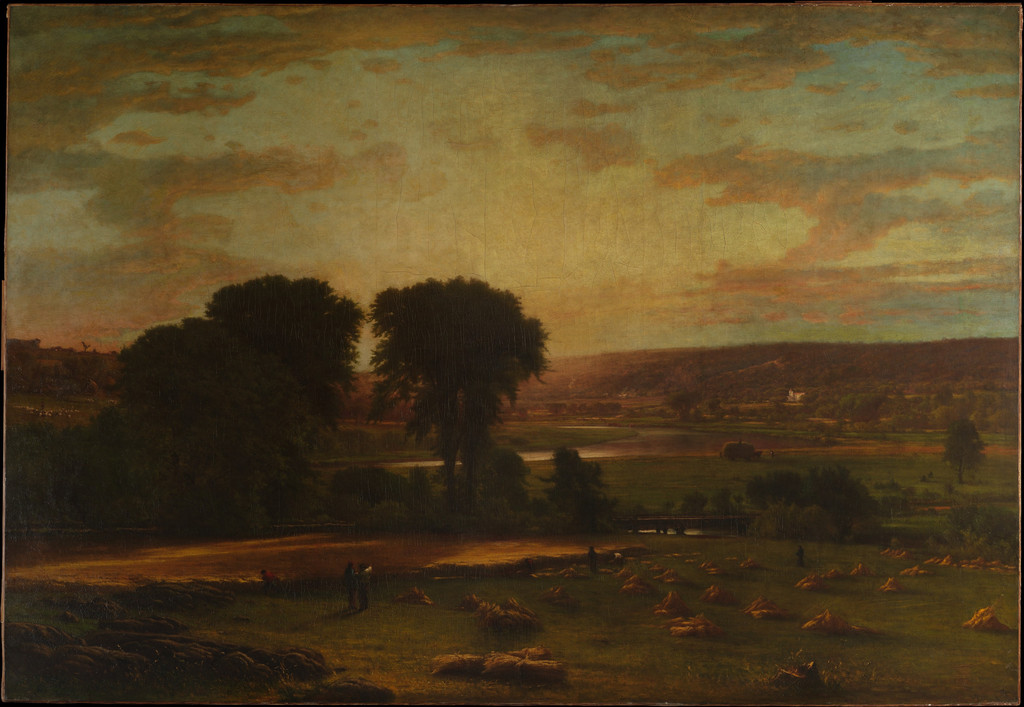
George Inness, Peace and Plenty, 1865. Oil on canvas. Met, 94.27. Gift of George A. Hearn, 1894; Metropolitan Museum of Art. Image source. Public domain.
Artworks directory
A collected selection of 46 individually identified museum objects: 43 paintings and three watercolours. This is not a complete catalogue raisonné. Repeated titles identify separate objects where their institutions or accessions differ. Links lead to a companion article where available, otherwise to the museum record. Unillustrated entries remain included; the original lost New Jerusalem is represented by its three transformed survivors.
| Name | Date | Medium |
|---|---|---|
| Crossing the Ford | 1848 | Oil on canvas |
| The Old Mill | 1849 | Oil on canvas |
| The Lackawanna Valley by George Inness | c. 1856 | oil on canvas |
| Delaware Water Gap | 1861 | Oil on canvas |
| Delaware Valley | c. 1865–75 | Oil on artist's board |
| Peace and Plenty | 1865 | Oil on canvas |
| Evening Landscape | 1867; later reworked | Oil on canvas |
| Summer in the Catskills | 1867 | Oil on canvas |
| The Valley of the Olives | 1867; reworked after 1880 | Oil on canvas |
| The Valley of the Shadow of Death | 1867 | Oil on canvas |
| Visionary Landscape | 1867/1880 | Oil on canvas |
| Catskill Mountains | 1870 | Oil on canvas |
| Across the Campagna | 1872 | Watercolor, gouache, and graphite on off-white wove paper |
| Olive Trees at Tivoli | 1873 | Gouache, watercolor, and graphite on blue wove paper with colored fibers |
| A Marine | c. 1874–75 | Oil on canvas |
| Twilight in Italy — Art Institute of Chicago (1911.44) | 1874 | Oil on panel |
| Pine Grove of the Barberini Villa | 1876 | Oil on canvas |
| The Storm | 1876 | Oil on canvas |
| Autumn Oaks | ca. 1878 | Oil on canvas |
| The Sisters | 1882 | Oil on millboard |
| Harvest, Montclair, New Jersey | 1884 | Oil on canvas |
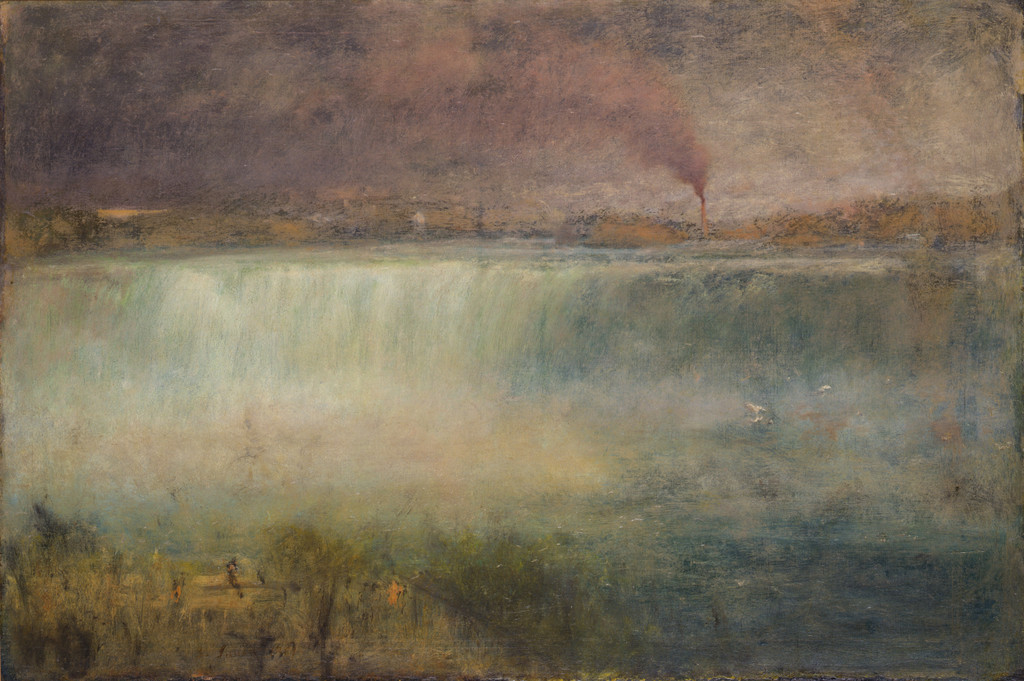
| Niagara Falls | 1885 | Oil on wood |
| A Silver Morning | 1886 | Oil on canvas |
| Landscape, Sunset | 1887–89 | Oil on canvas |
| September Afternoon | 1887 | Oil on canvas |
| Sunrise | 1887 | Oil on canvas |
| The Mill Stream, Montclair, New Jersey by George Inness | c. 1888 | Oil on canvas |
| Niagara by George Inness | 1889 | oil on canvas |
| The Mill Pond | 1889 | Oil on canvas |
| Sunset in the Valley | 1890 | Oil on canvas |
| The Moon at Night | 1890 | Oil on canvas |
| Twilight in Italy — Art Institute of Chicago (1911.42) | 1890 | Oil on canvas |
| Autumn Woods | 1891–94 | Oil on canvas |
| Moonrise | 1891 | Oil on canvas |
| Spring Blossoms, Montclair, New Jersey | ca. 1891 | Oil and crayon or charcoal on canvas |
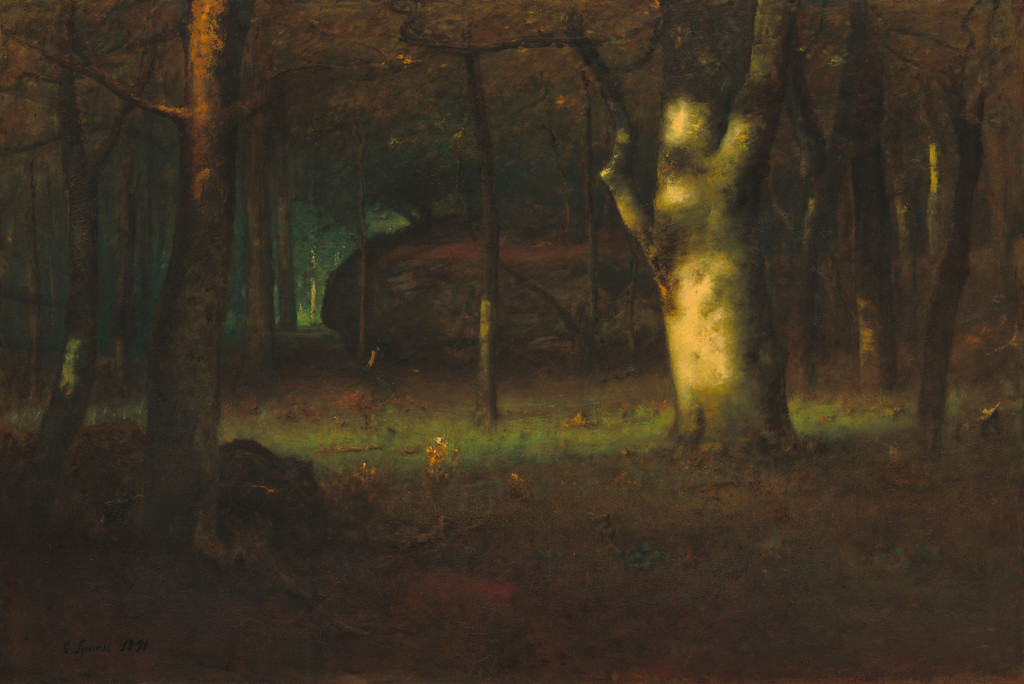
| Sunset in the Woods by George Inness | 1891 | oil on canvas |
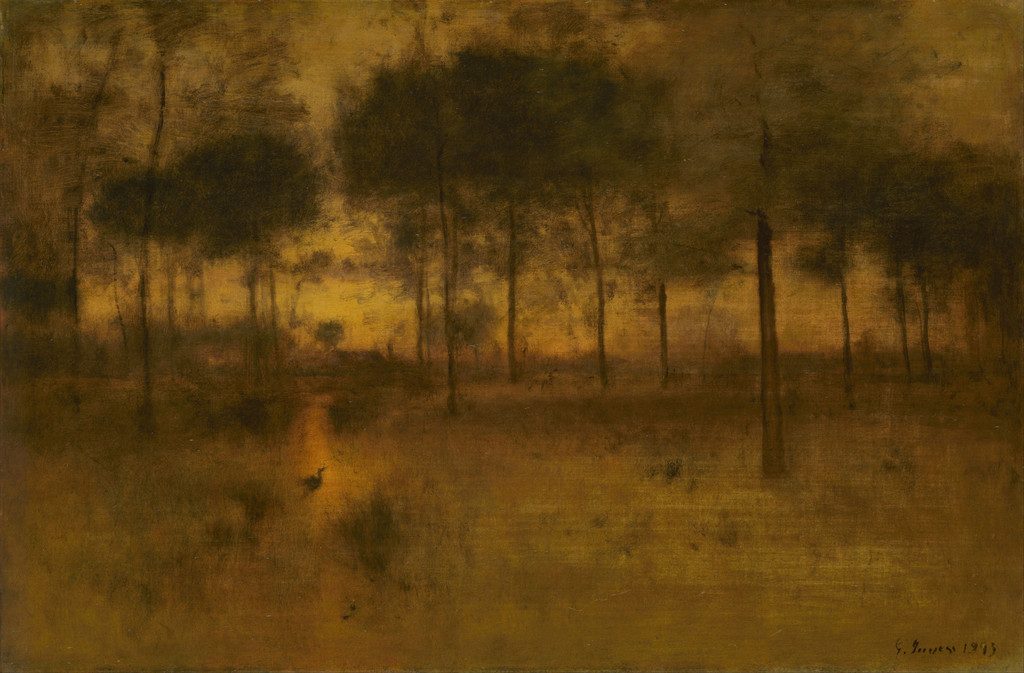
| The Home of the Heron — Princeton University Art Museum (y1943-93) | 1891 | Oil on canvas |
| Threatening | 1891 | Oil on canvas |
| Early Morning, Tarpon Springs | 1892 | Oil on canvas |
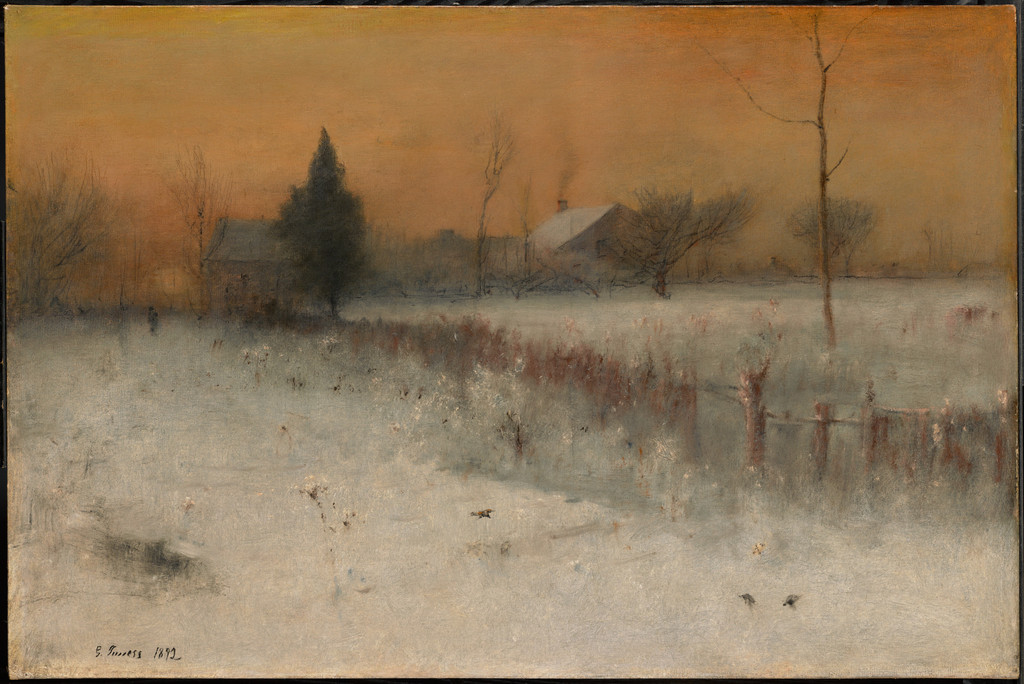
| Home at Montclair by George Inness | 1892 | oil on canvas |
| The Lonely Farm, Nantucket | 1892 | Oil on canvas |
| Afterglow | 1893 | Oil on canvas |
| Sunlit Valley | 1893 | Oil on canvas |
| The Home of the Heron — Art Institute of Chicago (1911.31) | 1893 | Oil on canvas |
| After a Summer Shower | 1894 | Oil on canvas |
| Landscape | n.d. | Watercolor with scraping on ivory wove paper |
Frequently Asked Questions
The Chicago canvas is dated 1870.[1]
A church, small figures, cultivated fields and a hayrick are visible. The museum draws attention to these features in its commentary.[1]
The reviewed record identifies its type, but no exact building name has been established here.
Edward B. Butler in 1912.[1]
Discussion
Look again at the images and ideas explored in Catskill Mountains by George Inness. These editorial prompts invite your observations.
Start with the nearest figures, move towards the church and stream, then follow the valley to the mountain. How does each scale of human presence affect your experience of the wider prospect?
Reader Insights
How do nearer activity and the distant hills share the composition?
How does this worked landscape compare with Peace and Plenty?
Which detail keeps the scene connected with people and cultivation?
Join the Conversation
Share a detail, comparison or question about Catskill Mountains by George Inness below.
References
- Art Institute of Chicago, Catskill Mountains, accession 1912.1623. Current object identity, commentary, provenance and selected exhibition history.
- Adrienne Baxter Bell, “George Inness (1825–1894),” Metropolitan Museum of Art (2012).
- Metropolitan Museum of Art, Peace and Plenty, accession 94.27.
- National Gallery of Art, The Lackawanna Valley, accession 1945.4.1.
- Metropolitan Museum of Art, Delaware Water Gap, accession 32.151.
- Splash image source.
George Inness, Catskill Mountains, 1870. Oil on canvas. Art Institute of Chicago, 1912.1623. Edward B. Butler Collection; Art Institute of Chicago. Image source. CC0 / Public domain.