 by Tom Gurney
Tom Gurney BSc (Hons) is an art history expert with over 20 years experience
Email: tomgurney1@gmail.com / Phone: +44 7429 011000
George Inness Quotes: Introduction
George Inness’s remarks about painting are most useful when their sources remain attached to them. Some survive as letters reproduced by his son; others are remembered studio conversations. Together they describe an artist concerned with selecting useful details, communicating experience and giving colour a sense of air. The six quotations below have been checked in printed sources. Their introductions distinguish a dated letter from an undated reply or a later recollection, so that each statement retains the circumstances that make it meaningful.[1][2]
At a Glance
- SelectionSix passages with their printed sources
- EvidenceLetters, published statements and remembered speech
- Dated letters22 July 1881 and 23 July 1891
- ReadingWording, context and limits kept together
Contents
- Reading Inness through his son’s book
- Useful detail and the work of selection
- The artist’s spiritual purpose
- Grey colour, richness and air
- Impressions and a rejected label
- Painting without paint
- Memory and imagination in a woodland letter
- Bringing the words back to the paintings
Reading Inness through his son’s book
George Inness Jr. published Life, Art, and Letters of George Inness in 1917. It is a substantial source for the painter’s working life, but it brings several kinds of evidence together. A transcribed letter can record an identifiable occasion. A remembered conversation preserves what the son understood his father to have said. The son’s own description of a method is another category again.
Those distinctions matter because a short quotation often circulates more widely than its introduction. An observation about pictures being painted at one moment can become a universal rule. A recollection can acquire an invented date. Keeping the printed page and type of testimony visible helps a reader judge what each sentence can establish.
The selections here preserve the source wording, including the spelling “gray” in the 1881 letter. They do not turn an undated remark into a dated manifesto. Where the original manuscript has not been examined, the reference identifies the published transcription actually consulted.
Useful detail and the work of selection
“Never put anything on your canvas that isn’t of use.”
The son recalls this instruction while describing his father’s studio practice at Medfield. It is remembered speech, rather than a dated surviving letter. Its emphasis falls on the purpose of a detail within a painting: the mere ability to represent something does not explain why it belongs there.[1]
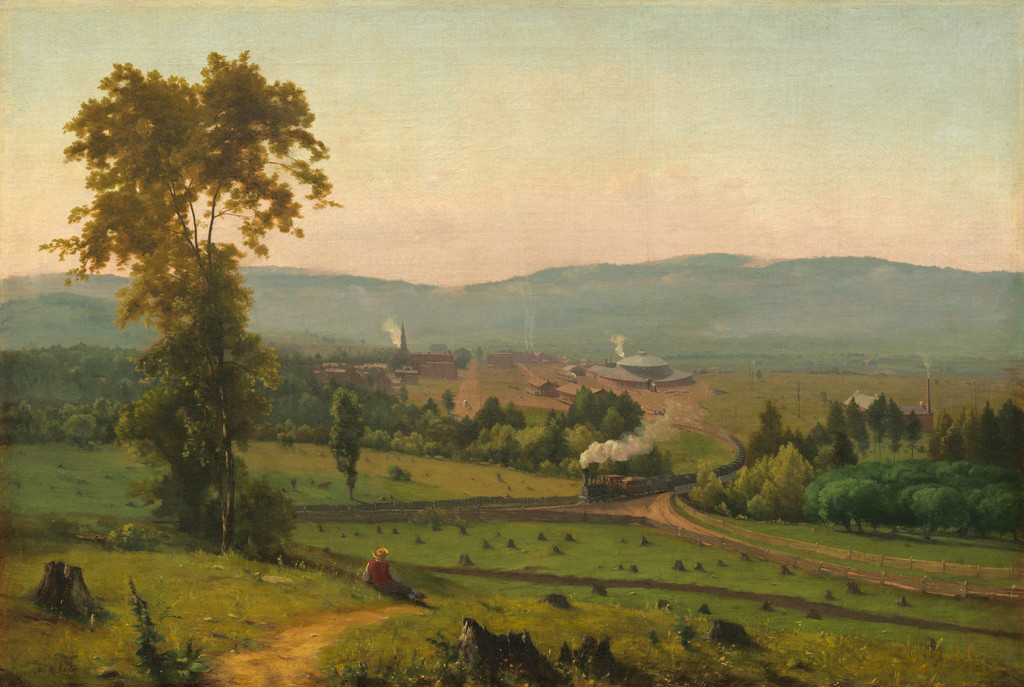
“Use” can be understood through composition. A tree may establish scale, interrupt a horizon or direct attention towards an opening. A small figure may supply a point of recognition among less definite shapes. The instruction does not necessarily demand that every mark illustrate a narrative; a visual relationship can itself give the mark a function.
In The Lackawanna Valley, the train, surviving tree, reclining figure and cut stumps create different kinds of attention. Looking at what each contributes offers a practical way to consider the recollection. The quotation is a question to bring to the picture, rather than proof that the son’s account explains the intention behind every object.
The artist’s spiritual purpose
“The true use of art is, first, to cultivate the artist’s own spiritual nature, and, second, to enter as a factor in general civilization.”
This statement appears on printed page 17 of the memoir. The son supplies no date for it in that passage. Its position in the book should therefore not be used to assign it to a particular year in the painter’s youth.[1]
The sentence connects inward development with a public consequence. Art works upon the person making it, yet it also enters a world shared with others. Neither part can be reduced to the production of a convincing likeness. The artist’s motive and the viewer’s experience become relevant to what a painting does.
That helps frame a reading of Inness’s religious interests, but it does not provide a symbolic dictionary. A bird, sunset or particular colour cannot be assigned a fixed spiritual meaning simply because the artist described art in these terms. The documented allegorical history of The New Jerusalem requires its own evidence; a late landscape requires attention to its particular composition.
Grey colour, richness and air
“All these pictures are painted with very gray colors, which I find give me the truest tone of nature, so that, although they are very rich, they are full of air.”
Unlike the undated spiritual statement, this sentence belongs to a letter to the artist’s wife dated July 22, 1881. The letter begins on printed page 156 and continues on page 157. “These pictures” refers to the works then under discussion, rather than a description of every painting Inness made.[1]
The contrast between grey colour and richness is especially useful. Grey need not mean a completely colourless surface. Colours can appear warm or cool in relation to one another while remaining restrained enough to suggest atmosphere. The remark asks us to consider relationships across the whole picture, rather than the brilliance of a single isolated passage.
The phrase “full of air” also redirects attention from objects towards the intervals between them. A distant tree can seem farther away through a change in clarity or colour; a field can feel continuous even where its boundaries soften. Inness’s letter describes an effect he valued. It does not identify particular pigments or prescribe a fixed sequence of layers.
Impressions and a rejected label
“We are all the subjects of impressions, and some of us legitimates seek to convey our impressions to others.”
The memoir reproduces this sentence in an undated reply addressed to “Editor Ledger,” written from Tarpon Springs. The son explains that the newspaper’s identity had been lost. In the surrounding passage, Inness objects to being classified as an Impressionist while discussing the communication of impressions.[1]
The distinction belongs to the artist’s argument. Receiving an impression of nature is a broad human experience; membership of a named artistic tendency is a more specific historical claim. The quotation cannot be used to reverse his objection and present him as straightforwardly declaring an allegiance to French Impressionism.
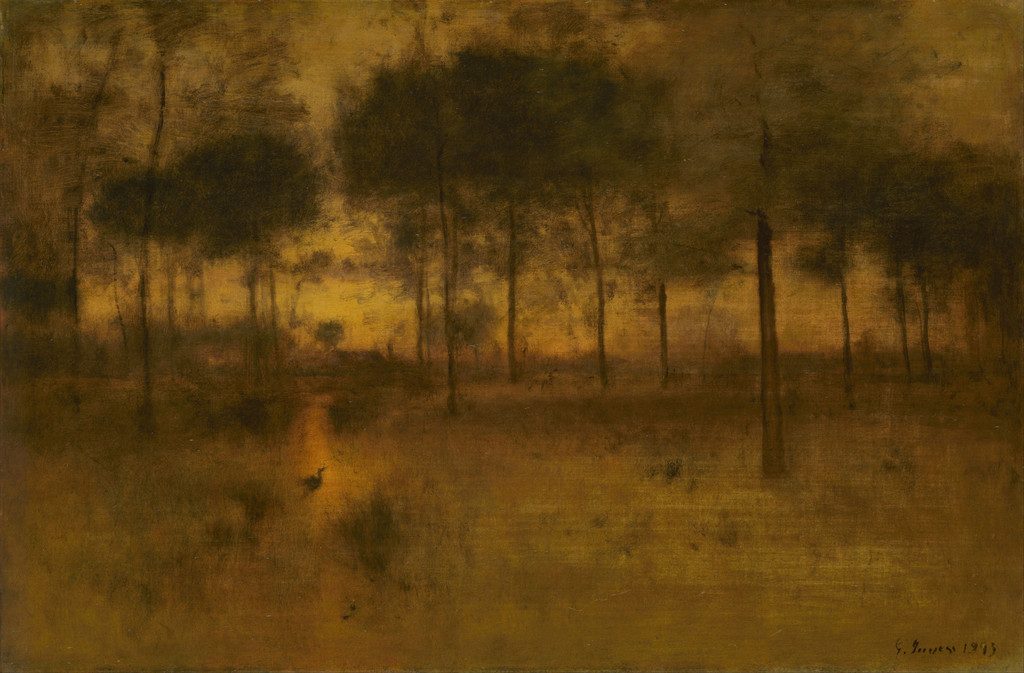
For looking at The Home of the Heron, the useful question is how a picture communicates an experience through selected shapes and tonal relationships. A small bird can remain recognisable while the surrounding landscape feels less definite. That visual effect deserves description on its own terms, before a movement label is asked to explain it.
Watch: George Inness
Choose a film to explore the artist’s work, its interpretation and its wider setting.
The Montclair Art Museum's George Inness Gallery
Visit the George Inness Gallery at the Montclair Art Museum in this State of the Arts feature.
Watch on YouTubePainting without paint
“If I could only paint without paint!”
The son records this wish on printed page 246, in a discussion of the effect of his father’s painting. It is a recollection of speech. The surrounding account concerns the concealment of technique and the convincing presence of a landscape, rather than the literal elimination of the painter’s materials.[1]
The paradox becomes clearer beside the son’s later account of glazing, scumbling and repainting on pages 252–254. A landscape that seems immediately present to the viewer may result from considerable material work. Concealing effort does not imply that the painting was effortless, or that its surface was completed in a single spontaneous session.
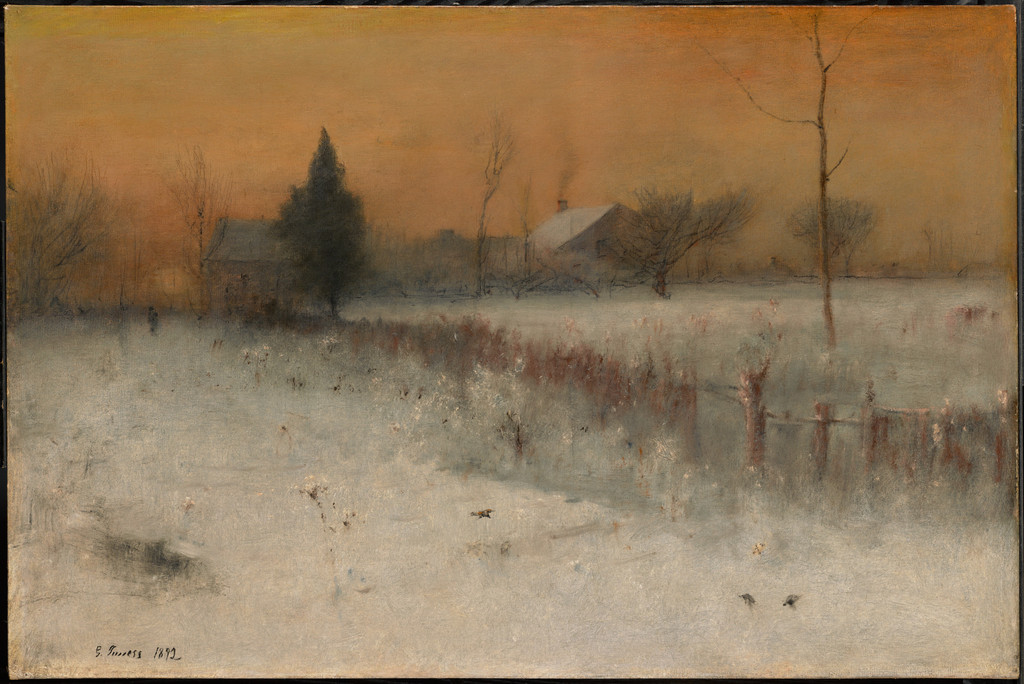
This is a useful way into Home at Montclair. Its broad snowy field and low winter sky can occupy attention before the viewer thinks about the marks that make them visible. The quotation concerns that ambition for a persuasive world; an account of the particular canvas’s handling still needs evidence specific to the work.
Memory and imagination in a woodland letter
“The idea is to represent an effect in the woods towards sundown, but to allow the imagination to predominate.”
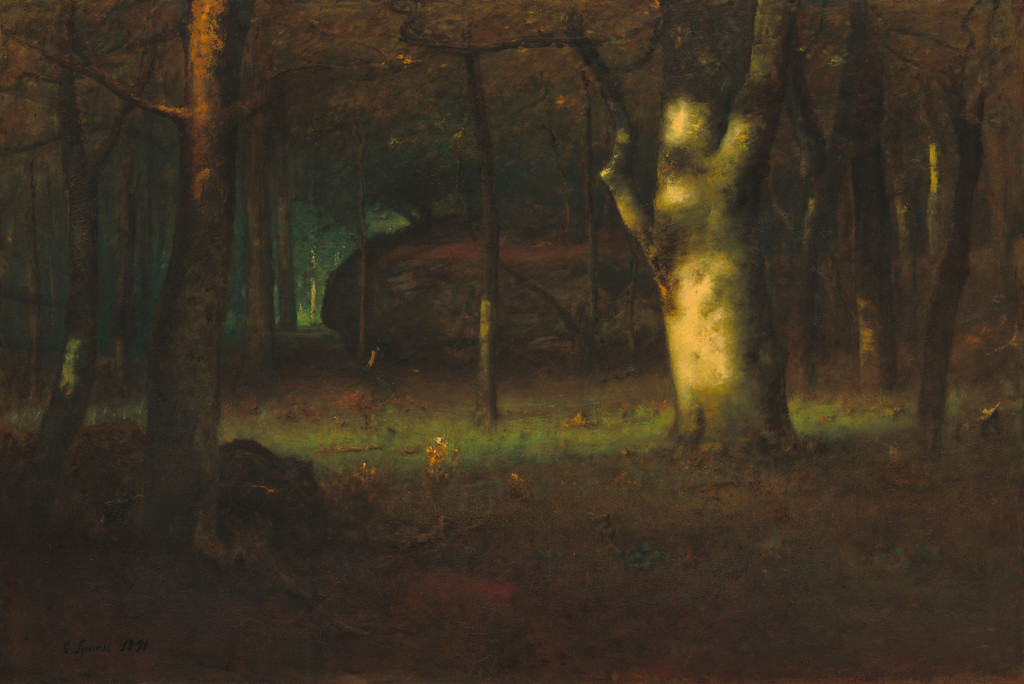
Inness wrote this sentence on July 23, 1891 in a letter associated with Sunset in the Woods. Dorothy W. Phillips printed the letter in the 1966 Corcoran catalogue, on page 120. That published scan has been checked; the original manuscript has not. Later scholarly apparatus traces the letter to the Norcross Collection at the Massachusetts Historical Society.[2][3]
The letter gives memory a concrete role. Inness refers to an earlier woodland sketch and to a painting begun years before the letter. Observation therefore provided material that could be reconsidered over time. The finished work need not repeat the sketch as a straightforward inventory of things once seen.
The pale trunks, dense canopy and small opening in Sunset in the Woods make this distinction worth considering. A reader can ask how the scene directs attention and sustains the feeling of fading light. The letter authorises an interest in imaginative transformation, but it does not tell us to assign a hidden meaning to every trunk or branch.
Bringing the words back to the paintings
These six passages do not form a complete theory assembled by Inness for publication as a single text. They come from different circumstances and reach us through different routes. Their value lies in the questions they sharpen: what does a detail contribute, how do restrained colours create atmosphere, and how can remembered observation be transformed into a convincing painted experience?
Read alongside the works, the quotations support a more precise account of his ambitions. Keep the object in view, preserve the statement’s source and allow its limits to remain visible. The style and technique article carries these questions further through the son’s technical account and independently published examination of a particular painting.
Artworks directory
A collected selection of 46 individually identified museum objects: 43 paintings and three watercolours. This is not a complete catalogue raisonné. Repeated titles identify separate objects where their institutions or accessions differ. Links lead to a companion article where available, otherwise to the museum record. Unillustrated entries remain included; the original lost New Jerusalem is represented by its three transformed survivors.
| Name | Date | Medium |
|---|---|---|
| Crossing the Ford | 1848 | Oil on canvas |
| The Old Mill | 1849 | Oil on canvas |
| The Lackawanna Valley by George Inness | c. 1856 | oil on canvas |
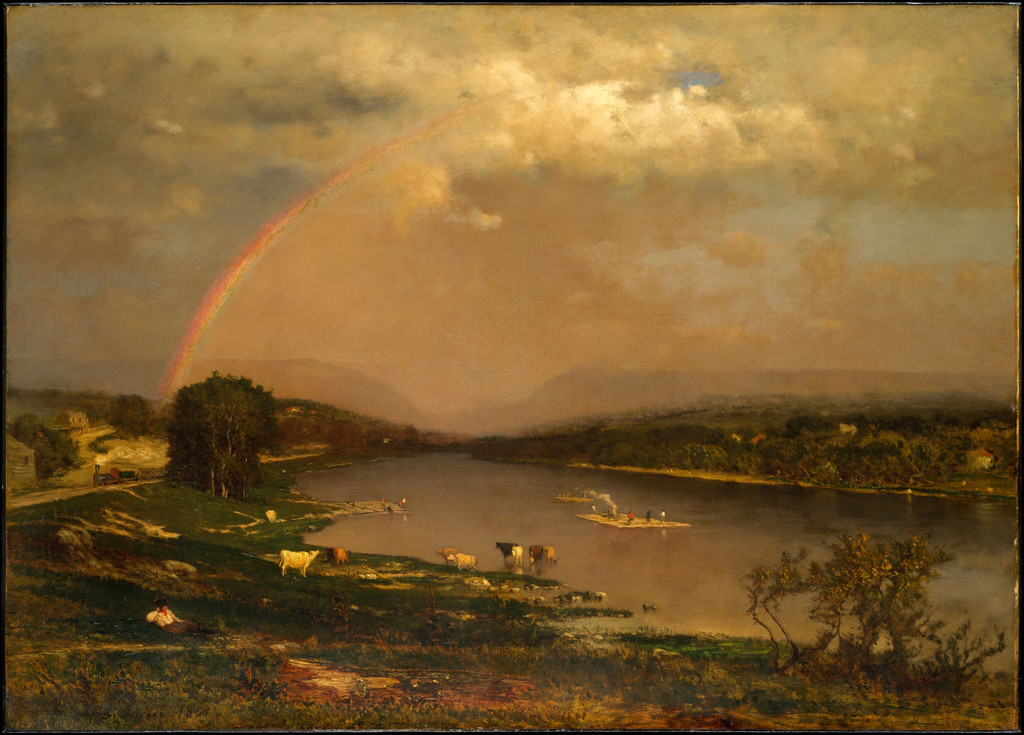
| Delaware Water Gap | 1861 | Oil on canvas |
| Delaware Valley | c. 1865–75 | Oil on artist's board |
| Peace and Plenty | 1865 | Oil on canvas |
| Evening Landscape | 1867; later reworked | Oil on canvas |
| Summer in the Catskills | 1867 | Oil on canvas |
| The Valley of the Olives | 1867; reworked after 1880 | Oil on canvas |
| The Valley of the Shadow of Death | 1867 | Oil on canvas |
| Visionary Landscape | 1867/1880 | Oil on canvas |
| Catskill Mountains | 1870 | Oil on canvas |
| Across the Campagna | 1872 | Watercolor, gouache, and graphite on off-white wove paper |
| Olive Trees at Tivoli | 1873 | Gouache, watercolor, and graphite on blue wove paper with colored fibers |
| A Marine | c. 1874–75 | Oil on canvas |
| Twilight in Italy — Art Institute of Chicago (1911.44) | 1874 | Oil on panel |
| Pine Grove of the Barberini Villa | 1876 | Oil on canvas |
| The Storm | 1876 | Oil on canvas |
| Autumn Oaks | ca. 1878 | Oil on canvas |
| The Sisters | 1882 | Oil on millboard |
| Harvest, Montclair, New Jersey | 1884 | Oil on canvas |
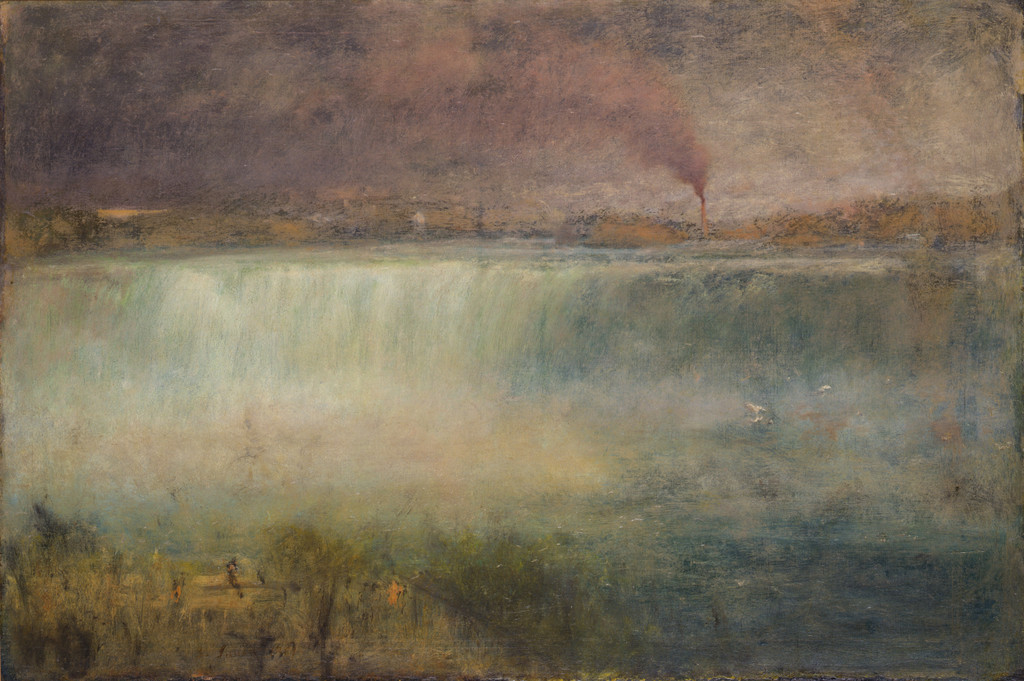
| Niagara Falls | 1885 | Oil on wood |
| A Silver Morning | 1886 | Oil on canvas |
| Landscape, Sunset | 1887–89 | Oil on canvas |
| September Afternoon | 1887 | Oil on canvas |
| Sunrise | 1887 | Oil on canvas |
| The Mill Stream, Montclair, New Jersey by George Inness | c. 1888 | Oil on canvas |
| Niagara by George Inness | 1889 | oil on canvas |
| The Mill Pond | 1889 | Oil on canvas |
| Sunset in the Valley | 1890 | Oil on canvas |
| The Moon at Night | 1890 | Oil on canvas |
| Twilight in Italy — Art Institute of Chicago (1911.42) | 1890 | Oil on canvas |
| Autumn Woods | 1891–94 | Oil on canvas |
| Moonrise | 1891 | Oil on canvas |
| Spring Blossoms, Montclair, New Jersey | ca. 1891 | Oil and crayon or charcoal on canvas |
| Sunset in the Woods by George Inness | 1891 | oil on canvas |
| The Home of the Heron — Princeton University Art Museum (y1943-93) | 1891 | Oil on canvas |
| Threatening | 1891 | Oil on canvas |
| Early Morning, Tarpon Springs | 1892 | Oil on canvas |
| Home at Montclair by George Inness | 1892 | oil on canvas |
| The Lonely Farm, Nantucket | 1892 | Oil on canvas |
| Afterglow | 1893 | Oil on canvas |
| Sunlit Valley | 1893 | Oil on canvas |
| The Home of the Heron — Art Institute of Chicago (1911.31) | 1893 | Oil on canvas |
| After a Summer Shower | 1894 | Oil on canvas |
| Landscape | n.d. | Watercolor with scraping on ivory wove paper |
Frequently Asked Questions
His son records that remark on printed page 246 of the 1917 memoir. Introduce it as remembered speech rather than a dated surviving letter.[1]
The reply to “Editor Ledger” reproduced by his son rejects that classification while discussing impressions. The reply is undated and the newspaper identity was lost.[1]
It comes from a letter to his wife dated July 22, 1881. Its reference to “these pictures” should remain connected to that occasion.[1]
Discussion
Look again at the images and ideas explored in George Inness Quotes. These editorial prompts invite your observations.
Choose one quotation and one painting. Does the statement help identify a specific visual relationship, or does it encourage an interpretation the picture cannot independently support? Compare the usefulness of the dated woodland letter with the broader remembered wish to paint without paint.
Reader Insights
Which quotation makes you notice a particular relationship in a painting?
How does a dated letter differ from a remembered studio remark as evidence?
What changes when the words remain attached to their surrounding passage?
Join the Conversation
Share a detail, comparison or question about George Inness Quotes below.
References
- George Inness Jr., Life, Art, and Letters of George Inness (1917), printed pp.17, 46, 156–157, 168–169, 245–246 and 252–254. Selected printed scans checked; the complete book is not represented as fully read.
- Dorothy W. Phillips, A Catalogue of the Collection of American Paintings in the Corcoran Gallery of Art, vol.1 (1966), printed p.120. Transcription of the artist’s July 23, 1891 letter.
- Corcoran Gallery of Art: American Paintings to 1945, scholarly apparatus (2011), printed pp.296–299. Selected entry for Sunset in the Woods, including the letter’s archival location.
- Splash image source.
George Inness, Sunset in the Woods, 1891. Oil on canvas, 122.2 × 183.2 cm. National Gallery of Art, 2014.79.43. Corcoran Collection; National Gallery of Art. Image source. CC0 / Public domain.