 by Tom Gurney
Tom Gurney BSc (Hons) is an art history expert with over 20 years experience
Email: tomgurney1@gmail.com / Phone: +44 7429 011000
Pine Grove of the Barberini Villa by George Inness: Introduction
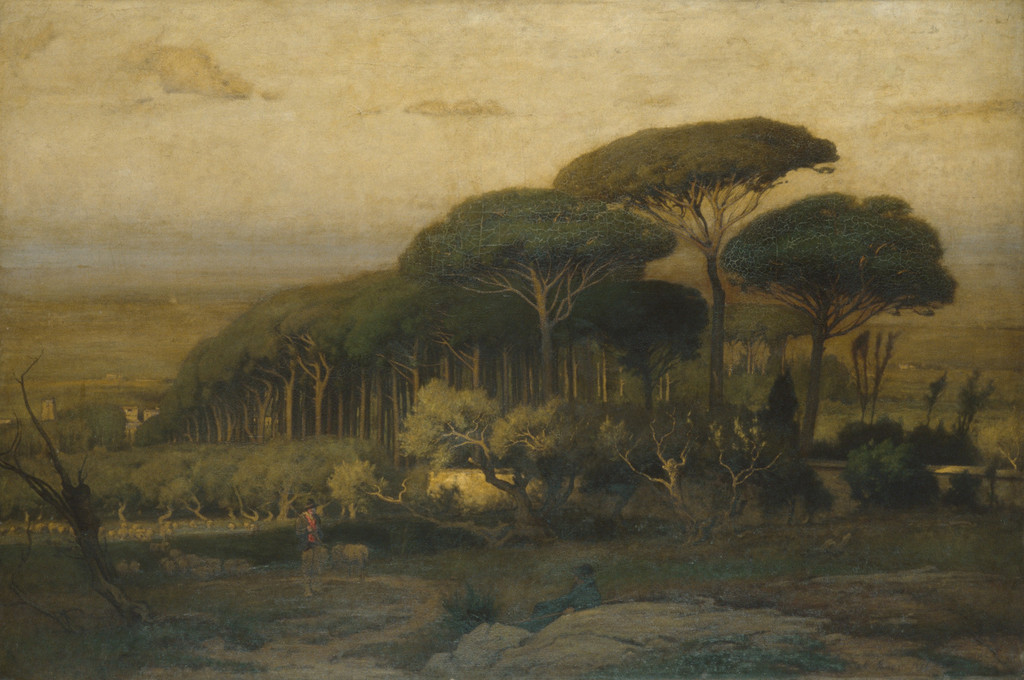
Broad pine crowns repeat across George Inness’s Pine Grove of the Barberini Villa, their narrow trunks forming a grove beneath a large pale sky. The left side opens towards a hazy distance, while small figures and animal forms occupy the nearer ground. The Metropolitan Museum of Art dates this oil canvas to 1876. At 200 × 301 cm, it gives an Italian landscape a scale very different from Inness’s small watercolour studies.[1]
At a Glance
- ArtistGeorge Inness (1825–1894)
- TitlePine Grove of the Barberini Villa
- Date1876
- MediumOil on canvas
- Dimensions200 × 301 cm
- CollectionMetropolitan Museum of Art, New York
- CreditGift of Lyman G. Bloomingdale, 1898
- Accession98.16
This work across George Inness’s career
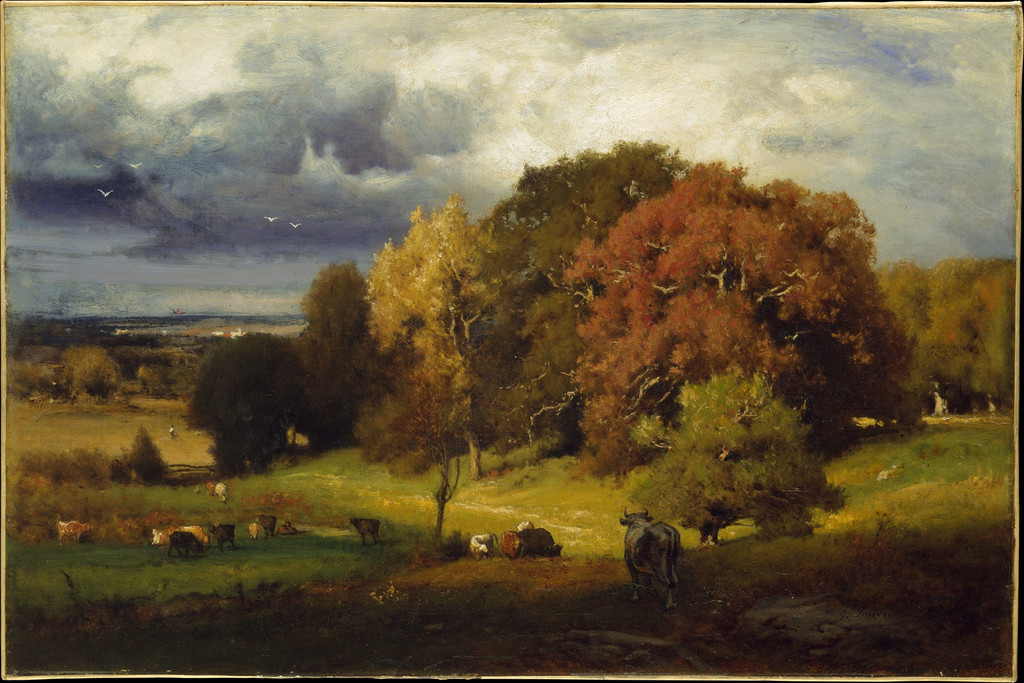
Autumn Oaks by George Inness
ca. 1878Contents
- A landscape three metres wide
- Castel Gandolfo and Lago Albano
- Crowns and repeated trunks
- Earth and sky across the composition
- Figures and animal forms in the foreground
- Different trees before the grove
- Impasto and stippling in the tallest tree
- The 1876 date and Italian subjects after travel
- Comparing small studies, rocks and late woods
- Annotated details
A landscape three metres wide
The width gives the pine group room to develop as a sequence. The crowns rise at unequal heights, and the nearer trees differ from the smaller forms deeper in the grove. The composition therefore offers repetition without making every tree identical.
The figures are small relative to the scene. A viewer can find them within the foreground, yet the trees and sky continue to dominate. This contrast makes scale part of the subject: the grove is experienced through a relation between modest living forms and a much broader arrangement of land and vegetation.
The large format also changes how the scene can be read. From a broader view, the tree crowns gather into substantial masses. Closer attention reveals branches, trunks and intervals between them. The picture sustains both levels, with its smaller details contributing to an arrangement that is legible across the canvas.
The scale should remain attached to this particular object. A reduced reproduction can show the composition clearly, but it cannot reproduce the experience of standing before a three-metre-wide painting. The measurements help explain why a small figure or a textured crown might have a stronger physical presence in the original.
Annotated Details from Pine Grove of the Barberini Villa
The numbered points identify visible features discussed in this article. Return from each detail to the whole composition. George Inness, Pine Grove of the Barberini Villa, 1876. Oil on canvas. Met, 98.16. Gift of Lyman G. Bloomingdale, 1898; Metropolitan Museum of Art. Image source. Public domain.
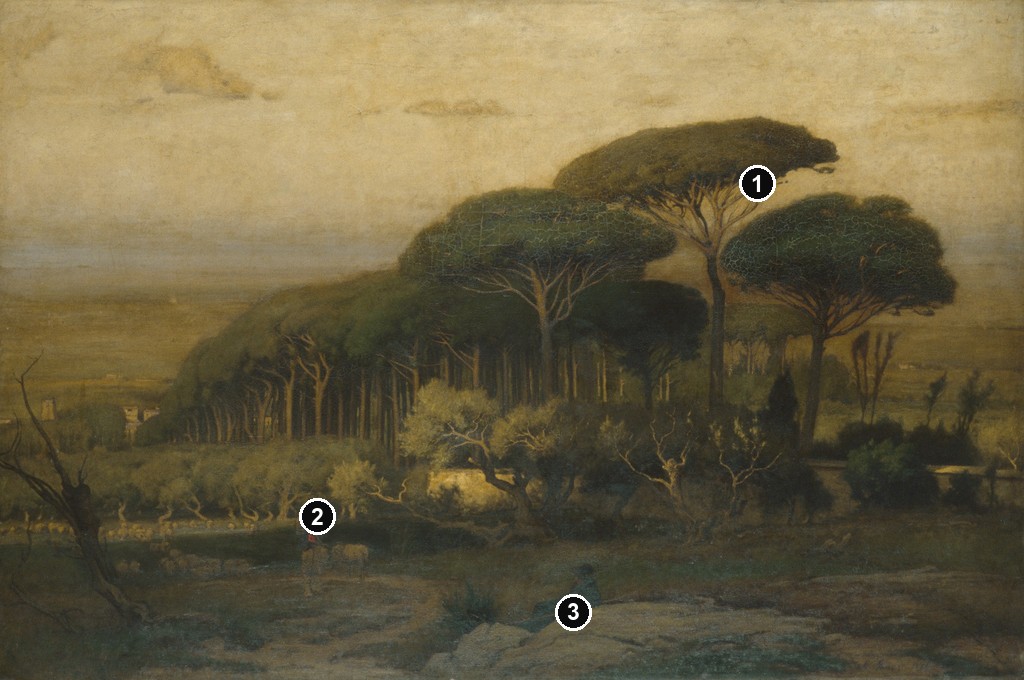
Details from PINE GROVE OF THE BARBERINI VILLA
Compare the cropped details with the complete images above. Notice how their colours, shapes and positions contribute to the larger compositions.
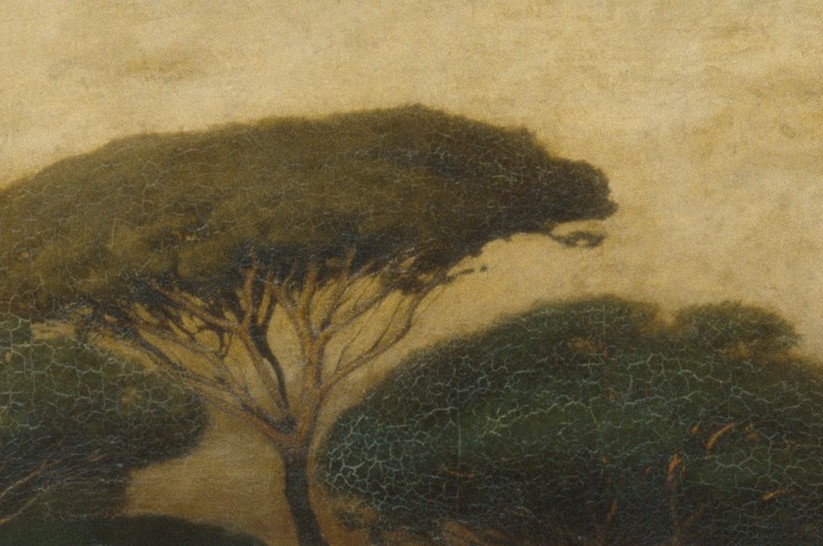
Umbrella-shaped crowns
Broad tree crowns overlap above slender trunks. Their repeated shapes organise a grove that recedes across the composition.
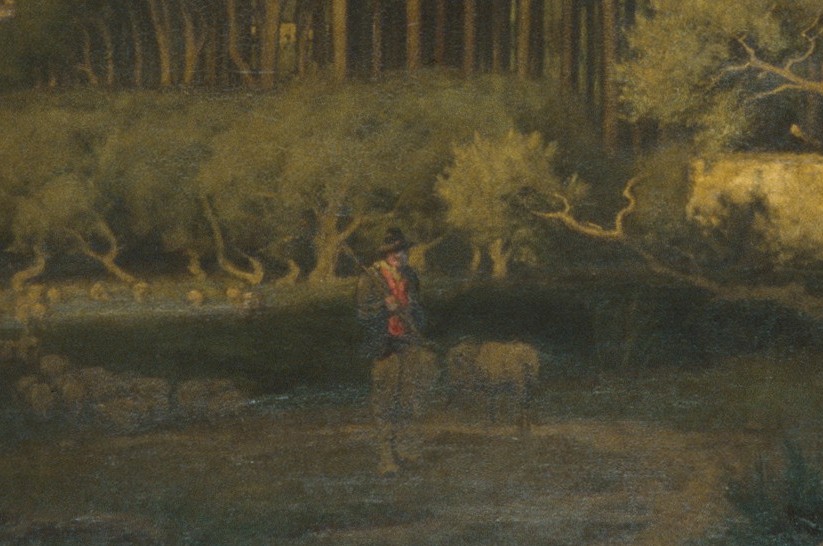
Standing figure
A small red-accented figure stands among the low growth. The colour makes the person noticeable within the darker lower landscape.
Seated foreground figures
Seated figures lie close to the lower edge. Their nearer scale differs from the standing person farther inside the grove.
Castel Gandolfo and Lago Albano
The Met identifies Villa Barberini on the outskirts of Castel Gandolfo, southeast of Rome, and Lago Albano visible through the trees. Its commentary places the town within the interests of nineteenth-century landscape painters.[1] These points establish the museum’s account of the Italian setting.
In the image, the left distance is less enclosed than the right. Hazy land and pale architecture appear beyond the nearer vegetation. The interval provides an outward prospect beside the denser grove, allowing the scene to contain both a wooded setting and a view beyond it.
The distant forms are subdued beside the dark pine crowns. Their quieter presence helps the trees stand forward, while keeping the wider landscape available. The painting’s depth depends partly on this difference in emphasis.
The title and current record identify the locality without converting the canvas into a survey. The picture remains an arrangement of trees, figures, ground and distance. A modern photograph could provide geographical context, but its viewpoint would need to be distinguished from the artist’s composition.
Crowns and repeated trunks
The umbrella-shaped crowns spread above comparatively slender trunks. Their broad horizontal masses contrast with the uprights below, giving the pine group two different rhythms. The viewer can follow the sequence of trunks into the grove, then move across the fuller forms overhead.
The tallest crown rises above its neighbours near the right of centre. Its height gives the group a point of emphasis, while the lower trees continue to either side. The arrangement feels ordered without turning into a straight row of matching silhouettes.
Branches remain visible beneath several crowns. They spread outward from the trunks before meeting darker foliage, making the supporting structure of the canopy legible. Some branching forms are clearer than others, which keeps the group from acquiring a uniform, diagrammatic appearance.
The deeper trunks become more closely gathered and less substantial. Their repetition leads inward beneath the crowns, where the ground is darker. The grove acquires depth through changes of spacing, scale and visibility rather than through a conspicuous central road.
Earth and sky across the composition
The sky occupies a broad pale region above the land. The crowns interrupt it at different heights, while the lower ground contains darker, denser forms. The Met describes a division into nearly equal areas of solid earth and open sky.[1]
This broad division is complicated by the trees. The trunks link ground and crown, while foliage projects into the upper region. The viewer therefore experiences two substantial areas that are also joined by repeated vertical forms.
The left opening adds another variation. Here, distance seems less enclosed than the grove, and pale forms interrupt the darker land. The sky’s openness is echoed, on a smaller scale, by an outward view below it. That relationship keeps the composition from becoming a simple division into two uniform blocks.
Try looking at the whole image before following any one trunk. Then return to the repeated uprights. The broad structure remains, but its internal intervals become more varied. This change in attention helps explain how order can coexist with a complex wooded landscape.
Bell explains the importance of Swedenborgian ideas to Inness’s understanding of relationships between visible nature and spiritual existence.[2] The Met tentatively connects this canvas’s order and balance with that interest.[1] The qualification matters: a contemplative response to the divided landscape is possible without giving every pine or foreground figure one fixed symbolic identity. The repeated forms provide something specific through which to consider the broader framework.
Figures and animal forms in the foreground
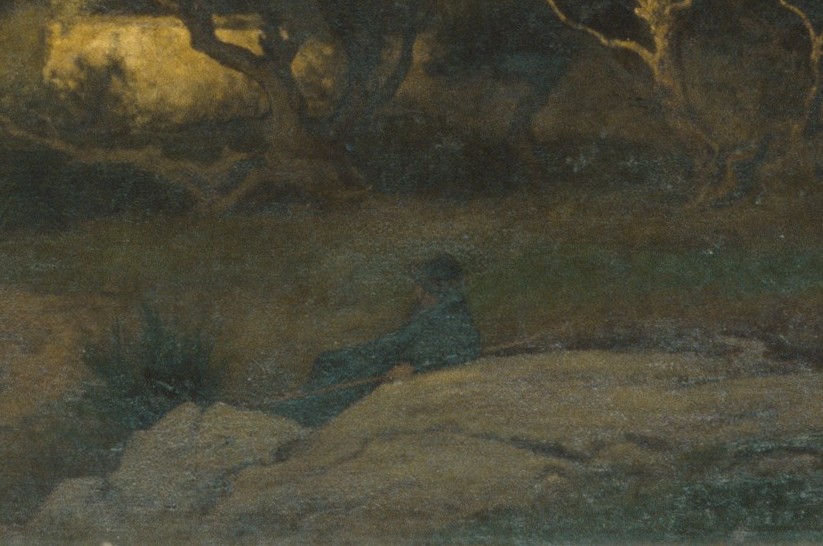
Two seated figures occupy the lower central area, their dark and blue-green clothing closely joined to the subdued ground. They are comparatively quiet forms. Their low positions contrast with the tall trees, offering a human scale within the larger prospect.
Farther left, a standing figure has a stronger red accent. Nearby pale animal forms introduce another rhythm close to the ground. Their lighter tones can be found against darker vegetation without becoming the picture’s main spectacle.
The difference between seated and standing figures matters to the arrangement. One group rests low in the foreground, while the more distant upright form interrupts the vegetation at a higher point. Attention can move between them before following the trunks into the grove.
These details make the landscape inhabited. The image does not securely identify the people or supply a particular conversation or occasion. Their placement already contributes enough: living forms occupy the ground beneath a canopy whose size gives their presence a more modest scale.
Watch: George Inness
Choose a film to explore the artist’s work, its interpretation and its wider setting.
The Montclair Art Museum's George Inness Gallery
Visit the George Inness Gallery at the Montclair Art Museum in this State of the Arts feature.
Watch on YouTubeDifferent trees before the grove
Smaller branching trees and shrubs occupy the ground in front of the pines. Their irregular, lighter branches differ from the tall trunks and broad crowns behind. This contrast adds another depth and another kind of structure to the composition.
A darker bare trunk leans into the lower left. Its angled branches interrupt the more regular rise of the pines. The nearest vegetation therefore introduces oblique movement before the eye reaches the repeated uprights farther back.
The smaller trees also prevent the grove from meeting the foreground in a single straight boundary. Their branches cross and overlap, making the transition more uneven. The scene becomes a succession of forms rather than a row of pines placed behind an empty strip of land.
Look from the nearest angled trunk towards the tallest crown. The movement passes through several kinds of branching and several changes of scale. That route reveals how much variety the painting contains within its broad impression of order.
Impasto and stippling in the tallest tree
The Met supplies a specific account of the tallest tree’s surface: heavy impasto, followed by stippling with a stiff brush. It describes the foliage as noticeably projecting from the painting’s surface.[1] The reported sequence belongs to this object and should remain tied to the museum’s observation.
Impasto refers to paint applied with sufficient body to make its thickness apparent. Stippling introduces repeated touches that can give an area a more broken texture. These terms help explain why the tree’s foliage may have a physical presence beyond its darker colour and greater height.
The reproduction can direct attention towards the crown, but it cannot replace examining relief on the original surface. A photograph records one view and lighting condition. It does not independently establish every layer or allow the paint’s thickness to be measured from colour alone.
The museum’s account is nevertheless useful because it complicates an overly simple idea of Inness as a painter of uniformly soft surfaces. This crown has a documented pronounced texture, within a landscape that also contains subdued distance and atmospheric relationships. Varied handling can contribute to the unity of the scene.
The 1876 date and Italian subjects after travel
Bell records Inness’s longer European residence from 1870 to 1874 and places Pine Grove among Italian subjects painted after his return to Boston.[2] The 1876 date therefore belongs to the canvas, while the documented residence supplies an earlier context for the subject.
This distinction makes memory and continued work on Italian themes relevant questions, without reconstructing an undocumented session at Castel Gandolfo in 1876. The current record identifies the scene; the chronology keeps a work’s date separate from the dates of travel.
The later collection event is clear. Lyman G. Bloomingdale gave the painting to the Met in 1898.[1] That gift and accession 98.16 identify the particular monumental canvas, whose credit should remain distinct from those of the museum’s smaller Italian sheets.
Comparing small studies, rocks and late woods
Across the Campagna, 1872, combines watercolour, gouache and graphite on a small off-white sheet in the Met.[3] Its broad sky above a low horizon makes a useful comparison for the much larger Pine Grove. The relative openness can be examined while keeping the works’ different materials and dimensions in view.
Olive Trees at Tivoli, 1873, uses gouache, watercolour and graphite on blue paper.[4] Its trees, rock forms and open distance offer another arrangement of Italian landscape, discussed on the drawings and watercolours page. Compare its graphic forms with the fuller repeated crowns here.
A Marine, circa 1874–75, is currently considered by AIC to represent Porto d’Anzio.[5] Its central rock offers a compact material emphasis below a dark sky. The pine grove instead develops a sequence of tall forms across a much wider wooded setting.
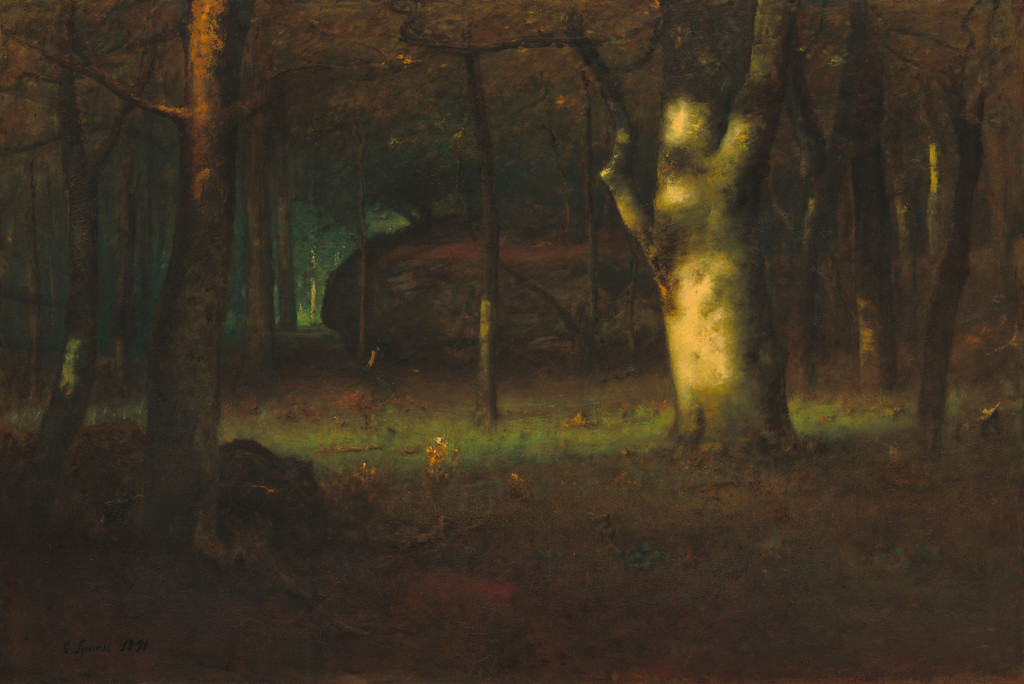
Sunset in the Woods, 1891, in the National Gallery of Art, keeps the viewer among trunks and shadow.[6] Its limited opening differs from the broad sky and outward prospect here. These contrasts make Pine Grove a distinctive example of how Inness could join monumental scale, repeated natural forms and varied handling within one landscape.
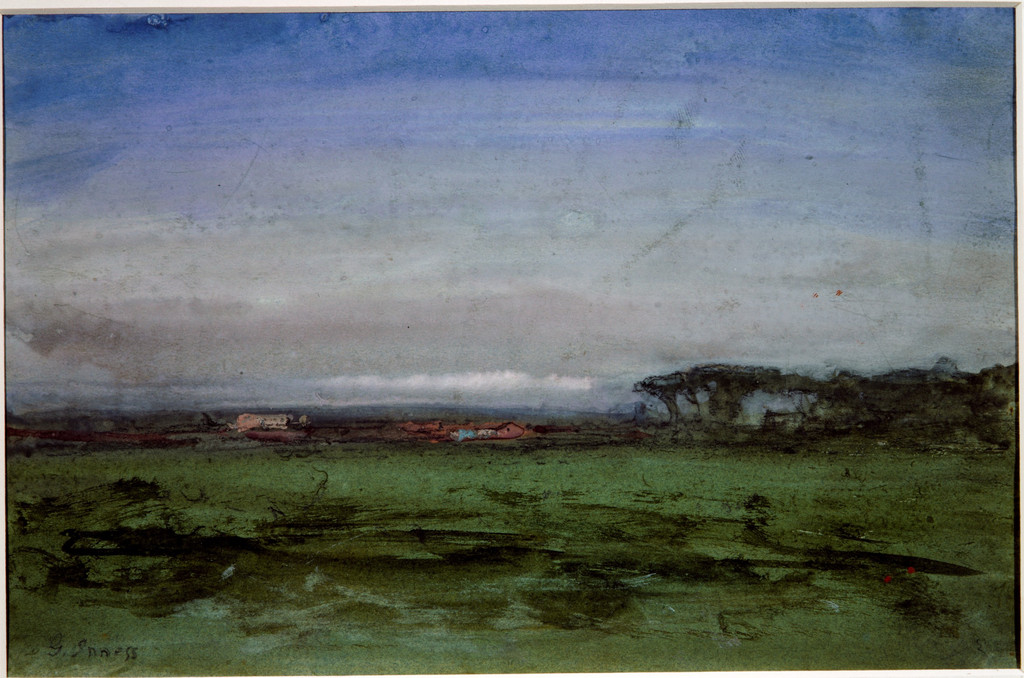
George Inness, Across the Campagna, 1872. Watercolour, gouache and graphite on off-white wove paper. Met, 67.55.145. Bequest of Susan Dwight Bliss, 1966; Metropolitan Museum of Art. Image source. Public domain.
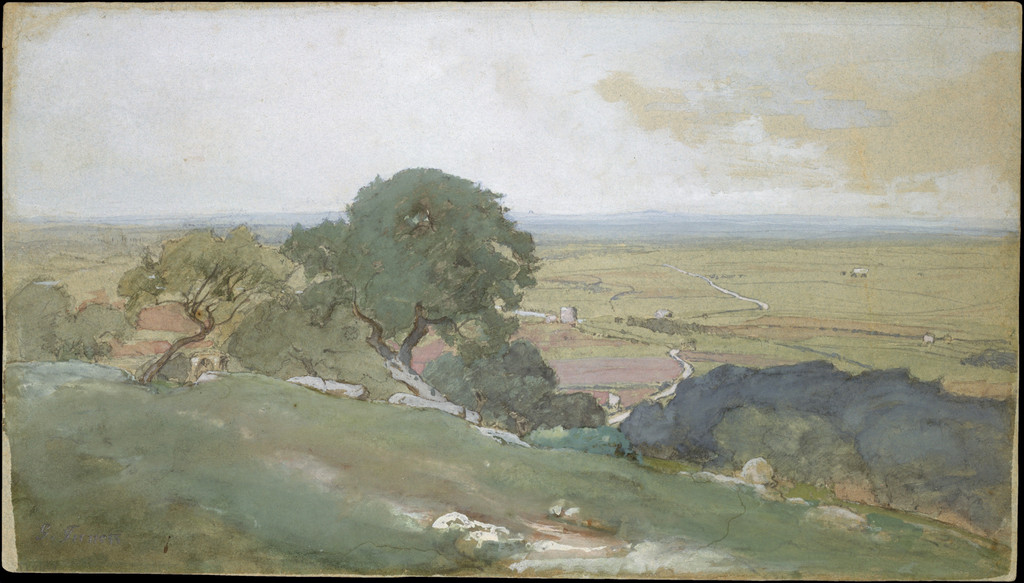
George Inness, Olive Trees at Tivoli, 1873. Gouache, watercolour and graphite on blue wove paper with coloured fibres. Met, 1989.287. Morris K. Jesup Fund, 1989; Metropolitan Museum of Art. Image source. Public domain.
Artworks directory
A collected selection of 46 individually identified museum objects: 43 paintings and three watercolours. This is not a complete catalogue raisonné. Repeated titles identify separate objects where their institutions or accessions differ. Links lead to a companion article where available, otherwise to the museum record. Unillustrated entries remain included; the original lost New Jerusalem is represented by its three transformed survivors.
| Name | Date | Medium |
|---|---|---|
| Crossing the Ford | 1848 | Oil on canvas |
| The Old Mill | 1849 | Oil on canvas |
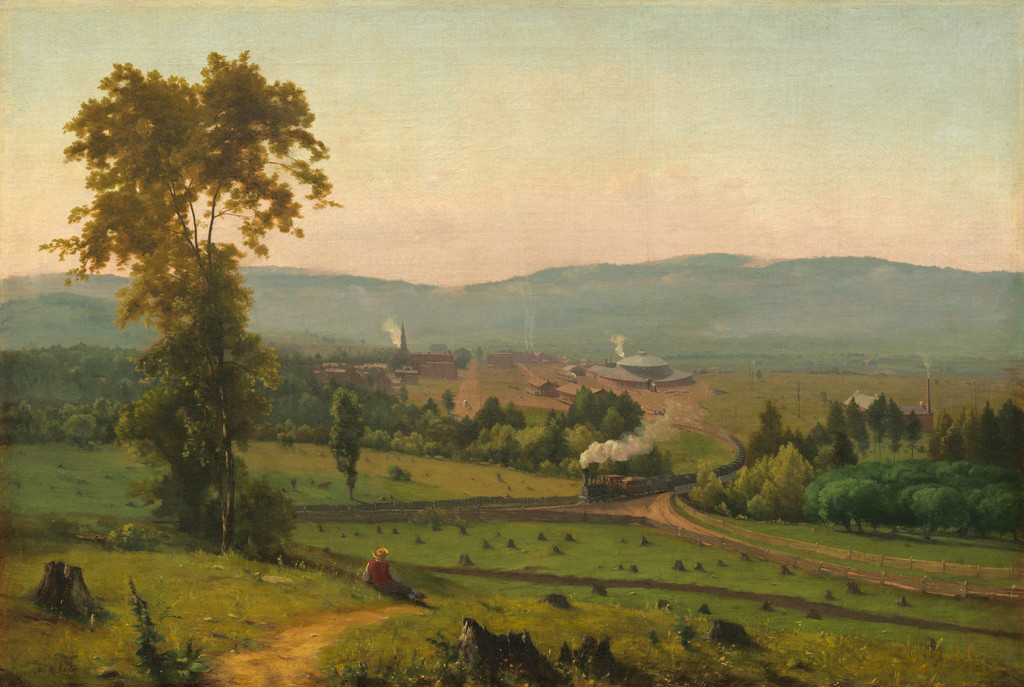
| The Lackawanna Valley by George Inness | c. 1856 | oil on canvas |
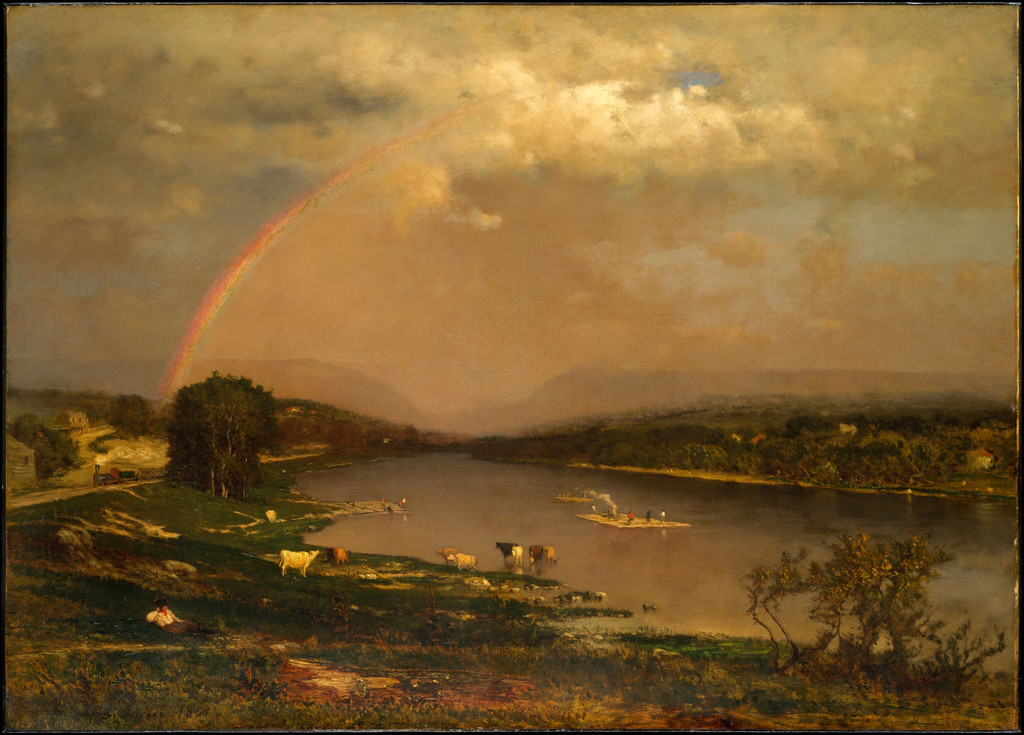
| Delaware Water Gap | 1861 | Oil on canvas |
| Delaware Valley | c. 1865–75 | Oil on artist's board |
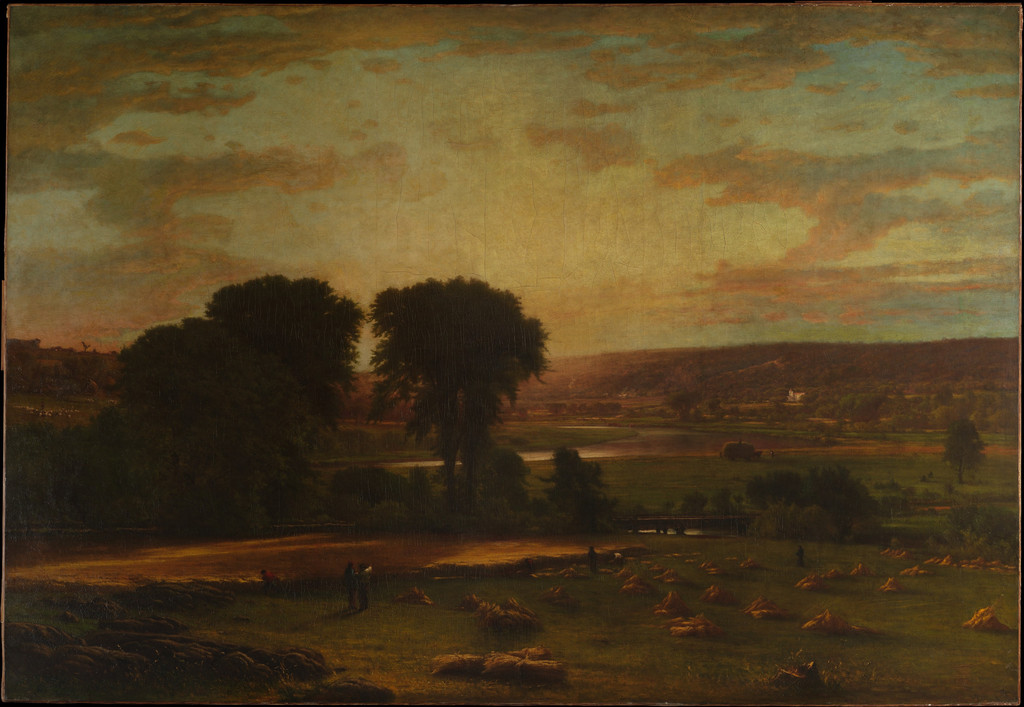
| Peace and Plenty | 1865 | Oil on canvas |
| Evening Landscape | 1867; later reworked | Oil on canvas |
| Summer in the Catskills | 1867 | Oil on canvas |
| The Valley of the Olives | 1867; reworked after 1880 | Oil on canvas |
| The Valley of the Shadow of Death | 1867 | Oil on canvas |
| Visionary Landscape | 1867/1880 | Oil on canvas |
| Catskill Mountains | 1870 | Oil on canvas |
| Across the Campagna | 1872 | Watercolor, gouache, and graphite on off-white wove paper |
| Olive Trees at Tivoli | 1873 | Gouache, watercolor, and graphite on blue wove paper with colored fibers |
| A Marine | c. 1874–75 | Oil on canvas |
| Twilight in Italy — Art Institute of Chicago (1911.44) | 1874 | Oil on panel |
| Pine Grove of the Barberini Villa | 1876 | Oil on canvas |
| The Storm | 1876 | Oil on canvas |
| Autumn Oaks | ca. 1878 | Oil on canvas |
| The Sisters | 1882 | Oil on millboard |
| Harvest, Montclair, New Jersey | 1884 | Oil on canvas |
| Niagara Falls | 1885 | Oil on wood |
| A Silver Morning | 1886 | Oil on canvas |
| Landscape, Sunset | 1887–89 | Oil on canvas |
| September Afternoon | 1887 | Oil on canvas |
| Sunrise | 1887 | Oil on canvas |
| The Mill Stream, Montclair, New Jersey by George Inness | c. 1888 | Oil on canvas |
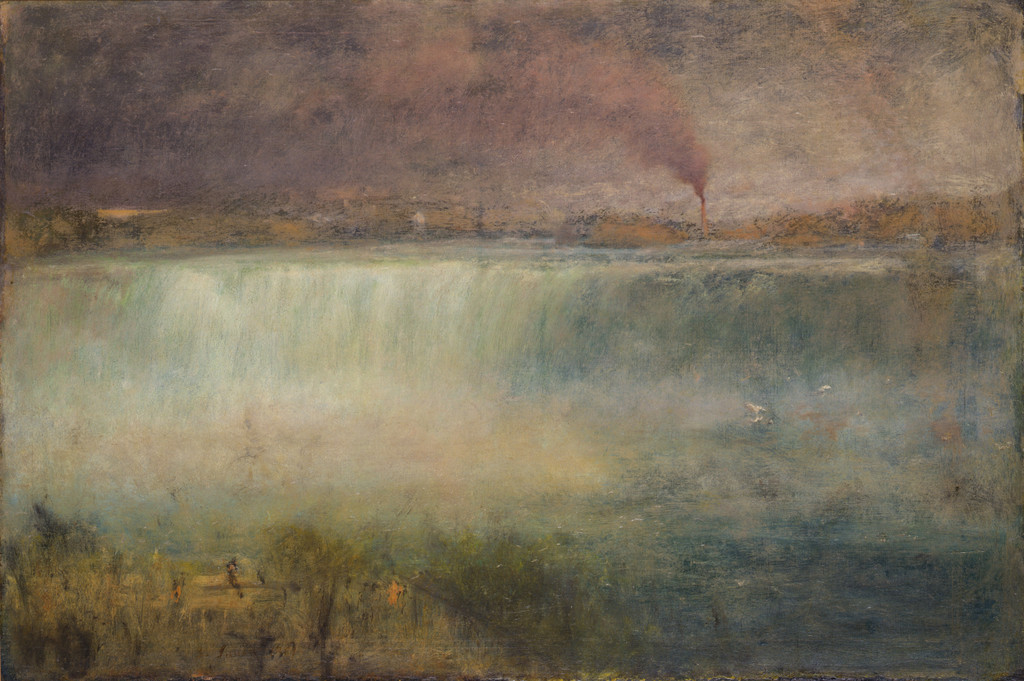
| Niagara by George Inness | 1889 | oil on canvas |
| The Mill Pond | 1889 | Oil on canvas |
| Sunset in the Valley | 1890 | Oil on canvas |
| The Moon at Night | 1890 | Oil on canvas |
| Twilight in Italy — Art Institute of Chicago (1911.42) | 1890 | Oil on canvas |
| Autumn Woods | 1891–94 | Oil on canvas |
| Moonrise | 1891 | Oil on canvas |
| Spring Blossoms, Montclair, New Jersey | ca. 1891 | Oil and crayon or charcoal on canvas |
| Sunset in the Woods by George Inness | 1891 | oil on canvas |
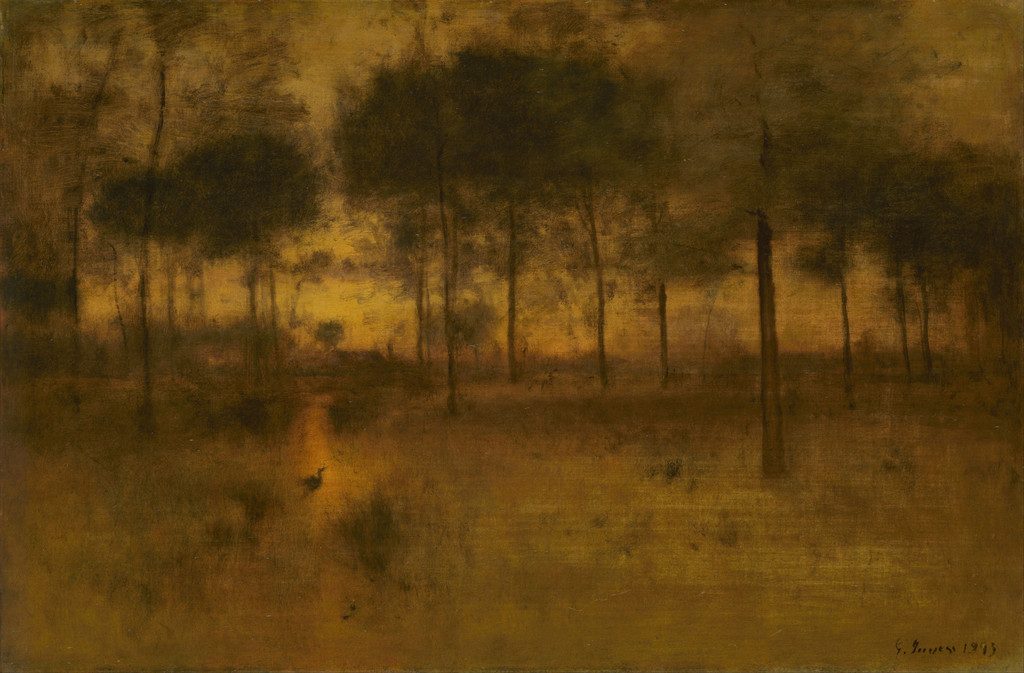
| The Home of the Heron — Princeton University Art Museum (y1943-93) | 1891 | Oil on canvas |
| Threatening | 1891 | Oil on canvas |
| Early Morning, Tarpon Springs | 1892 | Oil on canvas |
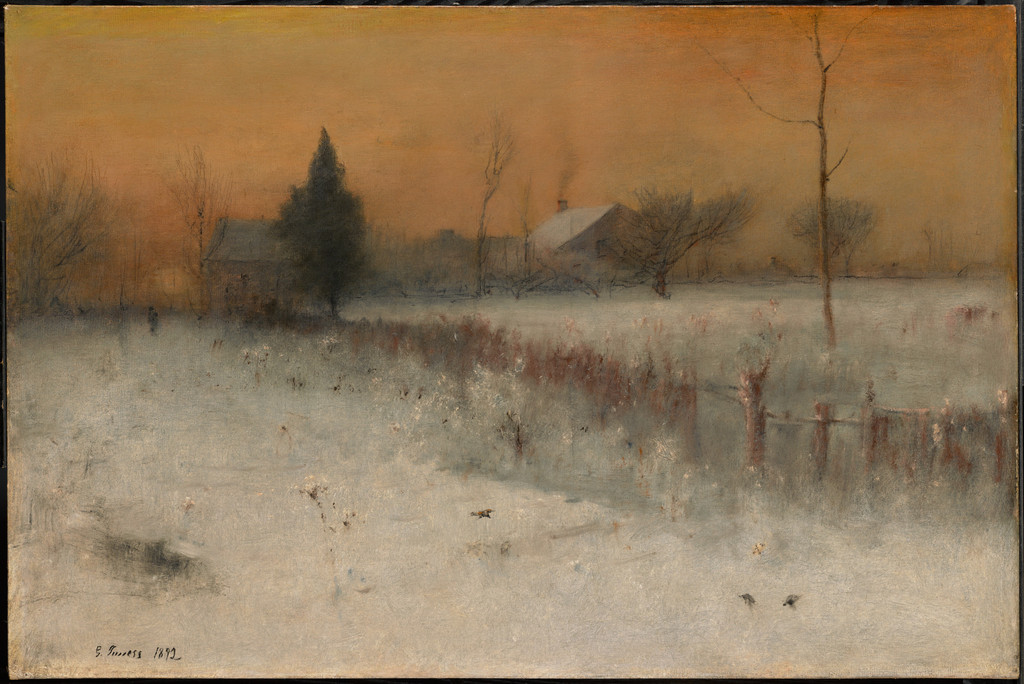
| Home at Montclair by George Inness | 1892 | oil on canvas |
| The Lonely Farm, Nantucket | 1892 | Oil on canvas |
| Afterglow | 1893 | Oil on canvas |
| Sunlit Valley | 1893 | Oil on canvas |
| The Home of the Heron — Art Institute of Chicago (1911.31) | 1893 | Oil on canvas |
| After a Summer Shower | 1894 | Oil on canvas |
| Landscape | n.d. | Watercolor with scraping on ivory wove paper |
Frequently Asked Questions
The Met records 200 × 301 cm.[1]
Bell places this canvas among Italian subjects after his 1870–74 European residence and return to Boston. Its date does not establish a new Italian visit.[2]
The Met describes heavy impasto followed by stiff-brush stippling, producing pronounced surface texture.[1]
The Met tentatively connects the order and balance with Swedenborgian ideas. It does not establish one fixed allegory for every feature.[1]
Discussion
Look again at the images and ideas explored in Pine Grove of the Barberini Villa by George Inness. These editorial prompts invite your observations.
Compare the broad crowns with the narrow trunks and smaller foreground branches. How does their repetition create order? Consider how the low figures and the left opening change the scale of the grove.
Reader Insights
How do repeated crowns and trunks organise the grove?
What changes when the canvas is set beside the two Italian sheets?
How do seated and standing figures establish different distances?
Join the Conversation
Share a detail, comparison or question about Pine Grove of the Barberini Villa by George Inness below.
References
- Metropolitan Museum of Art, Pine Grove of the Barberini Villa, accession 98.16. Current object identity, setting, tentative spiritual interpretation, surface account and gift.
- Adrienne Baxter Bell, “George Inness (1825–1894),” Metropolitan Museum of Art (2012).
- Metropolitan Museum of Art, Across the Campagna, accession 67.55.145.
- Metropolitan Museum of Art, Olive Trees at Tivoli, accession 1989.287.
- Art Institute of Chicago, A Marine, accession 1913.90.
- National Gallery of Art, Sunset in the Woods, accession 2014.79.43.
- Splash image source.
George Inness, Pine Grove of the Barberini Villa, 1876. Oil on canvas, 200 × 301 cm. Met, 98.16. Gift of Lyman G. Bloomingdale, 1898; Metropolitan Museum of Art. Image source. Public domain.