 by Tom Gurney
Tom Gurney BSc (Hons) is an art history expert with over 20 years experience
Email: tomgurney1@gmail.com / Phone: +44 7429 011000
Early Morning, Tarpon Springs by George Inness: Introduction
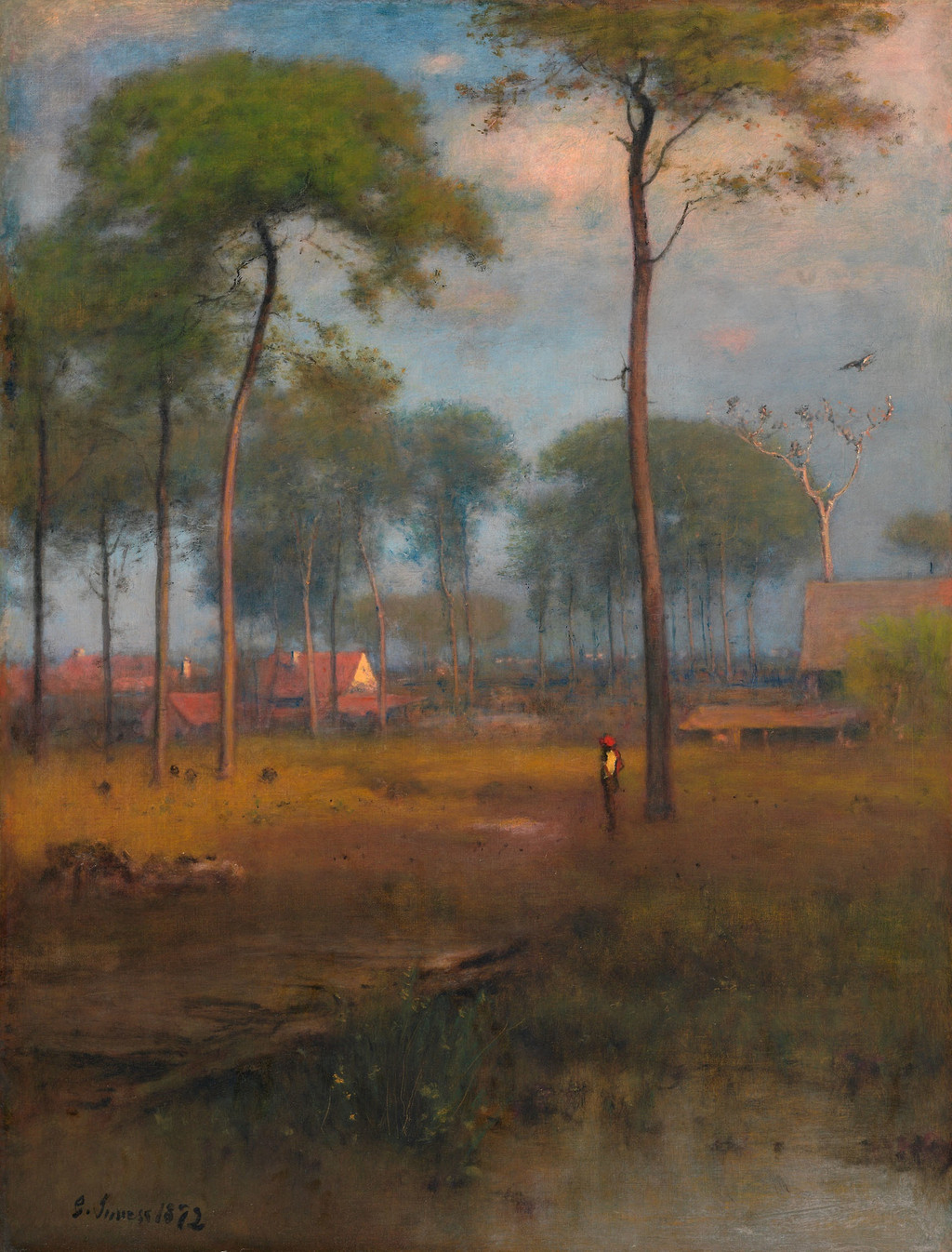
Tall trees rise through a pink and blue sky in George Inness’s Early Morning, Tarpon Springs. Near the base of a prominent trunk, a tiny red-hatted figure gives the grove a human scale. Low roofs and pale walls extend behind the trees, making this Florida morning an inhabited scene. The Art Institute of Chicago dates the oil painting to 1892 and records it as part of the Edward B. Butler Collection, accession 1911.32.[1]
At a Glance
- ArtistGeorge Inness (1825–1894)
- TitleEarly Morning, Tarpon Springs
- Date1892
- MediumOil on canvas
- Dimensions107.2 × 82.2 cm
- CollectionArt Institute of Chicago
- CreditEdward B. Butler Collection
- Accession1911.32
This work across George Inness’s career
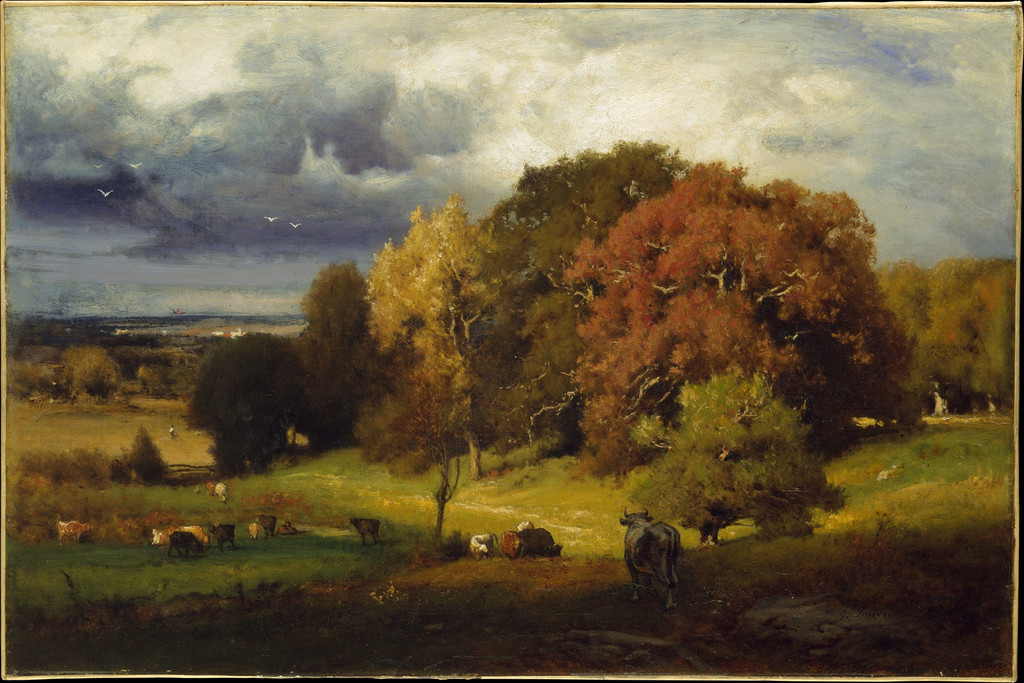
Autumn Oaks by George Inness
ca. 1878Contents
- An upright landscape
- A tiny figure beside a tall trunk
- Pink, blue and warm ground
- Buildings, intervals and distant forms
- Florida within a Montclair-based career
- Impressions and a remembered letter
- Gift and selected exhibition history
- Comparing grove, blossom and heron
- Annotated details
An upright landscape
The canvas is taller than it is wide, giving the trunks considerable room to rise. Their crowns occupy the upper area, while buildings and the small figure remain lower down. The format makes upward movement a central part of the experience, even though much of the scene’s human activity belongs near the ground.
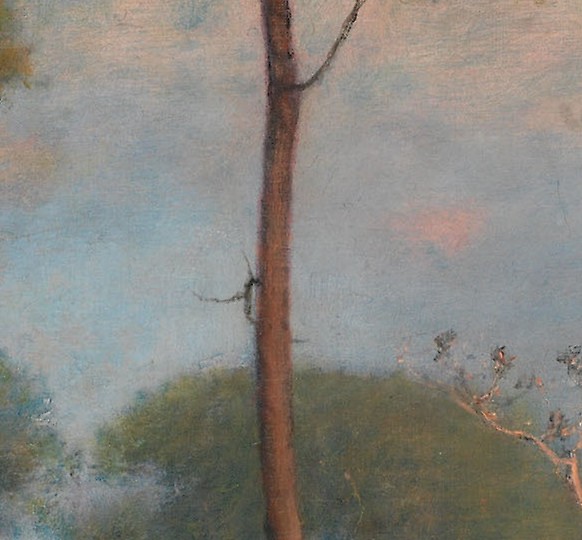
The most prominent trunk stands right of centre. It extends from the figure’s level towards foliage partly cut by the upper edge. At the left, another tall trunk leans slightly and supports a broader crown. Their unequal positions help structure the open sky between them.
Other, thinner trunks continue through the middle distance. Some are more distinct than others, and their spacing varies. They make the grove feel deeper without repeating the two nearest trees at the same scale. The scene therefore contains both strong uprights and a more delicate network of vertical marks.
The upper foliage also differs across the picture. The left crown forms a relatively broad green mass; the right tree’s branches spread into warmer sky. Their contrast gives the eye several routes upward rather than producing one evenly enclosed canopy.
Annotated Details from Early Morning, Tarpon Springs
The numbered points identify visible features discussed in this article. Return from each detail to the whole composition. George Inness, Early Morning, Tarpon Springs, 1892. Oil on canvas. Art Institute of Chicago, 1911.32. Edward B. Butler Collection; Art Institute of Chicago. Image source. Public domain.
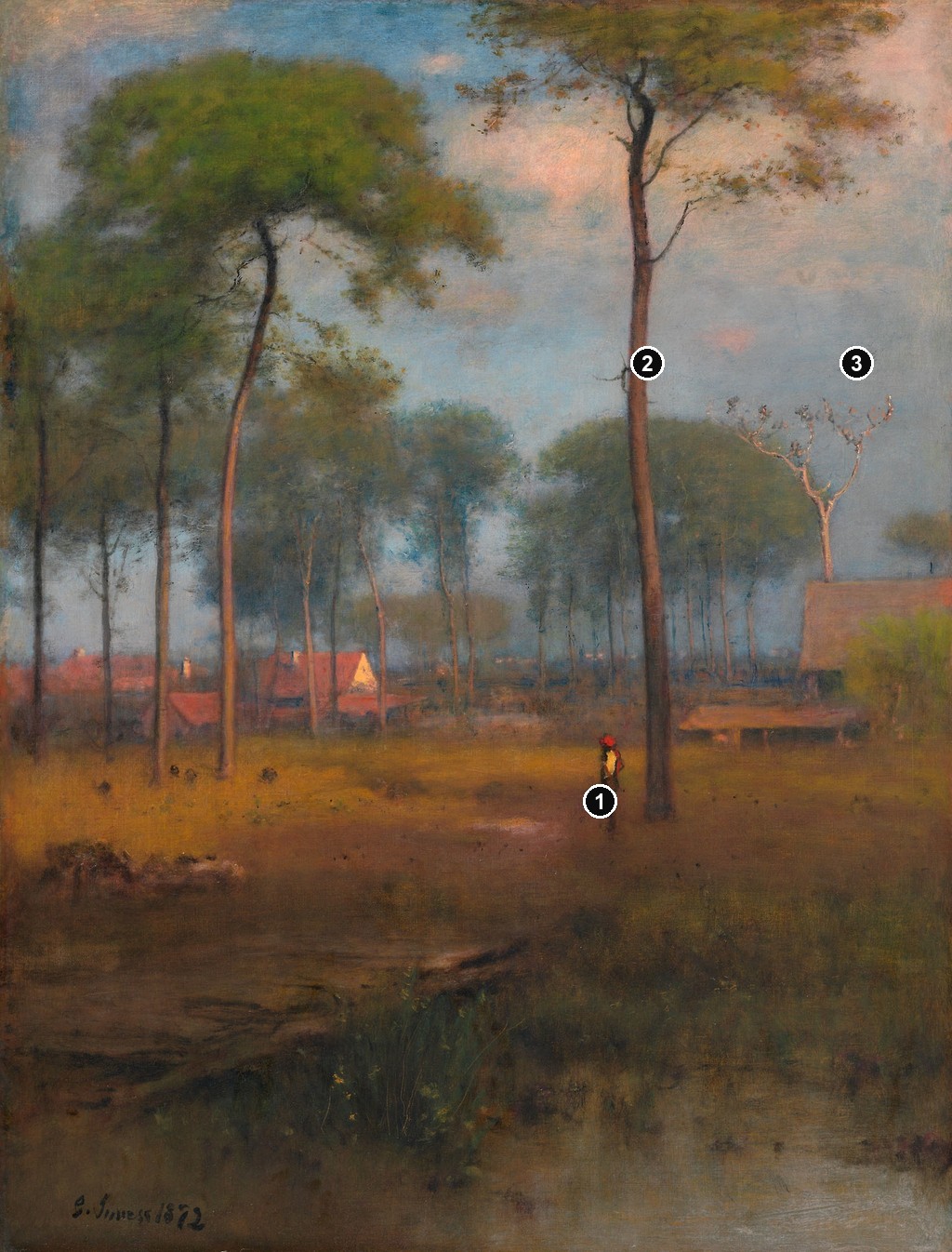
Details from EARLY MORNING, TARPON SPRINGS
Compare the cropped details with the complete images above. Notice how their colours, shapes and positions contribute to the larger compositions.
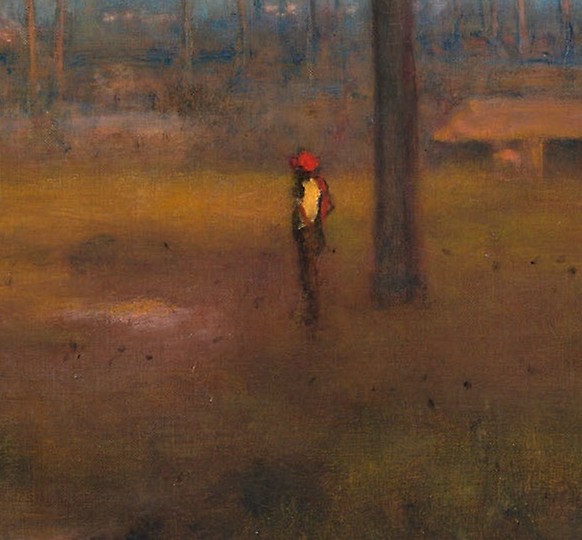
Red-hatted figure
A small person in a red hat stands beneath the trees. The bright accent gives the tall grove a point of human recognition.
Tall branching trunk
A long trunk rises into the pink-blue sky. Its height makes the upright format especially significant.
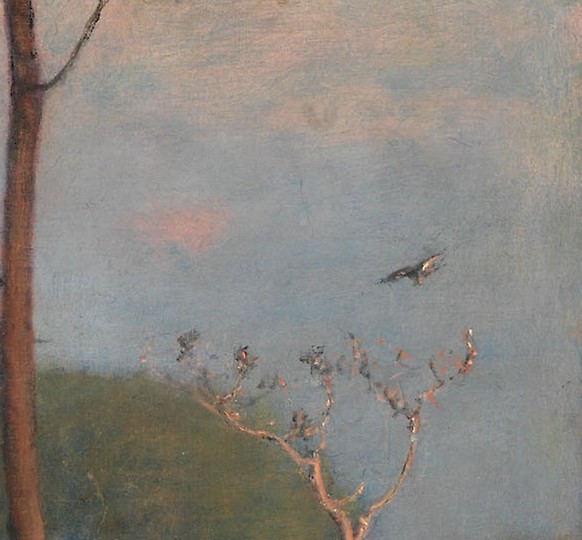
Bird in the open sky
A small bird appears against the paler sky at the right. Its airborne form supplies another scale beside the large trees.
A tiny figure beside a tall trunk
The red hat is one of the painting’s strongest small accents. It draws attention towards the figure despite the person’s minute scale beside the trees. Light clothing and darker legs make the body recognisable, while the details of face and action remain unresolved.
The figure stands close to the prominent right-of-centre trunk. That proximity makes the tree’s height especially apparent. Follow the person upward towards the branches, then return to the ground: the change in scale is more striking than either form considered alone.
The figure also occupies an interval of comparatively open ground. The buildings remain behind it, while the nearest lower foreground contains darker vegetation and irregular surface marks. Its placement helps separate those depths and makes the grove a space through which a person can move.
AIC interprets the clothing as visually related to the trunks and the red hat as suggestive of a low sun. Its commentary connects those relationships with a contemplative reading of the landscape.[1] The sun association is the museum’s interpretation; the visible red accent remains useful to examine without making it a literal celestial object.
Pink, blue and warm ground
Pale pink spreads through areas of the upper sky, while blue remains active between and behind the crowns. The colours are closely joined rather than divided into separate, sharply bounded zones. This relation gives the atmosphere a changing appearance across the upright composition.
The trunks carry warmer orange and brown tones through that cooler space. Their colour connects the upper scene with the lower buildings and ground. They therefore organise the image through both direction and temperature, bringing warm forms into contact with blue distance.
The red roofs provide a more concentrated warm band behind the grove. Pale walls interrupt it, and thin trunks cross in front. These overlaps let architecture participate in the atmospheric scene while remaining partly screened by trees.
The ground contains browns, ochres and darker greens. Its varied marks differ from the softer sky, giving the lower part of the picture a more material presence. The figure’s bright hat lies between these areas of subdued ground and more expansive light, which helps explain its force as a small accent.
Buildings, intervals and distant forms
The buildings sit low enough to leave the trees dominant. Their roofs and pale walls are clearer in some passages than in others. The eye finds them through the trunks, so the scene is experienced as a succession of overlaps rather than a direct view of one house.
That partially screened architecture matters to the subject. The grove is connected to residence, and the small person stands within a place shaped by habitation. The landscape’s contemplative quality does not depend on every building being removed from sight.
A more sparsely branched tree appears towards the right, near a bird-like mark against the sky. Its fine, warmer lines differ from the heavier trunk beside the figure. These changes give the upright forms more variety, while the small airborne mark offers another scale of attention within the open atmosphere.
The exact houses and the person have not been securely identified in the reviewed sources. Their visible positions already explain a great deal. The picture places familiar human forms low in the grove, then gives the trees and morning sky a much larger share of the canvas.
Watch: George Inness
Choose a film to explore the artist’s work, its interpretation and its wider setting.
The Montclair Art Museum's George Inness Gallery
Visit the George Inness Gallery at the Montclair Art Museum in this State of the Arts feature.
Watch on YouTubeFlorida within a Montclair-based career
Adrienne Baxter Bell records Inness’s late winter visits to Tarpon Springs alongside a wider pattern of travel. She also notes that he had made Montclair his permanent residence in 1885 while retaining a New York studio.[2] The Florida picture therefore belongs within a mobile late career, rather than proving a complete abandonment of Montclair.
The title identifies Tarpon Springs, and AIC describes sunrise light.[1] Those documented points can accompany the observed grove. They do not independently establish the exact day, address or moment of completion. A dated canvas and a named locality remain distinct from a fully reconstructed painting session.
The setting also offers a useful example of how location and composition work together. The tall trunks are central to the scene’s identity, while the upright format intensifies their presence. The painting makes a particular landscape available through choices of scale, spacing and colour.
Impressions and a remembered letter
In his 1917 memoir, George Inness Jr. reproduces an undated reply addressed to an editor in Tarpon Springs. His father rejects being classified as an Impressionist while explaining that people are subject to impressions and that painting should convey them. The son could no longer identify the newspaper confidently.[3]
The passage helps distinguish an interest in impressions from a simple movement label. It is not a securely dated statement about this 1892 canvas. Its relevance lies in the artist’s reported concern with what a painting communicates, alongside his resistance to the classification offered by the editor.
In Early Morning, the visual effect is accessible through specific relationships: a small red accent beside a tall trunk, warm roofs behind thin trees and pale pink within blue sky. Attending to those relations gives the word impression something concrete to describe, without treating the remembered reply as a universal technical formula.
Gift and selected exhibition history
AIC’s provenance records Reinhardt Galleries in Chicago, the sale to Edward B. Butler and Butler’s gift to the museum, all in 1911.[1] This is the documented route of the particular canvas, rather than the history of every Inness work in the Butler Collection.
The museum lists its participation in the 1994 tour of Masterworks of Modern Art from the Art Institute of Chicago to Niigata Prefectural Museum of Modern Art in Nagaoka, Aichi Prefectural Museum of Art in Nagoya and Yokohama Museum of Art.[1] The itinerary documents a specific later exhibition; it does not establish a broader history of reception without further sources.
Comparing grove, blossom and heron
The Mill Stream, Montclair, New Jersey, circa 1888, also puts a small figure among thin trunks, with an industrial tower farther back.[4] Compare the gesture and architectural upright there with the red-hatted figure and tall tree here. Each gives human presence a different relation to the surrounding forms.
Spring Blossoms, Montclair, New Jersey, circa 1891, combines oil with crayon or charcoal.[5] Its spreading blossom and more conspicuous branch structure differ from the rising grove. The blue and pink relationships provide a point of comparison, while format and material identification remain specific to each object.
The Home of the Heron, 1893, is a horizontal Chicago canvas anchored by a small bird near its lower left.[6] Against that broader, quieter field of golden atmosphere, the uprights of Early Morning become especially clear. Inness’s late landscapes vary considerably in how a small living form can guide attention through trees and light.
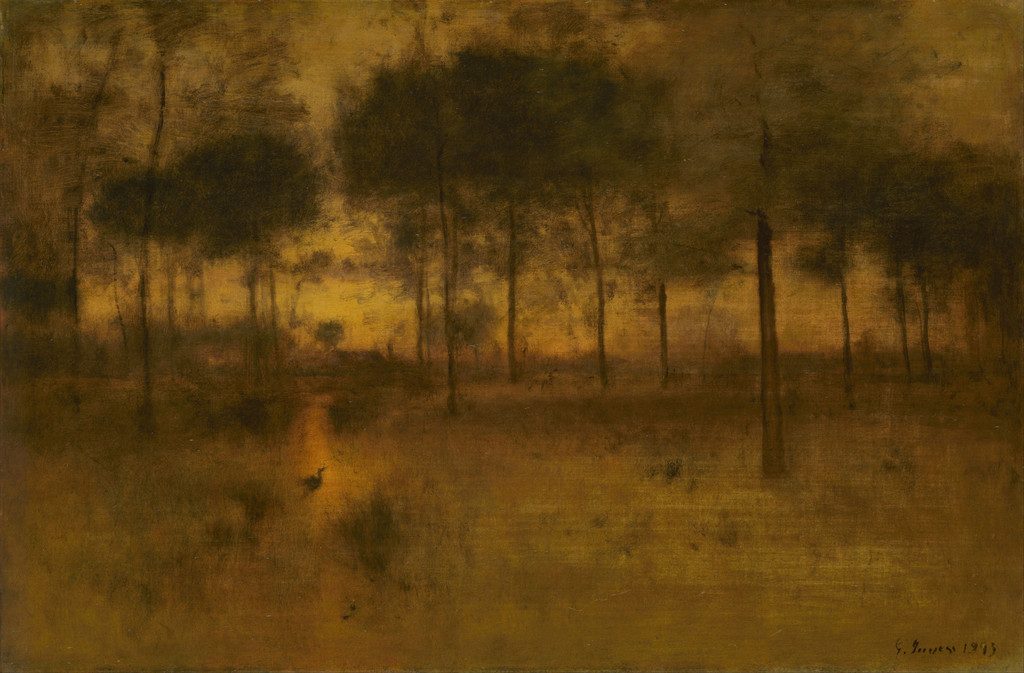
George Inness, The Home of the Heron, 1893. Oil on canvas. Art Institute of Chicago, 1911.31. Edward B. Butler Collection; Art Institute of Chicago. Image source. Public domain.
Artworks directory
A collected selection of 46 individually identified museum objects: 43 paintings and three watercolours. This is not a complete catalogue raisonné. Repeated titles identify separate objects where their institutions or accessions differ. Links lead to a companion article where available, otherwise to the museum record. Unillustrated entries remain included; the original lost New Jerusalem is represented by its three transformed survivors.
| Name | Date | Medium |
|---|---|---|
| Crossing the Ford | 1848 | Oil on canvas |
| The Old Mill | 1849 | Oil on canvas |
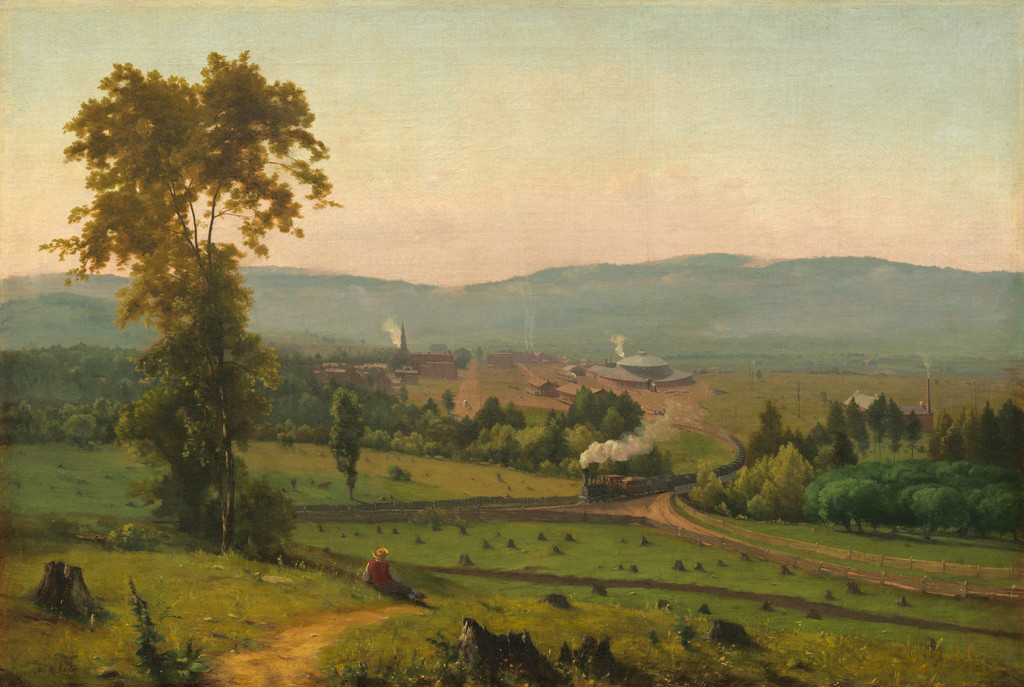
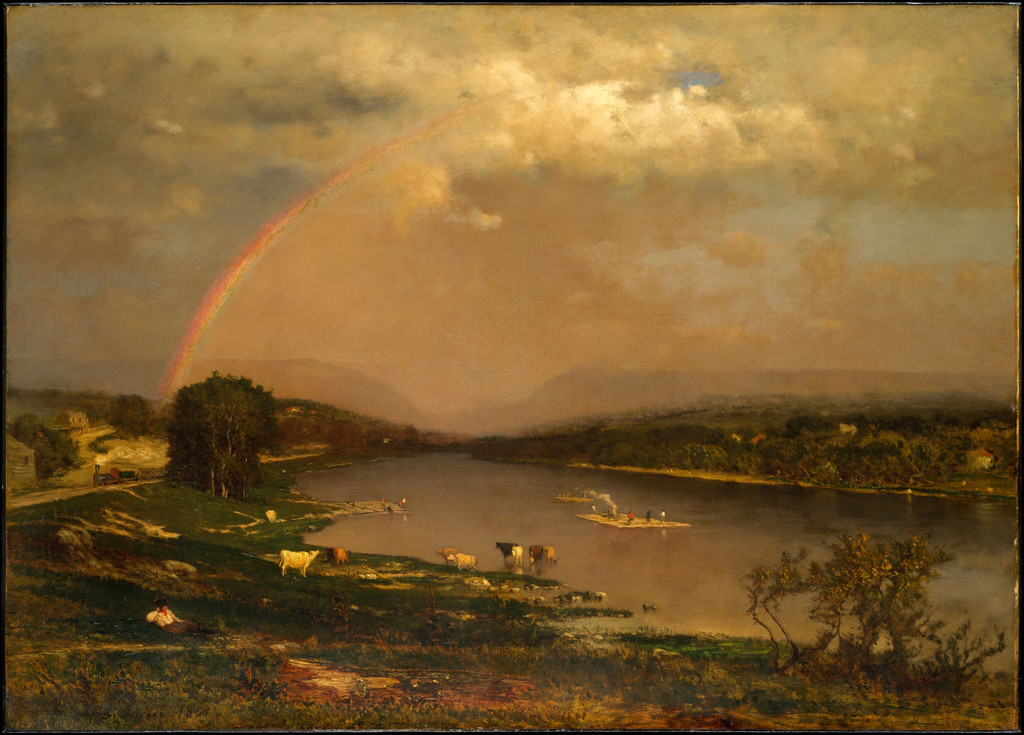
| The Lackawanna Valley by George Inness | c. 1856 | oil on canvas |
| Delaware Water Gap | 1861 | Oil on canvas |
| Delaware Valley | c. 1865–75 | Oil on artist's board |
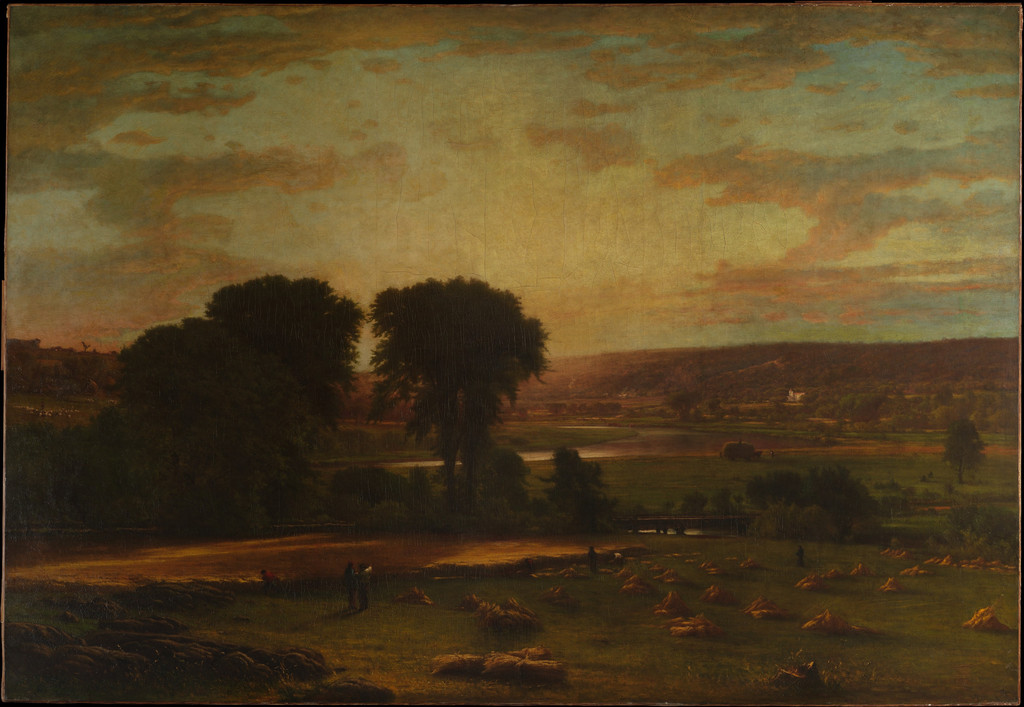
| Peace and Plenty | 1865 | Oil on canvas |
| Evening Landscape | 1867; later reworked | Oil on canvas |
| Summer in the Catskills | 1867 | Oil on canvas |
| The Valley of the Olives | 1867; reworked after 1880 | Oil on canvas |
| The Valley of the Shadow of Death | 1867 | Oil on canvas |
| Visionary Landscape | 1867/1880 | Oil on canvas |
| Catskill Mountains | 1870 | Oil on canvas |
| Across the Campagna | 1872 | Watercolor, gouache, and graphite on off-white wove paper |
| Olive Trees at Tivoli | 1873 | Gouache, watercolor, and graphite on blue wove paper with colored fibers |
| A Marine | c. 1874–75 | Oil on canvas |
| Twilight in Italy — Art Institute of Chicago (1911.44) | 1874 | Oil on panel |
| Pine Grove of the Barberini Villa | 1876 | Oil on canvas |
| The Storm | 1876 | Oil on canvas |
| Autumn Oaks | ca. 1878 | Oil on canvas |
| The Sisters | 1882 | Oil on millboard |
| Harvest, Montclair, New Jersey | 1884 | Oil on canvas |
| Niagara Falls | 1885 | Oil on wood |
| A Silver Morning | 1886 | Oil on canvas |
| Landscape, Sunset | 1887–89 | Oil on canvas |
| September Afternoon | 1887 | Oil on canvas |
| Sunrise | 1887 | Oil on canvas |
| The Mill Stream, Montclair, New Jersey by George Inness | c. 1888 | Oil on canvas |
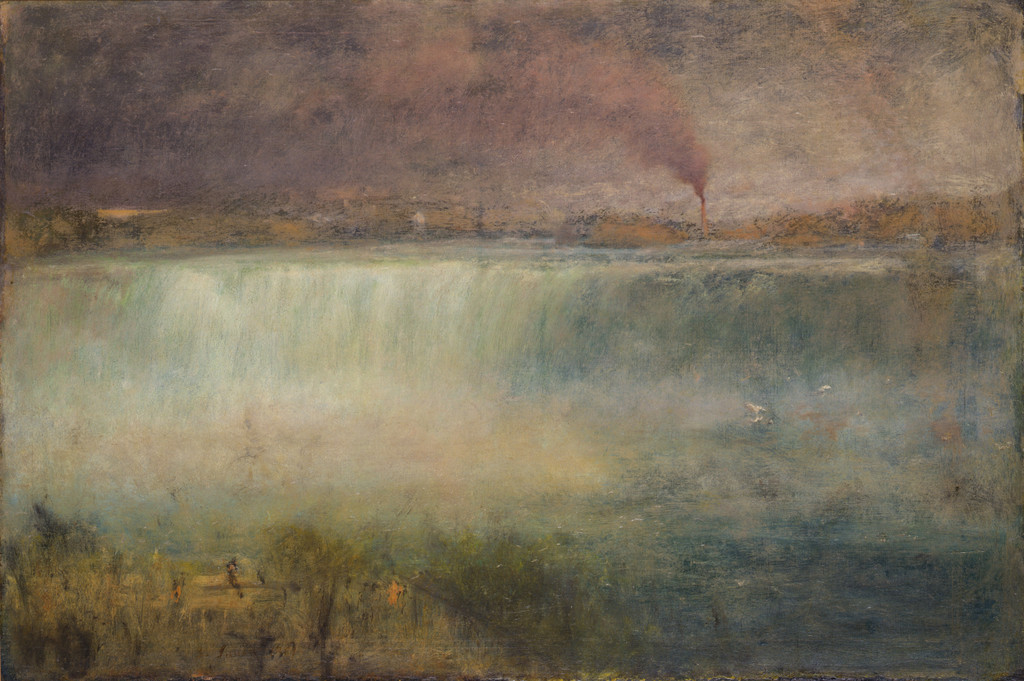
| Niagara by George Inness | 1889 | oil on canvas |
| The Mill Pond | 1889 | Oil on canvas |
| Sunset in the Valley | 1890 | Oil on canvas |
| The Moon at Night | 1890 | Oil on canvas |
| Twilight in Italy — Art Institute of Chicago (1911.42) | 1890 | Oil on canvas |
| Autumn Woods | 1891–94 | Oil on canvas |
| Moonrise | 1891 | Oil on canvas |
| Spring Blossoms, Montclair, New Jersey | ca. 1891 | Oil and crayon or charcoal on canvas |
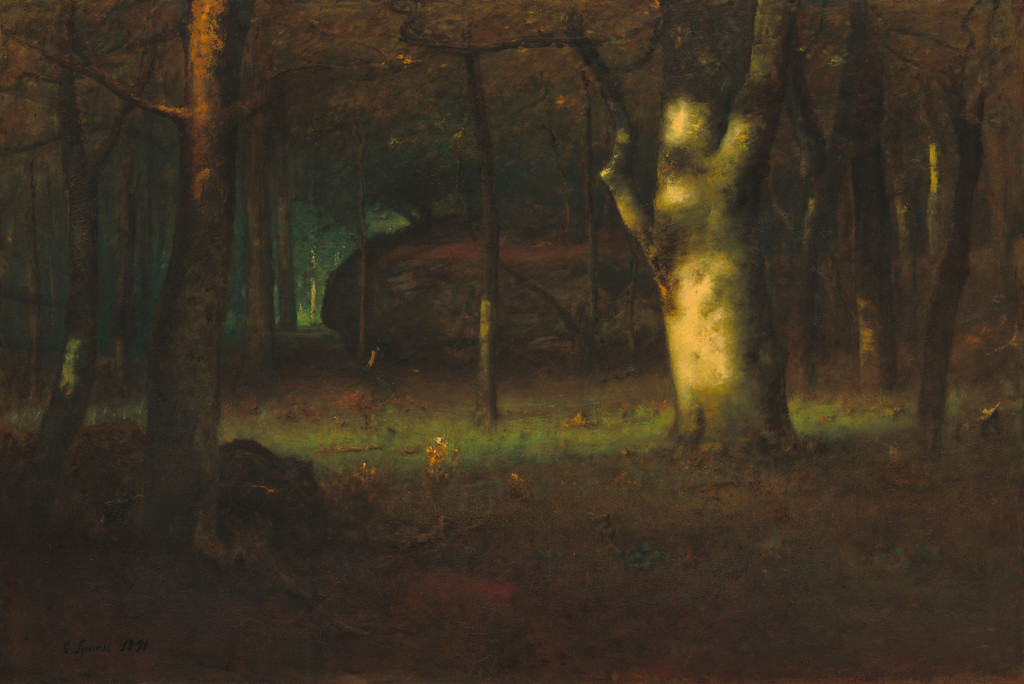
| Sunset in the Woods by George Inness | 1891 | oil on canvas |
| The Home of the Heron — Princeton University Art Museum (y1943-93) | 1891 | Oil on canvas |
| Threatening | 1891 | Oil on canvas |
| Early Morning, Tarpon Springs | 1892 | Oil on canvas |
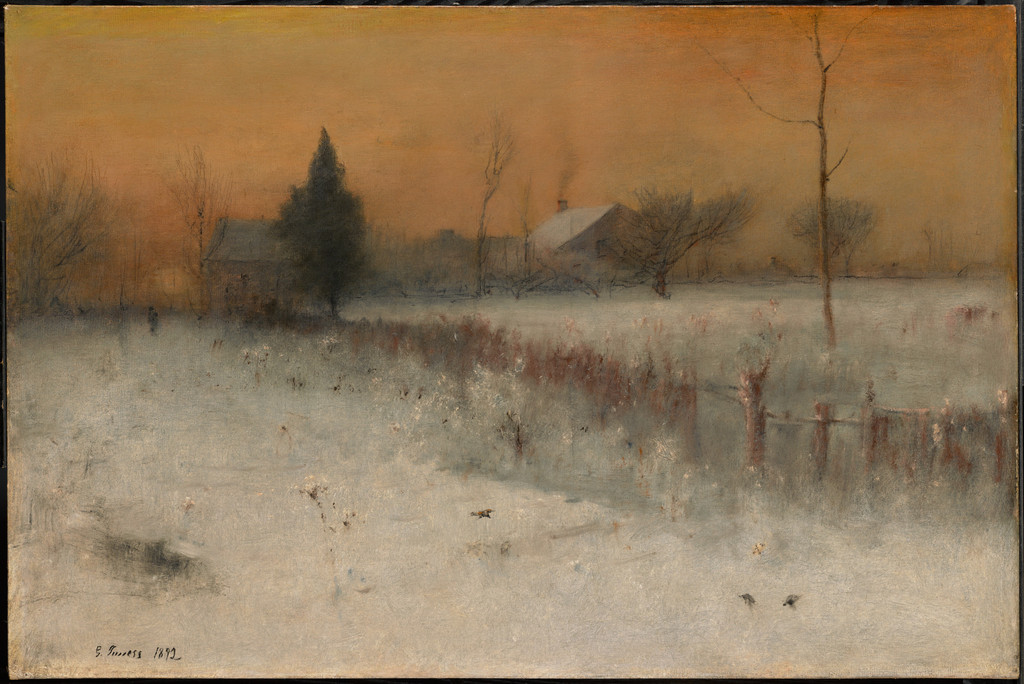
| Home at Montclair by George Inness | 1892 | oil on canvas |
| The Lonely Farm, Nantucket | 1892 | Oil on canvas |
| Afterglow | 1893 | Oil on canvas |
| Sunlit Valley | 1893 | Oil on canvas |
| The Home of the Heron — Art Institute of Chicago (1911.31) | 1893 | Oil on canvas |
| After a Summer Shower | 1894 | Oil on canvas |
| Landscape | n.d. | Watercolor with scraping on ivory wove paper |
Frequently Asked Questions
The current Chicago record dates it 1892.[1]
AIC suggests that association in its interpretation. The reviewed evidence supplies no corresponding statement by Inness about this canvas.[1]
Bell describes winter visits to Tarpon Springs within his late travels. His permanent Montclair residence began in 1885.[2]
No. The memoir reproduces an undated reply and leaves the newspaper’s identity uncertain.[3]
Discussion
Look again at the images and ideas explored in Early Morning, Tarpon Springs by George Inness. These editorial prompts invite your observations.
Follow the red-hatted figure up the nearest tall trunk. Then look across the lower roofs before returning to the sky. How does the upright format change the relation between habitation and morning light?
Reader Insights
How does the small red-hatted figure change your sense of the trees?
How does this upright grove differ from the horizontal heron landscape?
Where does morning colour most strongly join the sky and land?
Join the Conversation
Share a detail, comparison or question about Early Morning, Tarpon Springs by George Inness below.
References
- Art Institute of Chicago, Early Morning, Tarpon Springs, accession 1911.32. Current object record, attributed interpretation, provenance and selected exhibition itinerary.
- Adrienne Baxter Bell, “George Inness (1825–1894),” Metropolitan Museum of Art (2012).
- George Inness Jr., Life, Art, and Letters of George Inness (1917), printed pp. 168–169. Selected original pages examined; undated editor reply and newspaper uncertainty retained.
- Minneapolis Institute of Art, The Mill Stream, Montclair, New Jersey, accession 2000.236.
- Metropolitan Museum of Art, Spring Blossoms, Montclair, New Jersey, accession 11.116.4.
- Art Institute of Chicago, The Home of the Heron, accession 1911.31.
- Splash image source.
George Inness, Early Morning, Tarpon Springs, 1892. Oil on canvas. Art Institute of Chicago, 1911.32. Edward B. Butler Collection; Art Institute of Chicago. Image source. Public domain.