 by Tom Gurney
Tom Gurney BSc (Hons) is an art history expert with over 20 years experience
Email: tomgurney1@gmail.com / Phone: +44 7429 011000
George Inness Biography: Introduction
George Inness (1825–1894) developed a landscape practice in which observed places, remembered experience and philosophical questions could share the same canvas. His career extended from comparatively detailed scenes of cultivated land to later pictures organised around atmosphere and selective clarity. Travel in Europe, teaching in New Jersey, religious commitments and work in Montclair and Florida all contributed to that development. Adrienne Baxter Bell’s specialist chronology provides a framework; the paintings and selected letters reveal a career more varied than any single movement label can describe.[1]
At a Glance
- Life1825–1894; born Newburgh and raised in Newark
- First Academy exhibition1844
- Longer Italian residence1870–1874
- Permanent Montclair residenceFrom February 1885; New York studio retained
George Inness in context
Bars show approximate historical periods. c. means circa (about).
Hudson River School
c. 1825–1880 [15]Barbizon School
c. 1830–1870 [16]Notes and sources
Hudson River School. Cole’s arrival in New York and decline around the Centennial frame this broad comparison. Metropolitan Museum of Art
Barbizon School. An approximate period for the French landscape circle whose work Inness encountered. National Gallery of Art, Picturing France, p. 37
Each bar runs from the artist’s birth to their death.
Asher Brown Durand
1796–1886 · Birth–death [17]Thomas Cole
1801–1848 · Birth–death [18]George Inness
1825–1894 · Birth–death [19]Frederic Edwin Church
1826–1900 · Birth–death [20]Notes and sources
Asher Brown Durand. The surrounding lifespans provide a calendar comparison. Metropolitan Museum of Art.
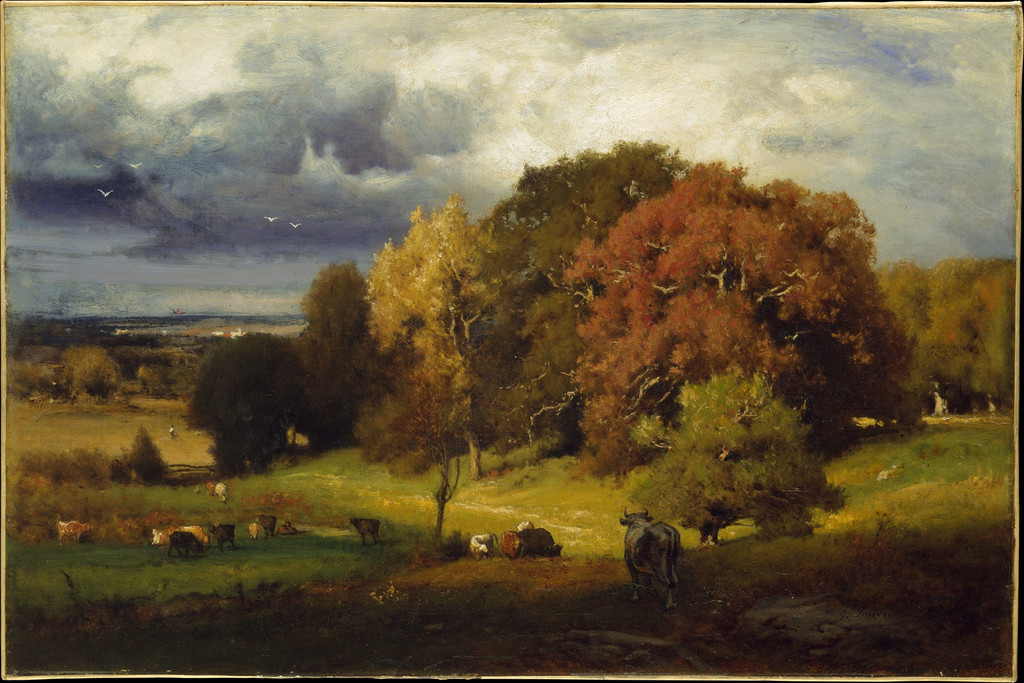
Autumn Oaks by George Inness
ca. 1878Contents
- Early instruction and the problem of learning
- A public career in cultivated landscape
- The first European journey
- The railway commission and the need for work
- Medfield, Eagleswood and the 1860s
- Religious purpose and the Triumph of the Cross
- The longer European residence and return
- Montclair and the late correspondence
- Continued travel, Florida and the final years
- The son’s memoir and a lasting reputation
Early instruction and the problem of learning
Inness was born in Newburgh, New York, in 1825 and grew up in Newark, New Jersey. His early training included brief instruction from John Jesse Barker, work in engraving and lessons with Régis François Gignoux in 1843. Bell records his first National Academy of Design exhibition in 1844 and the opening of his own New York studio in 1846.[1][2][3]
The son’s 1917 memoir supplies a different kind of account of those beginnings. He describes his grandfather accepting the boy’s determination to paint and placing him with Barker to learn a trade. The story presents artistic work beside a family’s practical expectations. It is a retrospective recollection, including the son’s judgments about his father’s abilities, rather than a contemporary record from the teacher’s studio.[4]
The same source describes Gignoux teaching colour and composition. It then reproduces a recollection in which Inness encounters old-master engravings in a print-shop window. He cannot remember the first picture, but recalls recognising a force in those prints that his own work lacked. The uncertainty about the particular image is part of the testimony and should remain visible.[4]
The recollection also names qualities he recognised in Cole and Durand, whose work was accessible to him. It makes reproduction an active part of learning: an image could be taken away, compared with nature and reconsidered. The account concerns what Inness later understood his education to have involved, rather than a complete inventory of every source he studied.[4]
Four stages of George Inness’s career
These periods group related developments; painting, travel and local work overlap across their boundaries.
Prints, instruction and cultivated landscapes
Brief instruction, engraving work and European encounters preceded the railway commission and other inhabited landscapes. [1]
Teaching, harvest and spiritual purpose
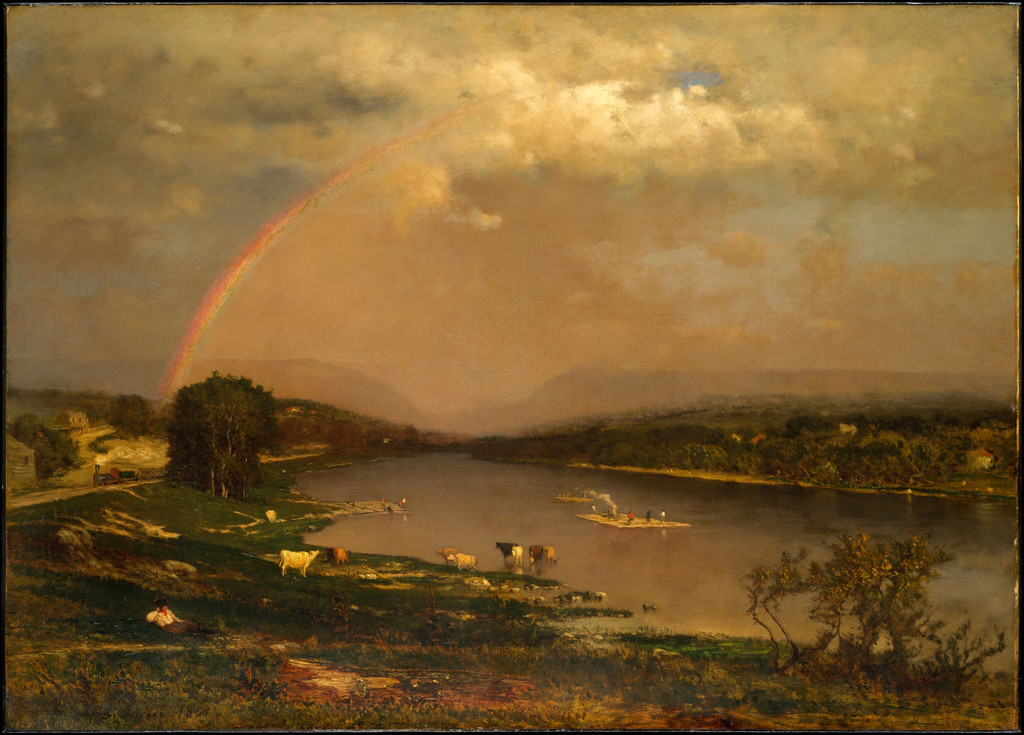
Medfield and Eagleswood brought teaching, Civil War activity and the Triumph of the Cross commission into the career. [1]
Small sheets and monumental trees
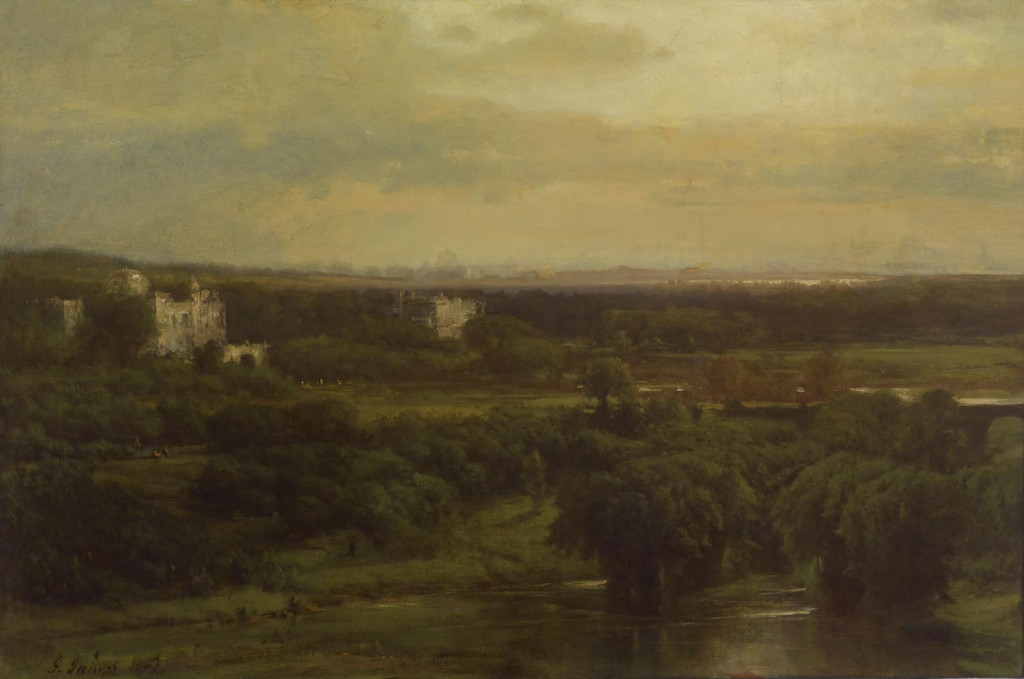
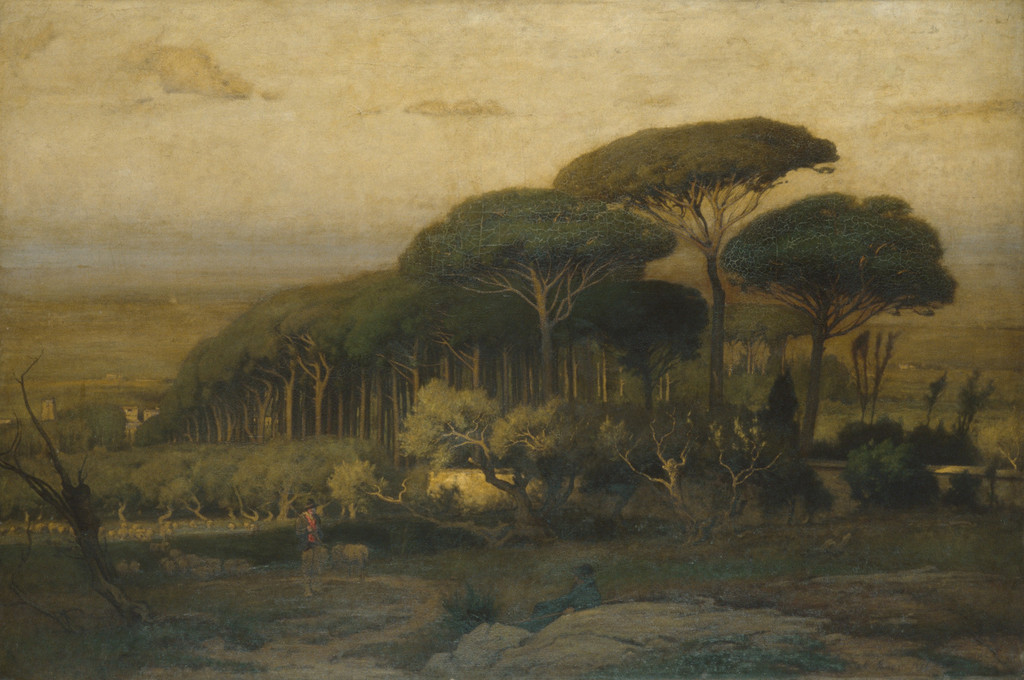
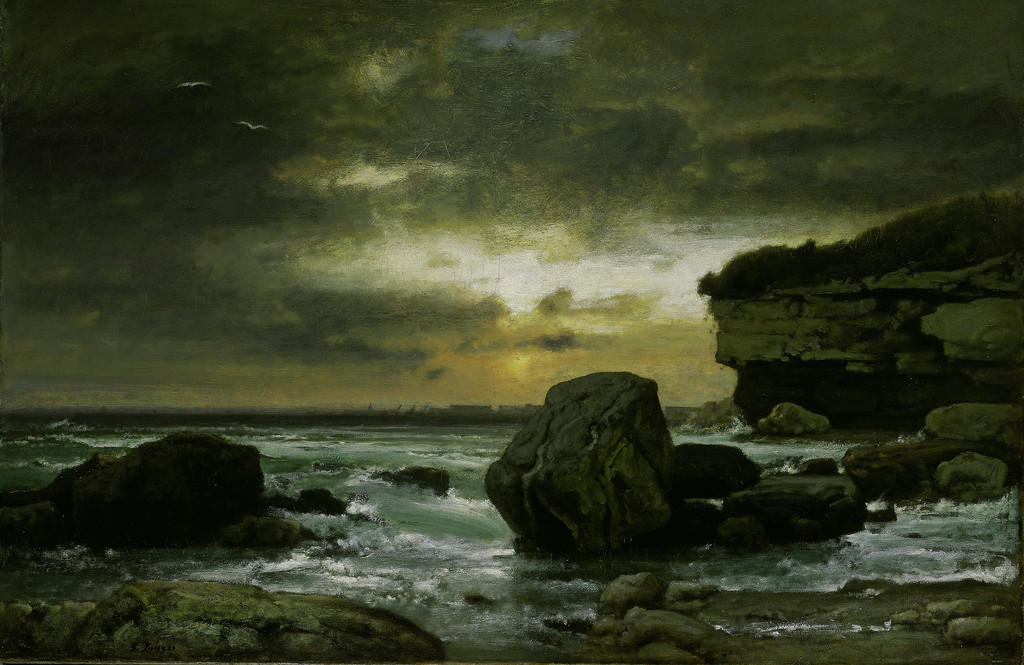
The longer European residence of 1870–74 supplied works on paper and subjects reconsidered after the return, including Pine Grove of the Barberini Villa. [1]
Winter ground, woods and Florida groves
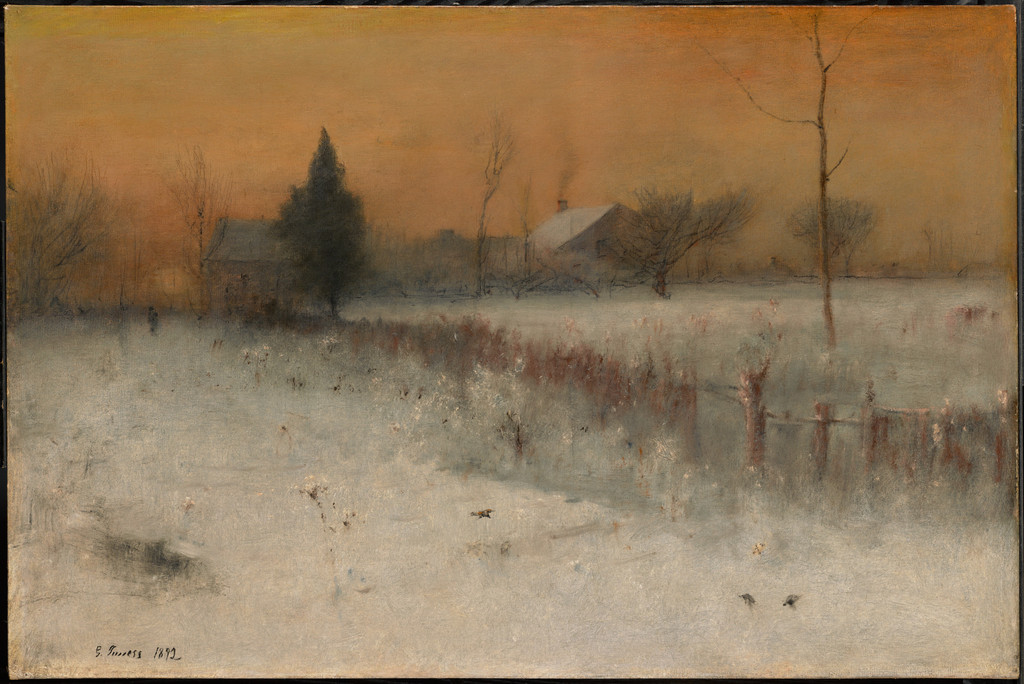
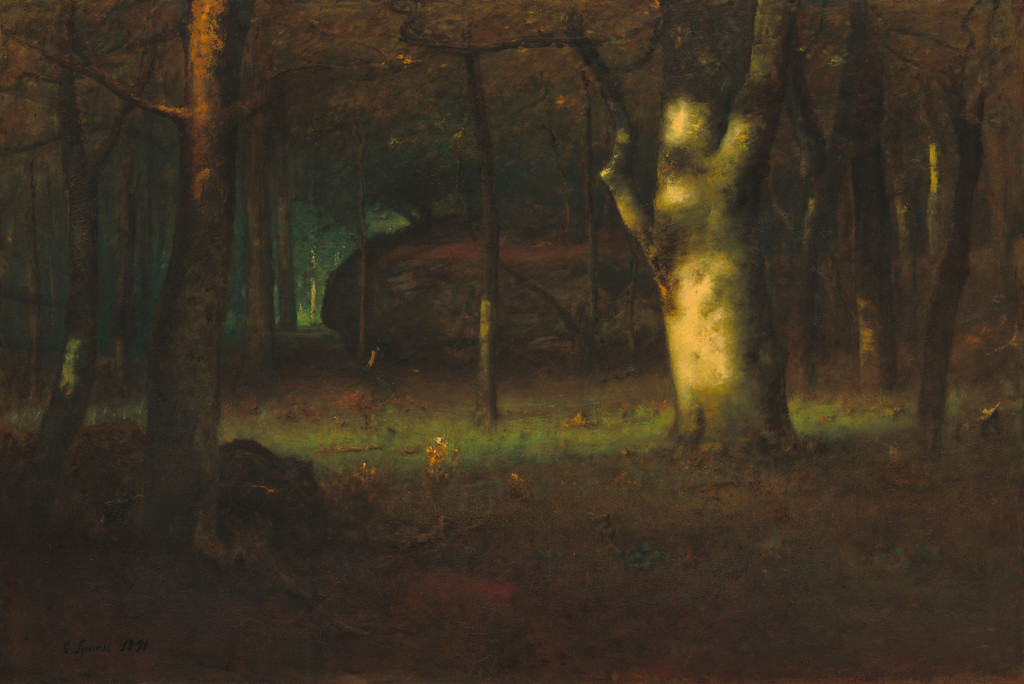
Rental in Montclair began in 1878; purchase and permanent residence followed. Florida journeys and other travel continued alongside the late local landscapes. [1]
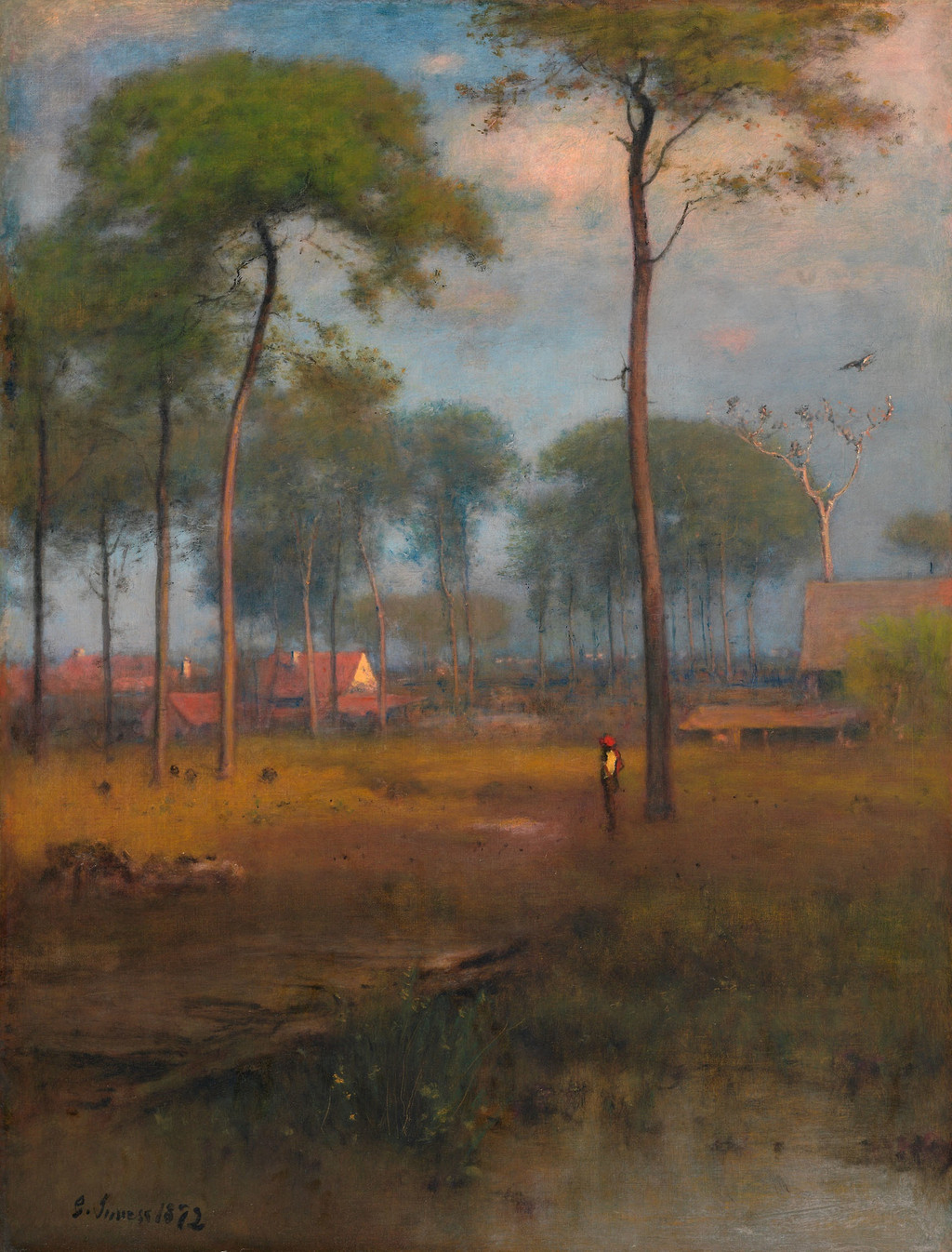
A public career in cultivated landscape
The early New York studio and Academy exhibition mark entry into a public art world. A painter needed more than an absorbing private interest in nature: work had to be made, displayed and encountered by others. Inness’s later letters and his son’s recollections repeatedly bring artistic aims into contact with practical circumstances.
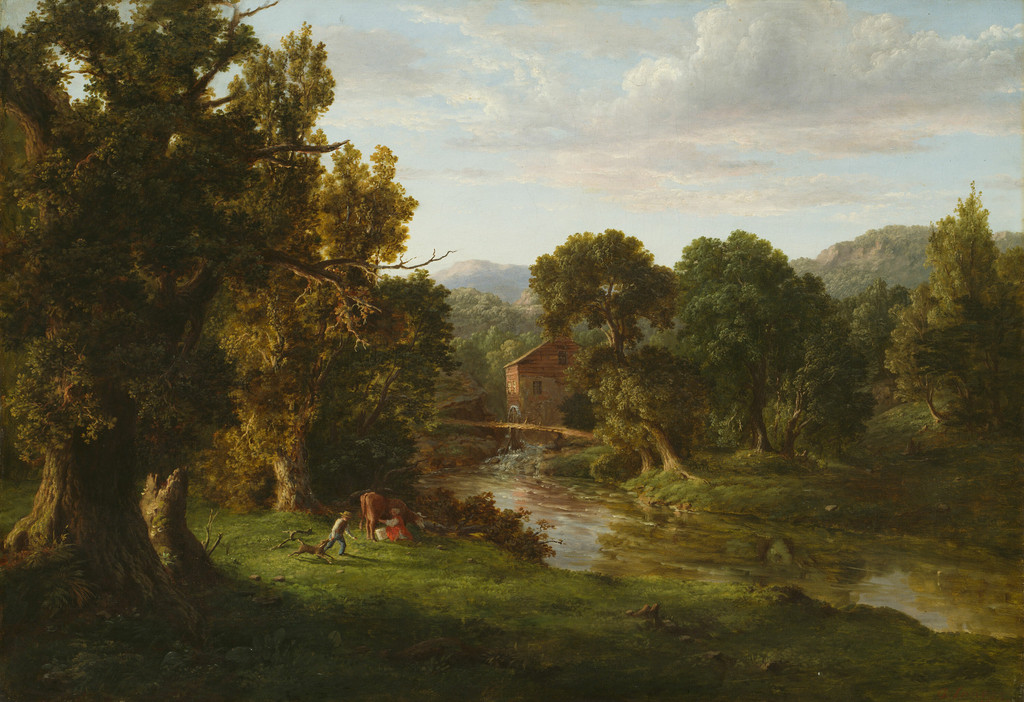
The Old Mill, dated 1849, offers a useful early example of the subjects he made available to that public. Trees enclose a working building and small foreground encounter. The landscape includes people and use, rather than relying on a scene emptied of habitation. The building’s place within the forest matters as much as its individual form.[5]
This interest would persist even while the appearance of his paintings changed. A train, field, mill or distant building could be incorporated into a landscape without becoming its only subject. The early picture consequently provides more than a starting date for a stylistic sequence. It establishes a concern that can be followed through later works.
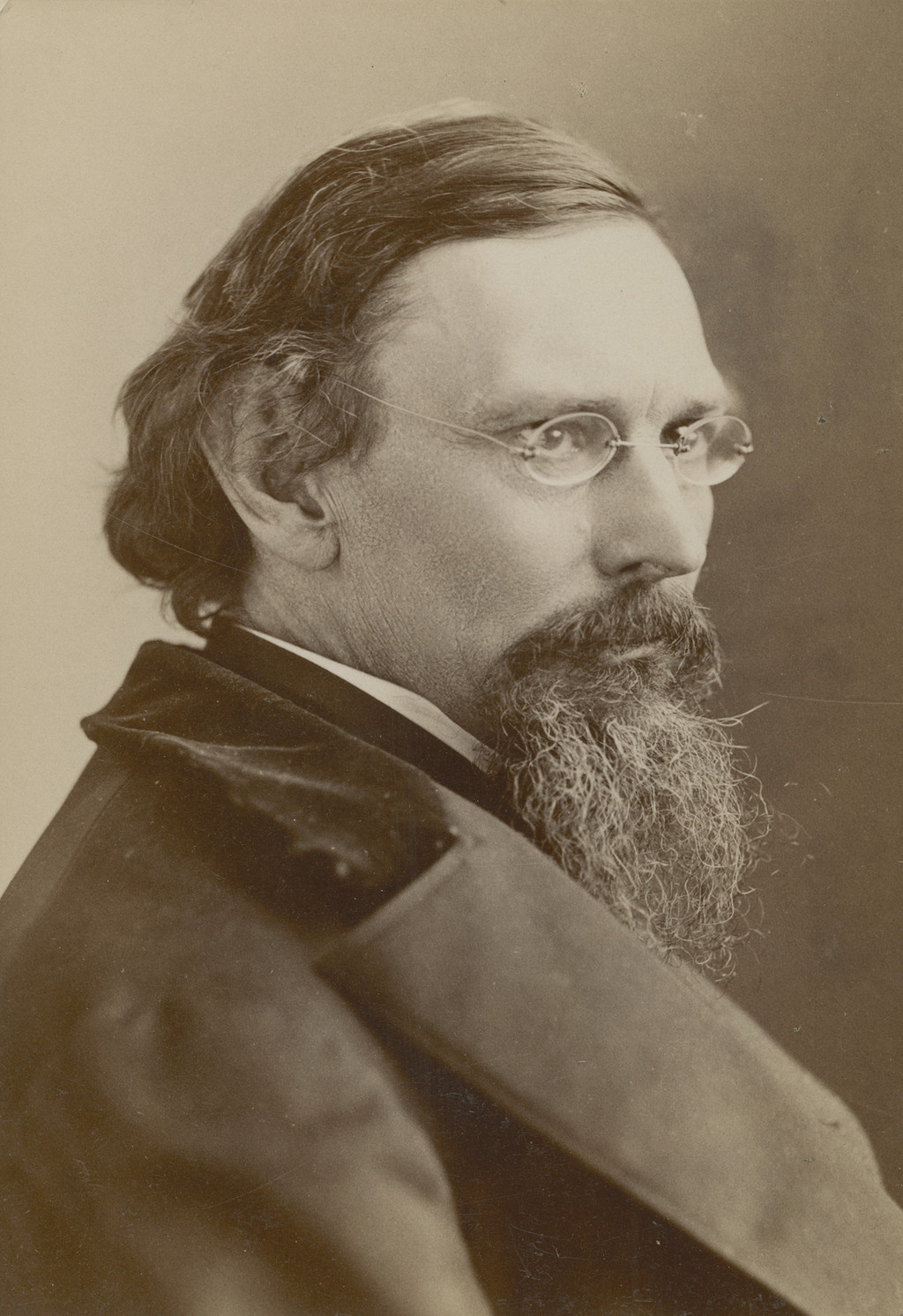
The period portrait accompanying this biography offers another historical point of reference. Napoleon Sarony’s cabinet-card photograph is dated after 1875 in its file record. It presents the older artist in three-quarter view, with spectacles and a beard. The approximate date and photographer are more secure information than any personality inferred from his expression.[6]
George Inness, The Old Mill, 1849. Oil on canvas. Art Institute of Chicago, 1939.388. The William Owen Goodman and Erna Sawyer Goodman Collection; Art Institute of Chicago. Image source. Public domain.
The first European journey
The first Italian visit in 1851–52 was a different episode from the longer residence beginning in 1870. The Philadelphia Museum of Art’s account relates the early journey to Inness’s interest in Baroque landscape, particularly Claude Lorrain and Salvator Rosa, and to the financial support of patron Ogden Haggerty. Italy supplied both actual terrain and places associated with admired predecessors.[2]
Bell connects the Florence visit with portraitist William Page, an interest in Titian and the introduction of Swedenborg’s writings. She also describes encounters with Barbizon painting in France. These relationships opened possibilities for painterly handling and emotional emphasis alongside the landscape forms he had already studied.[1]
The historical significance lies in the alternatives available to the artist. Landscape could be organised through grand compositional models, closer attention to ordinary places or a more expressive handling of paint. European study did not give him one finished method to carry home. His later work shows repeated selection among different possibilities.
The Philadelphia labels also report material connections between two early Italian canvases, including resizing. They propose a shared commission as a possibility, rather than a settled fact. That example shows why travel history and object history need to remain in relation: a familiar account of influence can be refined by what a particular canvas physically records.[2]
The railway commission and the need for work
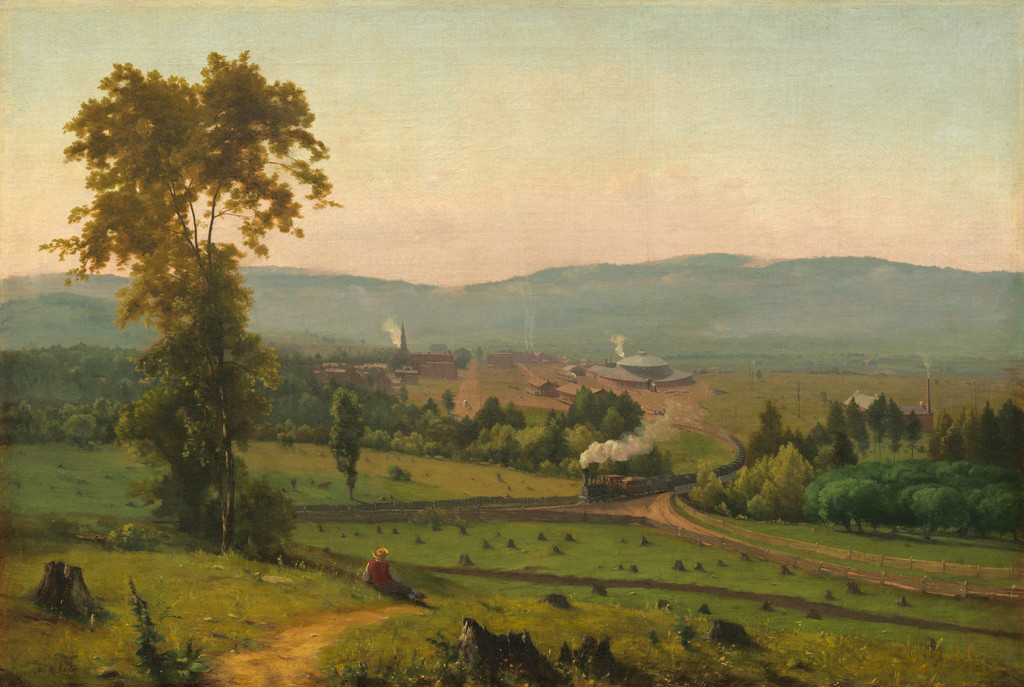
The Lackawanna Valley arose from a railroad advertising commission. The current NGA dates it circa 1856, while a September 1855 letter reproduced in the son’s memoir documents the Scranton visit. The difference separates preparation from the approximate completion date of the surviving object.[7][4]
The son’s account recalls a demand for more tracks than were then present at the roundhouse. It says his father objected but accepted the instruction. As retrospective testimony, the anecdote needs attribution; as a working-life episode, it makes the negotiation between artist and client unusually concrete.[4]
The resulting picture includes conspicuous foreground stumps beside the railway and settlement. Its commercial purpose does not exhaust what can be noticed in it. A biography attentive to both commission and image can explain why the canvas invites questions about industry while avoiding a claim that its motifs reveal one exact, unrecorded political verdict.
The same memoir later describes Inness buying the canvas back after finding it in Mexico. The episode concerns a mature artist encountering a surviving object from an earlier period of paid work. It also shows how the son’s book joins practical history with memory. The original advertising picture became available for reconsideration within the artist’s own life.[4]
Medfield, Eagleswood and the 1860s
Bell dates the move to Medfield, Massachusetts, to June 1860 and the invitation to teach drawing at Eagleswood in Perth Amboy, New Jersey, to autumn 1863. His students there included Louis Comfort Tiffany and Carleton Wiggins. She also describes his abolitionism and activity supporting the Union during the Civil War.[1]
Teaching makes another part of the career visible. Inness’s work was not confined to receiving instruction and producing finished canvases. He also communicated ideas about drawing to others. The son’s remembered studio advice about useful detail offers evidence of how he could frame a practical question, although it should not be treated as a transcript of an Eagleswood lesson.[4]
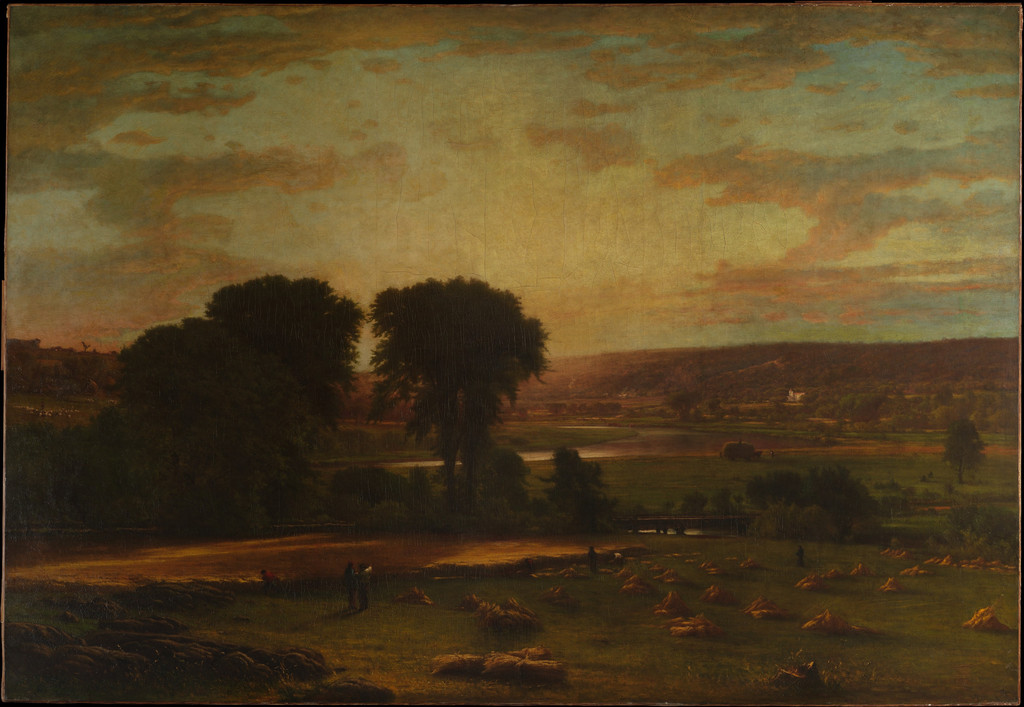
Peace and Plenty of 1865 gives this decade a very different scale from the earlier mill scene. Workers, harvest, water and distance occupy a large canvas under a broad golden sky. The Met interprets its title and imagery in relation to optimism surrounding the war’s conclusion. That interpretation belongs alongside its exact date and first exhibition in 1866, rather than replacing object history with a single slogan.[8][1]
The painting’s cultivated land also connects it to a recurring concern. A substantial landscape could be built around ordinary work and social presence, even at a scale associated with more spectacular subjects. Looking from The Old Mill to Peace and Plenty reveals continuity in inhabited landscape alongside a change in ambition and arrangement.
Religious purpose and the Triumph of the Cross
The Triumph of the Cross commission of 1866 led to a three-part religious series completed in 1867. Its documented pilgrim narrative drew on Bunyan and Swedenborg. Inness and Elizabeth Hart Inness were baptized into the New Church in October 1868; the same year brought his election as a full member of the National Academy, following his associate status since 1853.[1]
The series provides a particularly explicit instance of landscape carrying religious meaning. The New Jerusalem belonged to that original sequence. Its later fragmentation and reworking concern a subsequent object history, while the commission shows that spiritual narrative was an identified subject at the time of making.
The son reproduces a broader statement about art cultivating the artist’s spiritual nature and entering general civilisation. He gives no date for that statement on printed page 17. It illuminates a purpose attributed to Inness, but should not be assigned to a particular year simply because it appears in the memoir’s early chapters.[4]
That distinction is important across the career. Documented allegory, an undated philosophical statement and a contemplative response to a late painting are different kinds of evidence. A biography can connect them without making every bird or tree the illustration of one fixed doctrine.
Watch: George Inness
Choose a film to explore the artist’s work, its interpretation and its wider setting.
The Montclair Art Museum's George Inness Gallery
Visit the George Inness Gallery at the Montclair Art Museum in this State of the Arts feature.
Watch on YouTubeThe longer European residence and return
Inness’s family began a four-year European stay in 1870, followed by time in Normandy in 1874 and a return to work in America. The two Italian periods should remain separate. The later stay supplied another sustained encounter with countryside, studio production and markets for paintings abroad.[1][2]
The Met’s Italian works on paper show a painter exploring graphic structure and colour together. Across the Campagna of 1872 and Olive Trees at Tivoli of 1873 combine graphite, watercolour and gouache on different papers. A wide sky and low horizon organise one sheet; more forceful trees and rocks shape the other. Their differences are discussed in the drawings and watercolours article.[9][10]
Pine Grove of the Barberini Villa, dated 1876, demonstrates that Italian subjects continued after the residence. Its repeated crowns and tall trunks organise a large grove, with smaller figures occupying the ground. It belongs to the continuing transformation of travel material, rather than proving that the finished canvas was painted in front of the same view.[11]
The Philadelphia exhibition account considers Italy’s resonance across decades, including work made before, during and after travel. That framework is useful for biography because influence need not stop at a return journey. A place encountered earlier can remain available to memory, comparison and new pictorial decisions.[2]
George Inness, Pine Grove of the Barberini Villa, 1876. Oil on canvas. Met, 98.16. Gift of Lyman G. Bloomingdale, 1898; Metropolitan Museum of Art. Image source. Public domain.
Montclair and the late correspondence
The Montclair chronology has three stages: rental in June 1878, purchase in December 1884 and permanent residence from February 1885. Inness retained a New York studio. Keeping these events distinct explains why a Montclair subject can precede the permanent move, without treating every painting from 1878 as a view of the same property.[1]
Home at Montclair of 1892 makes a broad snowy field and winter sky into a substantial landscape. Low buildings, trees and small birds preserve habitation without dominating the view. The Clark describes thin paint and twilight; the son’s memoir offers his own response to a familiar field transformed by his father’s work.[12][4]
The letters also preserve an artist considering his work while it was in progress. In July 1881 he wrote to his wife about several pictures made with grey colour yet rich and full of air. The letter documents what he valued at that occasion. It is more precise evidence than an undated general account that all his landscapes were painted the same way.[4]
An undated Tarpon Springs reply to “Editor Ledger” provides another example. Inness rejects an Impressionist label while describing how people receive and communicate impressions. The son says the newspaper’s identity was lost. The passage preserves both a forceful artistic distinction and a limit in the record through which it reaches us.[4]
George Inness, Home at Montclair, 1892. Oil on canvas. Clark Art Institute, 1955.10. Sterling and Francine Clark Art Institute. Image source. Public domain.
Continued travel, Florida and the final years
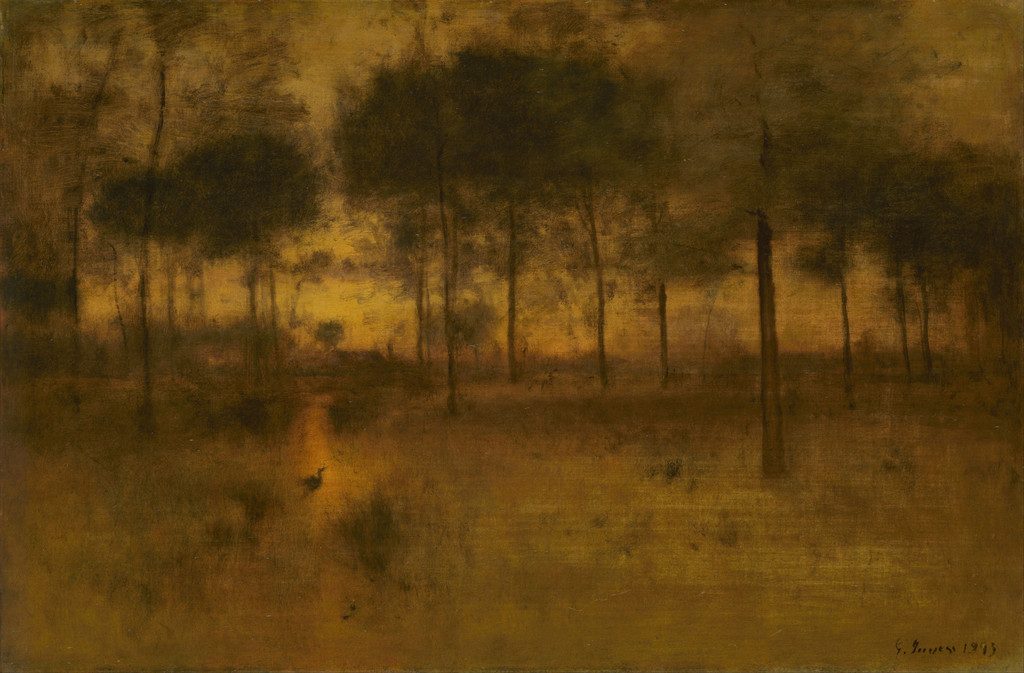
Montclair residence did not end travel. Bell describes late journeys and winter stays at Tarpon Springs, where Florida trees and light contributed to his subjects. Chicago’s The Home of the Heron of 1893 gives a small bird a point of recognition within warm, less definite vegetation. It shows how a late landscape can depend on selective clarity rather than an inventory of every surrounding form.[1][13]
The painting does not represent the whole late career. Winter fields, Italian memories, woodland interiors and Florida scenes offered different conditions. The variety matters because “Tonalist” is a useful context but an incomplete biography. An artist can sustain related concerns through markedly different subjects and formats.
Inness died in Bridge of Allan, Scotland, in 1894. Montclair Art Museum’s account records the memorial service at the National Academy of Design. The Academy thus appears near both ends of his public career: the early exhibition framework and the later commemoration of his life.[3]
The paintings continued to acquire new histories through exhibitions, collections and research. Exact museum records now distinguish objects that share titles and correct older provenance or date conventions. The biography needs those current identities as well as the testimony of people who knew the artist.
George Inness, The Home of the Heron, 1893. Oil on canvas. Art Institute of Chicago, 1911.31. Edward B. Butler Collection; Art Institute of Chicago. Image source. Public domain.
The son’s memoir and a lasting reputation
The 1917 memoir was written after the painter’s death by his artist son. It combines letters, recollections, judgments and reproduced speech. Its closeness to family experience gives it value, while its admiration gives readers a reason to distinguish testimony from an independent assessment. The source can preserve an incident without settling every question about it.
This is particularly clear in the early training story and the print-shop recollection. The son gives the career a direction: a young painter seeks more than the methods available around him. The account helps recover that remembered aspiration, but it cannot identify the forgotten engraving or turn every retrospective judgment into contemporary evidence.
The same care applies to quotations. A dated letter, remembered studio remark and undated philosophical statement should retain their different introductions. The quotation article presents selected passages with those distinctions; the style and technique article compares studio testimony with material examination of a particular canvas.
Inness’s career becomes richer through this combination of evidence. The public chronology establishes where and when major episodes occurred. The son’s book preserves ways the artist and family understood the work. The paintings themselves show how familiar land, travel and sustained reconsideration could become very different visual experiences over nearly half a century.
Artworks directory
A collected selection of 46 individually identified museum objects: 43 paintings and three watercolours. This is not a complete catalogue raisonné. Repeated titles identify separate objects where their institutions or accessions differ. Links lead to a companion article where available, otherwise to the museum record. Unillustrated entries remain included; the original lost New Jerusalem is represented by its three transformed survivors.
| Name | Date | Medium |
|---|---|---|
| Crossing the Ford | 1848 | Oil on canvas |
| The Old Mill | 1849 | Oil on canvas |
| The Lackawanna Valley by George Inness | c. 1856 | oil on canvas |
| Delaware Water Gap | 1861 | Oil on canvas |
| Delaware Valley | c. 1865–75 | Oil on artist's board |
| Peace and Plenty | 1865 | Oil on canvas |
| Evening Landscape | 1867; later reworked | Oil on canvas |
| Summer in the Catskills | 1867 | Oil on canvas |
| The Valley of the Olives | 1867; reworked after 1880 | Oil on canvas |
| The Valley of the Shadow of Death | 1867 | Oil on canvas |
| Visionary Landscape | 1867/1880 | Oil on canvas |
| Catskill Mountains | 1870 | Oil on canvas |
| Across the Campagna | 1872 | Watercolor, gouache, and graphite on off-white wove paper |
| Olive Trees at Tivoli | 1873 | Gouache, watercolor, and graphite on blue wove paper with colored fibers |
| A Marine | c. 1874–75 | Oil on canvas |
| Twilight in Italy — Art Institute of Chicago (1911.44) | 1874 | Oil on panel |
| Pine Grove of the Barberini Villa | 1876 | Oil on canvas |
| The Storm | 1876 | Oil on canvas |
| Autumn Oaks | ca. 1878 | Oil on canvas |
| The Sisters | 1882 | Oil on millboard |
| Harvest, Montclair, New Jersey | 1884 | Oil on canvas |
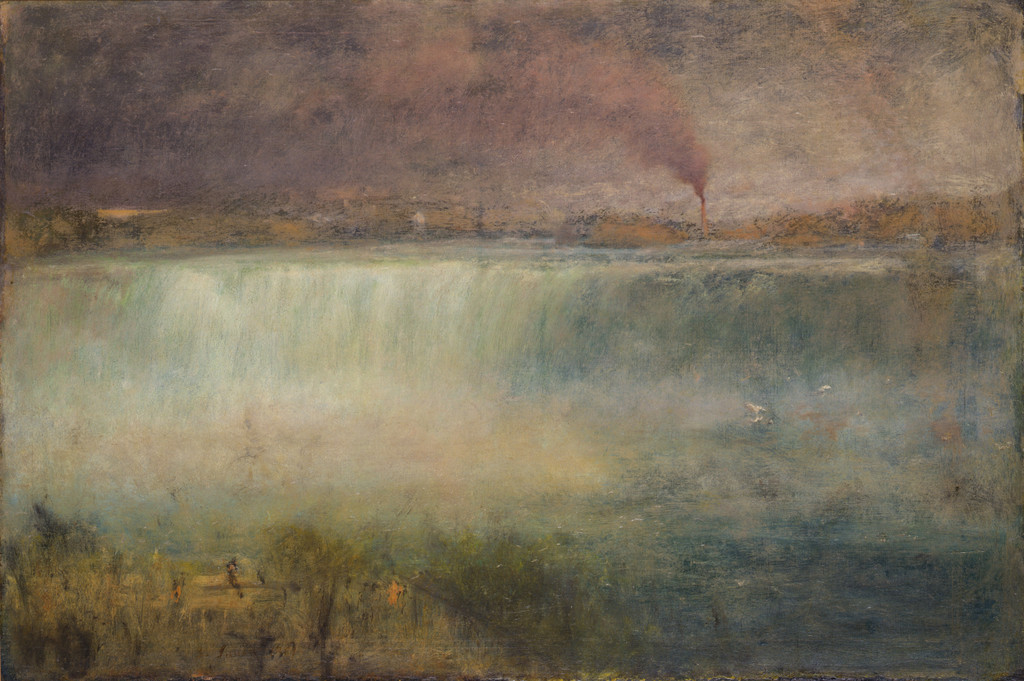
| Niagara Falls | 1885 | Oil on wood |
| A Silver Morning | 1886 | Oil on canvas |
| Landscape, Sunset | 1887–89 | Oil on canvas |
| September Afternoon | 1887 | Oil on canvas |
| Sunrise | 1887 | Oil on canvas |
| The Mill Stream, Montclair, New Jersey by George Inness | c. 1888 | Oil on canvas |
| Niagara by George Inness | 1889 | oil on canvas |
| The Mill Pond | 1889 | Oil on canvas |
| Sunset in the Valley | 1890 | Oil on canvas |
| The Moon at Night | 1890 | Oil on canvas |
| Twilight in Italy — Art Institute of Chicago (1911.42) | 1890 | Oil on canvas |
| Autumn Woods | 1891–94 | Oil on canvas |
| Moonrise | 1891 | Oil on canvas |
| Spring Blossoms, Montclair, New Jersey | ca. 1891 | Oil and crayon or charcoal on canvas |
| Sunset in the Woods by George Inness | 1891 | oil on canvas |
| The Home of the Heron — Princeton University Art Museum (y1943-93) | 1891 | Oil on canvas |
| Threatening | 1891 | Oil on canvas |
| Early Morning, Tarpon Springs | 1892 | Oil on canvas |
| Home at Montclair by George Inness | 1892 | oil on canvas |
| The Lonely Farm, Nantucket | 1892 | Oil on canvas |
| Afterglow | 1893 | Oil on canvas |
| Sunlit Valley | 1893 | Oil on canvas |
| The Home of the Heron — Art Institute of Chicago (1911.31) | 1893 | Oil on canvas |
| After a Summer Shower | 1894 | Oil on canvas |
| Landscape | n.d. | Watercolor with scraping on ivory wove paper |
Frequently Asked Questions
He rented there in 1878, bought the estate in 1884 and moved permanently in 1885, while retaining a New York studio.[1]
Distinguish the 1851–52 trip from the longer 1870–74 European residence. Italian subjects also continued after his return.[2]
Inness died in Bridge of Allan, Scotland, in 1894.[3]
Discussion
Look again at the images and ideas explored in George Inness Biography. These editorial prompts invite your observations.
Compare one early cultivated landscape with a late Montclair or Florida picture. Which concerns continue, and which visual relationships change? Consider what the son’s recollections add to the public chronology, while keeping their retrospective character visible.
Reader Insights
Which encounter with prints or teachers helps you understand the paintings?
How do the Italian sheets compare with the later Italian canvas?
What does the distinction between renting, purchasing and settling in Montclair add to the chronology?
Join the Conversation
Share a detail, comparison or question about George Inness Biography below.
References
- Adrienne Baxter Bell, “George Inness (1825–1894),” Metropolitan Museum of Art (2012).
- Philadelphia Museum of Art, George Inness in Italy, exhibition labels (2011). Selected labels read; complete exhibition catalogue not consulted.
- Montclair Art Museum, George Inness gallery commentary by Adrienne Baxter Bell.
- George Inness Jr., Life, Art, and Letters of George Inness (1917), selected printed pp.13–14, 17, 46, 108, 111, 156–157, 168–169 and 245–246. Actual selected scans read; original interviews and the complete book not represented as fully consulted.
- Art Institute of Chicago, The Old Mill, accession 1939.388.
- Napoleon Sarony, George Inness cabinet-card portrait, after 1875, exact Commons file record. The file identifies the NGA Library source; the library catalogue itself was not independently readable.
- National Gallery of Art, The Lackawanna Valley, accession 1945.4.1.
- Metropolitan Museum of Art, Peace and Plenty, accession 94.27.
- Metropolitan Museum of Art, Across the Campagna, accession 67.55.145.
- Metropolitan Museum of Art, Olive Trees at Tivoli, accession 1989.287.
- Metropolitan Museum of Art, Pine Grove of the Barberini Villa, accession 98.16.
- Clark Art Institute, Home at Montclair, accession 1955.10.
- Art Institute of Chicago, The Home of the Heron, accession 1911.31.
- Splash image source.
Napoleon Sarony, George Inness, after 1875. Albumen cabinet-card portrait. Napoleon Sarony; NGA Library Department of Image Collections, source stated by the Commons file record; public domain. Image source. Public domain.
- Kevin J. Avery, “The Hudson River School”, Metropolitan Museum of Art (2004). Origins in 1825 and decline in the 1870s–1880s; c. 1825–1880 is an approximate comparative range. Source
- National Gallery of Art, Picturing France, p. 37: the Barbizon school between about 1830 and 1870. Source
- Smithsonian American Art Museum, Asher Brown Durand: 1796–1886. Artist life dates. Source
- Smithsonian American Art Museum, Thomas Cole: 1801–1848. Artist life dates. Source
- National Gallery of Art, George Inness: 1825–1894. Artist life dates. Source
- Amon Carter Museum of American Art, Frederic Edwin Church: 1826–1900. Artist life dates. Source