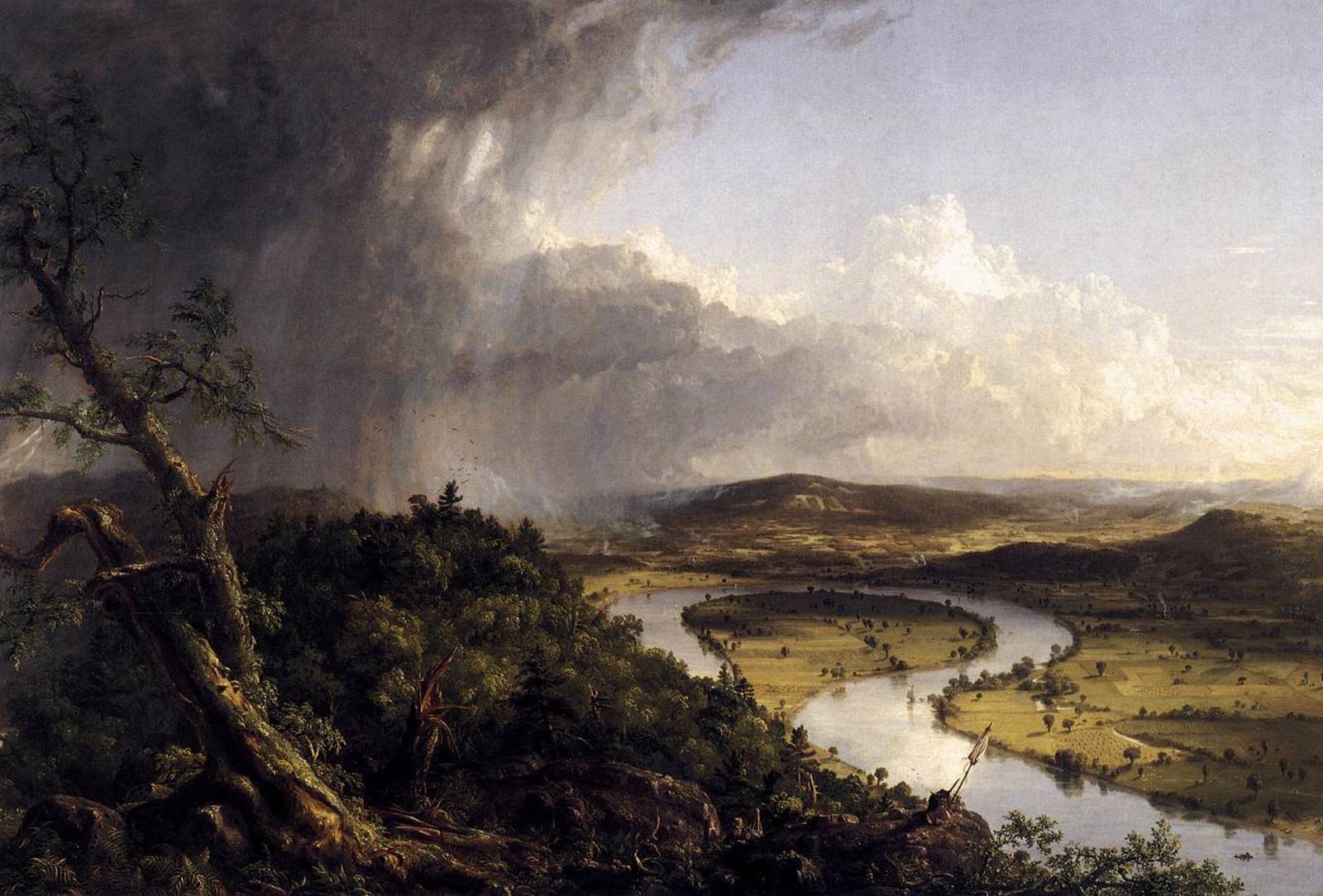
Image reference: Thomas Cole, The Oxbow.
At a Glance
- Core periodc. 1825–1875, with important earlier sources and later careers
- Principal centresNew York City · Hudson Valley · Catskills · White Mountains
- Wider geographyNew England · American West · South America · Arctic · Europe
- Known forexpansive landscapes · weather · detailed foregrounds · radiant distance · observation and invention
- Leading namesCole · Durand · Church · Bierstadt · Gifford · Kensett · Cropsey · Barstow · Duncanson · Moran
- Key contextIndigenous homelands · tourism · science · railroads · Civil War · conservation and dispossession
- Important cautiona loose network and retrospective label—not an organised society with one style
Contents
- The movement in context
- A school named after the event
- Thomas Cole and the origin story
- Wilderness, nation and inhabited land
- From field sketch to studio landscape
- Tourism, technology and the scenic gaze
- Church and the whole world in a frame
- Landscape through Civil War and Luminism
- The pictured West and conservation
- Artists to know
Where the Hudson River School fits
Thomas Cole
Principal careerAsher B. Durand
Principal careerFrederic Edwin Church
Principal careerAlbert Bierstadt
Principal careerSanford Robinson Gifford
Principal careerJohn Frederick Kensett
Principal careerJasper Francis Cropsey
Principal careerSusie M. Barstow
Principal careerRobert S. Duncanson
Principal careerThomas Moran
Principal careerThe Hudson River School transformed landscape painting into one of the great public languages of nineteenth-century American culture. Its artists pictured the Hudson Valley and Catskill Mountains, but also travelled to New England, the American West, South America, the Arctic and Europe. They made close studies outdoors, then returned to the studio to build paintings in which weather, light, geology and vegetation carried ideas about divine creation, national promise, historical change and private feeling.[1]
There was no school building, membership roll or manifesto. The name appeared only in the 1870s, when critics were already turning against the kind of ambitious landscape it described. What held these painters together was a changing professional network: shared teachers and sketching grounds, New York studios and clubs, exhibition venues, patrons and a belief that landscape could sustain serious art.[2] [3]
That belief produced images of extraordinary beauty. It also helped viewers imagine inhabited homelands as open “wilderness”, westward expansion as destiny and scenic preservation as separate from Indigenous history. The Hudson River School is most rewarding when both achievements and contradictions remain visible.
The practical centre of the Hudson River School lies between Thomas Cole's first celebrated Hudson Valley paintings in 1825 and the change in taste around the American Centennial of 1876. Those dates describe a cultural arc rather than a closed box. Cole's predecessors had already made American landscapes, while Church, Bierstadt, Moran and their contemporaries continued to paint long after critics declared their manner old-fashioned. Exhibitions now often use broader spans, from the 1810s or 1820s into the 1880s, to show how gradually the tradition formed and dispersed.[4] [5] [6]
In a wider history, it belongs to Romanticism: landscape offers an encounter with powers larger than the individual, whether understood as nature, God, time or the nation. The picturesque supplied irregular variety; the beautiful promised harmony; the sublime joined awe to danger. Yet these European aesthetic categories changed when applied to American territory, commercial tourism and settler expansion.
The Hudson River School overlaps with American Romanticism, nineteenth-century natural history and the later critical category called Luminism. It precedes Tonalism and American Impressionism, but it should not be presented simply as a primitive step toward them. Its most characteristic paintings ask different questions: how can a continent become a picture, what kind of history is carried by scenery, and who is permitted to claim the view?
A school named after the event
The phrase “Hudson River School” sounds as though a group of painters chose it for themselves. They did not. It began circulating in the 1870s and was often used disparagingly for an older New York landscape tradition whose monumental scenery no longer matched cosmopolitan taste. The label survived because it identifies something real: the importance of the Hudson, the artists' New York base and their social as well as professional connections.[2]
Thomas Cole is commonly called the founder, but that title is retrospective too. He inspired younger artists and directly taught Frederic Edwin Church, yet he did not establish an association. After Cole died in 1848, Asher B. Durand became the acknowledged senior figure. Members of the larger circle met at the National Academy of Design and the Century Association, exhibited together and, from 1858, often worked in the purpose-built Tenth Street Studio Building. Their friendships, rivalries and shared patrons made a fraternity without producing one style.[2] [17]
That distinction matters. Cole's moral allegories, Durand's woodland studies, Church's ecological panoramas, Kensett's restrained coasts and Bierstadt's enormous western spectacles do not look interchangeable. Even the boundaries are contested. Martin Johnson Heade was closely connected to Church but fits only some accounts of the school; George Inness began near its world and moved toward a different ideal. A useful category should clarify these relationships without turning them into compulsory membership.[24]
Before Cole: an American art made across the Atlantic
The movement's claims for a distinctive national landscape were built with international tools. Cole was born in Lancashire and emigrated with his family to the United States as a teenager. His early work as an engraver gave him experience in translating tonal structure into reproducible images. When he later travelled in Britain and Italy, he studied a European tradition that included Claude Lorrain's ordered light, Salvator Rosa's rugged drama and the landscapes of J. M. W. Turner and John Constable.[7] [8]
American painters did not have to choose between European knowledge and local subject matter. They could use inherited conventions to argue that the Hudson, Catskills and White Mountains deserved the cultural authority long granted to Roman ruins or Alpine passes. The contradiction was productive: national distinctiveness was expressed through an Atlantic exchange of pictures, books, travellers and ideas.
Later artists widened the network. Albert Bierstadt studied in Düsseldorf; Worthington Whittredge spent years in Germany; American collectors followed French and British art; Church read the German naturalist Alexander von Humboldt and the English critic John Ruskin. A painting might therefore combine a New York studio, German training, South American plants, European display practices and a claim about the United States. “American” describes the ambition and reception of such work, not cultural isolation.
Thomas Cole and the 1825 origin story
In the summer and autumn of 1825, the young Thomas Cole travelled by steamboat up the Hudson and sketched around the Catskills. Three resulting paintings displayed in New York attracted the attention of established artists and patrons. The episode later became the Hudson River School's foundation story: an immigrant artist discovers that American scenery can support ambitious painting.[7]
The reality was richer than the legend. The valley was already densely historical and increasingly commercial. Indigenous nations had known and managed it for millennia; Dutch and British colonisation had transformed landholding; farms, towns, mills, roads and river traffic structured daily life. Cole encountered an emerging scenic economy as well as “nature”. The Catskill Mountain House had opened in 1824, and steamboats were bringing visitors toward celebrated viewpoints.[4]
Cole's achievement was not the innocent discovery of untouched landscape. It was his ability to make scenery carry several kinds of meaning at once. Broken trees, distant water, passing storms and tiny human figures could evoke mortality, providence, settlement and time. He studied outdoors but selected and reorganised what he saw. The finished picture was an argument composed in paint.
Cole also wrote forcefully about scenery. In his 1836 “Essay on American Scenery”, he presented the country's landscape as a cultural inheritance available to all social classes, a source of refreshment, moral feeling and national pride. In the same text, he lamented the rapid destruction caused by the axe and by the triumphal language of “improvement”.[10] [11] His position is one of the tradition's defining tensions: he could oppose environmental damage while accepting a settler nation as the frame within which land acquired value.
Wilderness, nation and inhabited land
“Wilderness” was among the Hudson River School's most powerful ideas, but it was never a neutral description. A scene could be made wild by viewpoint, framing and omission. Roads, mills, farms or settlements might lie just beyond the canvas. Trees could conceal a hotel from which the view was easily reached. A tiny Native figure could make a valley seem timeless even while its people were being displaced.
The Hudson itself is Muhheacanituck, a homeland and living relation for Mohican people. In a contemporary interpretation of John Frederick Kensett's Hudson River Scene, Bonney Hartley of the Stockbridge-Munsee Community describes a place of continuing cultural and spiritual connection while confronting the unresolved taking of Mohican land. Artist Kay WalkingStick reads Bierstadt's western spectacle beside Shoshone presence and the destruction of bison; Joe Baker places George Inness's Delaware Water Gap within Lenapehoking and its histories of removal and industrial damage.[16]
These perspectives do not add politics to paintings that were previously only beautiful. They recover histories that the category of empty wilderness helped obscure. The beauty remains genuine, as does the painters' attention to atmosphere and terrain. But looking becomes more exact when a viewer asks which signs of habitation are present, which have been miniaturised, and which were edited away.
National identity also took several forms. A cultivated valley could suggest republican order; a storm-broken tree could imply endurance; a boundless western distance could invite settlement. Nature might be read as divine creation beyond human corruption, yet the painting itself entered a market supported by urban wealth. The school did not speak with one political voice. It gave competing convictions a shared visual arena.
The Oxbow and The Course of Empire
Cole's View from Mount Holyoke, Northampton, Massachusetts, after a Thunderstorm—The Oxbow of 1836 is often treated as a concise statement of the whole tradition. On the left, storm-darkened forest rises above snapped trees and rough ground. On the right, sunlight crosses an extensively cultivated valley where the Connecticut River bends back upon itself. Cole's small self-portrait and easel occupy the near wilderness, making artistic observation part of the subject.[13] [14]
It is tempting to turn this division into a simple choice between good nature and bad civilisation. Cole's thought was less stable. Agriculture could signify order, prosperity and human care, while unrestrained commerce threatened destruction. The painting asks whether cultivation can coexist with natural grandeur and whether the artist can mediate between them. Even its elevated viewpoint was not beyond modern access: scenic travel and changing infrastructure helped make such experiences available.
Cole's five-part Course of Empire makes the warning explicit through imaginary landscape. A single site passes from a “savage” condition through pastoral and imperial states to destruction and desolation. The sequence condemns pride and the belief that material power guarantees permanence.[9] [15] Its historical cycle also carries the prejudices of its age. The opening title makes civilisation a one-way hierarchy, while the apparently empty landscape turns imperial history into a universal law rather than a record of particular peoples and conflicts.
The series is therefore both critical and implicated. Cole distrusted commercial excess and expansionist confidence, yet used inherited ideas of savagery and civilisation. His best landscapes remain compelling because they do not settle their own contradictions. A viewer can experience visual splendour, ecological warning and political limitation at once.
Essential works
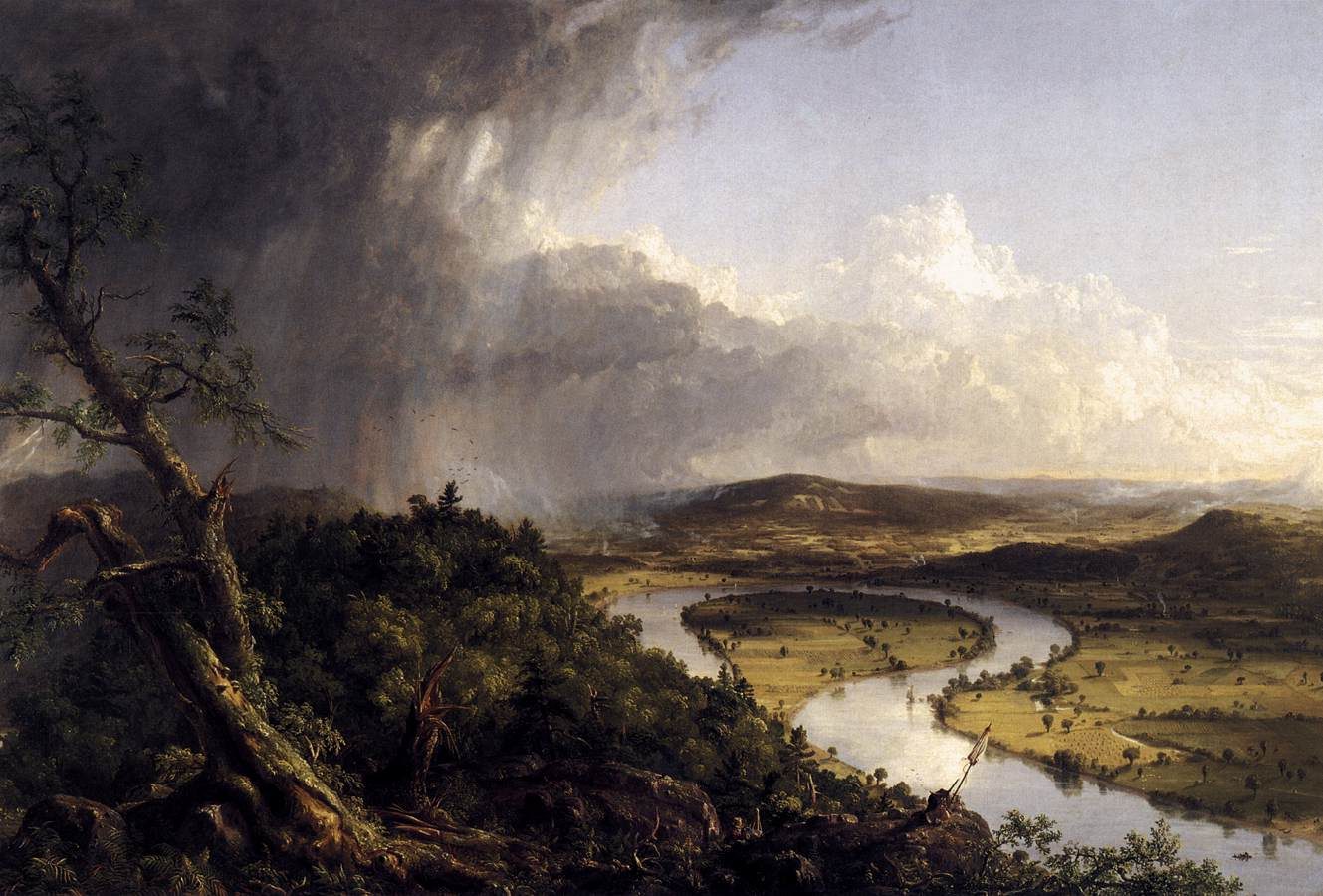
The Oxbow
Thomas Cole, 1836
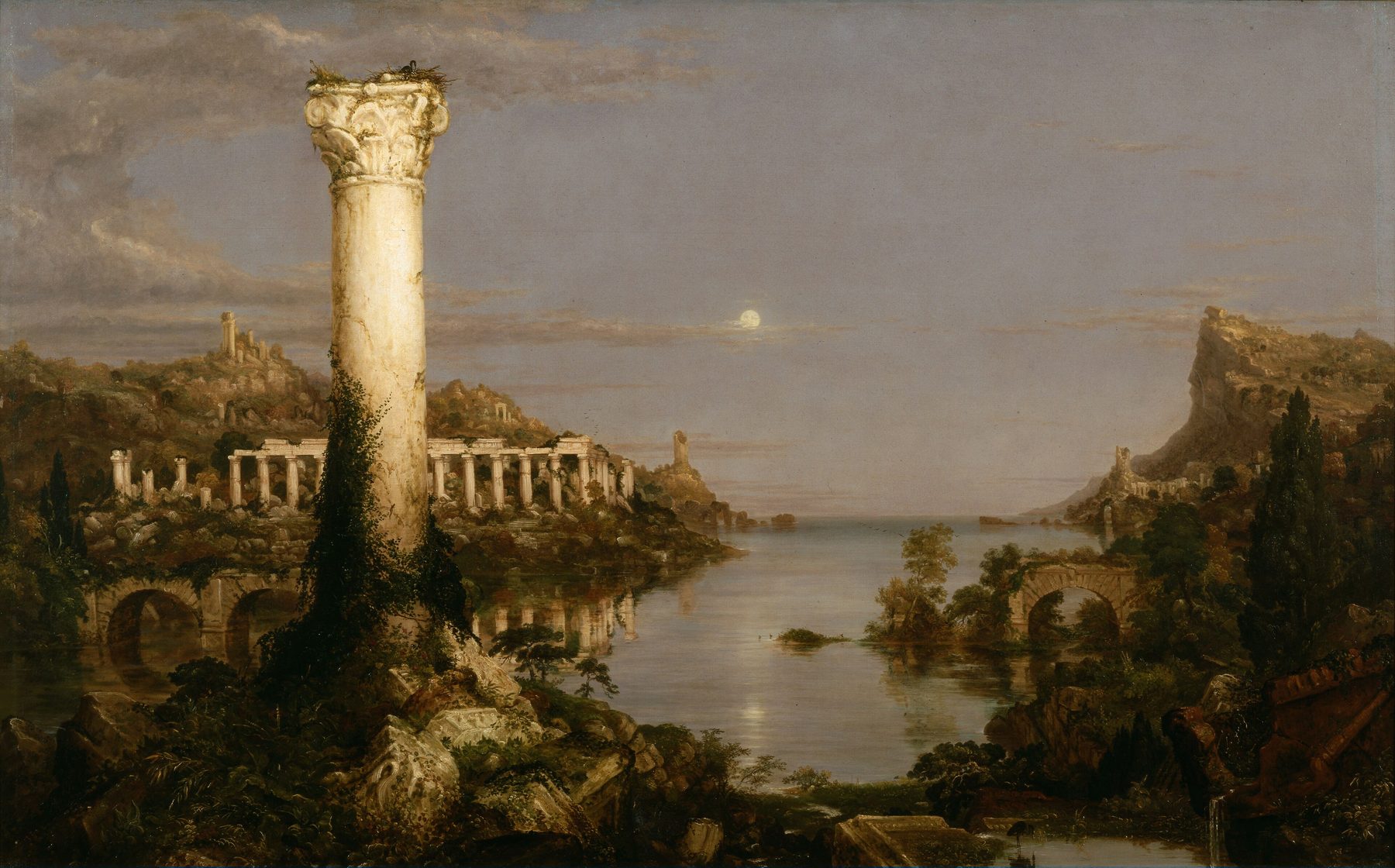
The Course of Empire: Desolation
Thomas Cole, 1836
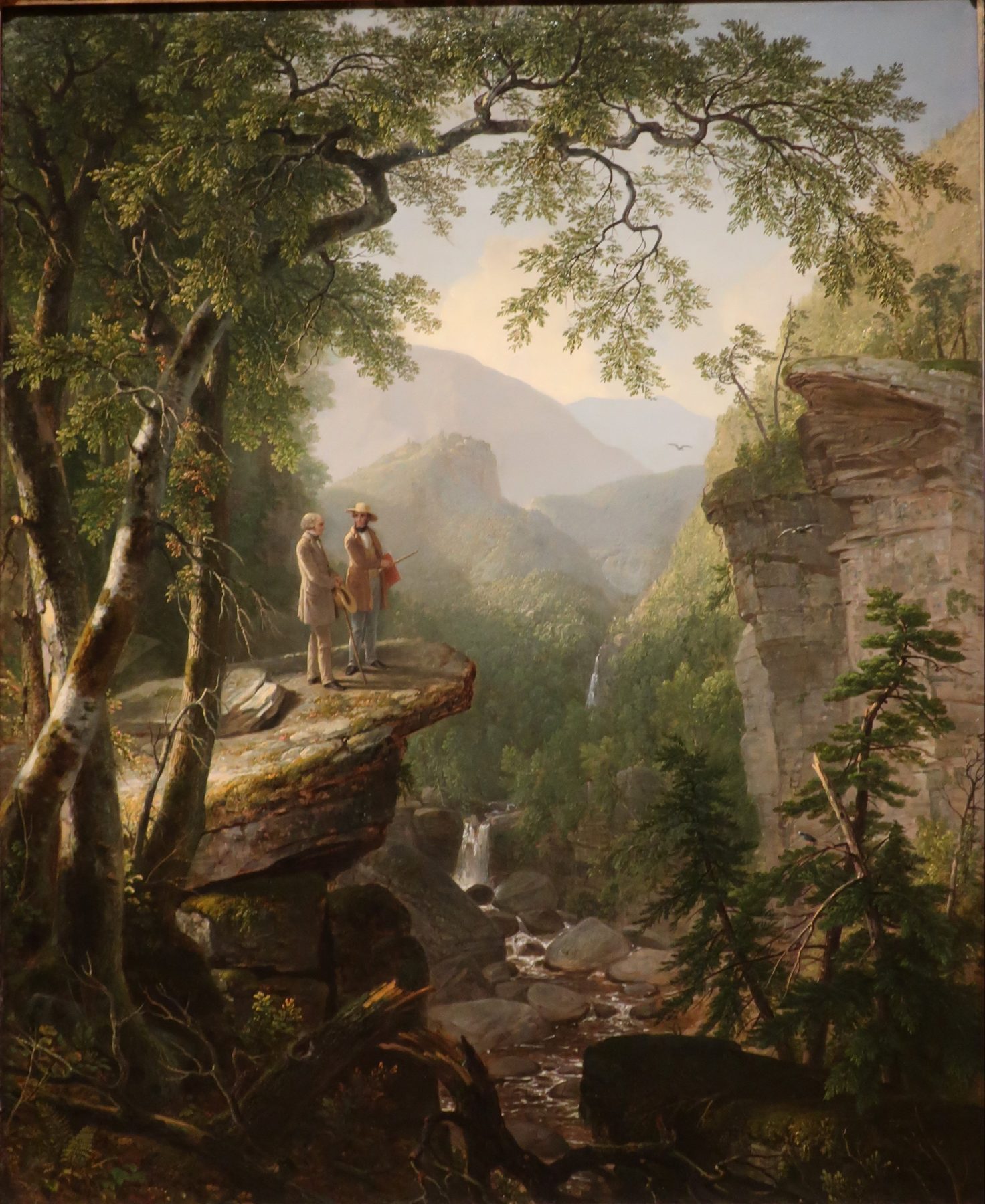
Kindred Spirits
Asher B. Durand, 1849
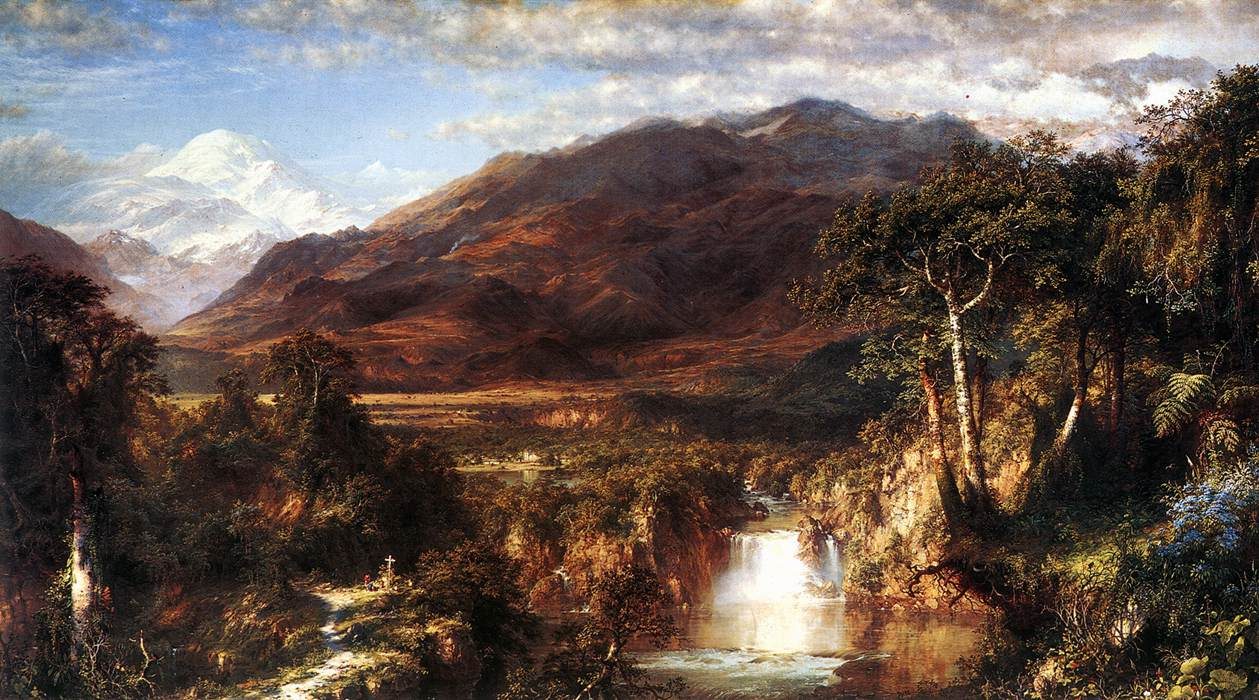
The Heart of the Andes
Frederic Edwin Church, 1859
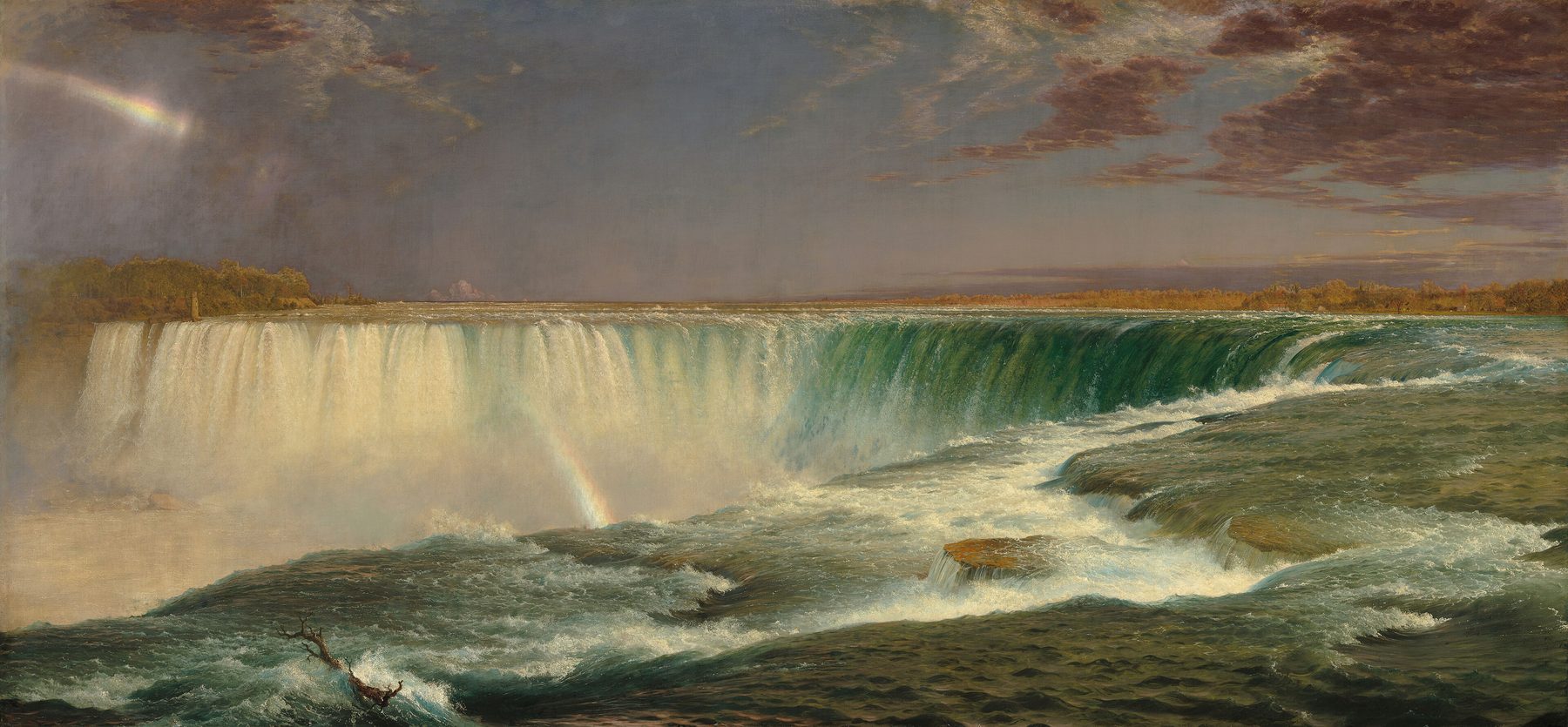
Niagara
Frederic Edwin Church, 1857
Durand and the making of a professional network
Asher B. Durand entered art through engraving and achieved national fame with his print after John Trumbull's Declaration of Independence. He gradually turned to painting, served as president of the National Academy of Design and, after Cole's death, became the senior voice of New York landscape. In nine “Letters on Landscape Painting” published in 1855–56, he urged younger painters to work patiently from nature while pursuing an idealised whole.[17]
Durand's outdoor studies could focus on a bank, tree or woodland interior without a grand narrative. Such exercises trained the eye to understand growth, texture and light. They were not always preparatory fragments for a particular finished canvas; direct study could have its own value.[18] His larger paintings nevertheless arranged nature through artistic convention, joining empirical attention to pastoral or spiritual order.[20]
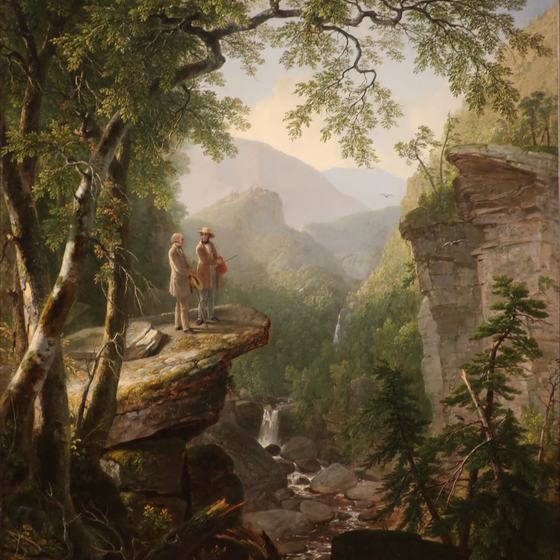
In Kindred Spirits of 1849, Cole and the poet William Cullen Bryant stand together above a Catskill gorge. The picture memorialises Cole, celebrates cultural friendship and turns the wild setting into a symbolic portrait of American art. It was commissioned as a gift for Bryant, so private affection, institutional community and patronage are inseparable.[19]
The larger network can be recovered through diaries as well as masterpieces. Jervis McEntee recorded studio visits, exhibitions, sales, sketching trips, weather, disappointment and the careers of friends. Such evidence replaces the myth of solitary geniuses with a working ecology of artists who needed one another's company, criticism, contacts and audiences.[21]
From field sketch to studio landscape
Hudson River School painters are admired for detail, but detailed is not the same as topographically exact. The normal process moved between outdoor encounter and studio construction. Artists made pencil drawings, oil studies, colour notes and written observations; collected botanical or geological information; and sometimes used photographs. Finished paintings could combine different viewpoints, seasons and moments of weather.
This synthesis made a landscape feel more complete than a single glance. Church's tropical pictures assemble vegetation associated with different elevations. Bierstadt expands valleys and moves peaks to strengthen a composition. Moran repeatedly returned to motifs years after seeing them. Gifford transformed travelled places through memory and a governing atmosphere. Their work belongs neither to documentary transcription nor free fantasy.[22]
Scale was another expressive choice. A small field study can preserve the speed of changing light. A cabinet picture rewards close domestic viewing. A wall-sized panorama makes the viewer's body feel exposed before vast distance. Smooth surfaces may suppress the hand so that space seems continuous; visible touches can make foliage, cloud or water flicker. The method varies with the desired experience.
When examining a finished painting, it is useful to ask what kind of truth it claims. Botanical truth, geological plausibility, remembered light, moral structure and literal map accuracy are not identical. The Hudson River School often makes several claims at once, and their friction is central to its effect.
Tourism, technology and the scenic gaze
Landscape painting flourished alongside a transportation revolution. Turnpikes, steamboats, canals and railways connected New York to the Hudson Valley, Catskills, Adirondacks and New England. Hotels offered comfort near supposedly remote scenery; guidebooks identified waterfalls and viewpoints; print culture helped visitors recognise the scenes they had come to see. The Catskill Mountain House, perched above the river from 1824, became both destination and symbol.[4]
Painters and tourists learned from one another. Images established visual expectations, while new routes produced patrons and subjects. A particular bend in the river could become famous because it was painted, engraved, described and visited. The “tourist's gaze” was not passive: infrastructure and representation organised where people stood, what they excluded and how they named the experience.[4]
The same systems altered the land. Tanneries stripped hemlock bark; logging cleared slopes; quarries cut mountains; mills and railways rearranged river edges. From the porch of Cole's Catskill home, industrial change was visible. His painted views could adjust or omit elements that disturbed the desired relation between cultivation and nature.[12]
Other artists included the transformation. In Samuel Colman's Storm King on the Hudson, sail and steam traffic share the river, while quarrying, trade and tourism form the unseen context of the mountain view.[55] Such details can be read neither as uncomplicated celebration nor automatic protest. They show modernity entering the scenic image.
Urban commerce financed this longing for refuge. Industrialists, merchants and financiers bought landscapes for New York interiors; railway and publishing interests supported western exploration; exhibitions converted distant sites into paid experiences.[56] The opposition between city and wilderness was therefore partly created inside the city.
Church: science, travel and the whole world in a frame
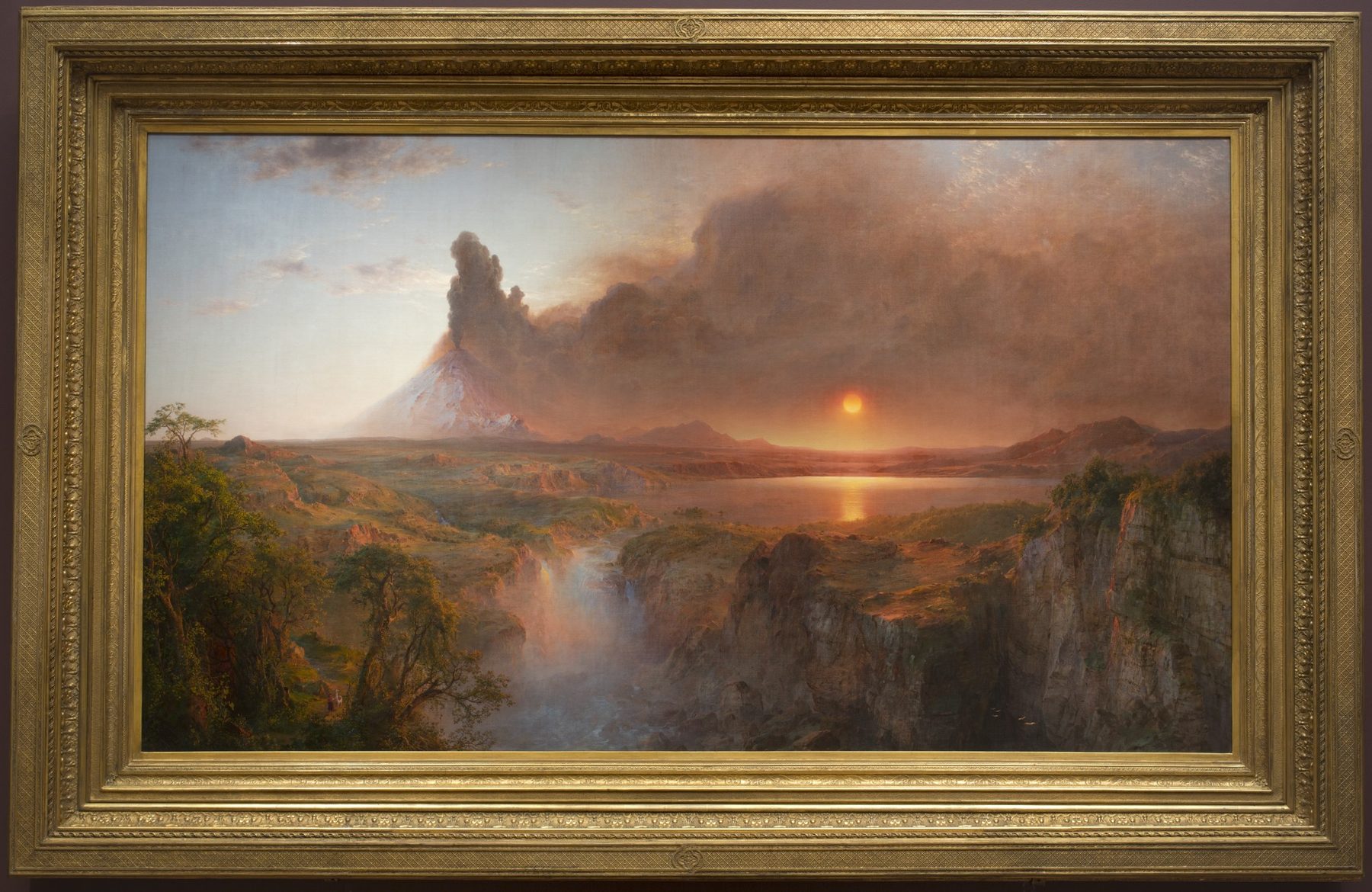
Frederic Edwin Church studied with Cole but built a more global career. He travelled in Colombia and Ecuador in 1853 and 1857, following places and ideas associated with Alexander von Humboldt. Humboldt had argued that nature should be understood as an interconnected whole and that scientific observation could intensify aesthetic wonder. Church responded by studying plants, clouds, mountains and climatic zones with extraordinary care.[26] [28] [29]
The Heart of the Andes of 1859 appears to open onto a single immeasurable place. Tropical plants crowd the foreground; a waterfall leads toward settlements and plains; a snow-covered peak rises through distant atmosphere. Yet Church assembled this environment from multiple observations. The painting is an ecological synthesis, not the view from one station. A tiny cross and worshippers in the foreground join Christian meaning to Humboldtian nature without exhausting the work's possible interpretations.[26]
Its first display made looking into an event. The enormous canvas was placed in an elaborate frame, lit in a darkened setting and approached like a window. Viewers could use opera glasses to explore details and paid admission to experience a simulated journey. More than a landscape hung on a wall, it became a carefully marketed encounter with distance.[27]
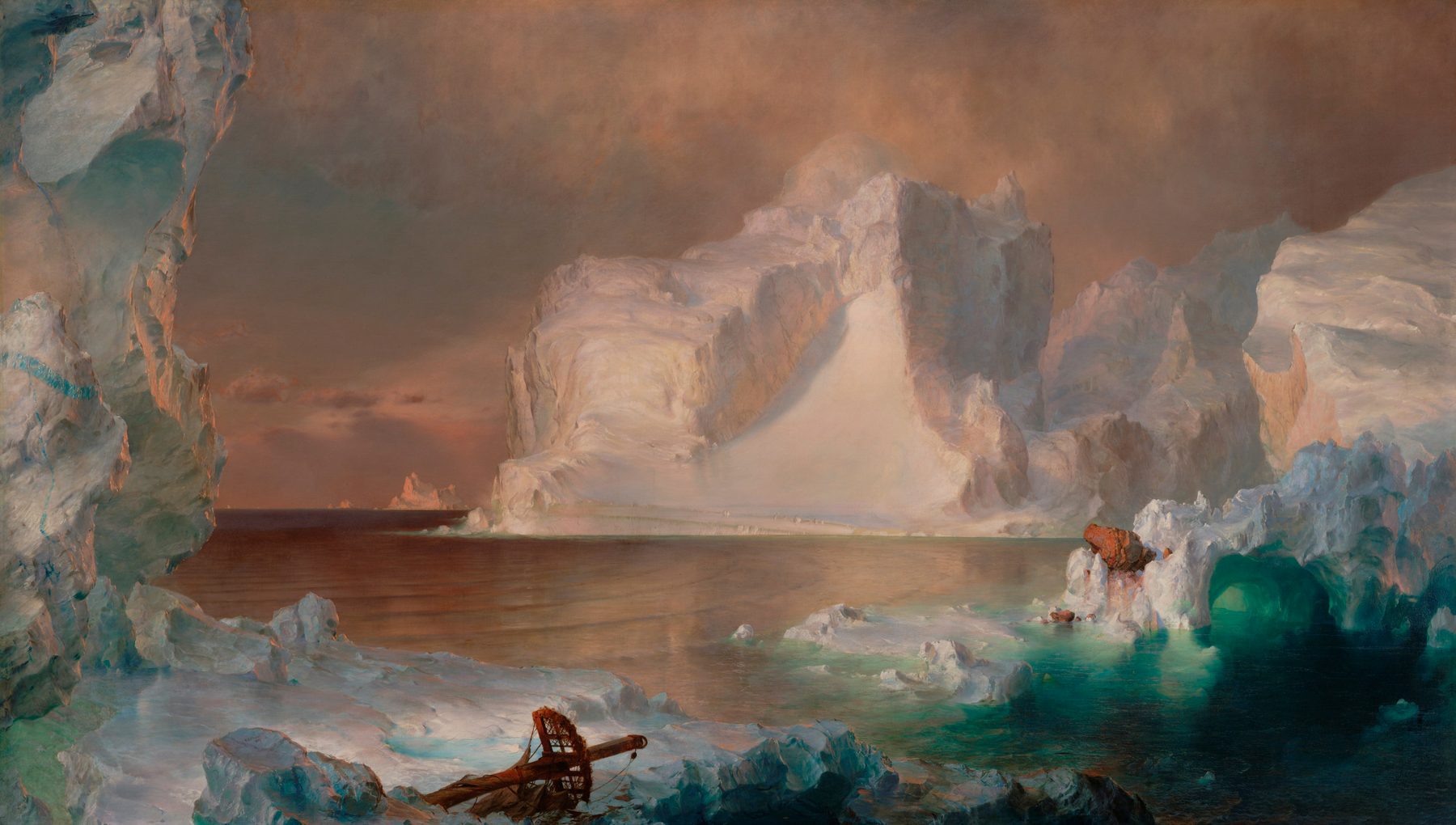
Church's travels also reached the North Atlantic, Mediterranean and Middle East. His Arctic pictures drew on the expedition of Isaac Israel Hayes, scientific debate and public fascination with perilous exploration. In Aurora Borealis, a trapped ship rests beneath electrically charged ribbons of light. Made during the Civil War, the painting has been interpreted through national crisis and hope, but its meanings remain suggestive rather than reducible to a political code.[30]
At Olana, Church designed a house, studio, road system and working landscape overlooking the Hudson. The views were deliberately composed through planting, clearing and movement. Olana demonstrates that preservation and design were not opposites: a landscape artist could make a three-dimensional environment in which agriculture, architecture, travel, collecting and scenic attention met.[25]
Follow the movement through four stages
–1848
Cole, wilderness and national ambition
Thomas Cole’s Catskill and Hudson Valley pictures establish a new professional and imaginative language for American landscape.
–1861
Networks, science and public spectacle
Durand, Church and their peers combine close observation, travel and ambitious exhibition strategies with increasingly expansive views.
–1875
Civil War, radiant light and the pictured West
Landscape absorbs the pressures of war and continental expansion while artists pursue atmospheric calm, sublime scale and western subjects.
–1900
Later careers, conservation and revision
Later landscapes carry the school’s visual habits forward as taste shifts and the environmental and political costs of expansion become harder to ignore.
The landscape as public spectacle
Church and Bierstadt became famous through the “great picture”, a single monumental canvas presented with the machinery of theatre. Curtains, darkened rooms, controlled illumination, printed guides and admission charges intensified the illusion that a wall had opened. The event transformed slow looking into mass culture.[27]
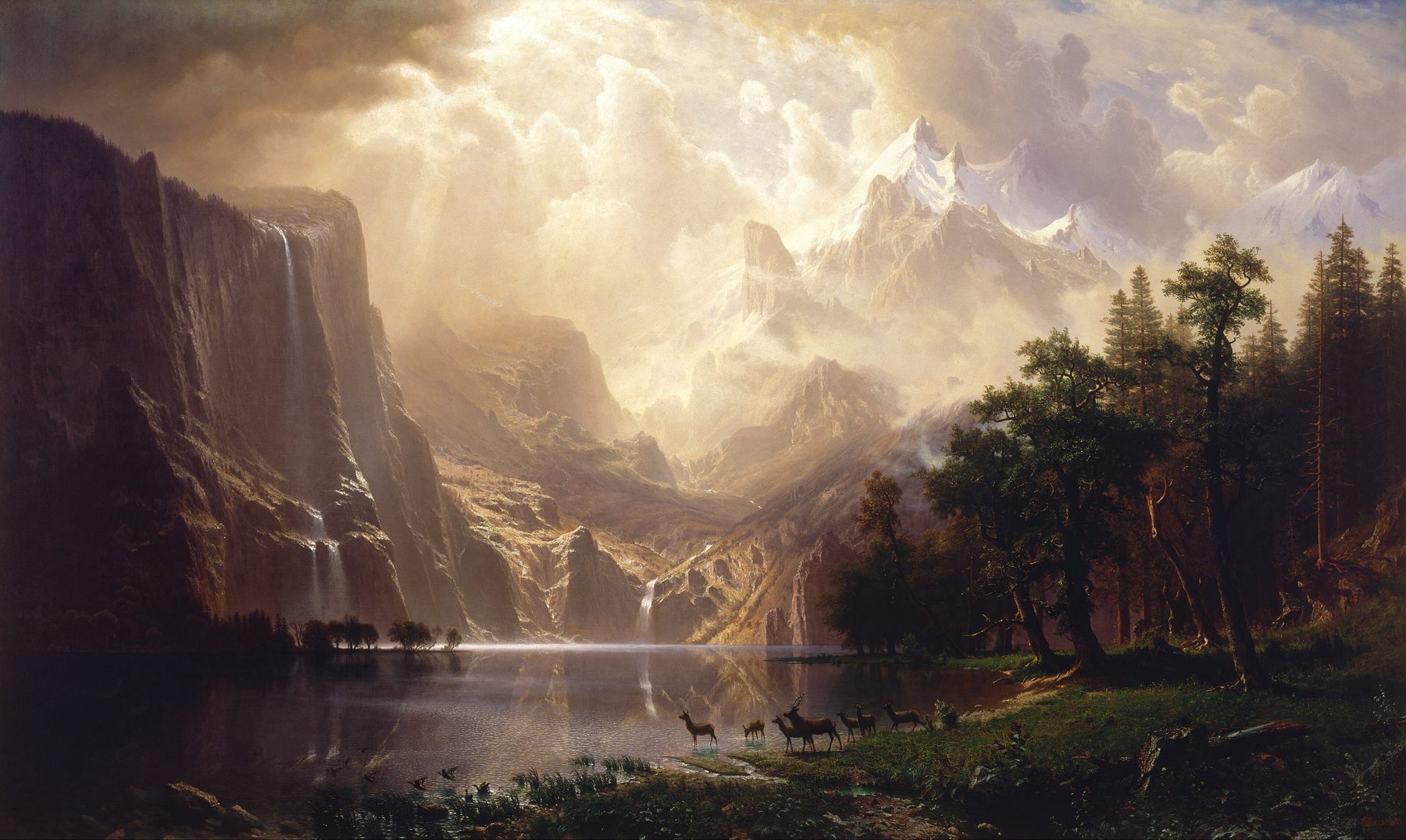
Church's Twilight in the Wilderness was shown on its own in 1860. Its fierce red-orange clouds and darkened land made sunset feel apocalyptic even though the picture contains no narrative action.[31] Bierstadt used related strategies for western panoramas. Among the Sierra Nevada, California was painted in Rome, exhibited in Berlin and London and later shown in the United States. Its international route complicates any idea that the national landscape was made only for domestic viewers.[36]
Spectacle does not invalidate observation. It reveals that visual truth was also produced by framing, scale, publicity and expectation. Viewers paid not simply to learn what the Andes or Sierra Nevada looked like, but to feel that they had travelled, discovered and possessed them through sight.
Landscape through Civil War
The Civil War disrupted the nation whose destiny landscape painting had often celebrated. Artists served, travelled, raised funds and responded to wartime imagery, yet many continued to paint places without soldiers or battles. Absence did not make landscape politically empty. Weather, damaged trees, divided spaces and uncertain horizons could resonate with contemporary crisis.[32]
Church's pictures attracted especially intense interpretation. Our Banner in the Sky converts a sunset into the Union flag; there the patriotic symbolism is explicit. Aurora Borealis and Twilight in the Wilderness are less determinate. Their ominous colour and threatened light were experienced by viewers who knew sectional conflict, Arctic failure and national anxiety, but no single allegorical key should be imposed on every cloud.[30] [31]
The Sanitary Fair of 1864 displayed art to raise funds for Union medical relief, embedding landscape within civic action and wartime philanthropy.[27] At the same time, the genre's national claims had to confront a fundamental question: what did the landscape of liberty mean in a republic built with slavery and governed by racial exclusion?
The war did not bring a clean stylistic break. It changed the pressures under which familiar forms were seen. A peaceful river, western valley or recovering woodland could imply mourning, reunion, escape or renewed possession according to artist, audience and context.
Quiet light and the later idea of Luminism
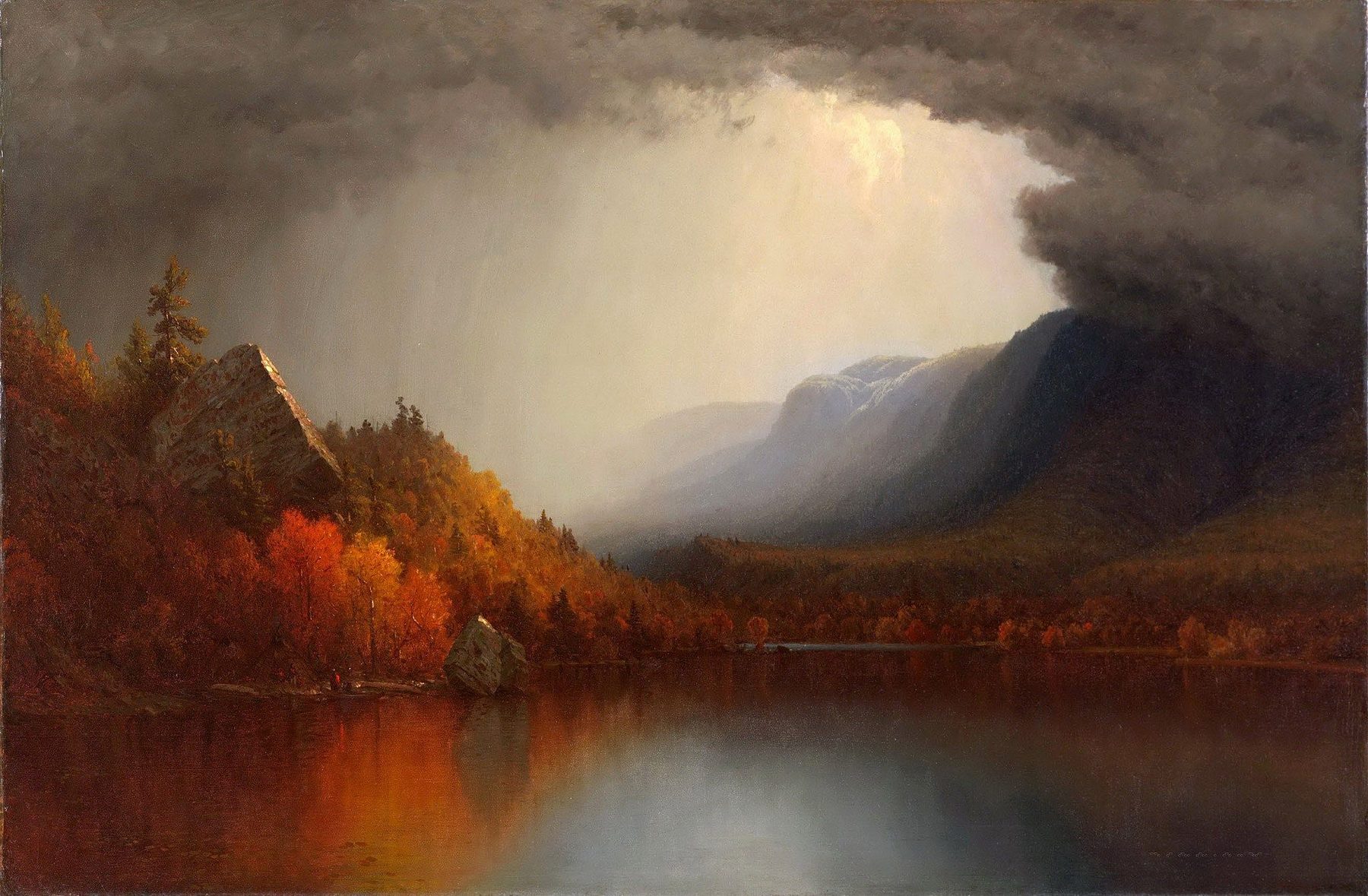
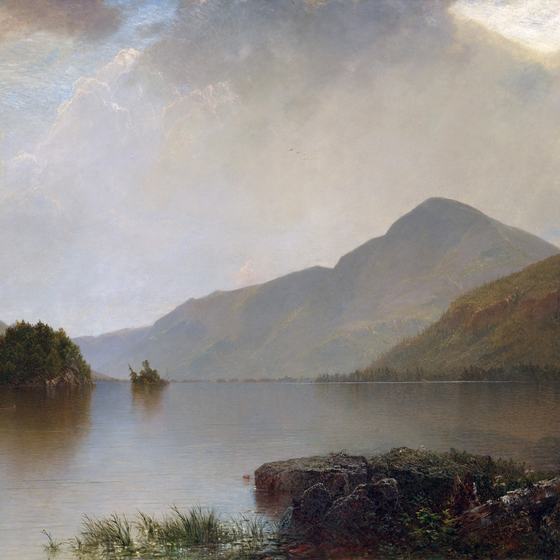
Some mid-century American landscapes turn away from storm and vertiginous depth toward still water, open horizons and lucid, evenly distributed light. John Frederick Kensett's late coastal scenes, Fitz Henry Lane's harbours, Martin Johnson Heade's marshes and works by Sanford Gifford have often been grouped under “Luminism”.[23]
The term is useful if treated as a later critical tool, not a movement the artists joined. It identifies tendencies: calm geometry, restrained anecdote, atmospheric precision, reflective surfaces and brushwork that may be difficult to see. It does not describe every work by the artists associated with it, nor does it map perfectly onto the Hudson River School.
Gifford, for example, travelled widely and could organise an entire scene around haze or golden light, making atmosphere a vehicle of memory.[22] Kensett's simplification can feel almost modern, yet its measured silence arose within nineteenth-century habits of sketching, patronage and retreat. Heade's relation to Church and the larger circle was close, but his marshes, hummingbirds and tropical subjects resist a single school identity.[24]
“Luminism” is therefore best used to sharpen looking. Does light describe objects, dissolve them or hold them in equilibrium? Does stillness feel devotional, scientific, commercial or psychologically withdrawn? The answers vary from picture to picture.
Women who reframed the landscape
The familiar history of the Hudson River School was constructed around male academicians, large canvases and well-documented patrons. Women painted the same mountains, travelled demanding routes, exhibited publicly, taught pupils and sold work, but faced unequal access to training, clubs, studios, critical attention and collections. Their relative absence from older surveys records institutional choices rather than lack of participation.
Recent research at the Thomas Cole National Historic Site has identified more than fifty women connected to nineteenth-century American landscape practice. Susie M. Barstow, Julie Hart Beers, Fidelia Bridges, Charlotte Coman, Eliza Greatorex, Mary Josephine Walters and Laura Woodward are among those who alter the field's shape.[46] [47]
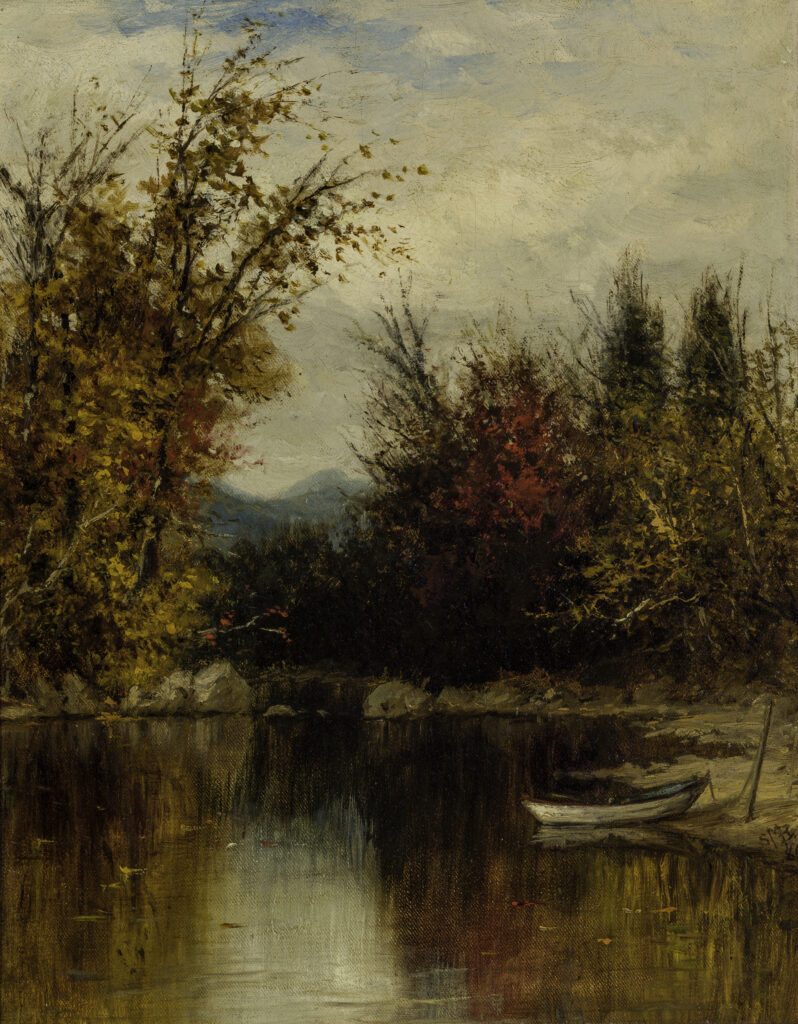
Barstow is especially revealing. She undertook strenuous sketching excursions, exhibited at the National Academy of Design and developed landscapes in the generation after the Civil War. Some of her finished pictures are smaller than the public spectacles of Church or Bierstadt, suited to parlour markets and accessible exhibition contexts. That difference should not be mistaken for diminished seriousness.[48]
Women also navigated social expectations around travel. A sketching expedition that enhanced a man's professional identity could be considered improper or unsafe for a woman. Family networks, women-led classes and group travel could create alternatives. Botanical study and watercolour sometimes offered routes into artistic authority while being dismissed as genteel accomplishments.
Restoring these artists does more than expand a list. It changes the questions asked of scale, medium, market and mobility. At the same time, calling every nineteenth-century woman landscape painter a Hudson River School member would conceal differences and create a retrospective equality that did not exist. Inclusion must preserve the history of exclusion.
Duncanson, freedom and the boundaries of the school
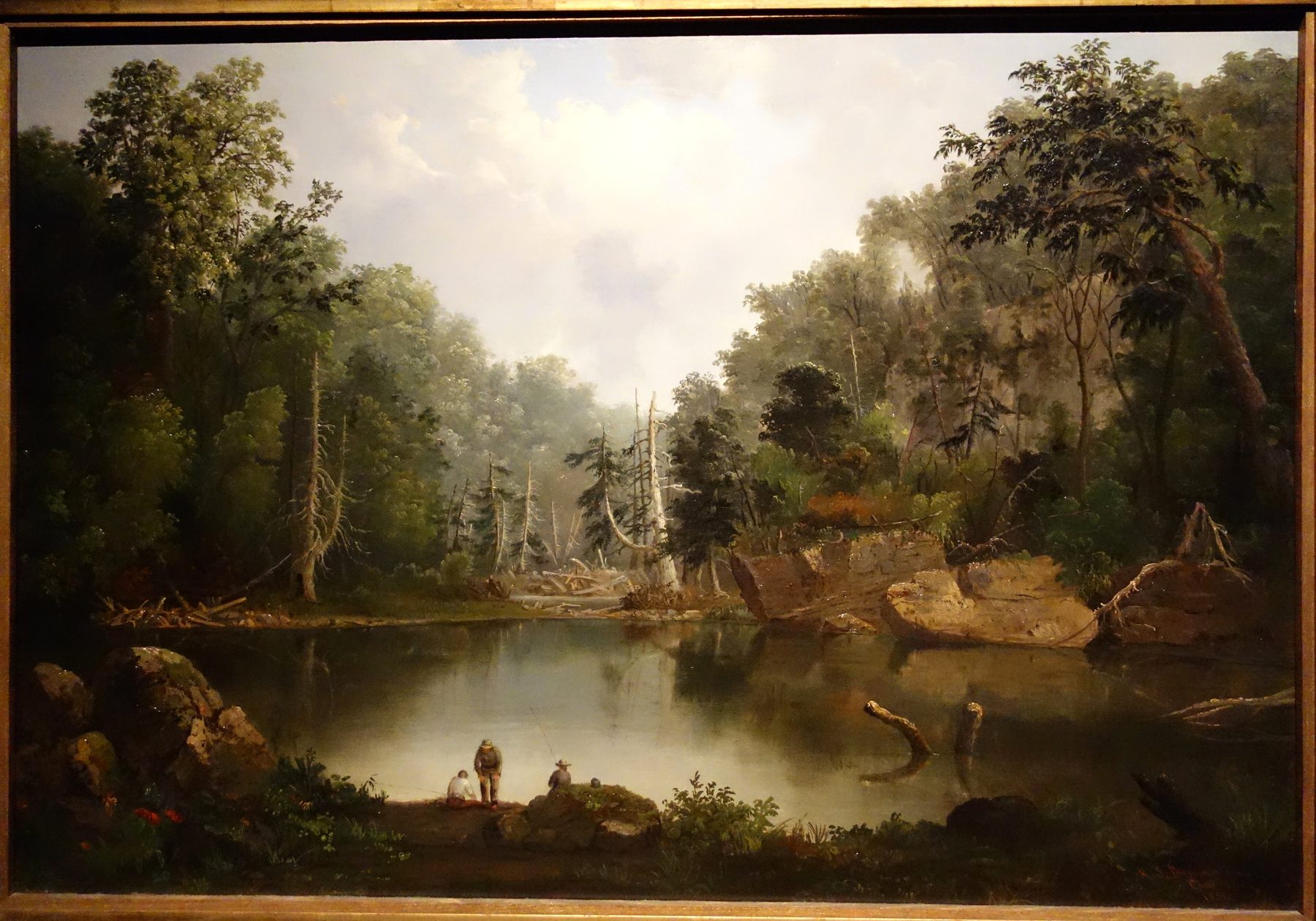
Robert S. Duncanson became one of the most internationally successful African American painters of the nineteenth century. Based for much of his career in Cincinnati, he developed ambitious landscapes, travelled in Europe and Canada and received important commissions. His career demonstrates that the Hudson River School was never only a white New York story, even if racism shaped its institutions and later canon.[49]
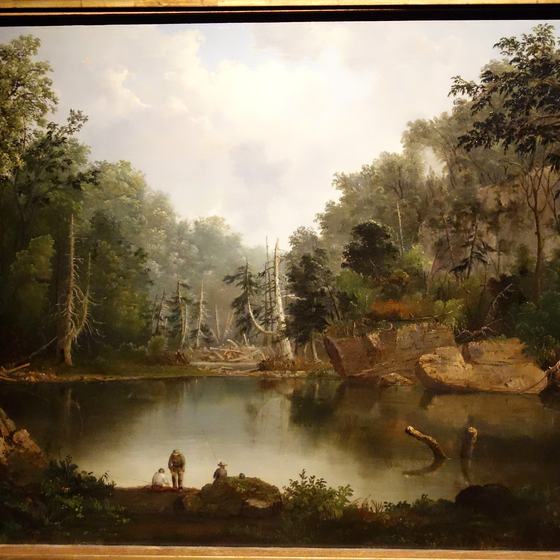
Duncanson worked in a state governed by restrictive Black Laws and within a city active in both abolitionism and racial violence. He associated with abolitionist networks and collaborated with the photographer James Presley Ball, but it would be reductive to treat every landscape as a coded political statement. His pastoral structure, colour, atmosphere and handling deserve the same formal attention given to Cole or Durand.[51] [54]
The suite of murals commissioned for Nicholas Longworth's Cincinnati home around 1850 is a landmark of American decorative painting. Imaginary landscapes transform an interior into a continuous world of water, vegetation and architectural distance.[50] New archival research cautions against assuming that Longworth's support made him an abolitionist. Patronage could cross political difference and should not be used to sanitise a commissioner's record.[52]
In Landscape with Rainbow, ordered trees and water lead toward radiant distance. A rainbow promises change without defining what kind. Its meaning becomes richer, not narrower, when seen beside Duncanson's life before and after the Civil War, his professional self-fashioning and his movement across borders.[53]
Whether Duncanson is placed inside the Hudson River School, beside it or within a broader American landscape tradition depends partly on how the category is drawn. That uncertainty exposes the New York bias of the conventional story and makes the category more historically useful.
Bierstadt and the pictured West
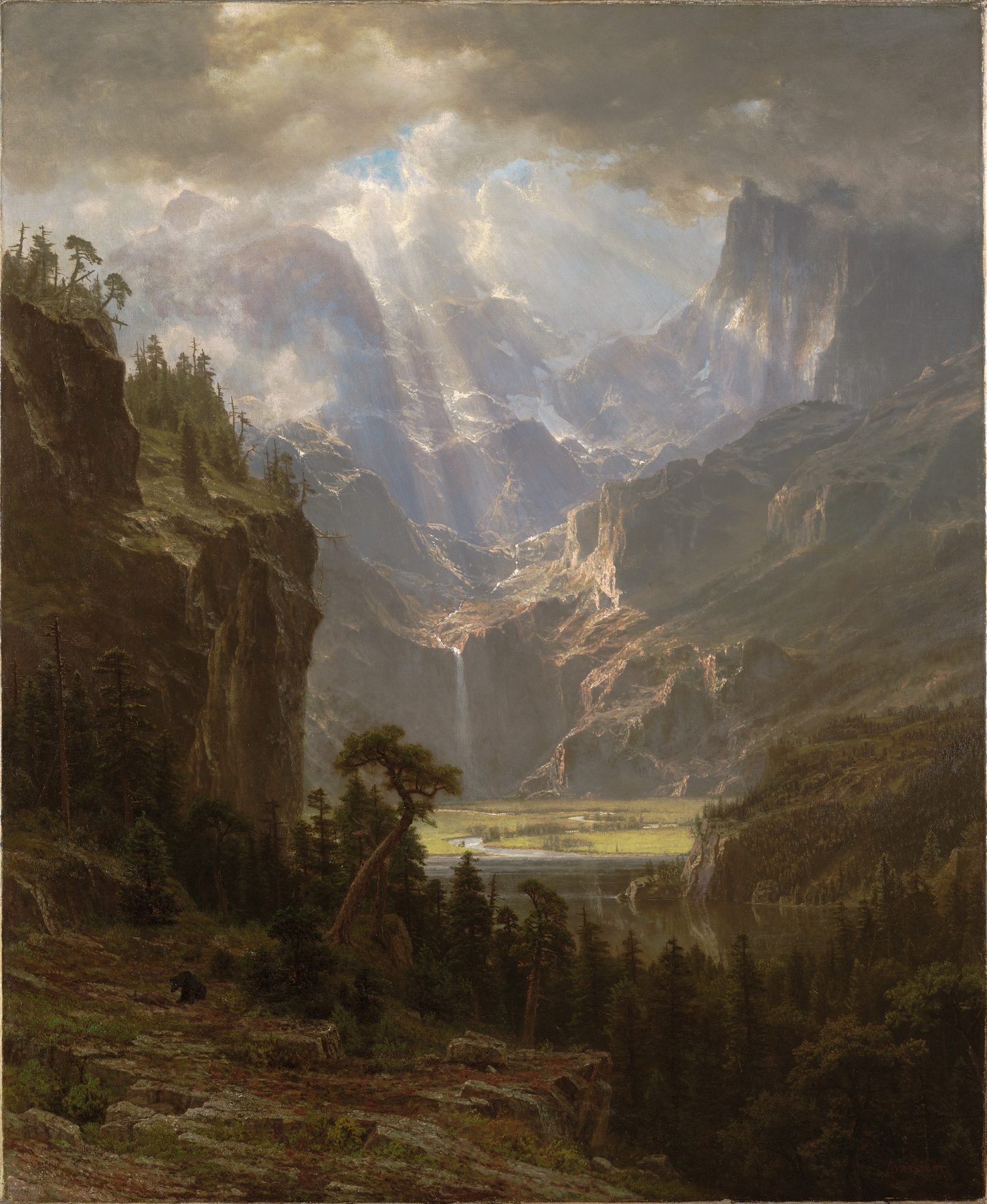
Albert Bierstadt travelled west with Frederick W. Lander's 1859 survey expedition, producing drawings, oil studies and observations that he later transformed into large studio paintings. His Düsseldorf training supported crisp detail and elaborate composition; his marketing turned western scenery into an international spectacle.[33] [34] [37]
The Rocky Mountains, Lander's Peak presents shining peaks above a lake and a Shoshone encampment. Bierstadt based Native figures on studies made during his journey, but the finished painting is an ideal construction made in New York. The village appears integrated into a timeless natural order while the expedition, survey and settlement pressures that enabled the picture remain outside the scene.[33] [35]
This is not simple absence: Shoshone people are visibly present. Yet their placement can still support a settler fantasy in which Indigenous life belongs to a picturesque past and the land awaits a different future. Kay WalkingStick's contemporary reading calls attention to the composite nature of the view and to the destruction of bison on which Plains life depended.[16]
Bierstadt's western works offered eastern and European audiences an experience of abundance, scale and apparently limitless possibility. Among the Sierra Nevada, California was painted in Rome and toured abroad before its American acquisition. The painting's glowing valley, waterfall and animal life convert geographic information into invitation.[36]
His Yosemite pictures could encourage concern for spectacular scenery, but often minimise Ahwahneechee ties to the valley.[38] The artist's achievement and the political work of the images cannot be separated. Their astonishing light makes possession feel like revelation.
Moran, surveys and national parks
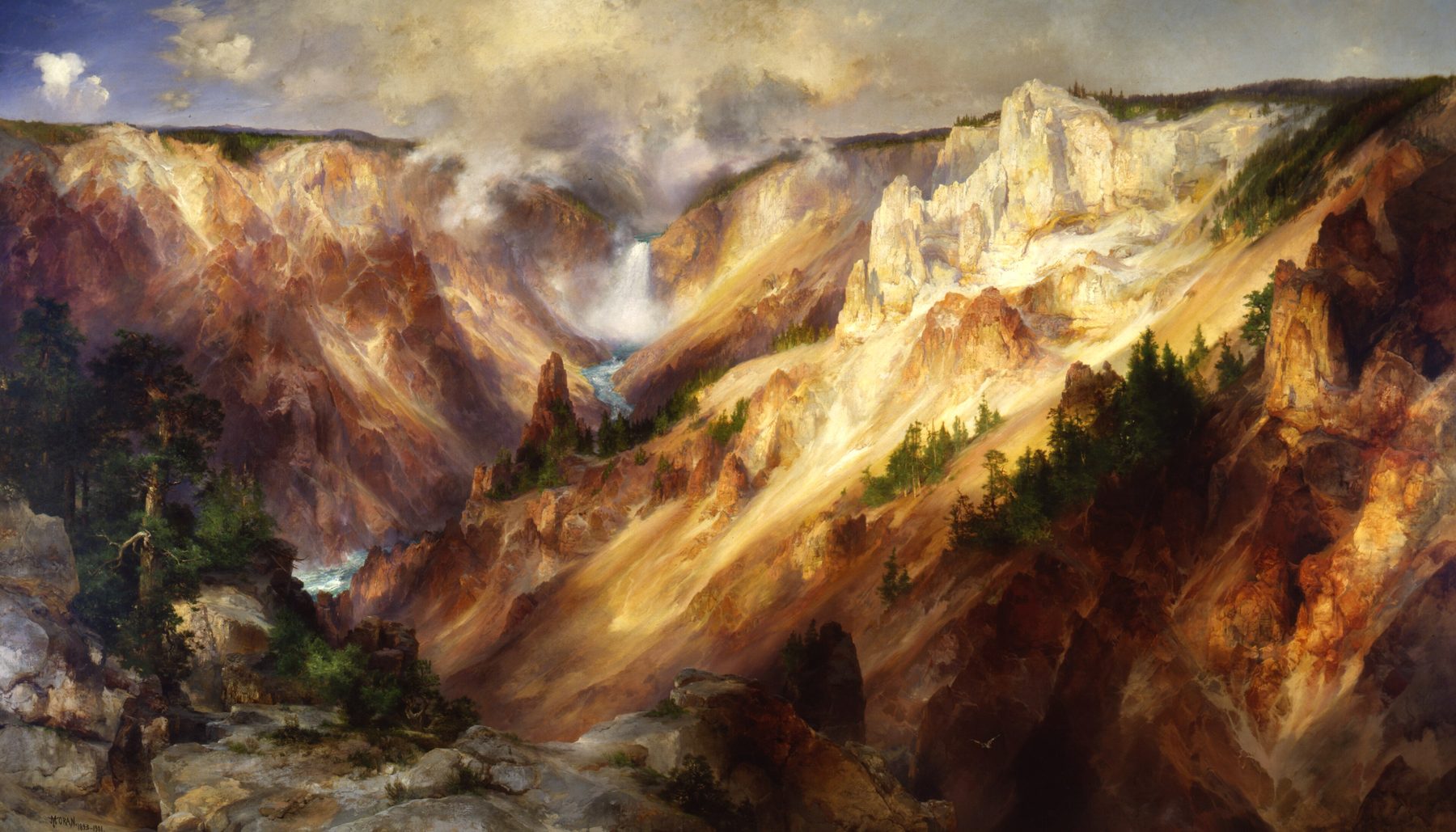
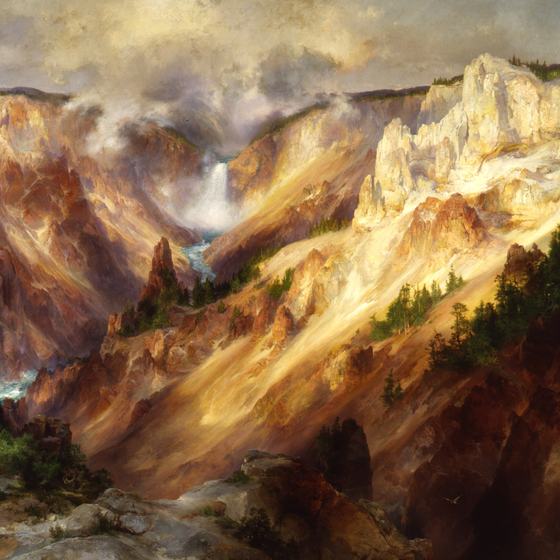
Thomas Moran joined Ferdinand V. Hayden's United States Geological Survey expedition to Yellowstone in 1871. The journey was supported in part by interests connected with the Northern Pacific Railroad, which expected tourism and development to follow western knowledge. Moran made watercolours and sketches; photographer William Henry Jackson produced images through a different medium. Together with maps, specimens and reports, their work helped eastern lawmakers imagine a region few had seen.[41] [42]
When Congress established Yellowstone National Park in 1872, visual evidence contributed to the debate. It is often said that Moran's paintings created the park. That compresses a collective political, scientific and promotional process into a heroic art story. The monumental canvases for which he became famous were produced after the expedition and continued to shape the park's public image.[45]
Moran did not always paint untouched sites. The Cliffs of Green River presents fantastic geological towers under shifting light, yet the location was near a railway junction and settlement. He repeatedly omitted the town and tracks, turning an accessible industrial corridor into a timeless western vision.[44]
Yellowstone itself was not empty. At least 27 tribes have historical and continuing associations with the region. The Tukudika, or Sheep Eaters, lived within the high country, while other nations hunted, travelled, traded and maintained spiritual relationships there. Park creation was followed by restrictions and removal, including policies that tried to make permanent Native presence disappear from the preserved landscape.[41] [43]
Moran's art therefore belongs to both conservation and expansion. Survey science, railroad promotion, federal power and aesthetic wonder moved together. His pictures helped viewers value geothermal and geological landscapes while supporting a system that claimed authority over them.
Conservation and dispossession
Hudson River School paintings have long been credited with teaching Americans to preserve nature. The claim contains truth. Cole protested deforestation; Church shaped and protected Olana's views; Bierstadt and Moran made distant scenery emotionally urgent. Their images supplied a public vocabulary for grandeur worth saving.
But scenic conservation did not protect all relationships to land. Yosemite has more than eight thousand years of human history. Ahwahneechee and other Native communities used fire, gathered plants, hunted, traded and made homes in the valley. The Mariposa Battalion entered in 1851, attacked communities and attempted removal. Later tourism and park management restricted Indigenous livelihoods even as officials marketed the valley as pristine.[39] [40]
The same paradox appears at Yellowstone. Federal designation restrained some private exploitation while asserting national control over Indigenous homelands. The park ideal could protect waterfalls, forests and animals by imagining nature as a domain from which human history had been removed.[41]
This does not mean conservation was fraudulent or beauty merely propaganda. It means preservation had beneficiaries, boundaries and costs. A painting can inspire environmental responsibility while carrying a colonial definition of wilderness. Recognising both effects gives present-day viewers a more demanding inheritance.
The question extends to eastern scenery. Mohican and Lenape histories do not vanish when a riverbank becomes a tourist destination or protected view. Conservation becomes more complete when it includes living communities, cultural knowledge and land practices rather than only the appearance of unpeopled nature.
Artists to know
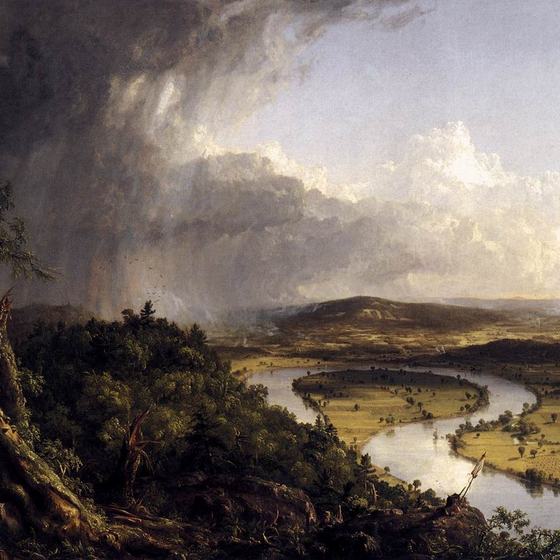
Thomas Cole
Cole established landscape as a vehicle for national, religious and historical thought. His best work moves between direct observation and allegory, celebrating scenery while warning against ecological and imperial arrogance.[7] [10]
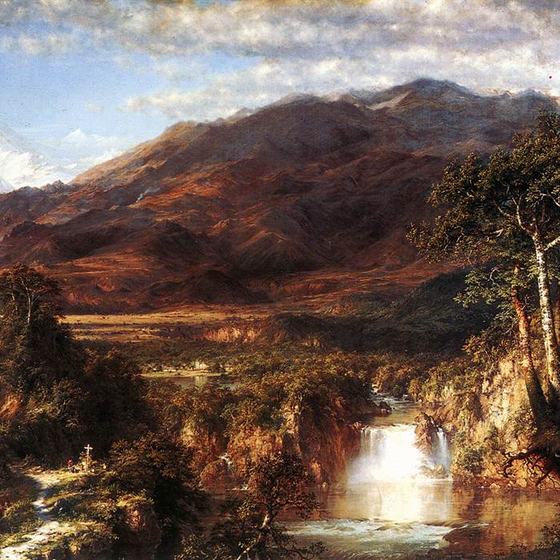
Frederic Edwin Church
Church expanded Cole's legacy across the globe. Humboldtian science, travel, Christian imagery, showmanship and minute visual description converge in paintings of the Andes, Arctic, Mediterranean and Hudson Valley.[26] [29]
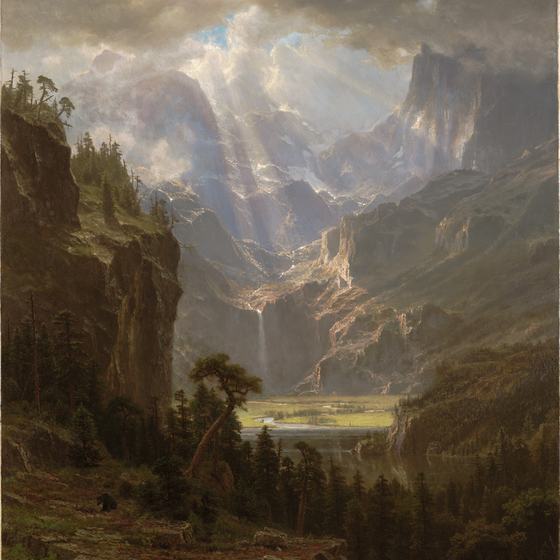
Albert Bierstadt
Bierstadt made the western panorama a major public spectacle. His paintings unite expedition evidence, Düsseldorf technique and studio invention while revealing how Manifest Destiny could be naturalised through beauty.[33] [36]
Thomas Moran
Moran translated survey experience into enduring images of Yellowstone and the West. His art helped build support for preservation while participating in railroad expansion and federal possession.[41] [45]
Further artists
Sanford Robinson Gifford
Gifford made atmosphere an organising force. His Hudson, mountain, European and Middle Eastern scenes often dissolve geography into luminous memory without losing the structure of observed place.[22]
John Frederick Kensett
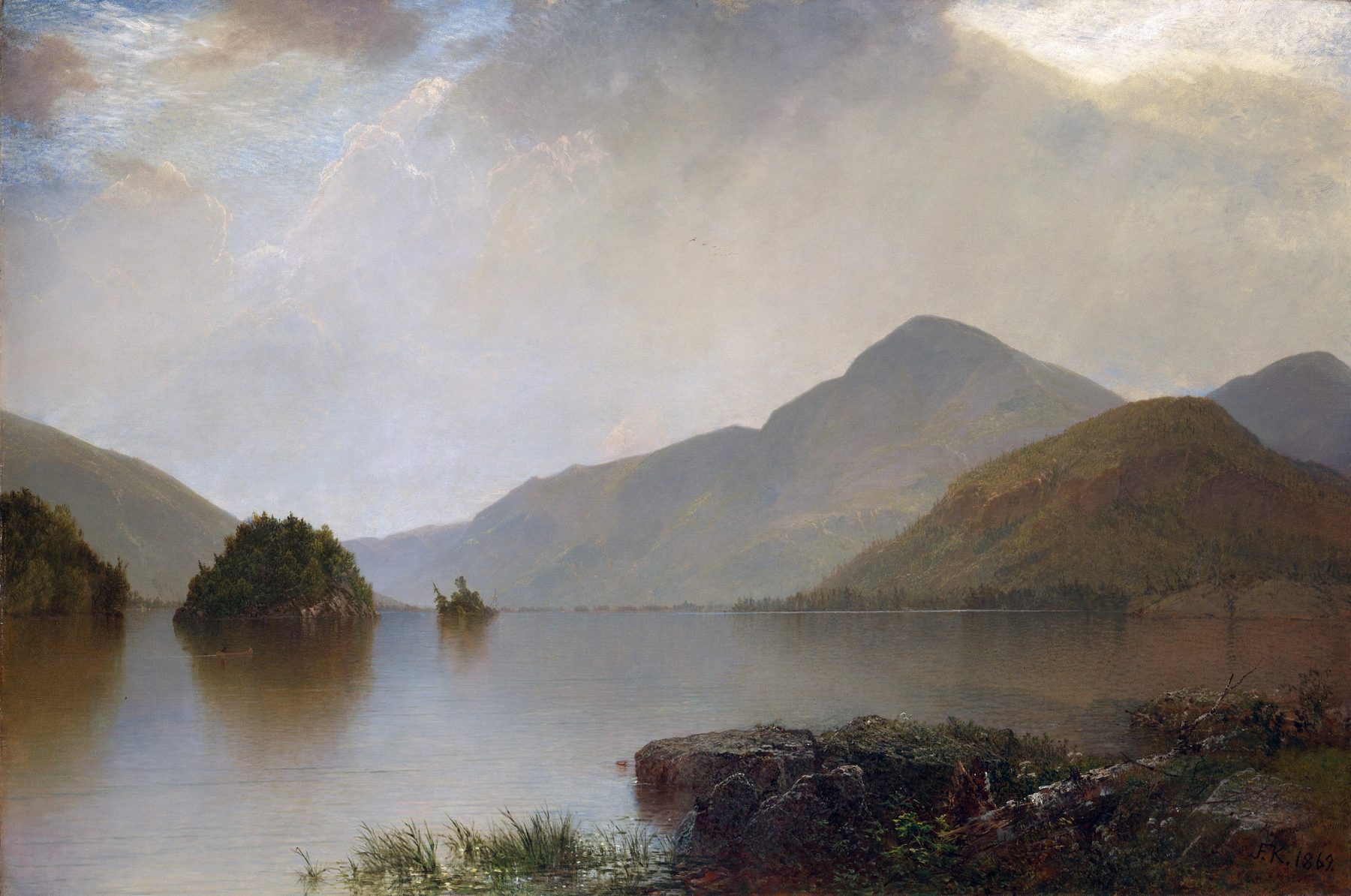
Kensett moved from detailed panoramic scenery toward late coastal pictures of remarkable restraint. His relation to “Luminism” is useful, provided the later term does not replace close attention to individual works.[23]
Jasper Francis Cropsey
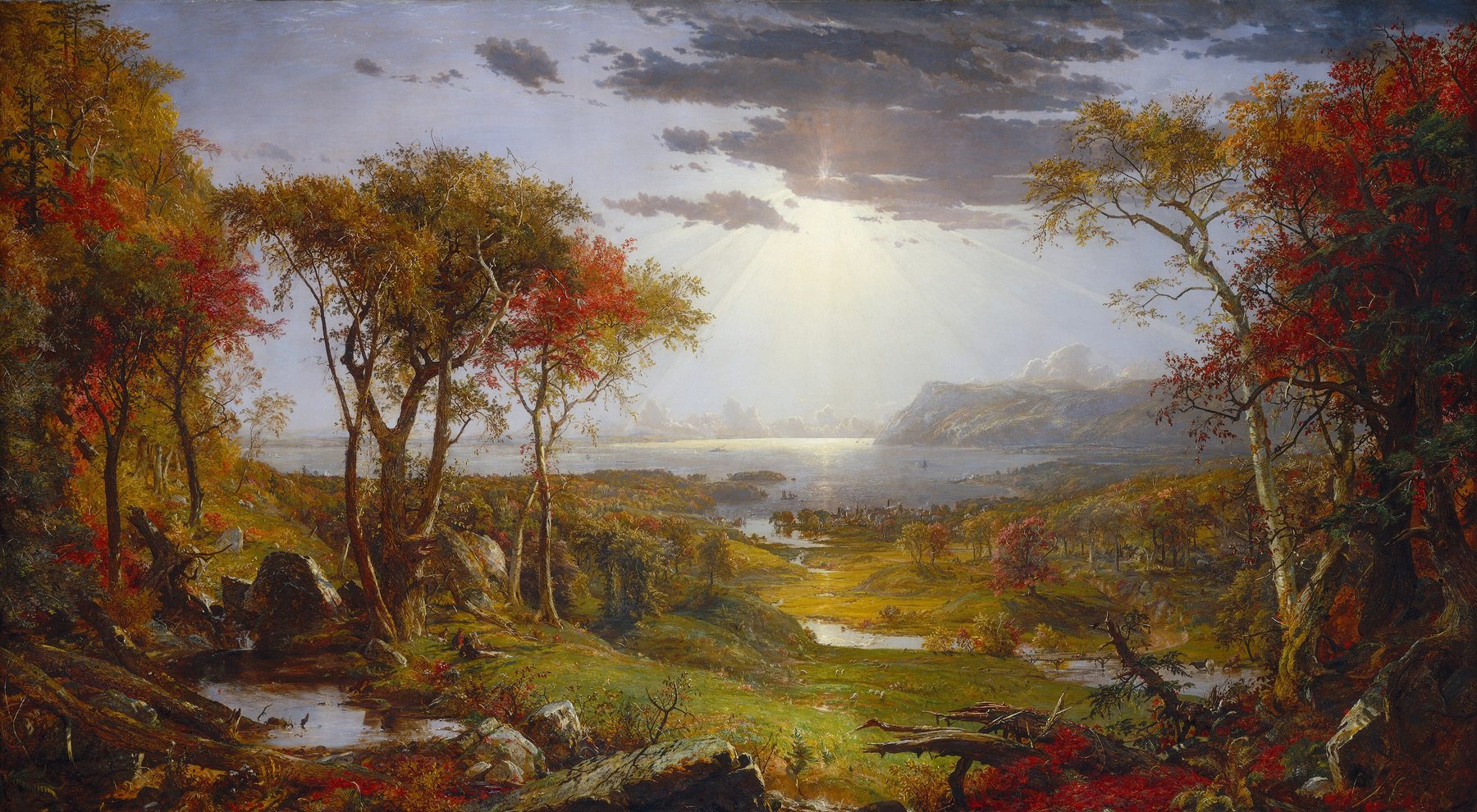
Cropsey became famous for autumn colour, using brilliant foliage to make the American season a national subject. His panoramas also contain farms, settlements and transport, bringing pastoral order into the spectacle of nature.[1]
Susie M. Barstow
Barstow combined serious outdoor travel with a professional exhibition career. Her recovery challenges histories that equated the movement with monumental canvases by male National Academicians.[46] [48]
Major artists directory
| Name | Nationality | Key Works |
|---|---|---|
| Albert Bierstadt | American | The Rocky Mountains, Lander’s Peak, Among the Sierra Nevada, California |
| Asher B. Durand | American | Kindred Spirits |
| Frederic Edwin Church | American | The Heart of the Andes, The Icebergs |
| Jasper Francis Cropsey | American | Autumn—On the Hudson River |
| John Frederick Kensett | American | Lake George |
| Robert S. Duncanson | American | Blue Hole, Flood Waters, Little Miami River |
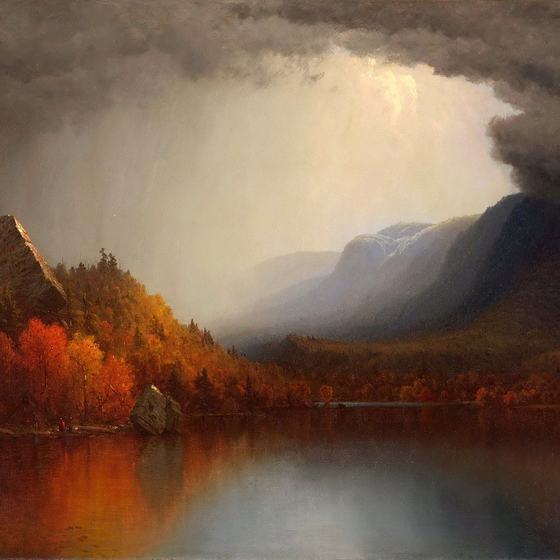
| Sanford Robinson Gifford | American | A Coming Storm |
| Susie M. Barstow | American | Early October near Lake Squam |
| Thomas Cole | British-American | The Oxbow, The Course of Empire: Desolation |
| Thomas Moran | American | The Grand Canyon of the Yellowstone |
How to look at a Hudson River School painting
Begin with scale. Does the painting ask for close domestic attention, or does it try to surround the body like a stage? Size often determines how detail works. In a cabinet picture, a branch can feel intimate; in a “great picture”, tiny trees become evidence of immense distance.
Next find the route through the scene. A river, path, waterfall, opening in trees or chain of highlights may carry the eye from foreground to horizon. The route can resemble travel itself, converting looking into exploration. Notice whether access feels easy, arduous or impossible.
Study the weather. Hudson River School space is often organised by a storm passing, mist lifting, sunset fading or light breaking through cloud. Weather marks time and makes landscape unstable. It can also carry emotion without forming a fixed symbol.
Look for human scale. Figures may be almost invisible: a hunter, tourist, farmer, Native family, boatman or artist. Their smallness can express humility before creation, but it may also make labour and habitation seem incidental. Ask who is represented as belonging and who appears only as picturesque evidence.
Read the edges and omissions. Is there a stump, fence, railway, smoke plume, road or hotel? Does a title call a view “wilderness” even though it was reached by steamboat? What might lie outside the frame? Such questions do not expose a painting as false; they reveal its construction.
Compare foreground and distance. Rough bark and identifiable plants can establish credibility, while a luminous horizon promises unity or transcendence. Church and Bierstadt often use accumulated detail to make an invented whole feel witnessed. Kensett may simplify the same relation until light and space approach abstraction.
Finally, distinguish the historical view from your own. A nineteenth-century collector might see providence, national expansion, scientific knowledge or desirable property. An Indigenous viewer may recognise homeland and removal. A present-day environmental reading may notice extraction or climate. The painting can hold these encounters without becoming an empty surface onto which anything can be projected; evidence from object, place and history still matters.
Decline, revival and legacy
The Hudson River School's decline began around the 1876 Centennial rather than on a single date. American collectors increasingly looked to France; figure painting gained prestige; the softer Barbizon landscape associated with George Inness offered intimacy and mood in place of monumental scenic declaration. Critics used the school label to dismiss an art they considered theatrical, repetitive or provincial.[2] [3]
The painters did not stop. Church developed Olana and continued working despite illness; Bierstadt sought new audiences; Moran carried western subjects into the twentieth century. Yet by the deaths of Church in 1900 and Bierstadt in 1902, their former fame had sharply faded.[2]
Museum collecting and scholarship revived the tradition during the twentieth century. That recovery first celebrated a national landscape canon, then widened to address ecology, tourism, gender, race and settler colonialism. Current exhibitions include women and Duncanson, while Indigenous interpreters challenge the fiction that sublime land was uninhabited.[5] [6] [16]
The legacy is therefore double. These painters gave American landscape an ambitious visual language and taught generations to value scenery. They also helped beauty perform cultural possession. Their work remains alive because the tension cannot be solved by admiration or condemnation alone.
Frequently Asked Questions
The name refers to the Hudson Valley subjects and New York centre of a loose landscape network. It was coined in the 1870s, often by critics who thought the tradition old-fashioned. The artists did not establish a school under that name, and many of their most important pictures represent places far beyond the Hudson.[1] [2]
About 1825–1875 is a useful core. Cole's 1825 Hudson and Catskill trip marks the beginning of his public success, while taste shifted around the 1876 Centennial. These are not hard boundaries: formative landscape painting came earlier, and Bierstadt, Moran, Church and others continued afterwards.[2] [4]
Usually not in the manner of a topographic record. They sketched outdoors and could study plants, rocks, clouds and light closely, but finished pictures were studio constructions. Artists combined viewpoints, adjusted scale, changed weather and selected details to create a coherent visual and intellectual experience.[18] [22]
No. Luminism is a later critical term applied to some especially still, lucid and light-filled American landscapes made around the middle of the century. It overlaps with the Hudson River School and includes artists often associated with it, but it was not a contemporary organisation and does not describe the full range of their work.[23]
Yes, although older accounts frequently omitted them. Artists now receiving sustained study include Susie M. Barstow, Julie Hart Beers and Laura Woodward, alongside many others who painted and exhibited nineteenth-century landscape. Unequal training, travel, club access, criticism and collecting affected both their careers and later visibility.[46] [47]
They contributed to public interest, but no single painting created Yellowstone or Yosemite. Survey reports, photographs, lobbying, railroad interests, legislation and many kinds of evidence were involved. Park narratives must also include Indigenous peoples whose homelands were brought under federal control and whose land use was restricted.[39] [41]
Not as decorative signs of a disappearing past. The Hudson Valley, Delaware Water Gap, Yosemite, Yellowstone and western mountain regions are living Indigenous homelands. A painting may include Native figures while still supporting a story of land open to settlement. Named contemporary Indigenous interpretations help viewers recover relationships and histories excluded by the wilderness ideal.[16]
After the Civil War and especially around the Centennial, collectors and critics increasingly favoured French art, figure painting and more intimate Barbizon-influenced landscapes. Monumental scenery came to seem theatrical or provincial. The decline was gradual, and twentieth-century museums and scholars later restored the school's visibility.[2] [3]
Discussion
When a landscape presents itself as timeless nature, which details tell you that it is also a historical place? Consider roads, stumps, buildings, figures, titles and what may lie beyond the frame. Does knowing the histories of tourism, extraction or Indigenous dispossession diminish the painting's beauty, or make that beauty more exact and consequential?
Reader Insights
Look for paths, stumps, farms, roads and figures before deciding that a landscape represents untouched wilderness.
Ask which observations came from travel and sketching—and which transformations occurred later in the studio.
Consider whose land is pictured, whose presence is minimised, and what national story the composition makes possible.
Join the Conversation
Which Hudson River School landscape most changes when you examine its politics as closely as its scenery? Share your view below.
References
- Hudson River School, National Gallery of Art. View Source
- The Hudson River School, Metropolitan Museum of Art. View Source
- The Hudson River School — German edition, Metropolitan Museum of Art. View Source
- The Making of the Hudson River School: The Popular Appeal of Landscape, Albany Institute of History & Art. View Source
- Hudson River School: Nature and the American Vision, Amon Carter Museum of American Art. View Source
- Poetry of Nature, New Britain Museum of American Art. View Source
- Thomas Cole (1801–1848) — German edition, Metropolitan Museum of Art. View Source
- Thomas Cole's Journey: Atlantic Crossings, Metropolitan Museum of Art. View Source
- Thomas Cole's Journey: Exhibition Galleries, Metropolitan Museum of Art. View Source
- Essay on American Scenery, Thomas Cole. View Source
- Primary Sources, Thomas Cole National Historic Site. View Source
- The Changing Landscape, Thomas Cole National Historic Site. View Source
- View from Mount Holyoke…—The Oxbow — French edition, Metropolitan Museum of Art. View Source
- The Oxbow by Thomas Cole, Metropolitan Museum Journal. View Source
- Thomas Cole: The Voyage of Life, National Gallery of Art. View Source
- Native Perspectives, Metropolitan Museum of Art. View Source
- Asher Brown Durand (1796–1886) — French edition, Metropolitan Museum of Art. View Source
- Sketch from Nature, Metropolitan Museum of Art. View Source
- Kindred Spirits — Spanish edition, Crystal Bridges Museum of American Art. View Source
- Pastoral Landscape, National Gallery of Art. View Source
- The Diaries of Jervis McEntee, Archives of American Art. View Source
- Hudson River School Visions: The Landscapes of Sanford R. Gifford, Metropolitan Museum of Art. View Source
- American Light: The Luminist Movement, 1850–1875, National Gallery of Art. View Source
- Church's Art, Olana State Historic Site. View Source
- Church's World, Olana State Historic Site. View Source
- The Heart of the Andes — French edition, Metropolitan Museum of Art. View Source
- Art and the Empire City, Metropolitan Museum of Art. View Source
- Paisaje sudamericano, Museo Nacional Thyssen-Bornemisza. View Source
- Frederic Edwin Church — Spanish edition, Museo Nacional Thyssen-Bornemisza. View Source
- Aurora Borealis, Smithsonian American Art Museum. View Source
- Twilight in the Wilderness, Cleveland Museum of Art. View Source
- The Civil War and American Art, Smithsonian American Art Museum. View Source
- The Rocky Mountains, Lander's Peak, Metropolitan Museum of Art. View Source
- The Rocky Mountains, Lander's Peak — German edition, Metropolitan Museum of Art. View Source
- Studies of Indian Chiefs Made at Fort Laramie, Metropolitan Museum of Art. View Source
- Among the Sierra Nevada, California, Smithsonian American Art Museum. View Source
- Albert Bierstadt — Spanish edition, Museo Nacional Thyssen-Bornemisza. View Source
- Sunrise, Yosemite Valley, Amon Carter Museum of American Art. View Source
- Yosemite Stories, National Park Service. View Source
- Archeology, National Park Service. View Source
- President Grant and the Yellowstone National Park Protection Act, National Park Service. View Source
- Thomas Moran's Diary, National Park Service. View Source
- The Tukudika Indians, National Park Service. View Source
- The Cliffs of Green River, Amon Carter Museum of American Art. View Source
- Thomas Moran, National Park Service. View Source
- Women Reframe American Landscape, Thomas Cole National Historic Site. View Source
- Women Reframe American Landscape Audio Tour, Thomas Cole National Historic Site. View Source
- Untitled landscape by Susie M. Barstow, Thomas Cole National Historic Site. View Source
- Robert S. Duncanson, Landscape, 1870, New Britain Museum of American Art. View Source
- Duncanson Murals, Taft Museum of Art. View Source
- The Power of Art and Freedom, Taft Museum of Art. View Source
- A New Look at the Longworths, Taft Museum of Art. View Source
- Landscape with Rainbow, Smithsonian American Art Museum. View Source
- Isaac Julien: Lessons of the Hour—Frederick Douglass, Smithsonian American Art Museum. View Source
- Storm King on the Hudson, Smithsonian American Art Museum. View Source
- American Landscapes, Metropolitan Museum of Art. View Source
- Image references 57–71: open-access reproductions and institutional collection records.
View 15 image sources
01 · commons.wikimedia.org02 · commons.wikimedia.org03 · commons.wikimedia.org04 · commons.wikimedia.org05 · commons.wikimedia.org06 · commons.wikimedia.org07 · commons.wikimedia.org08 · commons.wikimedia.org09 · commons.wikimedia.org10 · commons.wikimedia.org11 · commons.wikimedia.org12 · commons.wikimedia.org13 · commons.wikimedia.org14 · commons.wikimedia.org15 · commons.wikimedia.org
More ART Movements
Luminism
Tonalism
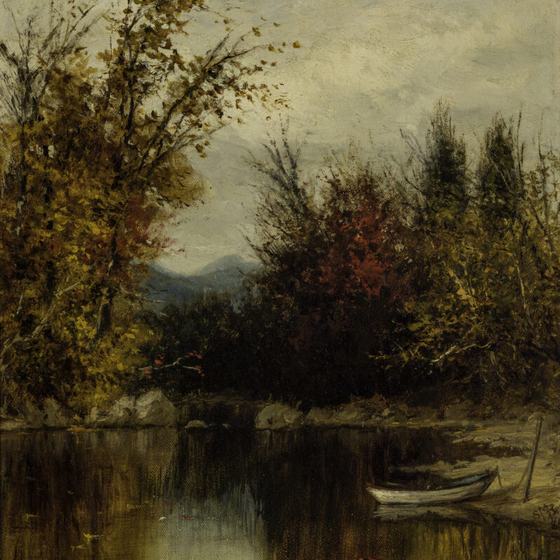
Naturalism
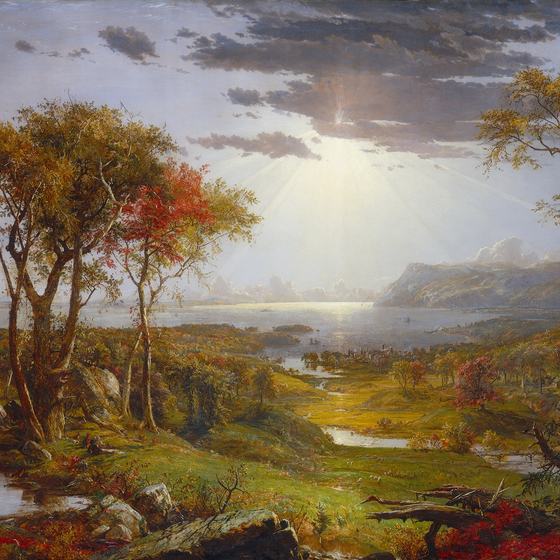
Düsseldorf School