


 by Tom Gurney
Tom Gurney BSc (Hons) is an art history expert with over 20 years experience
Email: tomgurney1@gmail.com / Phone: +44 7429 011000
Jasper Cropsey: Introduction
Jasper Francis Cropsey made landscape a meeting place for colour, architecture, travel and human activity. His autumn trees are among his most recognisable forms, but they stand within a much wider practice: woodland study, Italian coasts and ruins, English landmarks, imagined historical worlds, railway valleys and drawings on paper. The variety is easier to see when particular works are kept in view. [1] [2]
Born on Staten Island in 1823, Cropsey trained in an architectural office before developing a public career as a painter. Years in Italy and Britain extended his material and audiences, while later homes at Warwick and Hastings returned him to familiar country. His major Autumn—On the Hudson River was completed in London in 1860: an American landscape with a distinctly transatlantic history. [1]
Looking across the paintings reveals the work done by the scenery. Near trees can frame a river, a rounded mountain can gather the distance, and a railway can be absorbed into a broad autumn valley. Observation and arrangement operate together, with each landscape organising a different experience of place.
At a Glance
- Full name: Jasper Francis Cropsey
- Born: 18 February 1823, Rossville, Staten Island
- Died: 22 June 1900, Hastings-on-Hudson
- Training: Architecture and drawing in Joseph Trench’s office
- Main association: Hudson River School landscape painting
- Materials: Oil painting, drawing and watercolour
- Major international phase: London, 1856–63
- Important themes: Autumn, architecture, atmosphere and inhabited country
- Later homes: Aladdin and Ever Rest
Jasper Cropsey in context
Bars show approximate historical periods. c. means circa (about).
Hudson River School
c. 1825–1880 [15]Notes and sources
Hudson River School. Approximate context from Cole’s New York arrival to the Centennial-era decline. Kevin J. Avery, Metropolitan Museum of Art.
Each bar runs from the artist’s birth to their death.
Asher Brown Durand
1796–1886 · Birth–death [16]Thomas Cole
1801–1848 · Birth–death [17]Martin Johnson Heade
1819–1904 · Birth–death [18]Jasper Cropsey
1823–1900 · Birth–death [19]George Inness
1825–1894 · Birth–death [20]Frederic Edwin Church
1826–1900 · Birth–death [21]Notes and sources
Asher Brown Durand. Life dates from the Met’s institutional essay; calendar overlap alone does not prove collaboration. Metropolitan Museum of Art.
Thomas Cole. Life dates from the Met’s institutional essay; calendar overlap alone does not prove collaboration. Metropolitan Museum of Art.
Martin Johnson Heade. Life dates from the Met’s institutional essay; calendar overlap alone does not prove collaboration. Metropolitan Museum of Art.
Jasper Cropsey. Life dates from the Met’s institutional essay; calendar overlap alone does not prove collaboration. Metropolitan Museum of Art.
George Inness. Life dates from the Met’s institutional essay; calendar overlap alone does not prove collaboration. Metropolitan Museum of Art.
Frederic Edwin Church. Life dates from the Met’s institutional essay; calendar overlap alone does not prove collaboration. Metropolitan Museum of Art.
Contents
- Landscape with an architect’s training
- Greenwood Lake and the value of return
- Italy and a longer life for gathered material
- Imaginary history in War and Peace
- Britain as a place to paint America
- Autumn as structure, not just colour
- Railway scenery and its audiences
- Cultivation, leisure and historical memory
- Clouds and the painter’s own voice
- Annotated details
Landscape with an architect’s training
Cropsey’s early professional experience was architectural. Chotner traces a model-house diploma in 1837, followed by a five-year apprenticeship with Joseph Trench. Skill in drawing soon gave him responsibility for the office’s finished renderings, while painting developed alongside that work. [1]
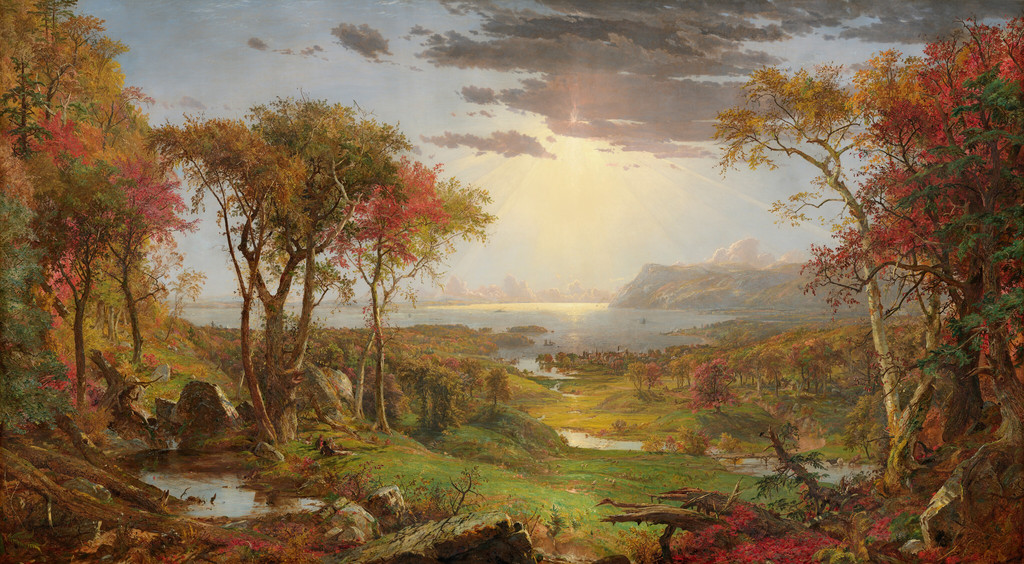
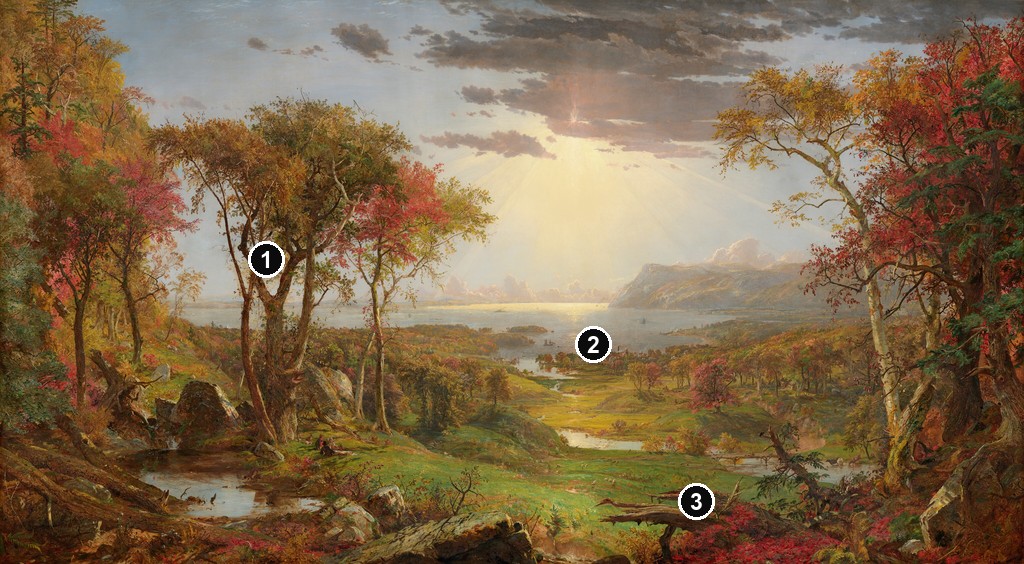
The training provides a useful question to carry into the pictures: how is a view organised? In the Hudson panorama, strong foreground trees create a place from which the eye reaches lighter water. In Warwick Castle, solid architecture gains a setting through river, reflection and foliage. Neither picture is a building plan, but both make spatial relations substantial.
Architecture also remained an actual practice. Early church commissions, later elevated railway stations and the design of working spaces belong to the life, alongside the painted buildings. The architecture article follows the projects separately, including what later surveys can establish about Ever Rest. [1]
That separation makes the connection more persuasive. An imaginary tower serves a symbolic landscape; a station has a transport function; a studio admits light for work. Cropsey’s attention to structures runs across these activities without giving them one identical purpose.
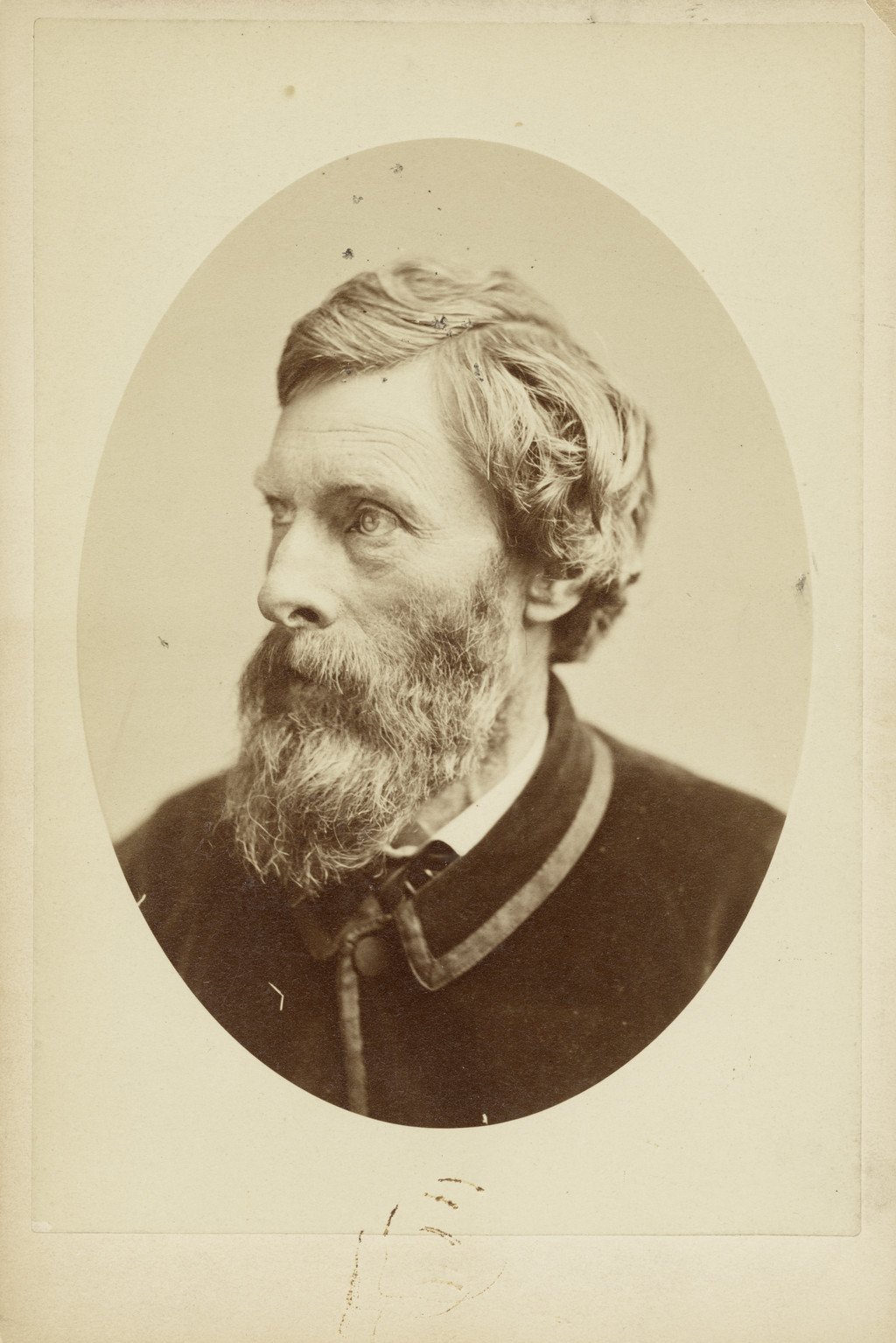
Napoleon Sarony, Jasper Francis Cropsey, about 1870. National Portrait Gallery, Smithsonian Institution, S/NPG.78.41. Original whole portrait and marked mount retained. Napoleon Sarony, ca1870 / National Portrait Gallery, Smithsonian Institution, S/NPG.78.41. Image source. Public domain. Proportionally resized only; full carrier, margins and native appearance retained.
Four stages of Jasper Cropsey’s career
These periods group related developments; painting, travel and local work overlap across their boundaries.
Architecture and the first landscapes
Staten Island beginnings, the 1837–1842 Trench apprenticeship, early church designs and Greenwood Lake studies preceded Academy associate membership in 1844. [1]
Italy, New York and London
Marriage in May 1847 and the first European journey preceded renewed American work and the seven-year London residence from 1856 to 1863. [1]
Railways, commissions and Aladdin
Pennsylvania landscapes, the 1867 watercolour society role, Aladdin’s 1866–1869 construction and later regional pictures developed before the house’s sale in 1884. [2]
A smaller home and continued practice
The 1885 move, 1886 purchase and studio completed about 1887 made Ever Rest a working home. Later regional travel and increased watercolour practice continued to the end of the life. [5]
Annotated Details from Jasper Cropsey
The numbered points identify visible features discussed in this article. Return from each detail to the whole composition. The captions keep each work’s identity, date and medium separate.
Autumn On The Hudson River
Jasper Francis Cropsey, Autumn—On the Hudson River, 1860. Oil on canvas, 151.8 × 274.9 cm. National Gallery of Art, Washington, 1963.9.1. Gift of the Avalon Foundation. Painted in London. Jasper Francis Cropsey / National Gallery of Art, Washington. Image source. CC0 / Public domain. Separate resized overview with numbered points; details cropped from the original, without recolouring, retouching or enlargement.
Starrucca Viaduct
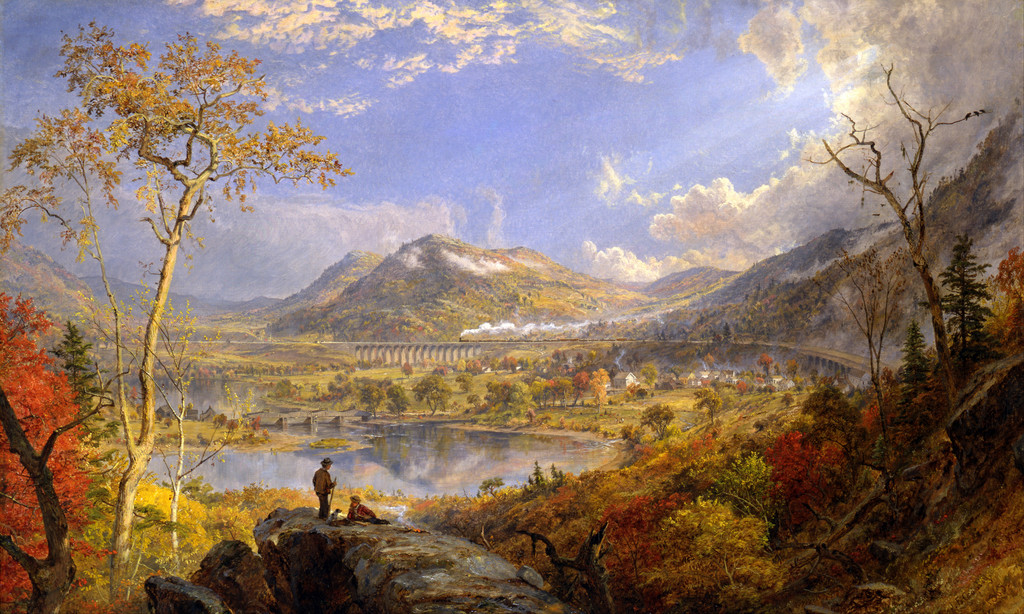
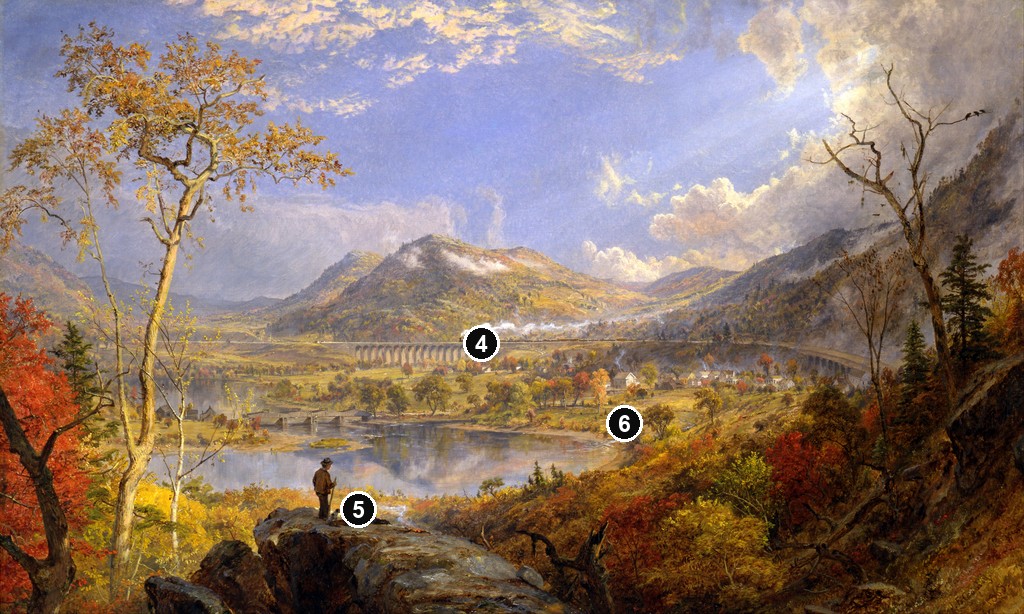
Jasper Francis Cropsey, Starrucca Viaduct, Pennsylvania, 1865. Toledo Museum of Art, 1947.58. Purchased with funds from the Florence Scott Libbey Bequest in Memory of her Father, Maurice A. Scott. Jasper Francis Cropsey / Toledo Museum of Art, via Google Art Project. Image source. Public domain. Separate resized overview with numbered points; details cropped from the original, without recolouring, retouching or enlargement.
Details from JASPER CROPSEY
Compare the cropped details with the complete images above. Notice how their colours, shapes and positions contribute to the larger compositions.
Autumn On The Hudson River
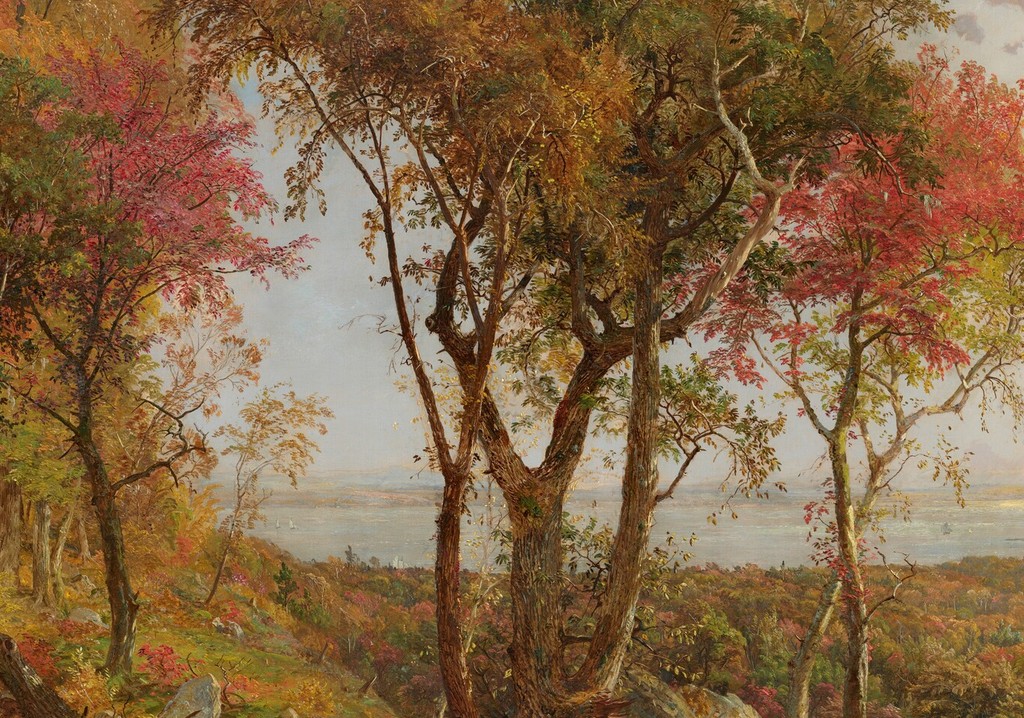
Trees framing the open river
Branching near trees and patches of red, yellow and green foliage enclose the brighter river. Their large scale helps distinguish the wooded foreground from the distant view.
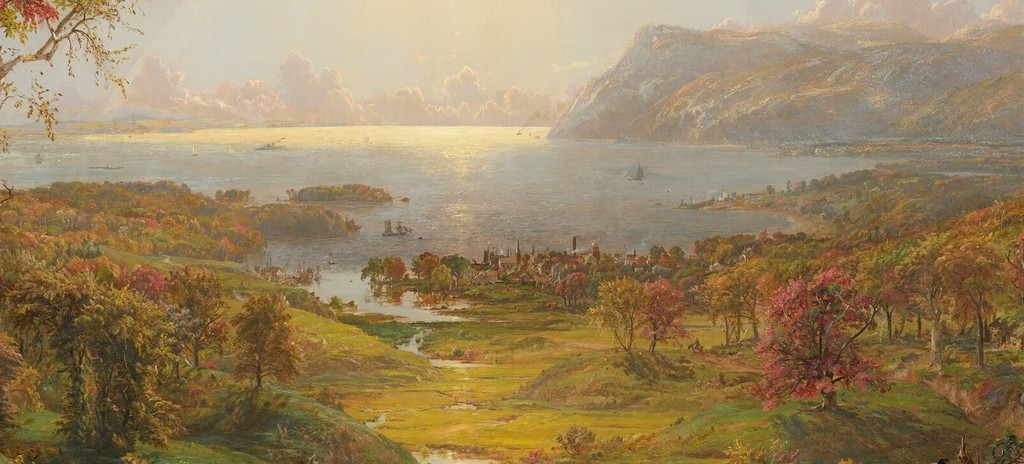
River, settlement and distant ridge
The river, small buildings and distant ridge occupy the central opening. Their reduced scale contrasts with the large trees at the edges.
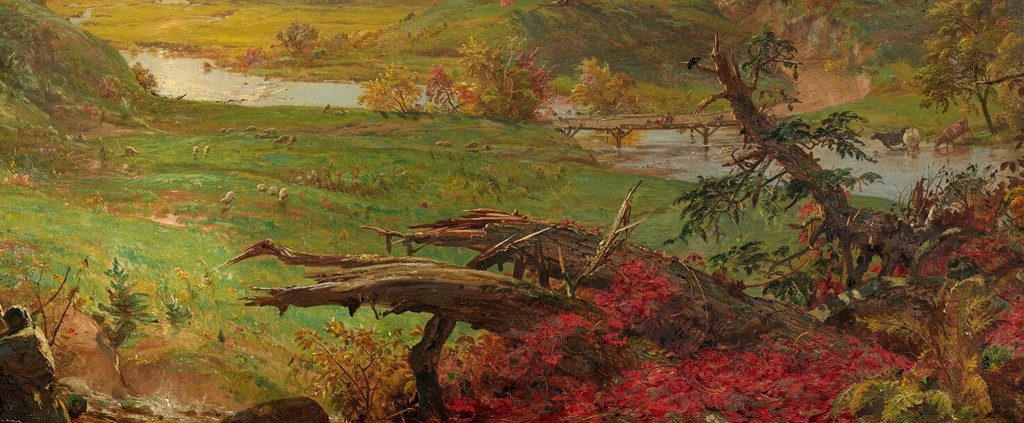
Water and fallen wood in the foreground
Near water, a small crossing and fallen timber carry the eye back into the foreground. Irregular wood and red vegetation interrupt the wider calm panorama.
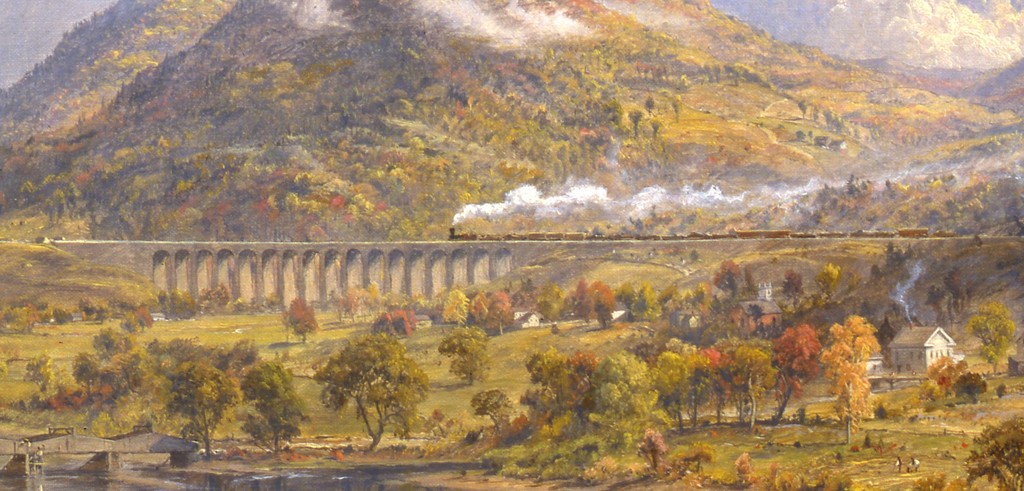
Starrucca Viaduct
Train crossing the repeated arches
A train and white plume extend across the viaduct. Repeated arches make the railway readable within the surrounding hills.
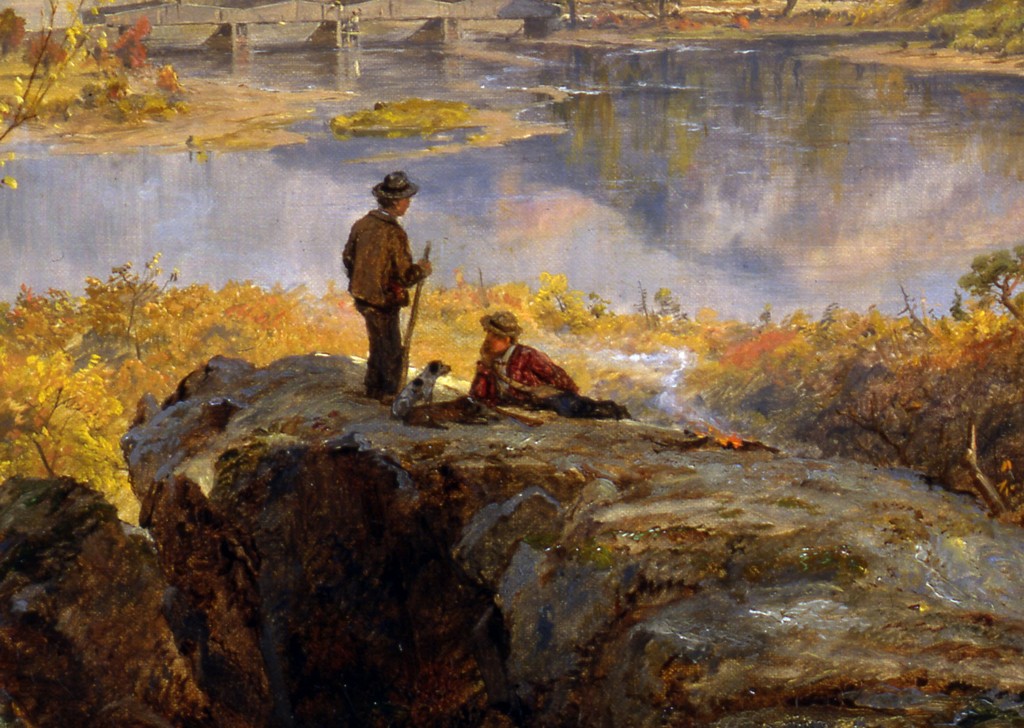
Two figures on the near ledge
Two small figures occupy the near rock ledge above the water. Their positions connect the viewing foreground with the broad railway landscape.
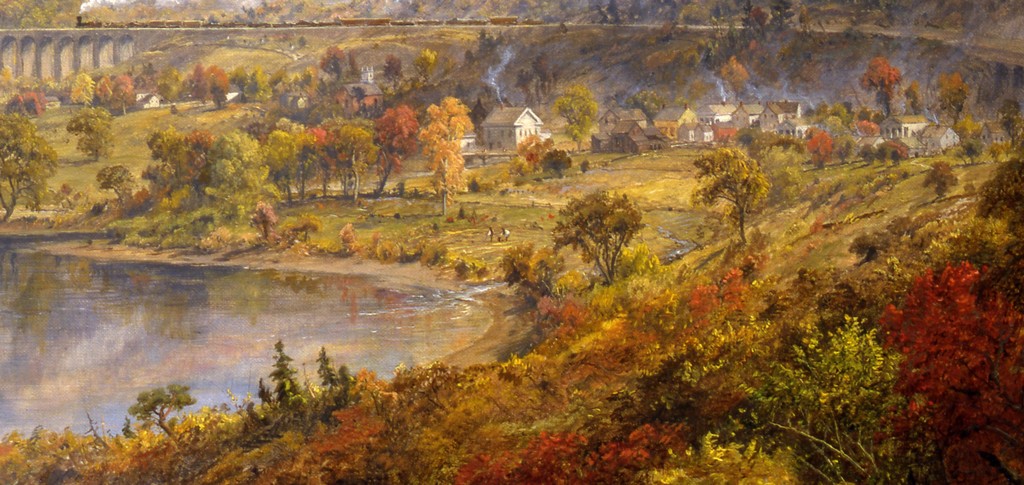
Water and settlement beneath the hills
Water, small buildings and autumn trees occupy the valley below the railway. Their varied forms soften the regular line of the viaduct.
Greenwood Lake and the value of return
Greenwood Lake supplied early successes and a lasting regional subject. Chotner describes studies from a New Jersey trip that led to accepted Art-Union pictures in 1843. Later visits also connected Cropsey with Maria Cooley, whom he married in May 1847. [1]
The place therefore belongs to more than one phase of the career. Early study, personal history and later painting meet within a familiar region. Returning to a subject could make it available for new arrangements rather than requiring each canvas to repeat an earlier view.
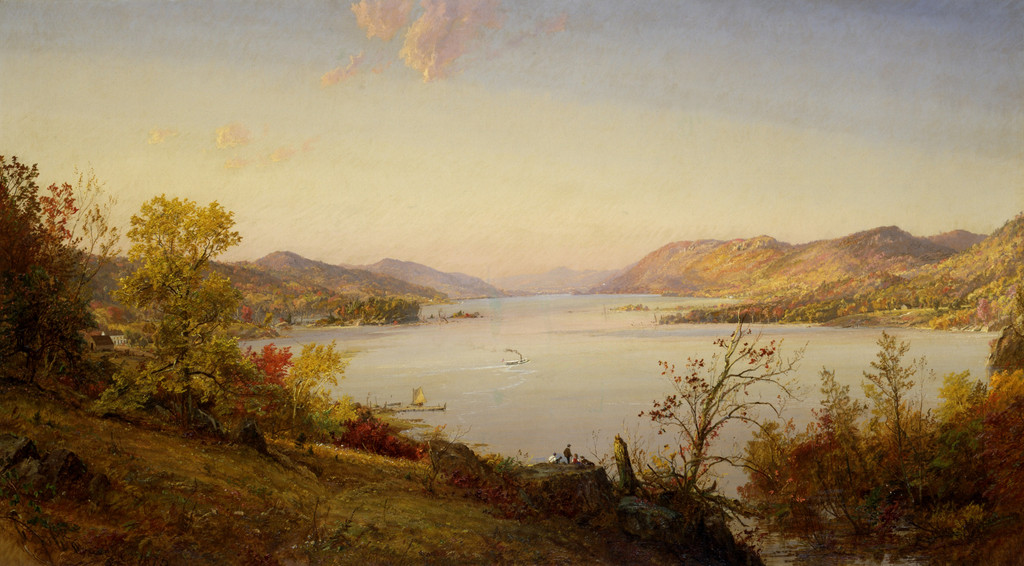
The Smithsonian’s Greenwood Lake of 1875 presents an extensive interval of water between warm shores. Near trees and figures establish a position for the viewer, while boats and hills distribute attention across the distance. Its accession 1967.125 distinguishes this canvas from other paintings of the same lake. [10]
Repeated locality also raises a useful historical question. Which parts are observed, remembered or recomposed? Maddox’s study of nearby Sugar Loaf shows how a familiar mountain could be heightened and other forms combined within an attractive view. Familiarity does not require literal transcription. [4]
Italy and a longer life for gathered material
The first European journey of 1847–49 extended Cropsey’s landscape material. Chotner places him among American artists in Rome after travel in Britain. Italian ruins, water and coast entered a practice that continued after his return to the United States. [1]
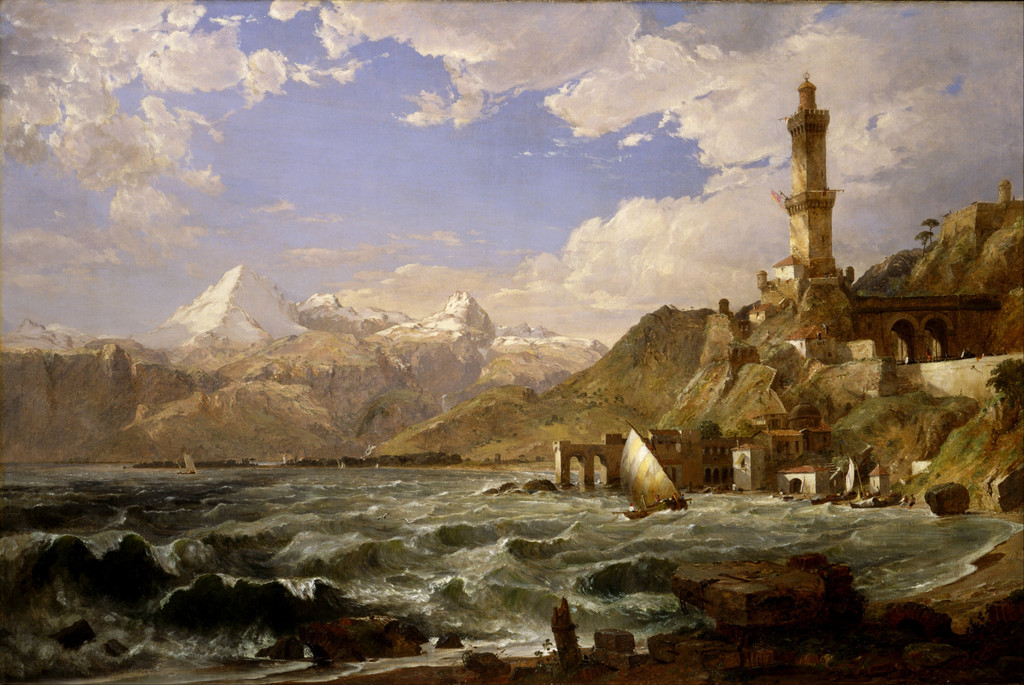
The Coast of Genoa is a finished oil of 1854, rather than proof of an Italian visit in that year. The whole canvas combines a coastal tower and rock with boats, moving sea and distant mountains. Its maritime energy differs from the calmer intervals of lake and river pictures. [9]
The comparison makes the time between study and finished work visible. Material gathered on a journey can remain useful, entering a later picture through selection and development. A painting’s date records its identity without necessarily dating the first encounter with its subject.
The drawings guide follows another Roman example: the small Torre dei Schiavi album sheet, whose catalogue date and visible inscription differ. Its paper tone, ruin and moon invite attention to a shaped subject on a modest support. The drawing’s own identity remains separate from an oil of the same monument. [12]
Imaginary history in War and Peace
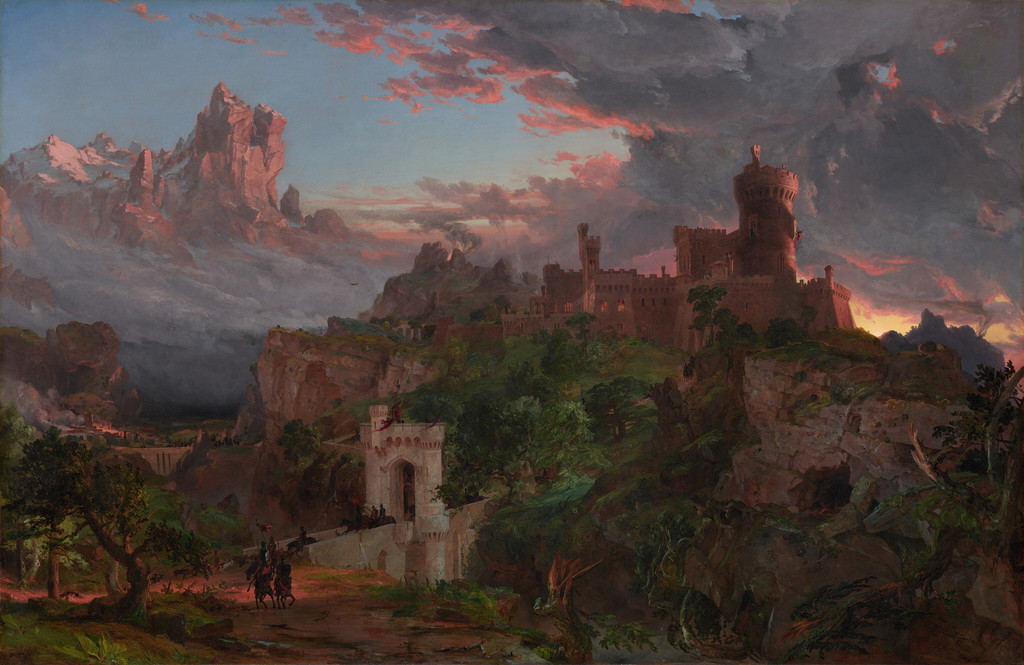
The companion Spirit of War and Spirit of Peace show a different ambition. Painted in 1851, they arrange contrasting worlds through architecture, figures, water and light. Chotner discusses the imaginary setting of War, while Woodmere interprets the temple and harbour of Peace through arts, learning and peaceful activity. [1] [11]
Landscape becomes a means of making a moral contrast available to the eye. The viewer encounters a castle above martial movement in one picture and a more open classical harbour in the other. The forms of settlement help define the social world presented.
Their imaginary character also sets a limit. These are not documentary prospects of places Cropsey visited, and their date should not be converted into a literal forecast of the Civil War. The historical context and the painter’s symbolic choices need to be considered together. [1] [11]
The pair expands the idea of him as an autumn specialist. Trees and colour remain part of the arrangements, but the subject includes what kinds of life a landscape can contain. Architecture, activity and atmosphere become partners in the argument.
Britain as a place to paint America
Cropsey lived in London from 1856 to 1863. Chotner describes commissions for English landmarks and American scenery, an active social circle, and exposure to Constable and Turner in museums and galleries. The residence gave him both new subjects and new audiences. [1]
Warwick Castle, England of 1857 belongs to that exchange. An actual English place could be painted for an American patron, while American river country could be made for British viewers. The direction of the subject and the direction of the audience did not always coincide. [1]
The most celebrated example is Autumn—On the Hudson River, completed in 1860. Strong reds and golds occupy near trees around a paler extensive distance. The painting gives a British audience a sustained encounter with the seasonal character of American country. [1]
Its reception involved questions about the credibility of the leaves. Chotner reports samples pasted to cardboard through a mediated Guardian account of June 1860, separately from Cropsey’s presentation to Queen Victoria in June 1861. The documented sequence is more useful than a later invented conversation about impossible foliage. [1]
Autumn as structure, not just colour
The autumn landscapes guide compares several forms of seasonal country. In the Hudson panorama, warm near trees frame a lighter river opening. In Sugar Loaf, a rounded mountain concentrates the distance. In Greenwood, the eye travels over a pale water interval surrounded by warmer shores.
The colour does different work in each arrangement. It establishes a strong near place, gathers attention around a landmark or follows the edges of water. Recognising the palette is only the beginning; the more sustained comparison concerns where it directs the eye.
Distance also changes the appearance of foliage. Near masses carry more differentiated leaves and trunks, while farther warmth is gathered into smaller shapes. The season can remain continuous across a landscape even as the painter changes its degree of detail.
These choices help explain why a familiar public association need not reduce the pictures to one formula. Cropsey could use autumn in a monumental exhibition work, a local lake scene or a railway valley. Their separate histories and structures keep them particular. [1] [2]
Railway scenery and its audiences
Starrucca Viaduct, Pennsylvania of 1865 places a railway within extensive autumn country. Foreground viewers occupy a rocky ledge, while a train crosses the farther valley. Its small share of the whole composition matters: the technology enters a scene already rich in settlement, fields, river and hills. [2]
Rebora considers the painting beside period guide imagery, versions and prints. She distinguishes the surviving Toledo canvas from a much larger lottery painting destroyed in 1871, and develops a critical reading of how pastoral beauty can accommodate industrial change. These are relationships between particular objects and histories, not evidence that all viewers approved of the railway. [2]
The Brandywine Museum’s 2025 account of the 1873 Ramapo commission adds a specific patron. James McHenry’s involvement with the Erie Railway gave Cropsey’s landscape a place in celebrating a commercial route. The patron’s transatlantic activities also continued the international dimension of the career after London. [6]
The railway guide brings paintings, travel literature and a period network map together. Those sources let the reader move between one picturesque prospect and the wider system of passengers, investment and image circulation that gave it meaning.
Jasper Francis Cropsey, Starrucca Viaduct, Pennsylvania, 1865. Toledo Museum of Art, 1947.58. The surviving canvas is distinct from the larger destroyed lottery painting. Jasper Francis Cropsey / Toledo Museum of Art, via Google Art Project. Image source. Public domain. Proportionally resized only; full carrier, margins and native appearance retained.
Watch: Jasper Cropsey
Look closely at Cropsey’s Mount Jefferson, then explore the wider Hudson River School tradition.
Summer or Autumn? Picturing the American Republic
Smarthistory discusses Cropsey’s seasonal landscape and the image of the American republic.
Watch on YouTubeCultivation, leisure and historical memory
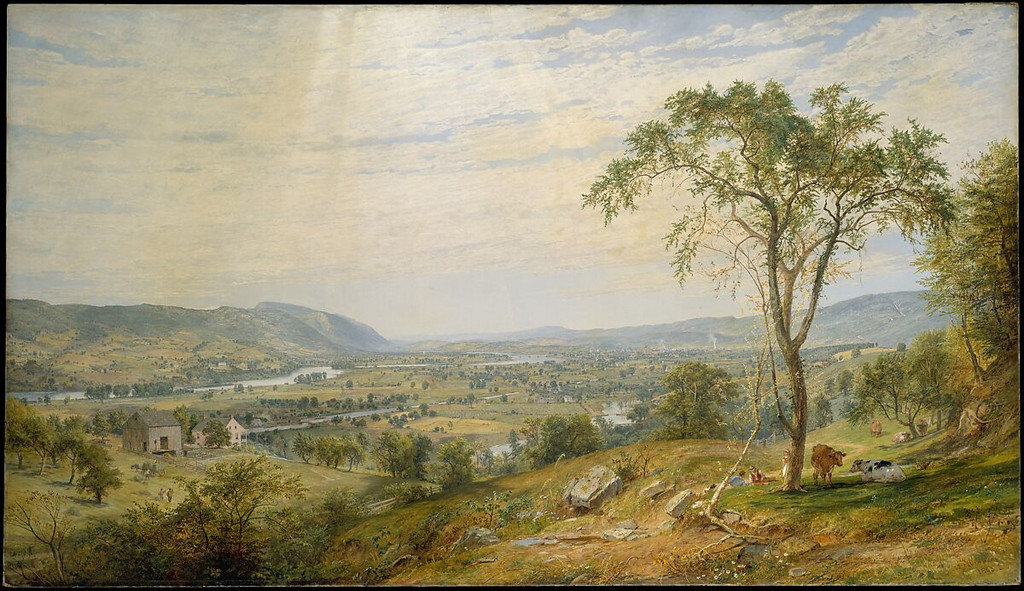
Human use extends beyond railway subjects. Valley of Wyoming of 1865 presents Pennsylvania country with fields, buildings, animals and figures. Rebora follows the commission and studies, including several prospects considered before the large finished canvas. [2]
The pastoral appearance should be considered beside the historical associations attached to the view. Rebora discusses the frame’s literary connection and the region’s more violent history. The picture’s attractiveness is part of what makes its treatment of memory worth examining. [2]
Catskill Mountain House of 1855 adds leisure to this range. The distant hotel was a functioning resort, even when the painted setting invited associations with older monumental architecture. Landscape could contain a modern tourist place while appearing extensive and dramatic. [2]
Buildings and small figures are therefore worth retaining when looking at the whole paintings. They help establish use, scale and a place for the spectator. A landscape can be beautiful and inhabited at once, with its selected details shaping the terms of that encounter.
Clouds and the painter’s own voice
Cropsey’s Up among the Clouds, published in The Crayon in August 1855, offers a primary account of his atmospheric interests. He attends to form, variety, space and the way clouds can affect a landscape’s character. His religious understanding of the artist’s purpose is part of the argument. [3]
The essay matters because it gives language to concerns visible across otherwise different subjects. A sea, a lake and an autumn river need not share one sky. Cropsey urges attention to the variety available to observation and warns against repeated agreeable effects. [3]
In the paintings, cloud passages can establish light over a distant opening or add movement above water. In Starrucca, smoke from a train enters that atmospheric field. The effect belongs to the relation between forms, rather than to a detached sky treated as a stock background.
The essay article follows the complete two pages, while style and technique compares the argument with documented paint construction. Those routes keep the painter’s written views separate from later technical examination.
Close study and material variety
The small Trees and a Stream of 1853 concentrates on an enclosed woodland. The Cleveland museum identifies an oil on board, probably made during summer study in Massachusetts. Its vertical arrangement and moving water offer a contrast with the broad panoramic canvases. [8]
Summer, Lake Ontario of 1857 brings near enclosure and an open distance into another relation. Newfields describes the scene as idealised and composed from motifs associated with different locales. The title should not be made into a guarantee that every form occupies one exact site. [7]
Material records add further differences. Chotner’s technical entries describe particular grounds, handling and layers in War, Warwick and Autumn. Their differing constructions are evidence about those canvases, rather than one universal Cropsey recipe. [1]
The distinction makes comparison more careful. Visible marks can suggest texture and emphasis, while a conservation account can establish preparation or layer structure not recoverable from the image alone. Both kinds of observation matter, with their sources made clear.
Aladdin, Ever Rest and continued work
Cropsey’s later homes connect the pictures with working conditions and domestic ambition. Aladdin outside Warwick, begun in 1866 and completed in 1869, included a large studio. Maddox describes windows and mirrors in the home that made surrounding scenery part of its interior experience. [1] [4]
After Aladdin was sold in 1884, Jasper and Maria moved to Hastings in 1885 and bought Ever Rest in 1886. The earlier Saunders cottage gained Cropsey’s studio addition about 1887. The foundation describes its north window, cupola and uses for work, family and guests. [1] [5]
The modern exterior photograph and later measured drawings belong to the house guide. They document the surviving setting without pretending to be original nineteenth-century plans or photographs. Furniture moved from Aladdin supplies another connection between the homes. [5]
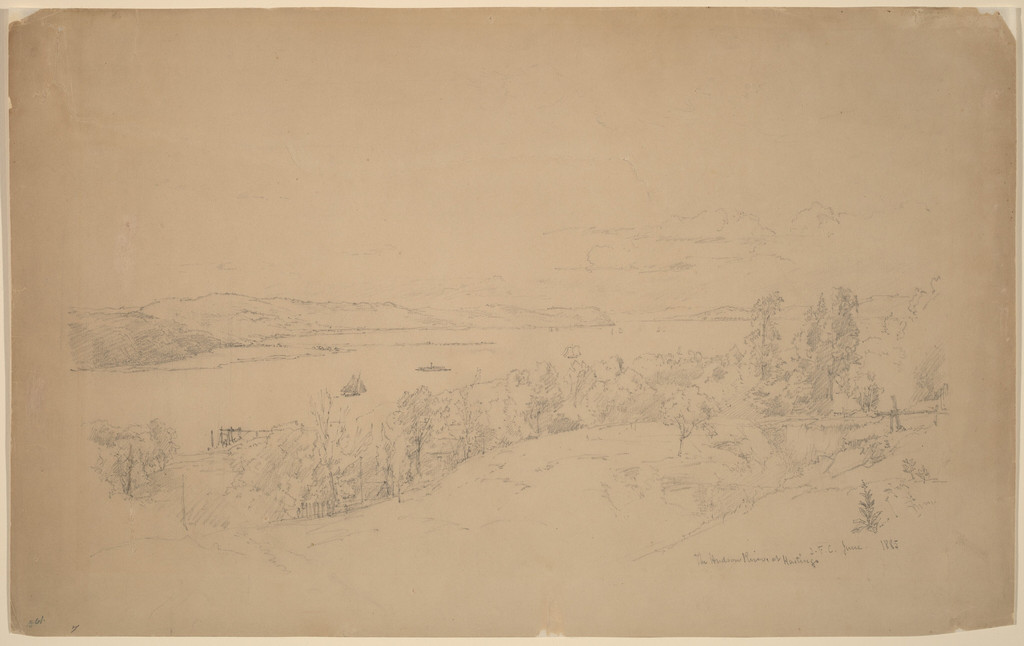
These places make the later career more than a list of dates. A smaller household could still contain an active studio, familiar objects and material gathered over many years. The June 1885 Hastings drawing gives a nearby river subject a place within that history. [13]
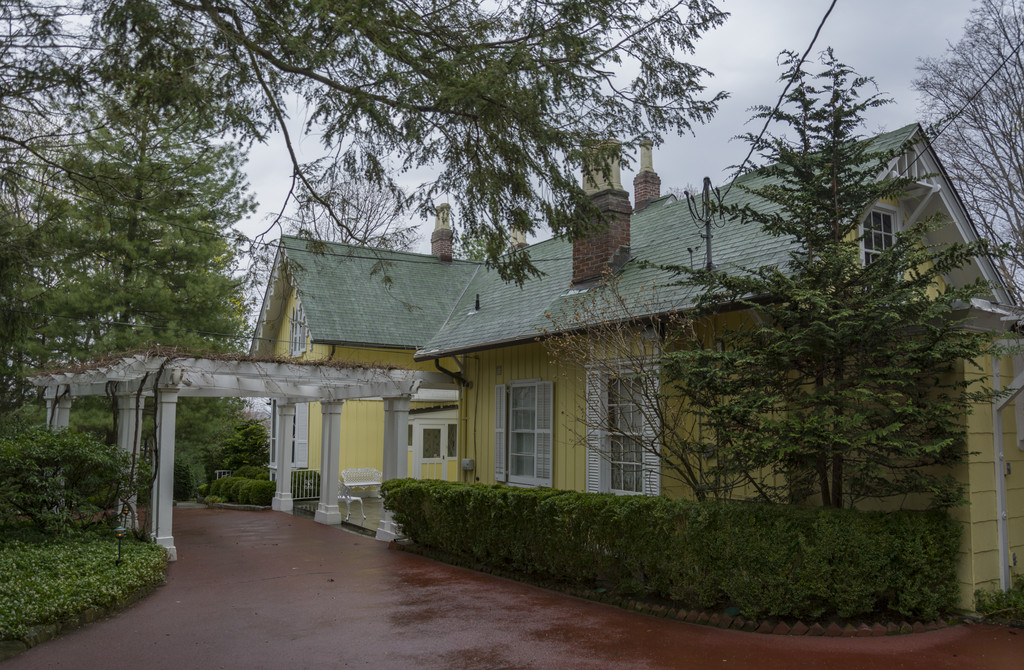
Ever Rest, Hastings-on-Hudson, photographed by Ɱ in 2018. A modern view of Cropsey’s later home, proportionally resized only; CC BY-SA 4.0. Ɱ, 2018; CC BY-SA 4.0. Image source. CC BY-SA 4.0. Proportionally resized only; full carrier, margins and native appearance retained.
A later career with changing emphasis
Chotner describes a decline in popularity as tastes favoured smaller, softer and more mood-oriented landscapes. Cropsey continued exhibiting, while the earlier public appetite for his detailed and dramatic views weakened. His later circumstances belong to a change in reception as well as a change in scale. [1]
The Brandywine Museum’s account of its 1887 autumn landscape also establishes a later regional trip. Moving to Hastings did not end every journey or every new encounter with scenery. A familiar seasonal subject could continue within different circumstances. [6]
Following his stroke in 1893, Cropsey increasingly used watercolour. The medium already belonged to his career: he had early lessons and was a founding member of the watercolour society in 1867. The later emphasis developed an existing practice rather than introducing it for the first time. [1] [2]
The biography follows that life sequence, while the paintings guide provides a selected route through the museum works. Together with the drawings and thematic articles, they make it possible to return from a broad reputation to the particular objects that sustain it.
Essential Jasper Cropsey works
Autumn—On the Hudson River by Jasper Cropsey
1860 · American river country presented to a British audience from a London studio.
Starrucca Viaduct by Jasper Cropsey
1865 · A moving train within an extensive inhabited autumn valley.
The Spirit of War by Jasper Cropsey
1851 · An imaginary castle and martial movement at dawn.
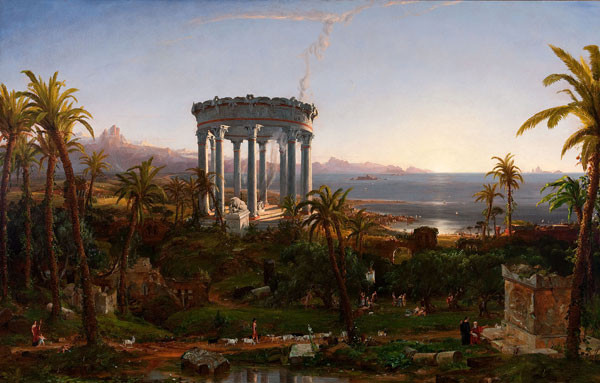
The Spirit of Peace by Jasper Cropsey
1851 · A contrasting temple, harbour and peaceful activity.
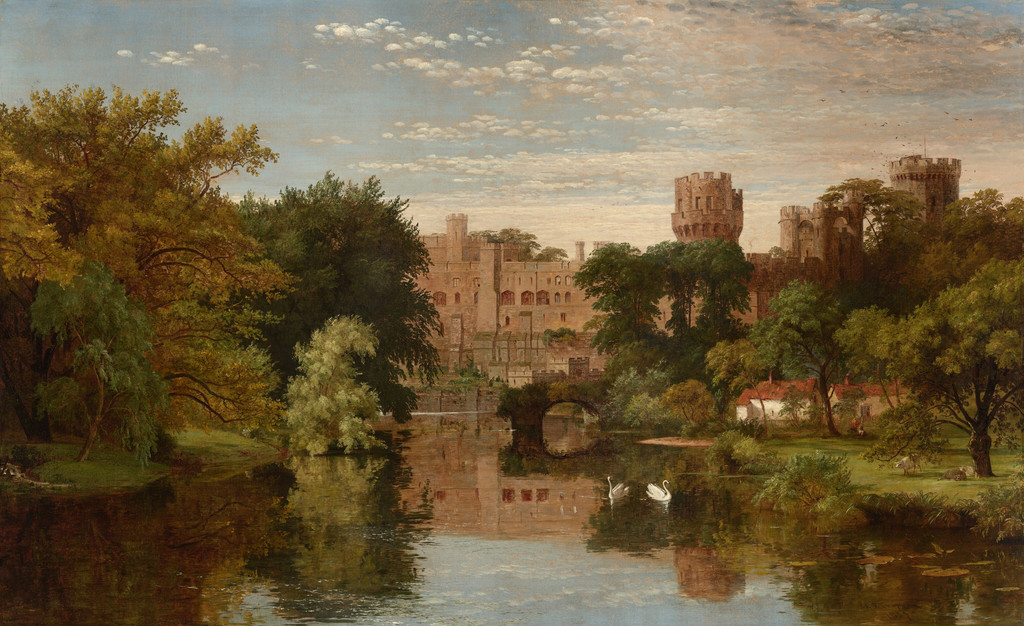
Warwick Castle by Jasper Cropsey
1857 · An English landmark developed through visits, drawing and pictorial arrangement.
The Valley of Wyoming by Jasper Cropsey
1865 · A commissioned Pennsylvania panorama with cultivation and historical associations.
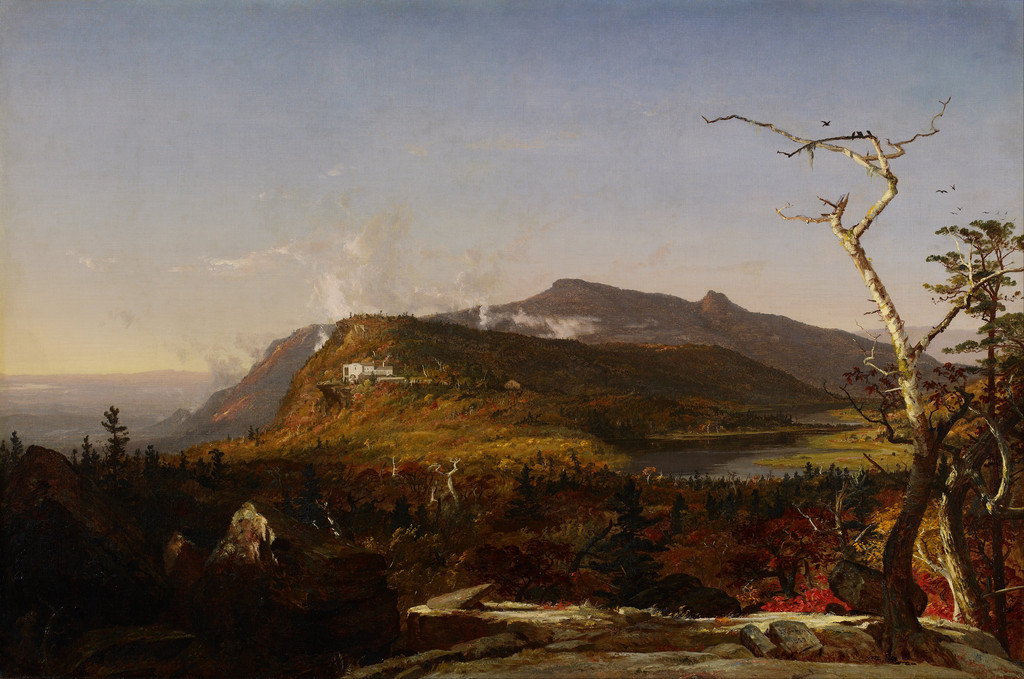
Catskill Mountain House by Jasper Cropsey
1855 · Mountain scenery surrounding a functioning tourist resort.
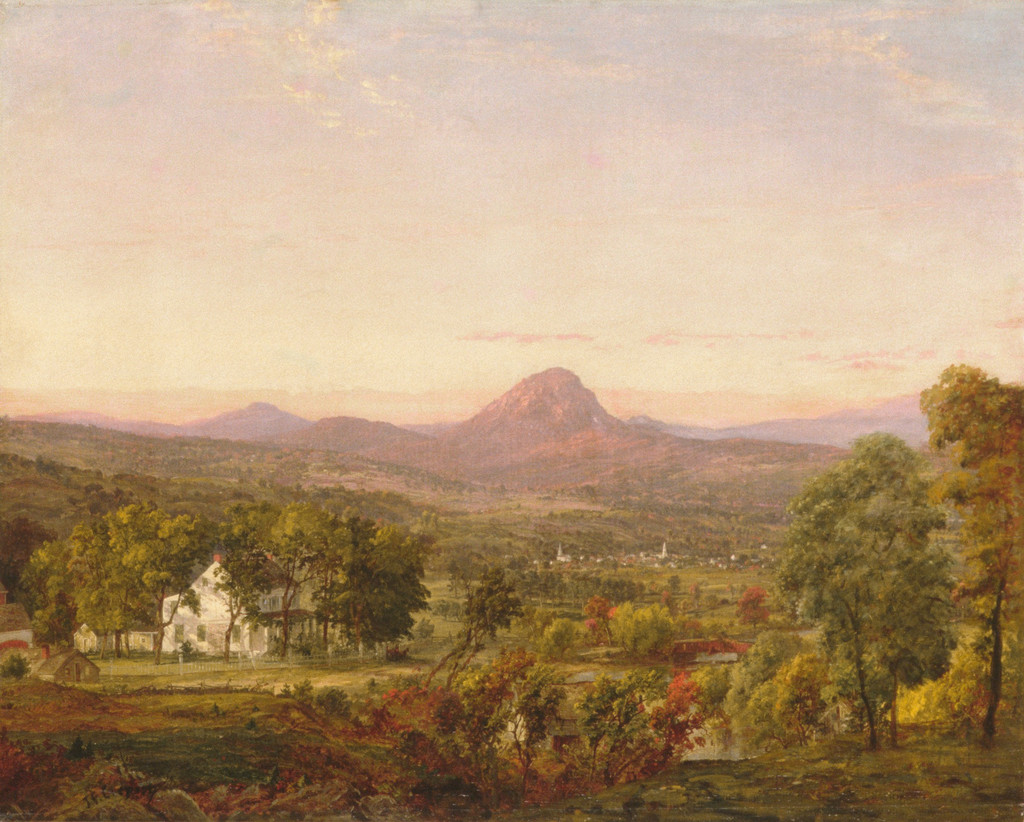
Sugar Loaf Mountain by Jasper Cropsey
ca1870–75 · A local rounded peak whose earlier subject title was corrected.
Greenwood Lake by Jasper Cropsey
1875 · Warm shores and activity around an open interval of water.
The Coast of Genoa by Jasper Cropsey
1854 · Coastal architecture, moving sea and atmospheric distance.
Artworks directory
A selected directory of 18 paintings, two drawings and three architectural projects. Repeated subjects retain distinct object identities. Links lead to a companion article where available, otherwise the consulted institutional record. Unillustrated objects remain searchable; this is not a complete catalogue raisonné.
Frequently Asked Questions
American autumn landscapes are a central public association, especially the large Hudson panorama completed in London in 1860. His selected works also reveal a wider range. [1]
He trained in architecture and designed early churches, later railway stations and working spaces alongside his painting career. [1]
Discussion
Look again at the images and ideas explored in Jasper Cropsey. These editorial prompts invite your observations.
Reader Insights
Which landscape most clearly joins colour with an organised route through space?
How do buildings, figures or transport change an apparently natural view?
Which subject beyond autumn makes you want to explore his work further?
Join the Conversation
Share a detail, comparison or question about Jasper Cropsey below.
Explore the wider art history
Explore the wider history of American artists, with portraits, landscapes and changing approaches to modern art.
Explore Cropsey’s place within the Hudson River School and its changing landscape subjects.
References
- Deborah Chotner, Cropsey biography and painting entries, American Paintings of the Nineteenth Century, Part I, National Gallery of Art (1996), printed pp.109–122. Career, architecture, War, Warwick, Autumn and specific technical records. View source
- Carrie Rebora, Cropsey biography and selected entries, American Paradise: The World of the Hudson River School, Metropolitan Museum of Art (1987), printed pp.200–216. Catskill, Wyoming, Starrucca and society context. View source
- J. F. Cropsey, Up among the Clouds, The Crayon, II, 6, 8 August 1855, pp.79–80. Complete primary essay on atmospheric form and painting. View source
- Kenneth W. Maddox, A Forgotten Mountain: Jasper F. Cropsey’s Paintings of Sugar Loaf, Metropolitan Museum Journal, 35 (2000), pp.221–236. Familiar regional subjects, composed topography and Aladdin. View source
- Newington-Cropsey Foundation, Ever Rest. Later cottage, studio, objects and preservation. View source
- Brandywine Museum of Art, Cropsey, Wyeth, and the American Landscape Tradition, 2025 large-print labels, selected PDF pp.8–9 and 19–22. McHenry’s Ramapo commission and later regional travel. View source
- Newfields, Summer, Lake Ontario, accession 71.13, via Google Arts & Culture. Composite summer composition of 1857. View source
- Cleveland Museum of Art, Trees and a Stream, accession 1977.118. Close 1853 oil-on-board study and probable setting. View source
- Smithsonian American Art Museum, The Coast of Genoa, accession 1984.162. Exact 1854 Italian-subject canvas. View source
- Smithsonian American Art Museum, Greenwood Lake, accession 1967.125. Exact illustrated 1875 lake canvas. View source
- Woodmere, The Spirit of Peace. Companion 1851 allegory and interpretation. View source
- Metropolitan Museum of Art, Torre dei Schiavi, album drawing, accession 1970.9.26 recto. Separate work on paper, current catalogue date compared with visible inscription. View source
- National Gallery of Art, Hudson River at Hastings, accession 1979.20.28. June 1885 graphite drawing. View source
- Splash image source.
Jasper Francis Cropsey, Autumn—On the Hudson River, 1860. National Gallery of Art, 1963.9.1. American river country completed in London. Jasper Francis Cropsey / National Gallery of Art, Washington. CC0 / Public domain. Proportionally resized only; full carrier, margins and native appearance retained.
View source - Kevin J. Avery, “The Hudson River School”, Metropolitan Museum of Art (2004). Origins in 1825 and decline in the 1870s–1880s; c. 1825–1880 is an approximate comparative range. View source
- Smithsonian American Art Museum, Asher Brown Durand: 1796–1886. Artist life dates. View source
- Smithsonian American Art Museum, Thomas Cole: 1801–1848. Artist life dates. View source
- National Gallery of Art, Martin Johnson Heade: 1819–1904. Artist life dates. View source
- National Gallery of Art, Jasper Cropsey: 1823–1900. Artist life dates. View source
- National Gallery of Art, George Inness: 1825–1894. Artist life dates. View source
- Amon Carter Museum of American Art, Frederic Edwin Church: 1826–1900. Artist life dates. View source