 by Tom Gurney
Tom Gurney BSc (Hons) is an art history expert with over 20 years experience
Email: tomgurney1@gmail.com / Phone: +44 7429 011000
The Spirit of War by Jasper Cropsey: Introduction
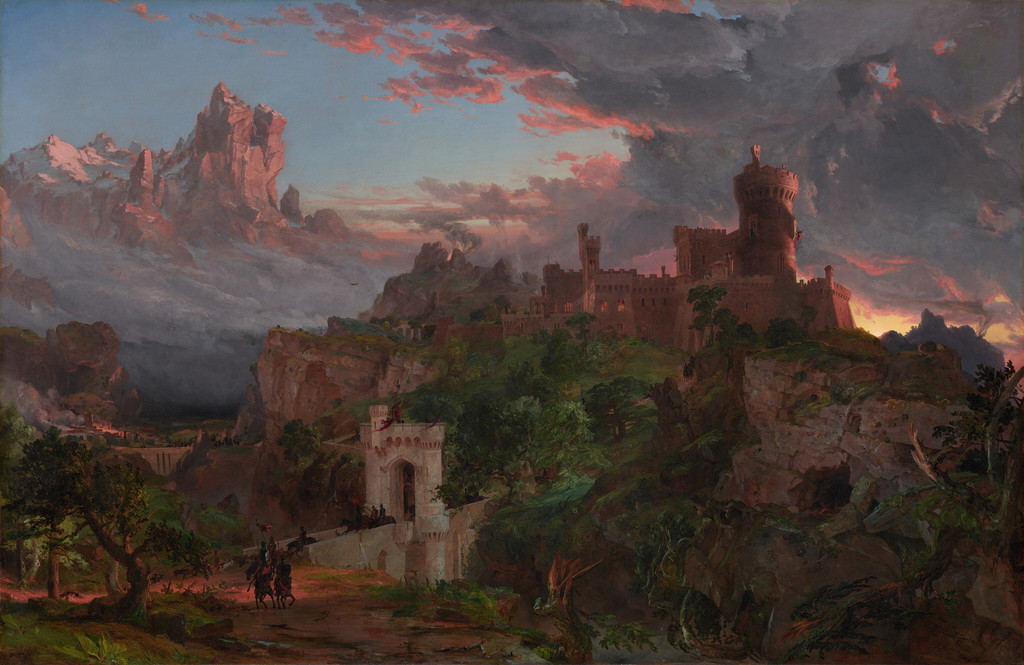
Jasper Cropsey’s The Spirit of War turns a castle, a jagged mountain landscape and hurried movement into an image of conflict. Painted in 1851, the oil on canvas measures 110.8 × 171.6 cm and belongs to the National Gallery of Art, Washington, accession 1978.12.1. The looming architecture and troubled sky establish the scene’s character before its smaller narrative details are examined. [1]
Its companion is The Spirit of Peace, now at Woodmere. The pair uses imagined historical landscapes to consider opposing conditions of human life. In the war picture, defence, flight and military movement gather beneath a building that promises protection while participating in the scene’s menace. [2]
At a Glance
- Artist: Jasper Francis Cropsey
- Title: The Spirit of War
- Date: 1851
- Medium: Oil on canvas
- Dimensions: 110.8 × 171.6 cm
- Collection: National Gallery of Art, Washington
- Accession: 1978.12.1
- Acquisition credit: Avalon Fund
- Companion: The Spirit of Peace, Woodmere
This work across Jasper Cropsey’s career
Contents
- An invented castle in a moral landscape
- Gate, bridge and mounted movement
- Dawn after a storm
- Near vegetation and difficult ground
- Cropsey’s explanation and its limits
- Thomas Cole and paired subjects
- The companion’s different world
- An American audience in 1851
- The particular painted surface
- Annotated details
An invented castle in a moral landscape
The castle is not treated in the NGA catalogue as a portrait of one identified building. Deborah Chotner describes it as a composite arranged for romantic and dramatic effect. Its medieval setting provides a framework for the painting’s argument, rather than locating a documented battle at an exact site. [2]
The building rises from a steep mass of land at the right. Its different towers break the skyline at unequal heights, with one large round tower especially prominent against the clouds. Walls and smaller structures extend outward along the hill.
That irregular outline connects the castle with the jagged mountains at the left. Built and natural forms share abrupt changes in height. The scene has little of the balanced, open architectural rhythm found in the companion’s round temple.
The castle’s location also creates a separation between the lower country and the protected height. Movement toward it must negotiate a rising approach. The painting makes shelter appear difficult to reach, increasing the significance of the people and animals along the route.
The result is an architecture of tension. The building can be read as a refuge, but its massive walls and sharp skyline remain part of a threatening environment. Protection and hostility occupy the same form.
Annotated Details from The Spirit of War
The numbered points identify visible features discussed in this article. Return from each detail to the whole composition. Jasper Francis Cropsey, The Spirit of War, 1851. National Gallery of Art, 1978.12.1, Avalon Fund. The castle is an invented composite within an allegorical landscape. Jasper Francis Cropsey / National Gallery of Art, Washington. Image source. CC0 / Public domain. Separate resized overview with numbered points; details cropped from the original, without recolouring, retouching or enlargement.
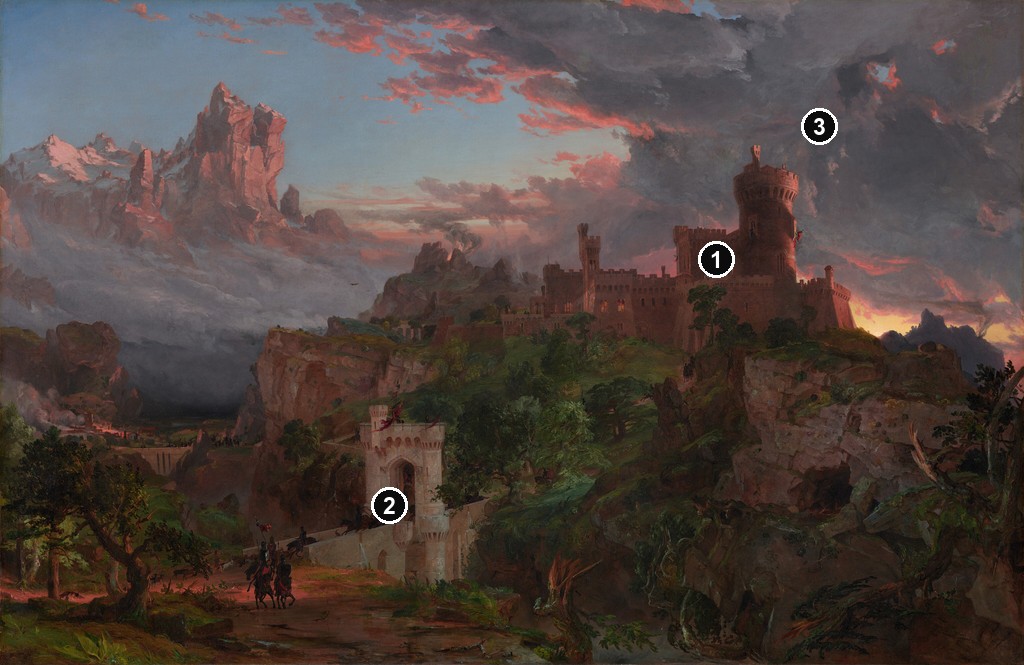
Details from THE SPIRIT OF WAR
Compare the cropped details with the complete images above. Notice how their colours, shapes and positions contribute to the larger compositions.
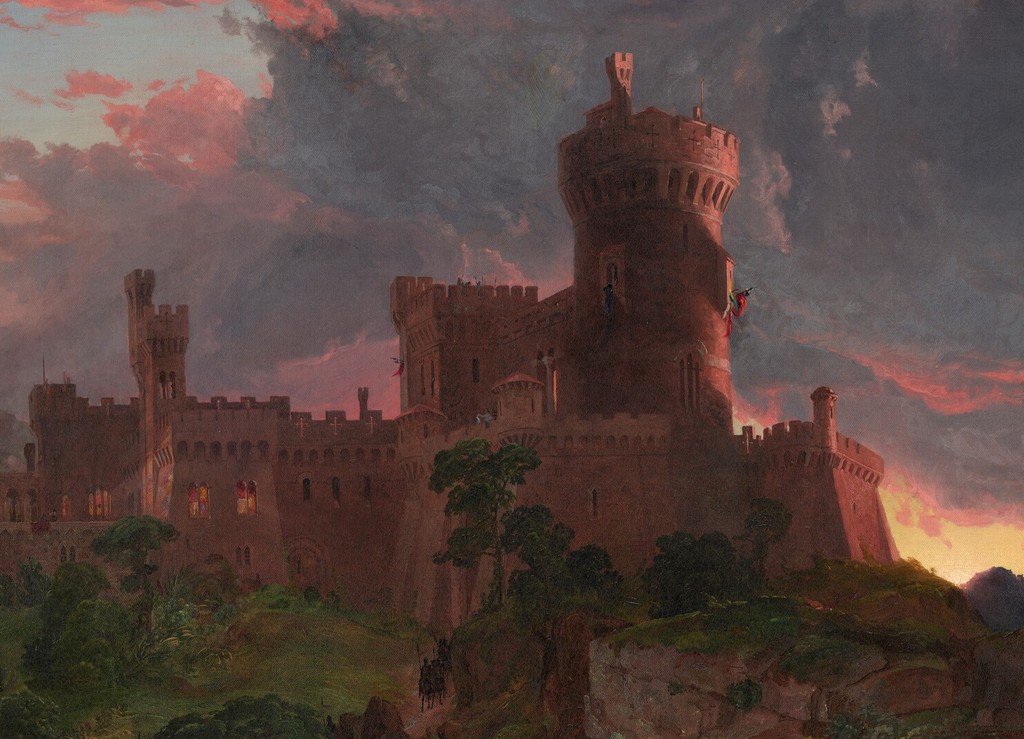
Castle above the rocky ground
A massive castle stands above steep rocky ground. Towers, walls and narrow openings form a dense silhouette against the changing sky.
Gate, bridge and mounted figures
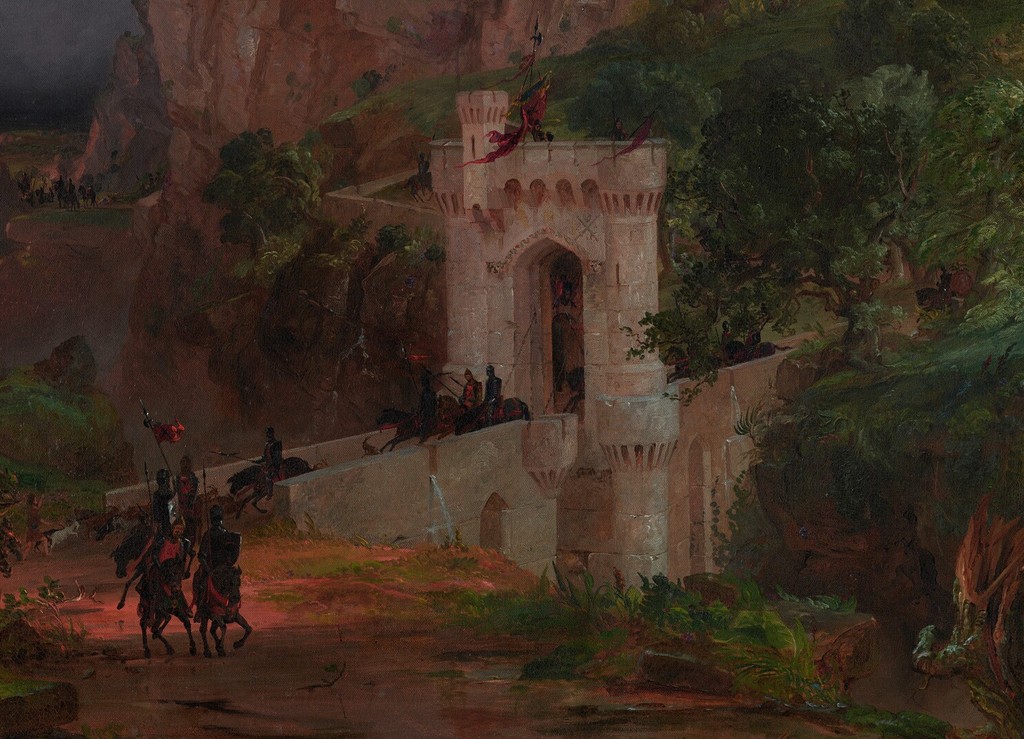
A pale gate and narrow bridge connect the castle with the near road. Mounted figures give scale to the steep approach without identifying a historical battle.
Red light and gathering cloud
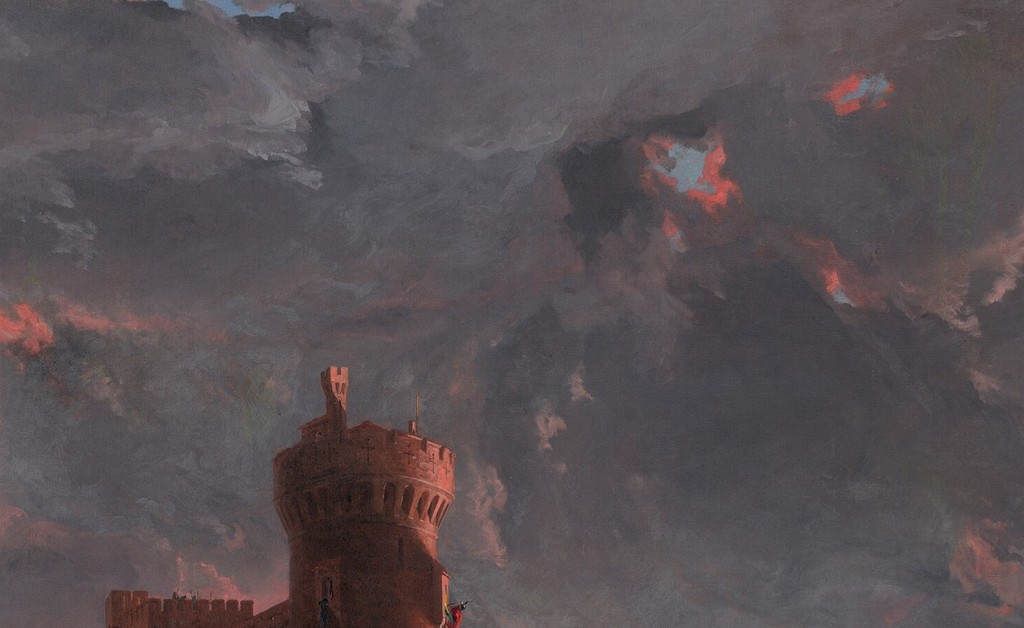
Red light runs through the dark clouds above the castle. The colour links the threatening sky with the warm stone below.
Gate, bridge and mounted movement
The foreground route leads toward a pale fortified gateway below the main castle. Its lighter stone stands out from the surrounding shadows. Banners, the opening and figures around it turn this near structure into a focus of movement.
Mounted figures occupy the lower approach. Their scale is small beside the gateway and much smaller beside the castle above. That difference makes the passage feel controlled by architecture: people move along a route whose boundaries and destination have already been set.
The bridge and rising path gather attention into a narrow interval. They connect parts of the landscape that the steep terrain would otherwise separate. Their practical function is clear within the imagined scene, while their compositional function is to direct the eye toward the defensive height.
At the left, the lower country opens into a darker distance. It is a different kind of space from the castle precinct, less enclosed and less securely defined. The contrast helps explain why the route toward the gate matters.
The foreground does not offer a detached platform for quiet contemplation. Its road belongs to the picture’s urgent action. Looking into the painting means following that action upward, through the lower gate and toward the larger structure on the hill.
Dawn after a storm
The warm colour in the sky might suggest sunset to a viewer encountering the work without its historical description. Cropsey’s account, discussed in Chotner’s catalogue entry, instead places the scene at early dawn after a stormy and rainy night. The catalogue associates the moving clouds, red light and distant peaks with that setting. [2]
The distinction changes the mood. Dawn usually promises a beginning, but here the arriving light reveals a world already shaped by threat. The scene’s energy comes from the uneasy relationship between illumination and darkness rather than from a reassuring end to the night.
The sky is divided into strongly different areas. A lighter blue opening occupies much of the upper left, while heavy clouds gather above and beyond the castle. Warm streaks cross those darker masses and touch the sharply rising peaks.
The mountains carry a more broken outline than the foreground hill. Their illuminated heights remain distinct above a lower zone of cloud or mist. This separation lets the eye register both the remoteness of the peaks and the unsettled atmosphere surrounding them.
The castle’s round tower stands against the dark upper field. Its shape stays clear, but the cloud mass makes its upward reach feel more forceful. The building appears to belong to the troubled sky as much as to the land supporting it.
Near vegetation and difficult ground
Twisted trees, exposed rock and broken branches give the near landscape a rough character. The forms do not create one smooth frame around the action. Instead, they interrupt the foreground with irregular edges and changes in direction.
Vegetation nevertheless supplies a counterpoint to the masonry. Pale green leaves and darker trees occupy the hill beneath the castle. Their variety makes the country more than an abstract stage for the building, even as their placement supports the larger dramatic arrangement.
The right-hand foreground has deep shadows and sharply separated rock forms. It makes the land feel difficult to traverse. The smoother road at the left therefore becomes more emphatic as the route through a complicated terrain.
Chotner observes that Cropsey’s allegorical ambition coexists with close attention to the natural world. The picture can be intensely constructed around a moral theme while still attending to the character of plants and rocks. Its drama does not remove its interest in landscape particulars. [2]
Cropsey’s explanation and its limits
An important source for the pair is a long draft letter dated 12 May 1854, discussed and partly transcribed in the NGA catalogue. It was written after the paintings’ 1851 date. The intended recipient is unknown, and the original archival document has not been used directly for this article. [2]
The account explains the choice of feudal conflict and the relationship between military threat and domestic suffering. Chotner discusses corresponding figures in the two paintings, including frightened or exhausted people in War and peaceful pastoral activity in its companion. The interpretation rests on the catalogue’s treatment of Cropsey’s description as well as the pictures. [2]
That distinction is useful because the letter is an explanation rather than a surviving diary entry from the day the canvas was begun. It provides substantial evidence of Cropsey’s stated intentions, but should not be presented as an independently consulted production record.
The catalogue also discusses small pencil drawings of the two subjects. It does not settle whether they preceded the paintings or served as later records. Their existence therefore cannot be used to claim a fully reconstructed preparatory sequence. [2]
Watch: Jasper Cropsey
Look closely at Cropsey’s Mount Jefferson, then explore the wider Hudson River School tradition.
Summer or Autumn? Picturing the American Republic
Smarthistory discusses Cropsey’s seasonal landscape and the image of the American republic.
Watch on YouTubeThomas Cole and paired subjects
Chotner connects the paintings with Thomas Cole’s example: ambitious themes, expressive landscapes and the pairing of contrasting subjects. Cropsey’s earlier Roman residence in a building associated with Cole’s studio belongs to this wider history of admiration, although the reason for choosing that address is uncertain. [2]
The comparison helps explain why a landscape could carry a moral argument of this scale. Buildings, vegetation, weather and human movement all contribute to the subject. The idea is distributed through the environment rather than confined to one symbolic figure.
Cropsey’s professional architectural background also makes the distinction between an invented castle and an observed building useful. In Warwick Castle, dated 1857, he depicted an identifiable English landmark. The two works give architecture a central role under different conditions: one constructs a medieval world for allegory; the other develops a particular castle subject. [4]
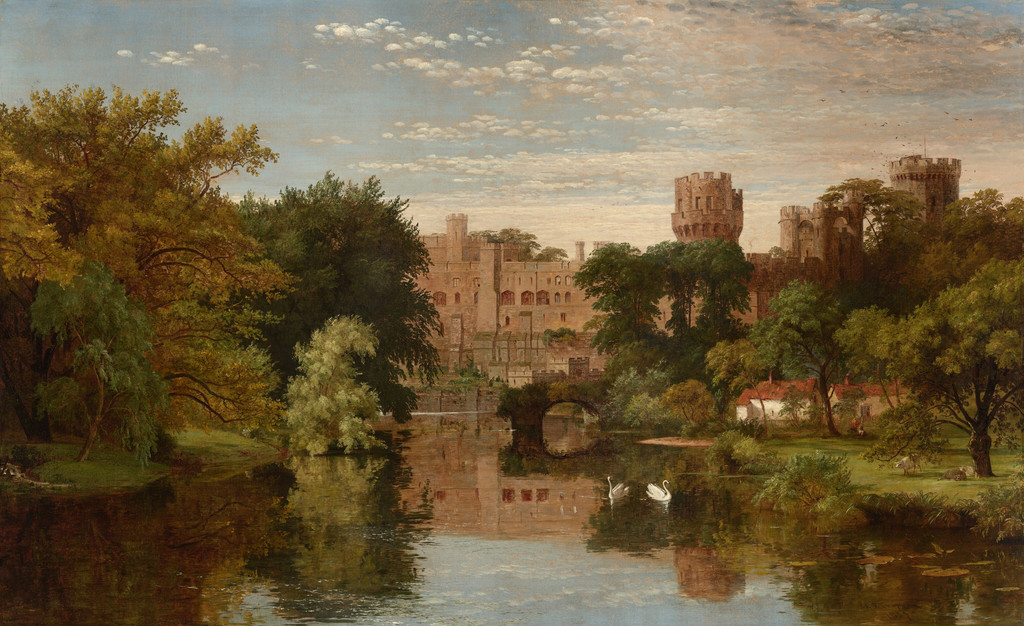
Jasper Francis Cropsey, Warwick Castle, England, 1857. Oil on canvas, 81.1 × 132.3 cm. National Gallery of Art, 1991.142.1. An identifiable landmark, unlike the invented castle in The Spirit of War. Jasper Francis Cropsey / National Gallery of Art, Washington. Image source. CC0 1.0. Proportionally resized only; full carrier, margins and native appearance retained.
The companion’s different world
The Spirit of Peace replaces the defensive castle with an open circular temple. Its palms, harbour and scattered activity offer a wider range of ordinary pursuits. Woodmere interprets the imagined ancient landscape through learning, trade, the arts and Christian symbolism. [3]
The change in architecture provides a clear visual contrast. War draws activity toward a protected height through a constricted route. Peace distributes activity across a more open setting, with water extending the view beyond the central building.
Their light is also different in function. The war picture’s dawn reveals danger and unsettled movement; the peaceful picture’s sunset supports a tranquil world. Together, the paintings make atmospheric effects part of their argument about human conditions. [2]
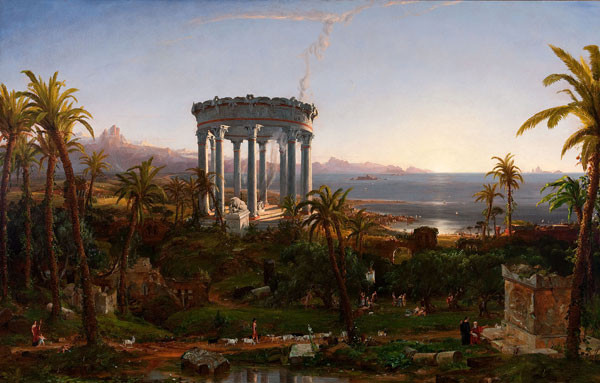
Jasper Francis Cropsey, The Spirit of Peace, 1851. Woodmere, Bequest of Charles Knox Smith. This companion presents an imaginary ancient landscape with an open temple and harbour. Jasper Francis Cropsey / Woodmere, via Wikimedia Commons. Image source. Public domain. Proportionally resized only; full carrier, margins and native appearance retained.
An American audience in 1851
Chotner relates the pair to the recent Mexican War and the strained debate over slavery in the western territories, including the fragile Compromise of 1850. This historical reading gives the remote settings an immediate relevance for Cropsey’s audience. [2]
It does not turn the canvas into a literal representation of those events. The painting’s medieval castle and invented mountains provide a more general image of fear, mobilisation and endangered domestic life. Contemporary concerns could make that image especially resonant.
The future Civil War belongs to a later chapter of history. Its knowledge can shape a modern response to the pair, but an argument that Cropsey documented a specific prediction would require evidence beyond the retrospective resemblance.
The particular painted surface
The 1996 catalogue records a lined, moderately heavy twill support and a thin red ground. It describes the paint as applied with relatively free, low brushwork, and notes an old repaired tear near the upper right. These are observations published at that time, rather than a new examination of the canvas. The entry does not date the repair itself to 1996. [2]
Those findings are more specific than an inference from a digital image. They give evidence about the object’s construction and recorded condition, while the reproduction lets a reader study the broader distribution of forms and colour.
The NGA identifies the acquisition through the Avalon Fund. With its companion now at Woodmere, The Spirit of War can still be read as part of a pair whose central contrast remains clear: two landscapes organise architecture, light and human activity around opposing possibilities for life together. [1] [3]
Artworks directory
A selected directory of 18 paintings, two drawings and three architectural projects. Repeated subjects retain distinct object identities. Links lead to a companion article where available, otherwise the consulted institutional record. Unillustrated objects remain searchable; this is not a complete catalogue raisonné.
Frequently Asked Questions
Cropsey’s description, discussed in the NGA catalogue, specifies early dawn after a stormy night. The companion Peace picture is described with the soft light of sunset. [2]
Discussion
Look again at the images and ideas explored in The Spirit of War by Jasper Cropsey. These editorial prompts invite your observations.
Reader Insights
Does the castle seem primarily protective or threatening?
How does knowing that this is dawn change the scene’s mood?
Which difference between War and Peace most strongly carries the pair’s argument?
Join the Conversation
Share a detail, comparison or question about The Spirit of War by Jasper Cropsey below.
References
- National Gallery of Art, The Spirit of War, accession 1978.12.1. Exact 1851 canvas, dimensions and Avalon Fund acquisition. View source
- Deborah Chotner, The Spirit of War, American Paintings of the Nineteenth Century, Part I, National Gallery of Art (1996), printed pp.110–114. Allegory, dawn, Cole comparison, historical context, technical notes and discussion of Cropsey’s 12 May 1854 draft letter; original archive not consulted independently. View source
- Woodmere, The Spirit of Peace. Companion’s present collection and interpretation. View source
- Deborah Chotner, Warwick Castle, same NGA catalogue (1996), printed pp.114–118. Separate 1857 castle painting and Cropsey’s architectural subjects. View source
- Splash image source.
Jasper Francis Cropsey, The Spirit of War, 1851. Oil on canvas, 110.8 × 171.6 cm. National Gallery of Art, Washington, 1978.12.1. Avalon Fund. Jasper Francis Cropsey / National Gallery of Art, Washington. CC0 / Public domain. Proportionally resized only; full carrier, margins and native appearance retained.
View source