


 by Tom Gurney
Tom Gurney BSc (Hons) is an art history expert with over 20 years experience
Email: tomgurney1@gmail.com / Phone: +44 7429 011000
Jasper Cropsey Paintings: Introduction
Jasper Cropsey’s paintings range from close woodland studies to broad river panoramas, imagined historical landscapes and recognisable English and Italian subjects. Autumn is an important part of his reputation, but the selected works also show summer country, maritime weather, architecture and the changing relation between scenery and human activity. [1]
This guide introduces particular museum paintings and the questions they raise. It is a selected route through his work, rather than a complete catalogue of everything he made. Dates, media and collection identities keep repeated subjects and related versions distinct, while the linked artwork pages follow their individual histories more fully.
Selected Jasper Cropsey paintings
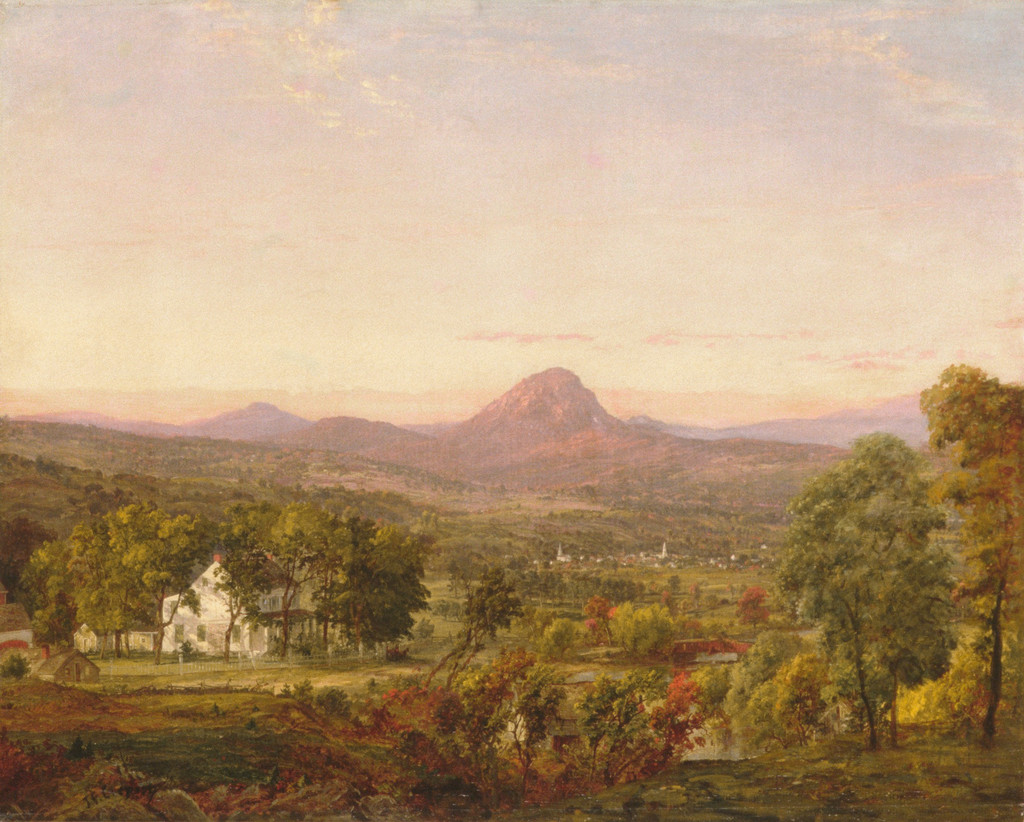
At a Glance
- Artist: Jasper Francis Cropsey, 1823–1900
- Main practice represented: Landscape painting in oil
- Range: Woodland, river, lake, coast, mountain, architecture and allegory
- Major public association: American autumn colour
- Transatlantic subjects: Italy, Britain and American scenery painted in London
- Later themes: Familiar regional landscapes and smaller seasonal pictures
- Scope: Selected paintings with museum records
- Separate route: Drawings and watercolours
Contents
- Imagined history and its contrasting worlds
- An actual castle in an arranged prospect
- Autumn as a public subject
- Railways and cultivated valleys
- Italy, sea and weather
- Summer and composite country
- Close observation on a small board
- Lakes and a local mountain
- Mountains and a resort
- Annotated details
Imagined history and its contrasting worlds
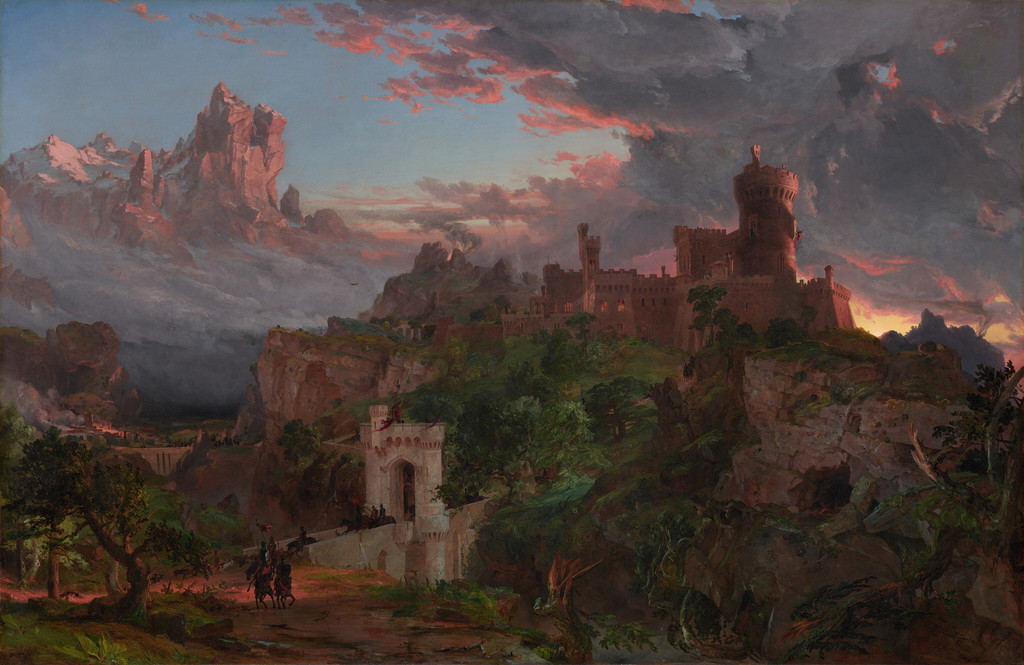
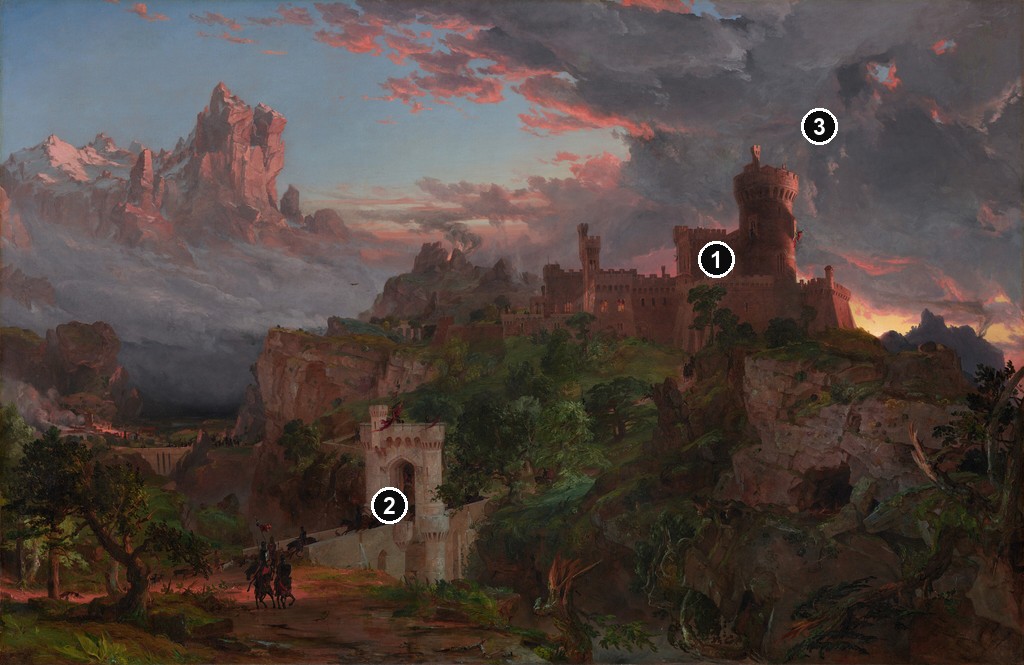
The Spirit of War and The Spirit of Peace are companion landscapes of 1851. The first places a castle above a dark valley and martial movement at dawn; the second uses a classical temple, harbour and warmer setting for a different social vision. Chotner and Woodmere discuss their imaginary settings and historical associations. [1] [5]
The contrast makes architecture part of the subject rather than a decorative addition. Walls, towers, temple and harbour help distinguish the worlds being presented. Their relation to the figures and surrounding country gives the pair its larger argument.
These are painted allegories, not records of two actual places Cropsey visited. They belong to a historical context that includes the Mexican-American War, but their 1851 date should not be turned into a literal prediction of the later Civil War. [1] [5]
The whole reproductions also have different capacities. The available Peace image supports a broad comparison of temple, harbour and foreground activity. Its smaller resolution does not support the same close-detail examination as the larger War source.
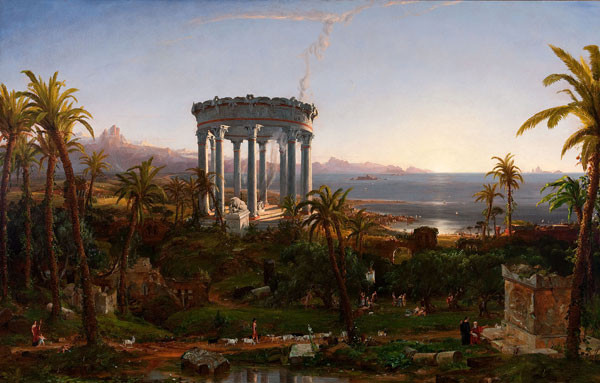
Jasper Francis Cropsey, The Spirit of Peace, 1851. Woodmere, Charles Knox Smith bequest. The smaller source supports a whole-picture comparison. Jasper Francis Cropsey / Woodmere, via Wikimedia Commons. Image source. Public domain. Proportionally resized only; full carrier, margins and native appearance retained.
Annotated Details from Jasper Cropsey Paintings
The numbered points identify visible features discussed in this article. Return from each detail to the whole composition. The captions keep each work’s identity, date and medium separate.
The Spirit Of War
Jasper Francis Cropsey, The Spirit of War, 1851. National Gallery of Art, 1978.12.1, Avalon Fund. The castle is an invented composite within an allegorical landscape. Jasper Francis Cropsey / National Gallery of Art, Washington. Image source. CC0 / Public domain. Separate resized overview with numbered points; details cropped from the original, without recolouring, retouching or enlargement.
Valley Of Wyoming
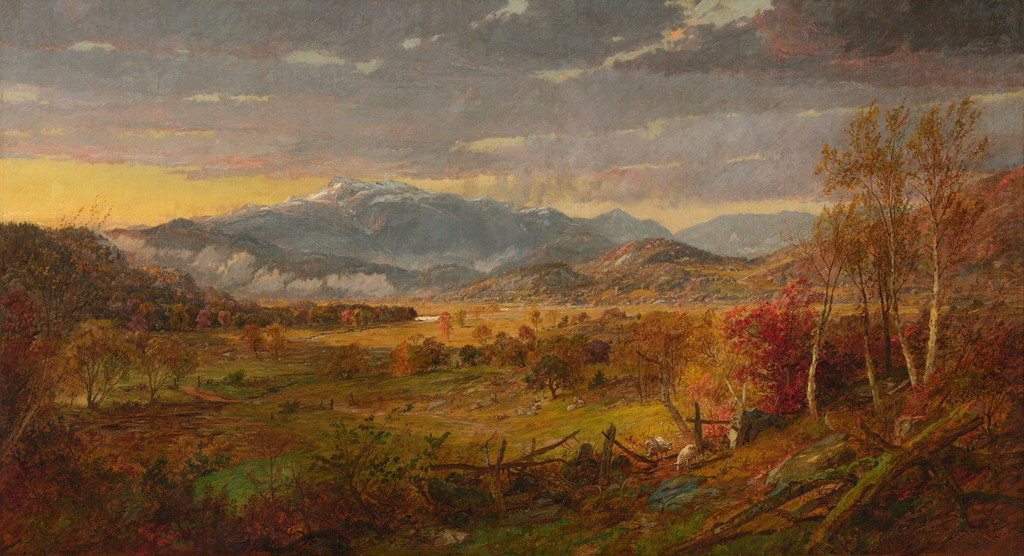
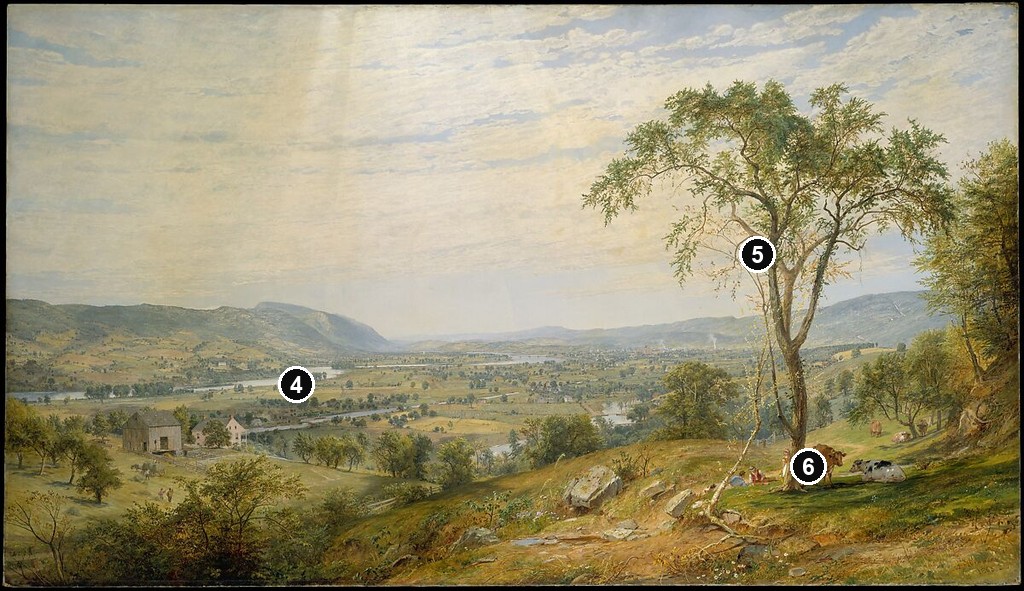
Jasper Francis Cropsey, The Valley of Wyoming, 1865. Oil on canvas, 123.2 × 213.4 cm. Metropolitan Museum of Art, 66.113. Gift of Mrs. John C. Newington, 1966. This reproduction shows the canvas; the original frame’s poem is discussed from museum and catalogue records. Jasper Francis Cropsey / The Metropolitan Museum of Art,66.113. Image source. CC0 1.0. Separate resized overview with numbered points; details cropped from the original, without recolouring, retouching or enlargement.
Details from JASPER CROPSEY PAINTINGS
Compare the cropped details with the complete images above. Notice how their colours, shapes and positions contribute to the larger compositions.
The Spirit Of War
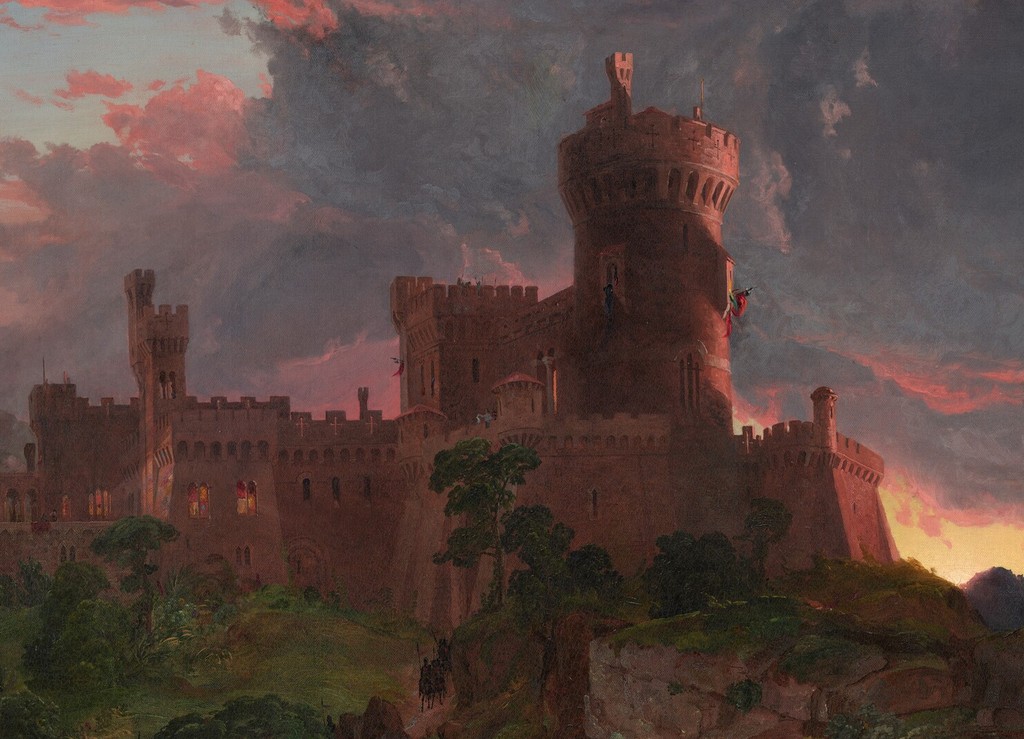
Castle above the rocky ground
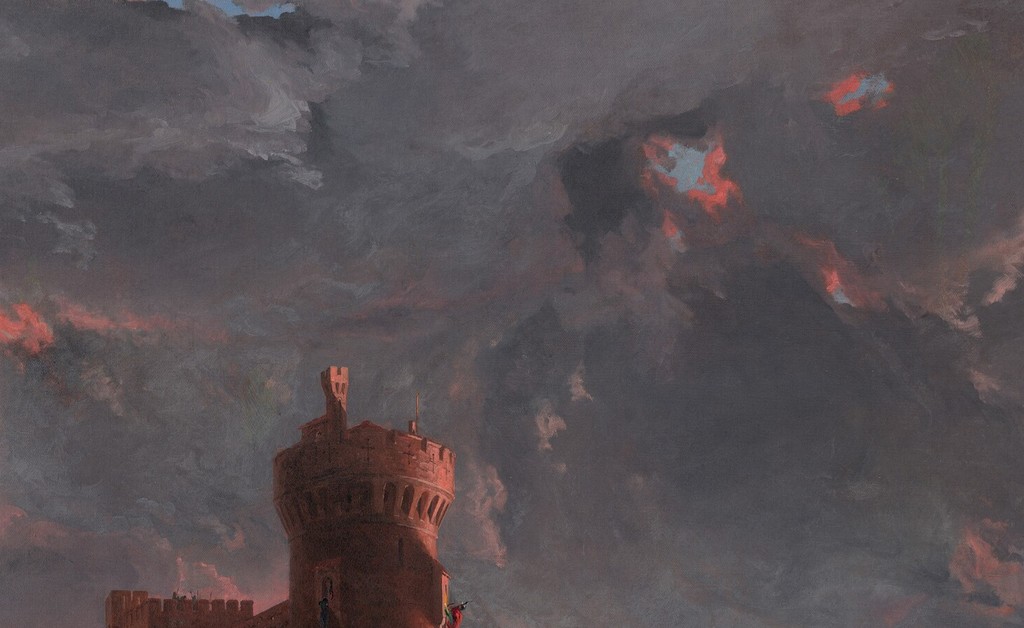
A massive castle stands above steep rocky ground. Towers, walls and narrow openings form a dense silhouette against the changing sky.
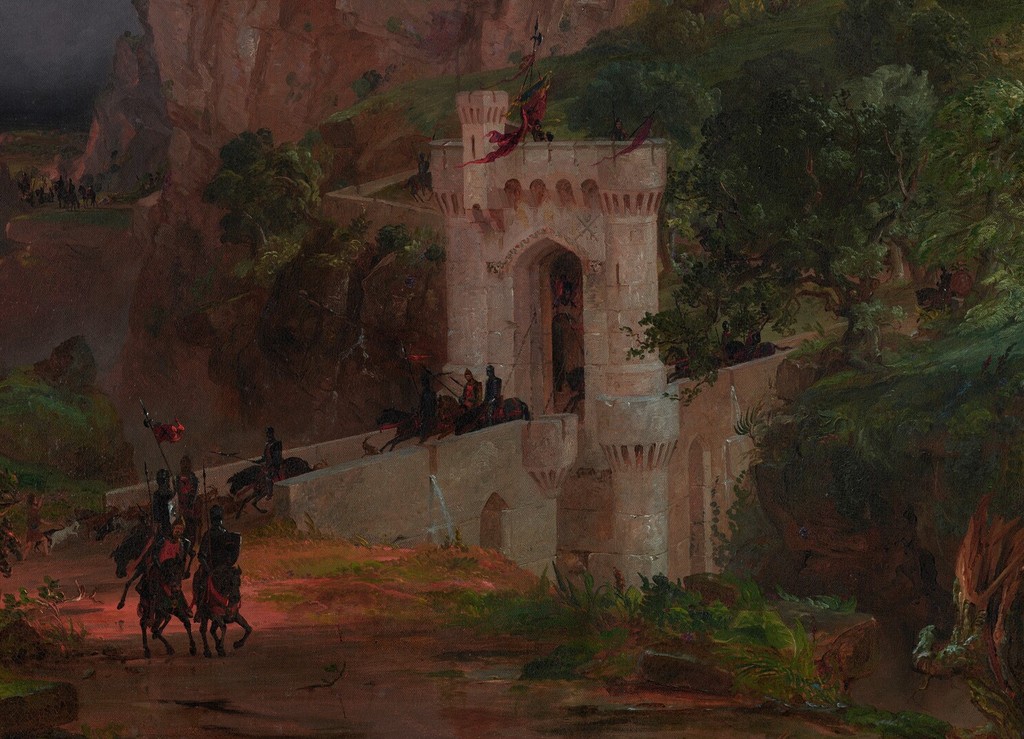
Gate, bridge and mounted figures
A pale gate and narrow bridge connect the castle with the near road. Mounted figures give scale to the steep approach without identifying a historical battle.
Red light and gathering cloud
Red light runs through the dark clouds above the castle. The colour links the threatening sky with the warm stone below.
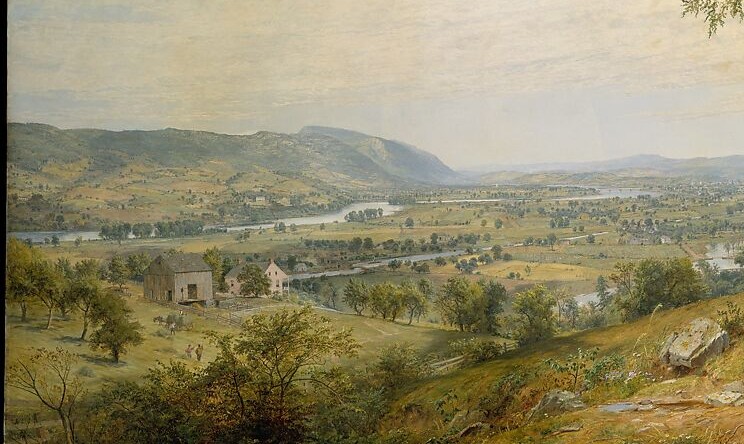
Valley Of Wyoming
Settlement within the broad valley
Buildings, fields and the winding waterway occupy the valley. The broad native crop preserves their arrangement; it does not identify every small structure.
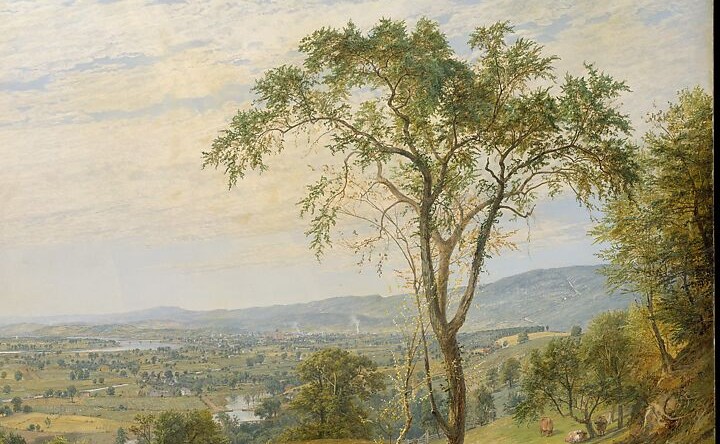
Near tree and distant hills
A large near tree overlaps the distant hills and sky. Its scale establishes the difference between the viewing foreground and the far valley.
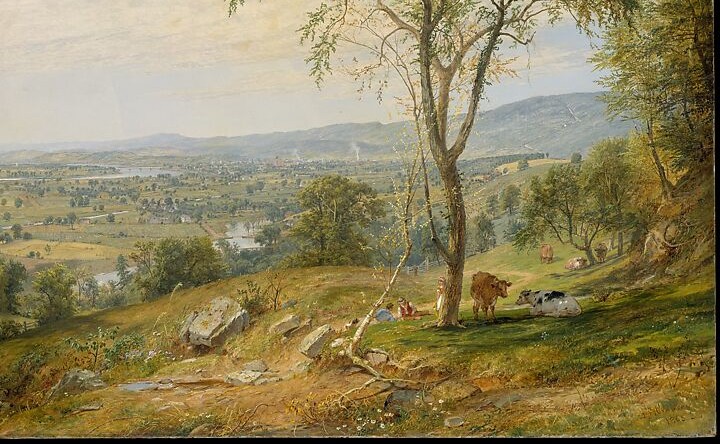
Figures and cattle on the near slope
Small figures and cattle occupy the near sloping ground beneath the tree. Their broad setting remains visible; tiny facial and animal details are not inferred.
An actual castle in an arranged prospect
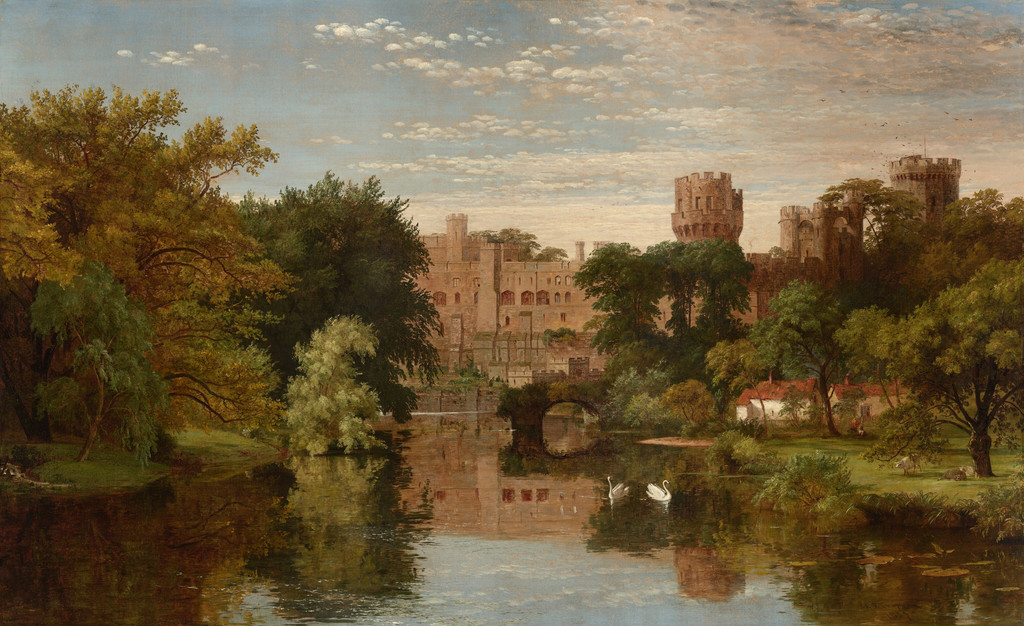
Warwick Castle, England is a different architectural subject, dated 1857. Chotner traces Cropsey’s visits and drawings, a patron’s involvement and the choices made in the finished picture. A recognisable site becomes a carefully organised river view. [1]
The castle’s solid forms are balanced by water, trees and near birds. Reflection and foliage help connect the building with the surrounding landscape. Comparing it with War shows the difference between observed architecture developed pictorially and an imaginary historical setting.
The documented preparatory material does not make the final painting a measured survey. Chotner discusses additions and possible associations, keeping the work’s arrangement visible within its history. A particular landmark can remain recognisable while the artist shapes the viewer’s experience. [1]
Autumn as a public subject
Autumn—On the Hudson River was completed in London in 1860. Its large scale and American foliage made it a substantial presentation of scenery to British viewers. Chotner discusses its critical reception, the credibility of its colour and its exhibition history. [1]
The composition joins strongly coloured near trees with a much paler river distance. The opening between the foreground groups permits an extensive view, while water, fields and small signs of activity give the country several layers of use.
Its history demonstrates that an American subject could be produced and received abroad. The painting is linked to remembered and studied scenery, yet its public life belongs partly to London. The autumn guide compares this panorama with other seasonal arrangements rather than treating its palette as a formula for all Cropsey landscapes.
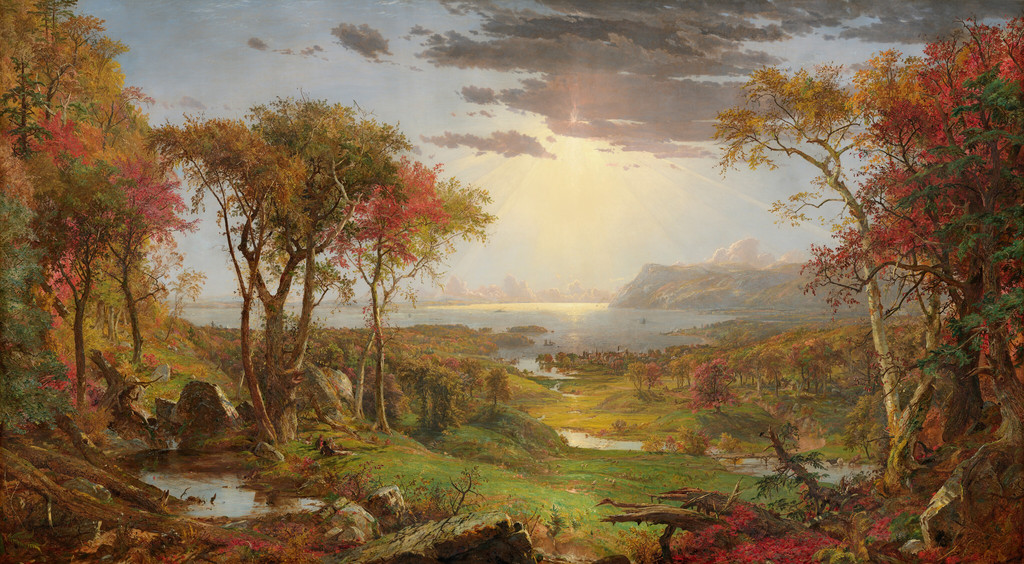
Jasper Francis Cropsey, Autumn—On the Hudson River, 1860. National Gallery of Art, 1963.9.1. An American panorama completed in London. Jasper Francis Cropsey / National Gallery of Art, Washington. Image source. CC0 / Public domain. Proportionally resized only; full carrier, margins and native appearance retained.
Railways and cultivated valleys
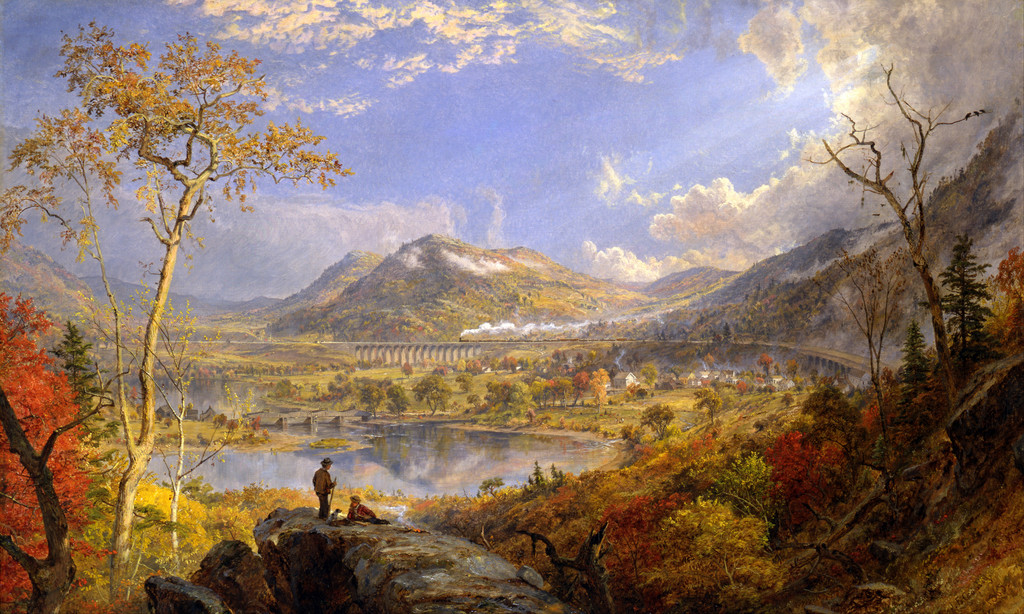
Starrucca Viaduct, Pennsylvania of 1865 places a railway inside a broad autumn valley. The exact surviving Toledo painting is accession 1947.58. Rebora distinguishes it from a much larger lost lottery canvas and considers its relation to period travel imagery and later prints. [2] [12]
The train is one moving element among settlement, fields, water and mountain slopes. Its pale smoke finds a relation with brighter clouds, while two foreground viewers occupy a separate place of contemplation. The whole picture makes industrial movement attractive within a larger landscape.
Valley of Wyoming, also dated 1865, shows Pennsylvania river country with cultivated ground, buildings, figures and animals. Rebora traces the commission and studies; the Met’s current record discusses the original frame’s literary association and the painting’s historical meaning. [2] [13]
The two works help explain why inhabited scenery matters in Cropsey’s art. Attractive expanses are organised around places of work, movement or settlement. Their harmony can be enjoyed while also examined through the histories that shaped the views.
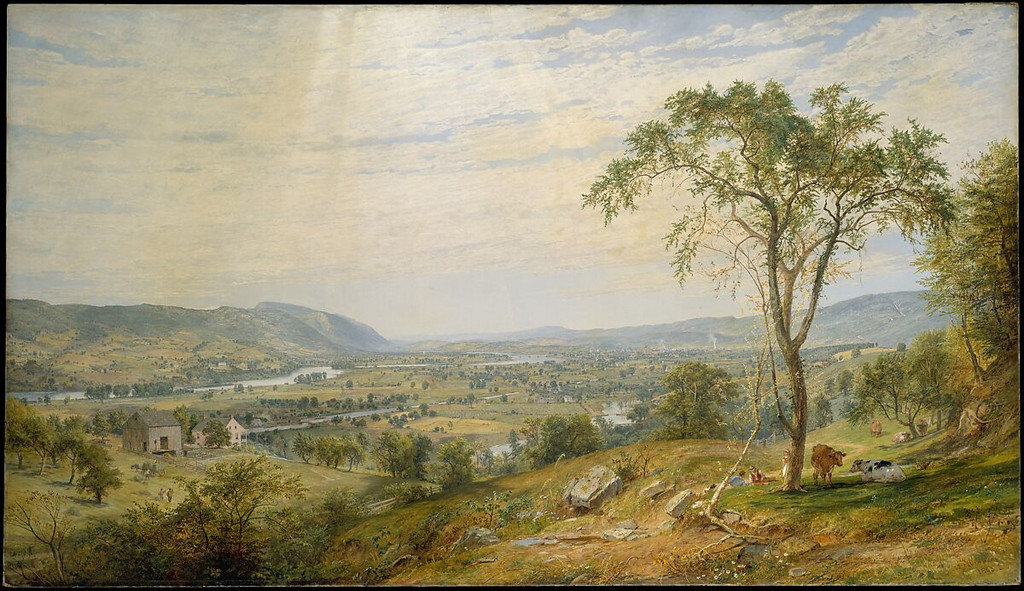
Jasper Francis Cropsey, Valley of Wyoming, 1865. Metropolitan Museum of Art, 66.113. Cultivated Pennsylvania river country. Jasper Francis Cropsey / The Metropolitan Museum of Art,66.113. Image source. CC0 1.0. Proportionally resized only; full carrier, margins and native appearance retained.
Italy, sea and weather
The Coast of Genoa is a large oil of 1854 at the Smithsonian American Art Museum, accession 1984.162. It belongs to the Italian material developed after Cropsey’s first European journey, rather than proving that he was still travelling in Italy in the year of completion. [1] [4]
The whole canvas combines a rocky coast and tower with boats, moving water and distant pale mountains. Sea and sky give the subject a different energy from the quieter lake panoramas. The snowy distance remains a visible form without an unsupported identification of one exact peak.
The Met’s Torre dei Schiavi, The Roman Campagna, dated 1847, is another distinct Italian oil, accession 2025.267. Its museum record gives the medium and history, but supplied no image during this research. The album drawing of the same subject belongs to the drawings guide; it is not used as a replacement illustration for this painting. [9]
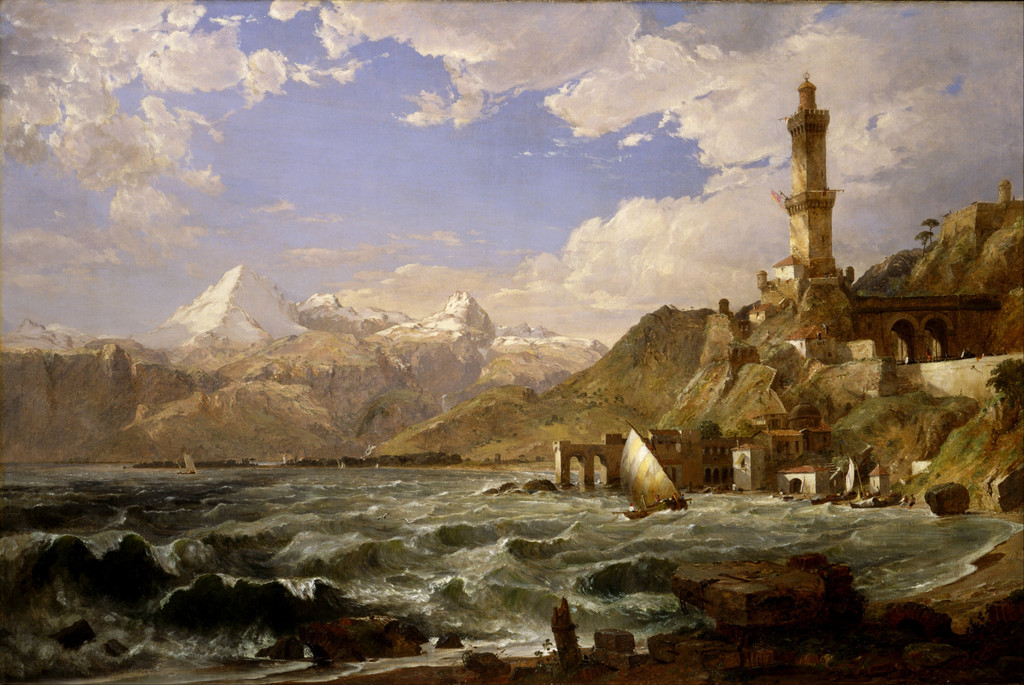
Jasper Francis Cropsey, The Coast of Genoa, 1854. Smithsonian American Art Museum, 1984.162. Italian material developed after his first European journey. Jasper Francis Cropsey / Smithsonian American Art Museum, via Google Art Project. Image source. Public domain. Proportionally resized only; full carrier, margins and native appearance retained.
Summer and composite country
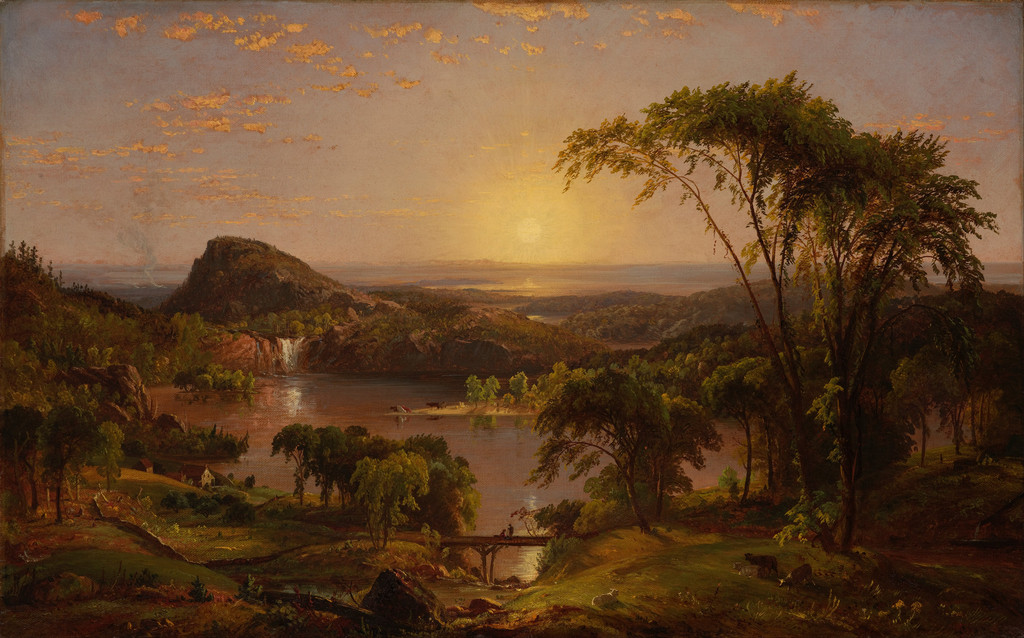
Summer, Lake Ontario is dated 1857 and belongs to Newfields, accession 71.13. The museum describes it as an idealised composition combining motifs from different locales. Its title identifies a subject association without guaranteeing one literal waterfront prospect. [7]
The picture’s near enclosure, waterfall and lighter distance make a route through contrasting forms. Foliage surrounds moving water while the farther country opens beyond it. Seasonal character is built into a composition whose parts need not all derive from one spot.
The example is useful beside the Hudson panorama. Both can connect observed material with arrangement, though their seasons and spatial structures differ. Composite scenery belongs to Cropsey’s practice alongside more specifically documented sites.
Watch: Jasper Cropsey
Look closely at Cropsey’s Mount Jefferson, then explore the wider Hudson River School tradition.
Summer or Autumn? Picturing the American Republic
Smarthistory discusses Cropsey’s seasonal landscape and the image of the American republic.
Watch on YouTubeClose observation on a small board
Trees and a Stream of 1853 is an oil on board at the Cleveland Museum of Art, accession 1977.118. The museum associates it with outdoor study, probably in Massachusetts. Its modest vertical format concentrates on an enclosed woodland rather than an extensive national prospect. [6]
Trunks, rocks and bright moving water create the principal structure. The eye meets several near surfaces before reaching the darker trees beyond. Its scale invites comparison with Cropsey’s larger landscapes without reducing it to an unproven preparatory exercise.
The probable location remains qualified. No exact later canvas is assigned as its destination, and the trees are not given confident species names on the strength of the image. The board’s visible arrangement already supplies a valuable example of a different kind of looking.
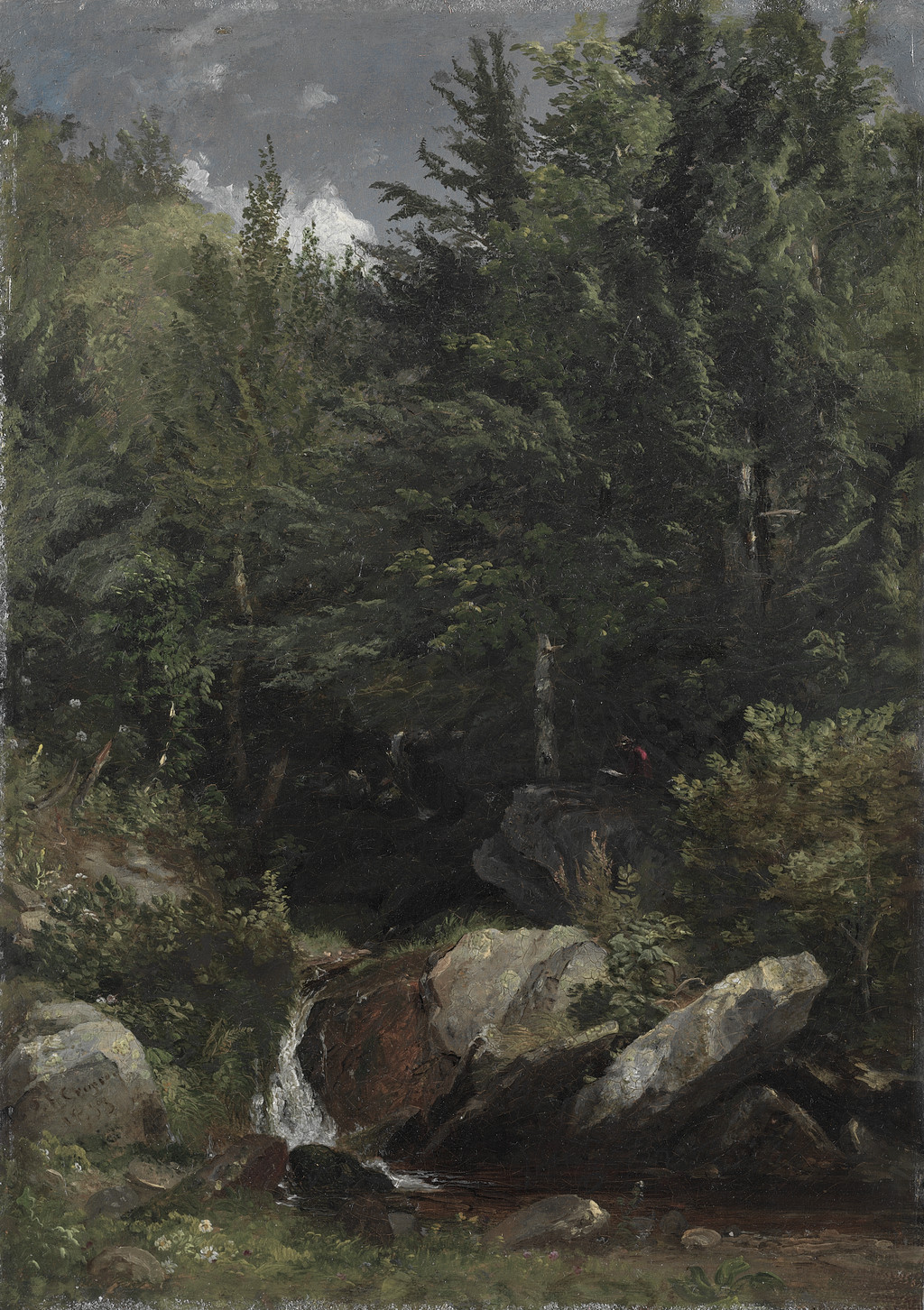
Jasper Francis Cropsey, Trees and a Stream, 1853. Oil on board, Cleveland Museum of Art, 1977.118. Jasper Francis Cropsey / Cleveland Museum of Art. Image source. CC0 1.0. Proportionally resized only; full carrier, margins and native appearance retained.
Lakes and a local mountain
The Smithsonian’s Greenwood Lake is dated 1875, accession 1967.125. Its broad water interval is surrounded by warm shores, near activity and distant hills. It is a separate painting from the Thyssen-Bornemisza museum’s larger Greenwood Lake of 1870. [3] [11]
The repeated subject demonstrates continuing interest in a familiar region. A lake could be revisited and rearranged, with the weight of figures, boats, shoreline and sky changing from one composition to another. A shared title does not erase the identities of the individual canvases.
Sugar Loaf Mountain, Orange County, New York is dated about 1870–75 by the Met. Maddox’s study corrected its earlier Mount Chocorua subject identification through comparisons with regional topography and related material. The correction concerns the depicted mountain, not a change of artist attribution. [14] [15]
Its rounded height concentrates the distance above fields and a pale house. Familiar country and deliberate emphasis work together. The current approximate date remains preferable to inventing an exact year from later comparative drawings.
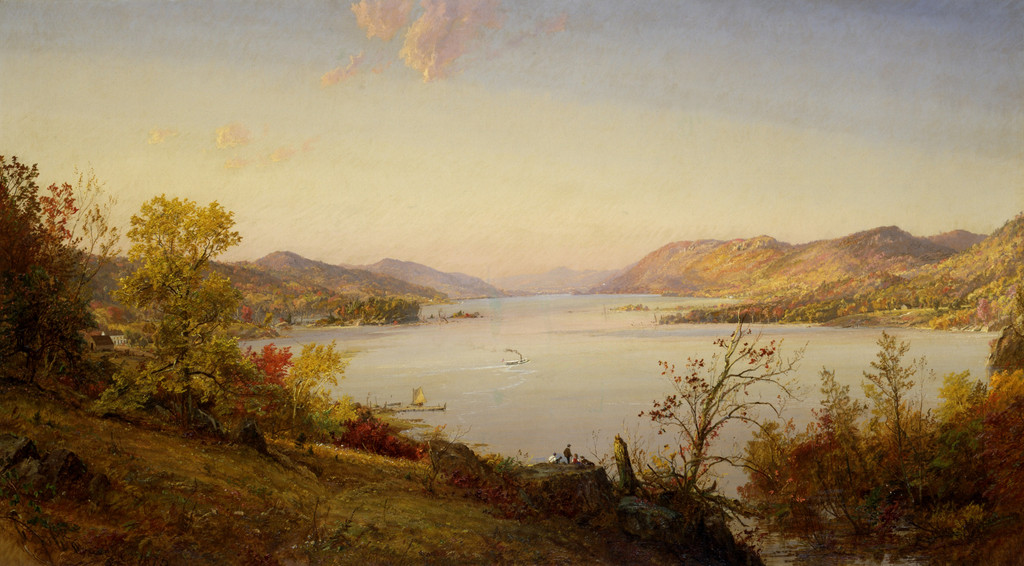
Jasper Francis Cropsey, Greenwood Lake, 1875. Smithsonian American Art Museum, 1967.125. Separate from the Thyssen painting of 1870. Jasper Francis Cropsey / Smithsonian American Art Museum. Image source. Public domain. Proportionally resized only; full carrier, margins and native appearance retained.
Mountains and a resort
View of Mt. Washington is the National Gallery of Art’s canvas of 1881, accession 2015.19.157. It should be distinguished from other Mount Washington paintings with different dates and collections. Repeated subject matter requires the same care as the Greenwood Lake views. [10]
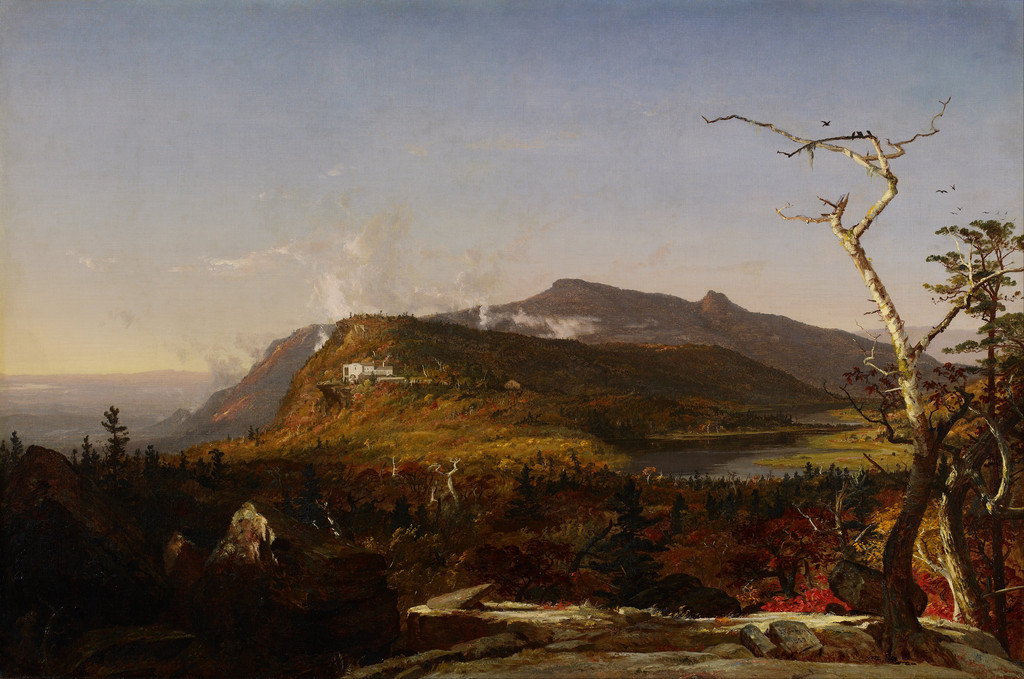
Catskill Mountain House of 1855 combines a dramatic landscape with a functioning resort. Rebora discusses the painting’s relation to earlier drawings and Cole’s example, while the museum-supplied record identifies the Minneapolis canvas as accession 31.47. [2] [16]
The hotel’s distant position can invite associations with historical architecture, but it was not a literal abandoned ruin. The picture joins natural scenery with a modern place of leisure. Its individual history adds another form of human use to the selected landscapes.
Later seasons and changing audiences
The Brandywine Museum’s 2025 labels discuss Autumn on the Brandywine of 1887, accession 81.7, through a regional trip and changing later demand. The work is considered here through that record rather than illustrated with an unverified image. [8]
Chotner describes a shift in taste that made Cropsey’s detailed, dramatically composed landscapes less fashionable. He nevertheless continued working and exhibiting, with increasing attention to watercolour after his 1893 stroke. The later career belongs to a changing practice and audience, not a sudden absence of art. [1]
The selected museum directory gives routes into that varied record. A painting entry should identify its actual medium, date and collection, while a drawing, print or building retains its own category. Reading across those identities makes the range clearer without claiming a complete lifetime count.
Artworks directory
A selected directory of 18 paintings, two drawings and three architectural projects. Repeated subjects retain distinct object identities. Links lead to a companion article where available, otherwise the consulted institutional record. Unillustrated objects remain searchable; this is not a complete catalogue raisonné.
Frequently Asked Questions
His selected works also include woodland study, summer, maritime scenes, English architecture and imaginary historical landscapes. [1]
It is a selected museum-based guide. The individual artwork pages provide deeper histories of the illustrated works.
Discussion
Look again at the images and ideas explored in Jasper Cropsey Paintings. These editorial prompts invite your observations.
Reader Insights
Which selected painting most changes your understanding of his range?
How does close woodland study compare with an extensive panorama?
Where do buildings or transport become part of the landscape’s meaning?
Join the Conversation
Share a detail, comparison or question about Jasper Cropsey Paintings below.
References
- Deborah Chotner, Cropsey biography and painting entries, American Paintings of the Nineteenth Century, Part I, National Gallery of Art (1996), printed pp.109–122. Career, War, Warwick, Autumn and changing audiences. View source
- Carrie Rebora, selected Cropsey entries, American Paradise: The World of the Hudson River School, Metropolitan Museum of Art (1987), printed pp.200–216. Catskill, Wyoming and Starrucca histories. View source
- Smithsonian American Art Museum, Greenwood Lake, accession 1967.125. Exact 1875 canvas. View source
- Smithsonian American Art Museum, The Coast of Genoa, accession 1984.162. Exact 1854 canvas. View source
- Woodmere, The Spirit of Peace. Companion allegory of 1851 and its interpretation. View source
- Cleveland Museum of Art, Trees and a Stream, accession 1977.118. Oil-on-board study of 1853 and probable location. View source
- Newfields, Summer, Lake Ontario, accession 71.13, via Google Arts & Culture. Museum account of the 1857 composite composition. View source
- Brandywine Museum of Art, Cropsey, Wyeth, and the American Landscape Tradition, 2025 large-print labels, PDF pp.8–9. Later Brandywine painting, trip and audience. View source
- Metropolitan Museum of Art, Torre dei Schiavi, oil of 1847, accession 2025.267. Separate painting with no image supplied during research. View source
- National Gallery of Art, View of Mt. Washington, accession 2015.19.157. Exact canvas of 1881. View source
- Museo Nacional Thyssen-Bornemisza, Greenwood Lake, inventory 496 (1983.39). Separate canvas of 1870. View source
- Toledo Museum of Art, Starrucca Viaduct, Pennsylvania, accession 1947.58. Exact 1865 canvas. View source
- Metropolitan Museum of Art, Valley of Wyoming, accession 66.113. Exact 1865 Pennsylvania painting and frame context. View source
- Metropolitan Museum of Art, Sugar Loaf Mountain, accession 61.262. Current title and date about 1870–75. View source
- Kenneth W. Maddox, A Forgotten Mountain: Jasper F. Cropsey’s Paintings of Sugar Loaf, Metropolitan Museum Journal, 35 (2000), pp.221–236. Revised subject identification and regional comparisons. View source
- Minneapolis Institute of Art, Catskill Mountain House, accession 31.47, via Google Arts & Culture. Exact museum-supplied record of the 1855 canvas. View source
- Splash image source.
Jasper Francis Cropsey, The Spirit of War, 1851. National Gallery of Art, 1978.12.1. An imaginary martial landscape at dawn. Jasper Francis Cropsey / National Gallery of Art, Washington. CC0 / Public domain. Proportionally resized only; full carrier, margins and native appearance retained.
View source