 by Tom Gurney
Tom Gurney BSc (Hons) is an art history expert with over 20 years experience
Email: tomgurney1@gmail.com / Phone: +44 7429 011000
Trees and a Stream by Jasper Cropsey: Introduction
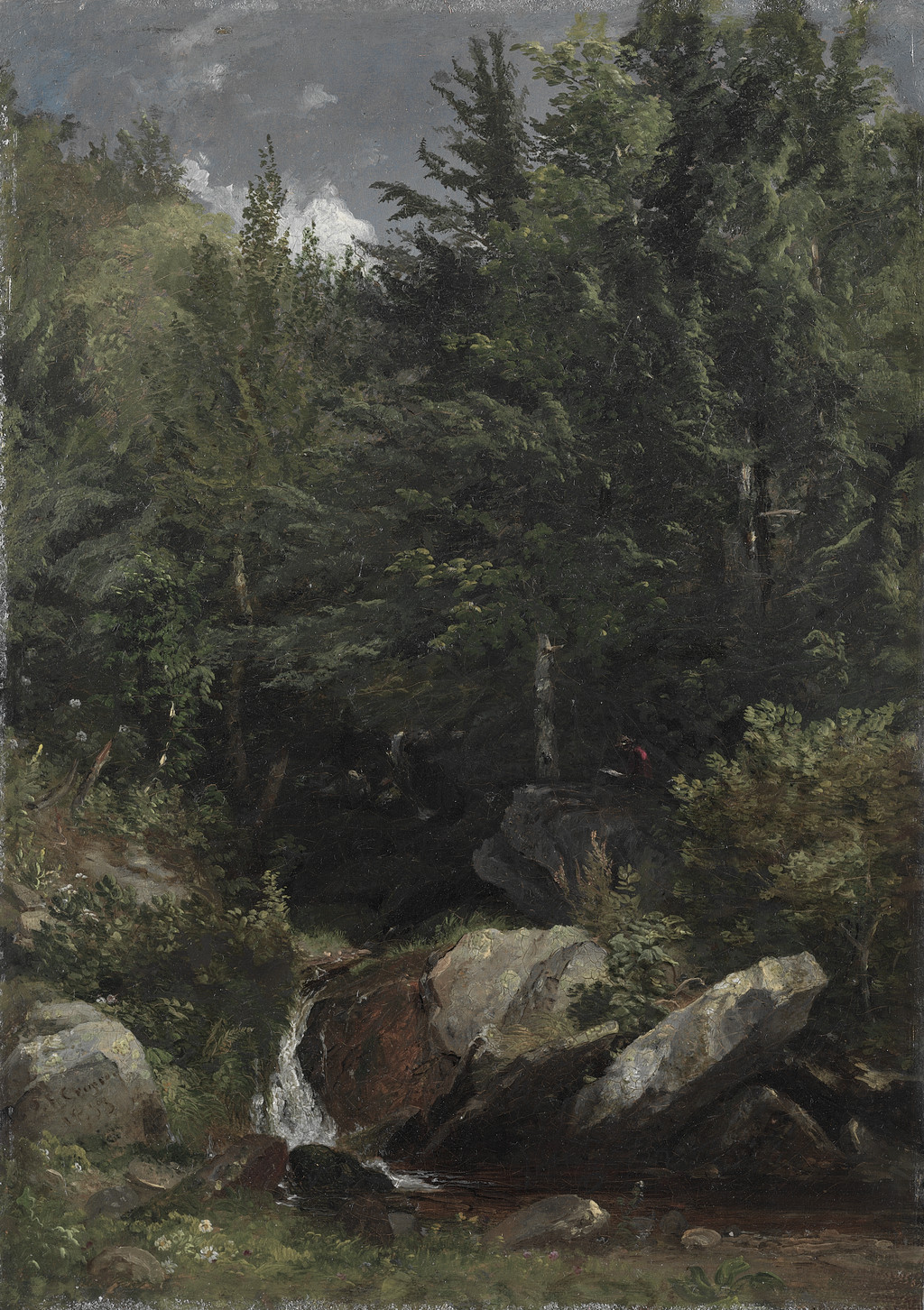
Jasper Cropsey’s Trees and a Stream brings the viewer close to a wooded watercourse. Instead of opening immediately onto a broad river valley, the small vertical painting follows water between rocks beneath a dense gathering of trees. The Cleveland Museum of Art dates this oil on board to 1853 and describes its setting as probably connected with Cropsey’s summer sketching in Massachusetts. The location remains a probability, rather than an identified stream. [1]
The picture offers a useful way into Cropsey’s work: its interest lies in the structure of a near landscape, where foliage, trunks and stone repeatedly interrupt the route into depth. The eye has to negotiate this country before it reaches the sky.
At a Glance
- Artist: Jasper Francis Cropsey
- Title: Trees and a Stream
- Date: 1853
- Medium: Oil on board
- Dimensions: 33.9 × 23.9 cm
- Collection: Cleveland Museum of Art
- Accession: 1977.118
- Location: Probably associated with Massachusetts sketching; exact site unconfirmed
This work across Jasper Cropsey’s career
Contents
- A vertical landscape at a small scale
- Following the water between rocks
- Trees within a wooded interior
- The probable sketching context
- Close attention and a larger imaginary landscape
- Annotated details
- The small figure within the woodland
A vertical landscape at a small scale
At less than thirty-four centimetres high, the board presents a markedly different encounter from a large panorama. Its narrow format lets Cropsey build the landscape upward. The foreground stones establish the base, the stream climbs through the centre, and successive trees lead toward the upper edge. The museum’s dimensions make the painting’s intimate physical scale clear. [1]
That upward movement does not turn the scene into a simple diagram. Some rocks project toward the viewer, while other forms disappear into shade. The water changes direction as it works through them. Trees overlap across the stream’s route, making the woodland feel thicker than a single line of trunks.
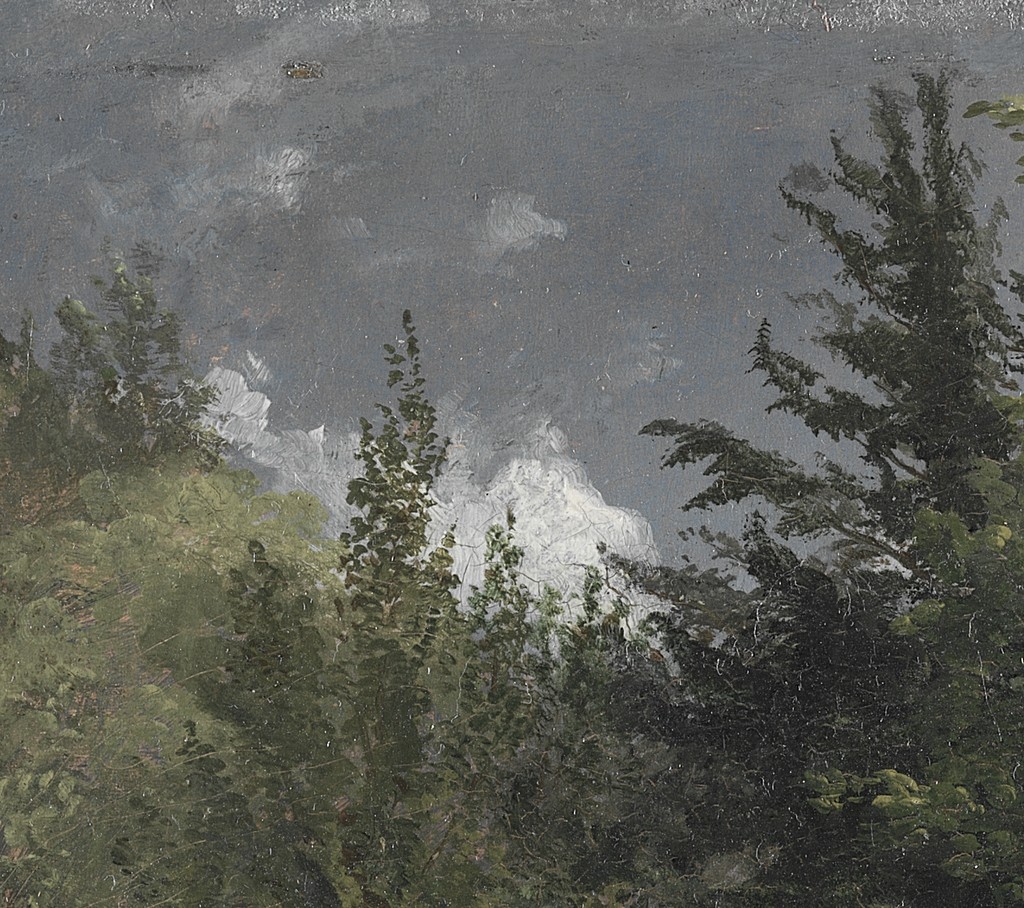
The picture’s uppermost opening is small. Pale sky appears beside the dark trees, but it does not provide the expansive destination found in many of Cropsey’s better-known paintings. Here, the enclosing vegetation remains the main experience. The sky helps distinguish the tree shapes and gives the shaded interior a measure of light.
Annotated Details from Trees and a Stream
The numbered points identify visible features discussed in this article. Return from each detail to the whole composition. Jasper Francis Cropsey, Trees and a Stream, 1853. Oil on board, 33.9 × 23.9 cm. Cleveland Museum of Art, 1977.118. A separate work, probably made during a summer stay in Massachusetts. Jasper Francis Cropsey / Cleveland Museum of Art. Image source. CC0 1.0. Separate resized overview with numbered points; details cropped from the original, without recolouring, retouching or enlargement.
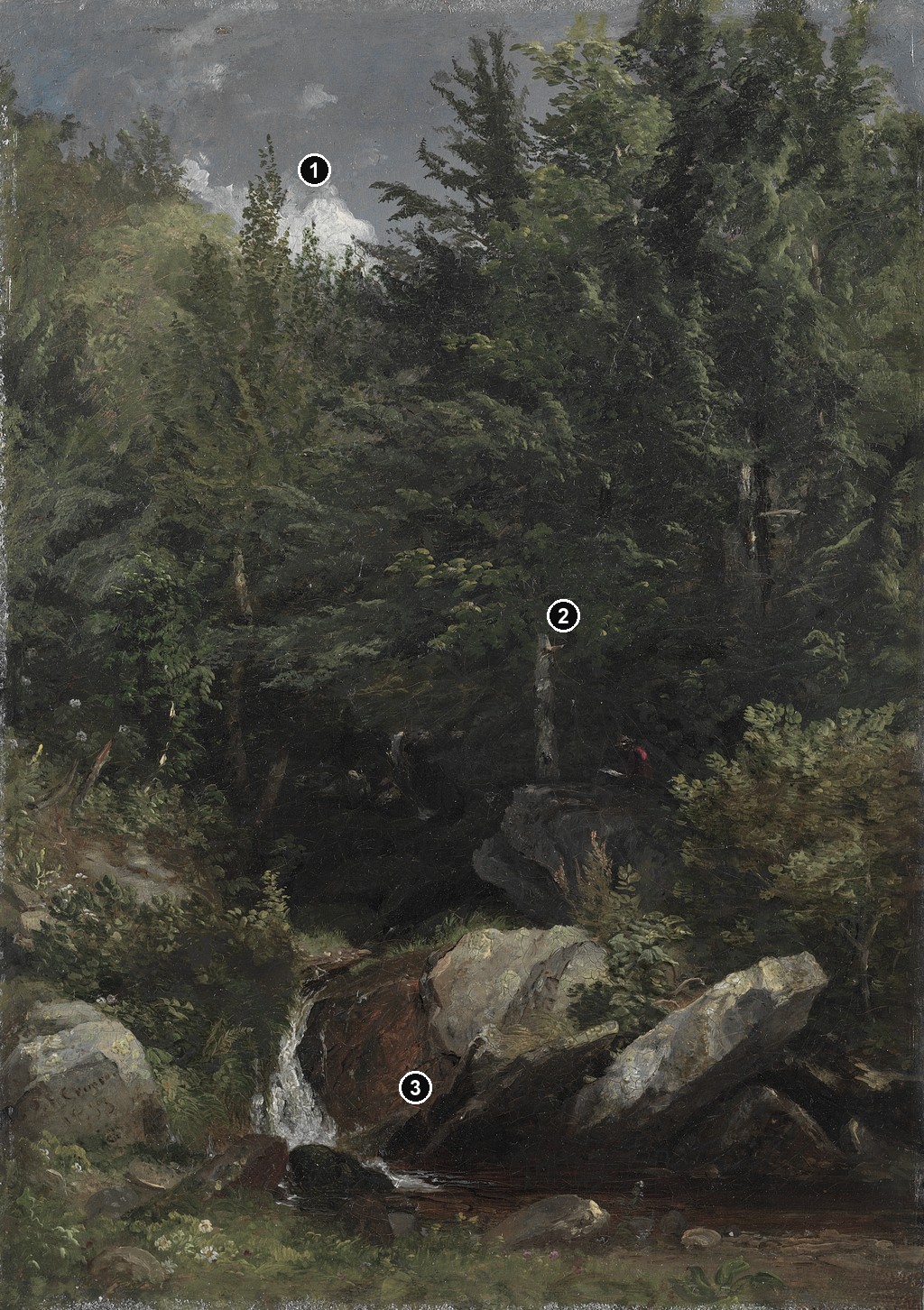
Details from TREES AND A STREAM
Compare the cropped details with the complete images above. Notice how their colours, shapes and positions contribute to the larger compositions.
Pale opening above the woodland
A pale sky opening appears above layered dark foliage. The small opening gives contrast to the enclosed wooded scene.
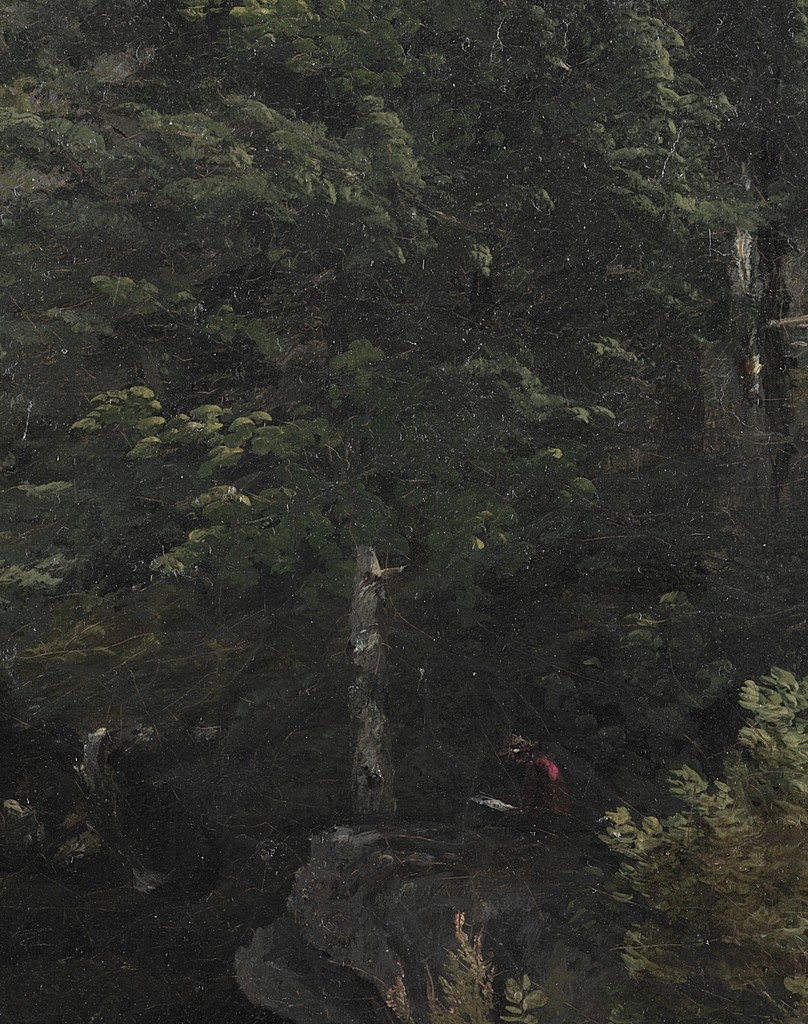
Trunks within the shaded foliage
Narrow trunks emerge unevenly through the shaded foliage. Differences of tone separate their forms without requiring a tree-species identification.
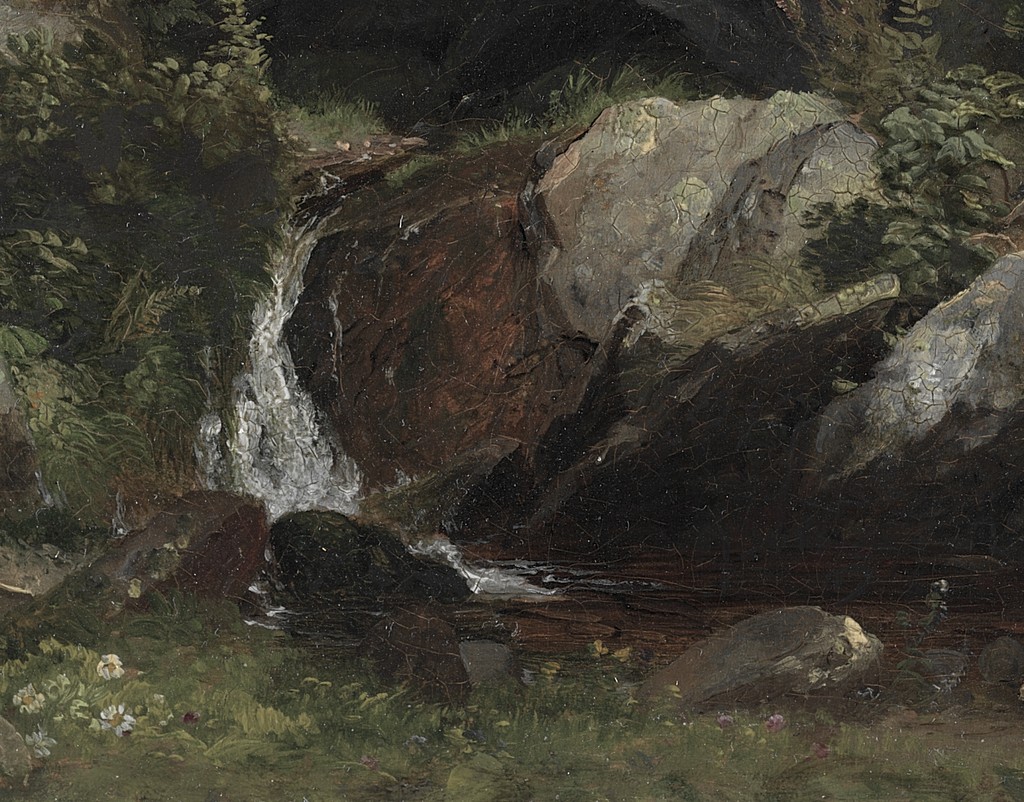
Stream passing between near rocks
A pale stream passes between irregular near rocks into darker water. Light marks along its edge make its descent visible.
Following the water between rocks
The stream provides the clearest connection between the different parts of the foreground. Light marks gather where water falls or moves over uneven stone. Against the darker surrounding surfaces, these passages draw attention to the water’s course without turning the whole stream into one uninterrupted white stripe.
Near the bottom, larger rocks break this movement into separate intervals. Their angled faces catch differing amounts of light, and vegetation grows around their edges. Water, stone and plants occupy the same tight space. The painting rewards following their contact points: a bright fall against a dark recess, a pale rock beside a patch of green, or a thin trunk emerging behind a larger mass.
Farther up, the water becomes less immediately distinct. This reduction is part of the scene’s depth. The stream remains a route through the wood, but the eye cannot follow every section with equal certainty. Shade and overlapping forms partly conceal it.
The irregular stones also prevent an easy passage into the picture. Cropsey has not supplied a smooth road or a welcoming riverside terrace. The near landscape requires attention to obstacles, differences in height and changes of surface. Its sense of movement comes as much from this broken ground as from the flowing water.
Trees within a wooded interior
The trunks are slender in relation to the large foreground rocks. They rise at different intervals, with foliage gathering into dark groups around them. A few lighter passages help separate a trunk from the surrounding vegetation, while other tree forms merge into the shaded interior.
Cropsey varies the outline of the foliage against the sky. Pointed and irregular projections keep the upper edge active. Within the woodland, smaller changes of tone suggest branches and leaves without giving each one the same degree of definition.
The result is a contrast between the solidity of the nearest stones and the complicated layering of the trees. Rocks can be approached as individual masses. The vegetation is harder to separate into a set of isolated objects. Looking through it involves noticing gaps, overlaps and occasional light, rather than counting every branch.
Small lighter marks interrupt the darker greens. Their scattered placement gives the foliage variation without making every part equally prominent. The brightest passages remain close to the water and the exposed rocks, so the woodland’s internal complexity supports the stream’s route through the painting.
Watch: Jasper Cropsey
Look closely at Cropsey’s Mount Jefferson, then explore the wider Hudson River School tradition.
Summer or Autumn? Picturing the American Republic
Smarthistory discusses Cropsey’s seasonal landscape and the image of the American republic.
Watch on YouTubeThe probable sketching context
The museum relates the painting to Cropsey’s probable activity in Massachusetts during the summer of 1853. That qualified identification is valuable because it places the work within his practice of studying American scenery while leaving the exact location open. [1]
Deborah Chotner’s National Gallery of Art biography describes Cropsey’s summer journeys through northeastern regions after his return from Europe in 1849. Such travel supplied material for his growing landscape career before he settled in London in 1856. The biography provides the broader pattern of work; it does not identify this particular stream. [2]
Nor does the label “study” establish a documented connection to one later canvas. A small outdoor subject can matter as a work in its own right. Here, the restricted field gives Cropsey space to explore how closely packed natural forms can produce a coherent view.
Close attention and a larger imaginary landscape
In Summer, Lake Ontario, painted in 1857, water and trees occupy a much wider arrangement. A cascade appears within an extensive landscape that opens toward distant water and light. Its museum describes the scene as an idealised composition combining different places. [3]
The comparison helps distinguish two kinds of landscape construction. Trees and a Stream concentrates on an enclosed piece of country. Summer, Lake Ontario distributes natural features across a broader invented whole. The shared motifs do not prove that the Cleveland board was a preparatory work for that painting.
Comparing the pictures reveals a range beyond distant autumn views. A stream can organise a close wooded interior or become one feature among many in an expansive composition. In this small board, its broken course holds the picture together while keeping the viewer’s attention among the trees and stones.
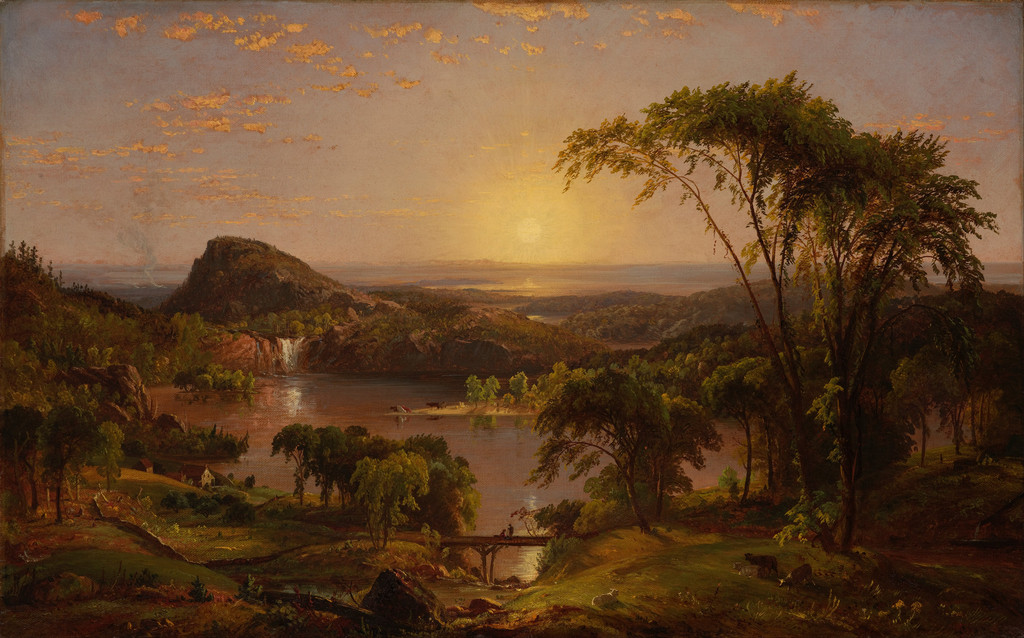
Jasper Francis Cropsey, Summer, Lake Ontario, 1857. Indianapolis Museum of Art at Newfields, 71.13. Gift of the Friends of the Museum. A separate idealised landscape, not a documented painting derived from the Cleveland board. Jasper Francis Cropsey / Indianapolis Museum of Art at Newfields, via Google Art Project. Image source. Public domain. Proportionally resized only; full carrier, margins and native appearance retained.
The small figure within the woodland
The woodland is not entirely without a human presence. A small figure wearing red sits on a dark ledge to the right of centre, above the stream’s brighter foreground falls. The red is easy to miss among the brown rock and deep vegetation. Once noticed, it changes the apparent scale of the surrounding forms: the projecting stones and tall trees become a setting large enough to contain a person.
The figure does not command the view in the manner of a portrait sitter or the protagonist of a narrative scene. Its modest size allows the water and overlapping growth to remain prominent. Moving between that small patch of colour and the distant opening of sky makes the depth of the enclosed landscape more palpable.
Cleveland’s current catalogue uses the fuller title Trees and a Stream on a Hillside. The additional words emphasise the sloping ground visible behind the rocks. This is the same 1853 board, accession 1977.118, given by Mr. and Mrs. Noah L. Butkin, rather than another version of the subject. [1]
Artworks directory
A selected directory of 18 paintings, two drawings and three architectural projects. Repeated subjects retain distinct object identities. Links lead to a companion article where available, otherwise the consulted institutional record. Unillustrated objects remain searchable; this is not a complete catalogue raisonné.
Frequently Asked Questions
The Cleveland Museum of Art proposes a connection with Cropsey’s Massachusetts sketching in the summer of 1853. It does not establish an exact named watercourse. [1]
The museum records a complete oil painting on a small vertical board, measuring 33.9 × 23.9 cm. Its concentrated format belongs to the object itself. [1]
Discussion
Look again at the images and ideas explored in Trees and a Stream by Jasper Cropsey. These editorial prompts invite your observations.
Reader Insights
Which first guides your eye into the wood: the water, the trunks or the light on the rocks?
Does the small opening of sky make the interior feel deeper or more enclosed?
How does the scene’s effect change when you compare it with a wide panorama?
Join the Conversation
Share a detail, comparison or question about Trees and a Stream by Jasper Cropsey below.
References
- Cleveland Museum of Art, Trees and a Stream, accession 1977.118. Current object record and qualified Massachusetts sketching interpretation. View source
- Deborah Chotner, Cropsey biography, American Paintings of the Nineteenth Century, Part I, National Gallery of Art (1996), printed pp.109–110. Consulted biography for northeastern travel and the chronology before London. View source
- Indianapolis Museum of Art at Newfields, Summer, Lake Ontario, accession 71.13, museum record via Google Arts & Culture. Museum interpretation of a landscape combining different locales. View source
- Splash image source.
Jasper Francis Cropsey, Trees and a Stream, 1853. Oil on board, 33.9 × 23.9 cm. Cleveland Museum of Art, 1977.118. Complete supplied image retained. Jasper Francis Cropsey / Cleveland Museum of Art. CC0 1.0. Proportionally resized only; full carrier, margins and native appearance retained.
View source