 by Tom Gurney
Tom Gurney BSc (Hons) is an art history expert with over 20 years experience
Email: tomgurney1@gmail.com / Phone: +44 7429 011000
Warwick Castle by Jasper Cropsey: Introduction
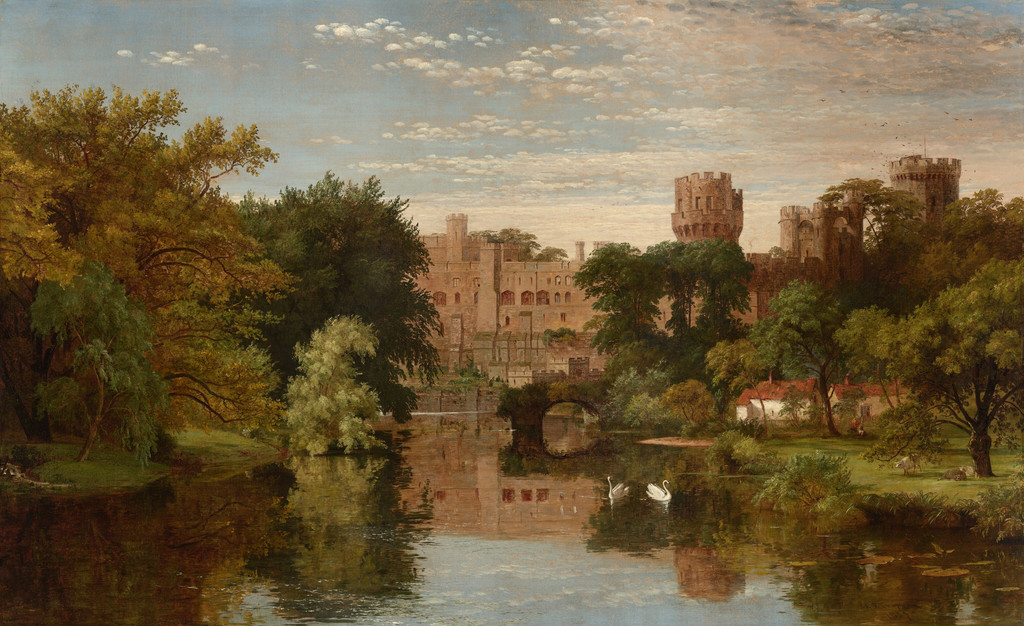
Jasper Cropsey’s Warwick Castle, England brings a substantial English landmark into a quiet river landscape. Painted in 1857, the oil on canvas measures 81.1 × 132.3 cm and belongs to the National Gallery of Art, Washington, accession 1991.142.1. Its towers, reflections, thick foliage and two foreground swans make architecture and surrounding nature equally important to the view. [1]
The picture was commissioned by the American businessman Cyrus W. Field. Deborah Chotner’s NGA catalogue entry relates it to Cropsey’s second English residence and a drawing made at the castle on 30 September 1856. Unlike the invented fortress in The Spirit of War, this painting develops an identifiable site through recorded observation. [2]
At a Glance
- Artist: Jasper Francis Cropsey
- Title: Warwick Castle, England
- Date: 1857
- Medium: Oil on canvas
- Dimensions: 81.1 × 132.3 cm
- Collection: National Gallery of Art, Washington
- Accession: 1991.142.1
- Patron: Cyrus W. Field
- Acquisition credit: Gift of Mr. and Mrs. Norman Hirschl, in Honor of the 50th Anniversary of the National Gallery of Art
This work across Jasper Cropsey’s career
Contents
- An English subject for Cyrus Field
- The river as an approach to the castle
- Towers, walls and foliage
- Two swans in the foreground
- Two visits and a dated drawing
- Paint handling recorded in the NGA catalogue
- An observed castle beside an imagined one
- The canvas in Washington
- Annotated details
An English subject for Cyrus Field
Chotner identifies Field as the commissioner and records a payment on account dated 23 September 1856. Both patron and artist were in London during this period. The painting was completed in time for the National Academy of Design’s spring exhibition in New York in 1857. [2]
These details place an English castle within a transatlantic artistic exchange. Cropsey worked abroad on a landmark subject for an American patron, then sent the canvas to an American exhibition. The work’s history links the observed site with an audience across the ocean.
Field is associated with the transatlantic telegraph enterprise. Chotner considers the castle picture in relation to his connection with England and his role in joining the Old and New Worlds. That is an interpretation of the commission’s significance, rather than a claim that telegraph machinery appears in the landscape. [2]
The subject offered an architectural monument with considerable visual presence. Cropsey could give the castle its weight while surrounding it with the greenery, water and atmospheric space that made it a landscape painting.
Annotated Details from Warwick Castle
The numbered points identify visible features discussed in this article. Return from each detail to the whole composition. Jasper Francis Cropsey, Warwick Castle, England, 1857. Oil on canvas, 81.1 × 132.3 cm. National Gallery of Art, Washington, 1991.142.1. Gift of Mr. and Mrs. Norman Hirschl, in Honor of the 50th Anniversary of the National Gallery of Art. Jasper Francis Cropsey / National Gallery of Art, Washington. Image source. CC0 1.0. Separate resized overview with numbered points; details cropped from the original, without recolouring, retouching or enlargement.
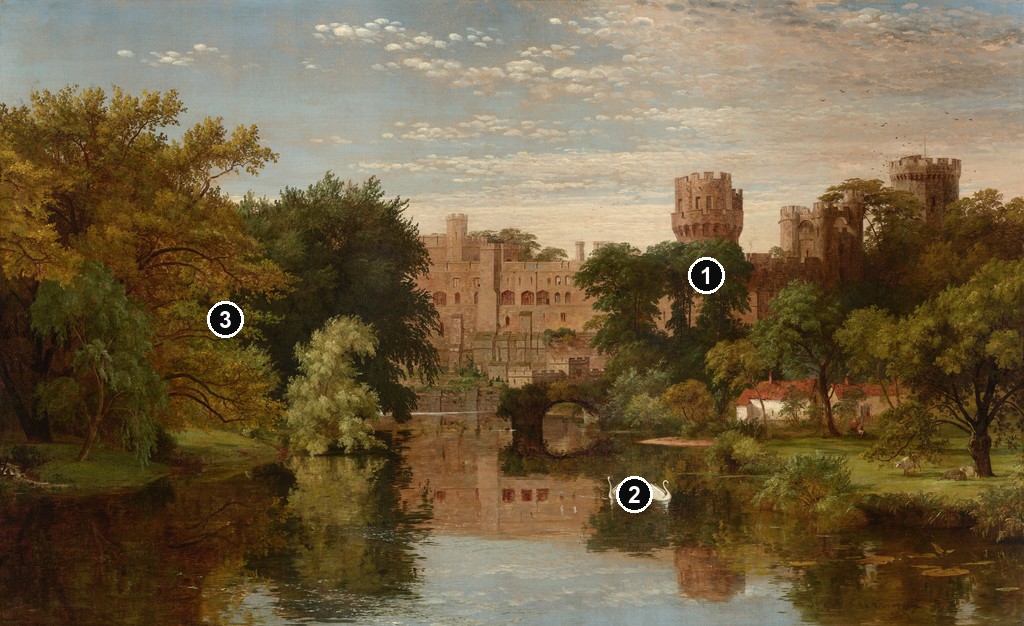
Details from WARWICK CASTLE
Compare the cropped details with the complete images above. Notice how their colours, shapes and positions contribute to the larger compositions.
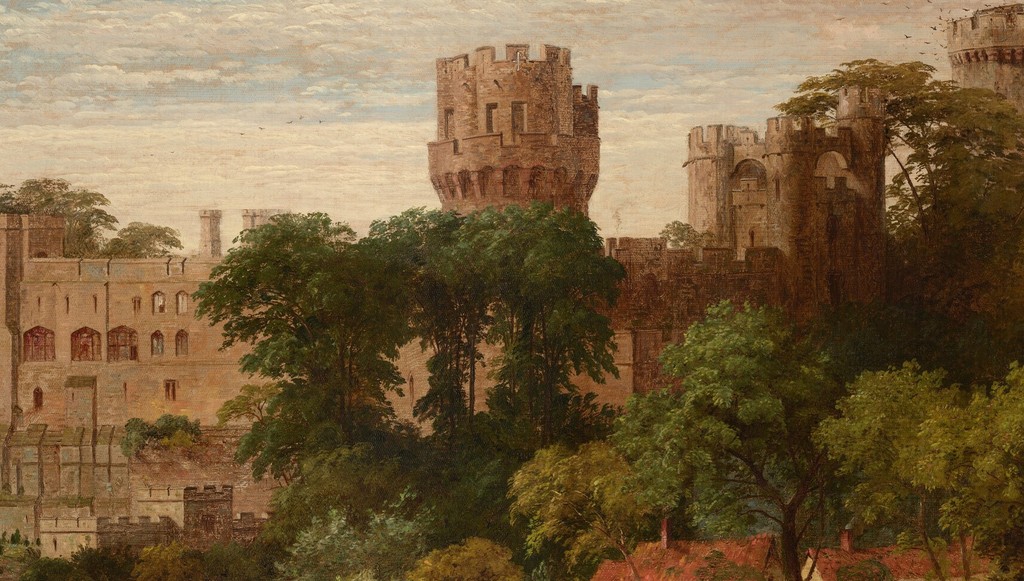
Towers and the river facade
Battlemented towers and the long facade rise above the river. Warm stone contrasts with the surrounding green foliage.
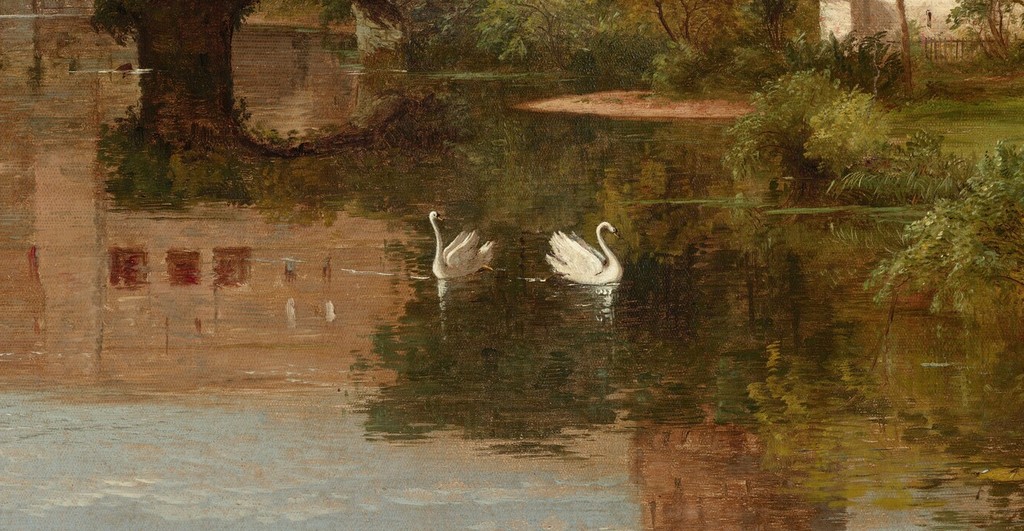
Swans beside the reflection
Two pale swans float beside the reflected building. Their small bright forms punctuate the darker river surface.
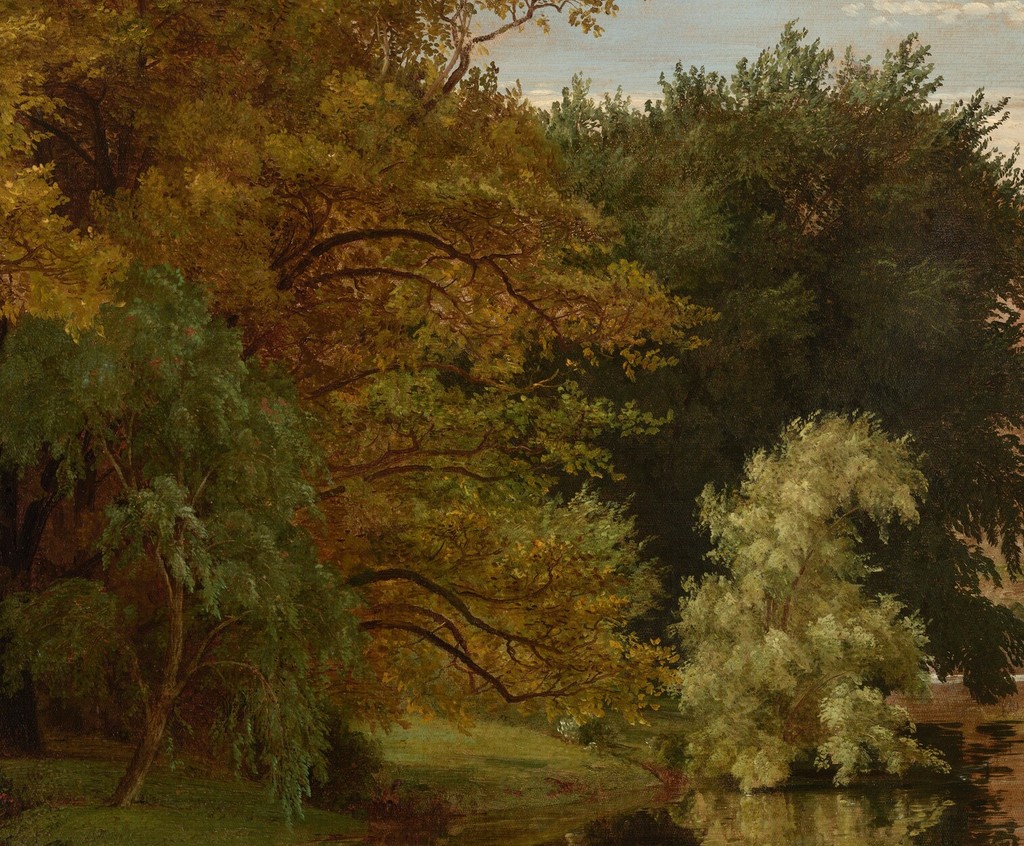
Trees enclosing the left bank
Several differently coloured tree masses fill the left bank. Their overlapping foliage provides a soft counterweight to the castle’s straight edges.
The river as an approach to the castle
The foreground water creates a broad interval between the viewer and the main building. Its surface carries reflections of the castle and trees, joining the solid architecture to a less stable image beneath it. The viewer reaches the building visually through that reflective space.
At the centre, a dark arch and adjoining masonry interrupt the water. The catalogue identifies these as the remains of an older bridge. Their lower position gives the eye a nearer architectural form before it rises toward the main castle. [2]
The river banks are unevenly framed. A dense mass of foliage occupies the left side, while trees and smaller buildings extend along the right. This makes the central water feel like an opening found within a thickly inhabited and wooded setting.
The reflections repeat the verticals of the architecture but soften their edges. A tower that reads clearly above the bank becomes a broken, darker form below it. Cropsey uses the difference between object and reflection to animate an otherwise tranquil foreground.
The water also carries the viewer’s attention across the composition. It reflects both castle and greenery, giving them a shared field. The buildings remain distinct, but their relation to the surrounding trees becomes more continuous when seen through the river.
Towers, walls and foliage
The castle extends across the middle distance in several connected forms. Towers rise above lower walls and rooms, with their separate outlines kept legible against the sky. The architecture has mass, but its long arrangement prevents one tower from occupying the whole scene.
Trees overlap parts of the building and its surroundings. At the left, dense foliage obscures the transition between bank and castle. At the right, trunks and crowns interrupt the masonry at different heights. This overlap keeps the monument within the landscape rather than isolating it against an empty backdrop.
The castle’s warm stone tones connect with the surrounding greens and browns. Bright portions of the architecture provide contrast, while darker foliage gathers around and beneath them. The eye can alternate between the structure’s geometric edges and the more irregular leaf masses.
A low white building with a reddish roof occupies the right-hand bank. Its smaller scale and simpler form help establish the larger castle’s prominence. It belongs to the near inhabited shore without competing with the towers above.
The sky remains comparatively light, with many small cloud passages across it. Their scale differs from the large architectural masses. They provide a varied upper field while leaving the castle’s skyline easy to follow.
Two swans in the foreground
Two white swans stand out near the right of the central water. Their curved forms differ from the angular masonry and upright tree trunks. They provide a compact point of activity within the broader reflections.
Their position is useful for depth. They occupy the water closer to the viewer than the main castle, yet remain small enough to preserve the river’s width. The eye can register them before returning to the buildings farther back.
Chotner notes that the swans do not appear in the 1856 drawing reproduced in the catalogue. Their presence in the finished oil therefore represents a difference between the recorded study and the canvas. The entry suggests a possible allusion to royalty or the Greville family crest, but does not establish that symbolism as certain. [2]
The visible compositional effect is clearer than the proposed heraldic meaning. Their white bodies catch attention within the water, their movement suits the tranquil setting, and their curved necks give the near view a rhythm different from the castle’s repeated verticals.
Watch: Jasper Cropsey
Look closely at Cropsey’s Mount Jefferson, then explore the wider Hudson River School tradition.
Summer or Autumn? Picturing the American Republic
Smarthistory discusses Cropsey’s seasonal landscape and the image of the American republic.
Watch on YouTubeTwo visits and a dated drawing
Cropsey had visited Warwick during his first European journey. Chotner records two sketches dated 30 June 1849, focusing on a tower above the trees. That earlier encounter preceded the commission by several years. [2]
The catalogue associates the NGA oil more directly with Castle and Moat, a pencil drawing on brown paper dated 30 September 1856, now at Yale University Art Gallery, accession 1970.8.1. Its account describes a close correspondence between the drawing and painting, together with working notes on light, water and reflections. [2]
The drawing is discussed here through that published catalogue. Its original sheet has not been independently examined for this article. The catalogue nevertheless supplies a documented relationship much more specific than a general claim that Cropsey sketched castles during his travels.
The study’s notes also show a kind of attention that a finished panorama can conceal. Architecture, water colour, lighter foliage and shadow were considered as separate features to carry into the oil. The completed scene brings those observations together in one continuous view.
Chotner proposes that the vantage point was a bridge across the Avon roughly a quarter of a mile from the castle. The proposal remains a scholarly identification rather than an independently verified modern camera position. [2]
Paint handling recorded in the NGA catalogue
The 1996 technical entry describes a fine plain-weave support that has been lined, with a warm rosy-buff ground. It records thinly applied paint, small areas of impasto in highlights, scumbling in sky and water, and layers of transparent glaze in architecture and foliage. These findings concern this canvas and the examination reported at that time. [2]
The account distinguishes several underlying preparations. Dark foliage, reflections and cottages appear over a transparent brown wash; architecture appears to have been developed over an intervening white layer. Lighter foliage is described with an ochre-toned base beneath coloured glazes. [2]
These observations help explain why the picture should not be reduced to one universal Cropsey recipe. Different parts of the same scene received different kinds of preparation and handling. The architecture and foliage could be coordinated visually while being built in distinct ways.
The entry also records visible changes in a lowered left tree line and a shifted right spire. It reports no major compositional revision. Such changes provide evidence of adjustment within the picture rather than proof that the finished view was transferred mechanically from a drawing. [2]
Those recorded alterations are a different kind of evidence from the freely visible river and swans. They derive from the museum’s study of the painted object. A digital reproduction supports the broad composition; the technical publication supports the more particular account of layers and revisions.
An observed castle beside an imagined one
The Spirit of War, painted in 1851, provides a useful architectural comparison. Chotner treats its fortress as an invented composite, placed within a hostile medieval landscape. Warwick’s building, by contrast, belongs to a named site and a documented drawing relationship. [3]
The difference changes the role of the surrounding country. In War, jagged peaks, dark clouds and difficult ground reinforce the castle’s menace. In Warwick, foliage, reflections and swans produce a quieter encounter with the monument.
Both pictures make the building more than a background detail. Each uses architecture to organise the viewer’s approach and to establish the landscape’s character. The contrast lies in the kind of world assembled around it: urgent defensive movement in one, tranquil river observation in the other.
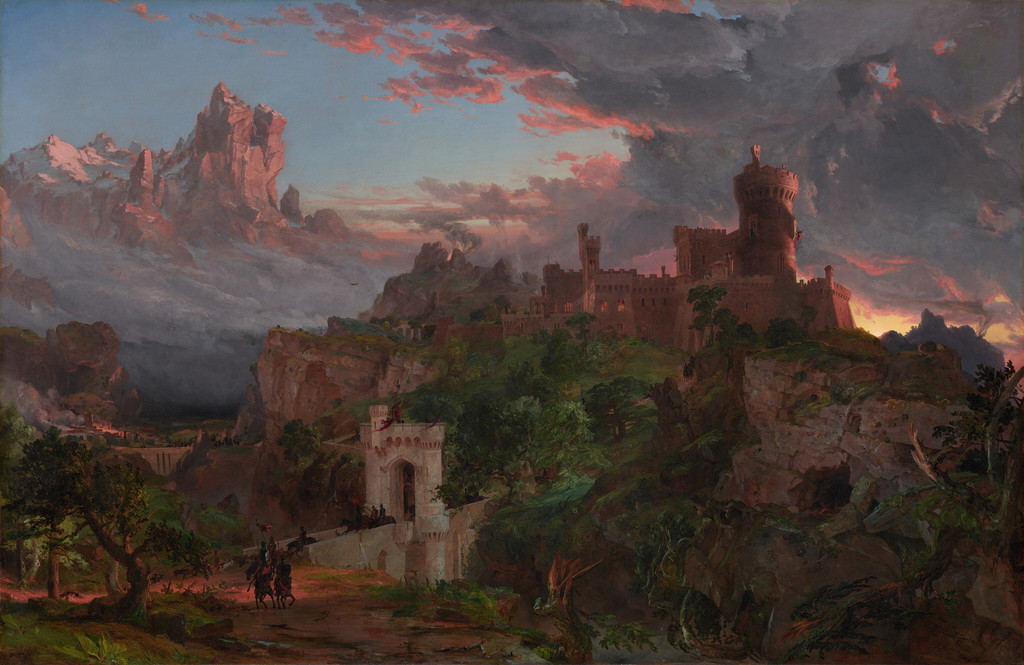
Jasper Francis Cropsey, The Spirit of War, 1851. National Gallery of Art, 1978.12.1, Avalon Fund. The castle is an invented composite within an allegorical landscape. Jasper Francis Cropsey / National Gallery of Art, Washington. Image source. CC0 / Public domain. Proportionally resized only; full carrier, margins and native appearance retained.
The canvas in Washington
The NGA credits Warwick Castle, England to the gift of Mr. and Mrs. Norman Hirschl in honour of the museum’s 50th anniversary. The accession number is 1991.142.1, distinct from the War companion discussed here. [1]
Cropsey’s painting rewards attention to the relationships around the monument. The river provides distance and reflection; trees partly cover and partly frame the stonework; swans bring a small living movement into the foreground. The castle remains imposing, but its landscape gives the encounter an expansive quiet.
Artworks directory
A selected directory of 18 paintings, two drawings and three architectural projects. Repeated subjects retain distinct object identities. Links lead to a companion article where available, otherwise the consulted institutional record. Unillustrated objects remain searchable; this is not a complete catalogue raisonné.
Frequently Asked Questions
Cyrus W. Field commissioned it. The NGA catalogue records payment on account on 23 September 1856 and its exhibition in New York in spring 1857. [2]
The catalogue links the oil to the 30 September 1856 pencil drawing Castle and Moat at Yale, accession 1970.8.1. The drawing is considered here through that catalogue. [2]
Chotner proposes a possible royal or heraldic allusion. It remains a qualified interpretation; their visible role in the foreground is clear independently of that proposed meaning. [2]
Discussion
Look again at the images and ideas explored in Warwick Castle by Jasper Cropsey. These editorial prompts invite your observations.
Reader Insights
Does the reflection soften or strengthen the castle’s presence?
How much difference do the two swans make to the foreground?
What changes when you compare this identifiable castle with the imagined fortress in The Spirit of War?
Join the Conversation
Share a detail, comparison or question about Warwick Castle by Jasper Cropsey below.
References
- National Gallery of Art, Warwick Castle, England, accession 1991.142.1. Exact 1857 canvas, dimensions and Hirschl gift credit. View source
- Deborah Chotner, Warwick Castle, American Paintings of the Nineteenth Century, Part I, National Gallery of Art (1996), printed pp.114–118. Commission, visits, 1856 drawing, swans, proposed viewpoint, exhibition and dated technical account. View source
- Deborah Chotner, The Spirit of War, same NGA catalogue (1996), printed pp.110–114. Invented castle and allegorical comparison. View source
- Splash image source.
Jasper Francis Cropsey, Warwick Castle, England, 1857. Oil on canvas, 81.1 × 132.3 cm. National Gallery of Art, Washington, 1991.142.1. Gift of Mr. and Mrs. Norman Hirschl, in Honor of the 50th Anniversary of the National Gallery of Art. Jasper Francis Cropsey / National Gallery of Art, Washington. CC0 1.0. Proportionally resized only; full carrier, margins and native appearance retained.
View source