 by Tom Gurney
Tom Gurney BSc (Hons) is an art history expert with over 20 years experience
Email: tomgurney1@gmail.com / Phone: +44 7429 011000
View of Mt. Washington by Jasper Cropsey: Introduction
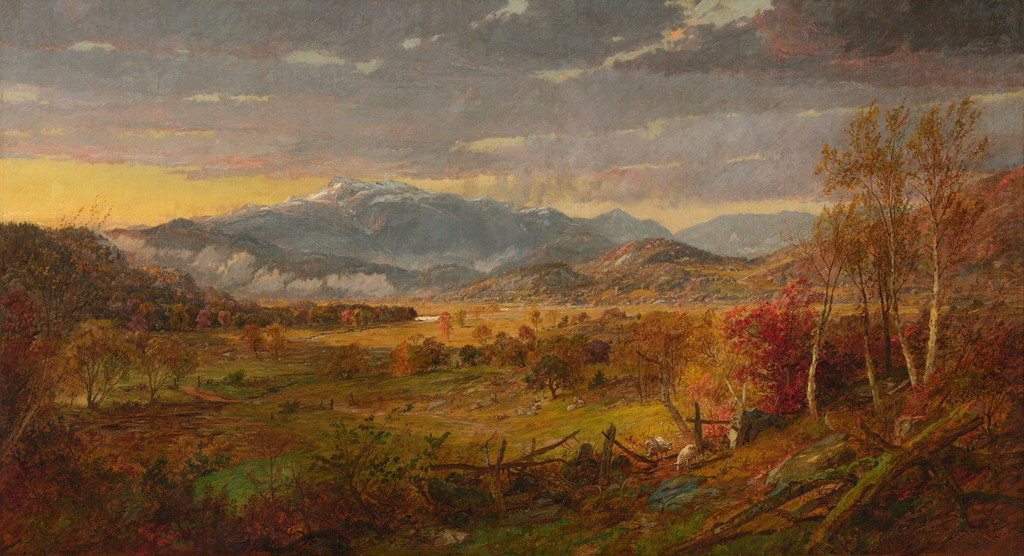
Jasper Cropsey’s View of Mt. Washington of 1881 sets a large mountain range above autumn country with fields, trees and grazing sheep. The National Gallery of Art records the painting as an oil on canvas, 60.96 × 112.08 cm, now part of its Corcoran Collection. The date is also inscribed beside Cropsey’s signature at the lower right. [1]
The mountain commands the distance, while a path and fence give the foreground an ordinary rural scale. Looking across the painting means moving between these two experiences: the small world close at hand and the extensive country beyond it.
At a Glance
- Artist: Jasper Francis Cropsey
- Title: View of Mt. Washington
- Date: 1881
- Medium: Oil on canvas
- Dimensions: 60.96 × 112.08 cm
- Collection: National Gallery of Art, Washington, Corcoran Collection
- Accession: 2015.19.157
- Acquisition credit: Gift of Mr. and Mrs. John C. Newington to the Corcoran in 1977
This work across Jasper Cropsey’s career
Contents
- Identifying the 1881 painting
- Mountain above a cultivated valley
- Sheep, fence and a foreground route
- Autumn colour and a banded sky
- Earlier interests and a different ideal landscape
- Family ownership and the Corcoran Collection
- Annotated details
Identifying the 1881 painting
Cropsey painted more than one subject associated with Mount Washington. The title alone is therefore insufficient to identify this canvas. Here, the 1881 date and the National Gallery accession distinguish the work from earlier paintings with related names. [1]
The Cleveland Museum of Art holds A View of Mount Washington, dated 1870, accession 1968.209. That is a separate canvas, with its own dimensions and collection history. [2]
Carrie Rebora’s entry in the Met’s American Paradise catalogue discusses another picture, the Mint Museum’s Mount Washington from Lake Sebago of 1871. Its title history and proposed identification belong to that painting. They do not establish a Lake Sebago viewpoint for the National Gallery’s 1881 work. [3]
Keeping these objects separate allows each composition to be considered on its own terms. The later canvas has a distinctive relationship between open farmland, autumn trees and the broad mountain distance.
Annotated Details from View of Mt. Washington
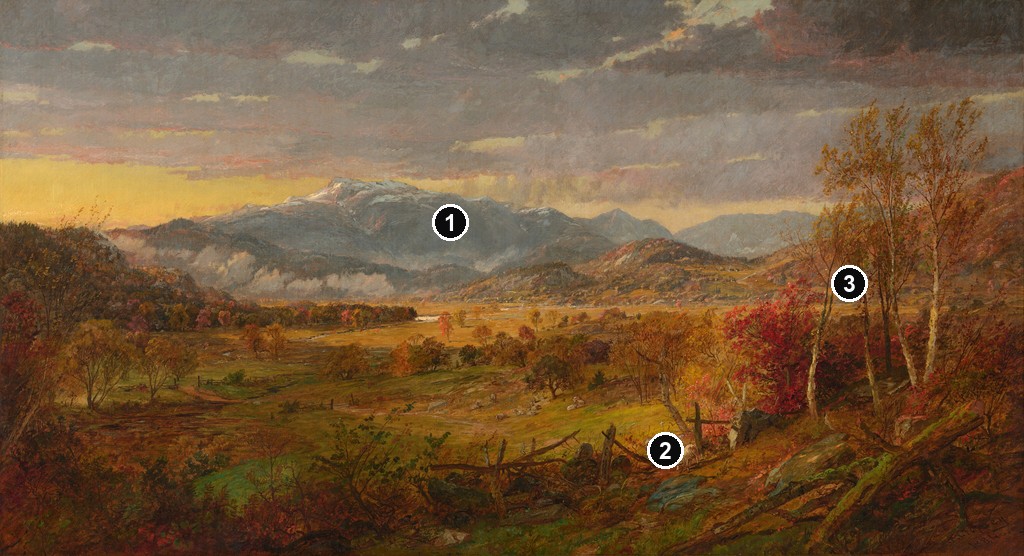
The numbered points identify visible features discussed in this article. Return from each detail to the whole composition. Jasper Francis Cropsey, View of Mt. Washington, 1881. Oil on canvas, 60.96 × 112.08 cm. National Gallery of Art, Washington, Corcoran Collection (Gift of Mr. and Mrs. John C. Newington, 1977), 2015.19.157. Jasper Francis Cropsey / National Gallery of Art, Washington. Image source. CC0 1.0. Separate resized overview with numbered points; details cropped from the original, without recolouring, retouching or enlargement.
Details from VIEW OF MT. WASHINGTON
Compare the cropped details with the complete images above. Notice how their colours, shapes and positions contribute to the larger compositions.
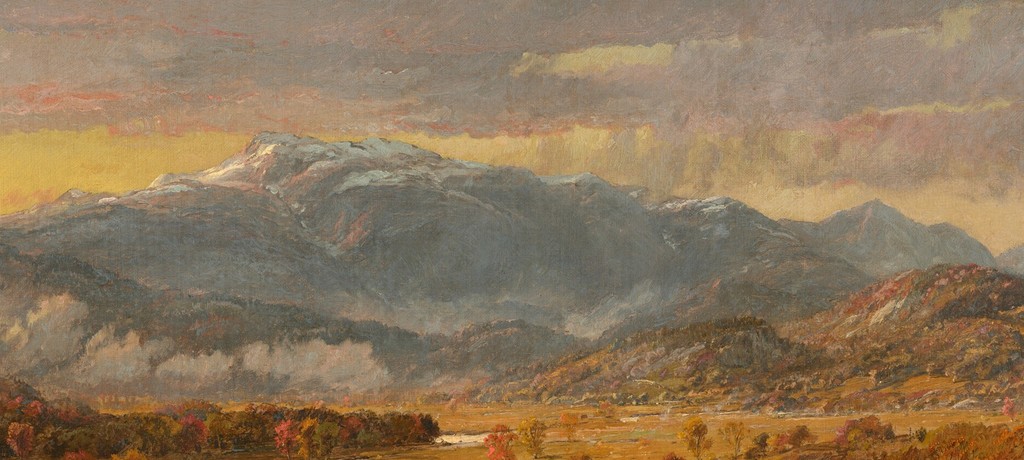
Mountain above the valley
The broad mountain rises above the nearer valley and low cloud. Cooler distant tones separate it from the autumn foreground.
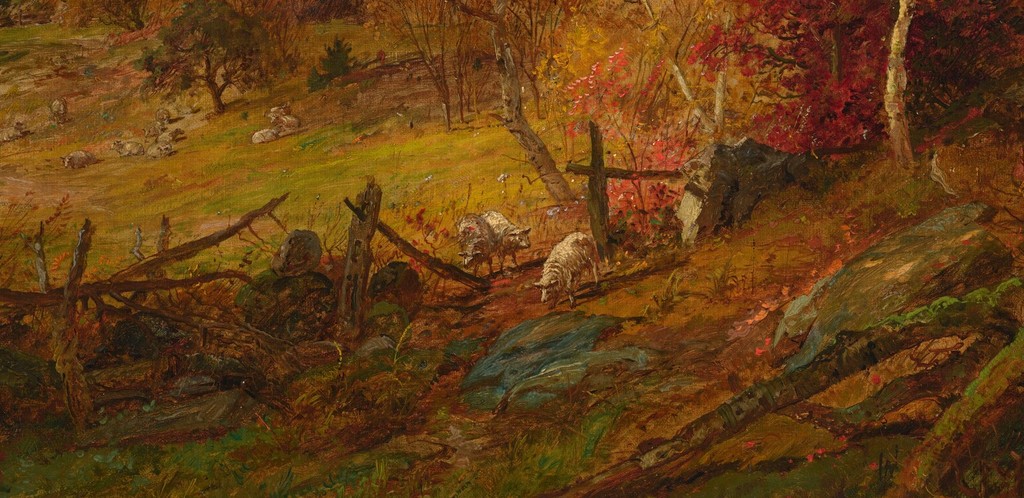
Sheep beside the broken fence
Sheep occupy the sloping near ground beside irregular fence rails. Their pale forms provide a scale comparison with the broad valley.
Autumn trees at the right
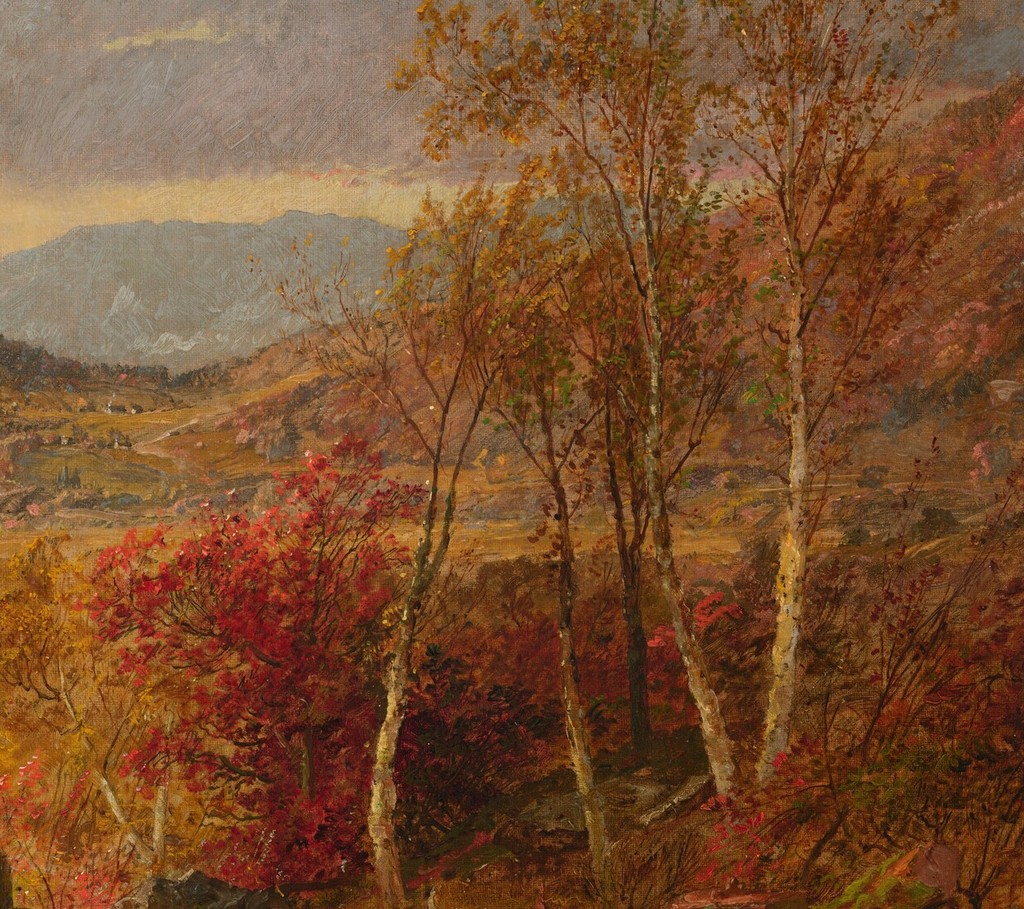
Pale trunks and warm foliage rise along the right edge. They frame the distant mountain without establishing the exact viewpoint.
Mountain above a cultivated valley
The mountain range extends across much of the painting’s width. Its pale upper ridges and cooler slopes remain visible beyond the warmer country below. Smaller hills intervene between the foreground and the highest forms, making the distance develop in stages.
This gradual recession gives the mountain a substantial presence without placing it immediately above the viewer. The nearest fields belong to a different scale of experience. The eye crosses them before reaching the higher ground, and the intervening country helps make the mountain seem far away.
The cultivated valley also prevents the scene from reading as a view of isolated wilderness. Open fields and scattered signs of rural occupation introduce places in which ordinary activity can occur. Trees divide those spaces and guide attention toward the larger landforms beyond.
Cropsey leaves a broad opening in the centre. The taller autumn trees gather more strongly toward the sides, especially on the right. Their placement keeps the distant mountain visible while giving the nearest country a frame.
Sheep, fence and a foreground route
The sheep occupy the nearer slope toward the right. Their small light forms stand out among the darker ground and vegetation. They give the viewer a familiar measure within a scene whose distant mountains could otherwise feel difficult to judge in scale.
A fence follows part of the foreground route. Its upright and slanting pieces introduce sharper, more angular forms among the curved ground and irregular trees. Together with the path, it suggests a landscape that is crossed and used, rather than observed only from afar.
The route does not make the entire distance equally accessible. It begins within the near country, where the viewer can distinguish the ground’s roughness and the fence’s individual pieces. Beyond that, the view opens into larger spaces whose details become smaller and less distinct.
That shift makes the foreground important to the mountain’s effect. Nearby things supply a point of entry. The canvas’s expansive distance gains force because the eye begins with objects and routes that can be understood at a human scale.
Autumn colour and a banded sky
Warm colours gather in the foliage and across the lower part of the scene. Red and orange trees stand out against darker greens, while lighter fields extend through the middle distance. These changes keep the cultivated country visually varied.
The mountain belongs to a cooler range of colour. Its blue and gray passages separate it from the warm foreground. That relationship contributes to the sense of recession: the more distant forms remain part of the same landscape, yet their appearance differs from the nearby vegetation.
Above the range, horizontal cloud bands extend across the sky. Darker passages sit against a brighter yellow opening, repeating something of the painting’s wide proportions. Their direction helps join the sky to the breadth of the mountain below it.
The upper and lower fields consequently work together. Trees and fences supply irregular near forms; mountains and cloud bands give the composition longer movements. Cropsey can sustain a broad panorama while retaining a more intimate foreground encounter.
Watch: Jasper Cropsey
Look closely at Cropsey’s Mount Jefferson, then explore the wider Hudson River School tradition.
Summer or Autumn? Picturing the American Republic
Smarthistory discusses Cropsey’s seasonal landscape and the image of the American republic.
Watch on YouTubeEarlier interests and a different ideal landscape
Cropsey’s interest in northeastern mountain scenery had a long history by 1881. Deborah Chotner’s NGA biography records a White Mountains visit after his return from Europe in 1849, followed by further summer travel through northeastern regions. That chronology establishes an earlier engagement with mountain subjects, rather than proving a particular journey or drawing session for this later canvas. [4]
Summer, Lake Ontario, dated 1857, offers a useful comparison. Its museum describes the landscape as an idealised combination of different locales. Broad water, a cascade, foreground cattle and an extensive opening of light share one small canvas. [5]
The 1881 view gives a named mountain a more dominant place, while again including rural activity close to the viewer. The comparison demonstrates how Cropsey could make a broad landscape intelligible through nearby animals and routes. It does not determine whether every feature in the Mount Washington painting corresponds to one exact surveyed position.
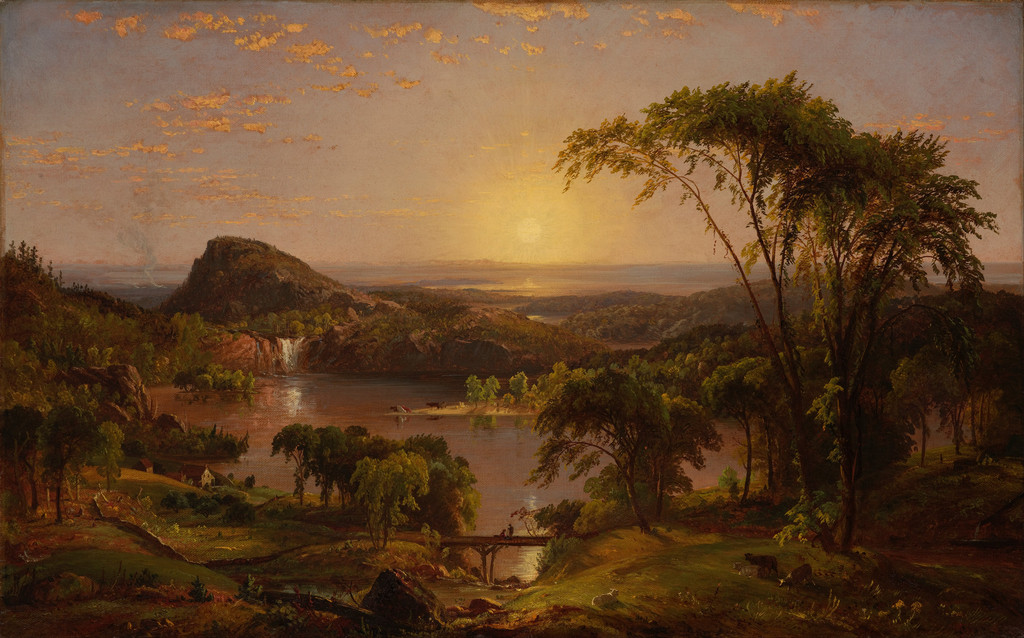
Jasper Francis Cropsey, Summer, Lake Ontario, 1857. Indianapolis Museum of Art at Newfields, 71.13. Gift of the Friends of the Museum. The museum describes a composition combining different locales. Jasper Francis Cropsey / Indianapolis Museum of Art at Newfields, via Google Art Project. Image source. Public domain. Proportionally resized only; full carrier, margins and native appearance retained.
Family ownership and the Corcoran Collection
The National Gallery traces the painting from Cropsey through his family to his great-granddaughter, Barbara Newington. Mr. and Mrs. John C. Newington gave it to the Corcoran Gallery of Art in 1977; the National Gallery acquired it in 2015. The present accession number records that later institutional acquisition, rather than the date of the painting. [1]
The resulting collection history is distinct from that of the earlier Cleveland and Mint canvases. Here, a late nineteenth-century landscape remained within the artist’s family before entering a public collection.
The picture’s effect likewise depends on its particular arrangement. The fence and sheep give the foreground a modest familiarity, while the long mountain range and clouded sky draw attention outward. The distance is expansive, but the near country continues to offer a place from which to look.
Artworks directory
A selected directory of 18 paintings, two drawings and three architectural projects. Repeated subjects retain distinct object identities. Links lead to a companion article where available, otherwise the consulted institutional record. Unillustrated objects remain searchable; this is not a complete catalogue raisonné.
Frequently Asked Questions
The National Gallery acquired the painting in 2015 after it had entered the Corcoran Collection through the Newingtons’ 1977 gift. It was painted in 1881. [1]
Discussion
Look again at the images and ideas explored in View of Mt. Washington by Jasper Cropsey. These editorial prompts invite your observations.
Reader Insights
Do the sheep make the mountain feel more distant or the foreground more familiar?
Which most clearly separates the near country from the far range: colour, detail or intervening hills?
How do the horizontal clouds relate to the broad shape of the mountain?
Join the Conversation
Share a detail, comparison or question about View of Mt. Washington by Jasper Cropsey below.
References
- National Gallery of Art, View of Mt. Washington, accession 2015.19.157. Current identity, inscription, dimensions and artist-family/Corcoran provenance. View source
- Cleveland Museum of Art, A View of Mount Washington, accession 1968.209. Separate 1870 painting, consulted for exact object distinction. View source
- Carrie Rebora, Mount Washington from Lake Sebago, in American Paradise (Metropolitan Museum of Art, 1987), printed pp.214–216. Selected entry actually read; its title and site discussion apply to the Mint’s 1871 canvas. View source
- Deborah Chotner, Cropsey biography, American Paintings of the Nineteenth Century, Part I, National Gallery of Art (1996), printed pp.109–110. Early White Mountains visit and northeastern summer travel. View source
- Indianapolis Museum of Art at Newfields, Summer, Lake Ontario, accession 71.13, museum record via Google Arts & Culture. Exact 1857 comparison and composite-landscape interpretation. View source
- Splash image source.
Jasper Francis Cropsey, View of Mt. Washington, 1881. Oil on canvas, 60.96 × 112.08 cm. National Gallery of Art, Washington, Corcoran Collection (Gift of Mr. and Mrs. John C. Newington, 1977), 2015.19.157. Jasper Francis Cropsey / National Gallery of Art, Washington. CC0 1.0. Proportionally resized only; full carrier, margins and native appearance retained.
View source