 by Tom Gurney
Tom Gurney BSc (Hons) is an art history expert with over 20 years experience
Email: tomgurney1@gmail.com / Phone: +44 7429 011000
Jasper Cropsey, Railways and Landscape: Introduction
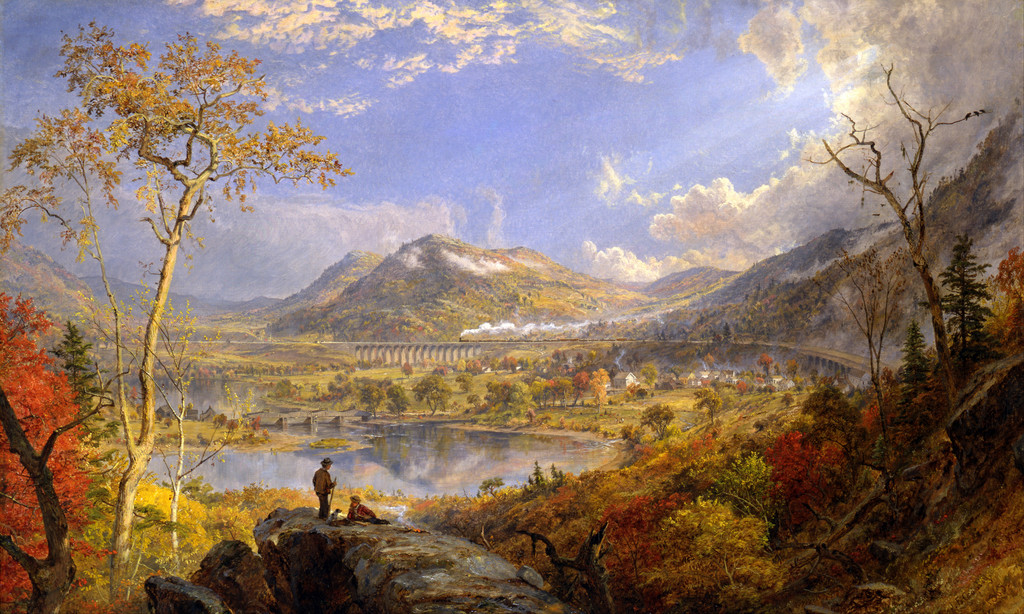
The railway entered Jasper Cropsey’s landscapes as more than a small modern object. It gave painters, passengers and patrons new connections between places, while travel literature taught readers to recognise scenery along a route. In Starrucca Viaduct, a train crosses a valley whose autumn trees, water and mountains remain the greater part of the view. The technology is conspicuous, but it belongs to an extensive arrangement of country. [1]
The subject also connected Cropsey with the people who financed railways. The Brandywine Museum’s 2025 account of his Autumn in the Ramapo Valley, Erie Railway describes a commission from James McHenry, a transatlantic railway businessman. Reading that commission beside a period guide and the Toledo painting shows how landscape could participate in travel, investment and the circulation of images. [5]
At a Glance
- Artist: Jasper Francis Cropsey, 1823–1900
- Principal illustrated painting: Starrucca Viaduct, Pennsylvania, 1865
- Other commission discussed: Autumn in the Ramapo Valley, Erie Railway, 1873
- Railway: New York and Erie / Erie Railway
- Period guide consulted: William MacLeod, eighth edition, 1855–6
- Map illustrated: G. W. & C. B. Colton & Co., 1869
- Related practice: Designs for later elevated railway stations
- Main questions: Scenic travel, industrial patronage and competing readings of progress
Contents
- The railway as a way of seeing
- A printed prospect before the painting
- A train inside an autumn panorama
- Harmony and its limits
- Paintings, prints and a destroyed panorama
- A railway network on the map
- McHenry and the Ramapo commission
- Station architecture and public movement
- An inhabited landscape beyond the railway
- Annotated details
The railway as a way of seeing
A railway journey organised scenery into a succession of views. A passenger could move quickly between inhabited valleys, rivers and mountainous ground, while a guide suggested which places deserved particular attention. The line connected scenery with the means of reaching it.
MacLeod’s Harper’s New York and Erie Rail-road Guide Book makes that relation unusually concrete. The directly consulted copy is the eighth edition of 1855–6, with engravings by Lossing and Barritt after his sketches. Its title advertises numerous illustrations, making the book a visual companion as well as a written route description. [2]
The guide gives the traveller instructions about looking. Around Starrucca, it recommends an elevated prospect, describes the valley’s combined attractions and praises the scene in autumn. Villages, meadows, the river and the railway can be gathered into one desirable view. [2]
Such passages are part of the book’s promotion of travel. Their enthusiasm helps us understand what a publisher wanted readers to notice; it does not settle what every resident or passenger thought about railway development. A historical guide offers a situated way of seeing rather than a neutral inventory of all its consequences.
Annotated Details from Jasper Cropsey, Railways and Landscape
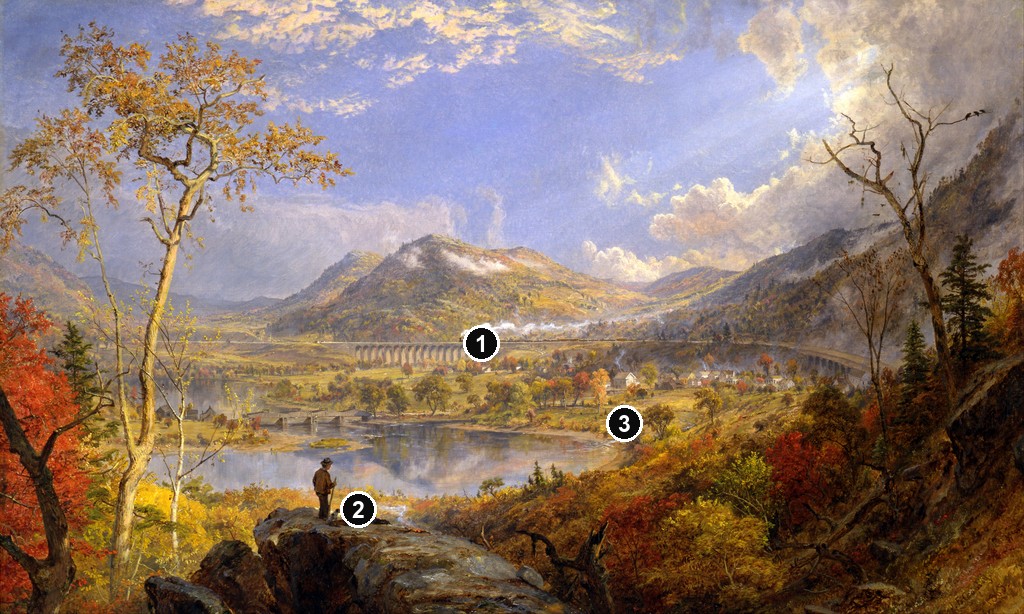
The numbered points identify visible features discussed in this article. Return from each detail to the whole composition. The captions keep each work’s identity, date and medium separate.
Starrucca Viaduct
Jasper Francis Cropsey, Starrucca Viaduct, Pennsylvania, 1865. Toledo Museum of Art, 1947.58. Purchased with funds from the Florence Scott Libbey Bequest in Memory of her Father, Maurice A. Scott. Jasper Francis Cropsey / Toledo Museum of Art, via Google Art Project. Image source. Public domain. Separate resized overview with numbered points; details cropped from the original, without recolouring, retouching or enlargement.
Valley Of Wyoming
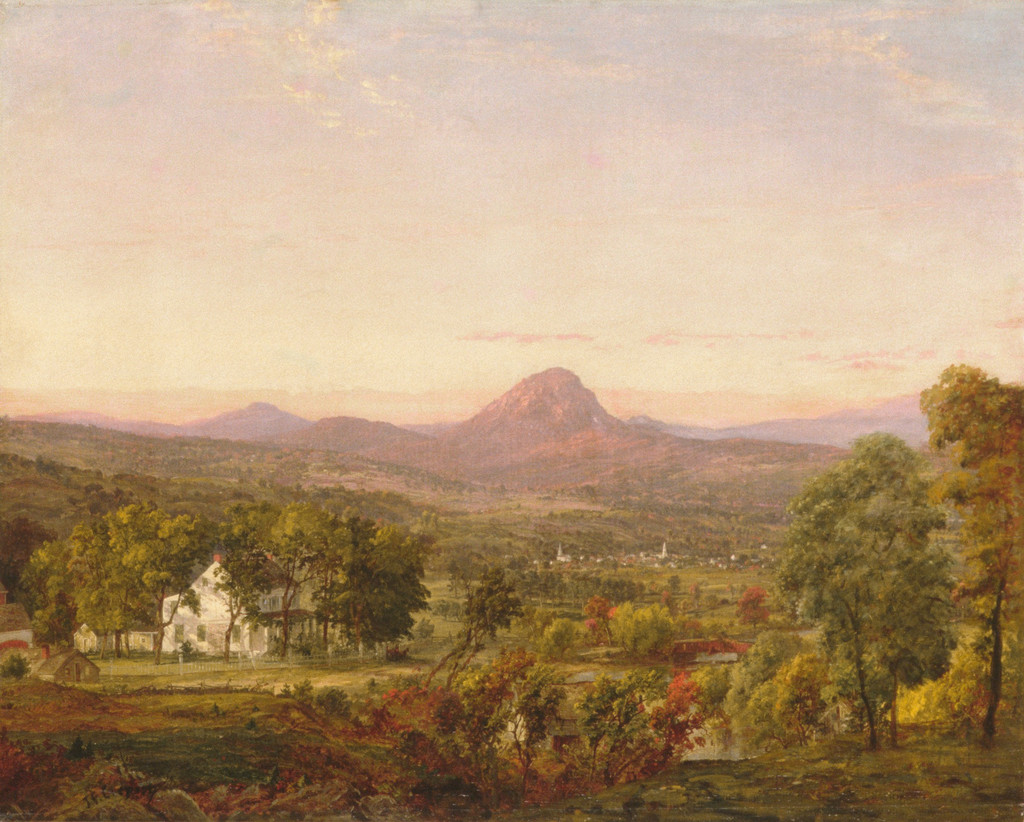
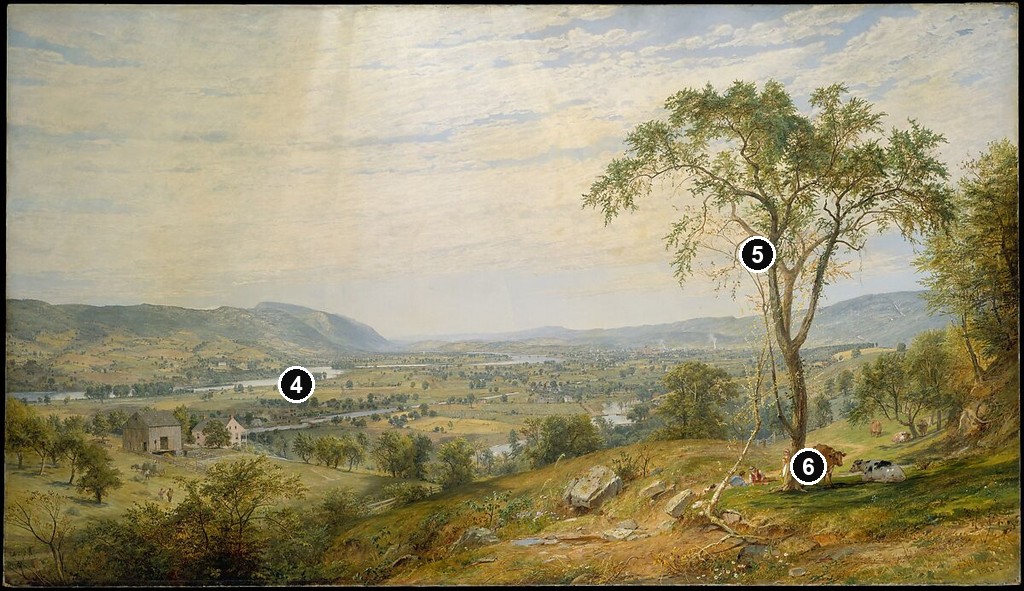
Jasper Francis Cropsey, The Valley of Wyoming, 1865. Oil on canvas, 123.2 × 213.4 cm. Metropolitan Museum of Art, 66.113. Gift of Mrs. John C. Newington, 1966. This reproduction shows the canvas; the original frame’s poem is discussed from museum and catalogue records. Jasper Francis Cropsey / The Metropolitan Museum of Art,66.113. Image source. CC0 1.0. Separate resized overview with numbered points; details cropped from the original, without recolouring, retouching or enlargement.
Details from JASPER CROPSEY, RAILWAYS AND LANDSCAPE
Compare the cropped details with the complete images above. Notice how their colours, shapes and positions contribute to the larger compositions.
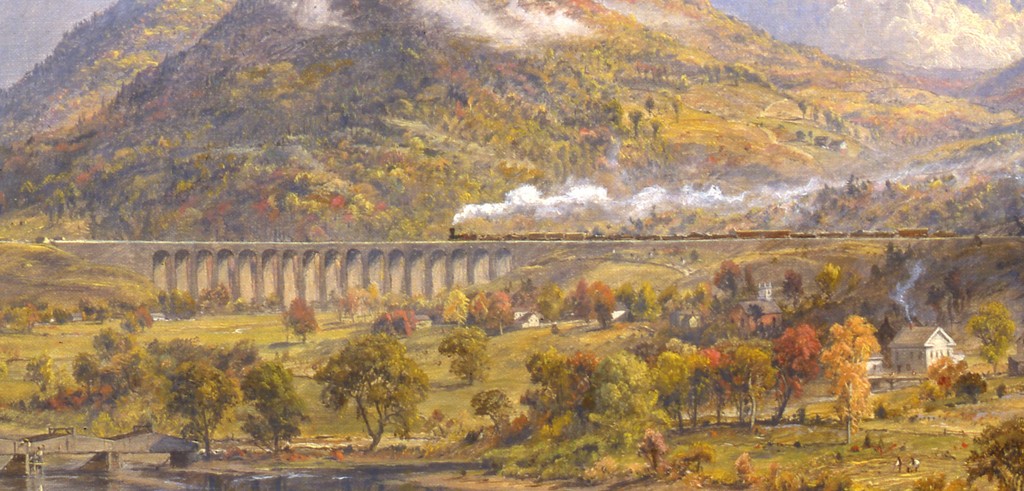
Starrucca Viaduct
Train crossing the repeated arches
A train and white plume extend across the viaduct. Repeated arches make the railway readable within the surrounding hills.
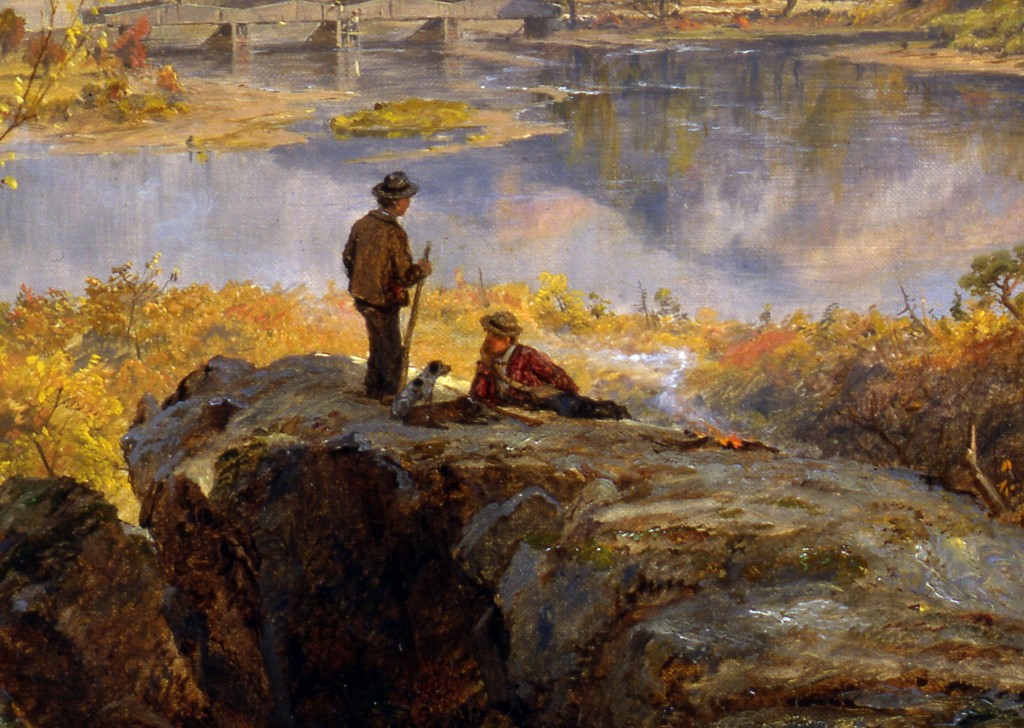
Two figures on the near ledge
Two small figures occupy the near rock ledge above the water. Their positions connect the viewing foreground with the broad railway landscape.
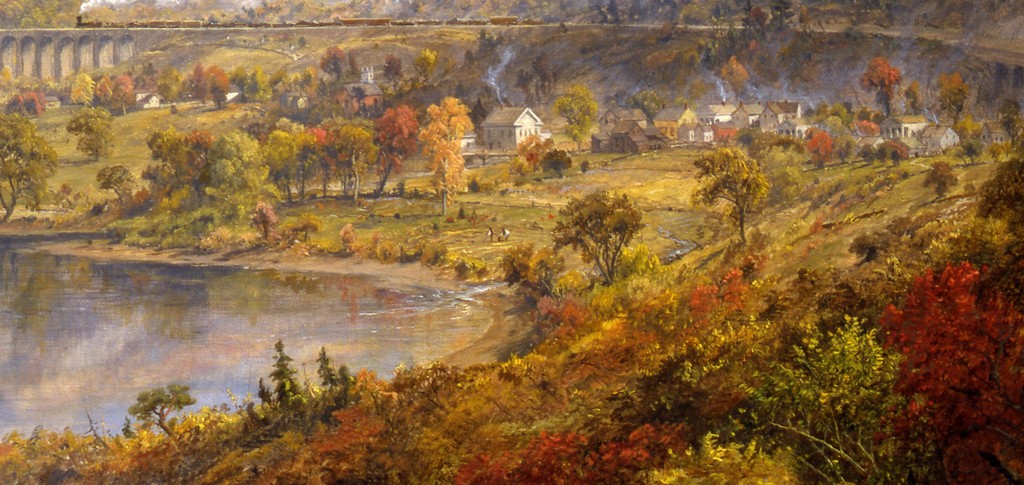
Water and settlement beneath the hills
Water, small buildings and autumn trees occupy the valley below the railway. Their varied forms soften the regular line of the viaduct.
Valley Of Wyoming
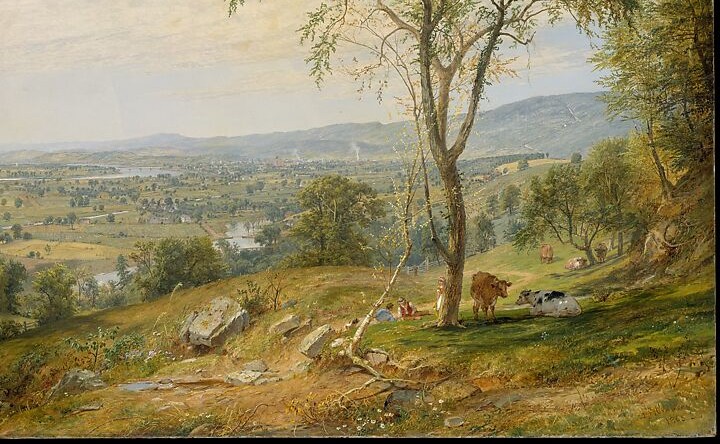
Settlement within the broad valley
Buildings, fields and the winding waterway occupy the valley. The broad native crop preserves their arrangement; it does not identify every small structure.
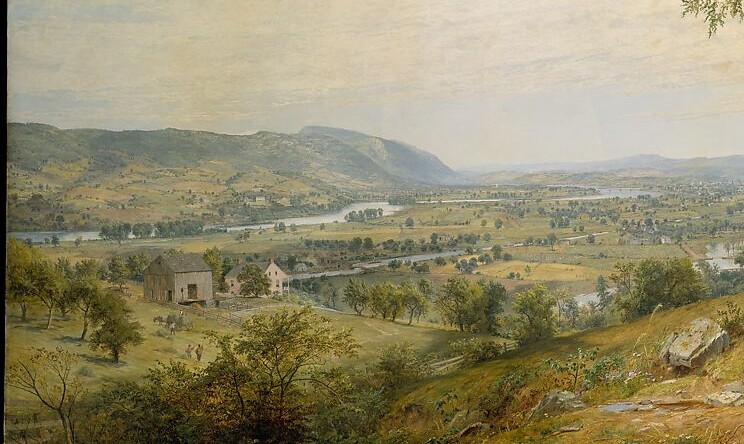
Near tree and distant hills
A large near tree overlaps the distant hills and sky. Its scale establishes the difference between the viewing foreground and the far valley.
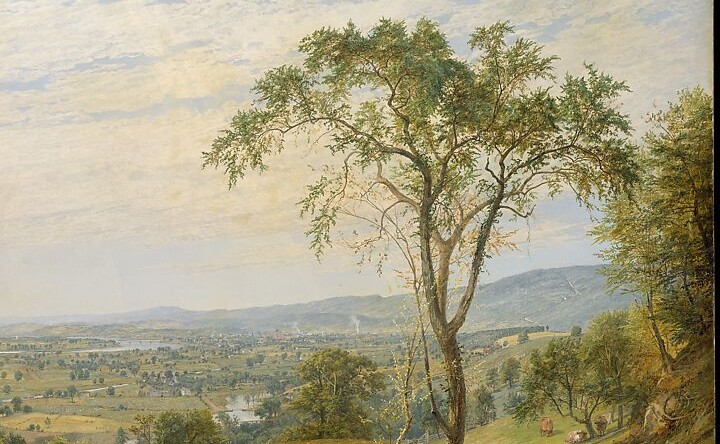
Figures and cattle on the near slope
Small figures and cattle occupy the near sloping ground beneath the tree. Their broad setting remains visible; tiny facial and animal details are not inferred.
A printed prospect before the painting
The whole page illustrated here retains both the Starrucca vignette and its surrounding text. The image gathers a broad valley into a compact round field, while the prose extends the scene into a traveller’s experience. Keeping the whole page makes that relationship visible.
The vignette is an illustration after MacLeod, rather than a drawing by Cropsey. Its presence matters because Rebora identifies a relationship between the earlier guide’s scenic arrangement and Cropsey’s later painting. The museum catalogue discusses the first edition of 1851; the facsimile used here comes from the separately consulted eighth edition. [1] [2]
The distinction prevents a misleading preparatory claim. A related printed view can help explain a composition’s history without becoming an original Cropsey sketch. Neither the engraving nor the text proves that the painter mechanically traced the scene.
In the 1865 painting, the foreground is developed into a place occupied by two viewers. Trees, rocks and the ledge give them a position outside the train’s immediate movement. The picture lets the painted spectators contemplate a route that carries other people through the valley.
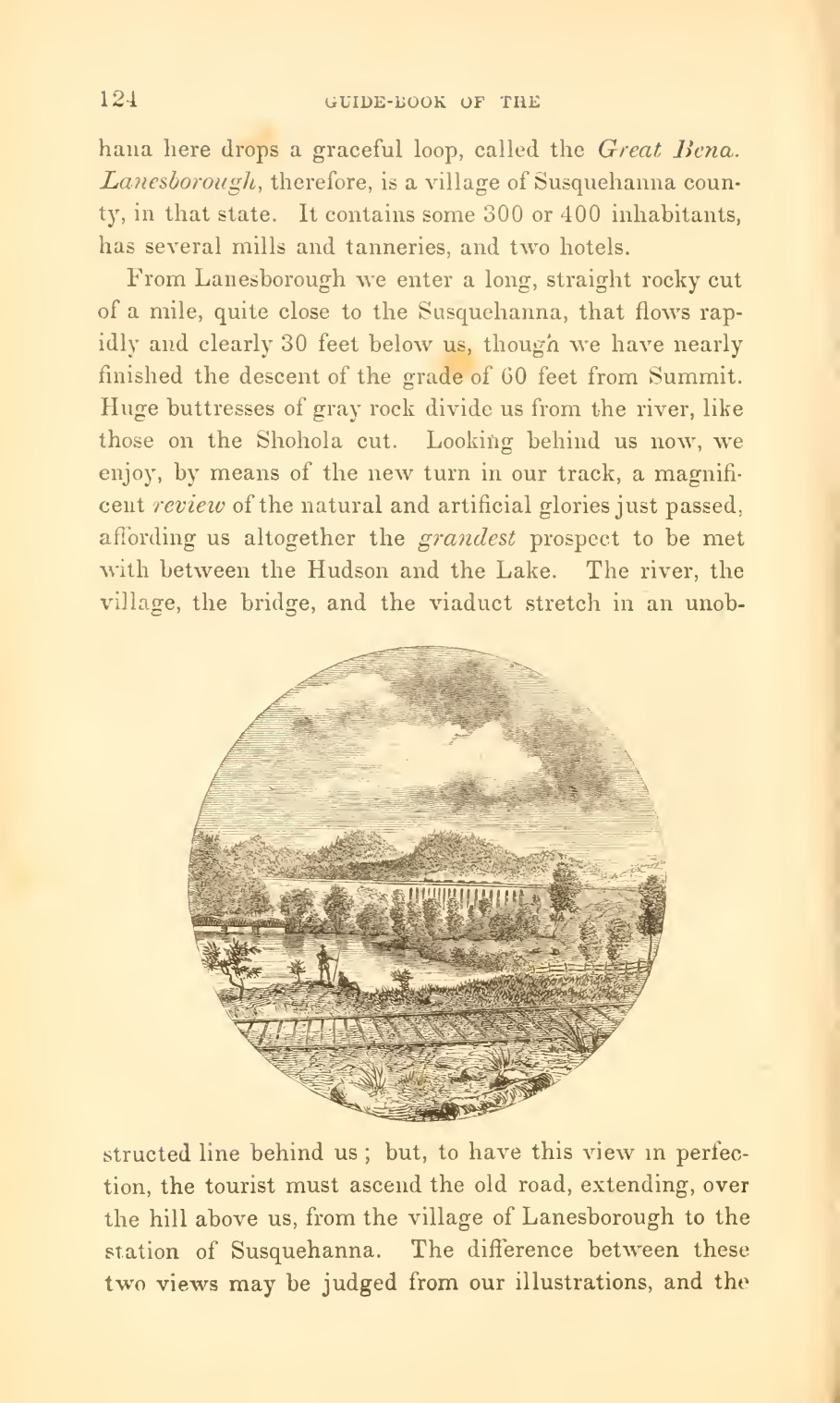
William MacLeod’s Harper’s New York and Erie Rail-road Guide Book, eighth edition, 1855–6, printed page 124. Engravings by Lossing and Barritt after MacLeod. The page is related travel imagery, not a Cropsey sketch. William MacLeod; Lossing and Barritt / Columbia University Libraries, Internet Archive. Image source. Public domain. Proportionally resized only; full carrier, margins and native appearance retained.
A train inside an autumn panorama
The exact Starrucca Viaduct illustrated here belongs to the Toledo Museum of Art, accession 1947.58. It is an oil on canvas dated 1865, measuring 56.8 × 92.4 cm. That identity is necessary because several related paintings and prints have complicated its history. [4]
The train and its smoke occupy only part of the valley. The bridge forms a repeated architectural rhythm across the distance, while nearby roofs, fields and the river suggest other patterns of use. Railway movement enters a place that is already inhabited.
The white smoke has a particular visual role. It rises above the line and gains brightness against the surrounding hills, then finds a relation with the pale cloud passages higher in the picture. Toledo’s interpretation emphasises this harmony between technological smoke and natural cloud. [4]
The foreground viewers give the painting another rhythm. Their pause contrasts with the train’s passage. A large autumn tree, rough ledge and warmer foliage make their position a substantial near place, from which the farther transport line can be considered.
Looking at the whole picture is especially useful here. Enlarging only the train can exaggerate its share of the composition. Its meaning depends partly on how Cropsey places it among fields, settlement, mountains and sky.
Harmony and its limits
Rebora’s catalogue entry develops a more critical reading of the same arrangement. It considers how pastoral beauty can absorb the railway into an attractive landscape, allowing industrial change to appear compatible with familiar rural pleasures. The painting’s patronage and historical circumstances form part of that argument. [1]
The museum’s harmonious interpretation and the catalogue’s critical account need not begin from different objects. Both attend to the relation between train, smoke, cloud and extensive scenery. They ask different questions about the effects of those choices.
The distinction gives the viewer a useful method. First identify how the painted forms fit together; then consider what that arrangement might encourage an audience to accept, admire or overlook. Visual harmony is evidence about a composition, while a claim about public attitudes requires additional historical support.
The guide’s language of development likewise belongs to its period and purpose. Its promotion of scenery and railway achievement should not be repeated as a complete account of the land or its inhabitants. Attractive travel imagery can coexist with consequences that its chosen prospect does not show.
Paintings, prints and a destroyed panorama
Cropsey’s Starrucca subject circulated through more than one format. Rebora discusses a very large painting made for the Crosby’s Opera House lottery, measuring about eight by fourteen feet. It was destroyed in the Chicago fire of 1871. The surviving Toledo canvas should never be described as that lost panorama. [1]
The distinction changes how we imagine the work’s audience. A large exhibition or lottery picture offered a different encounter from a smaller canvas in a collection. The same broad subject could move between public spectacle, private ownership and printed reproduction.
Rebora also records a chromolithograph of 1867 made by William Dreser and Thomas B. Sinclair in Philadelphia. It is not a Currier & Ives print. The catalogue considers the possibility that the Toledo canvas served an engraver, retaining uncertainty rather than declaring its exact role settled. [1]
These separate objects need their own identities. A painted version, a lost larger work and a later colour print can share a subject while differing in size, medium, date and purpose. Their relationships belong to the history of circulation; they do not permit their records to be merged.
Watch: Jasper Cropsey
Look closely at Cropsey’s Mount Jefferson, then explore the wider Hudson River School tradition.
Summer or Autumn? Picturing the American Republic
Smarthistory discusses Cropsey’s seasonal landscape and the image of the American republic.
Watch on YouTubeA railway network on the map
The accompanying map of the Erie Railway and its connections was produced by G. W. & C. B. Colton & Co. in 1869. The whole supplied two-sheet image retains its route colours, inset, distance information and original margins. Its Library of Congress call number includes the year 1869. [3]
The map offers a different scale from the painting. A valley prospect becomes one place within a wider network of connections. Routes extend across the Northeast and toward the Midwest, linking named destinations beyond the boundaries of one scenic view.
It is documentary context from after the Toledo canvas. There is no consulted evidence that Cropsey used this particular map to make the 1865 painting. Its value lies in showing how the railway could present itself through connections as well as through picturesque local scenery.
At ordinary page size, the many small labels cannot all be read comfortably. The source link leads to the full original for readers who want to examine routes and names. The overview supports the network comparison without pretending to replace a detailed map consultation.
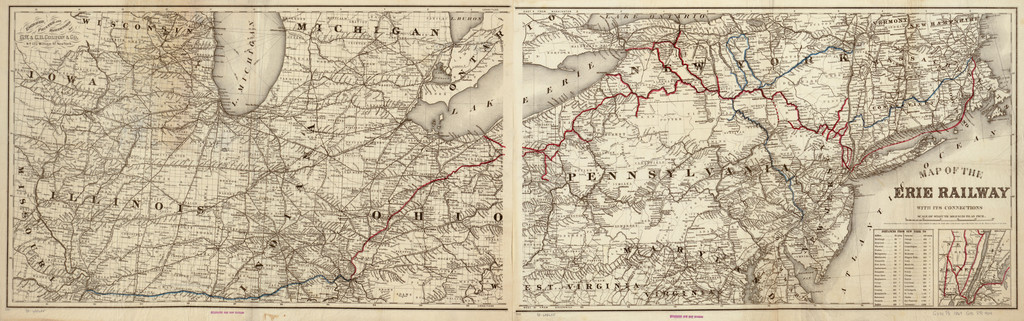
G. W. & C. B. Colton & Co., Map of the Erie Railway and its connections, 1869. Library of Congress, G3711.P3 1869 G15 RR404. Later network context; no evidence Cropsey used this map. G. W. & C. B. Colton & Co. / Library of Congress,98688655, via Wikimedia Commons. Image source. Public domain. Proportionally resized only; full carrier, margins and native appearance retained.
McHenry and the Ramapo commission
The Brandywine Museum’s 2025 exhibition account describes Autumn in the Ramapo Valley, Erie Railway of 1873 as a commission for James McHenry. It explains his background across Ireland, Philadelphia, Liverpool and London, and his involvement as a supplier to and investor in American railways. [5]
According to that account, McHenry had taken control of the Erie Railway and commissioned a depiction of its passage through the Ramapo scenery. Cropsey painted the work at Aladdin, his country home outside Warwick. His established reputation for combining natural and industrial subjects made him a fitting choice. [5]
This is a specific connection between an artwork and a railway patron. The commission gave landscape a place in the celebration of a commercial achievement. It also joined an American route with a businessman whose activities crossed the Atlantic.
The painting’s later appearance in the 2025 exhibition helps the museum tell that international history. Its labels identify a British private collection and emphasise Cropsey’s unusually substantial British audience. Those dated exhibition details should not be converted into a permanent public-display promise. [5]
The Ramapo painting is discussed here through the museum’s text. The illustrated railway canvas remains the licensed Toledo Starrucca. Keeping that distinction makes the commission useful evidence without presenting a substitute image as the exact 1873 work.
Station architecture and public movement
Cropsey also contributed to the built environment of railway travel. Chotner records designs for Queen Anne style stations of the Gilbert Elevated Railway on Sixth Avenue in New York. They belong to his later career, after his return from Britain in 1863. [6]
The station work connects his earlier architectural training with an expanding urban transport system. A railway could be both a painted subject in an autumn valley and a setting for structures used by passengers. These are different forms of practice, with different demands.
The stations should not be moved into the 1840s simply because architecture came early in his career. His apprenticeship, early churches and later transport designs occupy separate moments. The architecture guide follows those distinctions in more detail.
Likewise, the presence of a bridge in a painting does not make the picture an engineering design. Cropsey arranged visible architecture within landscape, while a station project required an actual built function. The connection lies in his sustained interest in how structures organise a place.
An inhabited landscape beyond the railway
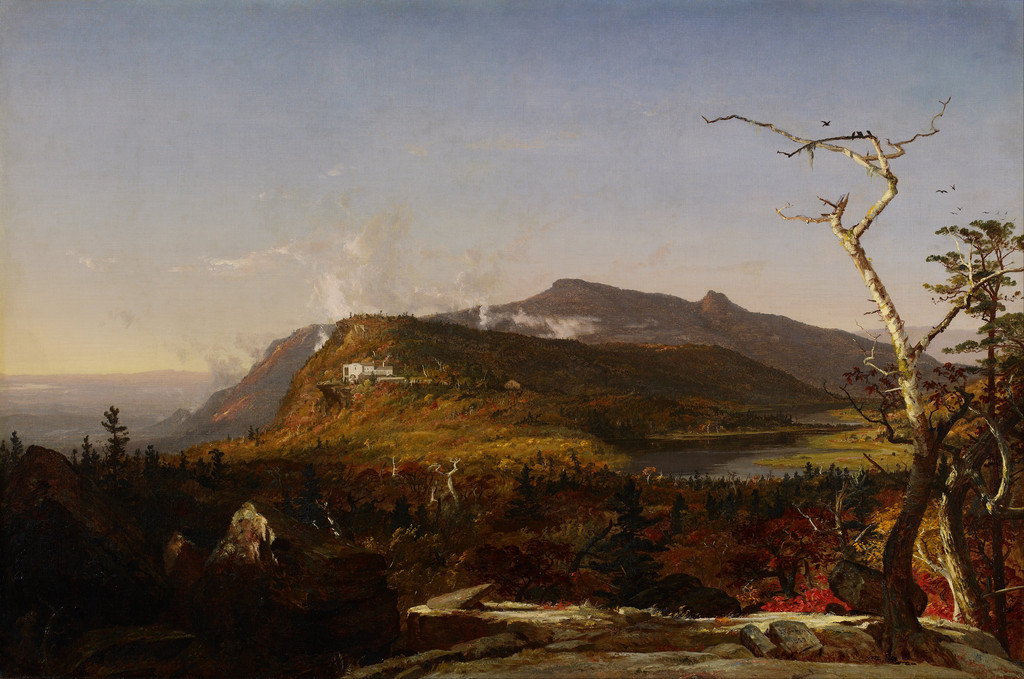
The Met’s Valley of Wyoming, also dated 1865, offers a useful comparison. Rebora traces its Pennsylvania commission and preparatory studies. Its broad river country contains fields, buildings, animals and figures, giving human occupation a place within an extensive panorama. [1]
The comparison keeps the railway within Cropsey’s broader landscape practice. He could make an inhabited valley attractive through several kinds of activity, rather than making every view a celebration of one machine. The organisation of near trees, cultivated ground and distant light matters in both canvases.
Railways sharpen the question of change because they add a visible route and moving train. Guides, maps, commissions and prints show how that route could connect passengers, investors and audiences. Reading those records beside the whole painting makes its attractive harmony more historically particular.
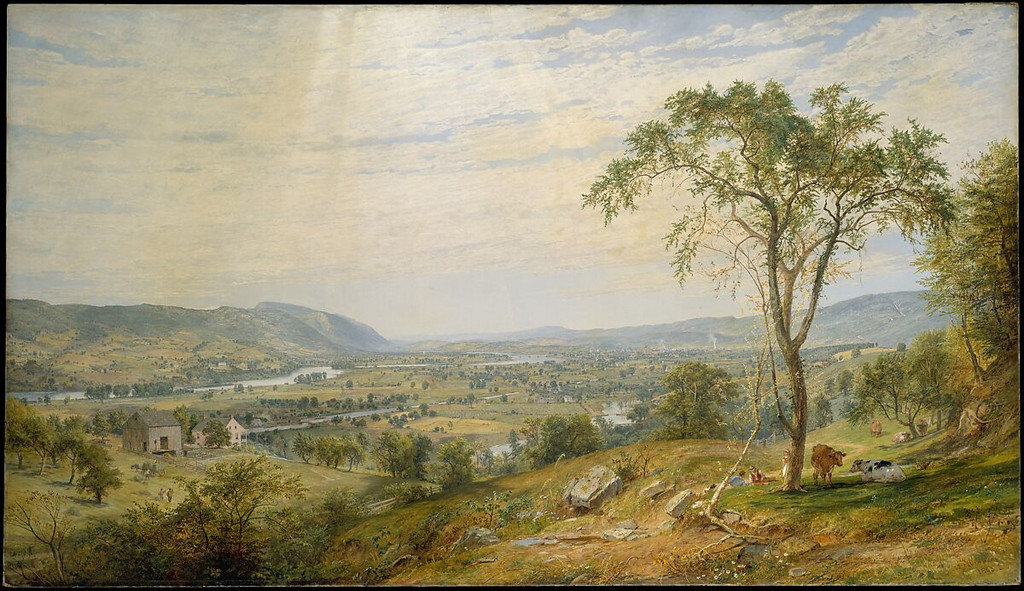
Jasper Francis Cropsey, Valley of Wyoming, 1865. Metropolitan Museum of Art, 66.113. A separate Pennsylvania commission provides a comparison of inhabited river country. Jasper Francis Cropsey / The Metropolitan Museum of Art,66.113. Image source. CC0 1.0. Proportionally resized only; full carrier, margins and native appearance retained.
Artworks directory
A selected directory of 18 paintings, two drawings and three architectural projects. Repeated subjects retain distinct object identities. Links lead to a companion article where available, otherwise the consulted institutional record. Unillustrated objects remain searchable; this is not a complete catalogue raisonné.
Frequently Asked Questions
No. The Toledo oil is a surviving smaller painting of 1865. Rebora distinguishes it from the eight-by-fourteen-foot lottery canvas destroyed in 1871. [1]
The consulted edition credits engravings by Lossing and Barritt after William MacLeod’s sketches. It is related period imagery, not a Cropsey preparatory drawing. [2]
No such use is established. The 1869 map postdates the Toledo painting and supplies network context. [3]
Discussion
Look again at the images and ideas explored in Jasper Cropsey, Railways and Landscape. These editorial prompts invite your observations.
Reader Insights
Does the train seem small or dominant when the whole canvas is visible?
How does the guide’s invitation to look compare with the painted spectators?
What changes when the railway patron and print history become part of the interpretation?
Join the Conversation
Share a detail, comparison or question about Jasper Cropsey, Railways and Landscape below.
References
- Carrie Rebora, selected Cropsey entries, American Paradise: The World of the Hudson River School, Metropolitan Museum of Art (1987), printed pp.208–213. Wyoming and Starrucca, guide relationship, versions, prints and critical pastoral interpretation. View source
- William MacLeod, Harper’s New York and Erie Rail-road Guide Book, eighth edition, 1855–6, title, preface and selected printed pp.115–127. Illustrated route promotion and the whole page 124 reproduced here. View source
- Wikimedia Commons, Map of the Erie Railway and its connections, Library of Congress file. G. W. & C. B. Colton & Co., 1869; whole map identity, source and reproduction rights. View source
- Toledo Museum of Art, Starrucca Viaduct, Pennsylvania, accession 1947.58. Exact 1865 canvas and interpretation of smoke and clouds. View source
- Brandywine Museum of Art, Cropsey, Wyeth, and the American Landscape Tradition, 2025 large-print labels, PDF pp.19–22. McHenry, the 1873 Ramapo commission and transatlantic patronage. View source
- Deborah Chotner, Cropsey biography, American Paintings of the Nineteenth Century, Part I, National Gallery of Art (1996), printed pp.109–110. Later elevated railway stations and career chronology. View source
- Splash image source.
Jasper Francis Cropsey, Starrucca Viaduct, Pennsylvania, 1865. Toledo Museum of Art, 1947.58. The train belongs to a much larger inhabited valley. Jasper Francis Cropsey / Toledo Museum of Art, via Google Art Project. Public domain. Proportionally resized only; full carrier, margins and native appearance retained.
View source