 by Tom Gurney
Tom Gurney BSc (Hons) is an art history expert with over 20 years experience
Email: tomgurney1@gmail.com / Phone: +44 7429 011000
Catskill Mountain House by Jasper Cropsey: Introduction
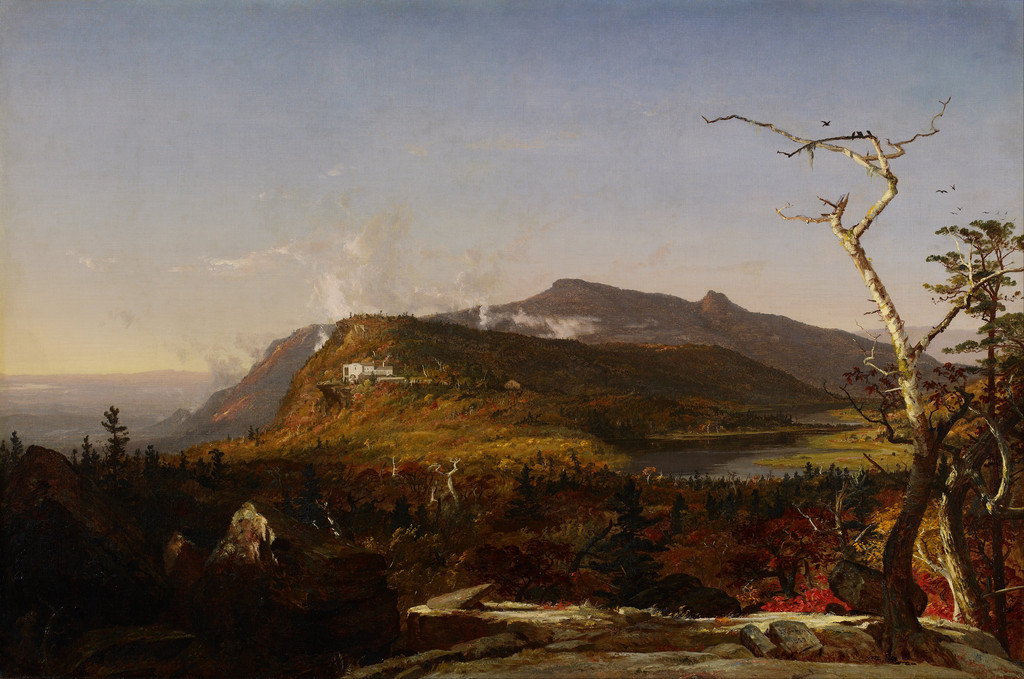
Jasper Cropsey’s Catskill Mountain House places a small white hotel within a much larger mountain landscape. Painted in 1855, the oil on canvas belongs to the Minneapolis Institute of Art, accession 31.47. Its unframed size is 29 × 44 inches, approximately 73.7 × 111.8 cm. The building’s pale facade catches attention from a distance, while rocks, woodland and an exposed foreground trunk dominate the nearer view. [1]
The subject joins a real tourist destination with a landscape organised around rugged forms and extensive atmosphere. Carrie Rebora’s catalogue study relates it to a dated Cropsey drawing and an earlier view by Thomas Cole. Her interpretation helps explain why this active resort can appear so remote within the painting. [2]
At a Glance
- Artist: Jasper Francis Cropsey
- Title: Catskill Mountain House
- Date: 1855
- Medium: Oil on canvas
- Dimensions: 29 × 44 inches, approximately 73.7 × 111.8 cm
- Collection: Minneapolis Institute of Art
- Accession: 31.47
- Acquisition credit: Bequest of Mrs. Lillian Lawhead Rinderer in memory of her brother, William A. Lawhead, and the William Hood Dunwoody Fund
This work across Jasper Cropsey’s career
Contents
- A hotel seen across the mountain country
- Rocks and the pale foreground trunk
- Lakes, slopes and open atmosphere
- A tourist experience viewed from outside
- The 1852 drawing and Thomas Cole
- A commission with unresolved details
- Sky in the year of Up among the Clouds
- A later landscape with railway travel
- The Minneapolis painting
- Annotated details
A hotel seen across the mountain country
The museum’s supplied label identifies the Mountain House as a resort on South Mountain, visited by artists and tourists for its extensive scenery. That information is a useful starting point because the painting gives little prominence to the hotel’s daily operations. [1]
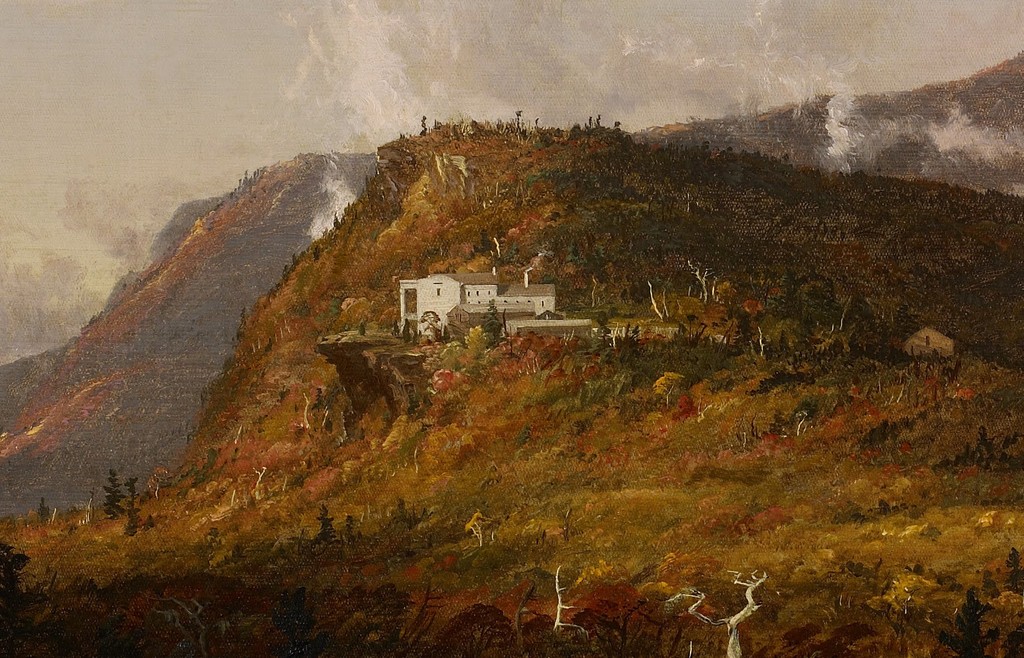
The building stands on a distant ledge at the left of the central mountain mass. Its horizontal white shape is small compared with the slopes around it. Pale walls and regular architectural divisions separate it from the darker woodland.
The hotel is therefore readily noticed without controlling the entire scene. It gives the view a particular landmark, but the eye must travel through substantial country to reach it. The surrounding hill, lakes, trees and sky retain the greater share of the canvas.
Its position also differs from that of the principal structures in Cropsey’s castle paintings. Here, architecture is reduced in scale and placed farther away. The scene does not approach the building along a clearly occupied route; it discovers the hotel across a rugged foreground.
Annotated Details from Catskill Mountain House
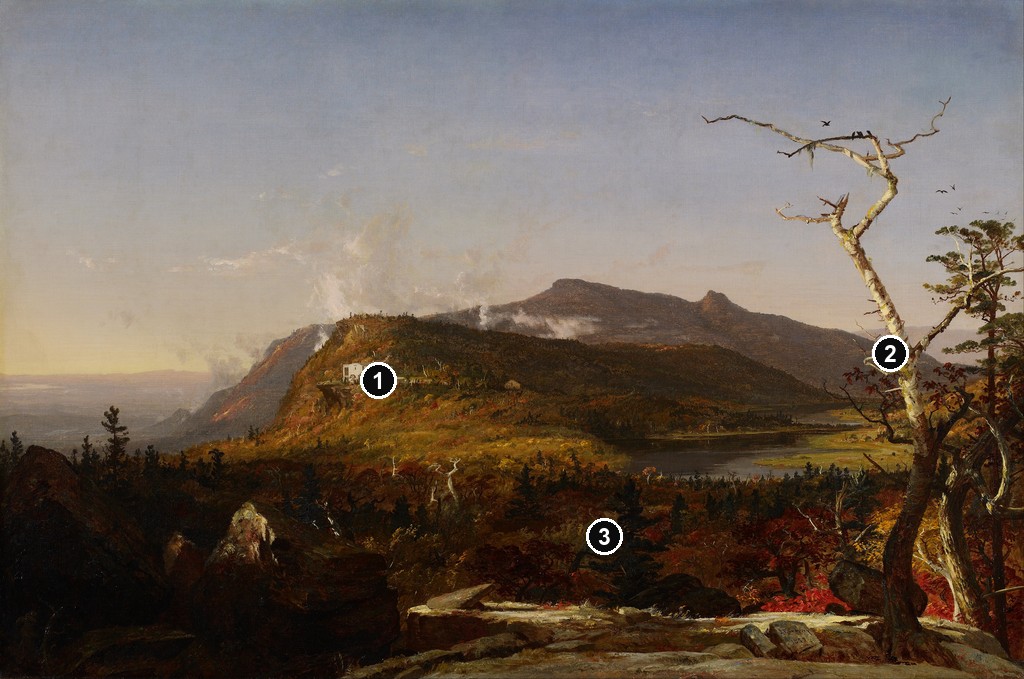
The numbered points identify visible features discussed in this article. Return from each detail to the whole composition. Jasper Francis Cropsey, Catskill Mountain House, 1855. Oil on canvas, 29 × 44 inches (approximately 73.7 × 111.8 cm). Minneapolis Institute of Art, 31.47. Bequest of Mrs. Lillian Lawhead Rinderer in memory of her brother, William A. Lawhead, and the William Hood Dunwoody Fund. Jasper Francis Cropsey / Minneapolis Institute of Art, via Google Art Project. Image source. Public domain. Separate resized overview with numbered points; details cropped from the original, without recolouring, retouching or enlargement.
Details from CATSKILL MOUNTAIN HOUSE
Compare the cropped details with the complete images above. Notice how their colours, shapes and positions contribute to the larger compositions.
Hotel on the wooded ridge
The pale hotel occupies a ledge on the wooded ridge. It remains a small built presence within the larger mountain landscape.
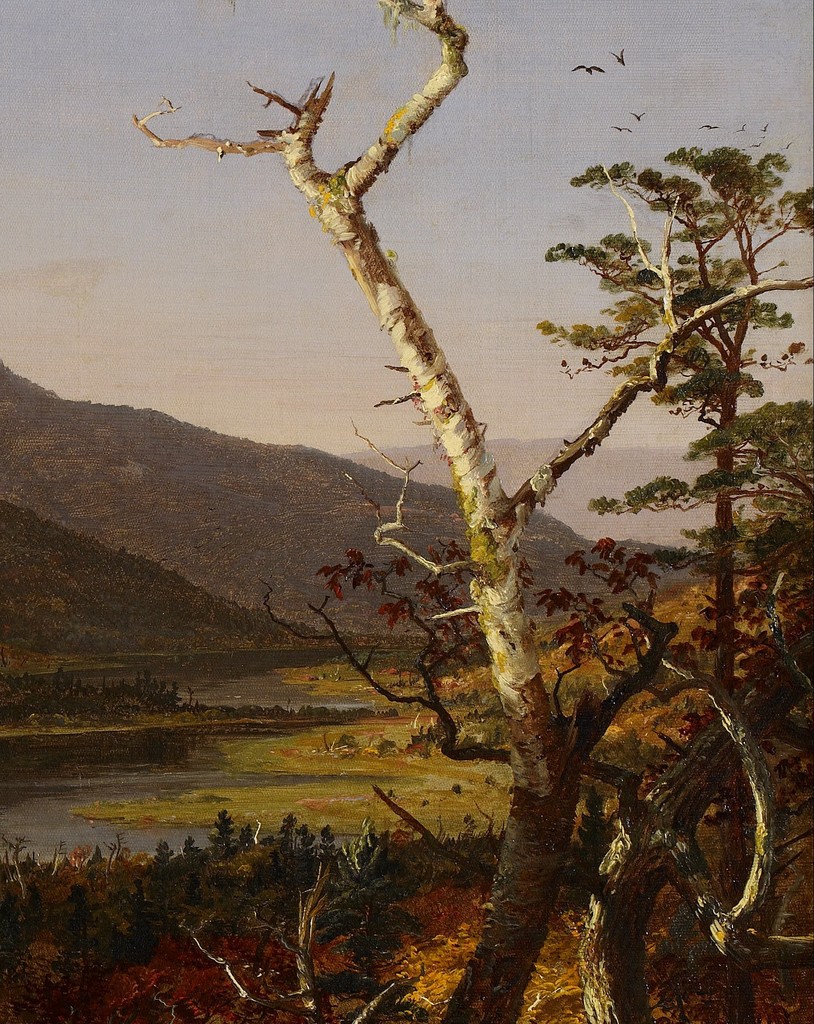
Pale branching trunk at the right
A pale, irregular trunk rises beside darker foliage and open sky. Its strong near outline contrasts with the low distant ridge.
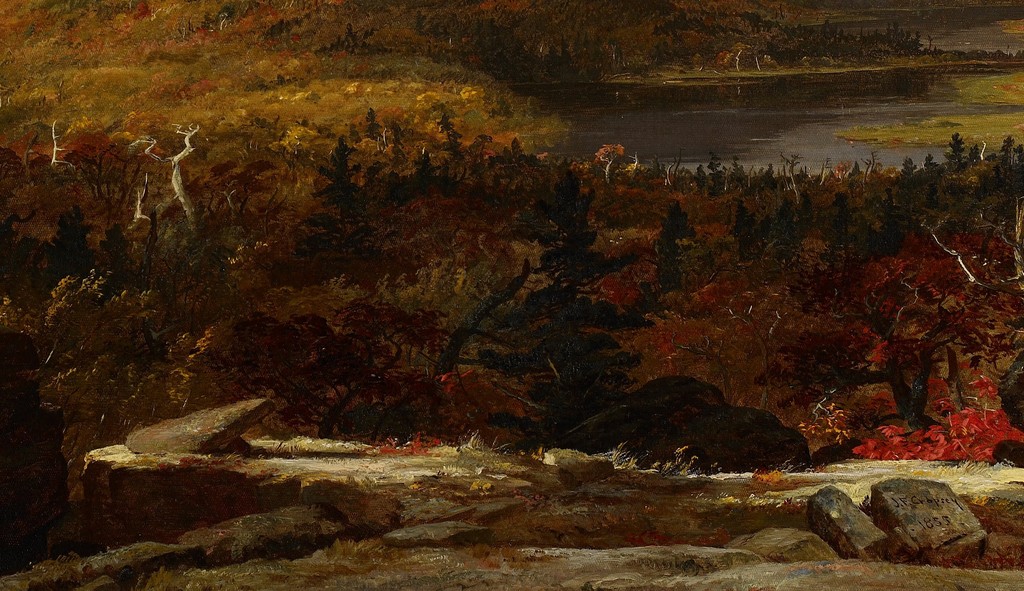
Foreground ledge and distant water
The broad crop links the uneven foreground rock platform with the darker woodland and water beyond. These successive zones establish depth.
Rocks and the pale foreground trunk
The nearest ground contains a sequence of exposed rocks. Their pale upper surfaces catch light while their lower edges fall into shadow. They create a rough platform that feels distinct from the distant hotel ledge.
At the right, a tall pale trunk rises almost to the upper edge of the picture. Its broken branches reach into the sky, and its irregular surface catches attention against the darker land behind it. The trunk is one of the strongest near forms in the composition.
That prominence establishes a difference in scale. The hotel is a recognisable but small shape far away; the weathered tree occupies a large part of the immediate view. Cropsey lets the foreground’s natural forms outweigh the distant architectural landmark.
The trunk also affects the route through the painting. Its curved vertical draws attention upward, while lower branches and surrounding foliage return the eye to the ground. From there, the nearer trees and rocks lead toward the lakes and hill.
Dark woodland fills much of the lower left. Together with the pale trunk at the right, it forms an unequal frame around the middle-distance country. The contrast makes the lighter spaces beyond feel like openings within an extensive wooded environment.
Lakes, slopes and open atmosphere
Water appears below the mountain at the right of the middle distance. Its lighter surface offers a quieter interval among the textured slopes and trees. The shore curves back toward the hill, helping connect different parts of the scene.
The mountain ridge extends across the centre with a varied but continuous outline. Smaller rises and dips prevent it from becoming a simple wall. The white hotel sits within that larger structure, close enough to remain legible but distant enough to appear absorbed by the country.
Light cloud and mist passages cross or rise from the slopes. They soften parts of the mountain without obscuring its full extent. The viewer can perceive both the solidity of the land and the atmosphere moving through it.
The sky occupies a large, relatively quiet upper field. Its broad pale-grey area makes the jagged foreground branches easy to read. It also gives the distant mountain a less confined setting than the dense woodland below might suggest.
This distribution of space is central to the painting. The foreground is crowded with particular forms; the sky remains open; the middle-distance land bridges them. The hotel participates in that structure as a small bright point within a much larger passage of terrain and air.
A tourist experience viewed from outside
Rebora contrasts the painting with historical descriptions of the resort’s comfort and social life. Her catalogue discusses accounts of its accommodations, entertainment and celebrated prospects. Those activities belong to the hotel’s history, even though the composition does not show them directly. [2]
The contrast is productive. A visitor inside the hotel could look outward from an organised place of accommodation; Cropsey places the viewer across the country, looking toward the building. The painting changes which part of the encounter becomes prominent.
The hotel’s small scale encourages attention to the rugged surroundings before its refined services. Architecture registers human occupation, but the foreground offers rocks, exposed timber and dense growth rather than tables, rooms or a busy promenade.
This does not mean the building was abandoned in 1855. The historical sources describe a functioning destination. Its distant, almost isolated appearance is an effect of the chosen view and arrangement, not evidence that the depicted hotel had become a literal ruin.
Watch: Jasper Cropsey
Look closely at Cropsey’s Mount Jefferson, then explore the wider Hudson River School tradition.
Summer or Autumn? Picturing the American Republic
Smarthistory discusses Cropsey’s seasonal landscape and the image of the American republic.
Watch on YouTubeThe 1852 drawing and Thomas Cole
Rebora discusses Cropsey’s Mountain Landscape, dated 22 June 1852, a pencil drawing on buff paper in the Museum of Fine Arts, Boston, accession 54.1642. She connects it with the viewpoint developed in the finished oil. The original drawing is considered here through her published catalogue account. [2]
The same discussion identifies Thomas Cole’s A View of the Two Lakes and Mountain House, Catskill Mountains, Morning of 1844, now in Brooklyn, accession 52.16, as an important model. Rebora explicitly distinguishes that relationship from direct copying. Cropsey’s dated drawing provides evidence of his own visit and engagement with the site. [2]
The comparison places the canvas within a tradition of showing the white hotel across a much larger mountain setting. Artists could select this view while giving different weights to foreground, atmosphere and human presence.
Rebora interprets Cropsey’s treatment as a nostalgic, mythic landscape in which the modern resort takes on the appearance of a classical remnant amid woodland. That is a reading of the picture’s effect. It should remain distinct from the building’s documented use as a tourist hotel. [2]
A commission with unresolved details
The museum’s short label states that Cropsey made the 1855 painting for James Edgar, described there as a Chicago businessman. The more detailed 1987 catalogue considers the Edgar commission very likely, but explains complications in attaching the surviving canvas to the records. [1] [2]
Rebora discusses three account-book entries in 1855 that record a total of $350 for the painting and frame. She also notes a contemporary report identifying a Chicago owner, difficulty locating Edgar in the relevant city directories, and an 1859 exhibition listing the painting under E. H. Sheldon’s ownership. [2]
Multiple versions make the question more complicated. The catalogue points to more than one Mountain House title in Cropsey’s later exhibition and sale records. A record of a painting of the subject cannot always be assigned to this canvas without further evidence. [2]
The useful conclusion is therefore narrower than a seamless ownership story. An Edgar commission has strong documentary support, while the precise connection between all named owners, versions and the Minneapolis painting remains qualified in the detailed scholarship.
Sky in the year of Up among the Clouds
Cropsey published Up among the Clouds in August 1855, the same year inscribed on this canvas. The essay asks for attention to cloud form, variation and the depth of the sky. It provides a contemporary statement of his atmospheric interests without establishing an exact order between text and painting. [3]
The large upper field makes those interests useful to consider here. Small changes in cloud and light keep the sky active without filling it with dense dramatic masses. Its openness lets the near branches and distant ridge define different kinds of contact with the atmosphere.
A later landscape with railway travel
Cropsey’s Starrucca Viaduct of 1865, now in Toledo, offers a different relation between modern activity and landscape. There, the railway and its bridge become part of an inhabited valley, with foreground viewers and a wider network of travel. [4]
The comparison clarifies this earlier hotel picture’s choices. Both works include a recognisable modern structure, yet one places it across a rugged, sparsely occupied scene and the other incorporates movement more visibly into the view. Cropsey could give tourism and infrastructure different roles within landscape composition.
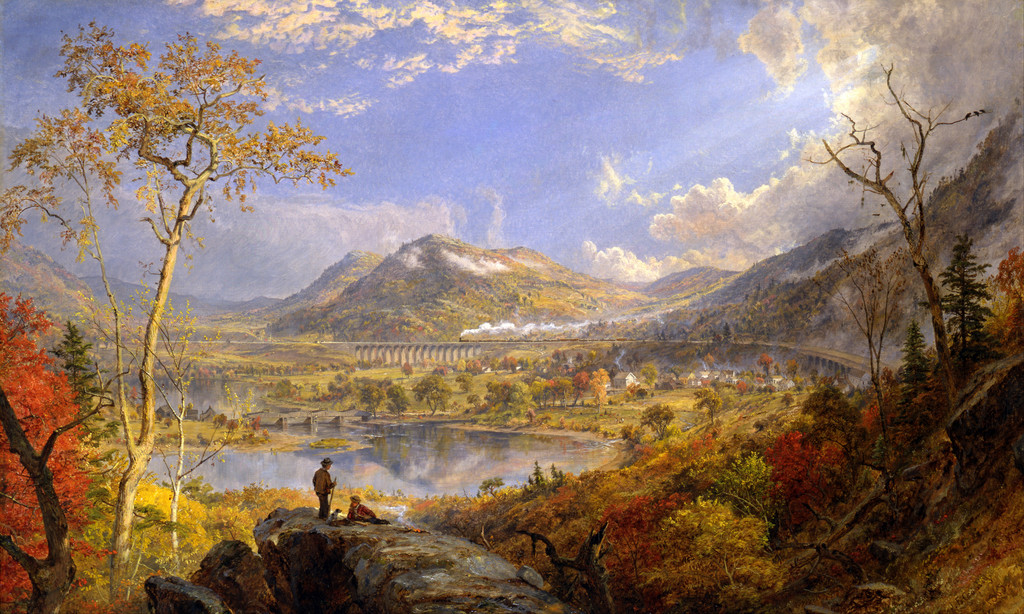
Jasper Francis Cropsey, Starrucca Viaduct, Pennsylvania, 1865. Toledo Museum of Art, 1947.58. Purchased with funds from the Florence Scott Libbey Bequest in Memory of her Father, Maurice A. Scott. Jasper Francis Cropsey / Toledo Museum of Art, via Google Art Project. Image source. Public domain. Proportionally resized only; full carrier, margins and native appearance retained.
The Minneapolis painting
The acquisition credit combines the Rinderer memorial bequest and the William Hood Dunwoody Fund. Accession 31.47 identifies the Minneapolis canvas independently of uncertainties in its earlier commission and version history. [1]
The painting’s distinctive encounter comes from the distance between near natural forms and the small hotel. The pale trunk and rocks give the viewer a rugged place to stand, the lakes open passages into the middle ground, and the white building supplies a landmark far beyond. The resort is part of the mountain country, while the country remains the larger subject.
Artworks directory
A selected directory of 18 paintings, two drawings and three architectural projects. Repeated subjects retain distinct object identities. Links lead to a companion article where available, otherwise the consulted institutional record. Unillustrated objects remain searchable; this is not a complete catalogue raisonné.
Frequently Asked Questions
Rebora identifies Cole’s 1844 canvas as a model but distinguishes that from direct copying. Cropsey’s own related drawing is dated 22 June 1852. [2]
Discussion
Look again at the images and ideas explored in Catskill Mountain House by Jasper Cropsey. These editorial prompts invite your observations.
Reader Insights
Does the hotel or the foreground trunk first hold your attention?
How does the distant building change your sense of the surrounding country?
What differs when modern travel becomes more visible in Starrucca Viaduct?
Join the Conversation
Share a detail, comparison or question about Catskill Mountain House by Jasper Cropsey below.
References
- Minneapolis Institute of Art, Catskill Mountain House, museum record supplied through Google Arts & Culture. Exact 1855 painting, unframed dimensions, acquisition credit and short resort/commission narrative. View source
- Carrie Rebora, Catskill Mountain House, American Paradise: The World of the Hudson River School, Metropolitan Museum of Art (1987), printed pp.203–205. Tourism, 1852 drawing, Cole comparison, interpretive reading and commission/version uncertainties; archival records discussed through this catalogue. View source
- J. F. Cropsey, Up among the Clouds, The Crayon, II, no. VI, 8 August 1855, pp.79–80. Contemporary discussion of clouds and atmospheric depth. View source
- Toledo Museum of Art, Starrucca Viaduct, Pennsylvania, accession 1947.58. Separate 1865 landscape with railway infrastructure. View source
- Splash image source.
Jasper Francis Cropsey, Catskill Mountain House, 1855. Oil on canvas, 29 × 44 inches (approximately 73.7 × 111.8 cm). Minneapolis Institute of Art, 31.47. Bequest of Mrs. Lillian Lawhead Rinderer in memory of her brother, William A. Lawhead, and the William Hood Dunwoody Fund. Jasper Francis Cropsey / Minneapolis Institute of Art, via Google Art Project. Public domain. Proportionally resized only; full carrier, margins and native appearance retained.
View source