 by Tom Gurney
Tom Gurney BSc (Hons) is an art history expert with over 20 years experience
Email: tomgurney1@gmail.com / Phone: +44 7429 011000
Greenwood Lake by Jasper Cropsey: Introduction
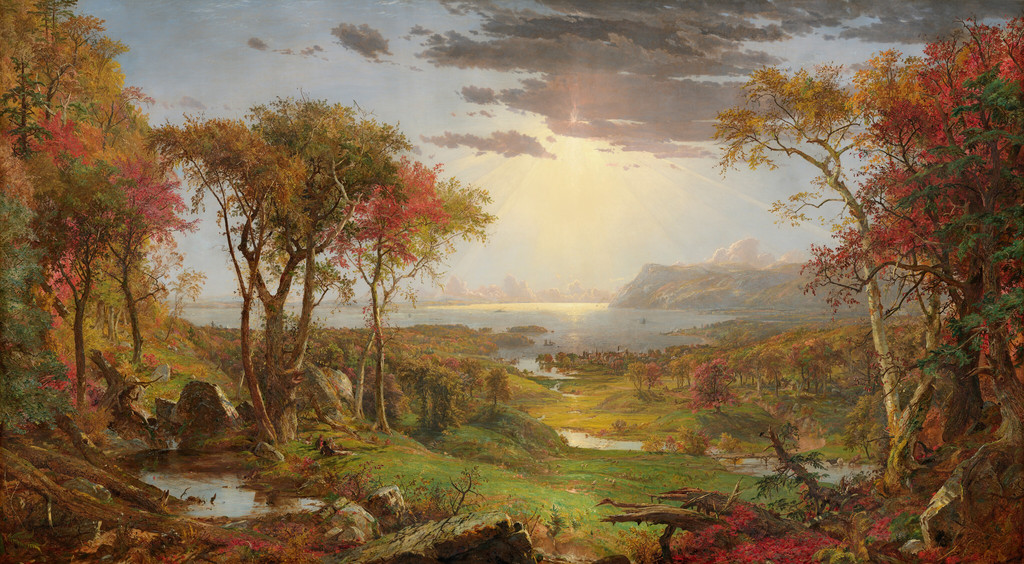
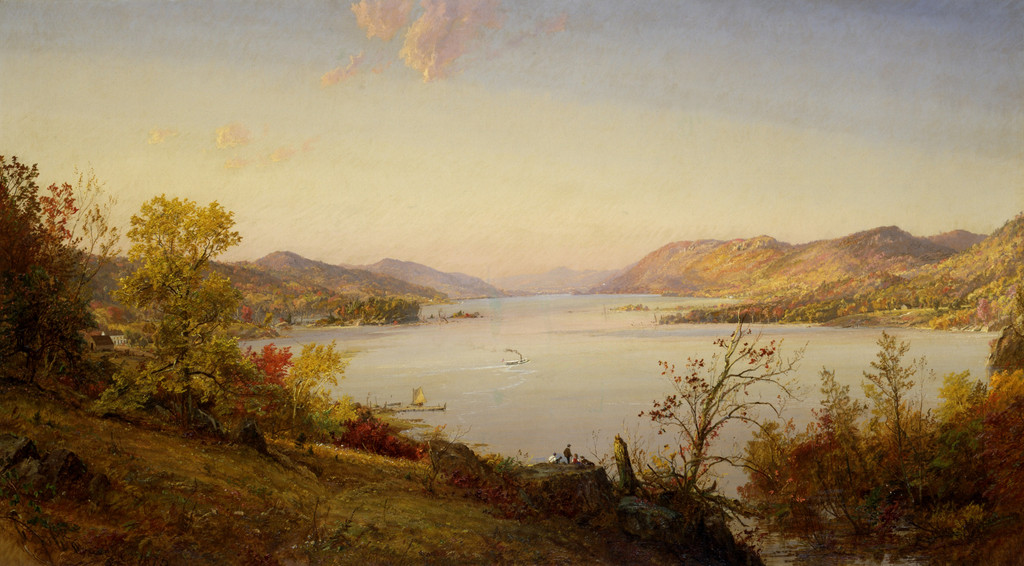
Jasper Cropsey’s Greenwood Lake of 1875 opens from a wooded foreground onto broad water and distant hills. It belongs to the Smithsonian American Art Museum, where the medium is recorded as oil on canvas mounted on Masonite. Measuring 76.5 × 136.5 cm, the picture gives autumn colour and the lake’s open surface a generous horizontal setting. [1]
The composition offers two ways of inhabiting the landscape. Small figures occupy a near ledge, while boats travel across the water beyond them. One group looks into the view; other forms move within it. Cropsey connects these different scales of activity through the same expanse of light and atmosphere.
At a Glance
- Artist: Jasper Francis Cropsey
- Title: Greenwood Lake
- Date: 1875
- Medium: Oil on canvas mounted on Masonite
- Dimensions: 76.5 × 136.5 cm
- Collection: Smithsonian American Art Museum
- Accession: 1967.125
- Acquisition credit: Gift of Ellen R. Wheeler
This work across Jasper Cropsey’s career
Contents
- Identifying the Smithsonian canvas
- A wooded place for the viewer
- Boats across the open water
- Autumn colour and the long horizon
- A subject with an early personal history
- The separate 1870 Greenwood Lake
- Another local landscape: Sugar Loaf Mountain
- The Smithsonian gift
- Annotated details
Identifying the Smithsonian canvas
Cropsey returned to Greenwood Lake repeatedly, so the title identifies a subject that appears in more than one work. For this article, the essential particulars are the Smithsonian’s 1875 date and accession 1967.125. They distinguish the illustrated painting from the larger 1870 canvas at the Museo Nacional Thyssen-Bornemisza. [1] [2]
The Smithsonian records canvas mounted on Masonite, a description of the object’s present support. That wording should be kept with its collection identity rather than treated as evidence that Cropsey chose that modern board in 1875. The record does not supply a mounting history. [1]
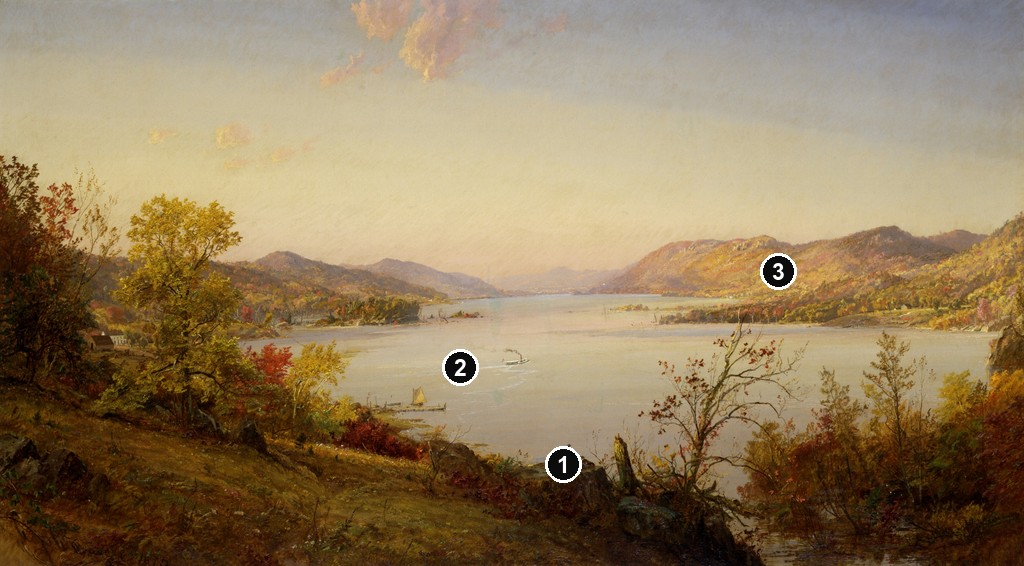
The illustrated composition can be recognised by its open central water, near trees at both sides and a small group on the foreground ledge. Its hills form a long sequence across the upper edge of the lake. These features give a visual identity alongside the museum’s date and catalogue number.
Annotated Details from Greenwood Lake
The numbered points identify visible features discussed in this article. Return from each detail to the whole composition. Jasper Francis Cropsey, Greenwood Lake, 1875. Smithsonian American Art Museum, 1967.125. Gift of Ellen R. Wheeler. A different arrangement of near foliage and broad open water in the region Cropsey repeatedly painted. Jasper Francis Cropsey / Smithsonian American Art Museum. Image source. Public domain. Separate resized overview with numbered points; details cropped from the original, without recolouring, retouching or enlargement.
Details from GREENWOOD LAKE
Compare the cropped details with the complete images above. Notice how their colours, shapes and positions contribute to the larger compositions.
Figures beside the near shore
Small figures occupy the near shoreline ledge. The broad crop keeps them within their setting and does not infer facial expression.
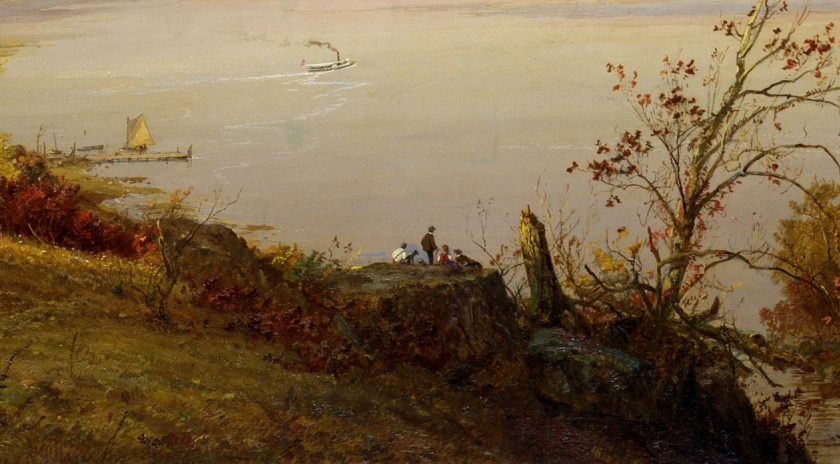
Sailboat and vessel on the open water
A pale sail and a more distant vessel interrupt the open water. Their small scale makes the lake’s breadth readable.
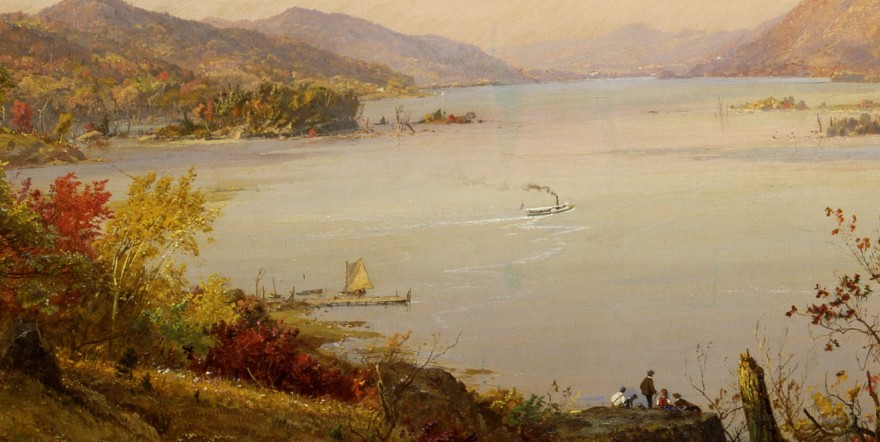
Warm ridge beyond the lake
A warm wooded ridge borders the lake at the right. Its broad colour masses contrast with the pale water and sky.
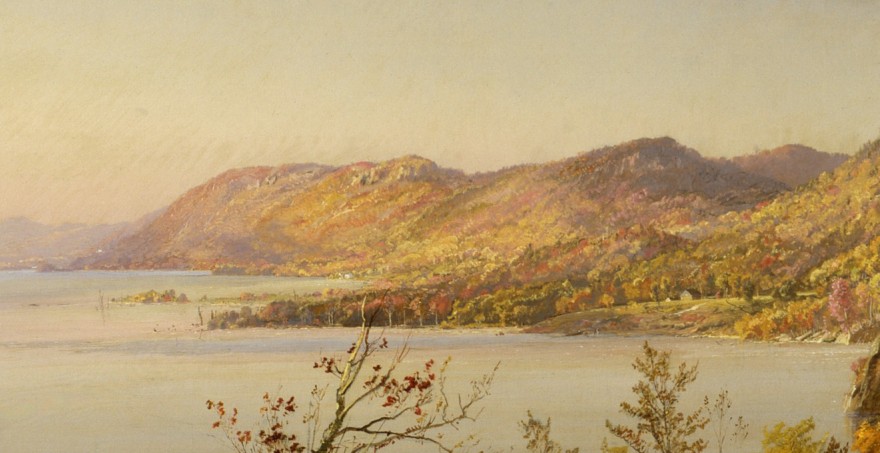
A wooded place for the viewer
The nearest land is darker than the water beyond it. Rocks, scattered trunks and foliage create an uneven foreground through which the eye finds openings. The bank feels close because its forms are more sharply separated than the distant hills.
At the left, a broad tree rises above smaller leaves and bushes. Its lighter crown catches the surrounding illumination, while the denser growth below creates a shaded interval. Nearby, a small building appears within the wooded shore rather than dominating it.
The right-hand trees have a different character. A slender, partly bare trunk and fine branches stand against the bright water. Their open structure lets the lake remain visible through them. Cropsey therefore frames the panorama with two unequal masses: fuller foliage at the left and a more broken screen at the right.
The foreground ledge supplies a position from which to look. The small figures gather near its edge, with the lake stretching beyond. Their size makes the land and water appear more extensive, and their placement suggests a pause within a landscape that contains other kinds of movement.
The people remain too small to support named identities or a detailed account of their conversation. What can be read clearly is their relation to the view. They occupy a near platform that turns the broad lake into something observed from within the country around it.
Boats across the open water
Several small craft interrupt the lake’s pale surface. A sailboat near the left shore has a warmer, more definite shape than the distant boats. Farther out, a low vessel and pale trailing passage introduce a different form of travel.
These boats create intervals across the water. They give the eye points to register without breaking the larger openness of the lake. Their small scale is essential: the central surface continues to feel broad because the craft occupy so little of it.
The near sail and the more distant vessel also set up a progression away from the foreground. One lies close to the wooded bank; another belongs to a wider stretch of water. The viewer can follow their separation as another measure of depth.
The distant shores converge toward a lighter opening near the centre. Boats, reflections and shoreline forms become less distinct as they approach that passage. Cropsey allows the far lake to recede through reduced contrast rather than closing it with one emphatic landmark.
The result is a scene that includes both viewing and travelling. The foreground figures are comparatively stationary, while the craft suggest movement through the landscape. Neither activity overwhelms the other. They help make the lake a lived place at different distances from the viewer.
Autumn colour and the long horizon
Warm foliage spreads through the banks and hills. The strongest near colours appear in small clusters against darker ground; farther away, they gather into larger belts along the slopes. Their changing scale keeps the autumn colour connected to the picture’s depth.
The right-hand hills catch more distinct illumination than some of the farther ridges at the left. Their uneven line gives the horizon a varied rhythm, while the water below remains comparatively level. Cropsey balances that change in the land with the long, quieter surface of the lake.
The sky occupies a substantial part of the canvas. Light clouds near the upper centre do not obscure its broad pale field. That openness helps the wooded shores feel extensive rather than enclosed beneath a dense canopy.
The atmosphere joins the water and distant country through related light tones. Nearer trees remain distinct enough to frame the view, but the far hills soften as they recede. The arrangement allows the picture to be detailed and expansive at the same time.
Watch: Jasper Cropsey
Look closely at Cropsey’s Mount Jefferson, then explore the wider Hudson River School tradition.
Summer or Autumn? Picturing the American Republic
Smarthistory discusses Cropsey’s seasonal landscape and the image of the American republic.
Watch on YouTubeA subject with an early personal history
Deborah Chotner’s biography traces Cropsey’s interest in Greenwood Lake to his early landscape studies. A two-week sketching trip to New Jersey produced two Greenwood Lake paintings accepted at an 1843 American Art-Union exhibition. During subsequent visits he met Maria Cooley, whom he married in May 1847. [3]
The lake therefore had a place in his work well before the 1875 canvas. Its history combines repeated artistic attention with a personal connection, but that does not identify the figures in this painting as family members.
Nor does familiarity with the area make this image a transparent record of every feature visible from a particular lookout. Cropsey’s repeated subjects could be arranged to emphasise different relations of foreground, water and distance. Here, the near ledge and long central opening organise the view into a deliberate panorama.
The separate 1870 Greenwood Lake
The Thyssen painting is dated 1870, measures 97 × 174 cm and carries inventory number 496, also recorded as 1983.39. Those dimensions and catalogue details establish a different object from the Smithsonian’s smaller 1875 canvas. [2]
In the Thyssen museum’s interpretation, Paloma Alarcó discusses the panoramic format and its attention to light and atmosphere. She relates the broad view to Cropsey’s mature interest in autumn landscape. That account is useful evidence of how another version of the subject has been studied, rather than a description to transfer unchanged to the Smithsonian picture. [2]
Repeated titles make object details especially useful. A reader following a reproduction, exhibition reference or museum link needs the date, size and collection to know which canvas is being discussed. The two paintings share a lake subject without becoming interchangeable illustrations of it.
Another local landscape: Sugar Loaf Mountain
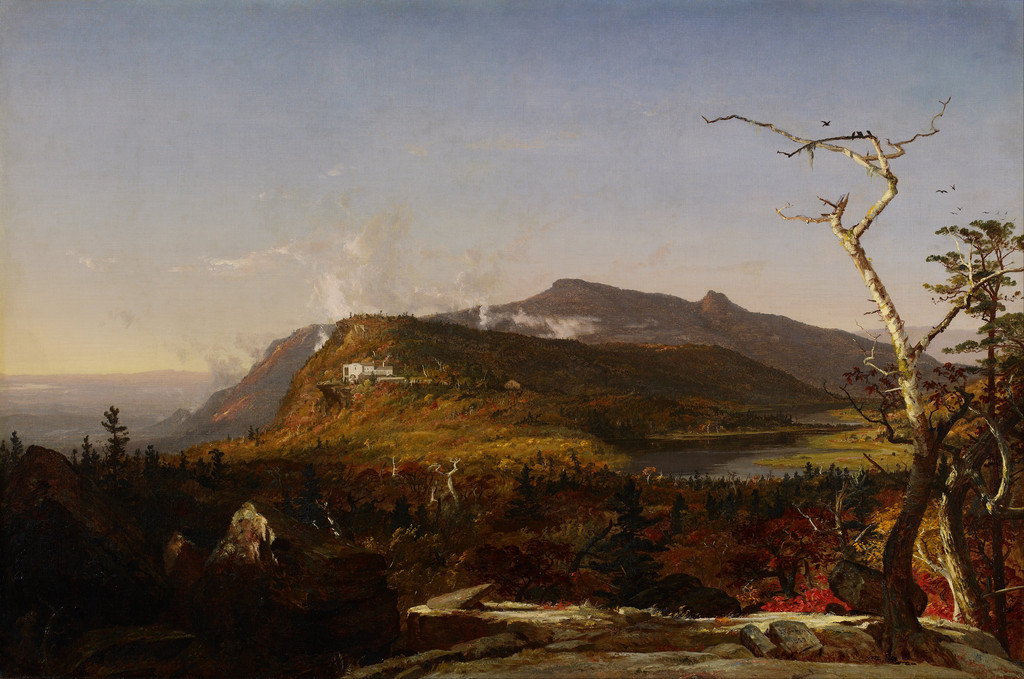
Sugar Loaf Mountain offers a different organisation of the surrounding region. Kenneth W. Maddox’s study identifies the Met painting’s subject as the rounded mountain in Orange County, New York, correcting its earlier association with Mount Chocorua in New Hampshire. The present museum date is about 1870–75. [4] [5]
That painting places a rounded height beyond farmland and trees. In Greenwood Lake, water occupies the central interval and hills stretch across a much longer horizon. Comparing them shows how an artist’s sustained interest in a region can produce different structures of looking, from an individual mountain to a lake panorama.
The comparison does not place Sugar Loaf Mountain within this lake’s distant outline. Its value lies in the different role each landscape gives to open space. Fields lead toward the mountain in one picture; a broad surface of water carries the eye between shores in the other.
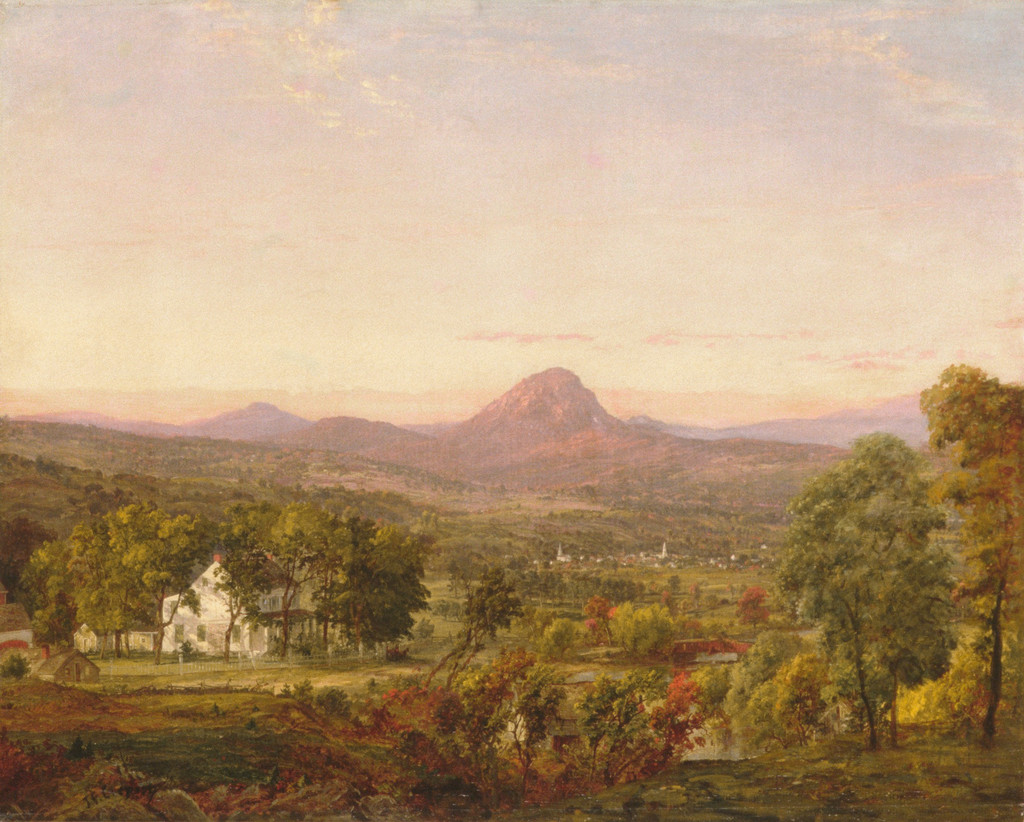
Jasper Francis Cropsey, Sugar Loaf Mountain, about 1870–75. Metropolitan Museum of Art, 61.262. The Orange County mountain subject was identified by Kenneth W. Maddox; it is not identified in the Greenwood Lake horizon. Jasper Francis Cropsey / The Metropolitan Museum of Art. Image source. CC0 / Public domain. Proportionally resized only; full carrier, margins and native appearance retained.
The Smithsonian gift
The Smithsonian credits Greenwood Lake to the Gift of Ellen R. Wheeler. Its accession, 1967.125, identifies the canvas within the museum’s collection. [1]
The painting’s enduring interest comes from the way its near and far activities share one field of light. The foreground group occupies a shaded place to look, the boats cross the open water, and the autumn hills extend beyond both. Cropsey gives the viewer a position within the scene while keeping the lake large enough to invite an outward journey.
Artworks directory
A selected directory of 18 paintings, two drawings and three architectural projects. Repeated subjects retain distinct object identities. Links lead to a companion article where available, otherwise the consulted institutional record. Unillustrated objects remain searchable; this is not a complete catalogue raisonné.
Frequently Asked Questions
The consulted Smithsonian record does not identify them. Their visible role is to provide a near group looking into the lake landscape.
He made early landscape studies associated with the lake and returned to it repeatedly. Chotner also records that he met Maria Cooley during a subsequent visit, before their marriage in May 1847. [3]
Discussion
Look again at the images and ideas explored in Greenwood Lake by Jasper Cropsey. These editorial prompts invite your observations.
Reader Insights
How does the shaded ledge affect your experience of the open water?
Do the boats make the view feel quieter or more active?
What changes when you compare the lake panorama with Sugar Loaf Mountain?
Join the Conversation
Share a detail, comparison or question about Greenwood Lake by Jasper Cropsey below.
References
- Smithsonian American Art Museum, Greenwood Lake, accession 1967.125. Exact 1875 object, present medium, dimensions and gift credit. View source
- Museo Nacional Thyssen-Bornemisza, Greenwood Lake, inventory 496 / 1983.39, with essay by Paloma Alarcó. Separate 1870 canvas and its panoramic interpretation. View source
- Deborah Chotner, Cropsey biography, American Paintings of the Nineteenth Century, Part I, National Gallery of Art (1996), printed pp.109–110. Early Greenwood Lake studies and marriage to Maria Cooley. View source
- Kenneth W. Maddox, A Forgotten Mountain: Jasper F. Cropsey’s Paintings of Sugar Loaf, Metropolitan Museum Journal, 35 (2000), pp.221–236. Revised identification of the Met mountain subject. View source
- Metropolitan Museum of Art, Sugar Loaf Mountain, accession 61.262. Current title and date, about 1870–75. View source
- Splash image source.
Jasper Francis Cropsey, Greenwood Lake, 1875. Oil on canvas mounted on Masonite, 76.5 × 136.5 cm. Smithsonian American Art Museum, 1967.125. Gift of Ellen R. Wheeler. Jasper Francis Cropsey / Smithsonian American Art Museum. Public domain. Proportionally resized only; full carrier, margins and native appearance retained.
View source