 by Tom Gurney
Tom Gurney BSc (Hons) is an art history expert with over 20 years experience
Email: tomgurney1@gmail.com / Phone: +44 7429 011000
The Hudson River at Hastings by Jasper Cropsey: Introduction
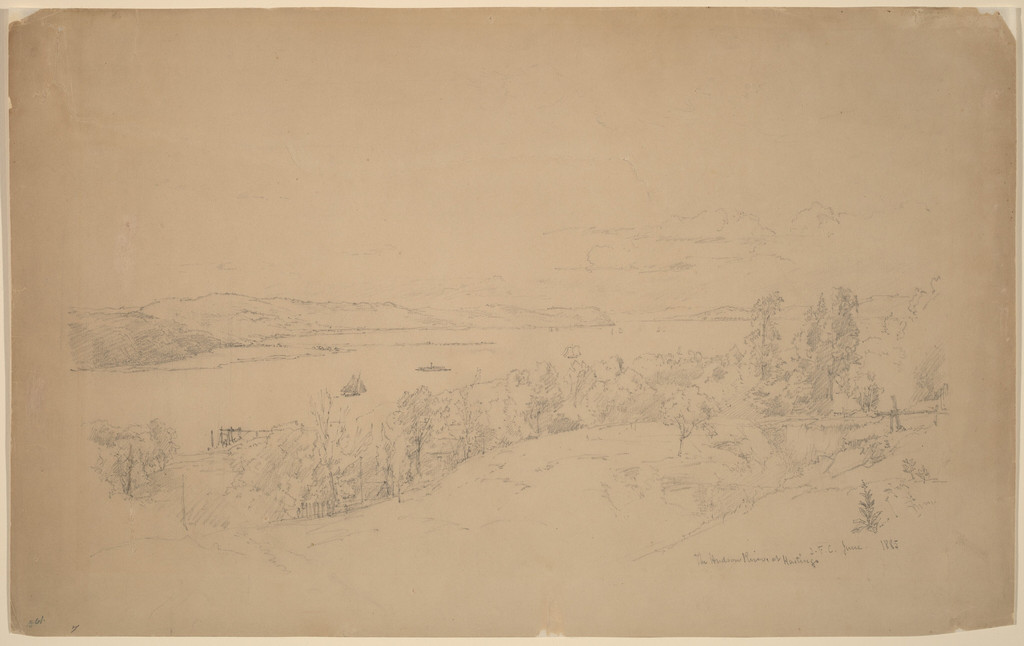
The Hudson River at Hastings is a quietly worked drawing from June 1885, the year Jasper Cropsey moved to Hastings-on-Hudson. The National Gallery of Art records it as graphite on paper, measuring 30.4 × 48.4 cm. Its light marks describe boats, water and a shoreline without filling the sheet with the colour and incident of a finished oil panorama. [1]
Looking closely at the drawing means attending to what Cropsey chose to mark. Much of the paper remains open, allowing a few lines and small groups of strokes to suggest a broad river setting.
At a Glance
- Artist: Jasper Francis Cropsey
- Title: The Hudson River at Hastings
- Date: June 1885
- Medium: Graphite on paper
- Dimensions: 30.4 × 48.4 cm
- Collection: National Gallery of Art, Washington
- Accession: 1979.20.28
- Subject: A river view at Hastings-on-Hudson
This work across Jasper Cropsey’s career
Contents
- A dated view on a complete sheet
- Boats and a distant shore
- Light marks and selective attention
- Hastings in the year of the move
- Another way of working on paper
- Annotated details
- Inscriptions and the drawing’s later history
A dated view on a complete sheet
The drawing is wider than it is high. A long shoreline extends across the upper part of the composition, leaving a substantial open area for the river. Marks nearer the bottom introduce the foreground, while the distant buildings and vessels appear much smaller.
This horizontal arrangement makes the sheet feel like an extended act of looking across water. The country on the opposite side is important, but it does not rise into the dominant mountain mass familiar from some of Cropsey’s paintings. The view develops along the river’s breadth.
The dated inscription gives the drawing a firmer chronological anchor than an undated landscape study would have. The museum records June 1885, placing this sheet near the beginning of Cropsey’s Hastings years. [1] That date identifies the work; it does not, by itself, establish where the artist stood while drawing it.
Drawing comparison: Torre dei Schiavi
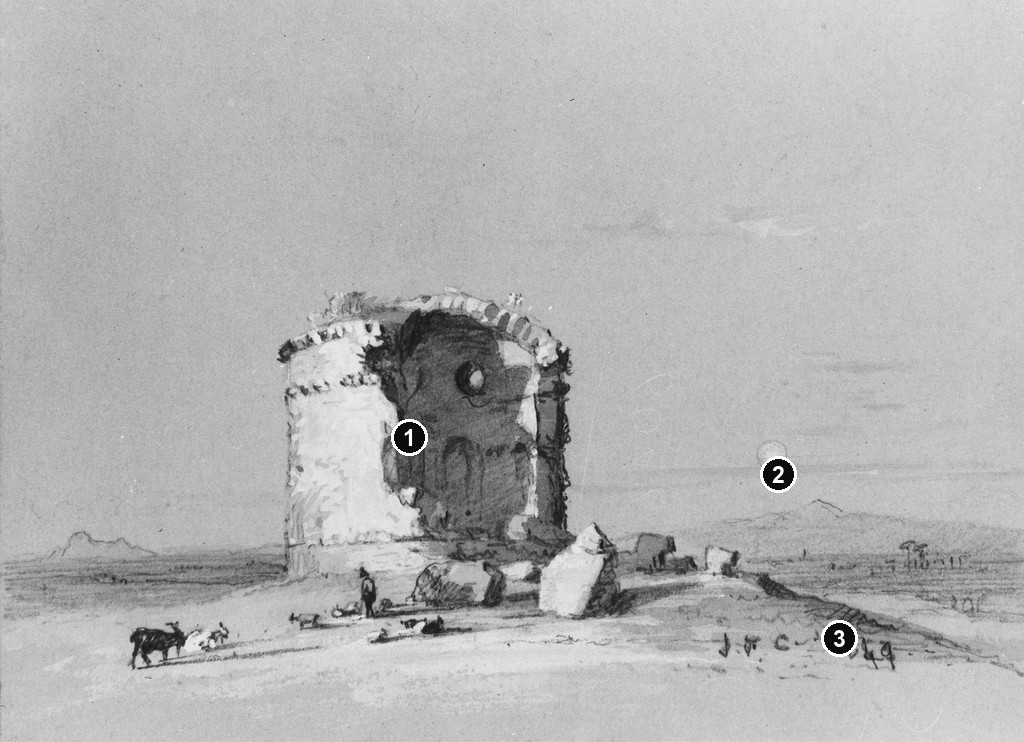
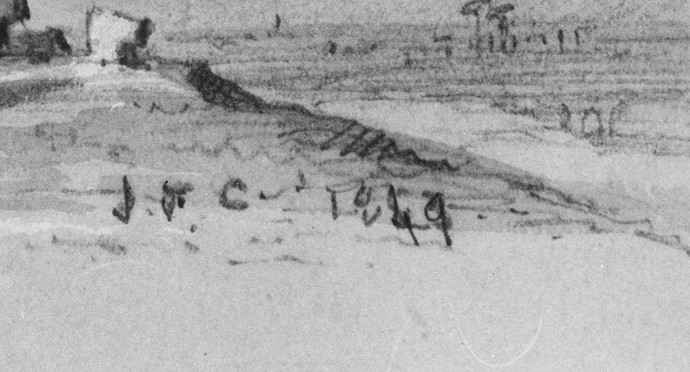
The whole Hastings graphite sheet appears earlier in this article. These numbered details examine the separate Torre dei Schiavi drawing, a comparison of working methods rather than a study for the Hastings scene. The numbered points identify visible features discussed in this article. Return from each detail to the whole composition. Jasper Francis Cropsey, Torre dei Schiavi, The Roman Campagna (from Cropsey Album). Metropolitan Museum of Art, 1970.9.26 recto. The museum catalogues the drawing as 1853; the visible inscription reads 1849. This is a different object from the 1847 oil. Jasper Francis Cropsey / The Metropolitan Museum of Art. Image source. CC0 / Public domain. Separate resized overview with numbered points; details cropped from the original, without recolouring, retouching or enlargement.
Details from THE HUDSON RIVER AT HASTINGS
Compare the cropped details with the complete images above. Notice how their colours, shapes and positions contribute to the larger compositions.
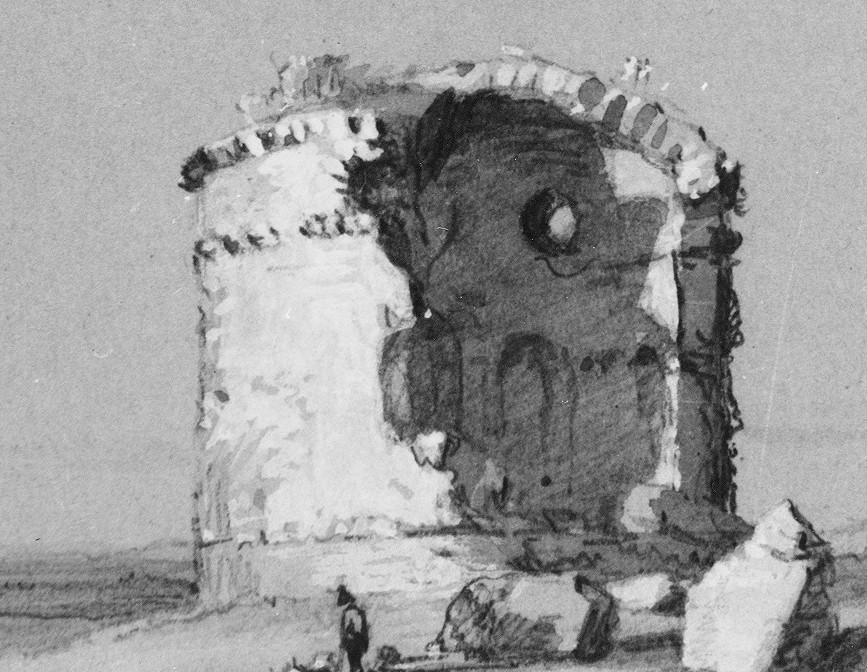
Light and shade across the ruin
Pale highlights and dark washes divide the broken cylindrical ruin. The contrast makes openings and uneven masonry legible on the toned sheet.
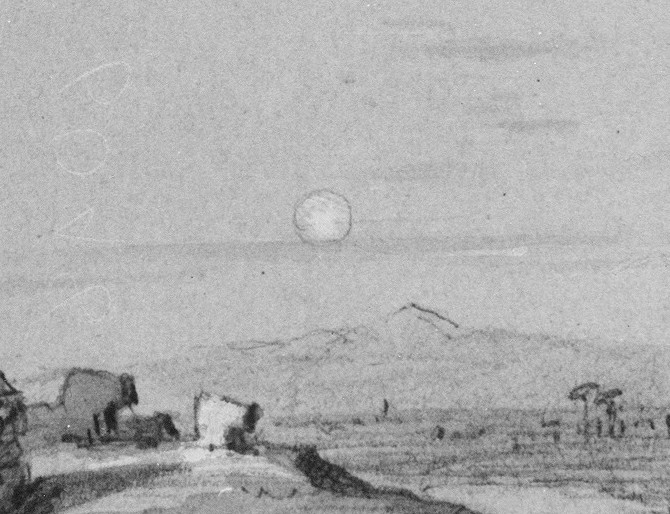
Moon and faint distant ridge
A faint circular moon appears above a low distant ridge. The broad crop retains the delicate marks without enhancing their contrast.
Inscription at the lower edge
The lower inscription visibly ends in 1849. It is kept separate from the Met’s current 1853 catalogue date rather than silently reconciling the two.
Boats and a distant shore
Small vessels interrupt the expanse of water. Their forms are economical: a few vertical and horizontal marks can distinguish a boat from the open river around it. The contrast between those small dark shapes and the largely unmarked sheet gives them more prominence than their size alone would suggest.
Buildings along the shore form another broken sequence. Some are suggested through upright strokes and compact roof-like shapes. Trees and other shoreline forms make that distant boundary irregular. It remains a place with differing structures, rather than a continuous line drawn across the page.
The scale of these marks matters. Nearer forms occupy more space, while the far shore gathers into a thinner band. Cropsey can therefore establish distance without colouring the whole river or giving every building a fully finished façade.
The scene includes ordinary movement and settlement, but the drawing does not require a story about a named vessel or an identified group of people. The relationship between near shore, open water and distant habitation supplies its principal structure.
Light marks and selective attention
The graphite varies in strength. Some passages are distinct enough to catch the eye immediately; others remain very light. This difference lets the viewer move between forms that are readily legible and areas that ask for slower attention.
The paper plays an active part in that effect. Open areas around the boats give the water breadth, while the light surrounding the distant marks keeps the far shore from becoming too solid. Much of the view is suggested through relationships between marks and spaces.
This economy is different from the dense foliage and strongly coloured foregrounds of many Cropsey oils. It shows how little information is sometimes needed to establish a landscape’s large divisions. A boat, a distant roof and the edge of a bank can provide several points of reference within an otherwise open field.
The drawing also gives access to a stage of work distinct from a fully elaborated exhibition canvas. That distinction should not be turned into an assumed sequence leading to a particular painting. The consulted museum record identifies the sheet, but does not establish such a destination. [1]
Hastings in the year of the move
According to the Newington-Cropsey Foundation, Cropsey moved to Hastings in 1885 and bought the former Saunders home the following year. This became Ever Rest, the surviving home associated with the later part of his career. The drawing belongs to that first year in the neighbourhood. [2]
The house had existed before Cropsey arrived. Its later studio addition made a larger workspace possible, while furnishings and family life connected the Hastings home with the household’s earlier residence at Aladdin. These details explain the setting of his later work without proving that this particular river view was drawn from the studio window. [2]
Drawing remained part of a practice that already included oils and watercolours. Cropsey had helped found the watercolour society in 1867, well before the stroke of 1893 that affected his later activity. The 1885 graphite sheet should therefore be understood within an established use of works on paper. [3] [4]
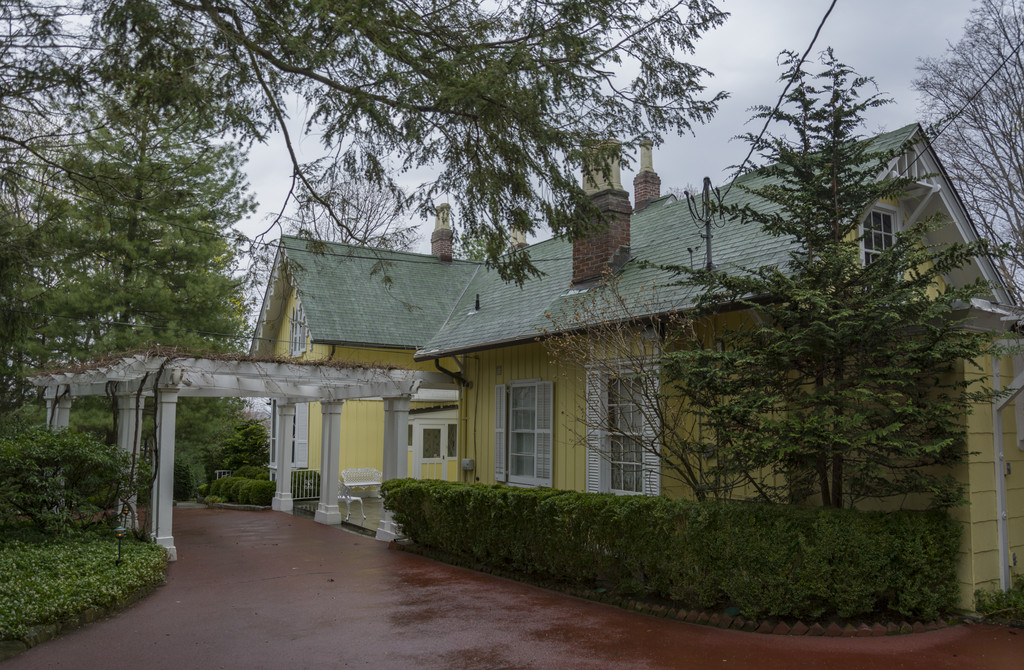
Ever Rest, photographed in 2018 by Ɱ. This modern external view shows the surviving Hastings home, rather than the exact position from which the 1885 river drawing was made. Ɱ,2018 / Wikimedia Commons. Image source. CC BY-SA 4.0. Proportionally resized only; full carrier, margins and native appearance retained.
Watch: Jasper Cropsey
Look closely at Cropsey’s Mount Jefferson, then explore the wider Hudson River School tradition.
Summer or Autumn? Picturing the American Republic
Smarthistory discusses Cropsey’s seasonal landscape and the image of the American republic.
Watch on YouTubeAnother way of working on paper
Cropsey’s Roman album drawing Torre dei Schiavi uses a combination of graphite, ink and white gouache on buff paper. The Met catalogues it as 1853, although an inscription visible on the sheet reads 1849; that discrepancy remains unresolved here. [5] It is a different object from the artist’s 1847 oil of the same Roman ruin. [6]
The comparison clarifies how varied a drawing can be. In the Roman sheet, a substantial architectural form and passages of wash establish a concentrated subject. At Hastings, lighter graphite marks distribute attention across the river. The two works offer different balances between a prominent object and the space around it.
Here, the river’s openness remains the defining experience. Small signs of boats and settlement keep the view inhabited, while the broad intervals of paper give the landscape room to extend beyond those particulars.
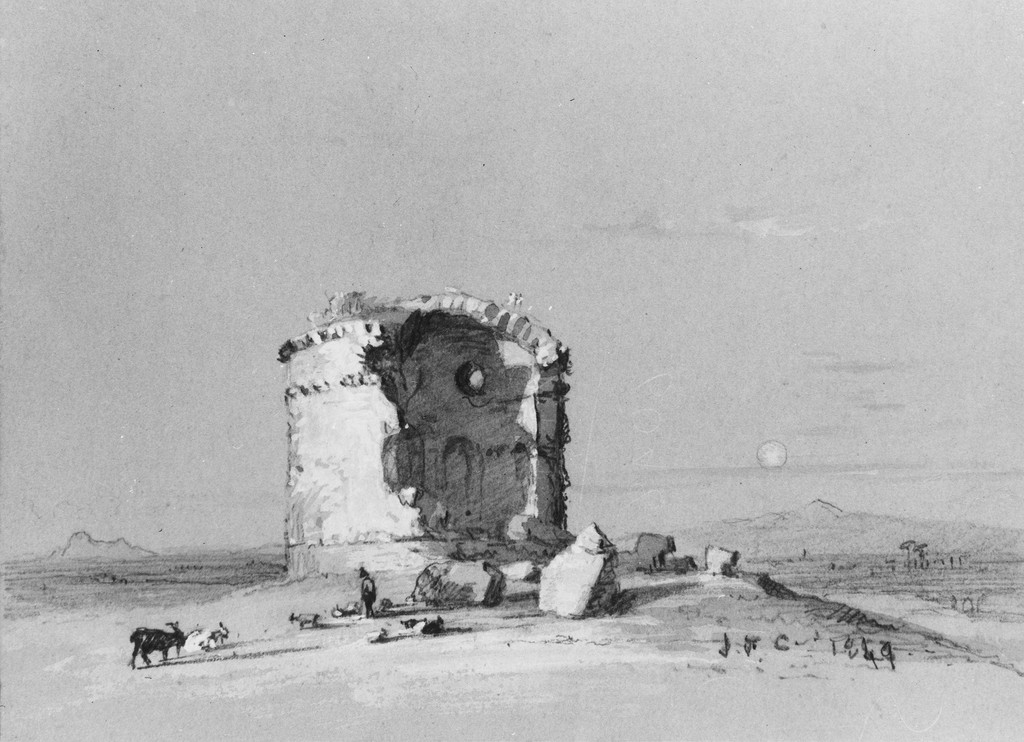
Jasper Francis Cropsey, Torre dei Schiavi, The Roman Campagna (from Cropsey Album). Metropolitan Museum of Art, 1970.9.26 recto. The museum catalogues the drawing as 1853; the visible inscription reads 1849. This is a different object from the 1847 oil. Jasper Francis Cropsey / The Metropolitan Museum of Art. Image source. CC0 / Public domain. Proportionally resized only; full carrier, margins and native appearance retained.
Inscriptions and the drawing’s later history
The museum distinguishes Cropsey’s identifying inscription from later marks. At the lower right it records his initials, the month and year, and the place-name title. Numbers at the lower left are attributed to a later hand. These have different evidential roles: the dated title connects the sheet with the artist’s Hastings subject, while the later notation belongs to its subsequent handling. [1]
The recorded provenance places the drawing with John Davis Hatch by 1976 and identifies his 1979 gift to the National Gallery. The museum also lists it in the history of its 1980 American Light exhibition, a later occasion for considering this quiet work on paper alongside nineteenth-century landscape art. That later presentation does not change the drawing’s own 1885 date. [1]
The sequence at Ever Rest supplies another useful distinction. The Foundation dates Cropsey’s new studio to about 1887 and describes its north-facing full-length window and windowed cupola. These arrangements supplied working light during the later Hastings years; the river drawing predates the completed studio. Its date therefore remains an important check on attempts to attach the view to that particular workspace. [2]
Artworks directory
A selected directory of 18 paintings, two drawings and three architectural projects. Repeated subjects retain distinct object identities. Links lead to a companion article where available, otherwise the consulted institutional record. Unillustrated objects remain searchable; this is not a complete catalogue raisonné.
Frequently Asked Questions
The National Gallery of Art identifies the medium as graphite on paper. Cropsey’s watercolour practice is part of the wider career, but this particular sheet is a graphite drawing. [1]
Discussion
Look again at the images and ideas explored in The Hudson River at Hastings by Jasper Cropsey. These editorial prompts invite your observations.
Reader Insights
Which small mark first makes the large open area read as a river?
How much detail do you need before the distant shore begins to feel inhabited?
What changes when a landscape is organised through graphite marks rather than colour?
Join the Conversation
Share a detail, comparison or question about The Hudson River at Hastings by Jasper Cropsey below.
References
- National Gallery of Art, The Hudson River at Hastings, accession 1979.20.28. Current object record, medium, dimensions and June 1885 inscription. View source
- Newington-Cropsey Foundation, Ever Rest. Hastings move and purchase chronology, studio addition and household history. View source
- Deborah Chotner, Cropsey biography, American Paintings of the Nineteenth Century, Part I, National Gallery of Art (1996), printed pp.109–110. Watercolour society role and later stroke chronology. View source
- Carrie Rebora, Cropsey biography, American Paradise: The World of the Hudson River School, Metropolitan Museum of Art (1987), printed pp.200–202. Society founding year of 1867. View source
- Metropolitan Museum of Art, Torre dei Schiavi, The Roman Campagna (from Cropsey Album), accession 1970.9.26 recto. Drawing media and current catalogue date, considered beside the visible 1849 inscription. View source
- Metropolitan Museum of Art, Torre dei Schiavi, The Roman Campagna, accession 2025.267. Separate oil of 1847; the museum has no available image for that object in the consulted current record. View source
- Splash image source.
Jasper Francis Cropsey, The Hudson River at Hastings, June 1885. Graphite on paper, 30.4 × 48.4 cm. National Gallery of Art, Washington, 1979.20.28. Jasper Francis Cropsey / National Gallery of Art, Washington. CC0 1.0. Proportionally resized only; full carrier, margins and native appearance retained.
View source