 by Tom Gurney
Tom Gurney BSc (Hons) is an art history expert with over 20 years experience
Email: tomgurney1@gmail.com / Phone: +44 7429 011000
The Coast of Genoa by Jasper Cropsey: Introduction
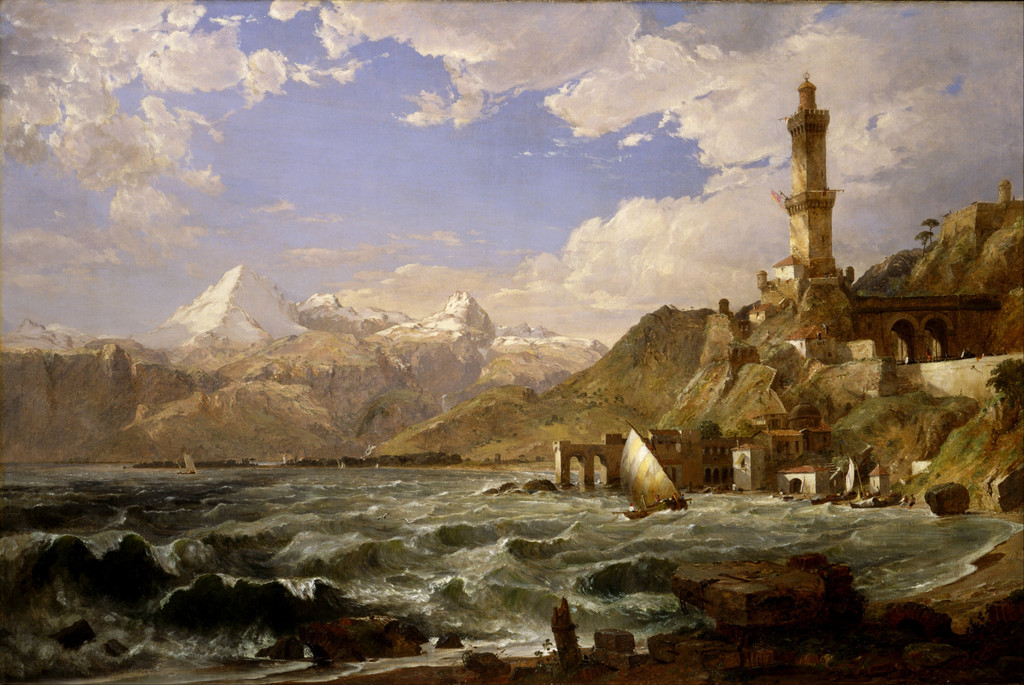
Jasper Cropsey’s The Coast of Genoa brings a tower, a steep shore and small boats into a wide encounter with sea, mountains and sky. Dated 1854, the oil on canvas measures 122.4 × 184.2 cm and belongs to the Smithsonian American Art Museum. Its expansive composition provides a different kind of landscape from the wooded American river valleys for which Cropsey is often known. [1]
The right-hand architecture gives the picture a strong point of orientation. Across from it, the sea opens toward pale distant mountains. The viewer moves between a substantial built landmark and an atmosphere that seems to extend far beyond the shore.
At a Glance
- Artist: Jasper Francis Cropsey
- Title: The Coast of Genoa
- Date: 1854
- Medium: Oil on canvas
- Dimensions: 122.4 × 184.2 cm
- Collection: Smithsonian American Art Museum
- Accession: 1984.162
- Acquisition credit: Gift of Aileen B. Train, Helen B. Spaulding and Julia B. Key
This work across Jasper Cropsey’s career
Contents
- An Italian subject painted after the European journey
- Tower and shore on the right
- Water as an active foreground
- Pale mountains and the opening into distance
- Clouds and the structure of the upper field
- A Roman drawing as a different comparison
- The Smithsonian canvas
- Annotated details
An Italian subject painted after the European journey
The painting’s date places it after Cropsey’s first European journey. Deborah Chotner’s NGA biography describes his marriage to Maria Cooley in May 1847, travel in Britain that summer and a period among American artists in Rome before his return to the United States in 1849. The 1854 canvas belongs to the years following that return. [2]
This chronology matters because a landscape can remain available to an artist beyond the moment of travel. In its 2018 exhibition presentation of The Coast of Genoa, the Polk Museum of Art discussed Cropsey’s continued use of Italian sketches and studies for later oils. That interpretation situates the canvas within a longer practice of returning to material gathered abroad. [3]
It does not establish one particular surviving drawing as the complete preparatory source for this painting. The distinction is between a documented wider practice and a fully traced sequence for the individual work. Here, the European journey supplies a historical setting for a picture completed later.
The Smithsonian classifies its subject as the Italian coast and harbour at Genoa. The title and museum identification provide the geographical association, while the actual composition asks to be considered as a painted arrangement of shore, buildings, water and distance. [1]
Annotated Details from The Coast of Genoa
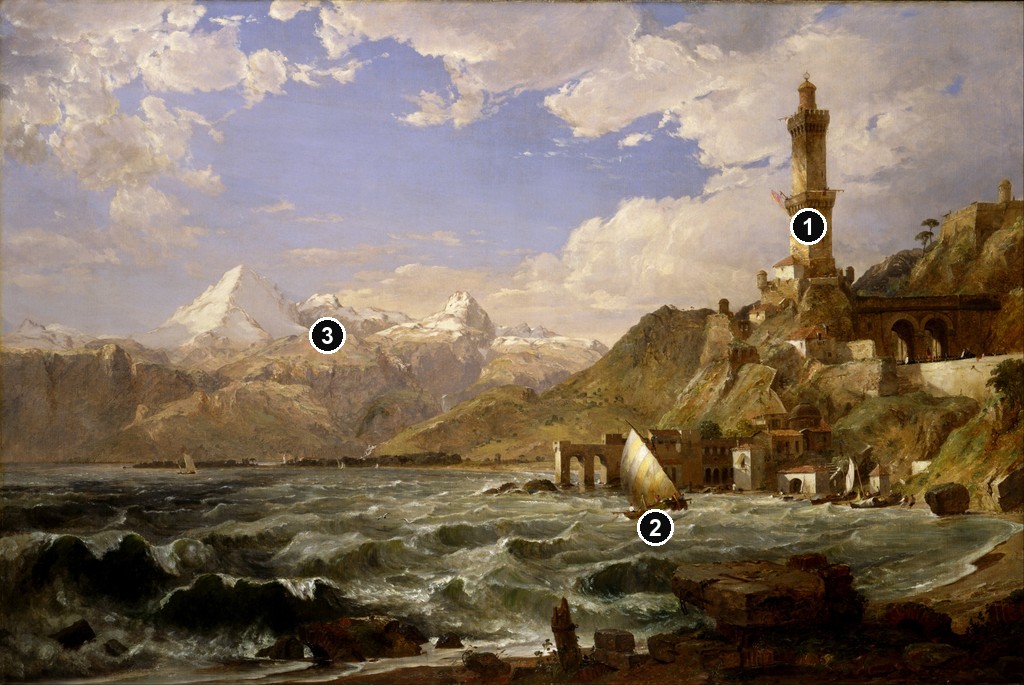
The numbered points identify visible features discussed in this article. Return from each detail to the whole composition. Jasper Francis Cropsey, The Coast of Genoa, 1854. Oil on canvas, 122.4 × 184.2 cm. Smithsonian American Art Museum, 1984.162. Gift of Aileen B. Train, Helen B. Spaulding and Julia B. Key. Jasper Francis Cropsey / Smithsonian American Art Museum, via Google Art Project. Image source. Public domain. Separate resized overview with numbered points; details cropped from the original, without recolouring, retouching or enlargement.
Details from THE COAST OF GENOA
Compare the cropped details with the complete images above. Notice how their colours, shapes and positions contribute to the larger compositions.
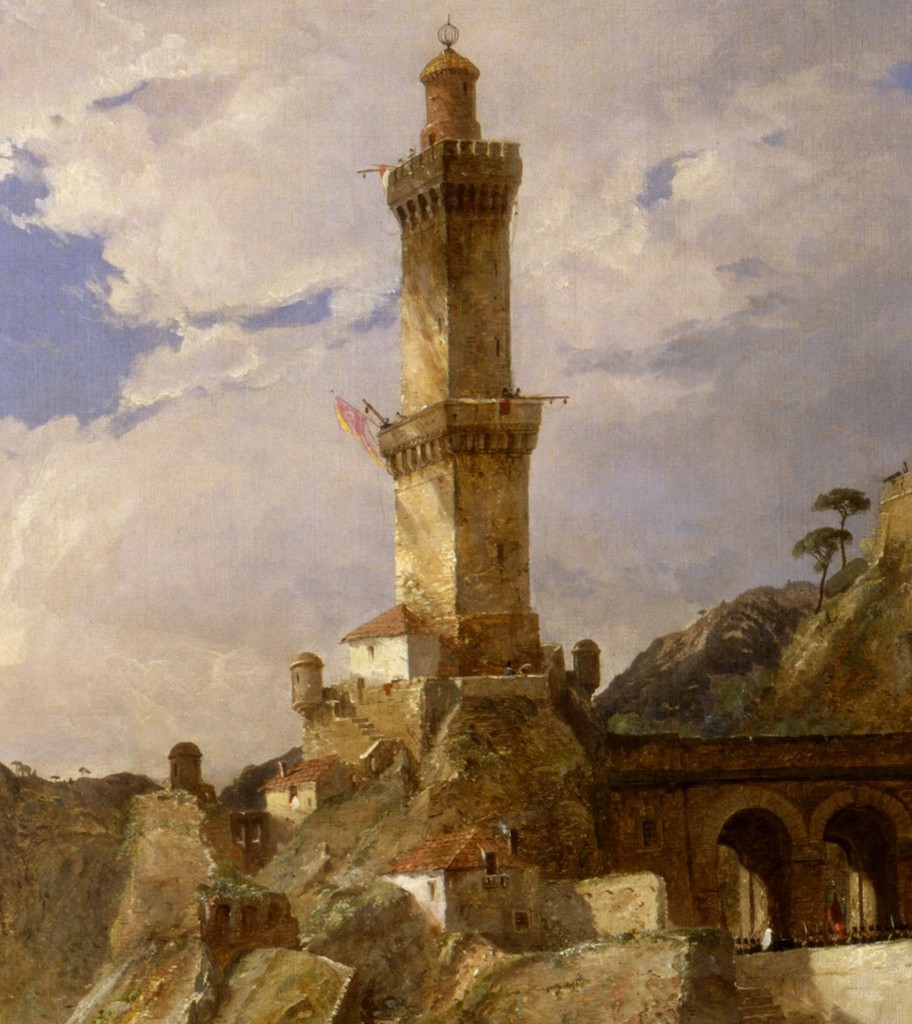
Tower rising above the coast
A tall tower rises above stone buildings on the rocky coast. Its vertical form connects the shore with the large clouded sky.
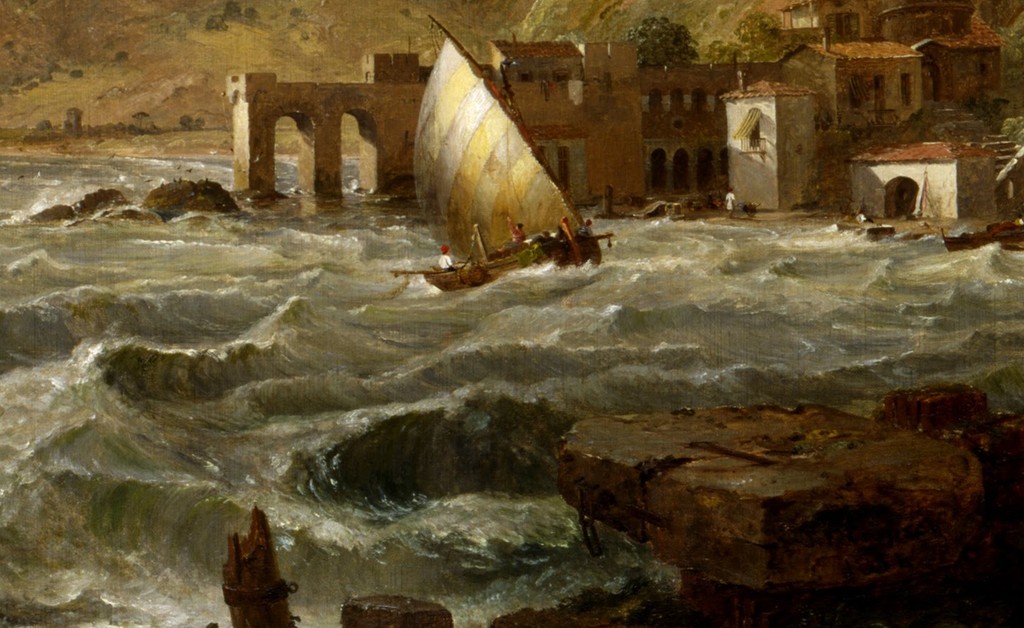
Sail and breaking waves
A pale sail cuts across the restless water beside the coastal buildings. White wave edges repeat its brightness in the near sea.
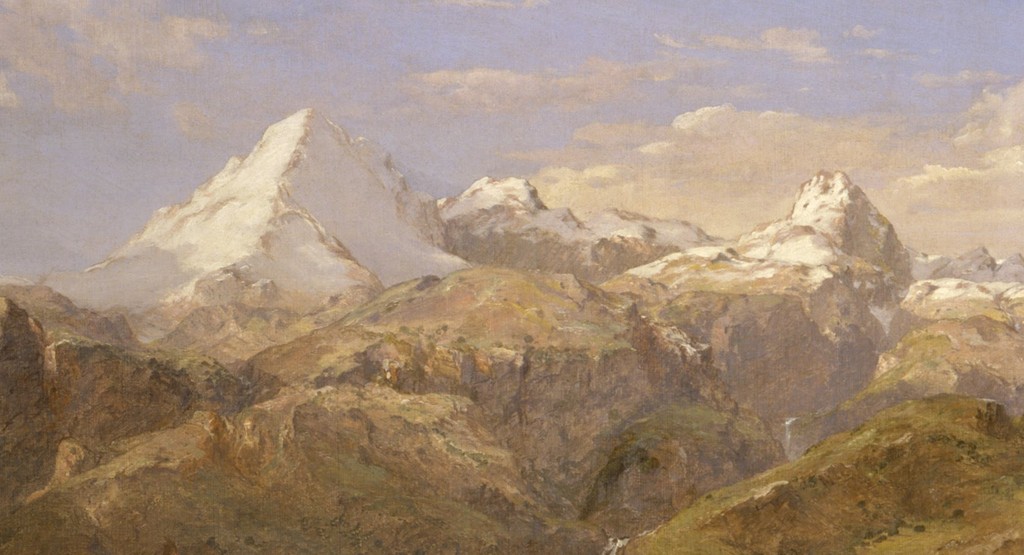
Snowy peaks beyond the sea
Snowy peaks stand beyond the coastal water. Their pale forms add depth to the invented panoramic arrangement; this crop does not name a particular summit.
Tower and shore on the right
The tall tower stands high above the water on the right. Its narrow upright form is readily distinguished from the broader mass of rock beneath it. Smaller buildings and openings occupy the lower shore, giving the architecture more than one level.
This grouping creates a steep transition from the tower’s height to the boats beside the water. The eye can follow the descending ground and built forms toward the shore. Individual structures remain relatively small within the painting, yet their concentration gives this side substantial weight.
The architectural edges also differ from the natural forms around them. A tower has a more definite vertical outline than the broken cliff or the moving sea. Cropsey uses that difference to make the built landmark prominent without separating it from the landscape.
Its location near the edge leaves much of the canvas open. The tower does not occupy the centre and block the distance. It holds the right side while the eye travels leftward across water and mountains, allowing the painting to combine a recognisable near landmark with an extensive view.
Water as an active foreground
Dark waves and white foam make the nearest water restless. The sea occupies a broad area across the lower part of the canvas, and changes in its surface interrupt an easy movement toward the distant shore. Light catches separate crests rather than illuminating the water uniformly.
The boats introduce smaller shapes within this activity. Pale sails near the right-hand shore can be read against the darker water, while more distant craft appear reduced in scale. The differences help distinguish the nearby coast from the wider maritime space beyond it.
A small figure at the edge of the foreground gives the viewer another scale of reference. The figure’s size relative to the rocks and water makes the surrounding elements feel large. Its precise identity or occupation is not needed to understand that relationship.
Unlike the mirror-like water in some of Cropsey’s inland scenes, this surface does not offer a stable reflected image of the landscape above it. Its changing pattern gives the foreground an independent rhythm. The built shore remains comparatively fixed while the sea presents repeated signs of movement.
Pale mountains and the opening into distance
Beyond the near water, the land rises into much paler mountain forms. Their colour and reduced detail set them apart from the darker shore at the right. They provide an extensive background without competing with the tower for the same kind of prominence.
The shift from dark foreground water to pale distant land establishes depth through contrast. The near waves are broken and sharply varied; the far ridges gather into larger, softer forms. The eye reads a considerable interval between them.
These mountains also connect the land to the sky. Their pale upper surfaces approach the lighter cloud passages above, while darker slopes preserve a distinction between mountain and atmosphere. The distance feels open because the two fields remain related without becoming indistinguishable.
The consulted museum record does not identify a particular distant peak. Giving it a familiar Alpine name would add a certainty that the evidence does not provide. The important visual relationship is between the receding mountain range and the much stronger near shore.
Watch: Jasper Cropsey
Look closely at Cropsey’s Mount Jefferson, then explore the wider Hudson River School tradition.
Summer or Autumn? Picturing the American Republic
Smarthistory discusses Cropsey’s seasonal landscape and the image of the American republic.
Watch on YouTubeClouds and the structure of the upper field
Clouds occupy a large part of the canvas. Their irregular masses vary in light and darkness, with blue openings between them. This keeps the sky active across the width of the painting instead of treating it as one uniform backdrop.
The tower rises into that field, so its dark outline can be compared with the brighter and softer cloud forms. At the left, the mountains lead the eye upward more gradually. These different contacts between land and sky help balance the upper part of the composition.
The picture predates Cropsey’s Up among the Clouds by a year. Published in 1855, the essay argues for attention to the sky’s depth, variation and cloud structure, including the form of dramatic weather rather than darkness alone. It offers a useful later statement of concerns that can be brought to this painting, without proving that the canvas was made to illustrate the text. [4]
Look, for example, at the way some cloud edges remain distinct while other passages seem less firmly bounded. That variation affects the space of the sky. It also gives the large upper field a pace different from the repeated dark waves below.
A Roman drawing as a different comparison
Cropsey’s Torre dei Schiavi drawing offers another encounter with Italian architecture. The Met records graphite, white gouache and ink on buff paper, with a catalogue date of 1853. A visible inscription on the sheet reads 1849, leaving a dating discrepancy that should remain explicit. [5]
The Roman drawing concentrates on a ruin within an open landscape. In The Coast of Genoa, the tower is one element in a larger arrangement of harbour, mountain and sea. Both works give architecture a strong role, but their balance of space is different: the ruin gathers attention within a relatively sparse sheet, while the coastal tower holds one side of a much busier panorama.
The drawing is also a separate object from Cropsey’s 1847 oil of the Roman ruin, newly recorded at the Met as accession 2025.267. It is useful to compare the drawing’s visual organisation with Genoa without confusing its medium or uncertain dating with that other painting. [6]
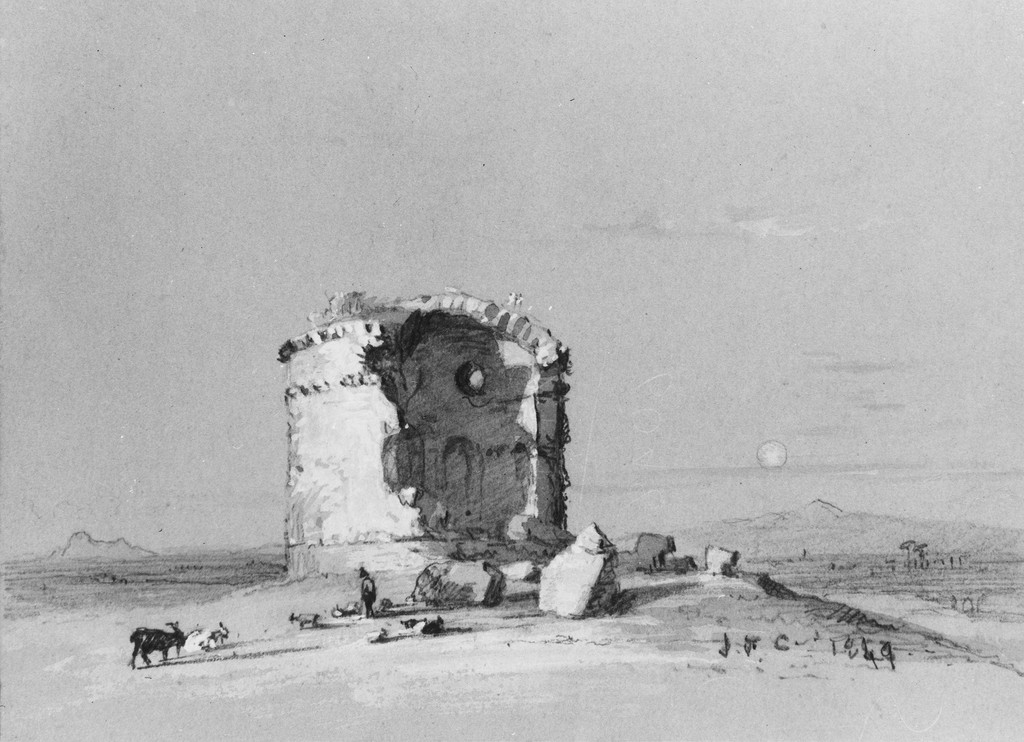
Jasper Francis Cropsey, Torre dei Schiavi, The Roman Campagna (from Cropsey Album). Metropolitan Museum of Art, 1970.9.26 recto. The museum dates the drawing 1853; the visible inscription reads 1849. This is a separate object from the 1847 oil. Jasper Francis Cropsey / The Metropolitan Museum of Art. Image source. CC0 / Public domain. Proportionally resized only; full carrier, margins and native appearance retained.
The Smithsonian canvas
The Smithsonian credits the painting to the gift of Aileen B. Train, Helen B. Spaulding and Julia B. Key. Its accession is 1984.162. Those particulars identify the large canvas discussed here, rather than an unspecified Italian view among Cropsey’s many landscapes. [1]
The composition’s scale supports the breadth of its subject. Near architecture and boats provide points the viewer can recognise individually, while sea, mountains and clouds create larger fields through which to look. Cropsey joins these differences in one continuous view: the tower anchors the shore, the waves animate the foreground, and the pale distance keeps the landscape open.
Artworks directory
A selected directory of 18 paintings, two drawings and three architectural projects. Repeated subjects retain distinct object identities. Links lead to a companion article where available, otherwise the consulted institutional record. Unillustrated objects remain searchable; this is not a complete catalogue raisonné.
Frequently Asked Questions
The consulted museum record does not identify a particular peak. Its visible role is to establish a pale mountain distance beyond the coast. [1]
It belongs to the Smithsonian American Art Museum, accession 1984.162, through the gift of Aileen B. Train, Helen B. Spaulding and Julia B. Key. [1]
Discussion
Look again at the images and ideas explored in The Coast of Genoa by Jasper Cropsey. These editorial prompts invite your observations.
Reader Insights
Does the tower or the sea first establish the picture’s scale for you?
How do the cloud masses differ from the waves in their rhythm and edges?
What changes when you compare the coastal tower with the isolated Roman ruin?
Join the Conversation
Share a detail, comparison or question about The Coast of Genoa by Jasper Cropsey below.
References
- Smithsonian American Art Museum, The Coast of Genoa, accession 1984.162. Exact 1854 object, dimensions, subject categories and gift credit. View source
- Deborah Chotner, Cropsey biography, American Paintings of the Nineteenth Century, Part I, National Gallery of Art (1996), printed pp.109–110. Marriage and first European journey, 1847–49. View source
- Polk Museum of Art, The Coast of Genoa by Jasper F. Cropsey, 2018 exhibition record, now in the Ashley Gibson Barnett Museum archive. Earlier Italian studies and the practice of using them for later paintings. View source
- J. F. Cropsey, Up among the Clouds, The Crayon, II, no. VI, 8 August 1855, pp.79–80. Complete essay and original scans consulted for cloud form and atmospheric variety. View source
- Metropolitan Museum of Art, Torre dei Schiavi, The Roman Campagna (from Cropsey Album), accession 1970.9.26 recto. Drawing media and catalogue date, considered with the visible 1849 inscription. View source
- Metropolitan Museum of Art, Torre dei Schiavi, The Roman Campagna, accession 2025.267. Separate 1847 oil; no available object image in the consulted current record. View source
- Splash image source.
Jasper Francis Cropsey, The Coast of Genoa, 1854. Oil on canvas, 122.4 × 184.2 cm. Smithsonian American Art Museum, 1984.162. Gift of Aileen B. Train, Helen B. Spaulding and Julia B. Key. Jasper Francis Cropsey / Smithsonian American Art Museum, via Google Art Project. Public domain. Proportionally resized only; full carrier, margins and native appearance retained.
View source