 by Tom Gurney
Tom Gurney BSc (Hons) is an art history expert with over 20 years experience
Email: tomgurney1@gmail.com / Phone: +44 7429 011000
The Spirit of Peace by Jasper Cropsey: Introduction
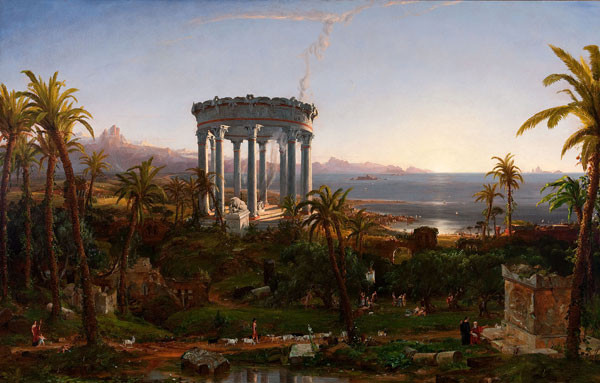
Jasper Cropsey’s The Spirit of Peace presents an imaginary ancient landscape organised around a circular temple, palms and an open harbour. Painted in 1851, the oil on canvas measures 60 × 80 inches and belongs to Woodmere through the Bequest of Charles Knox Smith. Its architecture and small figures make peaceful life visible through several kinds of activity. [1]
The painting has a companion, The Spirit of War, now at the National Gallery of Art. The pair contrasts two conditions of human life through the character of their landscapes: a place for learning, commerce and ordinary pursuits beside a hostile world of defensive architecture and approaching conflict. [1] [2]
At a Glance
- Artist: Jasper Francis Cropsey
- Title: The Spirit of Peace
- Date: 1851
- Medium: Oil on canvas
- Dimensions: 60 × 80 inches
- Collection: Woodmere
- Acquisition credit: Bequest of Charles Knox Smith
- Companion painting: The Spirit of War, National Gallery of Art
This work across Jasper Cropsey’s career
Contents
- An imaginary ancient world
- The circular temple and open sky
- Harbour and foreground life
- Woodmere’s Christian interpretation
- A companion to The Spirit of War
- Conflict and the date 1851
- Two paintings in different collections
- Annotated details
An imaginary ancient world
Woodmere describes the scene as a romantic, invented landscape containing temples, tombs, earlier ruins and active figures. It interprets those activities as the benefits of peace: philosophy, the exchange of knowledge, trade, music, dance and representation. [1]
The range of elements is important. Peace is given a positive content beyond the absence of a battle. The picture makes room for thought, exchange and everyday movement, with different parts of the landscape supporting different pursuits.
Its architecture does not identify one surveyed ancient city. Instead, the temple, fragments and distant buildings create an imagined setting in which several kinds of civilisation can be brought together. The coast extends that setting outward, allowing a world of movement and contact beyond the near garden-like ground.
The result is a moral landscape expressed through a habitable place. Cropsey gives the idea of peace an environment in which people can pass time, meet one another and carry on useful activity. The broad view lets these small actions share one continuous space.
Annotated companion: The Spirit of War
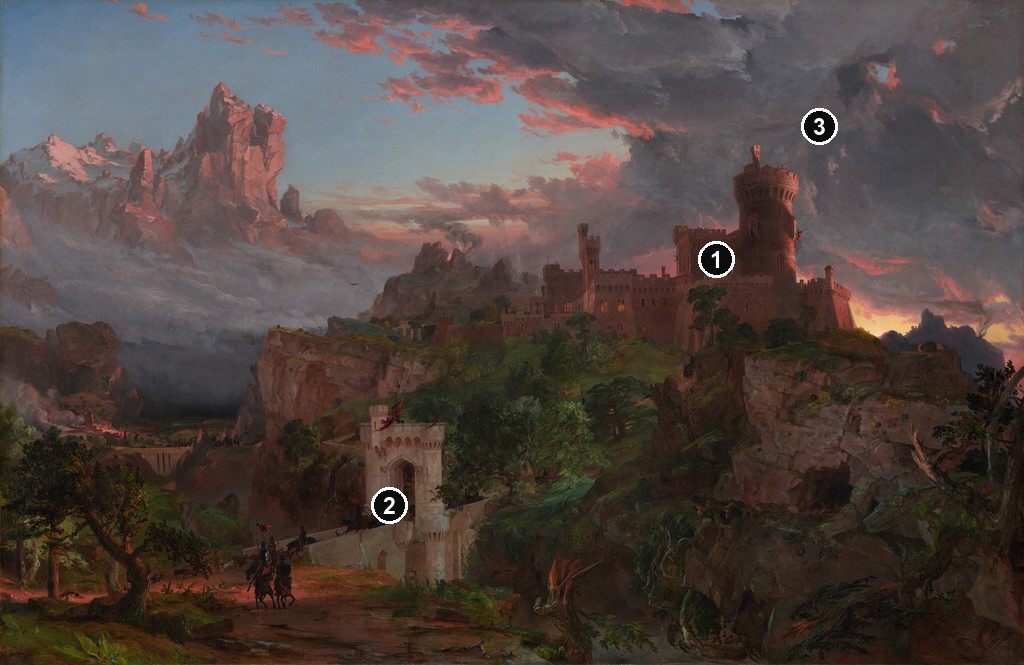
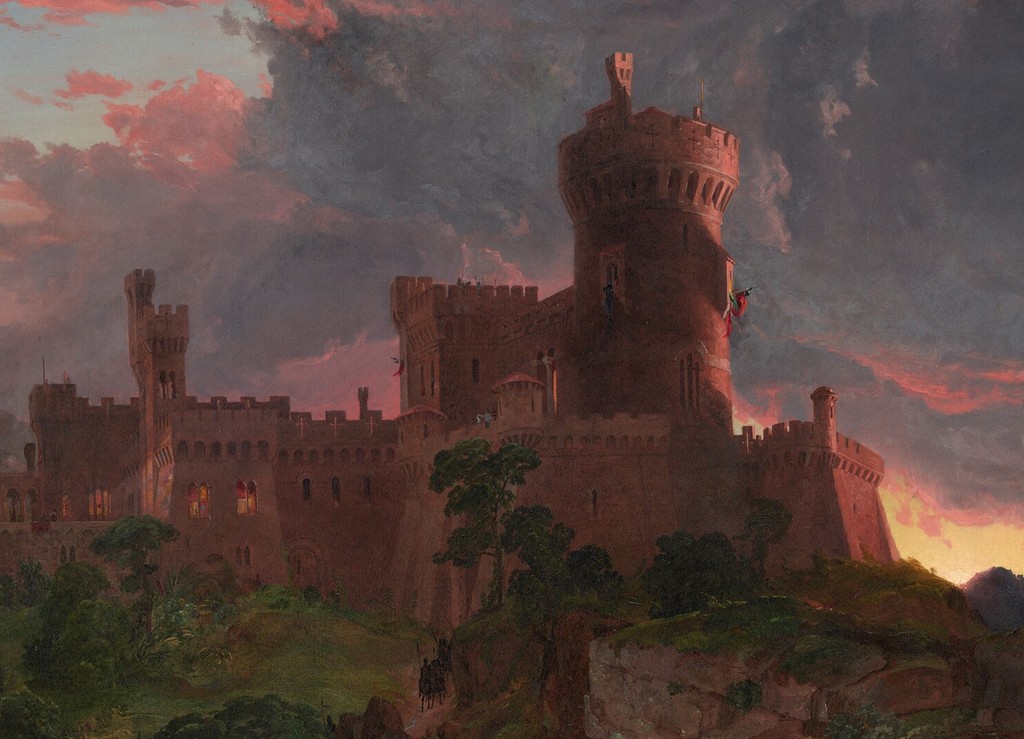
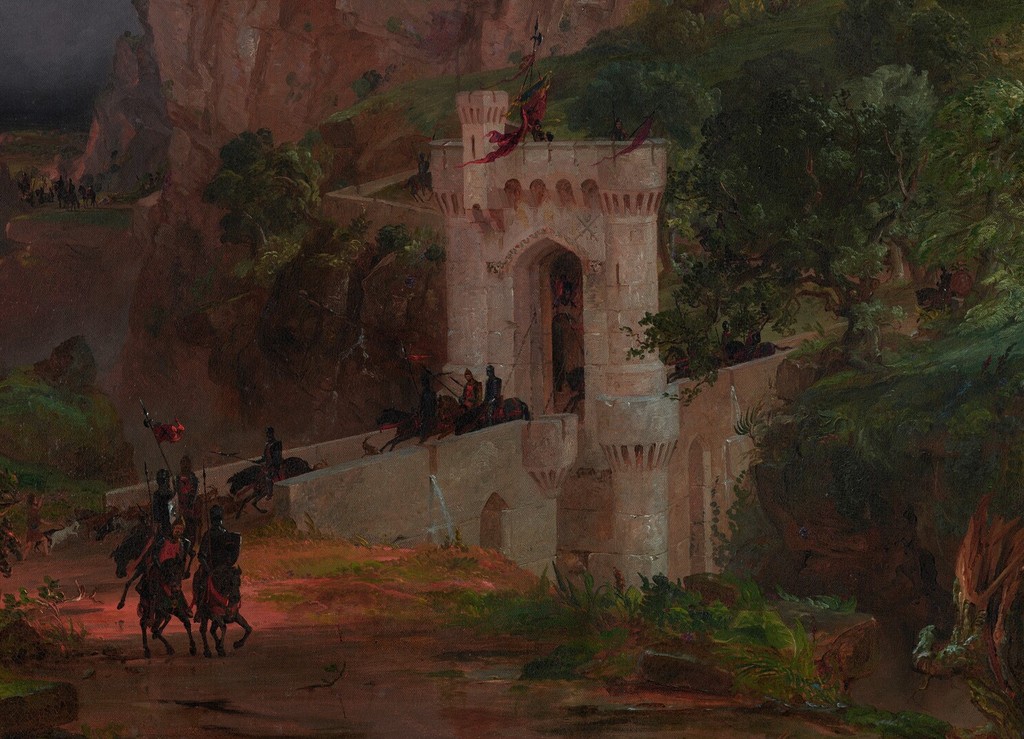
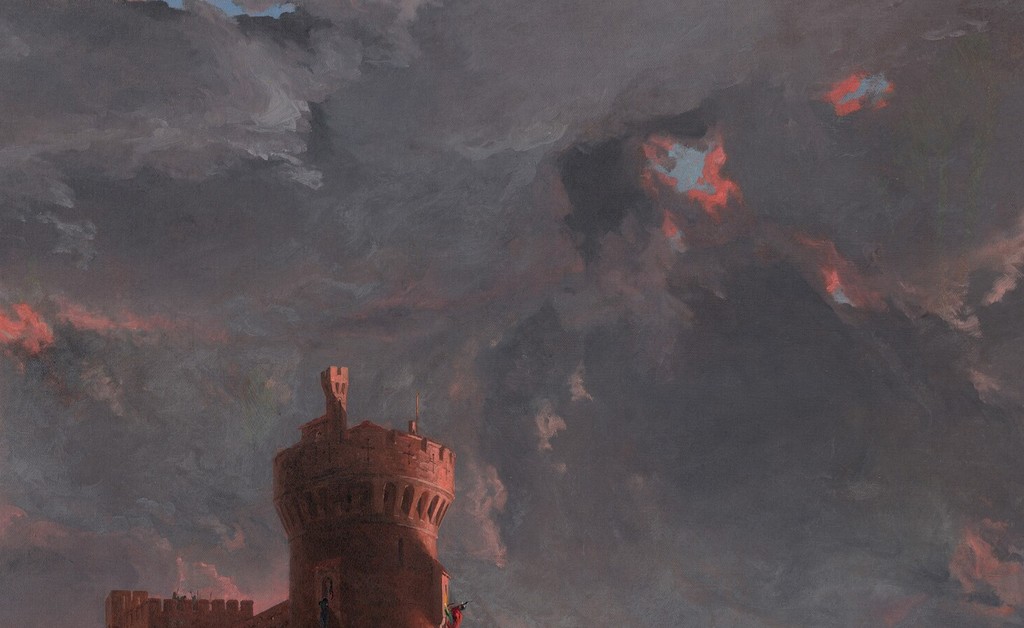
The whole Peace image appears earlier in this article. These numbered details examine its contrasting companion, War. The numbered points identify visible features discussed in this article. Return from each detail to the whole composition. Jasper Francis Cropsey, The Spirit of War, 1851. National Gallery of Art, 1978.12.1, Avalon Fund. The castle is an invented composite within an allegorical landscape. Jasper Francis Cropsey / National Gallery of Art, Washington. Image source. CC0 / Public domain. Separate resized overview with numbered points; details cropped from the original, without recolouring, retouching or enlargement.
Details from THE SPIRIT OF PEACE
Compare the cropped details with the complete images above. Notice how their colours, shapes and positions contribute to the larger compositions.
Castle above the rocky ground
A massive castle stands above steep rocky ground. Towers, walls and narrow openings form a dense silhouette against the changing sky.
Gate, bridge and mounted figures
A pale gate and narrow bridge connect the castle with the near road. Mounted figures give scale to the steep approach without identifying a historical battle.
Red light and gathering cloud
Red light runs through the dark clouds above the castle. The colour links the threatening sky with the warm stone below.
The circular temple and open sky
The round temple occupies a prominent position above the middle of the foreground. Its repeated columns make a clear rhythm against the more irregular palms and foliage. Open spaces between the columns allow light and background to remain part of the structure.
That openness matters to the composition. The temple is a substantial landmark, yet it does not form an opaque wall across the view. Its architecture gathers attention while letting the eye continue beyond and through it.
The palms provide a contrasting set of forms. Their narrow trunks and spreading crowns interrupt the sky differently from the temple’s regular supports. Some stand close to the building; others frame the wider landscape at the edges.
The sky is broad and comparatively clear, with a thin cloud passage rising above the temple. Its light field gives the upper composition room to breathe. The distant coast remains low beneath it, so the central architecture gains prominence without filling the whole landscape.
Viewed as a whole, the temple brings order to a setting that contains many small forms. Trees, ruins, people and shore activity can vary around it while its circular rhythm holds the composition together. This is one reason the building remains legible even in a modest reproduction.
Harbour and foreground life
The water opens across the right-hand distance. Small craft occupy its surface, giving the sea a role within the inhabited world rather than treating it as an empty backdrop. The distant shore and buildings extend the scene beyond the temple precinct.
In the foreground, paths connect separate areas of activity. Figures and animals are distributed across the ground instead of gathering around one dominant protagonist. Their scale keeps the broader landscape visible while allowing peaceful occupation to become part of its character.
The changes in ground level also create smaller spaces within the panorama. A bridge and low walls divide passages near the lower edge. Behind them, foliage and architectural fragments establish other places to pause or move through.
These features let the eye travel slowly. It can register the temple first, then the harbour, then return to the more enclosed near ground. The painting’s idea unfolds through this movement among several quiet occupations rather than through one single dramatic event.
The available whole image supports these broad relationships. The more exact identification of individual pursuits and symbolic carvings comes from the museum’s interpretation. Keeping those two kinds of evidence clear helps a reader understand both the visible arrangement and its documented meaning.
Woodmere’s Christian interpretation
Woodmere relates the painting to Cropsey’s belief in Christianity’s historical inevitability. It interprets a shepherd and goats as an allusion to Christ guarding his flock, and the lion, boy and lamb on the round temple’s monument as a reference to Isaiah’s vision of peace. [1]
This reading gives the apparently ancient setting a Christian future. The landscape can include the arts and learning of earlier civilisations while suggesting a condition in which hostility will cease. Its religious argument works through the relations among figures, animals and architecture.
The interpretation should remain attributed to Woodmere rather than presented as an identification established independently from every small mark in the reproduction. It supplies a documented account of the symbols that the broader composition places within its tranquil setting.
Watch: Jasper Cropsey
Look closely at Cropsey’s Mount Jefferson, then explore the wider Hudson River School tradition.
Summer or Autumn? Picturing the American Republic
Smarthistory discusses Cropsey’s seasonal landscape and the image of the American republic.
Watch on YouTubeA companion to The Spirit of War
Deborah Chotner’s NGA catalogue entry treats the two paintings as Cropsey’s first completed efforts in this ambitious allegorical mode. She connects their pairing, expressive colour and landscape vocabulary with Thomas Cole’s example. The comparison concerns the kind of moral and compositional ambition Cropsey pursued, alongside his many observed landscapes. [2]
In the illustrated companion, a castle dominates a much more jagged and threatening setting. Its towers and defensive route concentrate the movement of people and mounted figures. Strong warm light presses against dark terrain and turbulent clouds.
The two buildings therefore organise different worlds. Peace’s temple is open, regular and surrounded by ordinary activity. War’s castle is defensive, abrupt and associated with refuge and mobilisation. The difference involves both architecture and the actions that gather around it.
Chotner’s discussion also distinguishes the paintings’ times of day. The peaceful picture has the soft light of sunset; Cropsey’s description of the war scene places it at early dawn after a stormy night. Their warm tones should not cause the two settings to be labelled with the same hour. [2]
Reading the pair together makes each composition more specific. The harbour’s openness becomes clearer beside the castle’s defensive enclosure. The small pursuits of peaceful life acquire weight when compared with hurried movement under the threat of conflict.
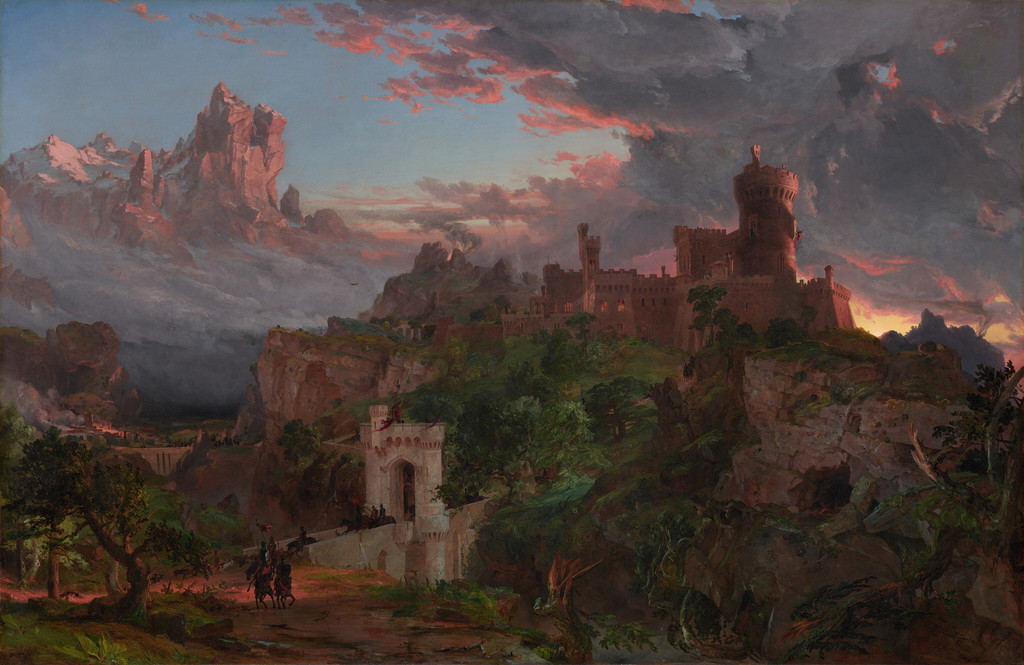
Jasper Francis Cropsey, The Spirit of War, 1851. Oil on canvas, 110.8 × 171.6 cm. National Gallery of Art, Washington, 1978.12.1, Avalon Fund. Cropsey’s description sets this scene at early dawn. Jasper Francis Cropsey / National Gallery of Art, Washington. Image source. CC0 / Public domain. Proportionally resized only; full carrier, margins and native appearance retained.
Conflict and the date 1851
Woodmere associates the painting’s completion with Cropsey’s response to the American war with Mexico. The 1851 date belongs to the period following that conflict. This context helps explain the relevance of a contrast between war and peace for an American audience. [1]
Chotner also considers the pair within the tense political circumstances of the early 1850s. Such readings give the invented landscapes a relationship to contemporary concerns without making their ancient and medieval settings literal depictions of American events. [2]
The date is ten years before the outbreak of the American Civil War. A later viewer can bring knowledge of that conflict to the paintings, but describing the pair as a documented prediction would go beyond the evidence considered here.
Two paintings in different collections
The Spirit of Peace belongs to Woodmere through the Charles Knox Smith bequest. The Spirit of War belongs to the National Gallery of Art, accession 1978.12.1, acquired through the Avalon Fund. Their status as companions does not mean they share a present collection. [1] [3]
That distinction matters when following museum records or planning a visit. Each canvas has its own collection identity and display arrangements. Their relationship can still be studied through the whole compositions and the sources that discuss the pair.
The Spirit of Peace gives an abstract ideal a landscape full of specific uses. Its open temple, harbour and inhabited foreground offer places for learning, exchange and ordinary life. Beside the threatening companion, those small activities become the substance of the painting’s argument.
Artworks directory
A selected directory of 18 paintings, two drawings and three architectural projects. Repeated subjects retain distinct object identities. Links lead to a companion article where available, otherwise the consulted institutional record. Unillustrated objects remain searchable; this is not a complete catalogue raisonné.
Frequently Asked Questions
Woodmere describes it as an imaginary landscape. Its temple, ruins, palms and coast provide a setting for peaceful activities and religious symbolism. [1]
It anchors the composition. Woodmere interprets its monument’s lion, boy and lamb through Isaiah’s vision of peace, within the painting’s Christian argument. [1]
Discussion
Look again at the images and ideas explored in The Spirit of Peace by Jasper Cropsey. These editorial prompts invite your observations.
Reader Insights
How does the open temple differ from the castle in The Spirit of War?
Which ordinary activity most contributes to the idea of peace?
Does the harbour make the landscape feel self-contained or connected to a wider world?
Join the Conversation
Share a detail, comparison or question about The Spirit of Peace by Jasper Cropsey below.
References
- Woodmere, The Spirit of Peace. Date, medium, dimensions, Charles Knox Smith bequest, symbolic interpretation and war-with-Mexico context. View source
- Deborah Chotner, The Spirit of War and its companion, American Paintings of the Nineteenth Century, Part I, National Gallery of Art (1996), printed pp.110–114. Pairing, Cole comparison, allegorical development and contrasting times of day; Cropsey’s historical description consulted through this catalogue. View source
- National Gallery of Art, The Spirit of War, accession 1978.12.1. Separate companion canvas, 1851, Avalon Fund. View source
- Splash image source.
Jasper Francis Cropsey, The Spirit of Peace, 1851. Oil on canvas, 60 × 80 inches. Woodmere, Bequest of Charles Knox Smith. Whole painting reproduced at the available native resolution. Jasper Francis Cropsey / Woodmere, via Wikimedia Commons. Public domain. Proportionally resized only; full carrier, margins and native appearance retained.
View source