 by Tom Gurney
Tom Gurney BSc (Hons) is an art history expert with over 20 years experience
Email: tomgurney1@gmail.com / Phone: +44 7429 011000
Starrucca Viaduct by Jasper Cropsey: Introduction
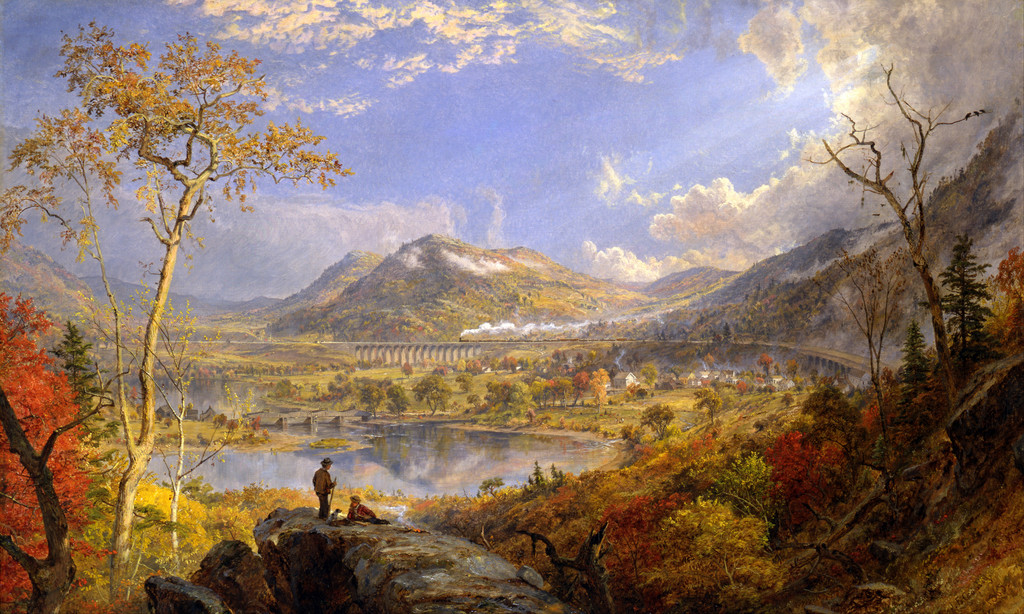
Jasper Cropsey’s Starrucca Viaduct, Pennsylvania places a moving train within an expansive autumn valley. The 1865 oil on canvas measures 56.8 × 92.4 cm and belongs to the Toledo Museum of Art, accession 1947.58. Two small foreground figures look across water, cultivated ground and a settlement toward the railway crossing beyond. [1]
The painting gives the bridge a clear place without making its engineering dominate the whole view. Trees frame the near ground, mountains rise behind the line, and the train’s white smoke joins a wider rhythm of cloud and light. That arrangement has supported both a harmonious reading and a more critical discussion of how landscape could make industrial change appear benign. [1] [2]
At a Glance
- Artist: Jasper Francis Cropsey
- Title: Starrucca Viaduct, Pennsylvania
- Date: 1865
- Medium: Oil on canvas
- Dimensions: 56.8 × 92.4 cm
- Collection: Toledo Museum of Art
- Accession: 1947.58
- Acquisition credit: Purchased with funds from the Florence Scott Libbey Bequest in Memory of her Father, Maurice A. Scott
This work across Jasper Cropsey’s career
Contents
- Foreground viewers and the valley beyond
- Water, village and cultivated country
- Train smoke and clouds
- Earlier drawings of Starrucca
- MacLeod’s railway guide and the viewpoint
- The surviving canvas and the lost Crosby painting
- The chromolithograph
- A later map of the railway network
- Harmony and a critical reading
- Annotated details
Foreground viewers and the valley beyond
The two figures occupy a rocky ledge near the lower centre. One stands, while the other is seated or reclining beside him. Their position gives the viewer a near place from which to consider the extensive country beyond.
The standing figure faces into the scene. His dark form reads clearly against the lighter water below, but remains small beside the trees and valley. The human scale makes the landscape feel broad without supplying a large central protagonist.
The ledge is important in its own right. Its exposed surface provides an opening within the near foliage, while a dark cleft and uneven ground surround it. The figures appear to have reached a particular vantage point rather than floating in an unspecified foreground.
Trees frame that position unequally. At the left, a tall light trunk rises into a crown of warm leaves. At the right, a darker, more bare tree interrupts the clouds and the rising hillside. Their different forms keep the frame varied while directing attention toward the centre.
The eye moves from these near trees and figures to the water, settlement and railway beyond. Cropsey does not ask the viewer to notice the bridge without first encountering a substantial landscape around it. The engineering enters a view already organised by foreground scale and distance.
Annotated Details from Starrucca Viaduct
The numbered points identify visible features discussed in this article. Return from each detail to the whole composition. Jasper Francis Cropsey, Starrucca Viaduct, Pennsylvania, 1865. Toledo Museum of Art, 1947.58. Purchased with funds from the Florence Scott Libbey Bequest in Memory of her Father, Maurice A. Scott. Jasper Francis Cropsey / Toledo Museum of Art, via Google Art Project. Image source. Public domain. Separate resized overview with numbered points; details cropped from the original, without recolouring, retouching or enlargement.
Details from STARRUCCA VIADUCT
Compare the cropped details with the complete images above. Notice how their colours, shapes and positions contribute to the larger compositions.
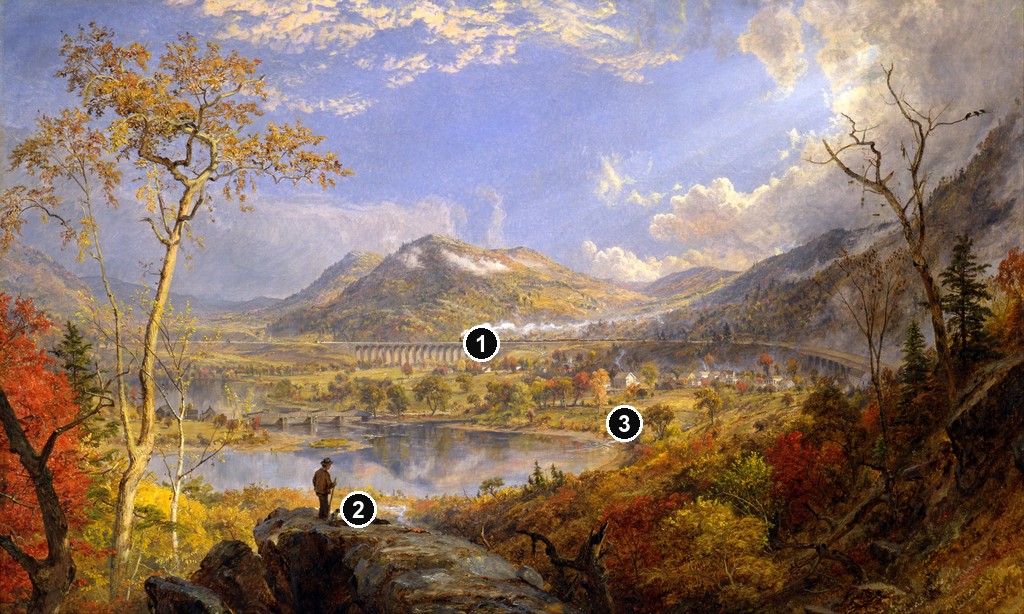
Train crossing the repeated arches
A train and white plume extend across the viaduct. Repeated arches make the railway readable within the surrounding hills.
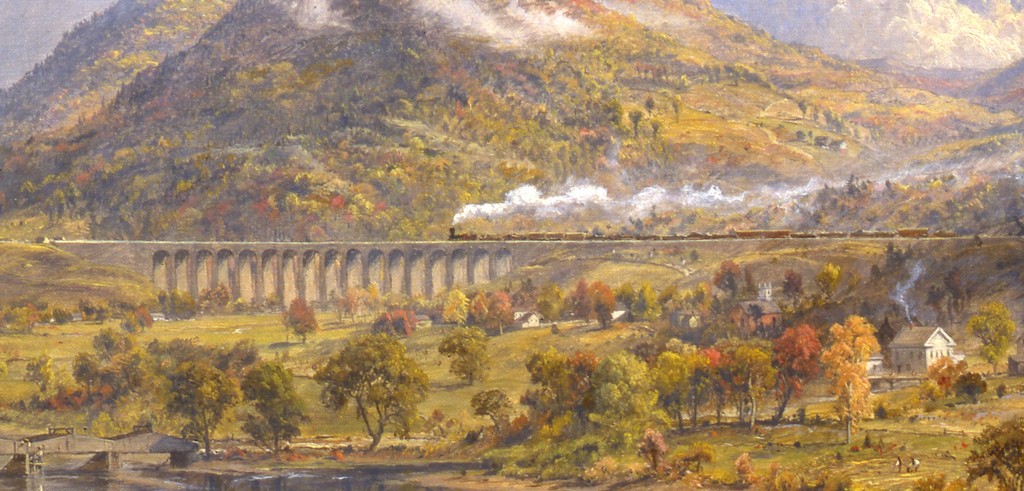
Two figures on the near ledge
Two small figures occupy the near rock ledge above the water. Their positions connect the viewing foreground with the broad railway landscape.
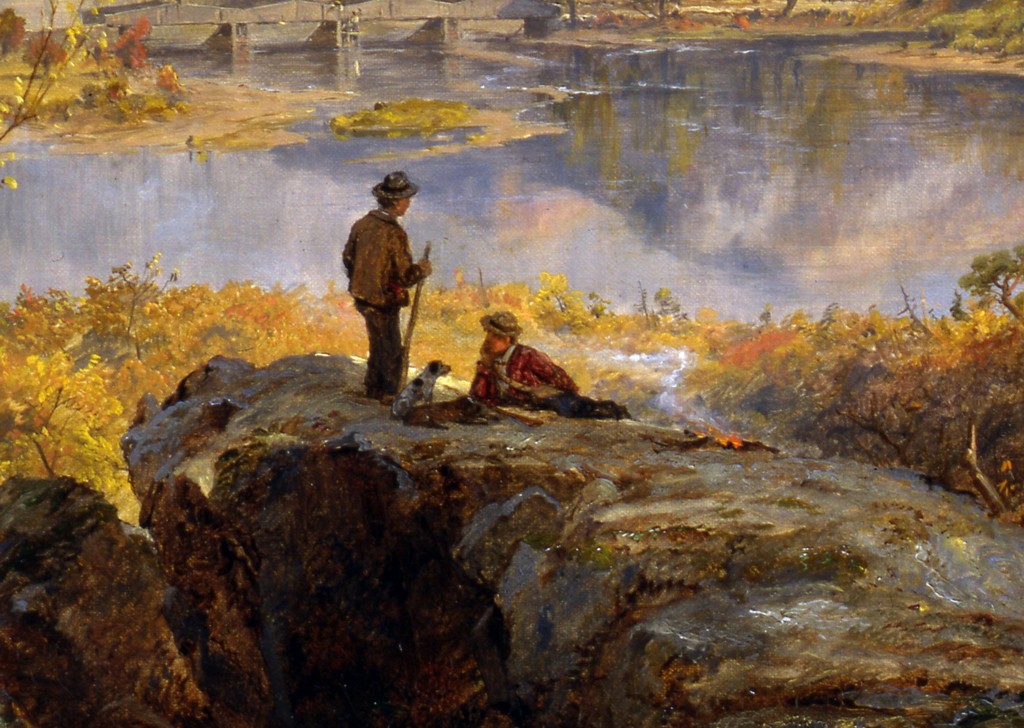
Water and settlement beneath the hills
Water, small buildings and autumn trees occupy the valley below the railway. Their varied forms soften the regular line of the viaduct.
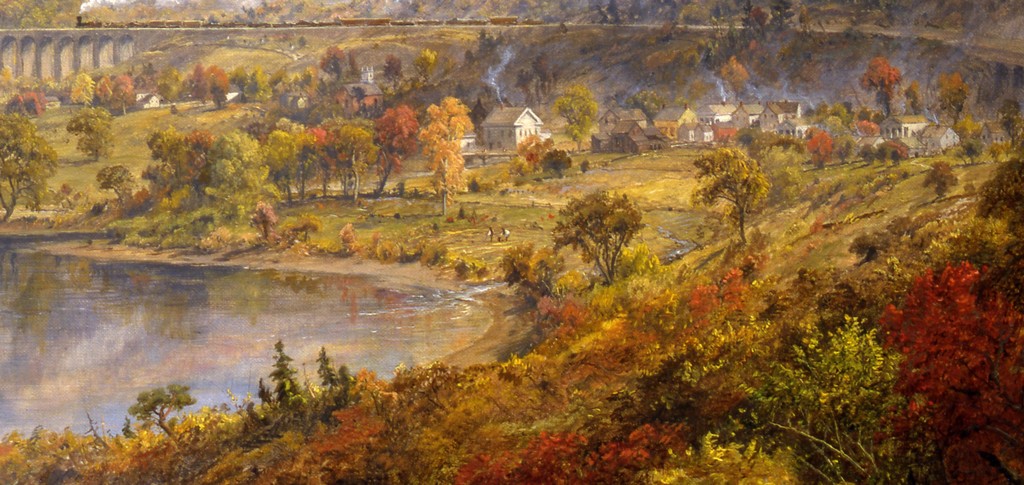
Water, village and cultivated country
The water curves through the middle ground, reflecting parts of the sky and banks. Its pale surface separates the near ledge from the settled land beyond. A smaller bridge crosses it at the left of the central opening.
White buildings gather among autumn trees on the farther bank. They are small but distinct enough to make the valley visibly inhabited. Fields and individual trees occupy the intervals between the water and railway.
These features complicate any impression that the train has entered untouched wilderness. The picture already contains settlement, cultivation and more than one crossing. The railway belongs to a landscape with a visible history of human use, even as mountains and foliage provide the larger setting.
The near tree colours are stronger and more individually separated than the farther slopes. Red and gold foliage creates bright accents around the viewer’s position. Beyond the water, the colours gather into broader patches that lead toward the viaduct and mountains.
The composition therefore works through several distances at once. A rock surface, a reflected bank, a white building and a mountain crest each give the eye a different scale of information. The railway’s small but repeated arches occupy one level within that sequence.
Train smoke and clouds
The viaduct makes a long horizontal passage across the farther country. Its repeated openings establish a clear architectural rhythm, but the line remains low within the larger view. The mountains and sky rise far above it.
The train is accompanied by a pale trail of smoke. That trail is brighter than much of the hillside behind it, so its movement can be noticed even though the vehicle itself is relatively small. It carries activity along the railway without taking over the composition.
Clouds repeat some of that pale, broken movement at a larger scale. Their light edges and varying densities give the sky an active upper field. The smoke belongs visually to the same world of bright passages, although it has a different cause from the clouds.
Toledo’s label draws attention to this echo between smoke and sky. It interprets the train and bridge as blending into the surrounding country, producing an idealised scene of human activity and nature in harmony. That reading describes a compositional achievement rather than establishing the railway’s actual environmental effects. [1]
The hills help produce that effect. Their forms rise behind the bridge and absorb much of its scale. Even when the train is located, the viewer continues to see the larger mountains, wooded slopes and atmosphere surrounding it.
Earlier drawings of Starrucca
Carrie Rebora’s catalogue entry discusses Cropsey drawings dated 15 October 1853, now at the Museum of Fine Arts, Boston. One, accession 52.1594, presents the wider valley; another, 52.1595, offers a closer viaduct view. They document an interest in the subject before the Toledo canvas’s 1865 date. [2]
These drawings are considered here through the published catalogue rather than an independent examination of the original sheets. Their dates nevertheless help separate Cropsey’s earlier encounter with the valley from the later development of finished oils and reproductions.
The interval between drawings and painting also discourages a simple account of one uninterrupted session at the site. The subject remained available for later use, with different versions serving different purposes. The Toledo picture belongs within that sustained interest.
MacLeod’s railway guide and the viewpoint
Rebora relates the composition to William MacLeod’s illustrated view in the 1851 Harper’s New-York and Erie Rail Road Guide. She identifies similarities extending to the two foreground figures. This is a scholarly argument about the painting’s visual sources, not direct evidence that the finished canvas was mechanically traced from an engraving. [2]
The guide consulted directly for this article is the eighth edition, dated 1855–6. Its title page credits engravings by Lossing and Barritt from MacLeod’s sketches. The whole printed page 124, reproduced here, places a round view of Starrucca within the guide’s surrounding text. [3]
This later edition must be distinguished from the 1851 edition discussed by Rebora. It provides an original period illustration and account of the route, while the argument about Cropsey’s earliest encounter with the guide remains attributed to the catalogue.
In the selected guide passages, the valley is presented as a scenic attraction for railway travellers. River, bridge, village, meadows and distant hills become parts of a view worth stopping to see. Autumn is recommended for its colour. [3]
That context gives the foreground viewers another significance. A panorama could belong to the experience of travel, with technology bringing people to the scenery as well as appearing within it. The painting’s viewing position and its railway subject can therefore be considered together.
The guide also expresses an enthusiastic nineteenth-century attitude toward development. It should be read as a period presentation of the railway’s achievements, rather than an objective measure of every benefit or consequence. Its purpose shapes the kind of scenery it celebrates.
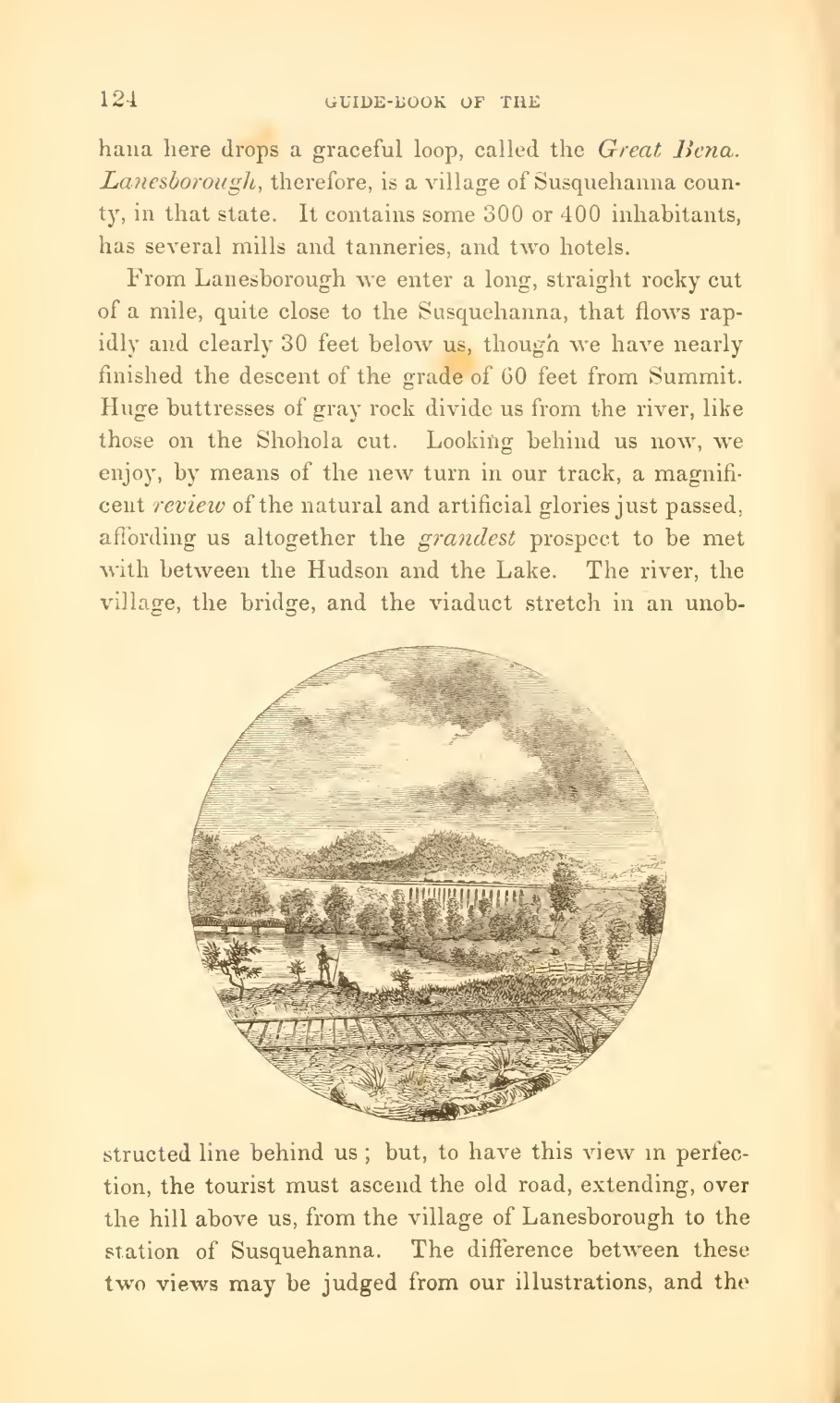
Starrucca, from the West, on printed page 124 of Harper’s New York and Erie Rail-road Guide Book, eighth edition, 1855–6. Engraving by Lossing and Barritt from William MacLeod’s sketch. This directly consulted edition is later than the 1851 edition discussed by Rebora. William MacLeod; Lossing and Barritt / Columbia University Libraries, Internet Archive. Image source. Public domain. Proportionally resized only; full carrier, margins and native appearance retained.
Watch: Jasper Cropsey
Look closely at Cropsey’s Mount Jefferson, then explore the wider Hudson River School tradition.
Summer or Autumn? Picturing the American Republic
Smarthistory discusses Cropsey’s seasonal landscape and the image of the American republic.
Watch on YouTubeThe surviving canvas and the lost Crosby painting
Rebora distinguishes several paintings with similar titles sold in 1865. One very large version, reportedly eight by fourteen feet, became a prize in the Crosby Opera House lottery in Chicago. It was destroyed with the opera house in the fire of 1871. That lost work is separate from the much smaller canvas now in Toledo. [2]
The catalogue leaves the Toledo painting’s identification among the other 1865 sales uncertain. It suggests that the surviving canvas might have been an engraver’s copy because of its relationship to the later print, but does not establish that possibility as fact. [2]
The distinction prevents a misleading survival story. A reader encountering the lottery and fire accounts should not assume that the illustrated Toledo picture was destroyed and somehow restored. The sources concern different objects within a repeated subject.
Its modest dimensions also make a different kind of encounter from the monumental Crosby version. The Toledo canvas can be studied through its layered near and far forms, but its size should remain part of its identity whenever the larger painting is discussed.
The chromolithograph
The 1867 chromolithograph after the subject helped carry the composition into a wider circulation. Rebora identifies William Dreser as the engraver and Thomas B. Sinclair of Philadelphia as publisher. The print is not a Currier & Ives production. [2]
Her entry discusses a proof and published impressions, including works at the MFA and the Met, and connects the reproduction with the opera-house lottery’s promotional arrangements. Those prints are separate objects from the oil paintings even where the scenery is closely related. [2]
The reproduction history helps explain the subject’s reach. A composed landscape of modern movement could circulate beyond the room containing the original canvas. It also gives another reason to preserve medium and object identity when following the title across collections.
A later map of the railway network
The supporting Map of the Erie Railway and its connections was issued by G. W. & C. B. Colton & Co. in 1869. Its whole two-sheet layout shows a network extending well beyond the single valley in Cropsey’s painting, together with an inset and distance information. The source file’s identity and visible imprint establish its date. [4]
The map postdates the 1865 canvas. It supplies historical network context rather than evidence that Cropsey used this particular sheet. Its wide spread of routes offers a different scale from the painting’s concentrated local view.
A whole-page overview preserves that larger arrangement; the source link allows readers to examine its small labels in the original. The map and picture present related material through different purposes: one organises connections across a region, while the other makes a particular landscape available to sustained looking.
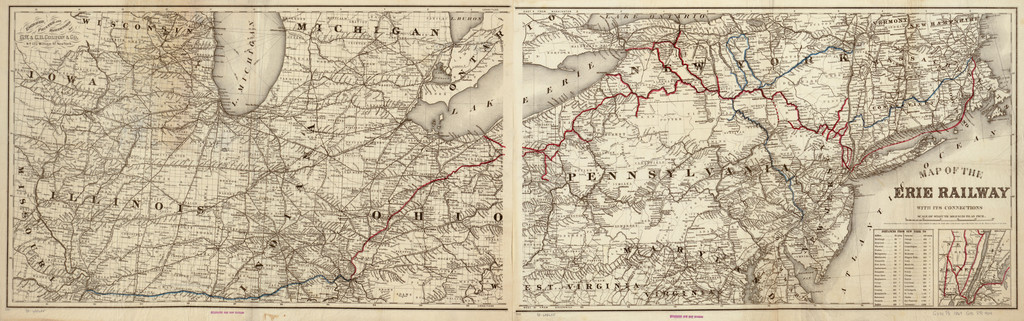
G. W. & C. B. Colton & Co., Map of the Erie Railway and its connections, 1869. Library of Congress. The map postdates the painting and supplies network context; no claim that Cropsey used this sheet. G. W. & C. B. Colton & Co. / Library of Congress,98688655, via Wikimedia Commons. Image source. Public domain. Proportionally resized only; full carrier, margins and native appearance retained.
Harmony and a critical reading
Toledo’s harmonious interpretation can be set beside Rebora’s more critical discussion of the pastoral ideal. She considers how picturesque landscapes could minimise the disruptive appearance of industrial progress and appeal to patrons whose interests were connected to development. That is an attributed scholarly reading, rather than a documented opinion shared by every original viewer. [1] [2]
The two readings begin from much of the same visible evidence. The railway is small, its path follows the country, and smoke relates to clouds. One response admires the joining of forms; another asks what is made easier to accept by that visual joining.
The painting remains useful because it supports that question without losing its particular landscape. The foreground figures, water, village and autumn slopes can be examined closely while the train’s broader significance is considered. Its visual quiet is itself part of the subject.
Collection and display
Toledo records the acquisition through funds from the Florence Scott Libbey bequest in memory of Maurice A. Scott. Its collection page, checked on 8 October 2026, lists a 2025–27 Art Bridges Partner Loan Network presentation at the Hudson River Museum in Yonkers and marks the object on loan. Collection ownership therefore should not be confused with guaranteed current display in Toledo. [1]
The surviving canvas brings a large network of travel into one carefully arranged view. Its foreground offers a place to look, its middle ground shows inhabited country, and its railway introduces movement at a distance. Cropsey makes those elements share a landscape whose apparent ease invites both pleasure and further questions.
Artworks directory
A selected directory of 18 paintings, two drawings and three architectural projects. Repeated subjects retain distinct object identities. Links lead to a companion article where available, otherwise the consulted institutional record. Unillustrated objects remain searchable; this is not a complete catalogue raisonné.
Frequently Asked Questions
The catalogue identifies William Dreser and publisher Thomas B. Sinclair, Philadelphia, for the 1867 reproduction. It is separate from the oil and is not by Currier & Ives. [2]
The map postdates the painting and is included for railway-network context. No evidence is claimed that Cropsey used that sheet. [4]
Discussion
Look again at the images and ideas explored in Starrucca Viaduct by Jasper Cropsey. These editorial prompts invite your observations.
Reader Insights
Does the train feel like an interruption or part of the view?
How do the foreground figures affect the landscape’s scale?
What becomes visible when you compare the painting’s quiet with the map’s wider network?
Join the Conversation
Share a detail, comparison or question about Starrucca Viaduct by Jasper Cropsey below.
References
- Toledo Museum of Art, Starrucca Viaduct, Pennsylvania, accession 1947.58. Exact object, acquisition credit, smoke/cloud interpretation and loan listing checked 8 October 2026. View source
- Carrie Rebora, Starrucca Viaduct, Pennsylvania, American Paradise: The World of the Hudson River School, Metropolitan Museum of Art (1987), printed pp.210–213. Drawings, guide relationship, distinct versions, Crosby lottery, chromolithograph and critical pastoral interpretation. View source
- William MacLeod, Harper’s New York and Erie Rail-road Guide Book, eighth edition, 1855–6. Title and preface, selected route passages printed pp.115–127, and whole printed page 124; engravings by Lossing and Barritt from MacLeod’s sketches. View source
- Map of the Erie Railway and its connections, G. W. & C. B. Colton & Co., 1869, exact Library of Congress source file on Wikimedia Commons. Whole map identity, visible imprint and public-domain reproduction record; historical context after the canvas’s date. View source
- Splash image source.
Jasper Francis Cropsey, Starrucca Viaduct, Pennsylvania, 1865. Oil on canvas, 56.8 × 92.4 cm. Toledo Museum of Art, 1947.58. Purchased with funds from the Florence Scott Libbey Bequest in Memory of her Father, Maurice A. Scott. Jasper Francis Cropsey / Toledo Museum of Art, via Google Art Project. Public domain. Proportionally resized only; full carrier, margins and native appearance retained.
View source