 by Tom Gurney
Tom Gurney BSc (Hons) is an art history expert with over 20 years experience
Email: tomgurney1@gmail.com / Phone: +44 7429 011000
Jasper Cropsey’s Autumn Landscapes: Introduction
Autumn became one of Jasper Cropsey’s most recognisable subjects, but it served several different kinds of landscape. Red and gold trees could frame a river panorama, surround a railway crossing or lead toward a familiar local mountain. The season gave him a changing palette and a public association with American scenery, rather than one composition repeated without variation. [1]
Comparing particular canvases makes that range clearer. Autumn—On the Hudson River was completed in London in 1860; Starrucca Viaduct followed in 1865; the Met’s Sugar Loaf Mountain is dated about 1870–75; and the Smithsonian’s Greenwood Lake is dated 1875. Their different structures show how seasonal colour could work within different views and histories. [1] [2] [9] [4]
At a Glance
- Artist: Jasper Francis Cropsey, 1823–1900
- Central concern: Autumn colour within varied landscape compositions
- Major London canvas: Autumn—On the Hudson River, 1860
- Railway example: Starrucca Viaduct, Pennsylvania, 1865
- Regional examples: Sugar Loaf Mountain and Greenwood Lake
- Later example discussed: Autumn on the Brandywine, 1887
- Evidence: Whole paintings, museum records, scholarly catalogues and period railway guide
Contents
- An American season seen from Britain
- Colour that frames a distant river
- A railway in autumn country
- Sugar Loaf: warmth around a local mountain
- Greenwood Lake: an open interval of water
- Wawayanda and the quiet of sunset
- Seasonal meaning and national identity
- Later autumn and changing audiences
- Looking across the whole paintings
- Annotated details
An American season seen from Britain
The large Hudson panorama gave British viewers an extensive encounter with American autumn. Chotner discusses critics who praised its colour and poetic effect alongside its fidelity to nature. Some viewers questioned whether the vivid foliage could be real, while travellers familiar with the United States supported its plausibility. [1]
The issue was partly one of experience. A viewer accustomed to another country’s seasonal changes could find Cropsey’s red and gold leaves surprisingly strong. The painting made that difference available at a scale large enough for detailed near trees and a broad river distance to be studied together.
Chotner reports leaf samples pasted to cardboard, citing a Guardian review of 6 June 1860 through Talbot. That mediated record supplies the evidence for the leaf story used here. It remains distinct from Cropsey’s later presentation to Queen Victoria in June 1861. [1]
The samples addressed the credibility of colour; they did not certify every part of the composition as one unchanged site. Observation and arrangement could work together. A faithfully studied leaf might enter a panorama shaped through decisions about mass, light and distance.
Annotated Details from Jasper Cropsey’s Autumn Landscapes
The numbered points identify visible features discussed in this article. Return from each detail to the whole composition. The captions keep each work’s identity, date and medium separate.
Autumn On The Hudson River
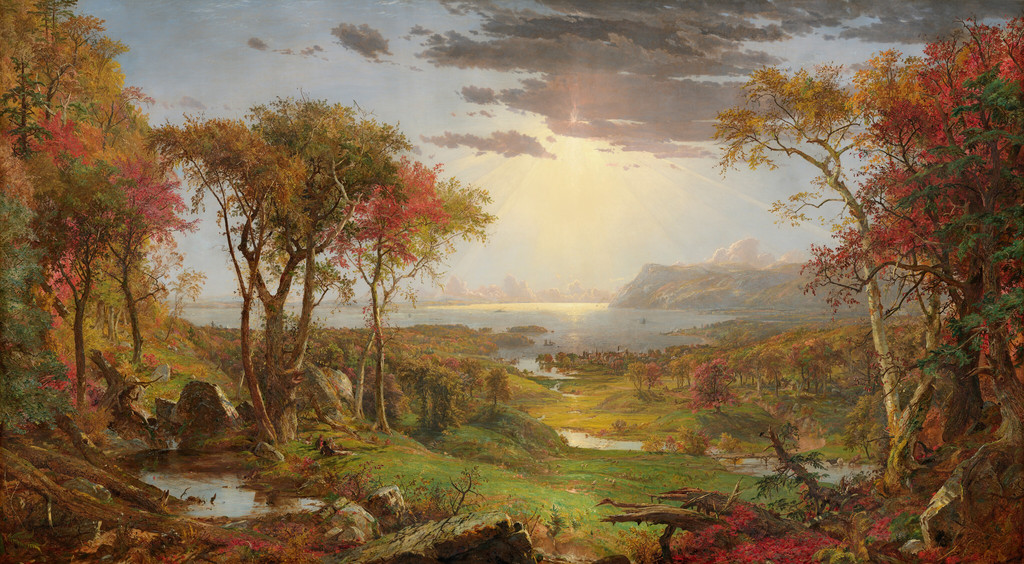
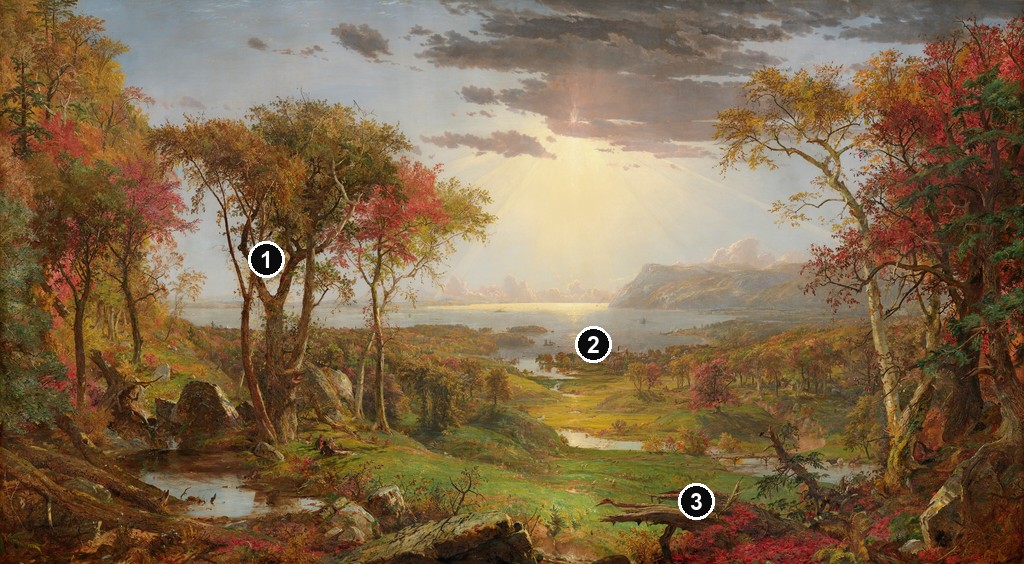
Jasper Francis Cropsey, Autumn—On the Hudson River, 1860. Oil on canvas, 151.8 × 274.9 cm. National Gallery of Art, Washington, 1963.9.1. Gift of the Avalon Foundation. Painted in London. Jasper Francis Cropsey / National Gallery of Art, Washington. Image source. CC0 / Public domain. Separate resized overview with numbered points; details cropped from the original, without recolouring, retouching or enlargement.
Greenwood Lake
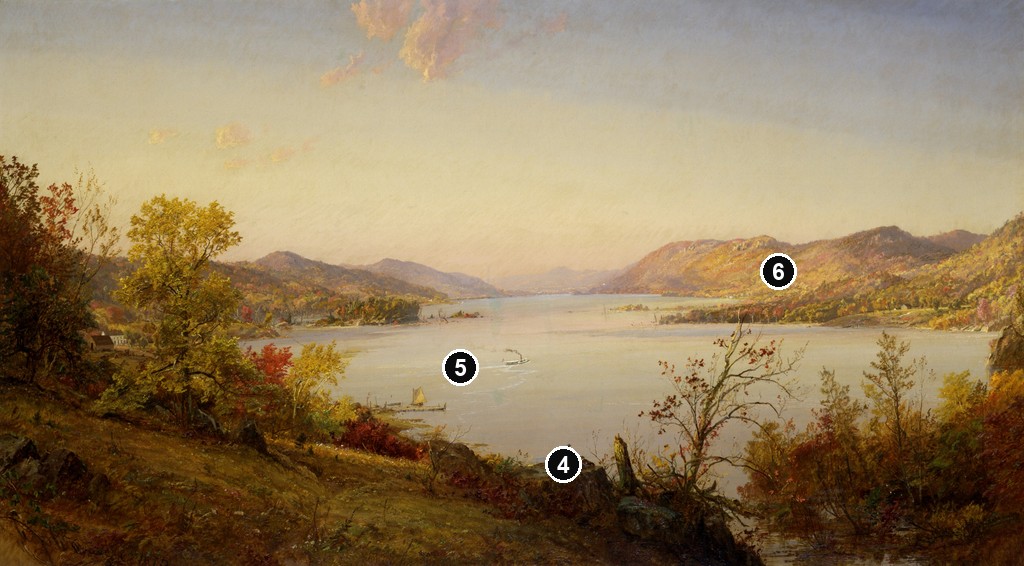
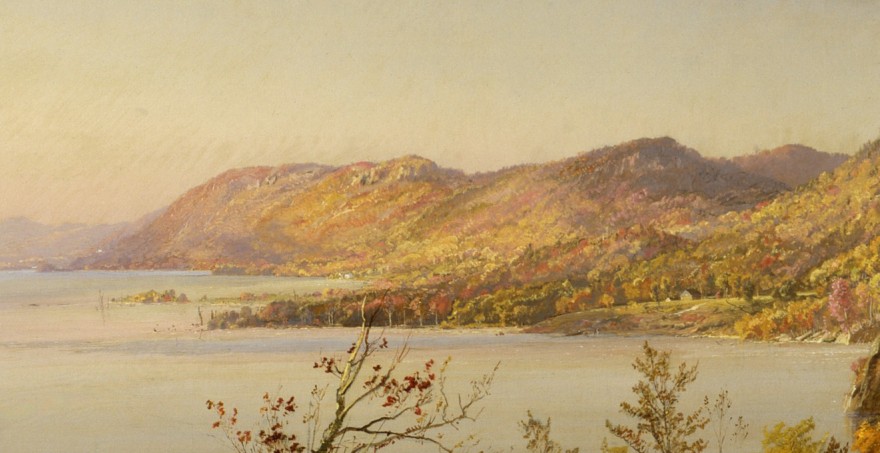
Jasper Francis Cropsey, Greenwood Lake, 1875. Smithsonian American Art Museum, 1967.125. Gift of Ellen R. Wheeler. A different arrangement of near foliage and broad open water in the region Cropsey repeatedly painted. Jasper Francis Cropsey / Smithsonian American Art Museum. Image source. Public domain. Separate resized overview with numbered points; details cropped from the original, without recolouring, retouching or enlargement.
Details from JASPER CROPSEY’S AUTUMN LANDSCAPES
Compare the cropped details with the complete images above. Notice how their colours, shapes and positions contribute to the larger compositions.
Autumn On The Hudson River
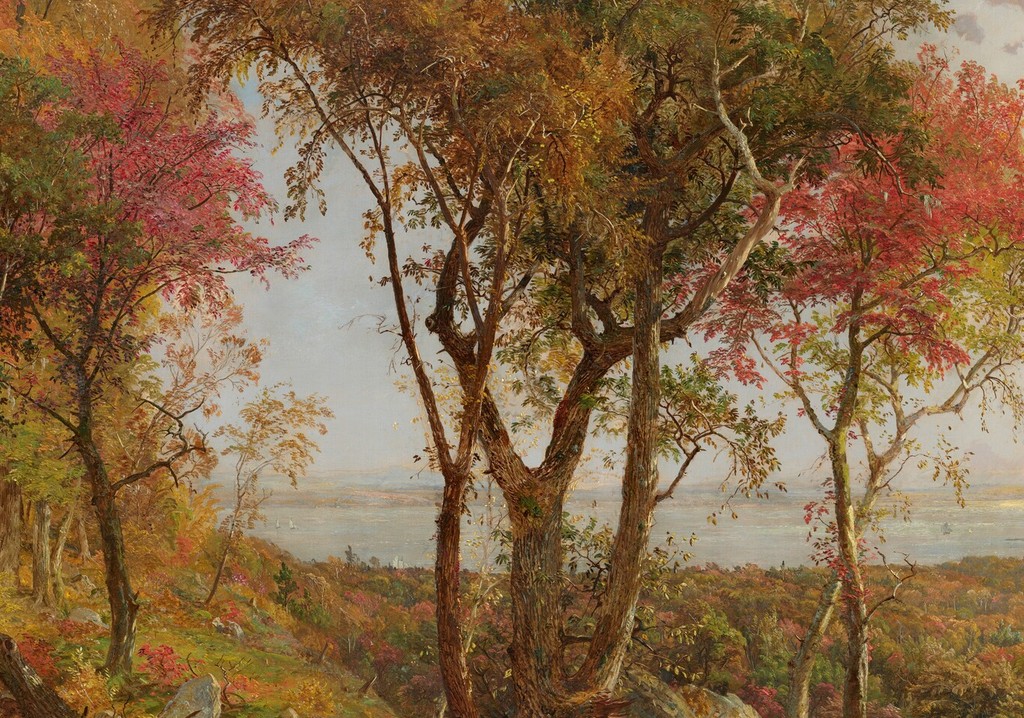
Trees framing the open river
Branching near trees and patches of red, yellow and green foliage enclose the brighter river. Their large scale helps distinguish the wooded foreground from the distant view.
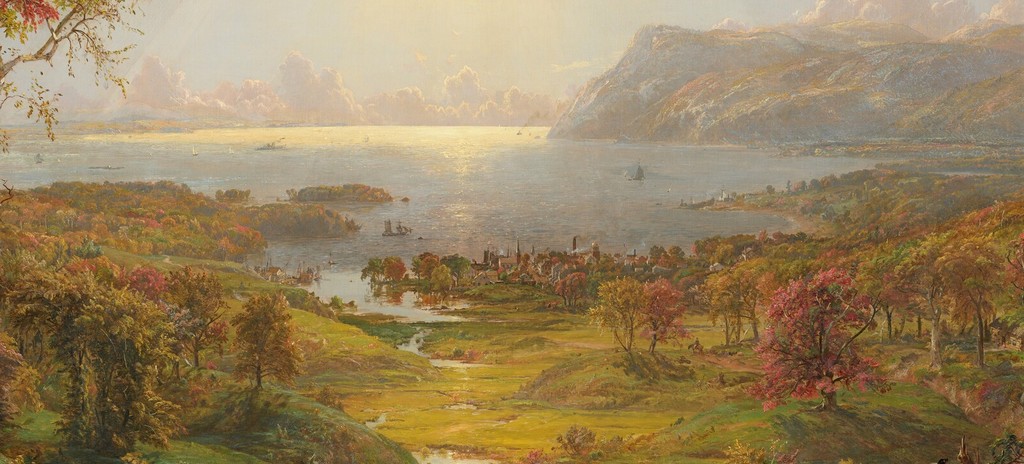
River, settlement and distant ridge
The river, small buildings and distant ridge occupy the central opening. Their reduced scale contrasts with the large trees at the edges.
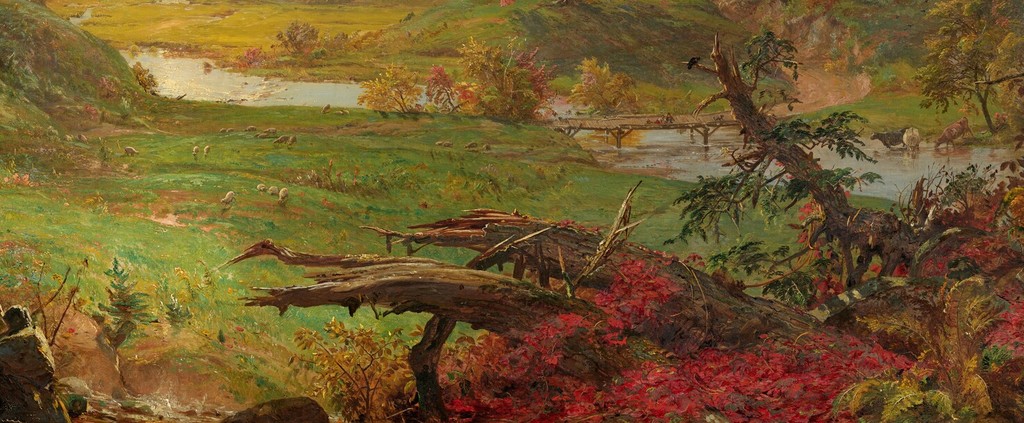
Water and fallen wood in the foreground
Near water, a small crossing and fallen timber carry the eye back into the foreground. Irregular wood and red vegetation interrupt the wider calm panorama.
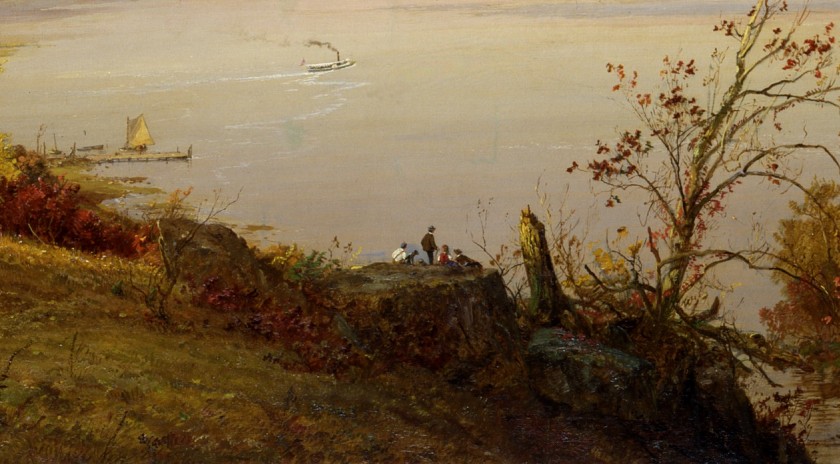
Greenwood Lake
Figures beside the near shore
Small figures occupy the near shoreline ledge. The broad crop keeps them within their setting and does not infer facial expression.
Sailboat and vessel on the open water
A pale sail and a more distant vessel interrupt the open water. Their small scale makes the lake’s breadth readable.
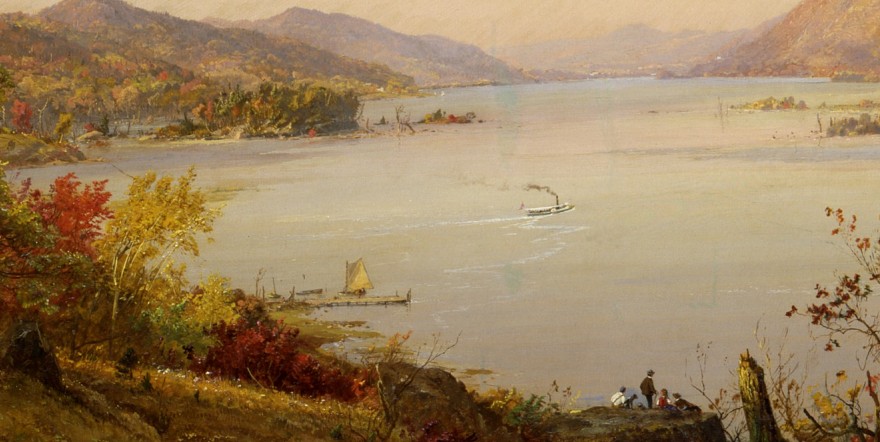
Warm ridge beyond the lake
A warm wooded ridge borders the lake at the right. Its broad colour masses contrast with the pale water and sky.
Colour that frames a distant river
In the 1860 canvas, the nearest reds and golds occupy substantial tree groups at the sides. The eye reaches the river through an opening between them. Autumn colour therefore becomes part of the view’s structure, making the foreground a strong frame for the lighter water beyond.
The tree groups are not identical. Their trunks, crowns and remaining greens create different patterns at the left and right. Warm colour is distributed through those patterns, so the season is expressed through several distinct forms rather than a single flat field.
Farther away, foliage becomes smaller and more gathered. Its warmth remains visible, but individual leaves are less sharply separated. The change lets the same seasonal material help establish depth across a large canvas.
The broad light above the Hudson adds another relation. Foreground trees remain substantial against a paler sky and distance. Their colour gives the viewer a near intensity from which to look outward into more extensive atmosphere.
A railway in autumn country
Starrucca Viaduct makes a different route through autumn. Two foreground figures occupy a rocky ledge, while the train and bridge lie within the farther valley. Warm foliage surrounds both near and distant activity, but the railway supplies a long line of movement across the country. [2]
The picture gives the train’s white smoke a place among brighter cloud passages. The museum’s harmonious reading and Rebora’s more critical pastoral interpretation both consider how the technology is absorbed into the larger landscape. Their different readings begin from related visible choices. [2] [5]
Autumn helps make those choices attractive. Near red trees, lighter crowns and coloured slopes give the valley a varied richness. The railway does not cross a blank stage; it enters a country already presented as extensive, inhabited and worth looking at.
The period Erie guide makes this scenic appeal explicit. The directly consulted eighth edition of 1855–6 recommends the Starrucca view in autumn and describes its combined river, village, meadow and railway attractions. It is a historical promotion of a traveller’s experience, rather than proof of a modern consensus about industrial development. [6]
The season could therefore belong to travel as well as contemplation. Technology helped bring visitors to scenery, and the view could in turn make technological change look compatible with a picturesque world. Cropsey’s painting allows that relationship to be considered through its particular forms.
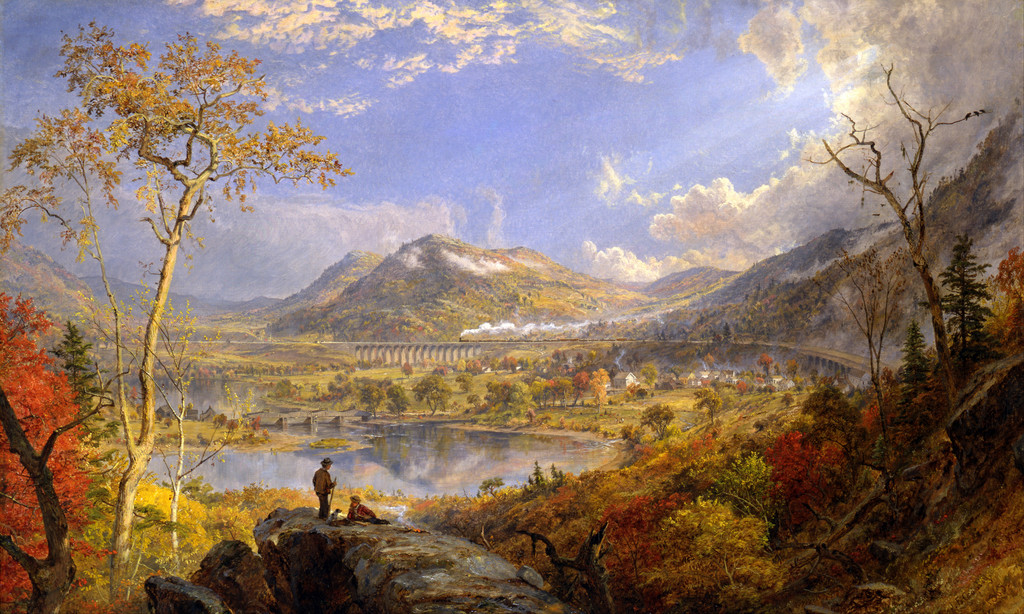
Jasper Francis Cropsey, Starrucca Viaduct, Pennsylvania, 1865. Toledo Museum of Art, 1947.58. The railway crosses an extensive autumn valley. Jasper Francis Cropsey / Toledo Museum of Art, via Google Art Project. Image source. Public domain. Proportionally resized only; full carrier, margins and native appearance retained.
Sugar Loaf: warmth around a local mountain
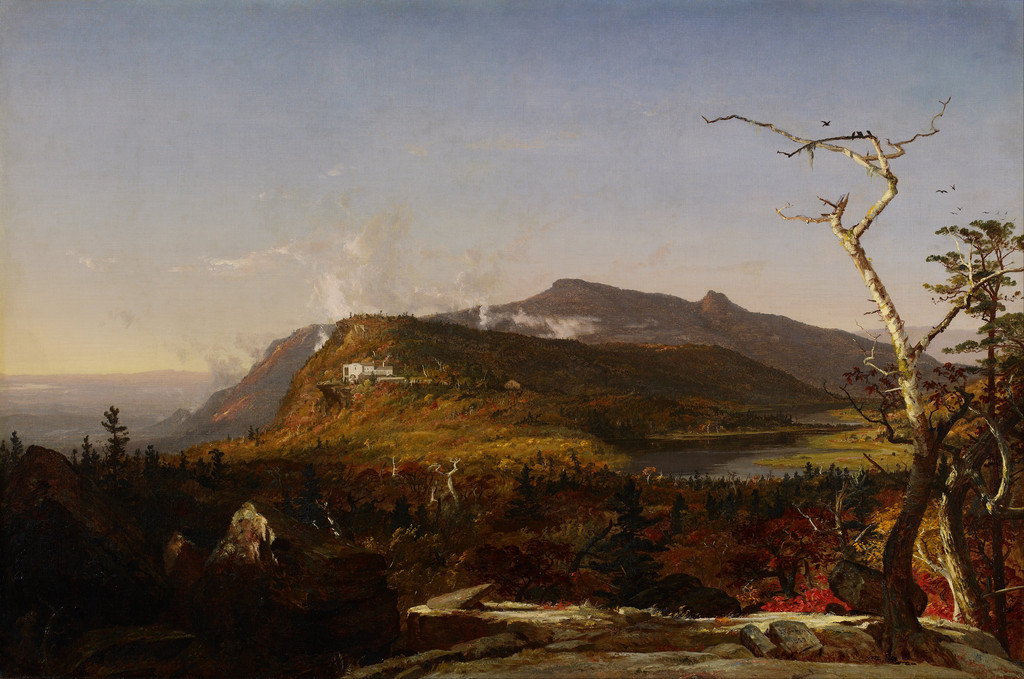
The Met’s Sugar Loaf Mountain directs the view toward one rounded peak. Near trees and a pale house occupy the lower field, while the mountain gains prominence through its central position and warmer colour. The arrangement is more concentrated than the Hudson canvas’s long river opening.
Kenneth W. Maddox’s study identifies the subject as Sugar Loaf in Orange County, New York, revising the earlier Mount Chocorua title. He also discusses the liberties Cropsey took with the mountain’s scale and form. The corrected regional identity does not turn the canvas into a measured transcription of every feature. [3]
Here, autumn colour works around an enlarged landmark. The fields and trees provide a layered approach, while the peak gathers the distance into a more definite form. The house and framing foliage make the mountain seem part of familiar inhabited country.
The example is useful because it connects seasonal beauty with composed emphasis. A local subject can be made more prominent, and remembered architecture may be included, without the viewer’s experience losing its continuity. The painting’s autumn character belongs to that arrangement as well as to its leaves.
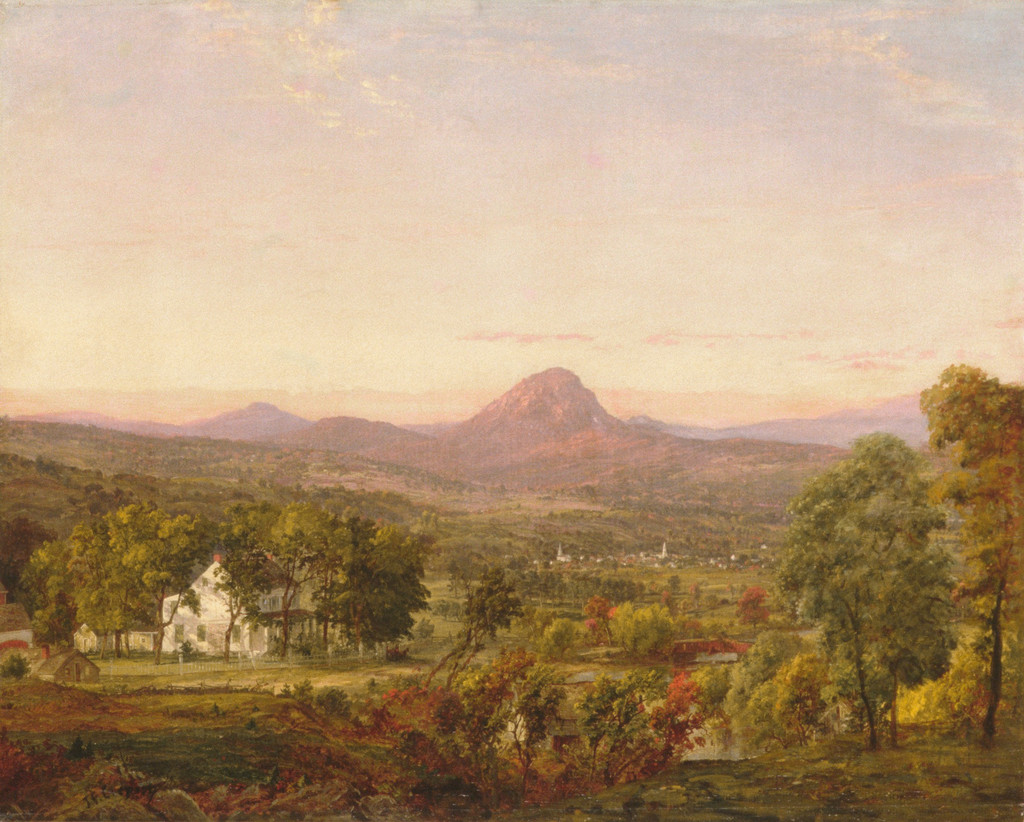
Jasper Francis Cropsey, Sugar Loaf Mountain, Orange County, New York, about 1870–75. Metropolitan Museum of Art, 61.262. Its rounded mountain concentrates the distance. Jasper Francis Cropsey / The Metropolitan Museum of Art. Image source. CC0 / Public domain. Proportionally resized only; full carrier, margins and native appearance retained.
Greenwood Lake: an open interval of water
The Smithsonian’s 1875 Greenwood Lake uses a much broader stretch of water as its central interval. Warm banks and hills extend around it, while near figures and trees supply a place from which to look. The museum identifies this canvas by accession 1967.125. [4]
The autumn colour is distributed along the shores rather than gathered mainly around one mountain. Boats interrupt the water at different distances, giving the broad surface signs of movement. The hills remain a long surrounding sequence.
The relation between season and space is therefore different again. In Sugar Loaf, the eye is led toward a central height. In Greenwood, it travels across a pale opening between warm shores. Colour can frame both routes while producing different experiences of distance.
The repeated lake subject also has a history beyond the autumn palette. Chotner traces Cropsey’s interest to early studies and subsequent visits, including the personal connection with Maria Cooley. The landscape remained part of his material across decades. [1]
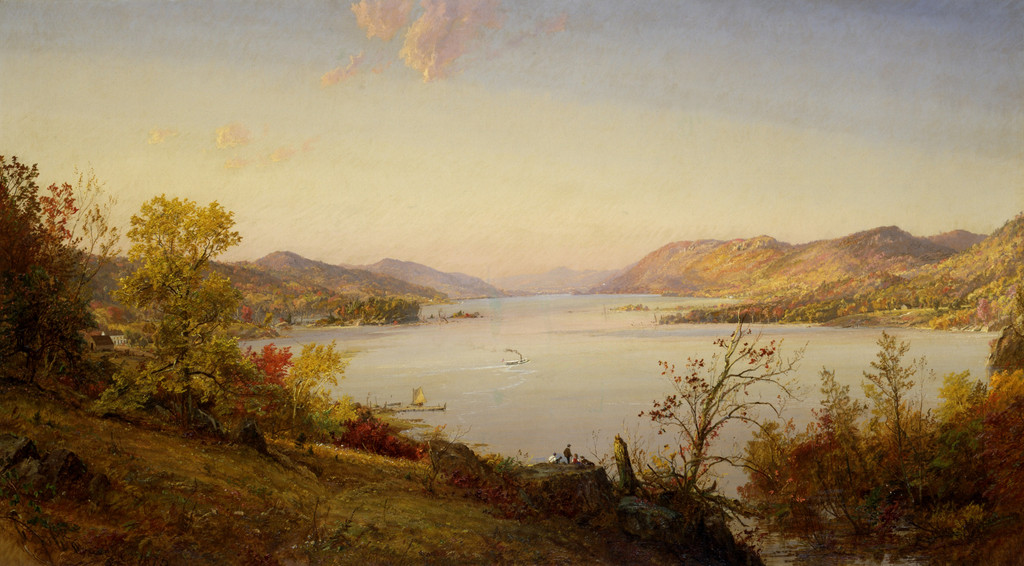
Jasper Francis Cropsey, Greenwood Lake, 1875. Smithsonian American Art Museum, 1967.125. Warm shores surround a broad interval of water. Jasper Francis Cropsey / Smithsonian American Art Museum. Image source. Public domain. Proportionally resized only; full carrier, margins and native appearance retained.
Watch: Jasper Cropsey
Look closely at Cropsey’s Mount Jefferson, then explore the wider Hudson River School tradition.
Summer or Autumn? Picturing the American Republic
Smarthistory discusses Cropsey’s seasonal landscape and the image of the American republic.
Watch on YouTubeWawayanda and the quiet of sunset
The New Britain Museum of American Art holds Lake Wawayanda, Sussex County, New Jersey, dated 1870, accession 1962.19. Its scholarly account describes a quiet lake scene with a warm autumn palette, reflected light and near activity. The work is considered here through that museum record. [7]
The museum relates the picture’s atmosphere to its horizontal composition and framing devices. Its interpretation gives another example of how autumn could contribute to a welcoming, inhabited landscape rather than a dramatic mountain or railway panorama. [7]
It also retains limits in the work’s history. The account identifies no known related drawing or journal entry for that individual canvas. Its convincing scenery should not be used to invent an exact preparatory sequence where the source supplies none. [7]
The variety across these lake pictures matters. A familiar region could yield several kinds of view, with near figures, water, foliage and light changing their weight from one composition to another. Autumn supplies continuity without erasing those differences.
Seasonal meaning and national identity
The reception of the London Hudson painting made autumn colour part of a public comparison between America and Britain. Chotner discusses its optimistic appeal and the historical and literary associations of the river country for a British audience. The season could help present an extensive American landscape as both distinctive and recognisable. [1]
That history does not require every coloured tree to carry one agreed national symbol. A viewer might attend to observed leaves, religious meaning, local familiarity or the pleasures of a panorama. Those responses can coexist with the work’s use in a broader presentation of American scenery.
The inhabited details deserve particular attention. Buildings, boats, fields and routes remain part of several autumn views. Their presence complicates a simple account of pure wilderness: Cropsey repeatedly showed country in which people lived, travelled and worked.
The seasonal beauty can make those uses appear quiet or harmonious, but its effects deserve to be examined rather than assumed. The railway scene is especially useful because it shows how the same coloured landscape can invite pleasure and questions about the change it contains.
Later autumn and changing audiences
Autumn on the Brandywine, dated 1887, belongs to the Brandywine Museum of Art, accession 81.7. Its 2025 exhibition labels describe a smaller-scale later painting connected with Cropsey’s trip to the Brandywine Valley and with changing demand among his clientele. The museum’s account supplies the context here; the painting is not illustrated in this comparison. [8]
The example also prevents a misleading claim that Cropsey stopped travelling entirely after moving to Hastings. A later work could still emerge from a regional visit, even as his circumstances and the scale of his output changed. [8]
Chotner describes a broader decline in popularity as tastes shifted toward softer, smaller, mood-oriented landscapes. That change affected the reception of his detailed and dramatically arranged work. It does not mean the autumn subject suddenly disappeared from his practice. [1]
Following the season across these examples makes its flexibility clear. It could contribute to a monumental exhibition picture, a railway landscape, a familiar local view or a later regional canvas. The continuity lies in sustained attention to colour, light and inhabited country; the compositions and audiences changed.
Looking across the whole paintings
A useful comparison begins with the whole view: where is the nearest warm colour, what opens beyond it, and which form holds the distance? In the Hudson picture it is a broad river horizon; in Starrucca it is a mountain valley crossed by rail; in Sugar Loaf it is a rounded height; in Greenwood it is an interval of water.
These differences keep Cropsey’s autumn landscapes particular. Their reds and golds are easy to recognise, but the more sustained interest comes from the work those colours do. They establish near places, connect layers of distance and give different kinds of country a seasonal character.
Artworks directory
A selected directory of 18 paintings, two drawings and three architectural projects. Repeated subjects retain distinct object identities. Links lead to a companion article where available, otherwise the consulted institutional record. Unillustrated objects remain searchable; this is not a complete catalogue raisonné.
Frequently Asked Questions
No. His work includes summer scenes, woodland studies, Italian and English subjects and allegorical landscapes. Autumn is an important public association, not the whole of his output. [1]
The illustrated river, railway, mountain and lake paintings organise distance differently. The season contributes to several compositions rather than one repeated formula.
The Brandywine museum connects Autumn on the Brandywine of 1887 with a regional trip. A claim that all later travel ceased would be too broad. [8]
Discussion
Look again at the images and ideas explored in Jasper Cropsey’s Autumn Landscapes. These editorial prompts invite your observations.
Reader Insights
Which autumn picture makes colour most important to its depth?
Where do signs of human use become most visible?
Does knowing about the British response change your view of the Hudson panorama?
Join the Conversation
Share a detail, comparison or question about Jasper Cropsey’s Autumn Landscapes below.
References
- Deborah Chotner, Cropsey biography and Autumn—On the Hudson River, American Paintings of the Nineteenth Century, Part I, National Gallery of Art (1996), printed pp.109–110 and 118–122. London reception, mediated leaf report, regional interests and later changing tastes. View source
- Carrie Rebora, Starrucca Viaduct, American Paradise: The World of the Hudson River School, Metropolitan Museum of Art (1987), printed pp.210–213. Railway picture and critical pastoral interpretation. View source
- Kenneth W. Maddox, A Forgotten Mountain: Jasper F. Cropsey’s Paintings of Sugar Loaf, Metropolitan Museum Journal, 35 (2000), pp.221–236. Regional subject identification and composed mountain form. View source
- Smithsonian American Art Museum, Greenwood Lake, accession 1967.125. Exact 1875 comparison canvas. View source
- Toledo Museum of Art, Starrucca Viaduct, Pennsylvania, accession 1947.58. Exact 1865 painting and harmonious smoke/cloud interpretation. View source
- William MacLeod, Harper’s New York and Erie Rail-road Guide Book, eighth edition, 1855–6, selected printed pp.115–127. Period promotion of autumn sightseeing around Starrucca. View source
- New Britain Museum of American Art, Cropsey collection records and scholarly account of Lake Wawayanda, Sussex County, New Jersey, accession 1962.19. Separate 1870 lake, compositional interpretation and limits of preparatory evidence. View source
- Brandywine Museum of Art, Cropsey, Wyeth, and the American Landscape Tradition, 2025 large-print labels, PDF pp.8–9. Autumn on the Brandywine, 1887, accession 81.7, later regional travel and clientele. View source
- Metropolitan Museum of Art, Sugar Loaf Mountain, Orange County, New York, accession 61.262. Current title and date of about 1870–75. View source
- Splash image source.
Jasper Francis Cropsey, Autumn—On the Hudson River, 1860. National Gallery of Art, 1963.9.1. Strong autumn trees frame a lighter river distance. Jasper Francis Cropsey / National Gallery of Art, Washington. CC0 / Public domain. Proportionally resized only; full carrier, margins and native appearance retained.
View source