 by Tom Gurney
Tom Gurney BSc (Hons) is an art history expert with over 20 years experience
Email: tomgurney1@gmail.com / Phone: +44 7429 011000
Sugar Loaf Mountain by Jasper Cropsey: Introduction
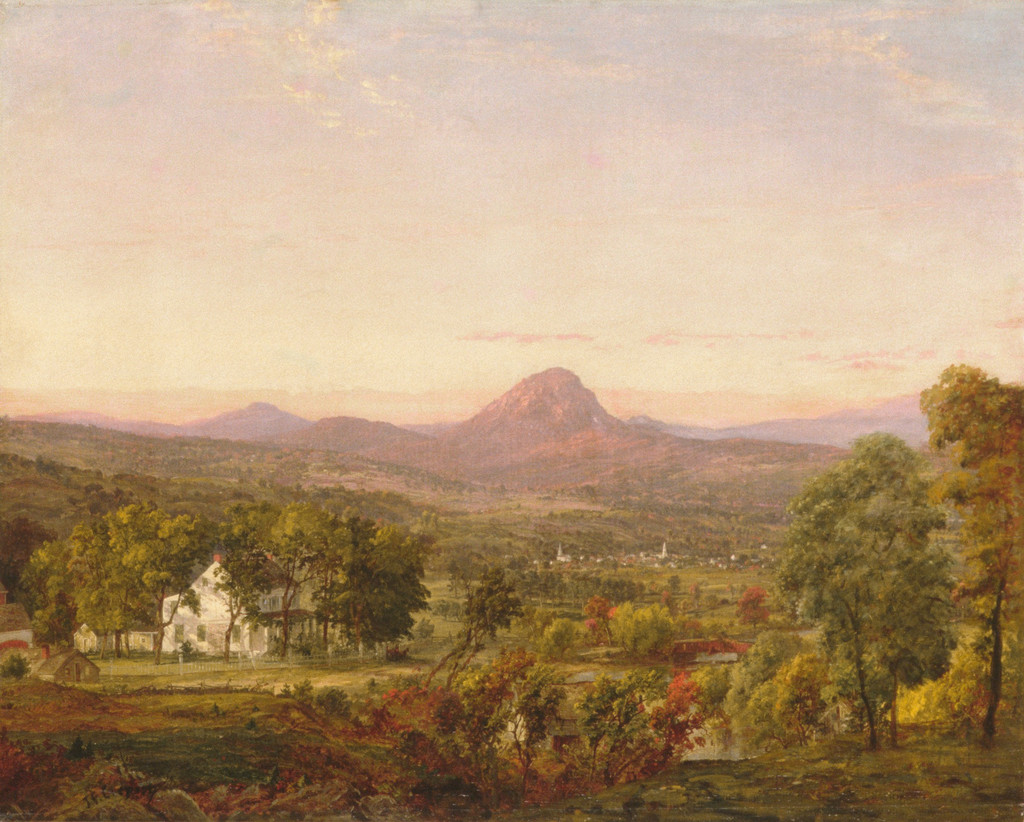
Jasper Cropsey’s Autumn Landscape, Sugar Loaf Mountain, Orange County, New York places a rounded mountain beyond fields, trees and a small settlement. The Metropolitan Museum of Art dates the oil on canvas about 1870–75. It measures 72.4 × 90.2 cm and carries accession 61.262. Its present geographical identification follows a revision of the earlier title, which associated the mountain with Mount Chocorua in New Hampshire. [1]
Kenneth W. Maddox’s 2000 study explains that change through a comparison of mountain shapes, regional drawings and related paintings. The story concerns the subject of an accepted Cropsey painting, rather than a change in its attribution. It also reveals how a familiar landscape can be reshaped within a finished composition. [2]
At a Glance
- Artist: Jasper Francis Cropsey
- Title: Autumn Landscape, Sugar Loaf Mountain, Orange County, New York
- Date: About 1870–75
- Medium: Oil on canvas
- Dimensions: 72.4 × 90.2 cm
- Collection: Metropolitan Museum of Art
- Accession: 61.262
- Acquisition credit: Purchase, Bertram F. and Susie Brummer Foundation, Inc., Gift, 1961
- Earlier subject identification: Mount Chocorua, New Hampshire
This work across Jasper Cropsey’s career
Contents
- A rounded mountain beyond the fields
- The house and inhabited foreground
- How Mount Chocorua became the earlier title
- Why the mountain’s shape mattered
- Drawings and related paintings
- Could the house be the Cooley homestead?
- Aladdin and the nearby country
- A different structure from Greenwood Lake
- A corrected subject with questions still open
- Annotated details
A rounded mountain beyond the fields
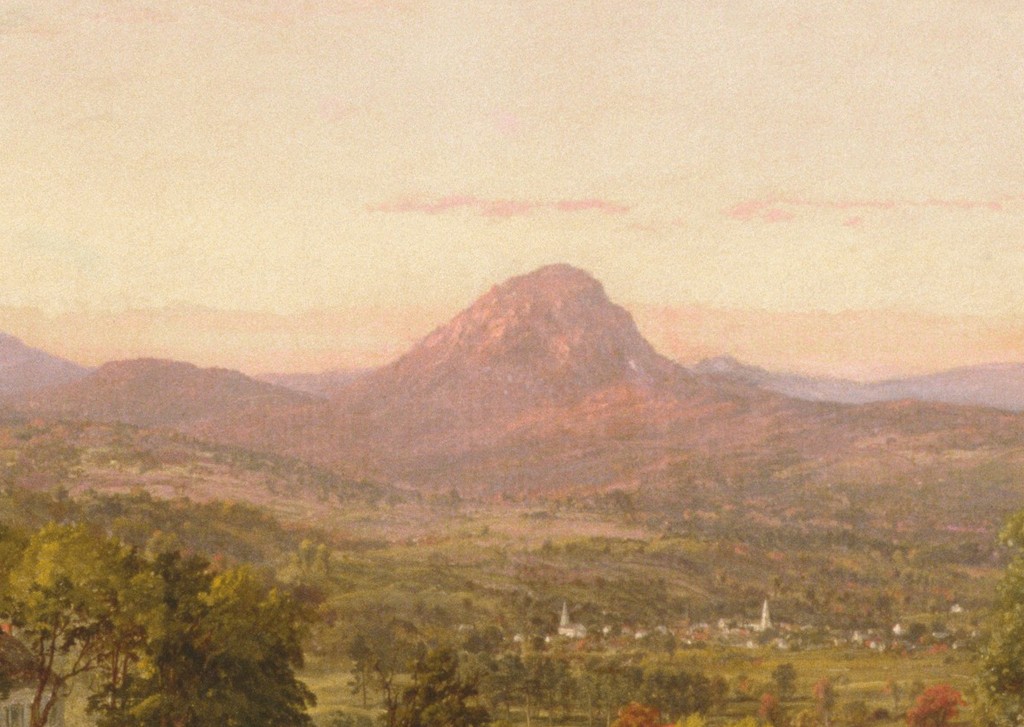
The mountain occupies a prominent position near the centre of the distant landscape. Its upper contour rises into a rounded peak, while lower slopes connect it to the surrounding country. Warm light gives it a colour different from the greener and darker foreground.
The distinction in colour makes the mountain easy to recognise without isolating it from the region around it. Lower ridges extend to either side, and the land between viewer and peak is filled with smaller changes in height. The central form belongs to a layered view rather than standing against an empty horizon.
The sky takes up a large part of the canvas. Its pale field gives the mountain room and makes its modestly varied outline legible. Thin cloud passages do not compete with the main rise of land.
The viewer’s route toward the peak passes through a much denser foreground. Trees, buildings, fields and darker near vegetation supply separate forms before the eye reaches the more unified distance. Cropsey uses that shift in detail to give the landscape depth.
Annotated Details from Sugar Loaf Mountain
The numbered points identify visible features discussed in this article. Return from each detail to the whole composition. Jasper Francis Cropsey, Autumn Landscape, Sugar Loaf Mountain, Orange County, New York, about 1870–75. Oil on canvas, 72.4 × 90.2 cm. Metropolitan Museum of Art, 61.262. Purchase, Bertram F. and Susie Brummer Foundation, Inc., Gift, 1961. Jasper Francis Cropsey / The Metropolitan Museum of Art. Image source. CC0 / Public domain. Separate resized overview with numbered points; details cropped from the original, without recolouring, retouching or enlargement.
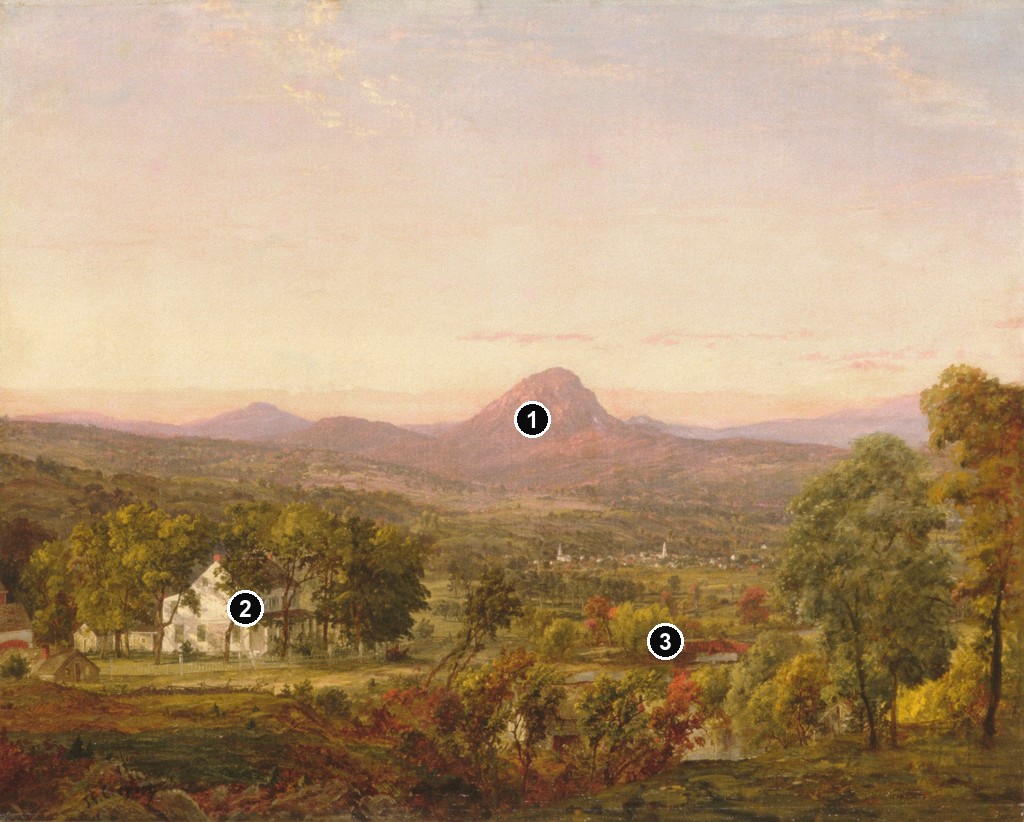
Details from SUGAR LOAF MOUNTAIN
Compare the cropped details with the complete images above. Notice how their colours, shapes and positions contribute to the larger compositions.
Mountain rising above the valley
The broad central mountain rises behind the settled valley. This soft source supports the relationship of large forms rather than minute geological details.
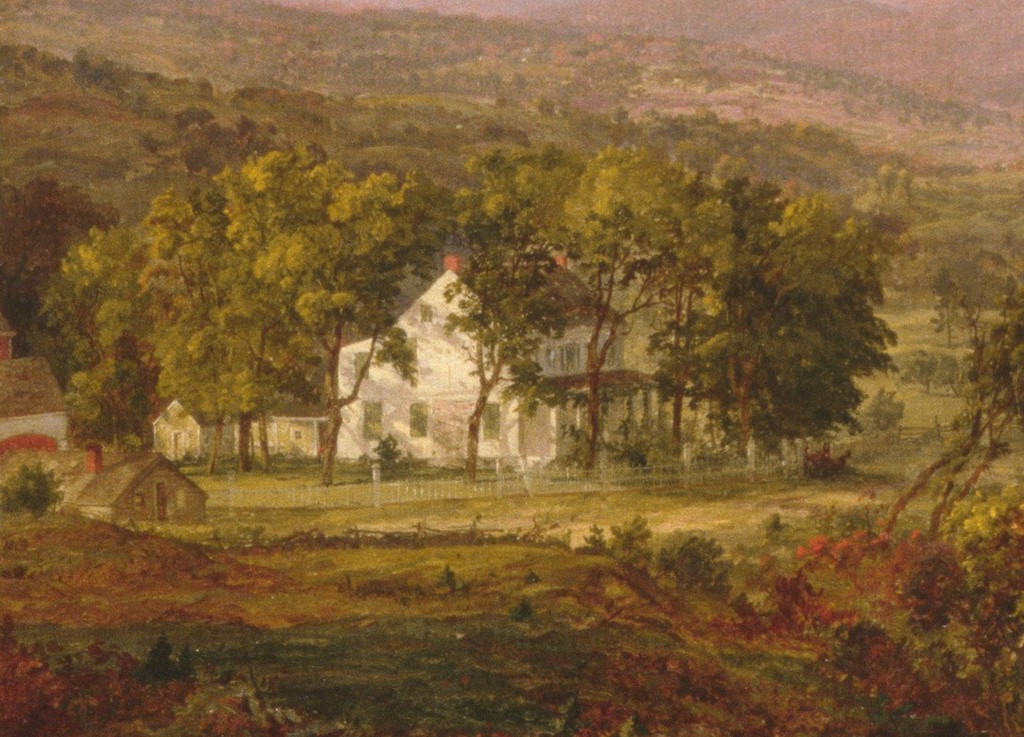
Pale house among near trees
A pale house and smaller buildings sit among near trees. The broad crop preserves their relationship with the cultivated ground; it does not establish the owner’s identity.
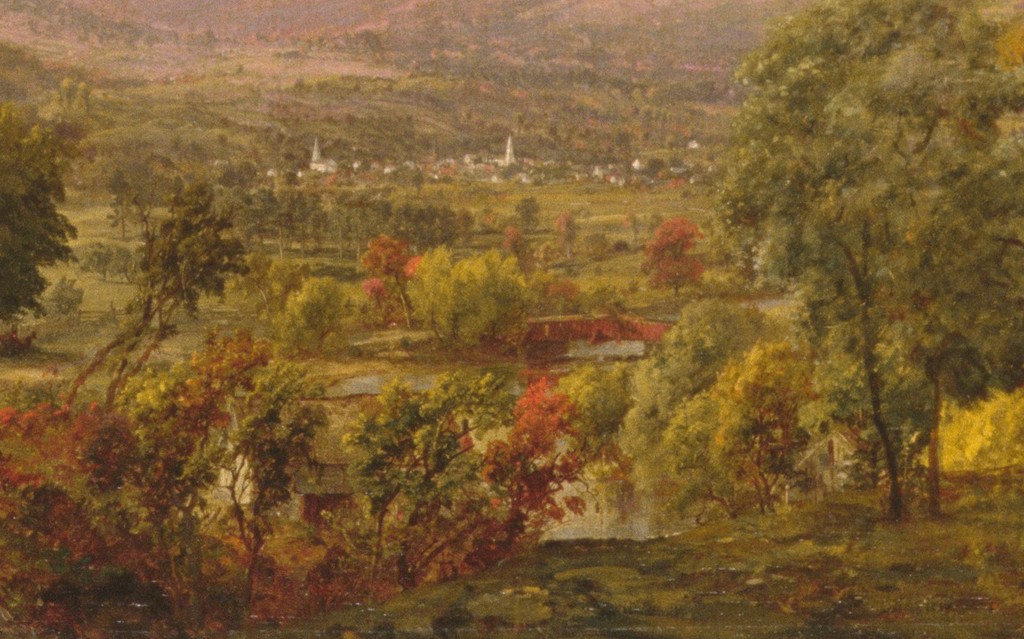
Cultivated valley and wooded foreground
Fields, small buildings and changing foliage extend across the valley. Near trunks and branches overlap those more distant forms.
The house and inhabited foreground
A pale house stands at the left, partly screened by trees. Its roof, walls and neighbouring structures provide a compact architectural group. Unlike the larger mountain, it occupies a nearer and more enclosed space.
The tree trunks create interruptions across its light facade. That overlap places the building within the wooded ground rather than leaving it as an isolated ornament. The pale fence and other near divisions give the surrounding land a sense of use.
At the right, a fuller mass of trees frames the opening into the valley. Their position balances the house and foliage at the left, but their shape is different. The composition does not use two identical screens around the central mountain.
Near the lower centre, warm red foliage and darker branches draw attention to the closest ground. Behind them, the fields become broader and less sharply divided. The arrangement links the foreground’s particular forms with the more extensive country beyond.
Small pale buildings and upright accents mark a settlement in the middle distance. They occupy little of the canvas but help establish the valley as inhabited. The broad reproduction supports that relationship; precise identification of individual distant buildings depends on the scholarship rather than independent recognition of each tiny mark.
How Mount Chocorua became the earlier title
Maddox traces the Chocorua identification through a 1955 loan by dealer Victor Spark to the Currier Gallery of Art’s White Mountains exhibition and an advertisement under the same title later that year. The Met acquired the painting in 1961 with that association already established. [2]
The title continued into later scholarship. Maddox notes that William S. Talbot’s 1970 treatment suggested a date around 1872 on stylistic grounds while retaining Chocorua as the subject. A subsequent Met catalogue also used that identification. [2]
This history shows how a subject name can persist once it enters exhibition and collection records. The painting’s attribution to Cropsey was not the point at issue. The question was whether the mountain in the image matched the place attached to its title.
The distinction matters for a reader following older books. A reproduction labelled Mount Chocorua may show this same canvas, accession 61.262, rather than another New Hampshire painting. The accession and dimensions help connect those references across the change in title.
Why the mountain’s shape mattered
Maddox compares the Met scene with Cropsey’s known drawings and smaller paintings of Chocorua. In those works, the New Hampshire mountain retains a sharper pyramidal and broken profile. The Met picture’s more rounded form and pastoral setting fit his Sugar Loaf landscapes better. [2]
The argument is more substantial than matching one silhouette to a modern photograph. It brings together how Cropsey represented both subjects, their surrounding landscapes and relationships among several compositions. A feature altered by the artist can still belong to a recognisable group of works.
Sugar Loaf rises to 1,226 feet above sea level, according to Maddox’s study. Yet he emphasises that Cropsey enlarged and reshaped its presence in his paintings. The painted mountain should therefore be identified through the wider evidence rather than treated as a scale-accurate outline of its real height. [2]
That observation links the title question with an artistic question. Cropsey could study a place carefully and still make its principal mountain more dominant in a finished oil. Identifying the subject does not require every part of the composition to function as topographical measurement.
Drawings and related paintings
Maddox discusses a sketchbook containing drawings dated 1875–76 and more detailed views made near Wickham Lake in October 1878. These records help establish Sugar Loaf’s position within the region and Cropsey’s attention to its actual surroundings. [2]
Their dates also require care. The drawings provide comparative evidence for the identification; they are not automatically preparatory sheets for a canvas presently dated about 1870–75. The study’s argument does not establish one of those later drawings as the exact initial design for the Met picture.
A smaller painting dated 1874, discussed by Maddox as then on long-term loan to the Georgia Museum of Art in Athens, supplies another important comparison. Its arrangement corresponds closely with the Met scene. The study uses the surrounding mountain forms and relative positions of house, settlement and peak to strengthen the Sugar Loaf identification. [2]
Maddox suggests that the Met version followed that smaller painting. This is a proposed relationship based on their compositions, not a newly established exact year for the larger canvas. The Met’s current approximate range remains about 1870–75. [1] [2]
Watch: Jasper Cropsey
Look closely at Cropsey’s Mount Jefferson, then explore the wider Hudson River School tradition.
Summer or Autumn? Picturing the American Republic
Smarthistory discusses Cropsey’s seasonal landscape and the image of the American republic.
Watch on YouTubeCould the house be the Cooley homestead?
The study notices a resemblance between the foreground house and the family home of Maria Cooley, Cropsey’s wife. It compares the structure with other paintings of the Cooley homestead and proposes that a personally meaningful building may have entered this landscape. [2]
The proposed identification remains qualified. Similar houses also appear among Cropsey’s landscape material, and the visible pale building alone cannot settle its name. It is useful to distinguish the house’s clear compositional role from the more tentative account of its identity.
The geography makes the proposal especially interesting. Maddox places the Cooley home near the southwest corner of Greenwood Lake, across the Bearfort Mountains from Cropsey’s Warwick home. It could not literally appear within the same view of Sugar Loaf. Its possible inclusion would therefore be another example of combining familiar material. [2]
The painting can accommodate that possibility because its organisation is already selective. The mountain is enlarged, the house becomes a strong near landmark, and the fields join them into a readable depth. A source-based proposal about the house enriches the interpretation without requiring it to be stated as fact.
Aladdin and the nearby country
Cropsey’s home called Aladdin belonged to the Warwick region. Deborah Chotner dates the beginning of its construction to 1866; Maddox describes the twenty-nine-room house as completed in 1869. It gave Cropsey a place to work within country he had known through earlier travels and personal connections. [3] [2]
Maddox discusses the studio and windows as part of that relationship with the surrounding landscape. The home’s views and Cropsey’s regional drawings help situate his repeated mountain subjects, but they do not prove that this canvas reproduces one exact studio-window outlook. [2]
The nearby country offered more than a single dominant mountain. Fields, wooded ridges, water and settlements supplied material that Cropsey could return to and rearrange. The Met scene presents that larger interest through a relatively compact picture with a particularly emphatic central peak.
A different structure from Greenwood Lake
The Smithsonian’s Greenwood Lake is dated 1875 and belongs to that museum as accession 1967.125. Its broad lake offers a different arrangement of near trees, open space and distant hills. [4]
In the Met painting, fields and inhabited ground lead toward one central mountain. In the lake picture, a much larger interval of water carries the eye between long shores. Both use near foliage to frame a distance, but they give that distance different shapes.
The comparison also helps separate familiarity from literal transcription. Knowing a region repeatedly can provide many motifs, yet each finished work makes its own choices about what will dominate. A mountain, a lake and a house can acquire different weights as the composition changes.
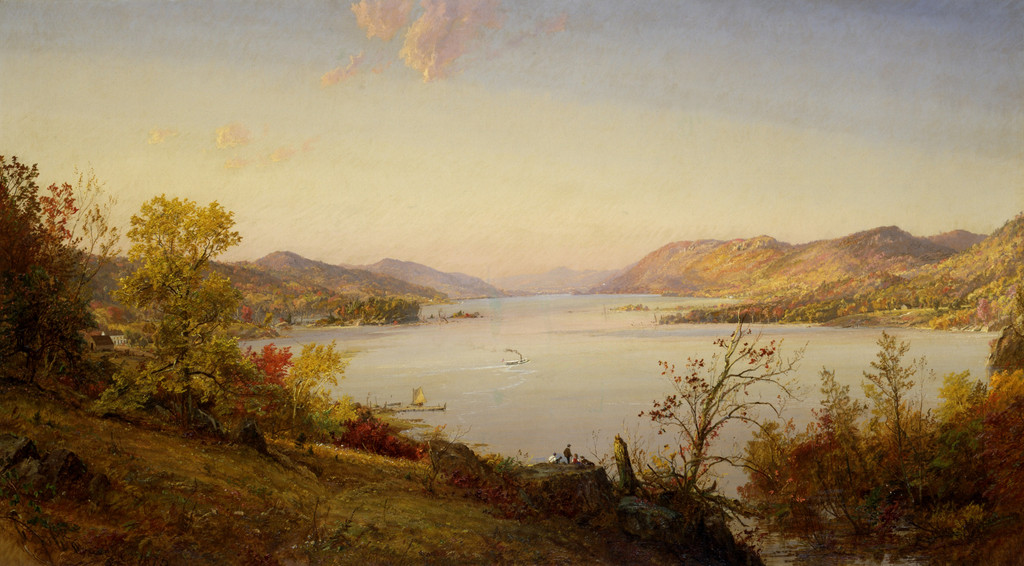
Jasper Francis Cropsey, Greenwood Lake, 1875. Smithsonian American Art Museum, 1967.125. Gift of Ellen R. Wheeler. A different arrangement of near foliage and broad open water in the region Cropsey repeatedly painted. Jasper Francis Cropsey / Smithsonian American Art Museum. Image source. Public domain. Proportionally resized only; full carrier, margins and native appearance retained.
A corrected subject with questions still open
The Met’s current title identifies Sugar Loaf Mountain in Orange County, New York. Maddox’s comparative study gives the historical and visual argument behind that revision. The approximate date, the proposed relation to the smaller 1874 painting and the possible Cooley house should retain their separate degrees of certainty. [1] [2]
The corrected title makes the picture more closely connected to Cropsey’s familiar country. It also makes the act of composition more visible. The rounded peak is a regional subject that has been enlarged in significance, while near architecture and autumn foliage prepare the route toward it. The painting’s particular force comes from how those elements are gathered into one view.
Artworks directory
A selected directory of 18 paintings, two drawings and three architectural projects. Repeated subjects retain distinct object identities. Links lead to a companion article where available, otherwise the consulted institutional record. Unillustrated objects remain searchable; this is not a complete catalogue raisonné.
Frequently Asked Questions
Maddox suggests that resemblance, while leaving the identification qualified. If so, the house was combined with a Sugar Loaf setting in which it could not literally have been seen. [2]
Discussion
Look again at the images and ideas explored in Sugar Loaf Mountain by Jasper Cropsey. These editorial prompts invite your observations.
Reader Insights
How does the pale foreground house balance the central mountain?
Does a corrected title change the way you look at the landscape?
Where can you see the difference between careful observation and composed arrangement?
Join the Conversation
Share a detail, comparison or question about Sugar Loaf Mountain by Jasper Cropsey below.
References
- Metropolitan Museum of Art, Autumn Landscape, Sugar Loaf Mountain, Orange County, New York, accession 61.262. Current title, approximate date, dimensions and acquisition credit. View source
- Kenneth W. Maddox, A Forgotten Mountain: Jasper F. Cropsey’s Paintings of Sugar Loaf, Metropolitan Museum Journal, 35 (2000), pp.221–236. Full comparative argument, earlier title history, regional drawings, proposed sequence and possible Cooley homestead. View source
- Deborah Chotner, Cropsey biography, American Paintings of the Nineteenth Century, Part I, National Gallery of Art (1996), printed pp.109–110. Aladdin construction beginning in 1866 and broader career chronology. View source
- Smithsonian American Art Museum, Greenwood Lake, accession 1967.125. Separate 1875 canvas used for the landscape comparison. View source
- Splash image source.
Jasper Francis Cropsey, Autumn Landscape, Sugar Loaf Mountain, Orange County, New York, about 1870–75. Oil on canvas, 72.4 × 90.2 cm. Metropolitan Museum of Art, 61.262. Purchase, Bertram F. and Susie Brummer Foundation, Inc., Gift, 1961. Jasper Francis Cropsey / The Metropolitan Museum of Art. CC0 / Public domain. Proportionally resized only; full carrier, margins and native appearance retained.
View source