 by Tom Gurney
Tom Gurney BSc (Hons) is an art history expert with over 20 years experience
Email: tomgurney1@gmail.com / Phone: +44 7429 011000
The Valley of Wyoming by Jasper Cropsey: Introduction
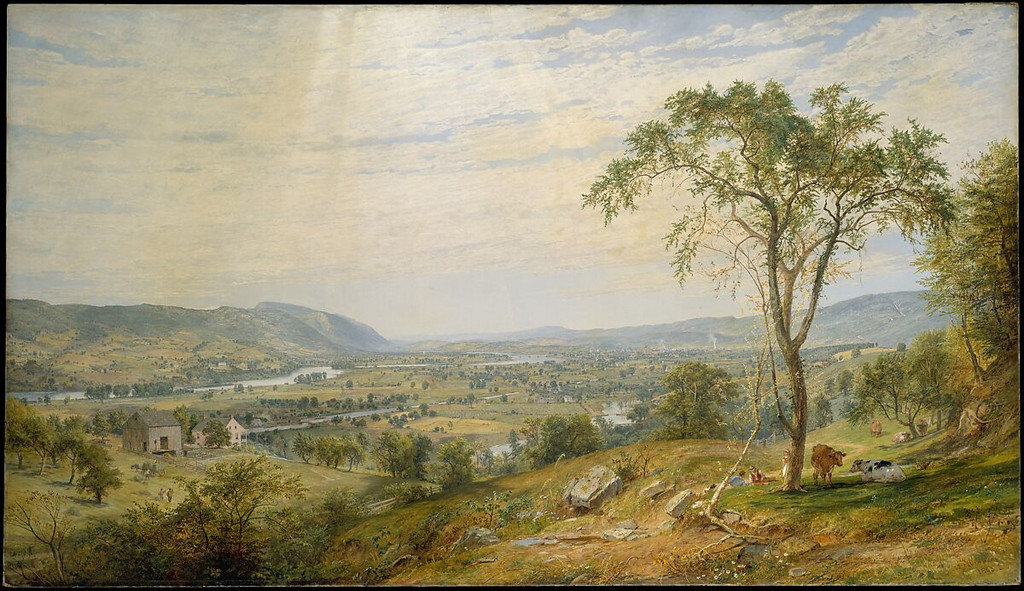
Jasper Cropsey’s The Valley of Wyoming opens from a grassy foreground onto a broad inhabited valley. Painted in 1865, the large oil on canvas measures 123.2 × 213.4 cm and belongs to the Metropolitan Museum of Art, accession 66.113. Its subject is Pennsylvania’s Wyoming Valley, where the commissioner, Milton Courtright, had grown up. [1] [2]
The scene looks peaceful, but its original frame connects the valley to a history of violence through verses from Thomas Campbell’s Gertrude of Wyoming. Cropsey’s choices therefore involve more than selecting a picturesque view. The painting joins a patron’s local memory, a cultivated landscape and a literary account of loss. [1] [2]
At a Glance
- Artist: Jasper Francis Cropsey
- Title: The Valley of Wyoming
- Date: 1865
- Medium: Oil on canvas
- Dimensions: 123.2 × 213.4 cm
- Collection: Metropolitan Museum of Art
- Accession: 66.113
- Acquisition credit: Gift of Mrs. John C. Newington, 1966
- Geographical subject: Wyoming Valley, Pennsylvania
- Commissioner: Milton Courtright
This work across Jasper Cropsey’s career
Contents
- A Pennsylvania panorama
- Tree, cattle and small figures
- Cultivated ground and the winding river
- Milton Courtright’s commission
- Drawings and the smaller oil study
- Campbell’s poem on the original frame
- A pastoral reading and its exclusions
- The date 1865 and the light above the valley
- A comparison with Starrucca Viaduct
- Annotated details
A Pennsylvania panorama
The title names a valley in Pennsylvania. It does not refer to the western state of Wyoming. That geographical distinction is essential to the commission and to the historical poem associated with the frame. [1]
The painting’s horizontal breadth gives the viewer a long sequence of hills, fields, water and settlement. Land rises at either side, while the central distance remains comparatively open. The scene recedes through many small forms rather than one uninterrupted stretch of empty ground.
The nearer slope supplies a clear place from which to look. Rocks and a fallen branch occupy the lower edge, and a tall tree rises at the right. Beyond them, the ground falls away toward buildings and the river.
This change in level makes the view expansive. The foreground feels close enough to enter, while the valley extends beyond it through a much larger set of spaces. Cropsey makes the scale of the country legible through the relation between an immediate bank and a distant horizon.
Annotated Details from The Valley of Wyoming
The numbered points identify visible features discussed in this article. Return from each detail to the whole composition. Jasper Francis Cropsey, The Valley of Wyoming, 1865. Oil on canvas, 123.2 × 213.4 cm. Metropolitan Museum of Art, 66.113. Gift of Mrs. John C. Newington, 1966. This reproduction shows the canvas; the original frame’s poem is discussed from museum and catalogue records. Jasper Francis Cropsey / The Metropolitan Museum of Art,66.113. Image source. CC0 1.0. Separate resized overview with numbered points; details cropped from the original, without recolouring, retouching or enlargement.
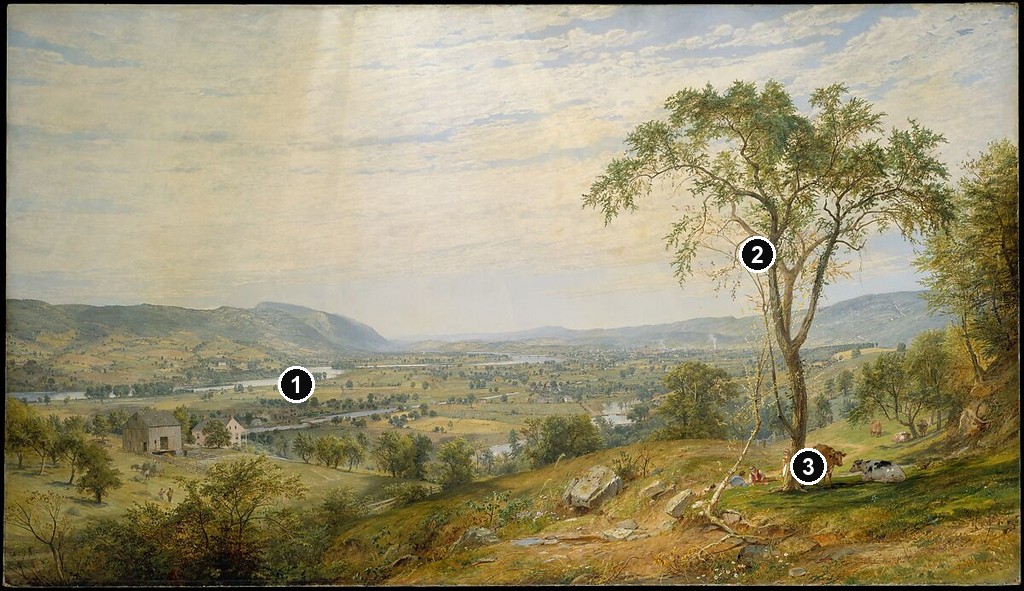
Details from THE VALLEY OF WYOMING
Compare the cropped details with the complete images above. Notice how their colours, shapes and positions contribute to the larger compositions.
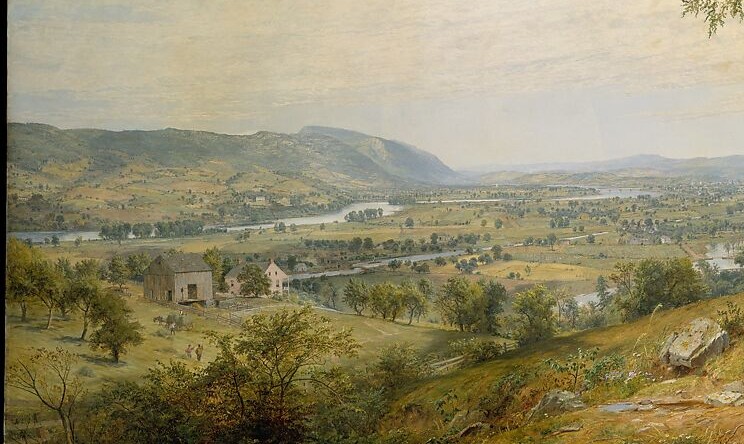
Settlement within the broad valley
Buildings, fields and the winding waterway occupy the valley. The broad native crop preserves their arrangement; it does not identify every small structure.
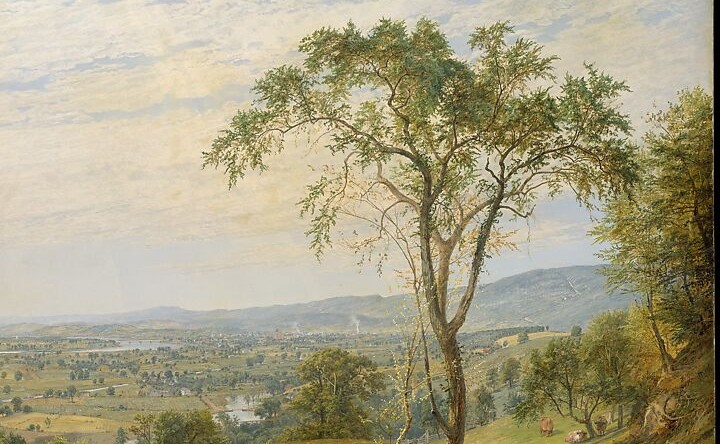
Near tree and distant hills
A large near tree overlaps the distant hills and sky. Its scale establishes the difference between the viewing foreground and the far valley.
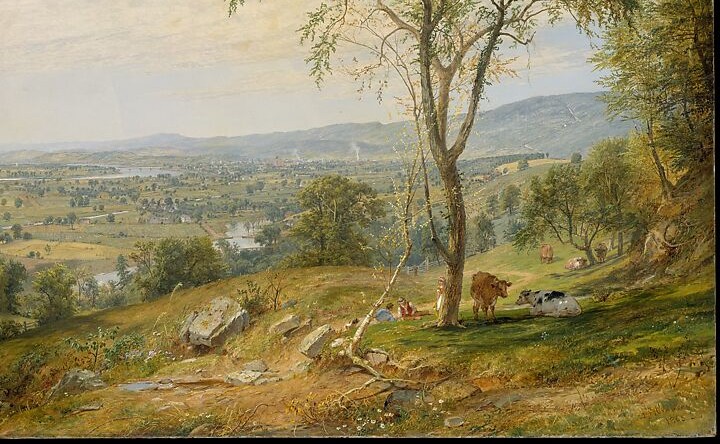
Figures and cattle on the near slope
Small figures and cattle occupy the near sloping ground beneath the tree. Their broad setting remains visible; tiny facial and animal details are not inferred.
Tree, cattle and small figures
The large right-hand tree is the most emphatic vertical in the composition. Its trunk divides into several branches, with an open crown that allows the sky to remain visible through the leaves. It frames the valley without forming a dense barrier across it.
The surrounding ground contains cattle in different positions. A brown animal stands near the trunk, while others rest farther to the right. Their scale supplies another measure of the land, and their ordinary activity contributes to the scene’s calm.
A small group of figures occupies the bank near the tree. They are reduced beside the trunk and the larger country beyond it. Their presence makes the foreground inhabited without turning the panorama into a close portrait of particular people.
The tree’s position connects these near forms to the sky. Its upper branches rise into the large pale field above the valley, while its lower trunk belongs to the grassy slope. It gives the composition a strong joining element between ground and atmosphere.
The rocks and broken wood have a different role. Their irregular edges establish the immediate surface at the viewer’s feet. From that rougher near ground, the eye can move toward the smoother fields and more distant settlement.
Cultivated ground and the winding river
At the left, two near buildings occupy a slope above the water. Their simple, distinct forms create a compact group within the larger landscape. Rows and clusters of trees spread through the country around them.
The river curves across the valley in several passages. Some remain clearly visible, while others are partly interrupted by banks, trees and the changing terrain. It provides a route through the country without becoming a single unbroken strip.
Fields divide the middle distance into different tones. Lighter stretches alternate with darker wooded patches and small structures. This variation keeps the valley active across its width, rewarding a slower movement through the composition.
The land is visibly used. Buildings, grazing animals, fields and river crossings make the scene a settled country. Describing it as uninhabited wilderness would miss much of what Cropsey has included.
The distant hills gradually lose the sharp definition of the nearer ground. Their long silhouettes close the view without blocking its central opening. That softening lets the panorama feel extensive even as the foreground remains comparatively specific.
Milton Courtright’s commission
Carrie Rebora’s catalogue entry dates the commission to early August 1864. Courtright was a civil engineer who later became the first president of the New York Elevated Railroad Company. He had grown up in Plains, Pennsylvania, in this valley. His exact instructions to Cropsey are not known. [2]
The connection with a childhood place helps explain why a landscape could carry personal significance for the patron. A commissioned view could recall familiar country through its main features, while also presenting that country in an attractive, coherent form.
Cropsey made sketches dated 8 and 9 August 1864 from several possible positions. Rebora discusses views from Plains, Prospect Rock and Inman’s Hill, with the last developed into the finished composition through a small oil study. [2]
The process involved selection among viewpoints. The large canvas was not simply the inevitable result of the first scene encountered. Cropsey considered different prospects before giving this particular arrangement of foreground, valley and distance its final breadth.
Drawings and the smaller oil study
The catalogue reproduces Wyoming Valley from Inman’s Hill, a pencil drawing dated 1864 at the Museum of Fine Arts, Boston, accession 1972.761. It also identifies the Met’s smaller Wyoming Valley, Pennsylvania of 1864, accession 25.110.63, as an oil study in the development of the final painting. [2]
Those works are considered here through the published catalogue. The 1864 oil measures 38.1 × 61 cm, considerably smaller than the 1865 canvas illustrated in this article. Their separate dates, sizes and accessions matter whenever a study is reproduced under a similar title. [2]
The relationship provides evidence of preparation without making the final picture a neutral enlargement. Moving from a smaller study to a wide canvas gives more room for near figures, landscape details and the relation of sky to ground. The finished work makes those elements part of a larger encounter.
Campbell’s poem on the original frame
The Met identifies the painting’s original frame as carrying an excerpt from Thomas Campbell’s Gertrude of Wyoming, published in 1809. The poem recalls the violence in the valley in 1778 during the American Revolution. The frame brings that history to a landscape whose painted surface contains no battle. [1]
Rebora discusses the selected verses in relation to the poem’s fuller story of love, warning and loss. She argues that Cropsey emphasised its pastoral passages while leaving much of the conflict outside the picture and chosen text. The interpretation concerns selection, rather than evidence that the valley lacked a violent history. [2]
The frame therefore changes the experience of looking. A viewer who reads the verses encounters memory alongside the broad fields and quiet cattle. The landscape’s present calm becomes connected to an earlier account of destruction.
The artwork image reproduced here shows the canvas and its photographed edge, rather than a legible view of the inscribed frame. The frame’s text and significance are discussed from the museum record and catalogue, not deciphered from this reproduction.
Watch: Jasper Cropsey
Look closely at Cropsey’s Mount Jefferson, then explore the wider Hudson River School tradition.
Summer or Autumn? Picturing the American Republic
Smarthistory discusses Cropsey’s seasonal landscape and the image of the American republic.
Watch on YouTubeA pastoral reading and its exclusions
Rebora’s interpretation asks what the peaceful arrangement leaves out. In her discussion, the patron’s memories and Cropsey’s picturesque choices shape a scene that makes the valley bright, habitable and optimistic. The poem’s wider conflict provides a different history alongside that visual pleasure. [2]
This reading does not require the painting to be dismissed as an inaccurate map. It asks how observed material was selected and presented. A river, a house or a hill can refer to a real place while being given a particular emotional and narrative role.
The foreground exemplifies that choice. Cattle rest or graze beside a small group; the tall tree offers a clear frame; the ground opens smoothly toward the country beyond. These forms invite an experience of continuity rather than showing signs of immediate danger.
The earlier history can still enter through the frame and sources. Reading the work together with those records makes its calm a question worth considering: is the view a recovery, a comforting memory, a selective account, or some combination of them?
The date 1865 and the light above the valley
The painting was completed in time for the National Academy of Design’s spring 1865 exhibition, according to Rebora. The Met’s current interpretation connects its completion as the Civil War ended with a remembrance of national tragedies and an optimistic pastoral and industrial future. That broader meaning is the museum’s reading of the work. [2] [1]
Light descends through the broad sky in pale passages. It gives the upper field variation and keeps the valley illuminated without concentrating the picture into one theatrical flash. The tall tree remains clear within that atmosphere.
Those visible rays can support a sense of openness or blessing for a viewer, but they do not establish a universal response. The museum’s providential interpretation and a reader’s direct visual experience remain related, distinct ways of understanding the light.
A comparison with Starrucca Viaduct
Starrucca Viaduct, also dated 1865, belongs to the Toledo Museum of Art. It gives a railway a visible place within an autumn valley. The train, bridge, settlement and foreground viewers create a different structure of modern activity from the Met panorama. [3]
In The Valley of Wyoming, the river and cultivated fields organise much of the distance. In the Toledo painting, the long railway crossing introduces another horizontal route. Both show inhabited country, but they distribute movement and attention differently.
Rebora connects the two works through a discussion of patrons and pastoral landscapes. Courtright’s engineering career gives that comparison historical weight without proving that every picturesque feature functions as an industrial symbol. [2]
The whole-painting comparison is most useful when those differences stay visible. One landscape recalls a patron’s childhood valley and includes a literary frame; the other makes a moving train part of a composed scenic view. Their shared date does not make their meanings identical.
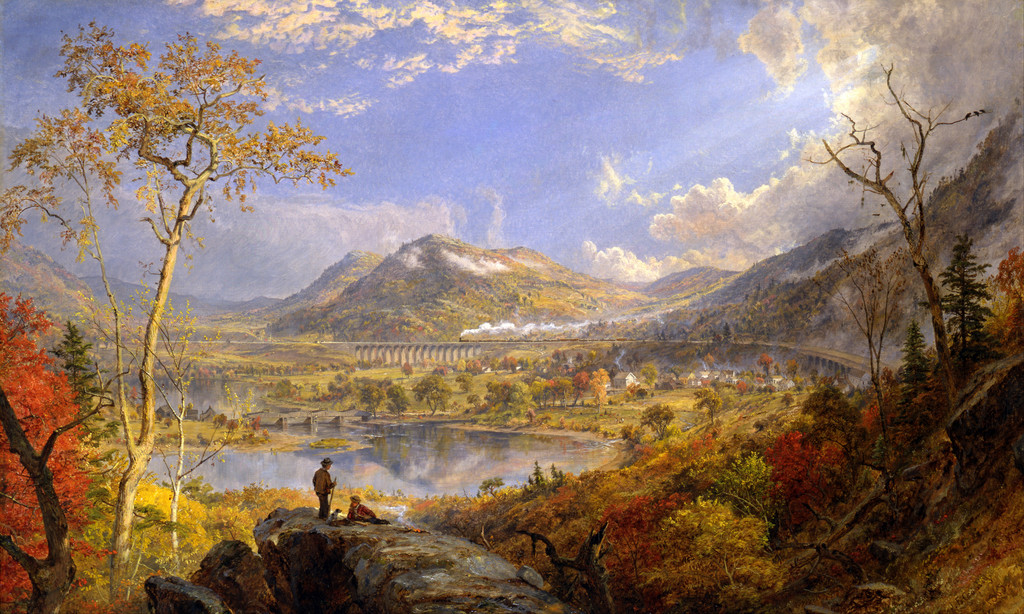
Jasper Francis Cropsey, Starrucca Viaduct, Pennsylvania, 1865. Toledo Museum of Art, 1947.58. Purchased with funds from the Florence Scott Libbey Bequest in Memory of her Father, Maurice A. Scott. Jasper Francis Cropsey / Toledo Museum of Art, via Google Art Project. Image source. Public domain. Proportionally resized only; full carrier, margins and native appearance retained.
The Met canvas
The Met acquired the large painting as the Gift of Mrs. John C. Newington in 1966. Accession 66.113 identifies it independently of the smaller study and other Wyoming subjects. [1]
Its breadth allows quiet details to carry a substantial argument. A near tree and cattle establish ordinary life; buildings and fields extend it into the valley; the river leads the eye onward. The original frame connects that generous view with a memory of loss, making the landscape a place where personal recollection and historical interpretation meet.
Artworks directory
A selected directory of 18 paintings, two drawings and three architectural projects. Repeated subjects retain distinct object identities. Links lead to a companion article where available, otherwise the consulted institutional record. Unillustrated objects remain searchable; this is not a complete catalogue raisonné.
Frequently Asked Questions
No. Rebora identifies a 38.1 × 61 cm oil study, accession 25.110.63, separately from the 123.2 × 213.4 cm final 1865 canvas, 66.113. [2]
Discussion
Look again at the images and ideas explored in The Valley of Wyoming by Jasper Cropsey. These editorial prompts invite your observations.
Reader Insights
How do the near tree and cattle shape your first impression of the valley?
What changes when the poem on the frame enters the reading?
Where does the scene’s calm feel observed, arranged or remembered?
Join the Conversation
Share a detail, comparison or question about The Valley of Wyoming by Jasper Cropsey below.
References
- Metropolitan Museum of Art, The Valley of Wyoming, accession 66.113. Exact 1865 canvas, gift, original frame and present curatorial interpretation; record reconsulted 8 October 2026. View source
- Carrie Rebora, The Valley of Wyoming, American Paradise: The World of the Hudson River School, Metropolitan Museum of Art (1987), printed pp.208–210. Courtright commission, August 1864 drawings, smaller oil study, Campbell verse selection, exhibition and critical pastoral reading. Original poem and archival records considered through this catalogue. View source
- Toledo Museum of Art, Starrucca Viaduct, Pennsylvania, accession 1947.58. Separate 1865 painting used for the railway-landscape comparison. View source
- Splash image source.
Jasper Francis Cropsey, The Valley of Wyoming, 1865. Oil on canvas, 123.2 × 213.4 cm. Metropolitan Museum of Art, 66.113. Gift of Mrs. John C. Newington, 1966. This reproduction shows the canvas; the original frame’s poem is discussed from museum and catalogue records. Jasper Francis Cropsey / The Metropolitan Museum of Art,66.113. CC0 1.0. Proportionally resized only; full carrier, margins and native appearance retained.
View source