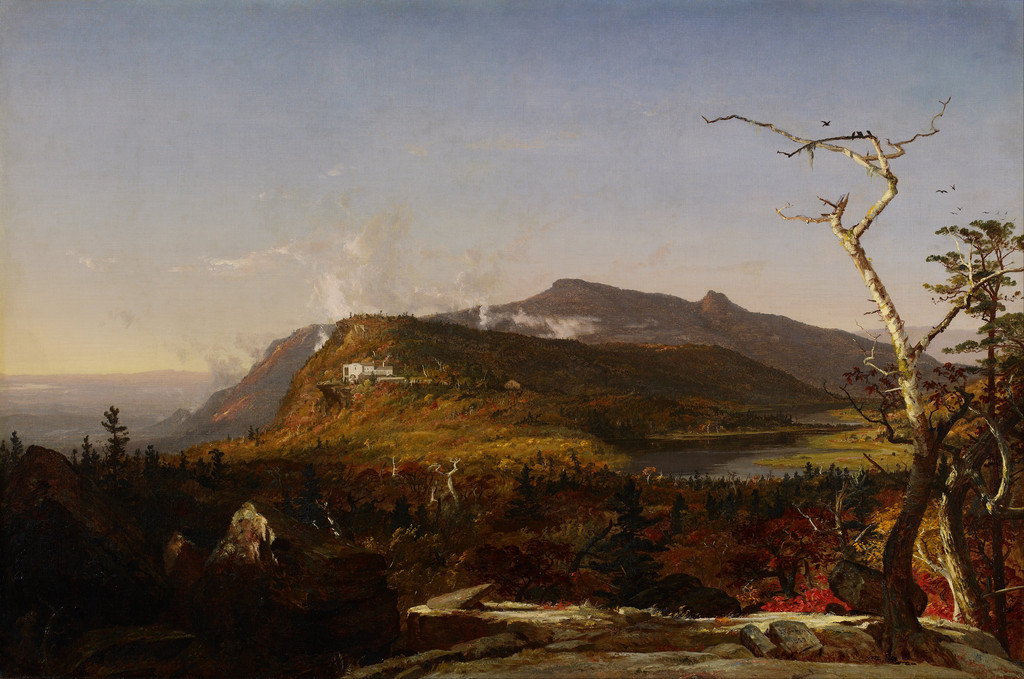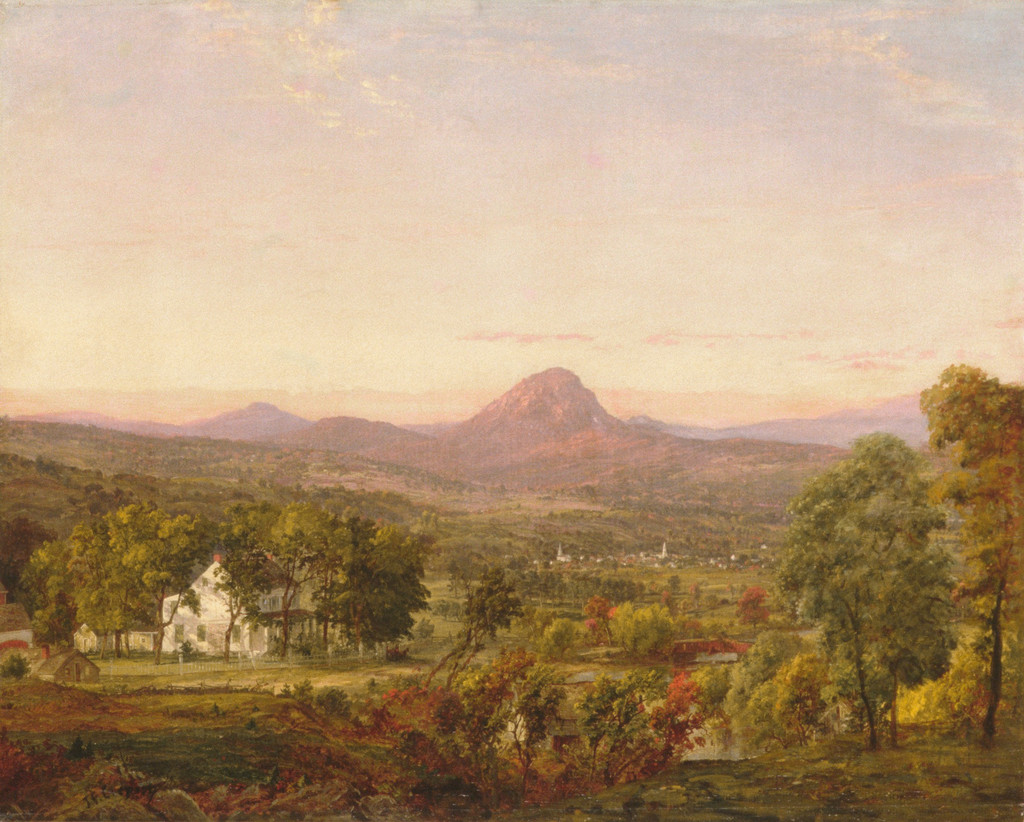
 by Tom Gurney
Tom Gurney BSc (Hons) is an art history expert with over 20 years experience
Email: tomgurney1@gmail.com / Phone: +44 7429 011000
Autumn—On the Hudson River by Jasper Cropsey: Introduction
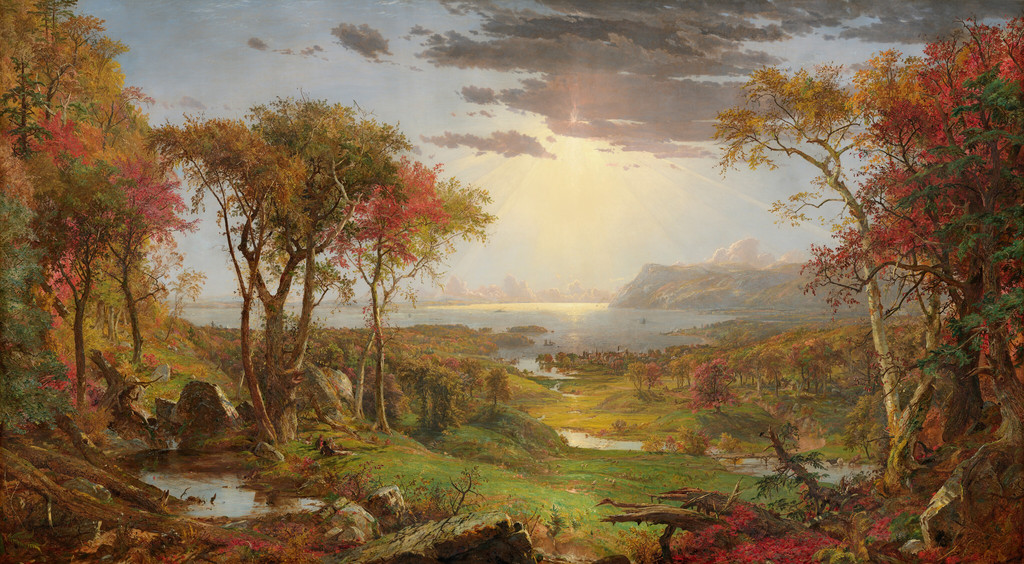
Jasper Cropsey’s Autumn—On the Hudson River opens between tall coloured trees onto a wide river distance. Painted in London in 1860, the oil on canvas measures 151.8 × 274.9 cm and belongs to the National Gallery of Art, Washington, accession 1963.9.1. Its ambitious scale allows individually varied foliage, small human activity and a broad atmosphere to occupy the same view. [1] [2]
The picture became a prominent example of Cropsey’s American autumn for a British audience. Deborah Chotner’s catalogue entry discusses its exhibitions, favourable response and the question some viewers raised about the vivid colours. That history joins the painting’s physical breadth with a particular encounter between an American subject and its presentation abroad. [2]
At a Glance
- Artist: Jasper Francis Cropsey
- Title: Autumn—On the Hudson River
- Date: 1860
- Medium: Oil on canvas
- Dimensions: 151.8 × 274.9 cm
- Collection: National Gallery of Art, Washington
- Accession: 1963.9.1
- Acquisition credit: Gift of the Avalon Foundation
- Place of execution: London
- Geographical setting: West bank of the Hudson near New Windsor and the Moodna
This work across Jasper Cropsey’s career
Contents
- London and an American landscape
- Coloured trees and the central opening
- Pond, figures and near ground
- The Moodna, New Windsor and the Hudson
- Light across the sky and water
- British response and the leaf samples
- Studio display, Pall Mall and the court
- A proposed engraving and repeated subjects
- What the 1996 examination records
- Annotated details
London and an American landscape
Chotner places the canvas’s completion in early spring 1860, during Cropsey’s London residence. The work took at least a year to develop. The artist was presenting remembered and studied American country to an audience across the Atlantic rather than finishing a large canvas beside the Hudson itself. [2]
Its inscription includes London and the year 1860. Those particulars give the painting a place of execution distinct from its geographical subject. The distinction is useful because the image’s detailed appearance can otherwise encourage an assumption that everything was painted in one session before the scene. [2]
The extended process allowed Cropsey to assemble a panorama from material gathered through earlier observation. Chotner discusses a related pencil study whose notes refer to an elm recorded in a White Mountains notebook. A particular American tree study could therefore enter a wider Hudson composition. [2]
The picture’s coherence comes from how those elements are arranged together. Near trees, lower water, fields and the river distance share one distribution of light. Their relationship within the finished canvas matters alongside the histories of the individual studies.
Annotated Details from Autumn—On the Hudson River
The numbered points identify visible features discussed in this article. Return from each detail to the whole composition. Jasper Francis Cropsey, Autumn—On the Hudson River, 1860. Oil on canvas, 151.8 × 274.9 cm. National Gallery of Art, Washington, 1963.9.1. Gift of the Avalon Foundation. Painted in London. Jasper Francis Cropsey / National Gallery of Art, Washington. Image source. CC0 / Public domain. Separate resized overview with numbered points; details cropped from the original, without recolouring, retouching or enlargement.
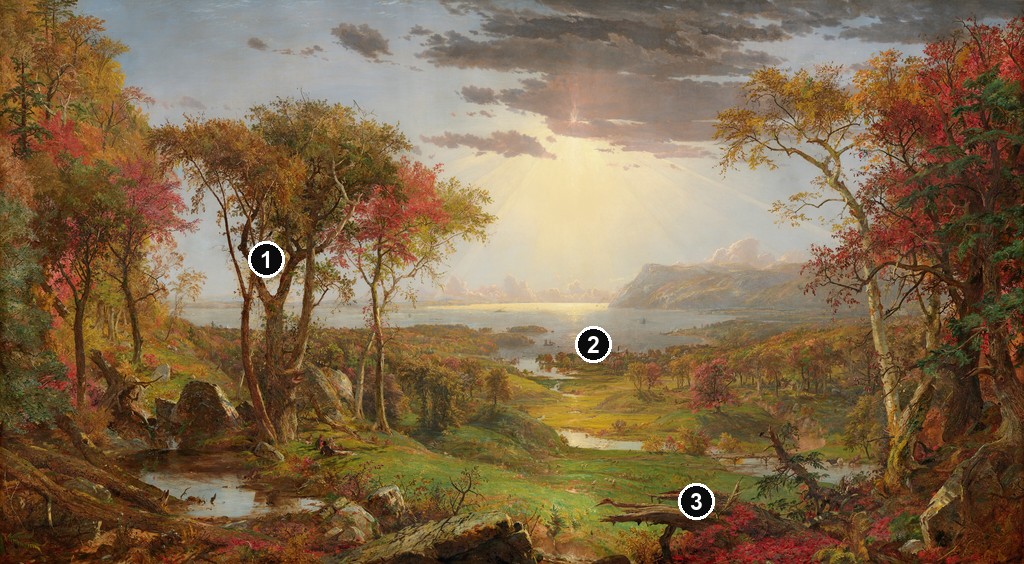
Details from AUTUMN—ON THE HUDSON RIVER
Compare the cropped details with the complete images above. Notice how their colours, shapes and positions contribute to the larger compositions.
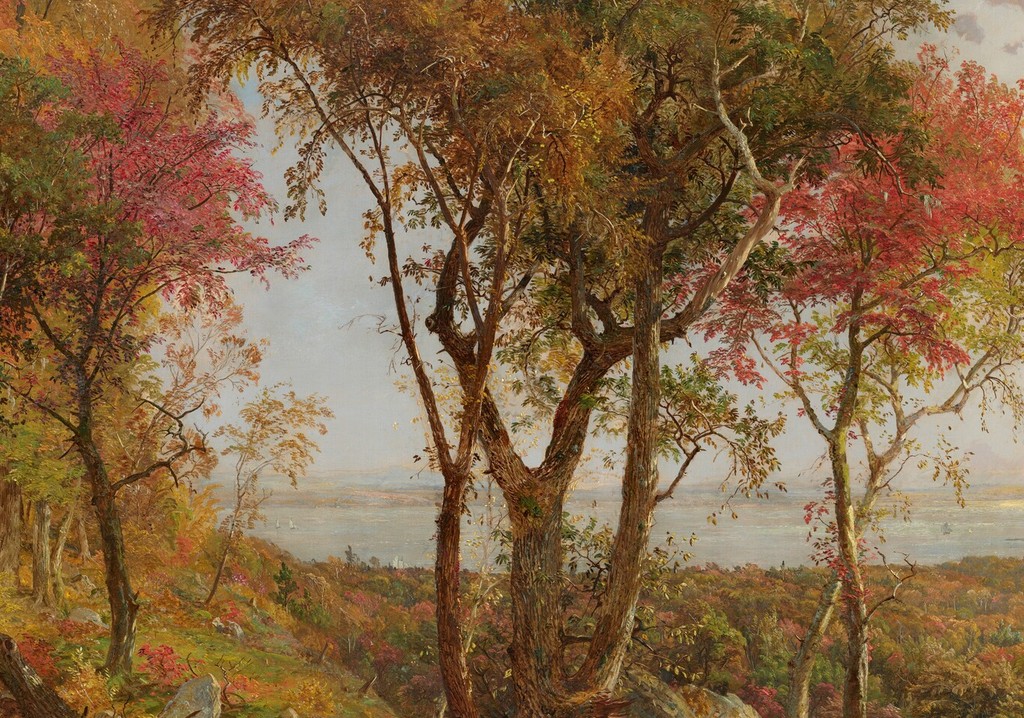
Trees framing the open river
Branching near trees and patches of red, yellow and green foliage enclose the brighter river. Their large scale helps distinguish the wooded foreground from the distant view.
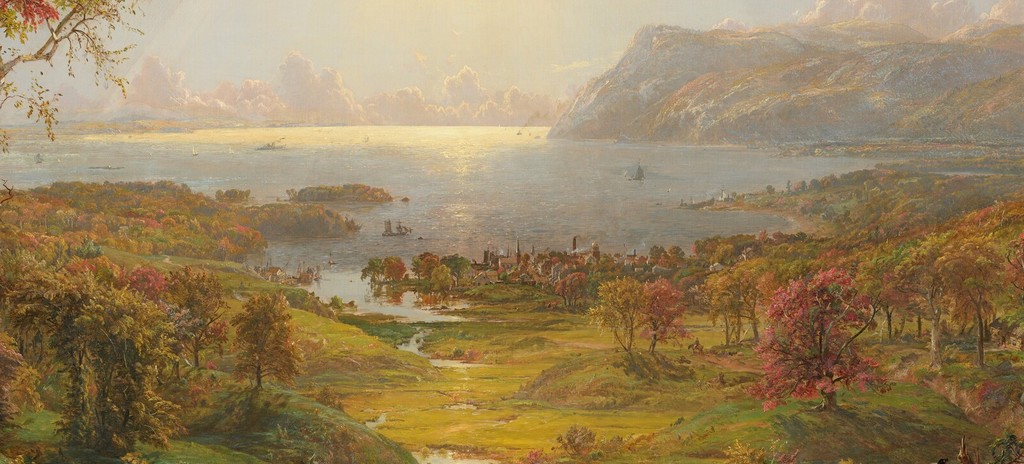
River, settlement and distant ridge
The river, small buildings and distant ridge occupy the central opening. Their reduced scale contrasts with the large trees at the edges.
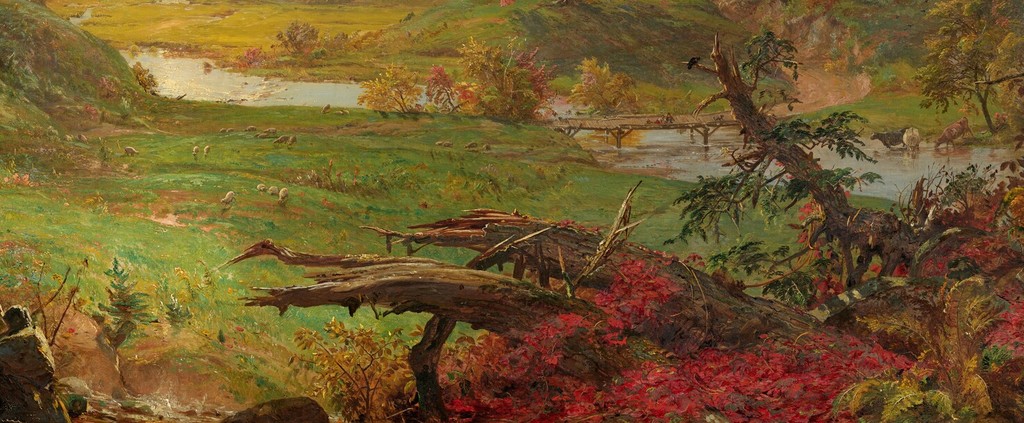
Water and fallen wood in the foreground
Near water, a small crossing and fallen timber carry the eye back into the foreground. Irregular wood and red vegetation interrupt the wider calm panorama.
Coloured trees and the central opening
The foreground trees form an extensive frame rather than a narrow border. Their trunks rise through much of the picture’s height, and their crowns carry reds, yellows, browns and remaining greens. They give the viewer substantial near forms before the river appears beyond them.
The two sides are unequal. At the left, several trunks and overlapping crowns gather into a dense wooded mass. At the right, pale trunks stand beside especially strong red foliage and rocky ground. The differences keep the framing alive across the width.
Individual trees retain distinct outlines within those larger groups. Some branches are relatively open; others support thicker crowns. The painting’s colour therefore depends on several related shapes, rather than one evenly applied band of autumn red.
Between the groups, the land opens toward the Hudson. The brighter central interval draws attention outward from the darker trunks. Cropsey makes the river distance feel discovered within the foreground country rather than placed beyond an unrelated decorative frame.
The coloured leaves also establish the scale of the distance. Their near texture is more readily separated than the trees along the far shore. As the eye moves outward, the same broad material becomes a softer and more continuous landscape field.
Pond, figures and near ground
A small pond occupies the left foreground beneath the trees. Its darker reflection and irregular edge give it a different character from the wide river beyond. It belongs to the near wooded ground, where roots, stones and fallen timber remain individually prominent.
Small human figures occupy this intimate part of the scene. Chotner describes the foreground group as hunters resting beneath the trees. Their scale gives the near landscape a place for human life without making those people the principal subject. [2]
The pond and figures slow the viewer’s movement. The larger river distance is immediately inviting, but the foreground offers other forms to register before looking outward. A dark pool, a pale stone and a branching trunk each occupy a different kind of space.
At the lower right, broken wood and exposed rock give the bank a rough surface. Their irregular shapes contrast with the gentler cultivated country farther away. Cropsey lets the near ground remain varied rather than smoothing the whole landscape into one idealised field.
This foreground also makes the view accessible. The viewer is given a position among recognisable natural forms, with human activity at a similar distance. The panorama beyond feels large partly because it begins from that comparatively intimate place.
The Moodna, New Windsor and the Hudson
Chotner discusses an early exhibition explanation, presumed to have been written by Cropsey. It identifies a west-bank view looking down the Hudson, between Newburgh and West Point, with the Moodna leading toward partly hidden New Windsor. The original printed explanation is considered here through the catalogue’s transcription. [2]
The geography gives the broad scene a more particular association. The river is reached through an inhabited stretch of country, with a smaller stream and cultivated land between the near trees and wider water.
The catalogue identifies the strong profile of Storm King Mountain at the right of the distance. Its height interrupts the river’s outward opening, while the water continues toward a much lighter horizon farther left. The identification belongs to the scholarly account rather than an exact modern route or camera coordinate supplied here. [2]
In the image, buildings, fields and small craft make the country visibly occupied. The scene’s breadth should not erase those signs of use. The river connects different parts of the landscape, and its scale allows distant activity to remain small within the whole.
The near-to-far progression also depends on colour. Strong reds and darker greens surround the viewer; more muted warm tones gather across the middle ground; the far water and hills become paler. Cropsey makes the autumn colour part of the painting’s depth as well as its seasonal identity.
Light across the sky and water
A broad light opening occupies the sky above the river. Darker cloud passages gather across the upper field, while pale rays extend toward the horizon. The change in atmosphere leads the eye outward without reducing the sky to one uniform colour.
The foreground trees meet that atmosphere in different ways. Dark trunks remain sharply distinct against lighter passages, while some upper foliage approaches the warmer cloud colours. The sky and leaves share a range of light without becoming the same material.
Cropsey’s 1855 essay Up among the Clouds asks artists to attend to “luminous, palpitating air.” The words come from the original essay, published five years before this canvas. They offer a useful statement of an interest in atmospheric depth and variation, without functioning as instructions for this individual painting. [3]
The early exhibition explanation described an October afternoon around three o’clock. That account is part of the picture’s historical presentation; the time is not independently calculated from the digital image. Chotner uses it to discuss the warm, extensive atmosphere Cropsey wanted viewers to recognise. [2]
British response and the leaf samples
Chotner discusses a reception in which critics could praise both poetic imagination and fidelity to nature. The strong red and gold foliage raised doubts among some British viewers, while travellers familiar with American autumn supported the colours’ plausibility. The question centred on a season experienced differently across the Atlantic. [2]
The catalogue reports tangible leaf samples pasted to cardboard, citing a review in The Guardian dated 6 June 1860 through Talbot’s scholarship. That is the documented form of the leaf story used here. The original newspaper has not been independently consulted for this article. [2]
The samples addressed a specific issue: whether the colours could belong to observed American foliage. They do not prove that every tree, cloud and building in the panoramic composition occupied exactly its painted position at one moment.
This distinction connects the reception with the painting’s construction. A carefully observed leaf can be part of a deliberately arranged landscape. Cropsey’s work could present accurate particulars within a view organised for breadth, atmosphere and emotional effect.
The record does not require a story in which Queen Victoria rejected the colours and Cropsey then demonstrated them to her with leaves. The catalogue treats the 1860 leaf report and the later court presentation as separate events. Combining them into a single dramatic encounter would exceed its evidence.
Watch: Jasper Cropsey
Look closely at Cropsey’s Mount Jefferson, then explore the wider Hudson River School tradition.
Summer or Autumn? Picturing the American Republic
Smarthistory discusses Cropsey’s seasonal landscape and the image of the American republic.
Watch on YouTubeStudio display, Pall Mall and the court
Cropsey first showed the large work in his London studio. Chotner discusses its later Pall Mall presentation and its inclusion in the London international exposition of 1862. The canvas’s scale suited a prominent public encounter rather than a small incidental display. [2]
The catalogue compares this ambition with the attention Frederic Edwin Church’s large landscapes had received in London. It presents Church’s success as a possible influence on Cropsey’s undertaking, not as a documented instruction from one artist to the other. [2]
Cropsey gathered favourable press notices into a pamphlet. The recognition culminated in his presentation to Queen Victoria on 27 June 1861. The event identifies the artist’s growing public standing; it should not be confused with the date the painting was completed. [2]
The studio showing also should not automatically be described as a paid-admission event. Chotner notes no evidence that Cropsey followed the fee-charging practice used for some other large landscape displays. The known exhibition sequence is substantial enough without supplying a ticket price.
A proposed engraving and repeated subjects
The catalogue records that Cropsey sold engraving rights to Messrs. Thompson and Company on 7 July 1860. Subscription forms survive in the archival material discussed there, but no resulting print had been found. A planned reproduction therefore should not be presented as a securely published engraving. [2]
That distinction is especially useful for an image with several related titles and studies. Chotner mentions smaller works associated with the subject but leaves their locations and exact relationships incompletely resolved. A repeated title alone cannot establish that a reproduction shows this large NGA canvas. [2]
The firm identifiers are the date 1860, the London inscription, the dimensions and accession 1963.9.1. They allow a reader to connect exhibition and collection references without confusing the canvas with a small study or another Hudson autumn.
What the 1996 examination records
The catalogue’s technical entry describes a lined plain-weave canvas with a very thin whitish ground. It records washes of colour followed by thicker applications, with numerous impasto passages particularly in the foliage. These are findings published in 1996, not a new examination for this article. [2]
The entry also notes that some raised paint had been flattened, probably through lining, and records a restoration in 1986. Such observations concern the individual object and its treatment history. They should not become a universal account of how every Cropsey autumn was made. [2]
The technical evidence adds a different scale of understanding to the whole view. The broad reproduction reveals the arrangement of tree groups, water and light; the published examination explains aspects of the layers and recorded surface. Each answers a different question about the painting.
An autumn comparison with Starrucca
The Toledo Museum of Art’s Starrucca Viaduct of 1865 offers a related but different panorama. There, a railway crossing and moving train occupy the farther valley, while two foreground figures look into the scene. The museum emphasises the visual relationship between train smoke and clouds. [4]
Both paintings give near trees a strong framing role and make distant activity small within an extensive country. Their routes through the view differ: the Hudson picture opens toward broad water and a light horizon; Starrucca develops a valley in which railway and river create separate paths.
The comparison prevents autumn colour from becoming the only subject noticed in Cropsey’s work. Red and gold foliage participates in several kinds of composition. It can lead toward a wide river, frame a technological crossing or give a particular mountain greater presence.
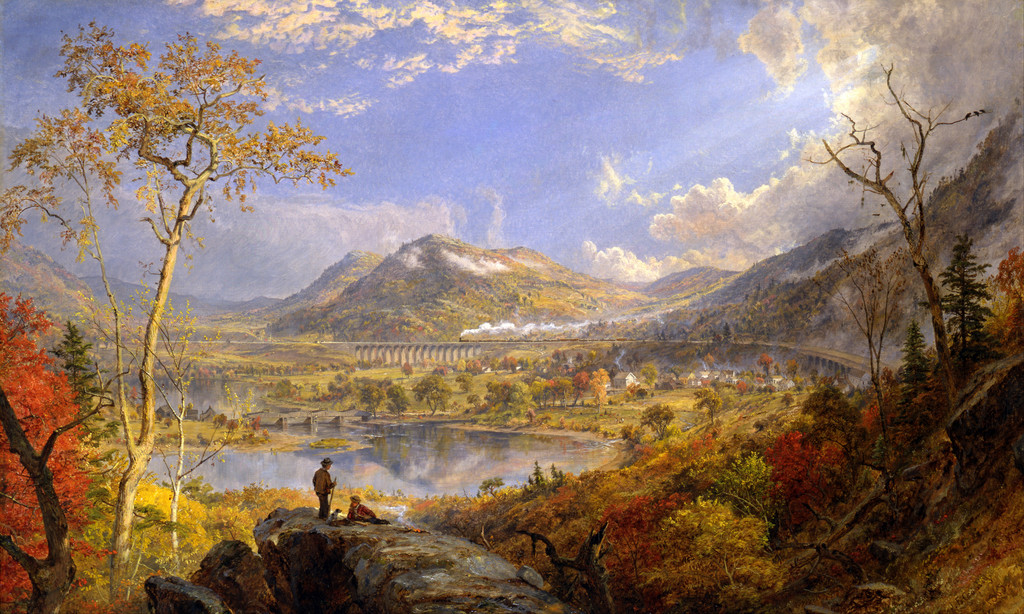
Jasper Francis Cropsey, Starrucca Viaduct, Pennsylvania, 1865. Toledo Museum of Art, 1947.58. A different autumn panorama, with a railway crossing in the distance. Jasper Francis Cropsey / Toledo Museum of Art, via Google Art Project. Image source. Public domain. Proportionally resized only; full carrier, margins and native appearance retained.
The NGA canvas
The painting entered the NGA through the Gift of the Avalon Foundation. Its accession identifies the large London-made canvas that established such a prominent public encounter with American autumn. [1]
The picture rewards movement between scales. Near bark, roots and water offer particular forms; fields and buildings extend the inhabited country; the Hudson and sky open toward a much larger distance. Its achievement lies in how those experiences share one coherent field, making the vivid foreground part of the panorama’s atmosphere and breadth.
Artworks directory
A selected directory of 18 paintings, two drawings and three architectural projects. Repeated subjects retain distinct object identities. Links lead to a companion article where available, otherwise the consulted institutional record. Unillustrated objects remain searchable; this is not a complete catalogue raisonné.
Frequently Asked Questions
The canvas was completed in London in early spring 1860. Its American subject draws on landscape material Cropsey had gathered earlier. [2]
Chotner reports leaves pasted to cardboard, citing a Guardian review dated 6 June 1860 through Talbot. Her account keeps that report separate from Cropsey’s presentation to Queen Victoria on 27 June 1861. [2]
The catalogue records the sale of engraving rights and surviving subscription forms, but no identified resulting print. The proposal should remain distinct from a confirmed publication. [2]
Discussion
Look again at the images and ideas explored in Autumn—On the Hudson River by Jasper Cropsey. These editorial prompts invite your observations.
Reader Insights
Which near tree group most strongly frames your view of the river?
How do the small signs of habitation affect the panorama’s character?
What changes when vivid local detail is understood as part of a composition made in London?
Join the Conversation
Share a detail, comparison or question about Autumn—On the Hudson River by Jasper Cropsey below.
References
- National Gallery of Art, Autumn—On the Hudson River, accession 1963.9.1. Exact 1860 object, dimensions and Avalon Foundation gift. View source
- Deborah Chotner, Autumn—On the Hudson River, American Paintings of the Nineteenth Century, Part I, National Gallery of Art (1996), printed pp.118–122. London production, study material, geography, historical presentation, leaf report, court date, proposed engraving and dated technical findings; archival and newspaper material considered through this catalogue. View source
- J. F. Cropsey, Up among the Clouds, The Crayon, II, no. VI, 8 August 1855, pp.79–80. Short quotation on p.79 checked against the actual original page; complete essay consulted. View source
- Toledo Museum of Art, Starrucca Viaduct, Pennsylvania, accession 1947.58. Separate 1865 composition used for the autumn and infrastructure comparison. View source
- Splash image source.
Jasper Francis Cropsey, Autumn—On the Hudson River, 1860. Oil on canvas, 151.8 × 274.9 cm. National Gallery of Art, Washington, 1963.9.1. Gift of the Avalon Foundation. Painted in London. Jasper Francis Cropsey / National Gallery of Art, Washington. CC0 / Public domain. Proportionally resized only; full carrier, margins and native appearance retained.
View source