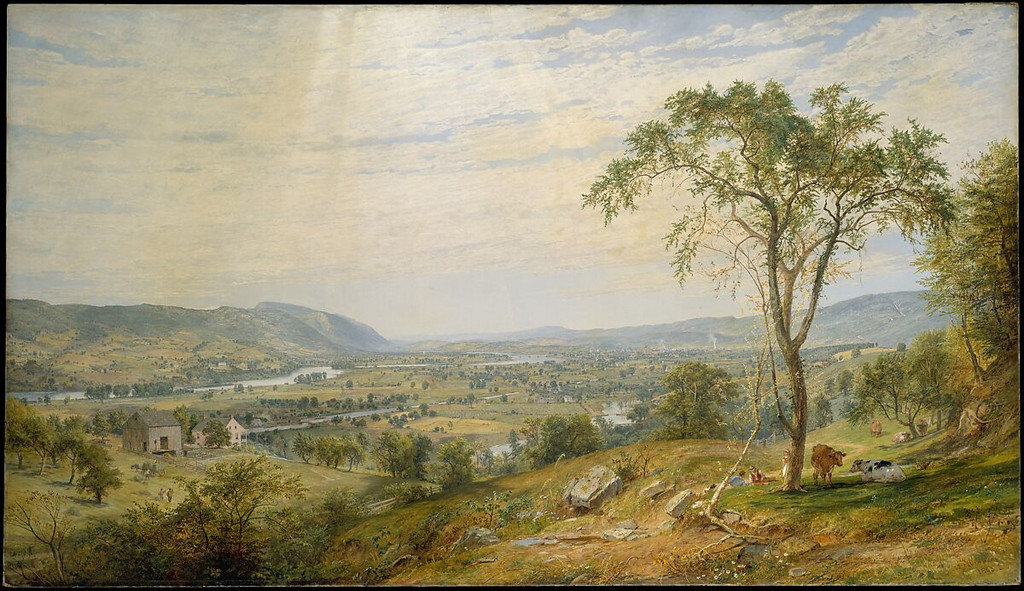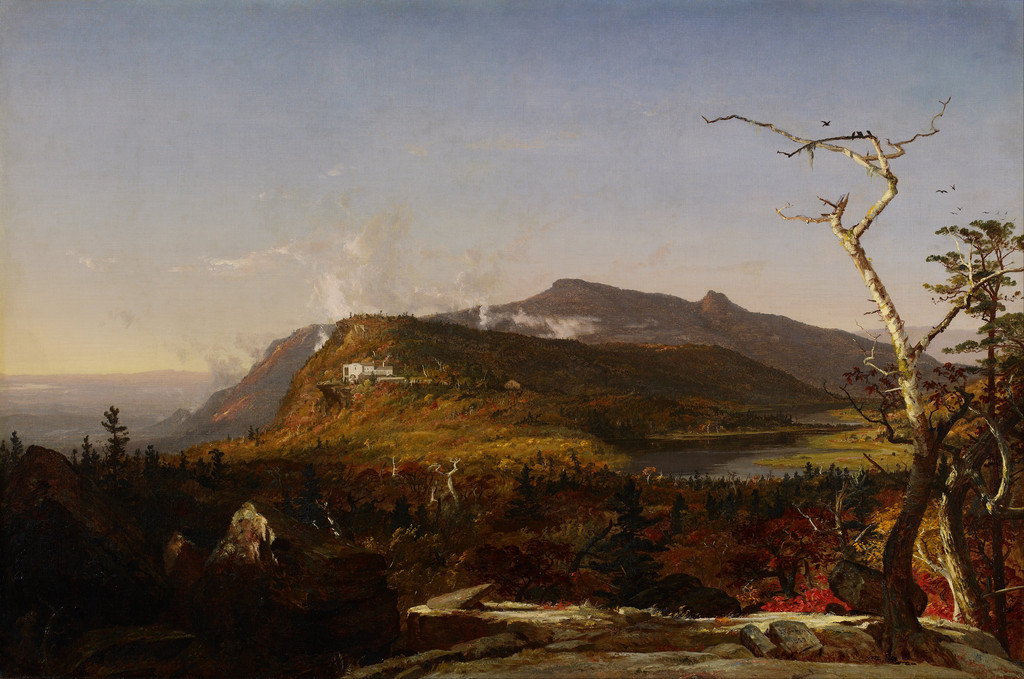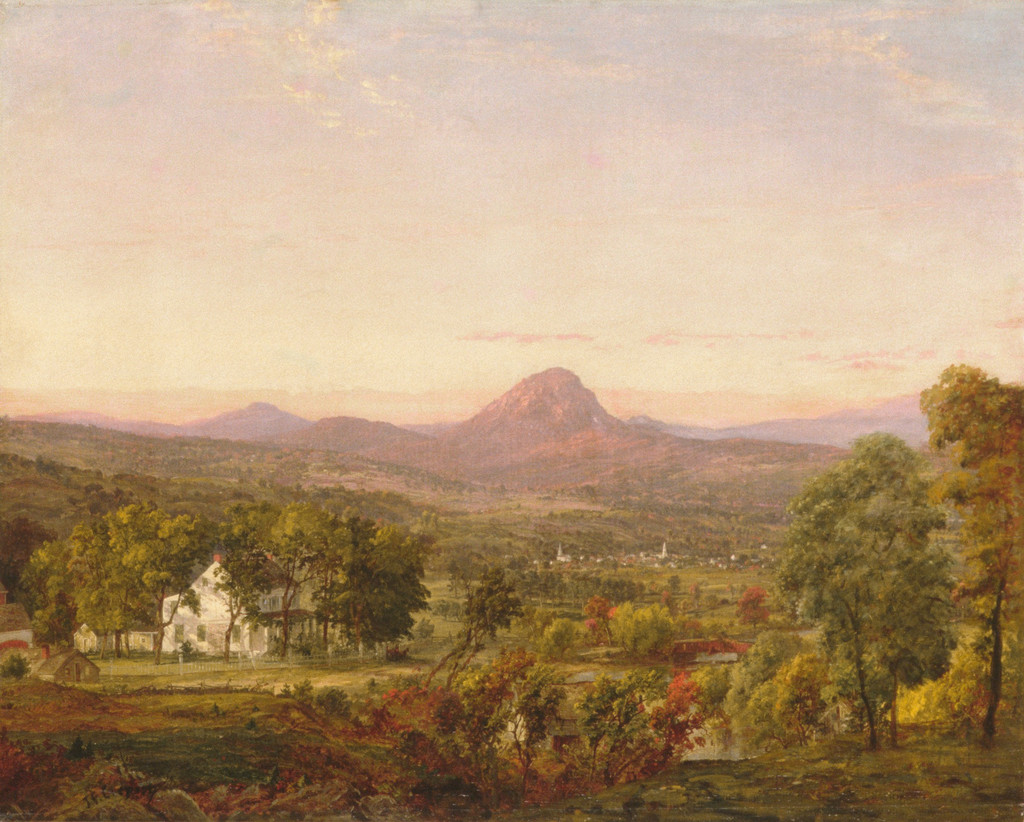
 by Tom Gurney
Tom Gurney BSc (Hons) is an art history expert with over 20 years experience
Email: tomgurney1@gmail.com / Phone: +44 7429 011000
Jasper Cropsey Drawings and Watercolours: Introduction
Paper work runs through Jasper Cropsey’s career, from architectural renderings and early lessons to outdoor studies, album drawings and later watercolours. It supplied ways of learning, recording and arranging a view before or alongside painting in oil. The record is more varied than a simple sequence in which every sheet became one finished canvas. [3] [5]
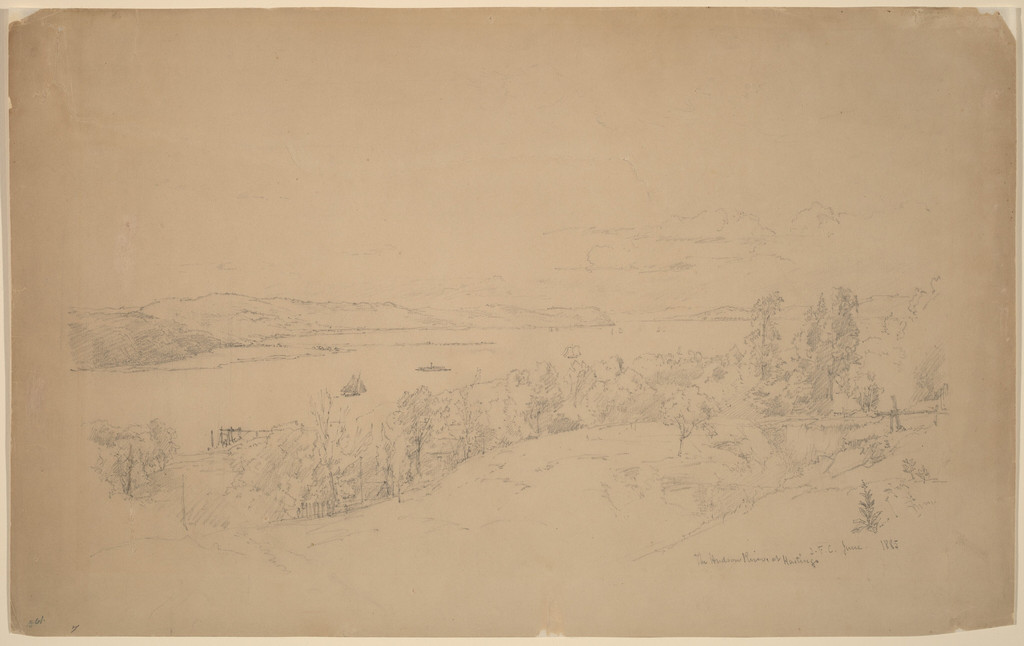
Two illustrated examples make that range tangible. The faint graphite Hudson River at Hastings records a river scene in June 1885. The Met’s small Torre dei Schiavi album drawing combines several materials on dark buff paper, with a moon and ruin contributing to a more shaped evening subject. Both deserve attention as individual works on paper. [1] [2]
Selected Cropsey drawings
At a Glance
- Artist: Jasper Francis Cropsey, 1823–1900
- Early training: Architectural rendering and lessons in watercolour
- Illustrated graphite: Hudson River at Hastings, June 1885
- Illustrated album sheet: Torre dei Schiavi, Met 1970.9.26 recto
- Date distinction: Torre catalogue 1853; visible inscription 1849
- Documented painting study: Warwick Castle Moat, 30 September 1856, discussed through Chotner
- Society role: Founder of the American Society of Painters in Watercolor in 1867
- Later practice: Increased watercolour work after the 1893 stroke
Contents
- Learning through drawing
- Outdoor material and the finished picture
- A faint river drawing at Hastings
- An album sheet from the Roman subject
- Warwick: a documented relationship
- Wyoming and a commissioned prospect
- A close woodland study in oil
- Watercolour before the late years
- Looking at the sheet as an object
- Annotated details
Learning through drawing
Cropsey’s apprenticeship with Joseph Trench began in 1837. Chotner records that his skill led to responsibility for nearly all the office’s finished renderings after eighteen months. Drawing was therefore a sustained working practice before he became publicly known for landscapes. [3]
His unfinished reminiscences of 1846 describe artistic learning within that employment. He recalls lessons with Edward Maury, copying his own watercolours in oil and encouragement from other artists. These are memories of developing skills across materials, rather than evidence that one medium replaced another permanently. [5]
The office work and landscape study offered different demands. A finished architectural rendering had to explain a proposed building; an outdoor drawing could select a particular prospect or record forms for later use. Both required decisions about what to make clear on a limited surface.
The memoir also needs to be read as self-description. Cropsey was a young artist explaining his beginnings, including grievances about employment. Chotner’s later researched account supplies a firmer chronology where the early testimony is less secure. [3] [5]
Annotated Details from Jasper Cropsey Drawings and Watercolours
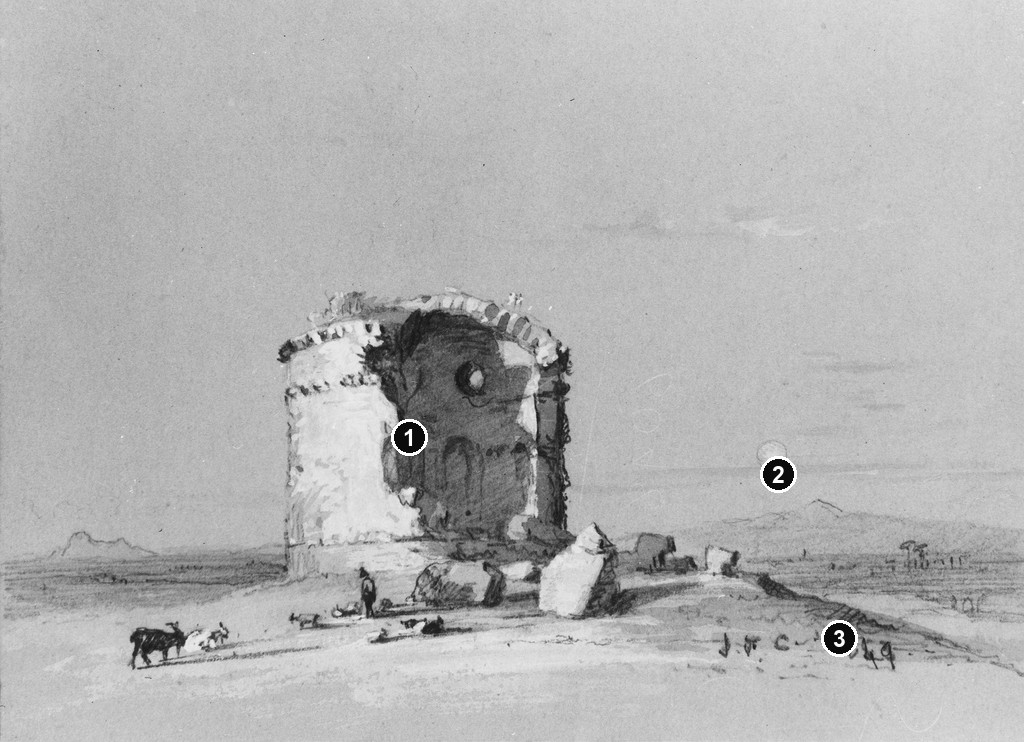
The numbered points identify visible features discussed in this article. Return from each detail to the whole composition. Jasper Francis Cropsey, Torre dei Schiavi, The Roman Campagna (from Cropsey Album). Metropolitan Museum of Art, 1970.9.26 recto. The museum catalogues the drawing as 1853; the visible inscription reads 1849. This is a different object from the 1847 oil. Jasper Francis Cropsey / The Metropolitan Museum of Art. Image source. CC0 / Public domain. Separate resized overview with numbered points; details cropped from the original, without recolouring, retouching or enlargement.
Details from JASPER CROPSEY DRAWINGS AND WATERCOLOURS
Compare the cropped details with the complete images above. Notice how their colours, shapes and positions contribute to the larger compositions.
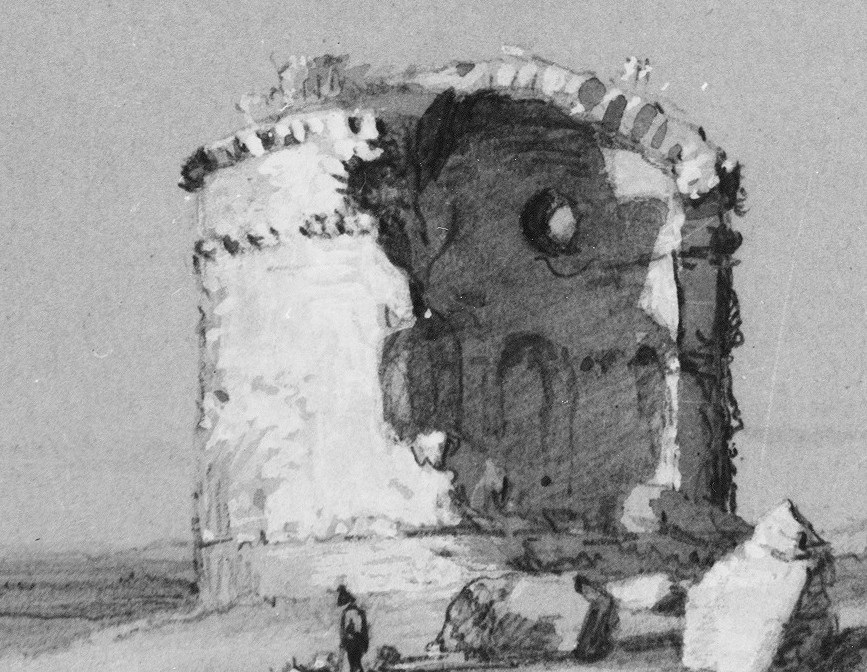
Light and shade across the ruin
Pale highlights and dark washes divide the broken cylindrical ruin. The contrast makes openings and uneven masonry legible on the toned sheet.
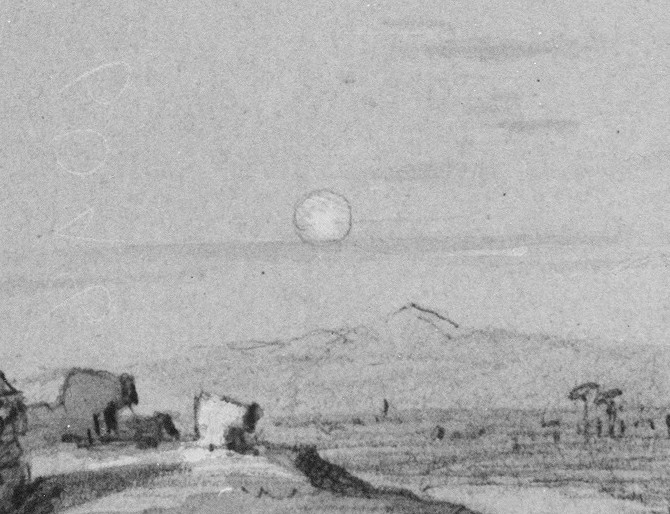
Moon and faint distant ridge
A faint circular moon appears above a low distant ridge. The broad crop retains the delicate marks without enhancing their contrast.
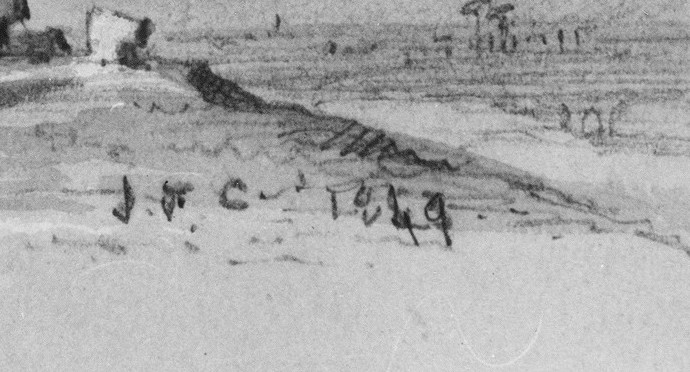
Inscription at the lower edge
The lower inscription visibly ends in 1849. It is kept separate from the Met’s current 1853 catalogue date rather than silently reconciling the two.
Outdoor material and the finished picture
Chotner traces sketching trips in New Jersey, the White Mountains and other eastern regions. Rebora’s selected catalogue entries connect particular drawings with the histories of Catskill, Wyoming and Starrucca subjects. Together these records establish a continuing practice of gathering landscape material. [3] [4]
The relation between a sheet and a canvas can take several forms. A drawing may preserve a viewpoint, record a motif, test an arrangement or remain an independent work. A later painting can retain selected forms while changing their scale, emphasis or setting.
That variety makes an exact connection worth demonstrating. A convincing woodland study is not automatically the preparatory source for every later tree. A familiar mountain can recur across drawings and paintings without allowing each object to be assigned to one certain chain of production.
The distinction helps the viewer compare rather than collapse the works. Ask which forms are demonstrably shared, which have changed, and whether the historical record identifies a direct relationship. Similar appearance alone can suggest a question without supplying its answer.
A faint river drawing at Hastings
Hudson River at Hastings is a graphite drawing dated June 1885, accession 1979.20.28 at the National Gallery of Art. Its whole sheet measures 30.4 × 48.4 cm. The date places it around the move to Hastings, before the later studio addition at Ever Rest. [1] [6]
The marks are light. River space remains broad, while boats and the farther shore interrupt it with small forms. Looking across the whole sheet gives those marks their scale: the open paper is part of the drawing’s effect, rather than empty material to be discarded.
The faintness also affects how it should be presented. The image here preserves the native appearance, with no contrast increase designed to make weak details seem certain. A modest visible mark should not acquire a more definite identity merely because a viewer wants a named building or boat.
The sheet connects late practice with the river around Hastings. It does not establish an exact view from an Ever Rest window, nor does the consulted record tie it to one finished oil. Its documented date, medium and locality are useful without those additions.
An album sheet from the Roman subject
The Met’s Torre dei Schiavi, The Roman Campagna, accession 1970.9.26 recto, is a small drawing in graphite, white gouache and brown and gray ink washes on dark buff wove paper. The museum dates it 1853, while the visible lower-right inscription reads 1849. Both dates are retained here as an unresolved distinction. [2]
The whole sheet places the substantial ruin toward the left and a moon in the open sky to the right. The support supplies a middle tone against which lighter and darker passages can operate. Linear marks and broader tonal areas make this a different paper experience from the faint Hastings graphite.
The museum interprets the ruin and rising moon through associations of Rome’s vanished grandeur and enduring time. That reading belongs to its curatorial account. It connects the depicted monument with Cropsey’s earlier Italian material without requiring an invented return journey in 1853. [2]
The drawing also remains a separate object from the Met’s oil of the Torre subject dated 1847. Shared subject matter does not make this sheet an illustration of that canvas or settle the exact preparatory relationship. The two records and media should be compared on their own terms. [7]
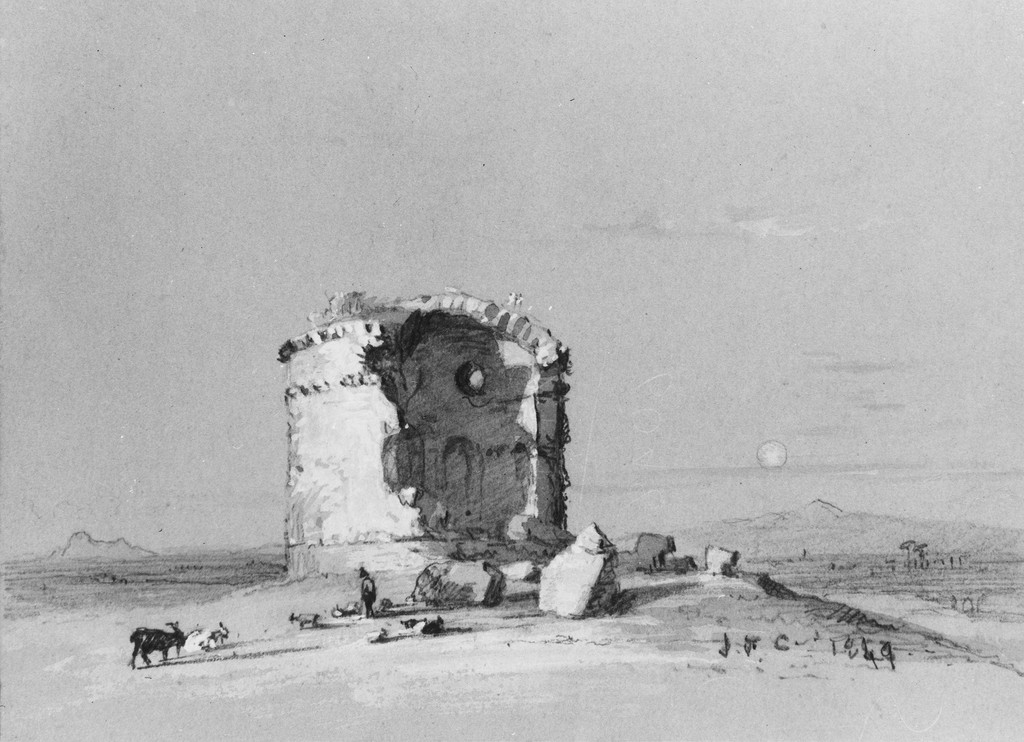
Jasper Francis Cropsey, Torre dei Schiavi, The Roman Campagna, Met 1970.9.26 recto. Museum date 1853; visible inscription 1849. Graphite, white gouache and ink washes; separate from the 1847 oil. Jasper Francis Cropsey / The Metropolitan Museum of Art. Image source. CC0 / Public domain. Proportionally resized only; full carrier, margins and native appearance retained.
Warwick: a documented relationship
Chotner’s account of Warwick Castle, England offers a stronger example of a named drawing within a painting’s history. She discusses Warwick Castle Moat, dated 30 September 1856, at Yale, accession 1970.8.1, alongside earlier material and the finished 1857 canvas. [3]
The drawing is considered here through the consulted catalogue, rather than presented as a sheet directly inspected for this article. That distinction allows its documented role to be discussed while preserving the extent of the evidence.
Chotner notes changes between the study and the painting, including the addition of two swans in the foreground. She treats a possible heraldic association as a suggestion, not a settled identification. The example shows how observed architecture and water could be developed for a finished composition. [3]
The whole illustrated canvas makes the final arrangement available: castle, river, foliage and foreground birds share one view. The catalogue supplies the historical comparison; the painting lets the reader consider the effect of that arrangement at its completed scale.
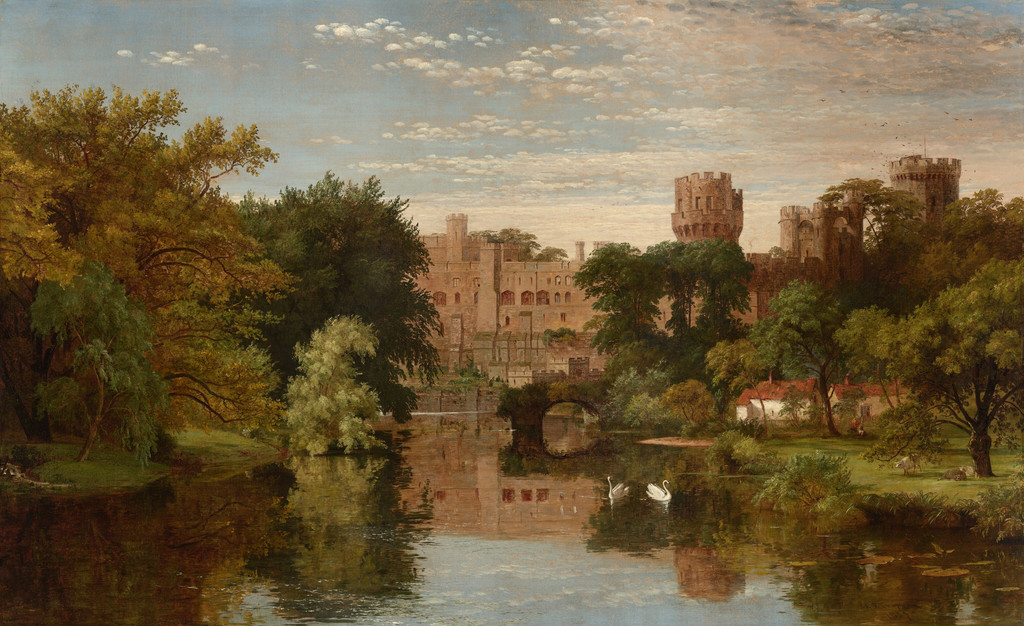
Jasper Francis Cropsey, Warwick Castle, England, 1857. National Gallery of Art, 1991.142.1. The finished oil is compared with drawing evidence discussed by Chotner. Jasper Francis Cropsey / National Gallery of Art, Washington. Image source. CC0 1.0. Proportionally resized only; full carrier, margins and native appearance retained.
Watch: Jasper Cropsey
Look closely at Cropsey’s Mount Jefferson, then explore the wider Hudson River School tradition.
Summer or Autumn? Picturing the American Republic
Smarthistory discusses Cropsey’s seasonal landscape and the image of the American republic.
Watch on YouTubeWyoming and a commissioned prospect
Rebora’s account of Valley of Wyoming connects a large commission with studies made in Pennsylvania in August 1864. Her discussion identifies views from Plains, Prospect Rock and Inman Hill, including material dated 8 and 9 August. These named places show the painter considering a valley through more than one prospect. [4]
The Museum of Fine Arts, Boston, holds the Inman Hill drawing under accession 1972.761. The Met also holds a separate 1864 painted study. Those objects should not be merged into the large finished oil of 1865. The documented sequence gives a concrete example of how drawing, painted study and a commissioned panorama could occupy different stages and formats. [4]
A close woodland study in oil
The Cleveland Museum of Art’s Trees and a Stream is dated 1853 and painted in oil on board. Its inclusion here is a medium comparison, not a reclassification as a drawing. The museum associates it with Cropsey’s outdoor study, probably in Massachusetts. [8]
Its vertical field concentrates attention on trunks, rocks and moving water. The near enclosure contrasts with the broader openness of the Hastings sheet. Study could therefore involve both different materials and different scales of attention.
The probable setting remains qualified, and no exact later canvas is assigned to the board. Its particular organisation already shows something useful: Cropsey could examine a small area of woodland as well as gather material for panoramic country.
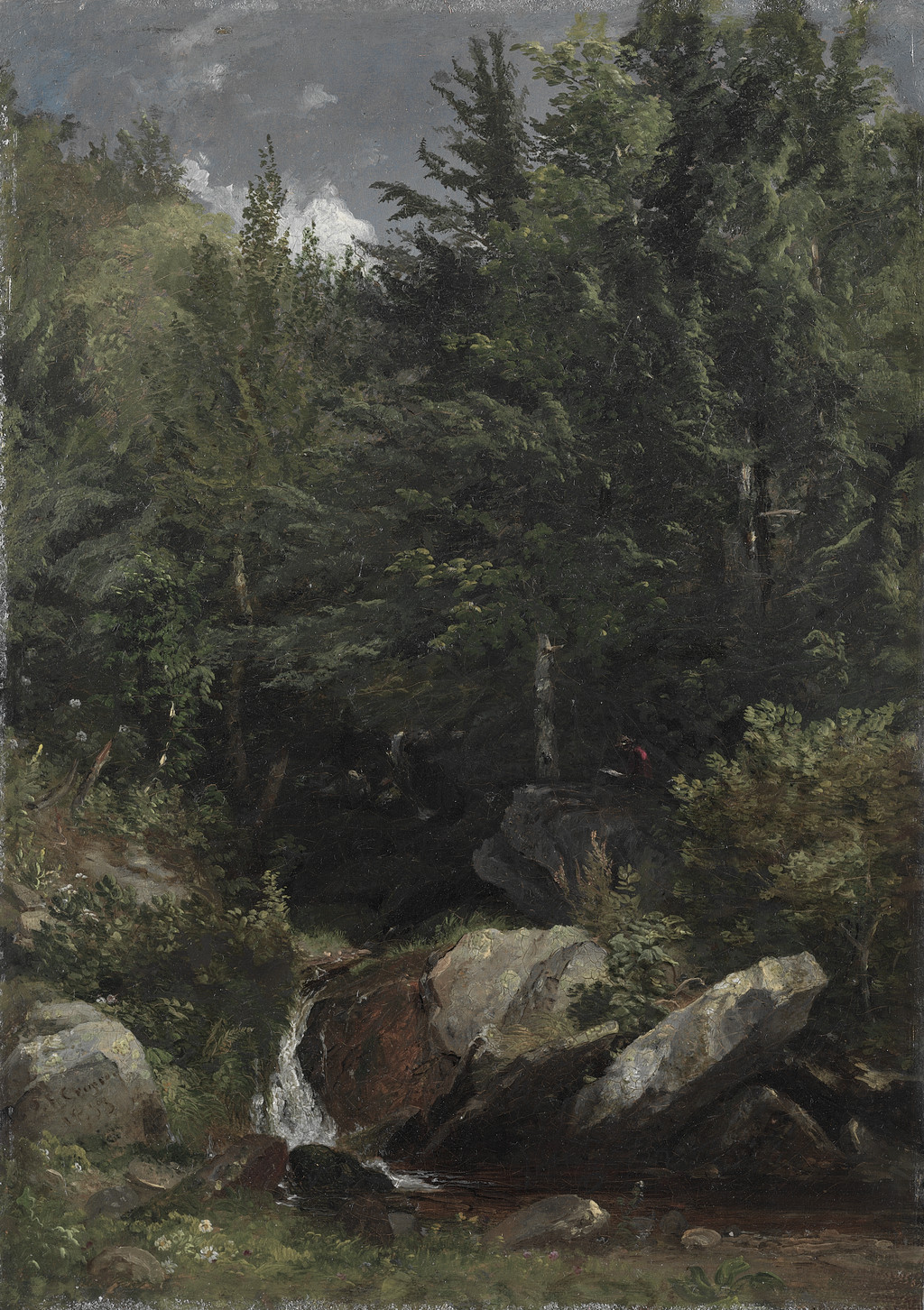
Jasper Francis Cropsey, Trees and a Stream, 1853. Oil on board, Cleveland Museum of Art, 1977.118. A close landscape study in oil, not a drawing. Jasper Francis Cropsey / Cleveland Museum of Art. Image source. CC0 1.0. Proportionally resized only; full carrier, margins and native appearance retained.
Watercolour before the late years
Watercolour entered Cropsey’s development long before the stroke of 1893. Chotner records early lessons from Maury, and identifies Cropsey as a founder of the American Society of Painters in Watercolor, later the American Watercolor Society. The founding year was 1867. [3] [4]
This chronology prevents a common simplification. Increased late use of watercolour was a change of emphasis within an established practice, rather than a sudden discovery of the medium in old age. Paper work belongs to the whole career.
Chotner describes the increased emphasis after the stroke while also recording continued work at Hastings. The foundation’s studio account supplies the setting in which that later practice took place. Those sources establish a career change without permitting a speculative medical explanation for particular brush marks. [3] [6]
Looking at the sheet as an object
The selected drawings invite attention to their complete supports. An inscription, paper tone or open margin can help explain a work’s identity and effect. Cropping those elements away may remove evidence even when the central motif remains attractive.
Medium labels likewise keep the comparison precise. Graphite alone, a combination of graphite and washes, watercolour and oil on board offer different possibilities. A general word such as study should not obscure what the object is made from.
Cropsey’s paper career becomes richer when those distinctions remain visible. Early rendering, outdoor observation, a shaped album subject and increased late watercolour all belong to the record. Their relationships with finished paintings are strongest where a particular object and a consulted source establish them.
Artworks directory
A selected directory of 18 paintings, two drawings and three architectural projects. Repeated subjects retain distinct object identities. Links lead to a companion article where available, otherwise the consulted institutional record. Unillustrated objects remain searchable; this is not a complete catalogue raisonné.
Frequently Asked Questions
The current Met catalogue gives 1853; the visible inscription gives 1849. This article retains the unresolved distinction. [2]
It is an oil on board, included as a comparison of close landscape study across media. [8]
Discussion
Look again at the images and ideas explored in Jasper Cropsey Drawings and Watercolours. These editorial prompts invite your observations.
Reader Insights
How does the open paper affect the Hastings river scene?
What changes when a sheet combines linear and tonal materials?
Which evidence would make a proposed drawing-to-painting relationship convincing?
Join the Conversation
Share a detail, comparison or question about Jasper Cropsey Drawings and Watercolours below.
References
- National Gallery of Art, Hudson River at Hastings, accession 1979.20.28. June 1885 graphite sheet, dimensions and inscription. View source
- Metropolitan Museum of Art, Torre dei Schiavi, The Roman Campagna, accession 1970.9.26 recto. Current catalogue date, materials, dimensions and curatorial interpretation; compared with the visible inscription. View source
- Deborah Chotner, Cropsey biography and Warwick Castle, American Paintings of the Nineteenth Century, Part I, National Gallery of Art (1996), printed pp.109–110 and 114–118. Early lessons, study practice, Warwick drawing and late watercolour emphasis. View source
- Carrie Rebora, Cropsey biography and selected entries, American Paradise: The World of the Hudson River School, Metropolitan Museum of Art (1987), printed pp.200–216. Watercolour society and documented landscape studies. View source
- Jasper Cropsey, unfinished 1846 reminiscences, Staten Island Historian, Summer 1983, PDF pp.10–12. Early artistic learning described retrospectively. View source
- Newington-Cropsey Foundation, Ever Rest. Hastings move and later studio. View source
- Metropolitan Museum of Art, Torre dei Schiavi, The Roman Campagna, oil of 1847, accession 2025.267. Separate painting record, not the illustrated album sheet. View source
- Cleveland Museum of Art, Trees and a Stream, accession 1977.118. Exact oil-on-board medium, date and qualified outdoor setting. View source
- Splash image source.
Jasper Francis Cropsey, Hudson River at Hastings, June 1885. Graphite on paper, 30.4 × 48.4 cm. National Gallery of Art, 1979.20.28. Jasper Francis Cropsey / National Gallery of Art, Washington. CC0 1.0. Proportionally resized only; full carrier, margins and native appearance retained.
View source