 by Tom Gurney
Tom Gurney BSc (Hons) is an art history expert with over 20 years experience
Email: tomgurney1@gmail.com / Phone: +44 7429 011000
Summer, Lake Ontario by Jasper Cropsey: Introduction
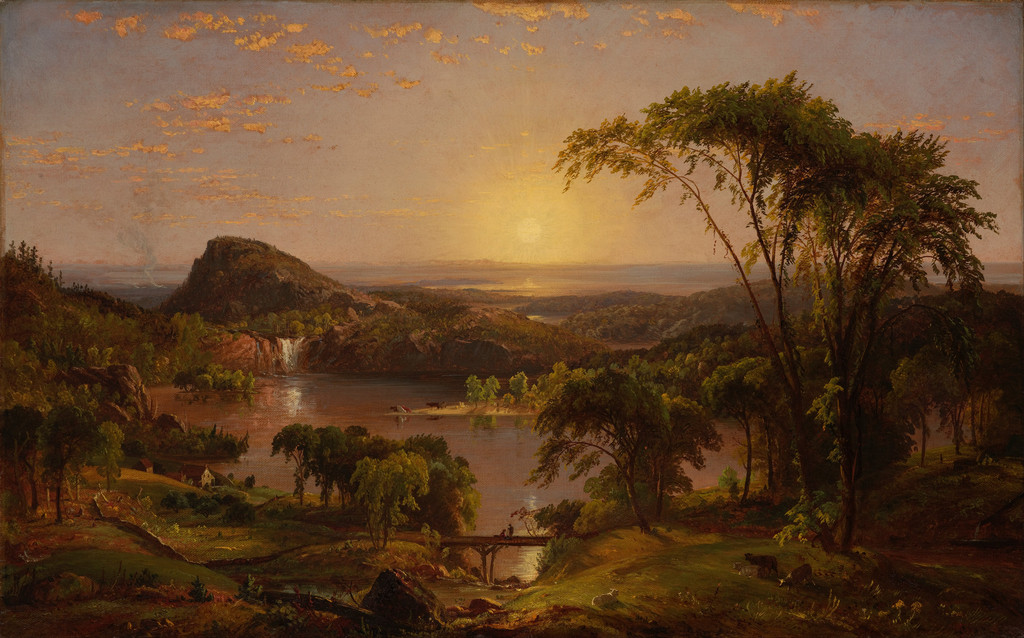
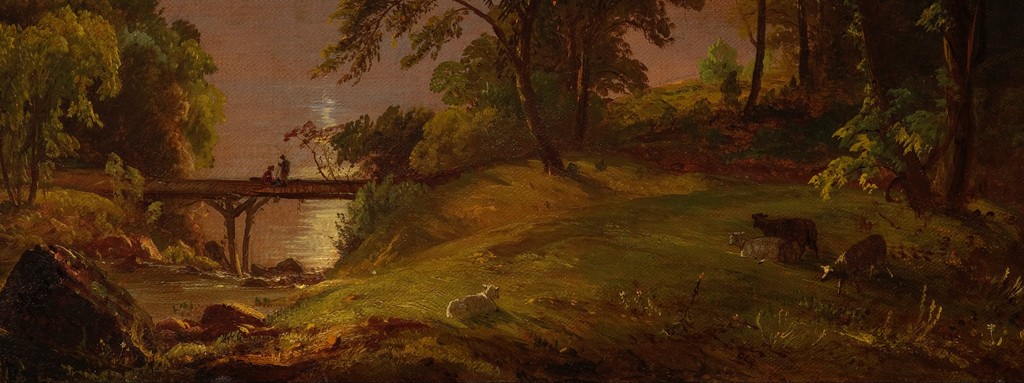
Jasper Cropsey’s Summer, Lake Ontario presents a spacious landscape in a relatively small canvas. Painted in 1857, it measures 38.1 × 61 cm and belongs to the Indianapolis Museum of Art at Newfields. Its light, water, wooded slopes and farm buildings bring several kinds of country scenery together. The museum describes the composition as an idealised arrangement combining motifs from different places. [1]
That description gives the geographical title a useful qualification. The picture can evoke Lake Ontario while drawing on a larger store of landscape forms. Its interest lies in how those forms work together: open water gathers the light, a cascade animates the near ground, and trees frame an extensive distance.
At a Glance
- Artist: Jasper Francis Cropsey
- Title: Summer, Lake Ontario
- Date: 1857
- Medium: Oil on canvas
- Dimensions: 38.1 × 61 cm
- Collection: Indianapolis Museum of Art at Newfields
- Accession: 71.13
- Acquisition credit: Gift of the Friends of the Museum
This work across Jasper Cropsey’s career
Contents
- A small canvas with a wide horizon
- Low light and luminous water
- Cascade, bridge and cattle
- A composite landscape
- An American scene during the London years
- A woodland study as a comparison
- The Newfields painting
- Annotated details
A small canvas with a wide horizon
The painting’s horizontal format gives it room to unfold across several zones. The nearest bank, the falling water and the larger lake do not compete for one compact centre. Each takes its place within a continuous view that extends toward low hills and a pale sky.
The darkest foreground forms establish a place from which to look. Beyond them, the surface of the lake occupies a more open interval. Farther away, wooded land rises and falls along the horizon. These changes in distance let a canvas only 61 cm wide suggest a much broader scene.
The foreground has more distinct edges and stronger contrasts than the distant land. Rocks, trees and the bridge can be recognised as separate forms, whereas the far shore gathers into softer bands. Cropsey makes the differences in definition carry much of the picture’s depth.
There is also a change in the amount of information offered to the eye. Near objects reward attention to their separate shapes; the distance is understood through larger relations of colour and light. Moving between the two scales is part of the experience of looking at the picture.
Annotated Details from Summer, Lake Ontario
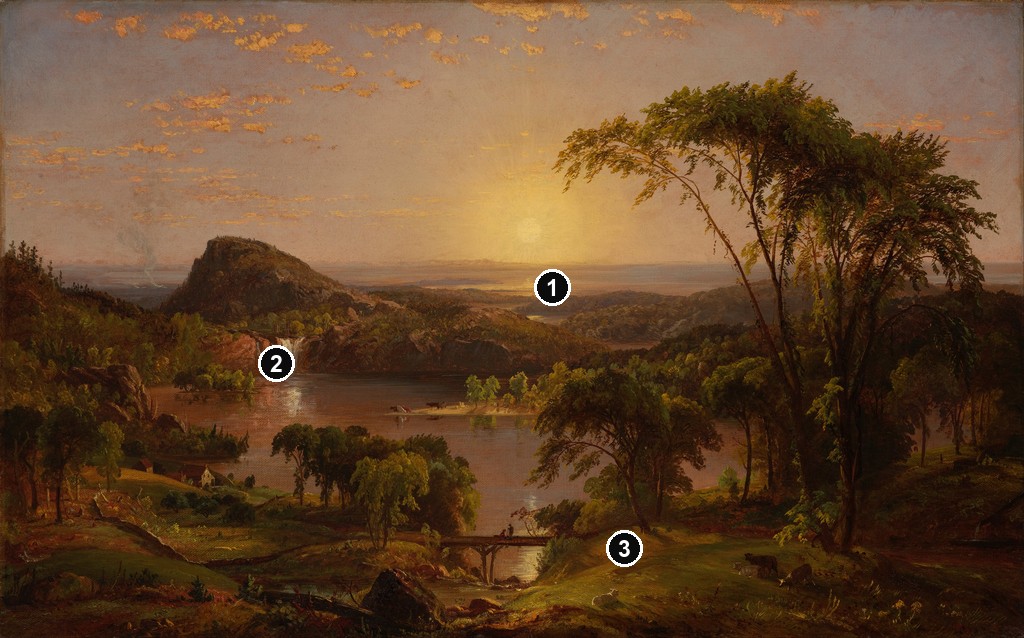
The numbered points identify visible features discussed in this article. Return from each detail to the whole composition. Jasper Francis Cropsey, Summer, Lake Ontario, 1857. Oil on canvas, 38.1 × 61 cm. Indianapolis Museum of Art at Newfields, 71.13. Gift of the Friends of the Museum. Jasper Francis Cropsey / Indianapolis Museum of Art at Newfields, via Google Art Project. Image source. Public domain. Separate resized overview with numbered points; details cropped from the original, without recolouring, retouching or enlargement.
Details from SUMMER, LAKE ONTARIO
Compare the cropped details with the complete images above. Notice how their colours, shapes and positions contribute to the larger compositions.
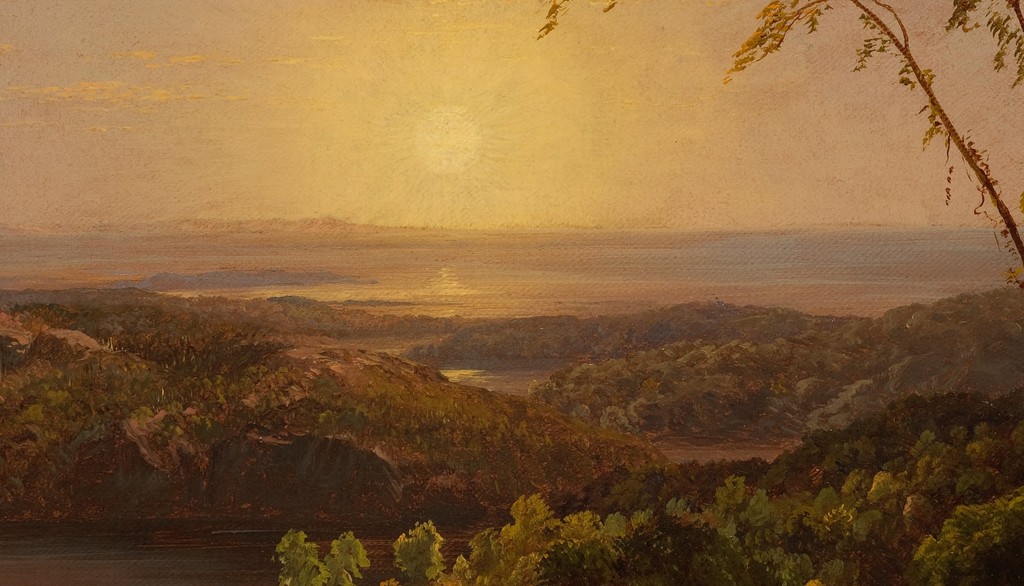
Low light across the distant water
A low bright opening and its reflection organise the distant water. This is a painted composite landscape, not a reconstruction of one exact shoreline.
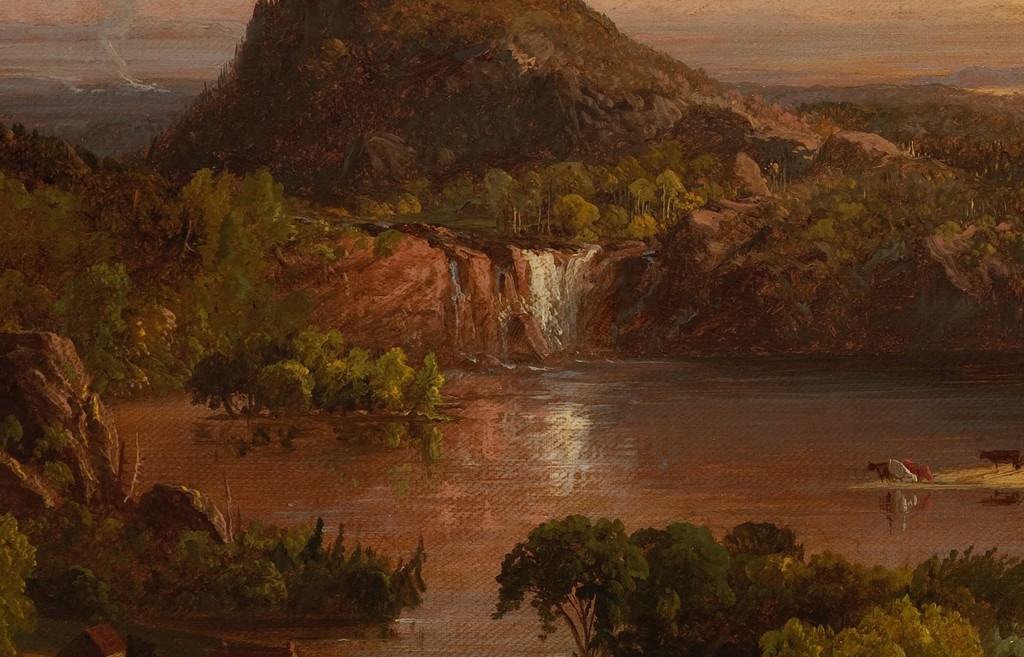
Fall entering the nearer basin
Pale falling water descends beneath a rounded rocky rise. The local vertical movement contrasts with the distant horizontal water.
Bridge and grazing animals
A small bridge, figures and grazing animals occupy the near ground. The broad crop connects these activities with the trees and water.
Low light and luminous water
The museum’s label identifies a setting sun and luminous mists as central to the scene’s romantic effect. It relates those elements, together with the orderly farm buildings, to a harmonious image of human life within nature. [1]
In the painting, the lighter water provides an opening between the darker banks. Its brightness draws the eye beyond the near trees and toward the distant landscape. The surface feels expansive partly because its variations are less abrupt than those in the foreground rocks and foliage.
The sky continues that opening. Light is distributed across a broad field rather than isolated in one small dramatic point. The pale atmosphere allows far-off hills to remain visible while reducing their prominence beside the near shore.
This effect changes the role of the darker passages. Trees and banks become strong frames for a light-filled middle distance. They do not simply describe local objects; they help the viewer perceive the open space beyond them. The landscape’s calm therefore depends on the arrangement of contrasting areas as much as on its individual motifs.
The label’s setting-sun interpretation does not require an exact clock time or a meteorological reconstruction. The painted relations are enough to see how low light joins water and atmosphere. The foreground remains grounded and substantial while the distance becomes less firmly bounded.
Cascade, bridge and cattle
The cascade brings movement into the near landscape. Pale falling water stands out against darker rock, giving a different rhythm from the extended surface of the lake. Where the lake invites the eye to travel outward, the cascade directs attention downward through a more concentrated passage.
The bridge provides another kind of connection across this part of the scene. Its built shape can be distinguished from the irregular ground beneath it. Together, bridge and water organise a transition between the foreground bank and the country beyond.
Cattle introduce a quieter form of activity. Their comparatively small scale gives the viewer a measure for the land around them, while their presence makes the bank feel inhabited. They belong to the same world as the buildings, paths and other signs of use.
These details help explain the museum’s interpretation of harmony. The human element is spread through ordinary rural features, rather than concentrated in one large figure. A bridge, farm structures and grazing animals give the setting a sense of continuing life.
The arrangement also holds two kinds of water within one composition. The cascade is broken, bright and visibly active; the larger lake is broad and relatively still. Cropsey uses both to vary the route through the picture. Looking only at the distant lake would miss the lively foreground passage that makes the opening beyond it feel more expansive.
A composite landscape
The Newfields description explicitly states that Cropsey combined motifs from several locales. That is a more useful starting point than treating every feature as evidence for a single exact viewpoint. It places selection and arrangement at the centre of the painting’s construction. [1]
A geographical title can establish a landscape’s association without functioning as a complete survey of its site. In this case, the museum’s account allows the lake, cascade, trees and farm buildings to be considered as components gathered into an ideal view.
The distinction also affects how one reads the bridge and falling water. Their convincing appearance does not by itself identify a particular surviving structure or waterfall. They work as recognisable landscape forms within the scene, but the consulted record does not trace each one to its original location.
The composition remains coherent because these different motifs share a single organisation of light and distance. The dark foreground prepares the brighter opening; the cascade and bridge lead into it; the farther land closes the horizon gently. The unity comes from their relationship within the painting.
Watch: Jasper Cropsey
Look closely at Cropsey’s Mount Jefferson, then explore the wider Hudson River School tradition.
Summer or Autumn? Picturing the American Republic
Smarthistory discusses Cropsey’s seasonal landscape and the image of the American republic.
Watch on YouTubeAn American scene during the London years
The date 1857 falls within Cropsey’s extended residence in London. Deborah Chotner’s biography places his arrival in June 1856 and his return to the United States in 1863. The American subject therefore belongs to a period when he was working abroad. [2]
This chronology is consistent with a picture assembled from landscape material gathered at different times and places. It does not identify a particular sketch as its preparatory source. The narrower claim supported here is that a dated American landscape emerged during the London phase of his career.
Cropsey had published Up among the Clouds two years earlier. The essay discusses the sky as a field of depth and variation, asking artists to observe changing cloud forms and the space between them. Those concerns offer a useful way to look at this painting’s broad atmosphere, while remaining a statement of general artistic attention rather than instructions for this specific canvas. [3]
A woodland study as a comparison
Trees and a Stream, dated 1853, offers a more enclosed view. The Cleveland Museum of Art identifies a small oil on board, probably made during a summer stay in Massachusetts. Its vertical format concentrates on dark woodland and moving water. [4]
Comparing the two works brings their different scales of attention into focus. In the woodland picture, foliage and rock largely contain the stream within a near space. In Summer, Lake Ontario, the cascade forms only one part of a view that opens across a much larger body of water.
The comparison does not make the Cleveland board a study for the Newfields painting. It shows how similar elements can take different roles: water can organise an intimate woodland interior or help carry the eye through a wide imagined country. The change in composition matters more than a presumed direct chain between the objects.
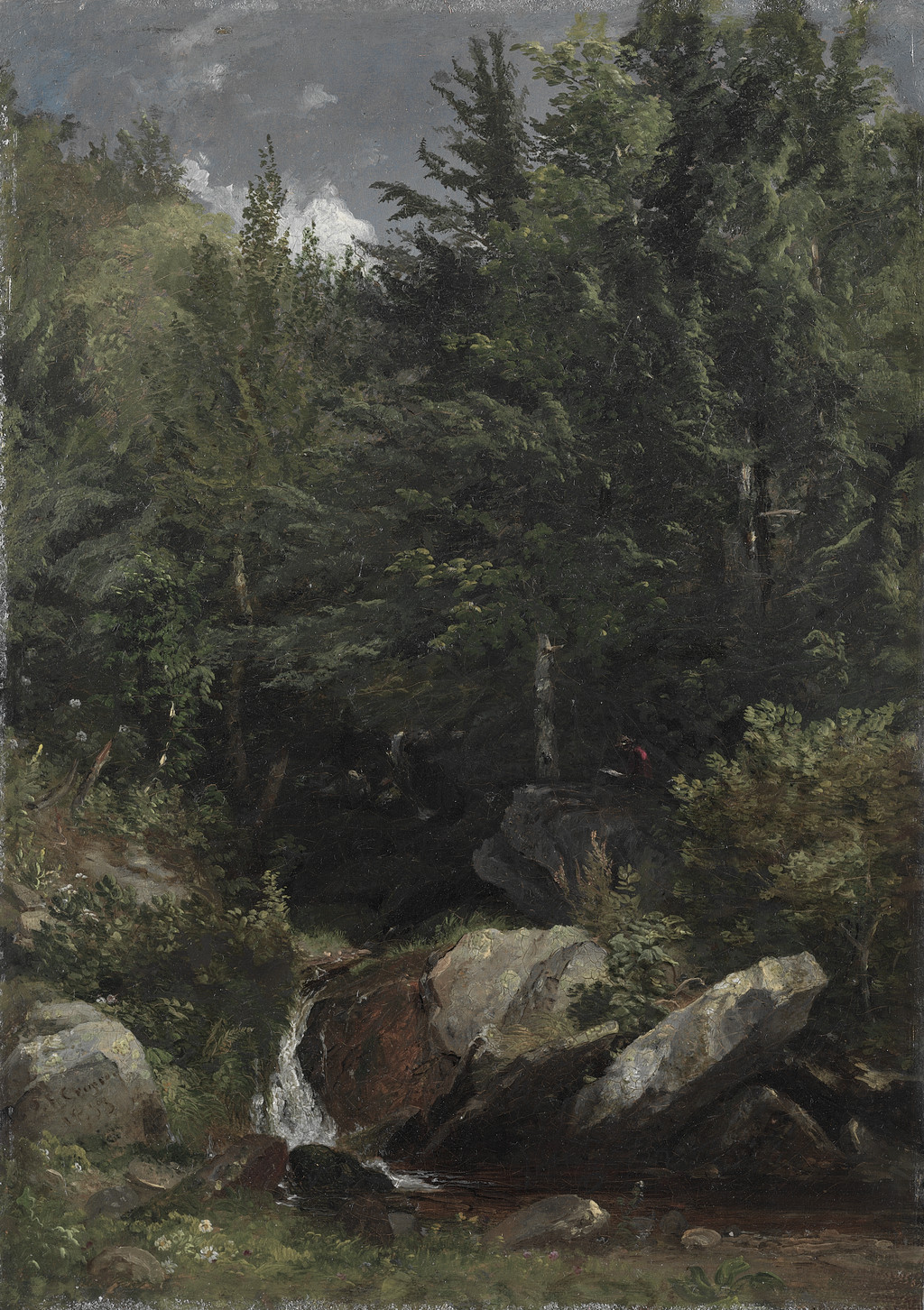
Jasper Francis Cropsey, Trees and a Stream, 1853. Oil on board, 33.9 × 23.9 cm. Cleveland Museum of Art, 1977.118. A separate work, probably made during a summer stay in Massachusetts. Jasper Francis Cropsey / Cleveland Museum of Art. Image source. CC0 1.0. Proportionally resized only; full carrier, margins and native appearance retained.
The Newfields painting
The acquisition credit is the Gift of the Friends of the Museum, and the accession number is 71.13. These identify the 1857 canvas within the Newfields collection. The unframed measurement, 15 × 24 inches, corresponds to 38.1 × 61 cm. [1]
The work invites a sustained movement between near activity and distant quiet. The cascade, bridge and cattle make the foreground specific enough to enter, while the luminous lake and soft horizon allow the view to expand. Its ideal character lies in that carefully joined experience of inhabited ground and open atmosphere.
Artworks directory
A selected directory of 18 paintings, two drawings and three architectural projects. Repeated subjects retain distinct object identities. Links lead to a companion article where available, otherwise the consulted institutional record. Unillustrated objects remain searchable; this is not a complete catalogue raisonné.
Frequently Asked Questions
The museum describes it as an idealised composition combining motifs from several different locales. The title associates it with Lake Ontario, but does not establish every feature as part of a single surveyed viewpoint. [1]
It belongs to the Indianapolis Museum of Art at Newfields, accession 71.13, through the Gift of the Friends of the Museum. [1]
Discussion
Look again at the images and ideas explored in Summer, Lake Ontario by Jasper Cropsey. These editorial prompts invite your observations.
Reader Insights
Does the cascade or the lake first direct your attention?
How do the bridge and cattle change the character of the landscape?
What becomes clearer when you compare this open view with Trees and a Stream?
Join the Conversation
Share a detail, comparison or question about Summer, Lake Ontario by Jasper Cropsey below.
References
- Indianapolis Museum of Art at Newfields, Summer, Lake Ontario, accession 71.13, museum record supplied through Google Arts & Culture. Object identity, unframed dimensions, acquisition credit and interpretation of the composite landscape. View source
- Deborah Chotner, Cropsey biography, American Paintings of the Nineteenth Century, Part I, National Gallery of Art (1996), printed pp.109–110. London residence and wider career chronology. View source
- J. F. Cropsey, Up among the Clouds, The Crayon, II, no. VI, 8 August 1855, pp.79–80. Sky, cloud form and atmospheric variety. View source
- Cleveland Museum of Art, Trees and a Stream, accession 1977.118. Separate 1853 oil on board and qualified Massachusetts setting. View source
- Splash image source.
Jasper Francis Cropsey, Summer, Lake Ontario, 1857. Oil on canvas, 38.1 × 61 cm. Indianapolis Museum of Art at Newfields, 71.13. Gift of the Friends of the Museum. Jasper Francis Cropsey / Indianapolis Museum of Art at Newfields, via Google Art Project. Public domain. Proportionally resized only; full carrier, margins and native appearance retained.
View source