


 by Tom Gurney
Tom Gurney BSc (Hons) is an art history expert with over 20 years experience
Email: tomgurney1@gmail.com / Phone: +44 7429 011000
Asher Brown Durand: Introduction
Asher Brown Durand (1796–1886) brought the close attention of an engraver to a long career in painting. His landscapes range from individual trees and enclosed woods to valleys, literary scenes and panoramas of changing land use. Prints, portraits, drawings and writing help explain how that landscape practice developed.[1]
This collection introduces exact works and the evidence behind them. It follows Durand’s movement between media, his associations with Thomas Cole and William Cullen Bryant, and the role of patrons and institutions. The paintings are approached as distinct objects, with their own dates, subjects and histories.
At a Glance
- LifeAugust 21, 1796–September 17, 1886
- BirthplaceJefferson Village, now Maplewood, New Jersey
- Early professionEngraver, trained with Peter Maverick
- Later focusLandscape painting and studies from nature
- National Academy president1845–1861
- Familiar worksKindred Spirits, The Beeches, In the Woods and Progress
- WritingNine Letters on Landscape Painting, 1855
- ExplorePaintings, engravings, studies, biography and regional landscape articles
Asher Brown Durand in context
Bars show approximate historical periods. c. means circa (about).
Hudson River School
c. 1825–1880 [23]Notes and sources
Hudson River School. An approximate span from Cole’s New York arrival to the Centennial. The name is a later critical category. Kevin J. Avery, Metropolitan Museum of Art.
Each bar runs from the artist’s birth to their death.
John Trumbull
1756–1843 · Birth–death [24]John Vanderlyn
1775–1852 · Birth–death [25]Asher Brown Durand
1796–1886 · Birth–death [26]Thomas Cole
1801–1848 · Birth–death [27]Notes and sources
John Trumbull. Life dates verified in the Met’s 2013 institutional account. Metropolitan Museum of Art.
John Vanderlyn. Life dates from the current Met object record. Metropolitan Museum of Art.
Asher Brown Durand. Career periods and exact works appear in the companion views. [1]
Thomas Cole. Life dates and landscape context. Metropolitan Museum of Art.
The Beeches
1845Kindred Spirits
1849God’s Judgment Upon Gog
ca.1851–52River Scene
1854In the Woods
1855The Catskills
1859Sunday Morning
1860Summer Afternoon
1865Contents
- An engraver who became a painter
- Portraits and a changing artistic direction
- Travel and the practice of observation
- Trees and composed woodland
- Cole, Bryant and a memorial landscape
- Valleys, water and inhabited places
- Progress and the uses of land
- Rest and dramatic weather
- Writing, teaching and artistic leadership
- Annotated details
An engraver who became a painter
Durand’s artistic beginnings belonged to the family workshop and the printed image. His father was a watchmaker and silversmith; Durand later remembered examining illustrated books, watchmakers’ cards and banknotes. The memoir published by his son connects looking at pictures with investigating how their lines were made.[3]
Formal training began with Peter Maverick in 1812. After five years of apprenticeship, Durand became a partner and opened the firm’s New York branch. The stages of pupil and associate are distinct, even when a short biography groups them within the same early period.[2]
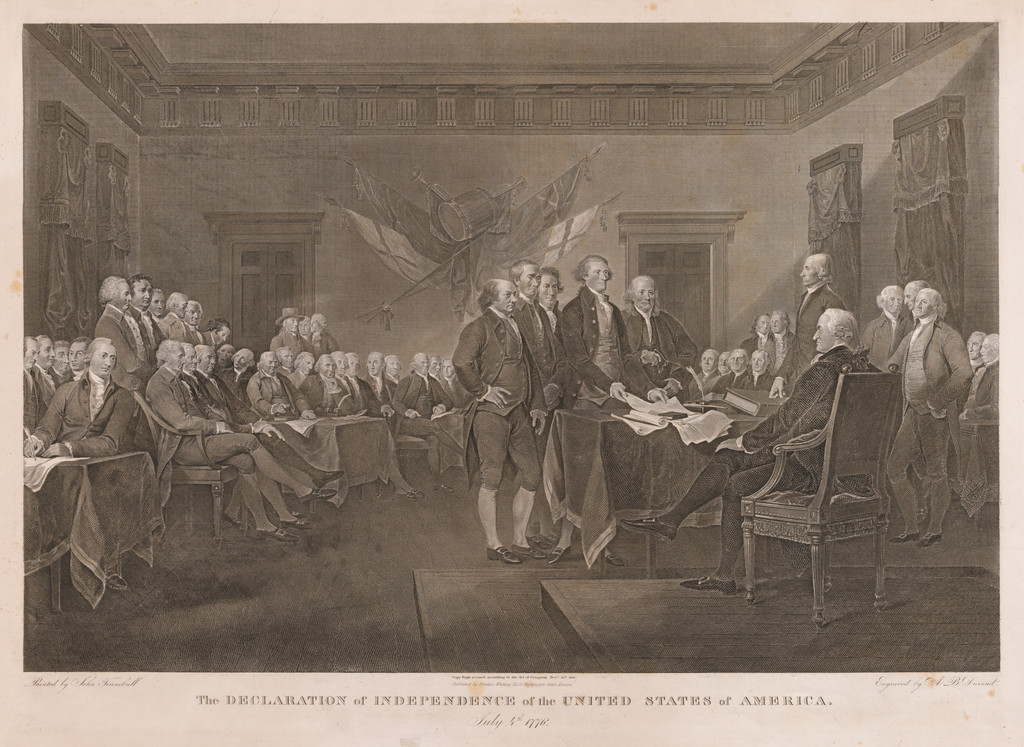
His engraving after Trumbull’s Declaration of Independence, completed in 1823, made his reputation. The major Ariadne print followed in 1835, after John Vanderlyn’s painting. These works show the translation of painted subjects into printed lines, rather than landscape emerging from an artistic career with no earlier accomplishments.[4]
The engravings overview follows this work through book illustration, banknotes and reproductive prints. Its object records keep the selected impressions separate from the paintings that supplied their models.
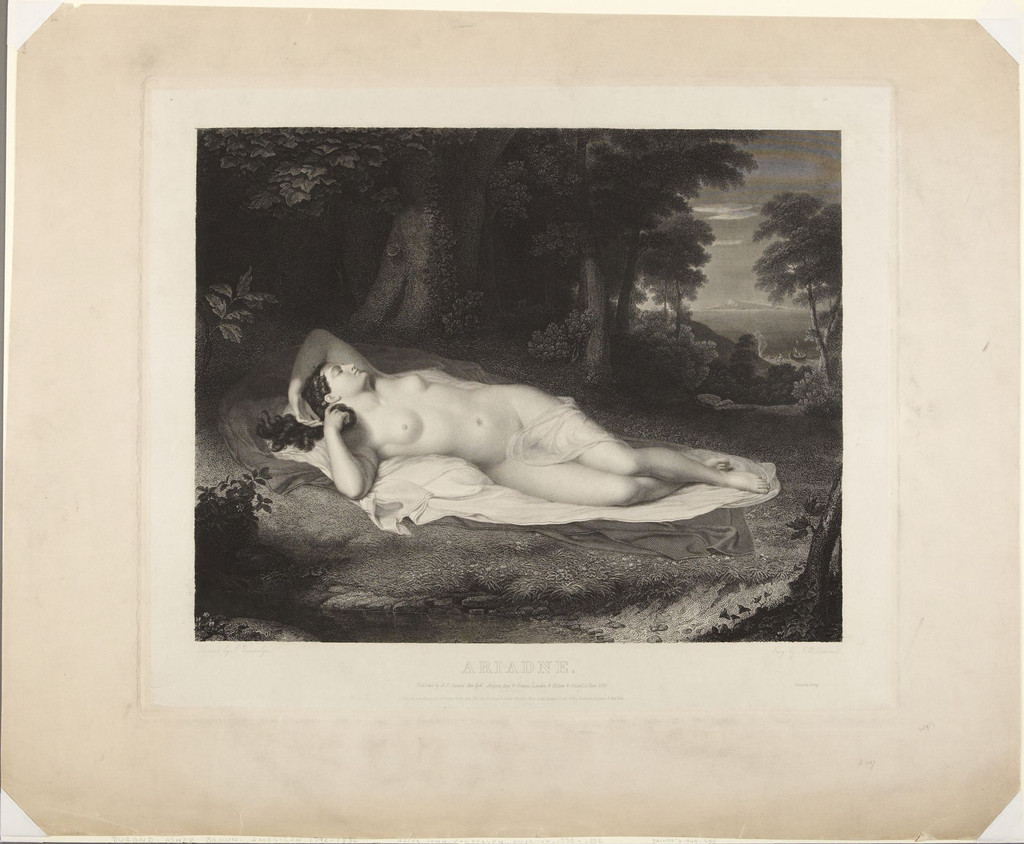
Asher Brown Durand after John Vanderlyn, Ariadne, 1835. Princeton University Art Museum, x1949-255. Gift of George L. King and David S. Mather. Complete print sheet with lettering retained. Princeton University Art Museum; Mather Collection. Image source. Public domain. Resized only; native appearance, complete carrier and margins preserved.
Four stages of Asher Brown Durand’s career
These periods group related developments; painting, travel and local work overlap across their boundaries.
From the family shop to major prints
Workshop experiment, the 1812–1817 apprenticeship and partnership preceded the 1823 Declaration print, commercial engraving and early painting. [3]
Prints, portraits and landscape study
Ariadne, portrait commissions, the 1837 Adirondack journey with Cole and the 1840–1841 European tour mark overlapping developments. [6]
The Academy, commissions and letters
The 1845–1861 presidency, memorial and literary paintings, changing land use and the 1855 letters gave landscape a public and written presence. [6]
Continued painting and recognition
Later commissions and summer work continued around the 1869 move to Maplewood. Exhibiting outlasted retirement; sources differ between 1878 and 1879 for the last painting. [14]
Annotated Details from Asher Brown Durand
The numbered points identify visible features discussed in this article. Return from each detail to the whole composition. The captions keep each work’s identity, date and medium separate.
Kindred Spirits
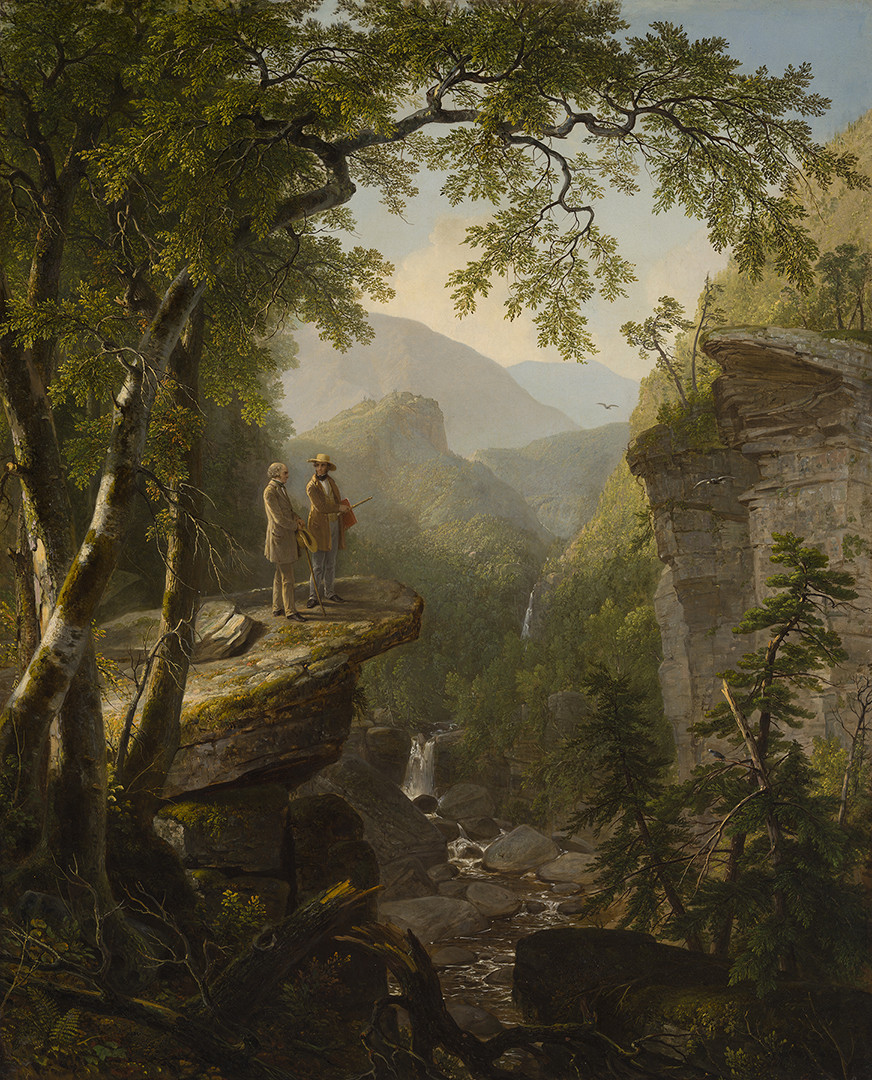
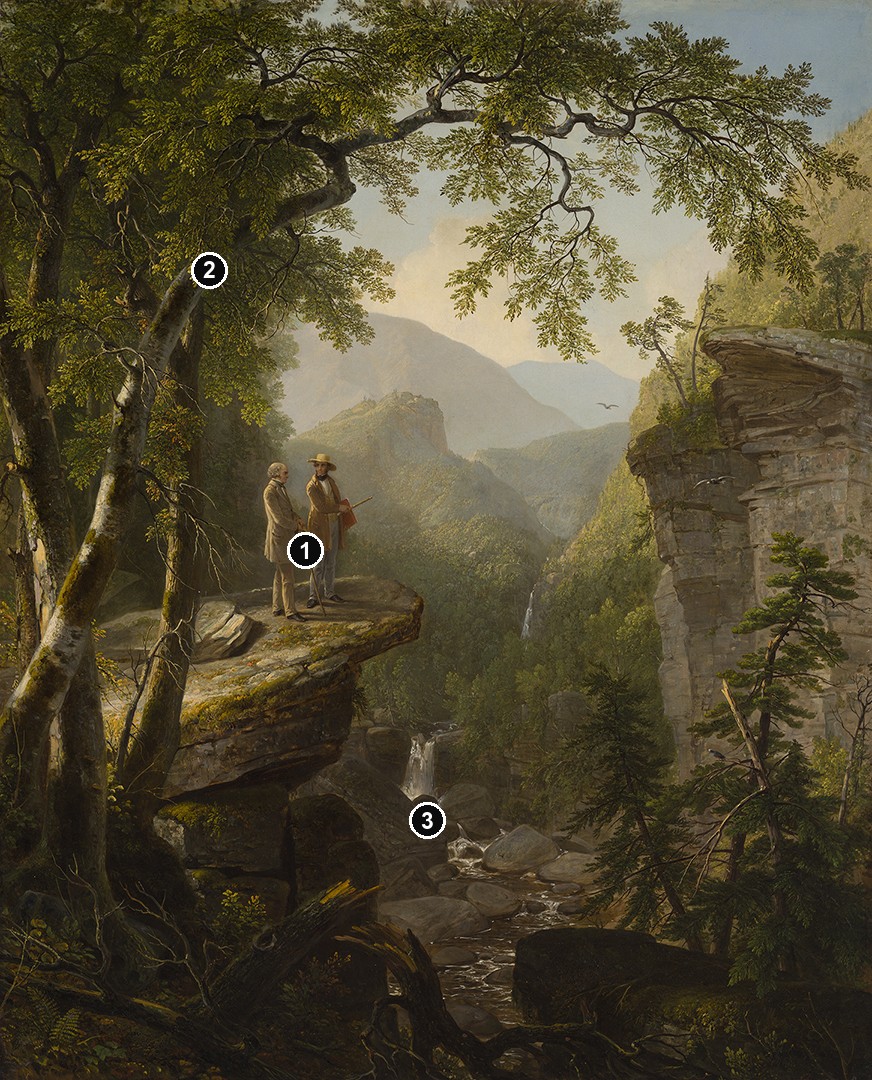
Asher Brown Durand, Kindred Spirits, 1849. Crystal Bridges Museum of American Art, 2010.106. Commissioned by Jonathan Sturges as a memorial to Thomas Cole and given to William Cullen Bryant. Broad composition shown at its available native resolution. Crystal Bridges Museum of American Art; museum-uploaded open-access reproduction. Image source. CC0 / Public domain. Resized only; native appearance, complete carrier and margins preserved.
Progress
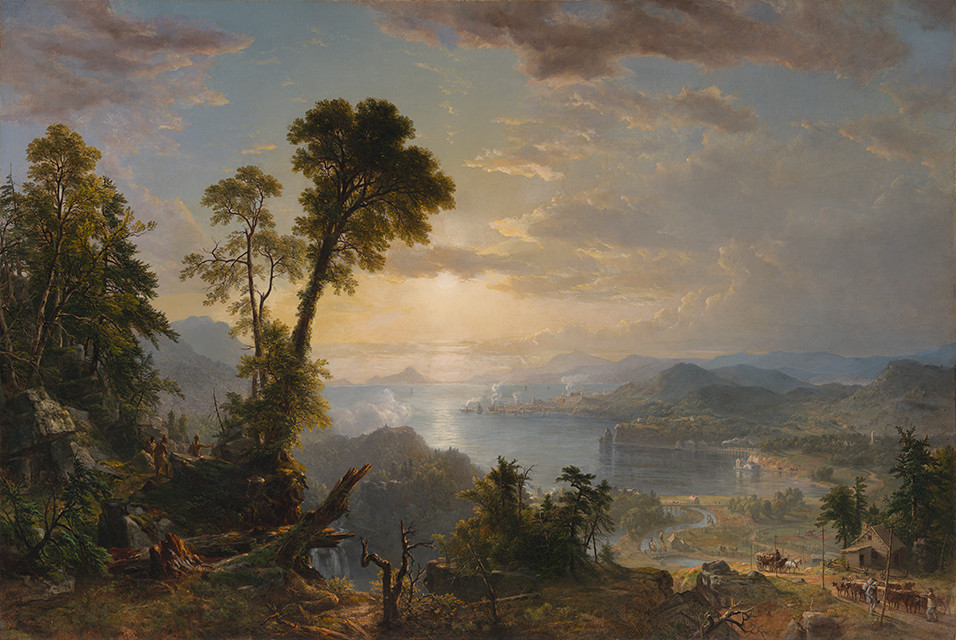
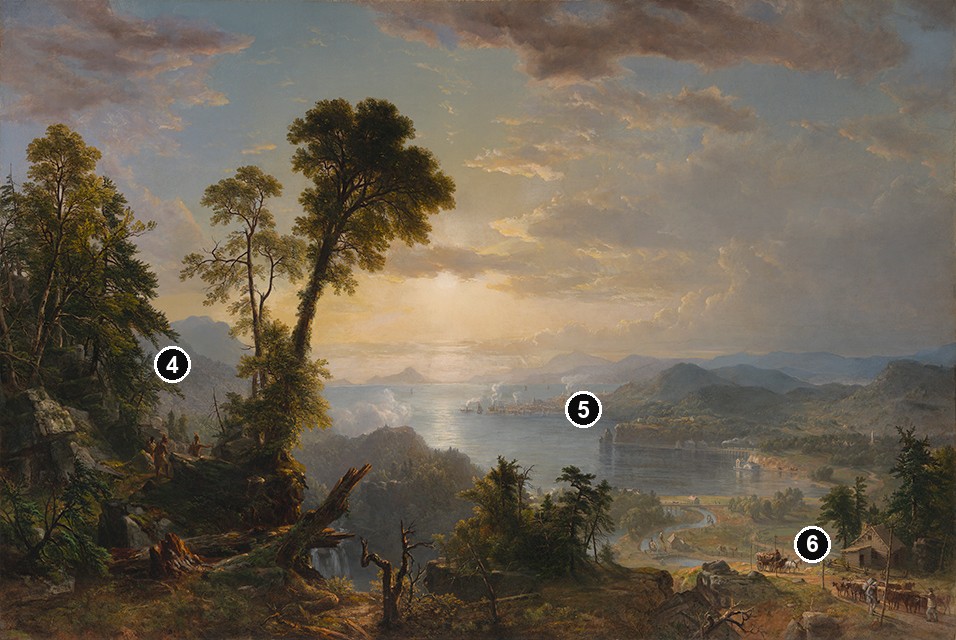
Asher Brown Durand, Progress (The Advance of Civilization), 1853. Oil on canvas. Virginia Museum of Fine Arts; gift of an anonymous donor. Whole museum-origin reproduction, retained at its native size. Virginia Museum of Fine Arts; museum-origin public-domain reproduction via Wikimedia Commons. Image source. Public domain. Resized only; native appearance, complete carrier and margins preserved.
Details from ASHER BROWN DURAND
Compare the cropped details with the complete images above. Notice how their colours, shapes and positions contribute to the larger compositions.
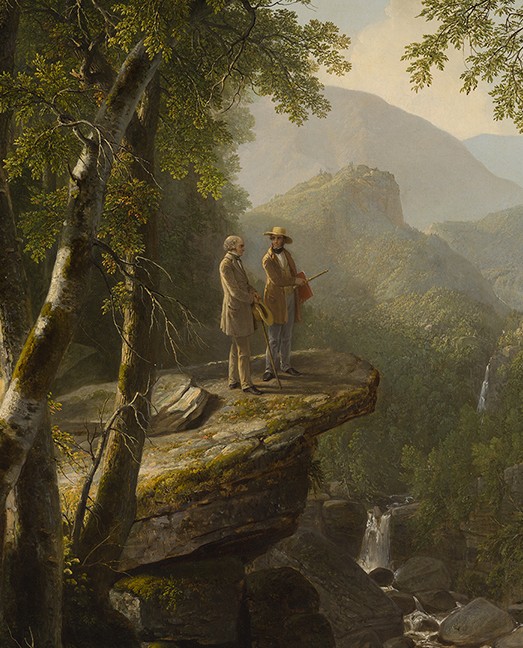
Kindred Spirits
Two men on the ledge
Two small standing figures occupy an open rock ledge above the gorge. The broad crop retains their relationship with the surrounding landscape; tiny facial details are not inferred.
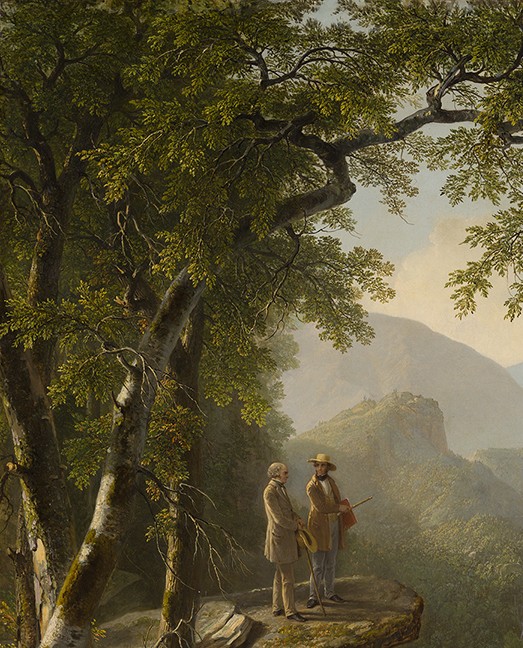
Enclosing tree and branches
A large near trunk and spreading branches enclose the figures’ space. Their darker forms frame the brighter distant opening.
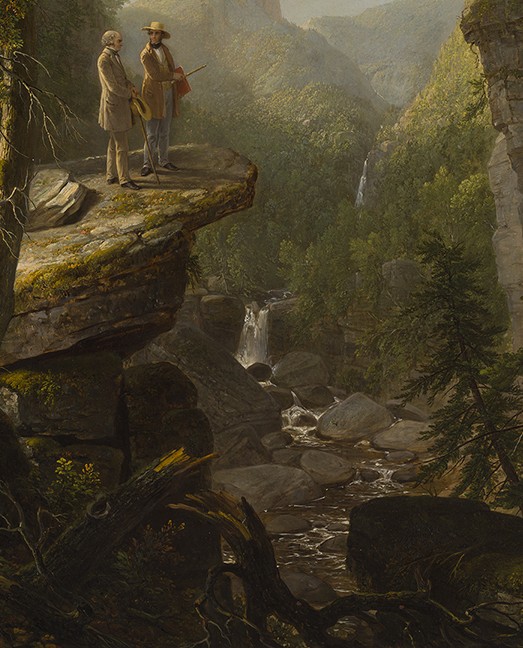
Water descending through the gorge
A pale fall and rocky watercourse continue below the ledge. The broad view connects water with the depth of the gorge.
Progress
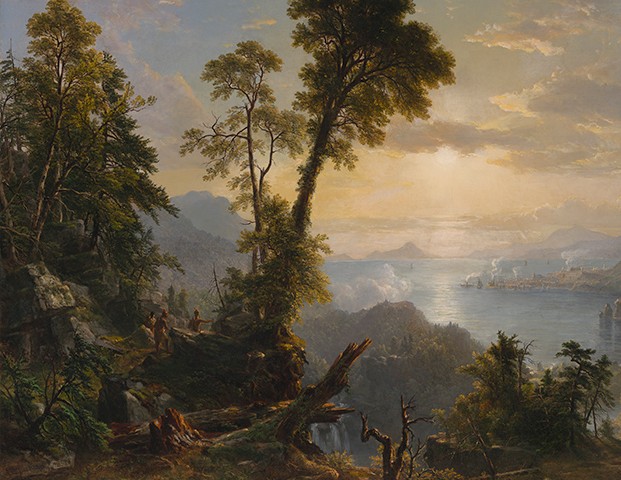
Figures within the left woodland
Small figures occupy a wooded ledge at the left. Their broad setting remains visible here; the image does not establish a specific nation.
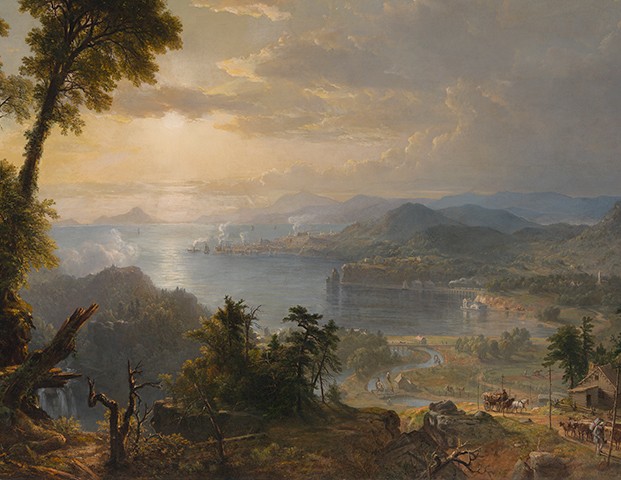
Transport and distant settlement
Waterways, vessels and the distant settlement occupy the more open landscape. Their small scale is retained within a broad crop.
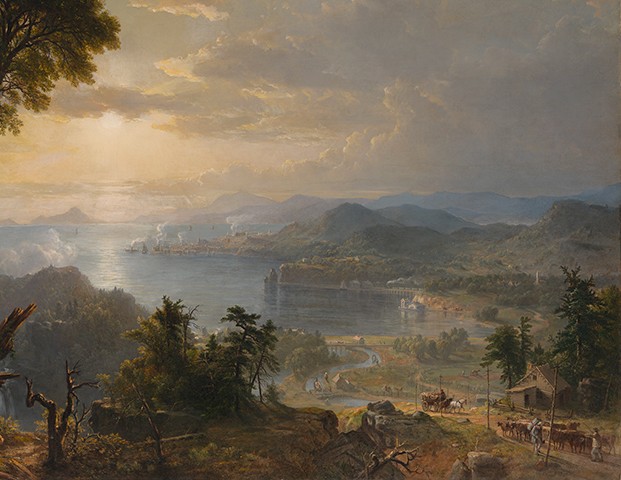
Near road and telegraph route
A road, figures, building and poles enter the right foreground. The crop shows their relationship with the larger panorama.
Portraits and a changing artistic direction
Painting gathered importance during the 1830s. Durand made portraits and figure subjects while receiving encouragement from artists and patrons. Luman Reed’s commissions for portraits of American presidents helped establish a new professional direction.[2]
A changing balance of work provides a clearer account than an instant conversion from one art to another. Durand’s printmaking experience remained relevant, and the skills involved in translating painted forms did not vanish when he worked more often in oil.
Landscape was also present before the familiar 1837 journey with Cole. Avery notes earlier Academy exhibition subjects; the shared Adirondack trip gave an existing interest new encouragement. This chronology allows the journey to matter without turning it into the first occasion on which Durand noticed scenery.[2]
The biography gives these transitions their wider setting: family, professional partnerships, artistic institutions, European travel and continued work in later life.
Travel and the practice of observation
In 1837 the Durands and Coles travelled to Schroon Lake in the Adirondacks. Olson’s research connects this period with Durand’s growing attention to trees and their individual forms. The journey offered a shared setting for looking closely, while the later works retained each artist’s character.[5]
Durand travelled to Europe in 1840–1841. The dated chronology places his departure on June 1, 1840, correcting an April date in a later summary. He visited collections, copied paintings and sketched encountered scenery. These activities provided different kinds of material for an expanding practice.[6]
In London, Charles Robert Leslie showed works and oil studies by John Constable. Durand’s recorded response valued their naturalness. A European example could reinforce his attention to American landscape, rather than requiring him to choose between all foreign art and all native observation.[3]
Repeated summer excursions later brought him to regions including the Catskills, Adirondacks and New England. The landscape travel article relates specific paintings to these regions, with a licensed modern waterfall photograph and a clearly dated later map. Neither image reconstructs Durand’s exact itinerary.
Trees and composed woodland
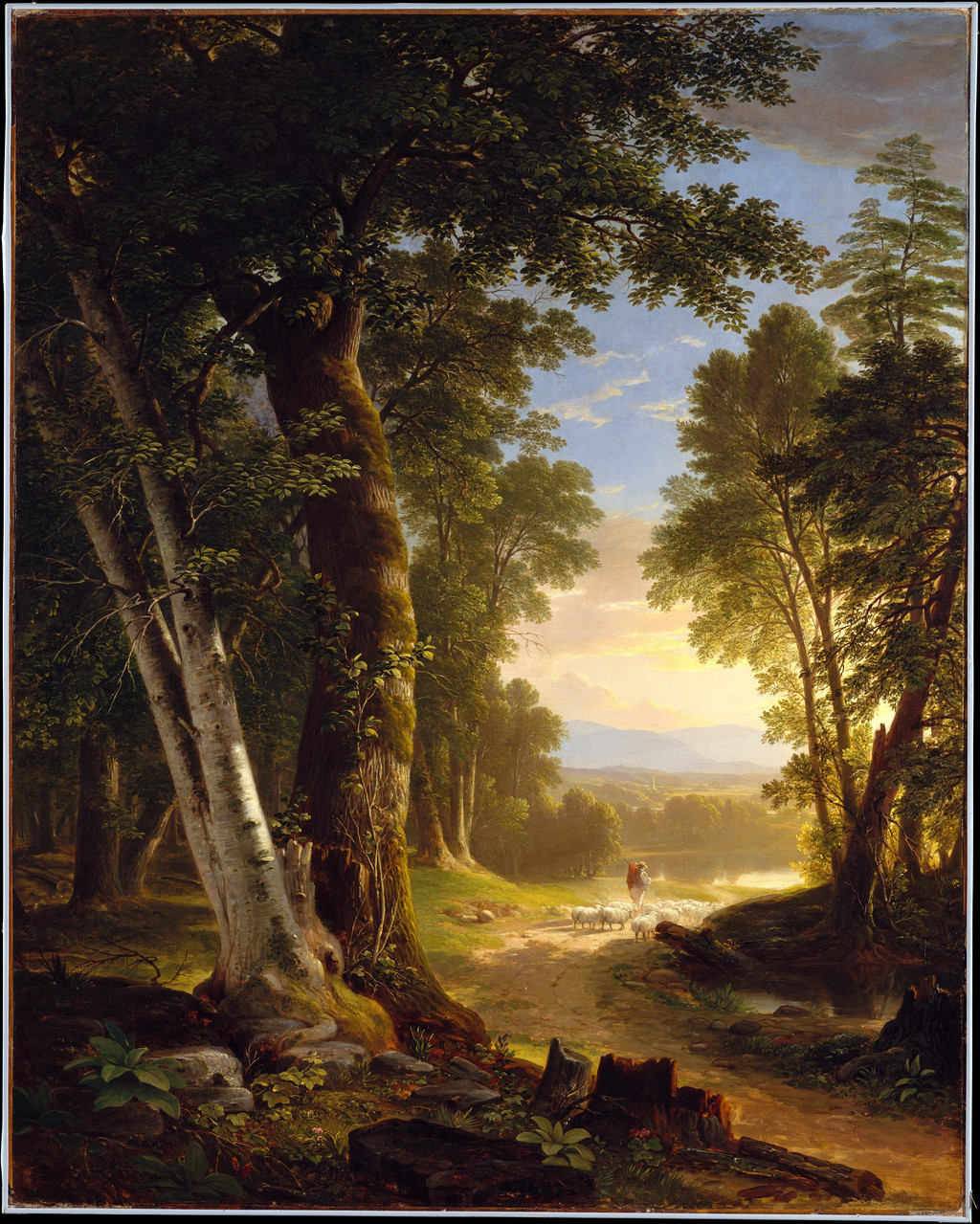
The Beeches, 1845, gives tall trunks a major role in organising a path, shepherd and flock. The Met’s collection catalogue discusses its relation to an outdoor study and to Constable’s example. It also records changes in the work’s title, helping identify the exact object across its exhibition history.[7]
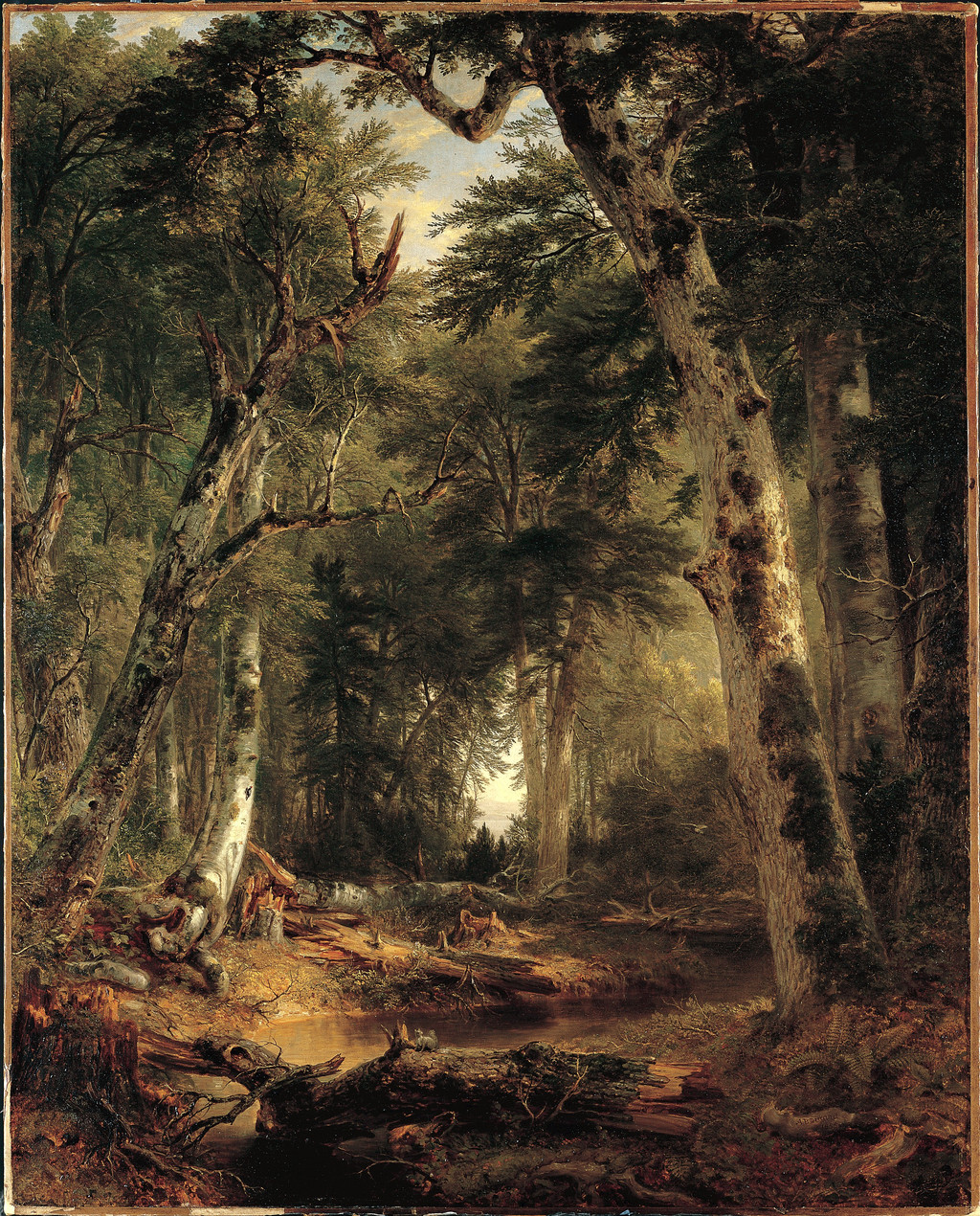
In the Woods, 1855, draws the viewer into a denser forest interior. Pale trunks, foliage, fallen wood and a lower stream establish different layers of space. The current Met record identifies its date and the Sturges family’s later memorial gift.[8]
These pictures join observation to arrangement. A tree can be examined individually and also act as a major structure within a finished composition. The balance between trunk, canopy and distant opening affects where attention rests and how the eye moves through the scene.
Olson distinguishes independent studies from drawings made for a named canvas. A resemblance can offer a comparison without proving direct transfer. The drawings and studies article follows that distinction through an actual graphite sheet and comparisons with painted trees.[5]
Asher Brown Durand, The Beeches, 1845. Metropolitan Museum of Art, 15.30.59. The museum catalogue relates it to an 1844 outdoor oil study; the small graphite sheet discussed in the drawings and studies article has no documented direct connection to this canvas. The Metropolitan Museum of Art. Image source. CC0 / Public domain. Resized only; native appearance, complete carrier and margins preserved.
Cole, Bryant and a memorial landscape
Durand’s Kindred Spirits, 1849, places Thomas Cole and William Cullen Bryant on a ledge above a wooded gorge. Jonathan Sturges commissioned the work after Cole’s death and gave it to Bryant. The current Crystal Bridges record preserves these roles and the painting’s subsequent provenance.[9]
The men occupy only a small part of the painted field. Trees, water, rocks and distant mountains give their encounter an extensive setting. The composition makes their connection with nature visible while retaining the particular identities that give the memorial its purpose.
Bryant also contributed writing to The American Landscape, 1830, a publication involving Durand’s engraved views. John’s memoir records the venture’s descriptive text and prospectus, as well as the fact that only one issue appeared. Their association therefore included print and readership before the painted memorial.[3]
Landscape—Scene from Thanatopsis, 1850, offers another connection with Bryant. The Met relates its funeral, farm work and ruins to his poem’s meditation on mortality. Literature enters this landscape through activities and forms rather than a portrait of the poet.[10]
Valleys, water and inhabited places
Durand’s landscapes do not all withdraw into woods. Dover Plains, 1848, looks across fields and a settled valley, with foreground figures and cattle helping establish the inhabited setting.[17] High Point: Shandaken Mountains, 1853, gives a prominent mountain another relationship with nearer water and figures.[18]
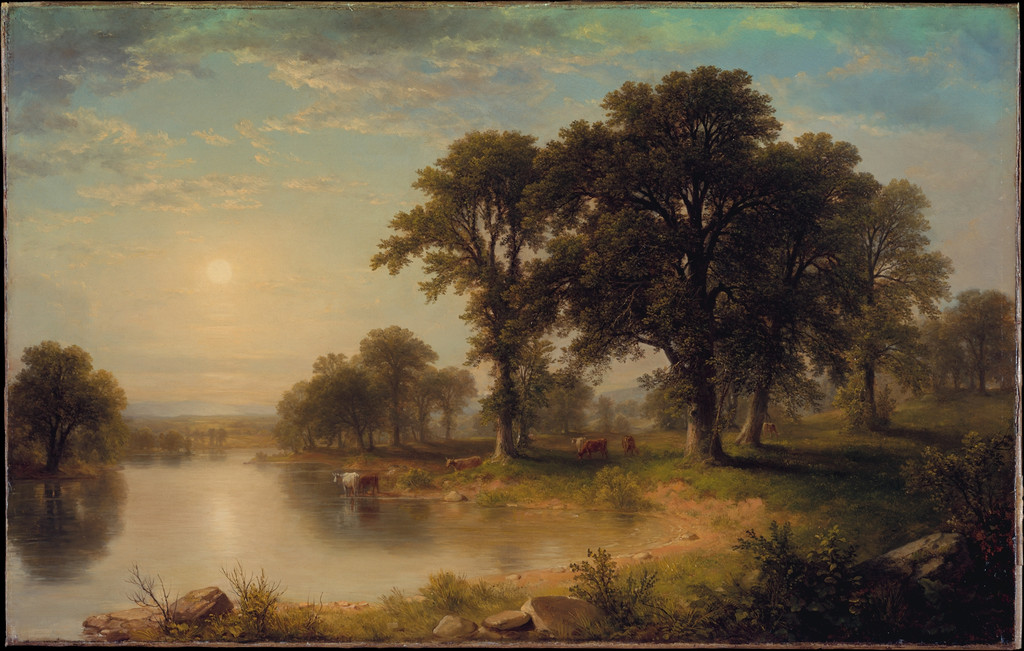
River Scene, 1854, and Summer Afternoon, 1865, use cattle, trees and broad water to create pastoral arrangements.[19][20] Their exact dates and collections matter, especially where a familiar title resembles a separate work. The paintings selection links these objects and their dedicated records.
The Catskills, 1859, brings the viewer closer to a rocky stream and large pale trunks. The Walters identifies Plattekill Clove and records William T. Walters’s commission. A regional subject can therefore support a very different composition from an expansive valley.[11]
The comparison encourages attention to scale and access. Some pictures offer ground across which the eye travels freely; others place trees and rocks near the viewer before revealing a distant opening. These differences affect the relationship between the viewer and the represented place.
Watch: Asher Brown Durand
Choose a film to explore the artist’s work, its interpretation and its wider setting.
Friendship and landscape, Asher B Durand's Kindred Spirits
Smarthistory and Crystal Bridges discuss friendship, memory and landscape in Kindred Spirits.
Watch on YouTubeProgress and the uses of land
Progress, 1853, places woodland, Native figures, transport, settlement and industry across a wide panorama. Paths, bridges and waterways contribute to the passage between its areas. Its arrangement raises questions about how land and people are represented within a picture of transformation.[12]
Rebecca Bedell’s study reconsidered the painting’s relationship with Charles Gould’s commission. Parts of the patron’s motive remain interpretation, and financial events in 1856 followed the picture’s completion. They should not be made into a recorded cause of the earlier work.
The painting’s generalised Native figures also require care. A specific nation is not established by the consulted evidence. Their position within the composition can be examined without converting a visual type into a securely identified community.
First Harvest in the Wilderness, 1855, gives transformation a more concentrated setting through a clearing, remaining trees, family activity and cattle. Its memorial commission was connected with the late Augustus Graham.[21] The dedicated articles compare these works while keeping their commissions and scales distinct. Durand’s landscape art could address changing land as well as the experience of close observation.
Asher Brown Durand, Progress, 1853. Oil on canvas. Virginia Museum of Fine Arts. Museum-origin public-domain reproduction; native size retained. Virginia Museum of Fine Arts; museum-origin public-domain reproduction via Wikimedia Commons. Image source. Public domain. Resized only; native appearance, complete carrier and margins preserved.
Rest and dramatic weather
Sunday Morning, 1860, combines a church, water, walkers, resting figures and a flock within an open landscape. The New Britain museum identifies William T. Walters’s commission and discusses the relationship between formal worship and devotion experienced outdoors. Its interpretation supplies a specific religious context without locating the whole composition at one proven site.[15]
Earlier works share the title. Their dates and owners differ, so a reference to Sunday Morning alone can leave the object uncertain. The dedicated article identifies the 1860 painting and separates it from the 1839 and 1850 versions.
God’s Judgment Upon Gog, 1852, presents a different scale of action. A prophet, army and animals occupy a ravine under dramatic weather. The Chrysler record identifies the biblical subject, while the reproduced painting allows comparison of its darker peaks, lightning and bright opening.[16]
These pictures extend the range beyond a uniformly quiet landscape style. Rest, belief and dramatic narrative can shape the same broad materials of trees, ground and sky. Their different arrangements help show why each exact work deserves its own article.
Writing, teaching and artistic leadership
Durand was president of the National Academy of Design from 1845 to 1861. The chronology supplies May 14 for his election and March 28 for his resignation. The term placed him at the centre of an institution during years of substantial landscape activity.[6]
His nine Letters on Landscape Painting appeared in The Crayon in 1855. The consulted primary excerpts discuss forms, trees, foliage, selection and representation. Careful drawing for a beginner and broader colour study for a practised artist receive different emphasis.[3]
Gallati examines the series within contemporary debate and discusses its imagined pupil. The literary form of personal instruction could address a wider audience. It does not establish one particular student as the recipient of every passage.[13]
The letters article and style and technique article explore this guidance alongside the works. Visible handling remains separate from laboratory evidence: the consulted sources do not provide a universal pigment recipe or paint-layer sequence for all Durand landscapes.
Later work and continued recognition
Durand resigned the Academy presidency before moving to the family property at Maplewood in 1869. Subsequent exhibitions and excursions show that retirement did not immediately end his painting. Snook’s chronology records continued participation, including works at the 1876 Centennial Exhibition.[6]
Orcutt’s study places these years within changing critical attention. Younger artists attracted interest through different subjects and scale, while Durand continued to make and show work. His later paintings should be considered individually, without assuming that age supplied one explanation for them all.[14]
The final painting’s inscribed 1878 date differs from the memoir’s 1879 account. The qualified range preserves the disagreement. Durand died on September 17, 1886, leaving a record that extended from workshop experiment to printed history, portraits, woodland studies and public landscape paintings.[1][14]
The routes through this collection follow those activities. A reader can begin with a familiar painting, compare its exact object record, then turn to the studies, writing and biography that place it within the wider career.
Essential Asher Brown Durand works
Kindred Spirits
1849 · Cole and Bryant within a memorial gorge, commissioned by Sturges.
Progress (The Advance of Civilization)
1853 · A wide panorama of woodland, transport, settlement and industry.
The Beeches
1845 · Tall trees organise a path, shepherd and flock.
In the Woods
1855 · Pale trunks and fallen wood within a dense forest interior.
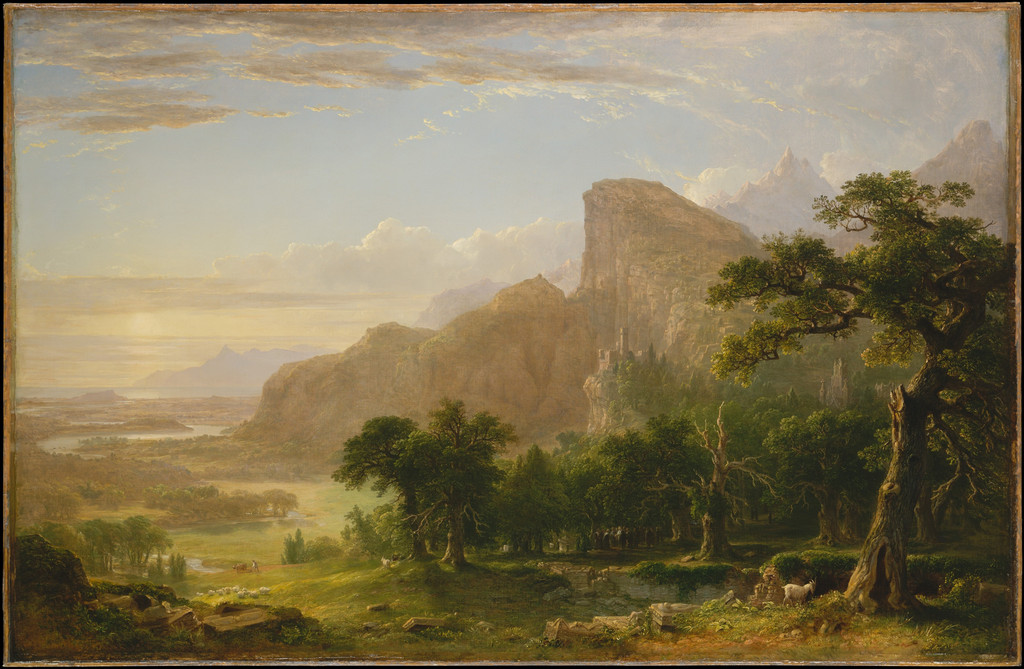
Landscape—Scene from Thanatopsis
1850 · Funeral, farm work and ruins within a literary landscape.
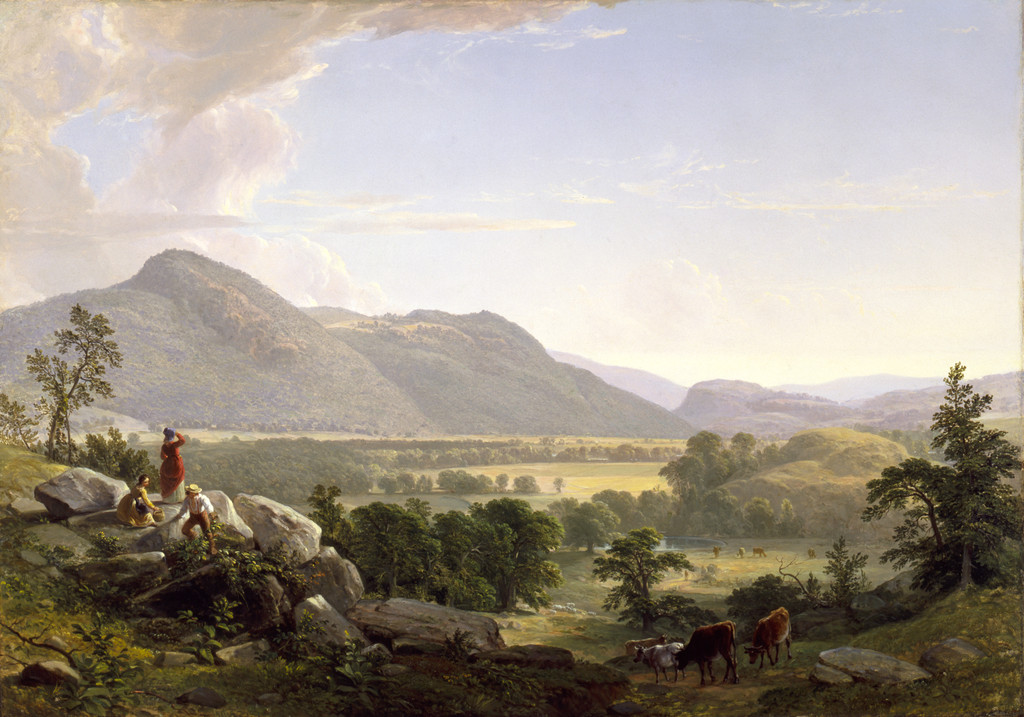
Dover Plains, Dutchess County, New York
1848 · Figures and cattle before an inhabited Dutchess County valley.
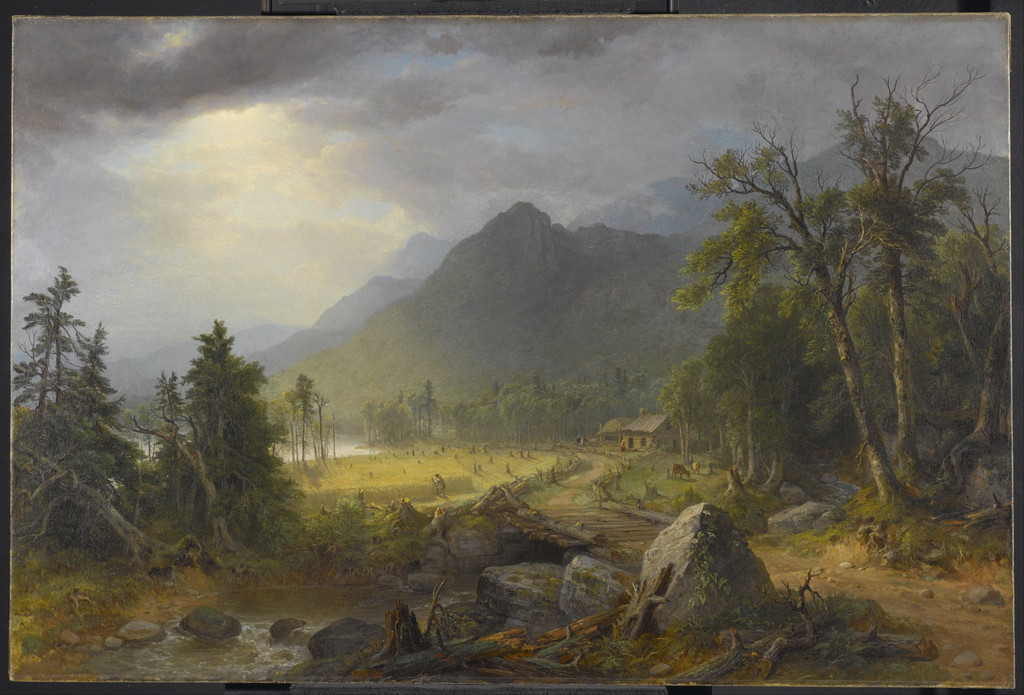
The First Harvest in the Wilderness
1855 · A clearing, family activity and the Augustus Graham memorial commission.
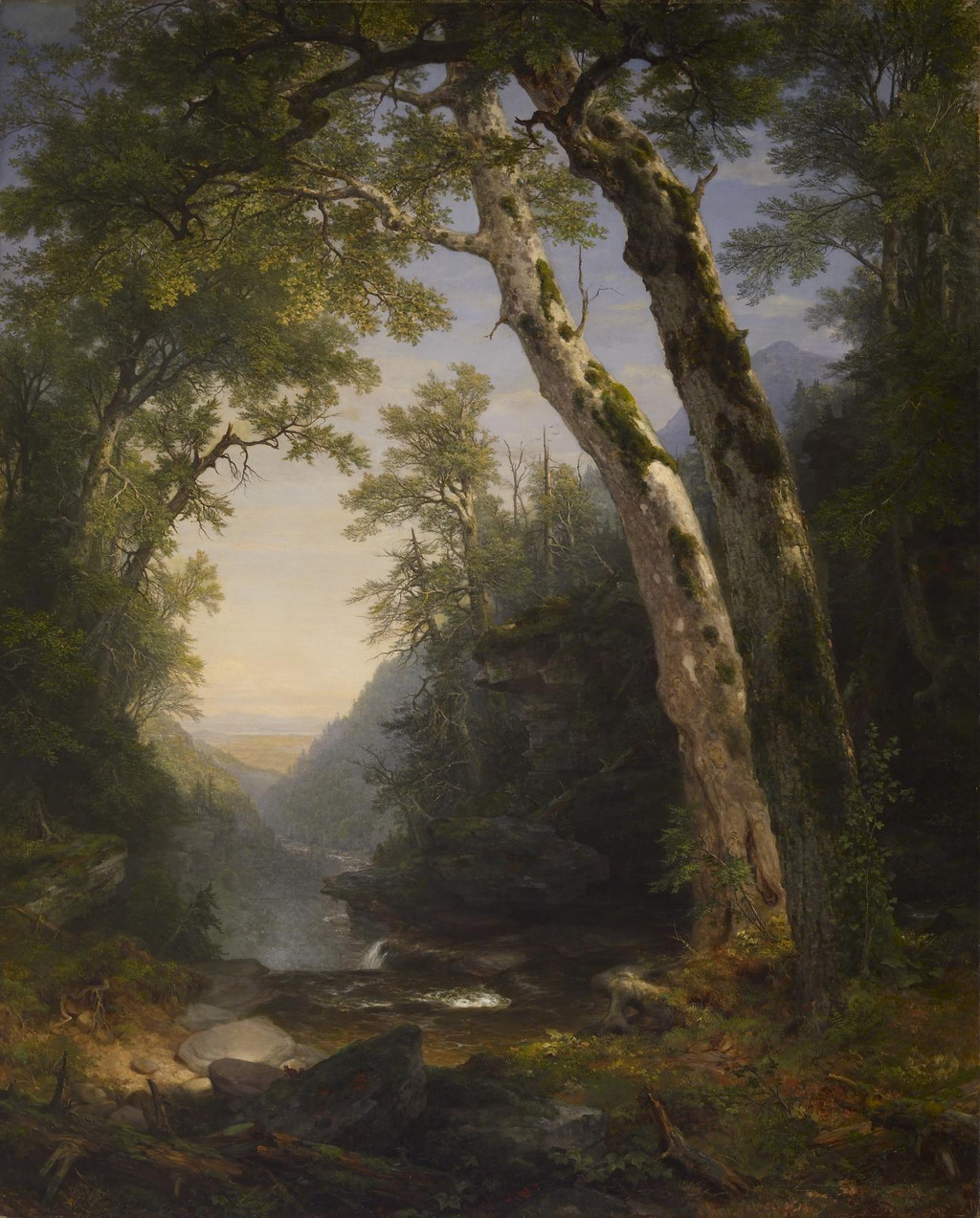
The Catskills
1859 · A rocky stream and pale trunks in a commissioned Plattekill landscape.
Ariadne: Durand’s Engraving after Vanderlyn
1835 · A 1835 engraved sheet after Vanderlyn, with a separate oil-copy comparison.
Signing the Declaration of Independence: Durand’s Print
1823 · An 1823 print after Trumbull’s smaller painting at Yale.
Artworks directory
A collected selection of 19 individually identified paintings, prints and a graphite study, including fifteen dedicated artwork articles. This directory is not a complete catalogue raisonné. Links lead to a companion article where available, otherwise the consulted institutional record. Progress is identified by title, date and museum; an unverified accession is omitted. Unillustrated objects remain searchable.
Frequently Asked Questions
His landscape paintings, including Kindred Spirits, The Beeches and In the Woods, and an earlier distinguished engraving career.[1]
The name groups artists associated with American landscape painting. It is useful for discussing Durand’s work and relationships, rather than functioning as a formal membership register.[2]
Discussion
Look again at the images and ideas explored in Asher Brown Durand. These editorial prompts invite your observations.
Reader Insights
Which landscape best shows the relationship between individual observation and composition?
How does Durand’s engraving career change your view of his later painting?
Which route through the collection would you follow: subjects, regions, media or biography?
Join the Conversation
Share a detail, comparison or question about Asher Brown Durand below.
Explore the wider art history
Explore the wider history of American artists, with portraits, landscapes and changing approaches to modern art.
Explore the Hudson River School, including Durand’s landscape practice and professional networks.
References
- Smithsonian American Art Museum, Asher B. Durand. Complete consulted biography; life and broad career. View source
- Kevin J. Avery, Asher Brown Durand (1796–1886), Met, 2009. Complete essay; painting transition and landscape context. View source
- John Durand, The Life and Times of A. B. Durand, 1894. Selected consulted chapters and Appendix I; early craft, publication, travel and landscape guidance. View source
- Marilyn S. Kushner and Linda S. Ferber, A Master Engraver, 2010. Consulted printed pp.53–55 and notes; early print achievements. View source
- Roberta J. M. Olson, Durand’s Trees as Spiritual Sentinels of Nature, 2010. Consulted printed pp.151–158 and notes; journey and independent studies. View source
- Sarah Barr Snook, Asher B. Durand: A Chronology, 2010. Consulted printed pp.245–246,248–249,251–252; travel, presidency and later work. View source
- Met, American Paintings in The Metropolitan Museum of Art, volume I, The Beeches. Actually consulted printed pp.414 and 416; title, study and composition. View source
- Met, In the Woods, 95.13.1. Current exact object and memorial gift. View source
- Crystal Bridges, Kindred Spirits, 2010.106. Current memorial record and provenance. View source
- Met, Landscape—Scene from Thanatopsis, 11.156. Actually consulted current primary indexed narrative and record. View source
- Walters Art Museum, The Catskills, 37.122. Exact regional subject and commission. View source
- Rebecca Bedell, Asher Durand’s Progress Reconsidered, 2019. Complete article and notes; panorama and patronage interpretation. View source
- Barbara Dayer Gallati, Durand’s Letters on Landscape Painting, 2010. Consulted printed pp.205–210 and notes; literary address and debate. View source
- Kimberly Orcutt, Neither Gone nor Forgotten: Durand’s Later Years, 2010. Consulted printed pp.219–225 and notes; later recognition and final-work dating. View source
- New Britain Museum of American Art, Sunday Morning. Complete consulted essay and notes; 1860 work and title variants. View source
- Chrysler Museum, God’s Judgment Upon Gog. Current exact biblical painting record. View source
- Smithsonian American Art Museum, Dover Plains, Dutchess County, New York. Actually consulted exact object record or bounded contemporary commission notice. View source
- Met, High Point: Shandaken Mountains. Actually consulted exact object record or bounded contemporary commission notice. View source
- Met, River Scene. Actually consulted exact object record or bounded contemporary commission notice. View source
- Met, Summer Afternoon. Actually consulted exact object record or bounded contemporary commission notice. View source
- Anonymous, Domestic Art Gossip, The Crayon 3, no.1 (January1856), p.30. Actually consulted exact object record or bounded contemporary commission notice. View source
- Splash image source.
Asher Brown Durand, Kindred Spirits, 1849. Crystal Bridges Museum of American Art, 2010.106. Commissioned by Jonathan Sturges as a memorial to Thomas Cole and given to William Cullen Bryant. Broad composition shown at its available native resolution. Crystal Bridges Museum of American Art; museum-uploaded open-access reproduction. CC0 / Public domain. Resized only; native appearance, complete carrier and margins preserved.
View source - Kevin J. Avery, “The Hudson River School”, Metropolitan Museum of Art (2004). Origins in 1825 and decline in the 1870s–1880s; c. 1825–1880 is an approximate comparative range. View source
- National Gallery of Art, John Trumbull: 1756–1843. Artist life dates. View source
- Smithsonian American Art Museum, John Vanderlyn: 1775–1852. Artist life dates. View source
- Smithsonian American Art Museum, Asher Brown Durand: 1796–1886. Artist life dates. View source
- Smithsonian American Art Museum, Thomas Cole: 1801–1848. Artist life dates. View source