 by Tom Gurney
Tom Gurney BSc (Hons) is an art history expert with over 20 years experience
Email: tomgurney1@gmail.com / Phone: +44 7429 011000
Progress (The Advance of Civilization) by Asher Brown Durand: Introduction
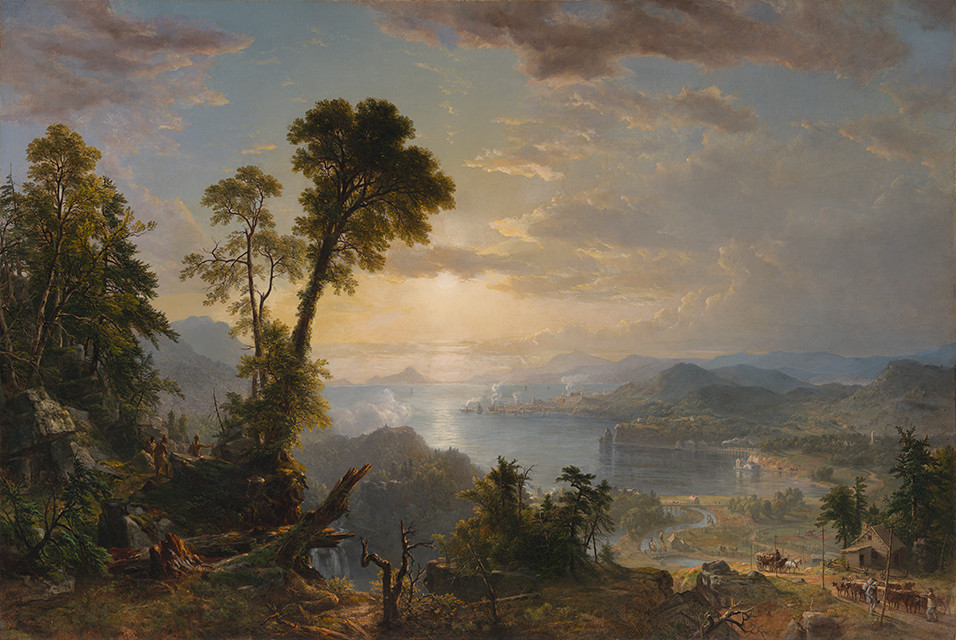
Asher Brown Durand’s Progress (The Advance of Civilization) places a wooded foreground beside a landscape of roads, settlement and transport. Painted in 1853 for Charles Gould, it now belongs to the Virginia Museum of Fine Arts. Its title suggests a direction of historical change, while its composition gives the viewer several places from which to consider that change. Later interpretations have examined both the costs of development and the way its imagined future marginalises Indigenous people.[1][2][3]
At a Glance
- ArtistAsher Brown Durand (1796–1886)
- TitleProgress (The Advance of Civilization)
- Date1853
- MediumOil on canvas
- Dimensions48 × 72 inches, as reported in Rebecca Bedell’s 2019 caption
- CollectionVirginia Museum of Fine Arts, Richmond
- CommissionerCharles Gould
- Museum acquisitionAnonymous gift, announced December 2018
This work across Asher Brown Durand’s career
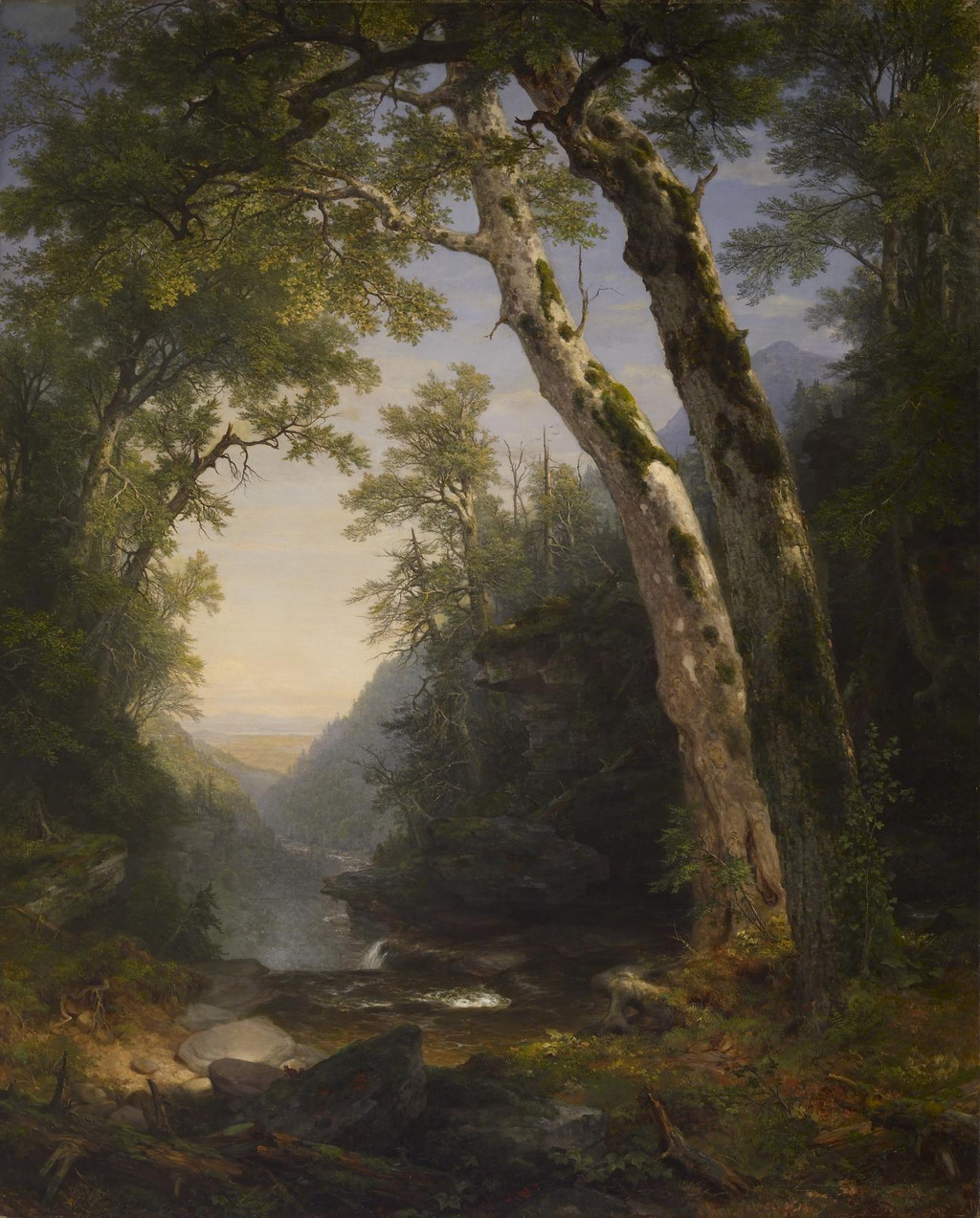
The Beeches
1845Kindred Spirits
1849God’s Judgment Upon Gog
ca.1851–52River Scene
1854In the Woods
1855The Catskills
1859Sunday Morning
1860Summer Afternoon
1865Contents
- A landscape divided by routes
- Woodland and Indigenous figures at the left
- Roads, water and the distant city
- Gould’s commission and the 1853 painting
- Bedell’s 2019 reconsideration
- Entering the museum collection in 2018
- A 2026 Indigenous dialogue at VMFA
- Comparing cultivation across Durand’s landscapes
- Annotated details
A landscape divided by routes
The composition opens from an elevated position overlooking a large expanse of water. Near trees occupy the left, while a road and cleared ground enter at the lower right. Across the water, a settlement spreads along the farther shore. Mountains and a broken cloud field enclose that distance, making the entire scene part of one large landscape.
The arrangement is strongly diagonal. The left foreground rises into dark trees and rock; the right opens toward a lower inhabited slope. The eye can follow these changing levels from close roots and broken trunks to cultivated ground and distant buildings. A road helps establish that movement, giving development a visible route into the picture.
Water provides a broad interval between the near land and the far city. Its relatively quiet surface separates them without breaking the view. The settlement is distant enough to appear as an assembled pattern of buildings, smoke and pale accents, yet substantial enough to act as a destination. Human activity is distributed through depth rather than concentrated in one foreground episode.
The road is only one possible entrance. The left side offers a more enclosed experience of rock, trunks and foliage. We can spend time with these near surfaces before looking outward over the water. This choice matters because a landscape with several viewing routes can sustain more than the movement suggested by its title.
The wide format lets the two sides coexist. A viewer sees wooded height, cleared ground and a distant urban shore in the same glance, then follows their differences more slowly. The painting supplies a continuous space in which contrasting kinds of occupation can be compared.
Annotated Details from Progress (The Advance of Civilization)
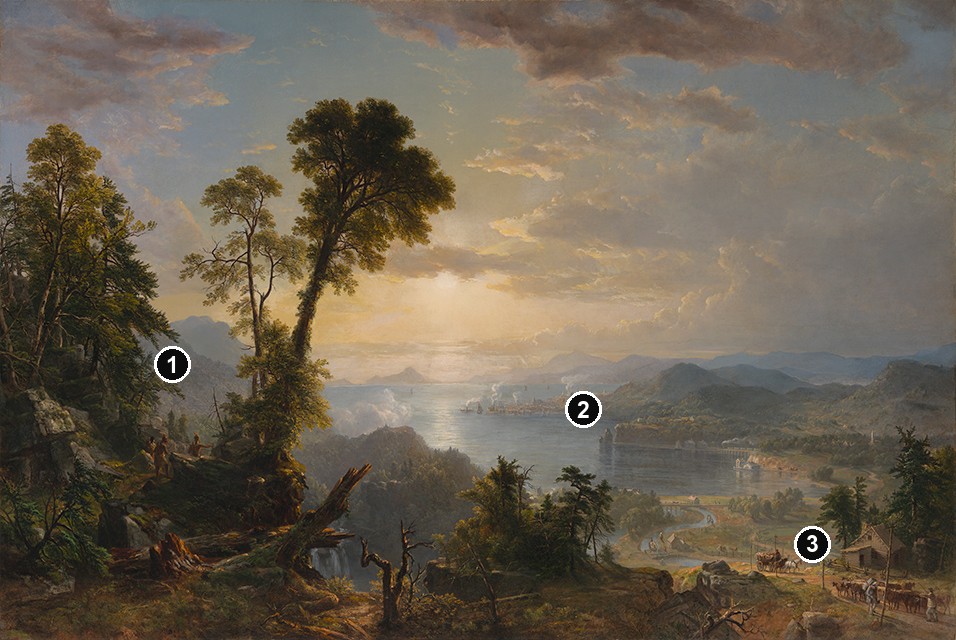
The numbered points identify visible features discussed in this article. Return from each detail to the whole composition. Asher Brown Durand, Progress (The Advance of Civilization), 1853. Oil on canvas. Virginia Museum of Fine Arts; gift of an anonymous donor. Whole museum-origin reproduction, retained at its native size. Virginia Museum of Fine Arts; museum-origin public-domain reproduction via Wikimedia Commons. Image source. Public domain. Resized only; native appearance, complete carrier and margins preserved.
Details from PROGRESS (THE ADVANCE OF CIVILIZATION)
Compare the cropped details with the complete images above. Notice how their colours, shapes and positions contribute to the larger compositions.
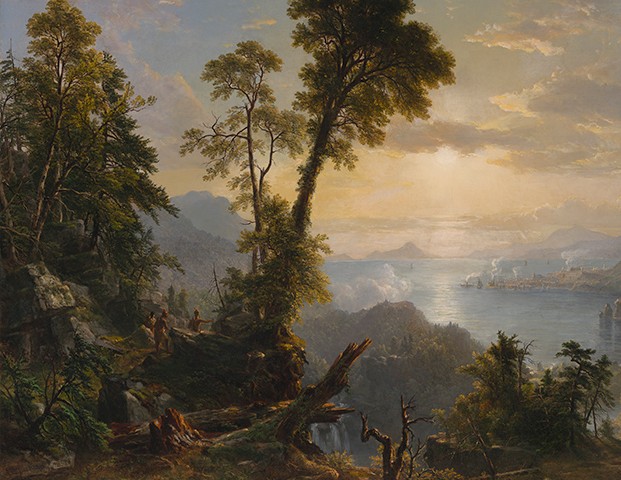
Figures within the left woodland
Small figures occupy a wooded ledge at the left. Their broad setting remains visible here; the image does not establish a specific nation.
Transport and distant settlement
Waterways, vessels and the distant settlement occupy the more open landscape. Their small scale is retained within a broad crop.
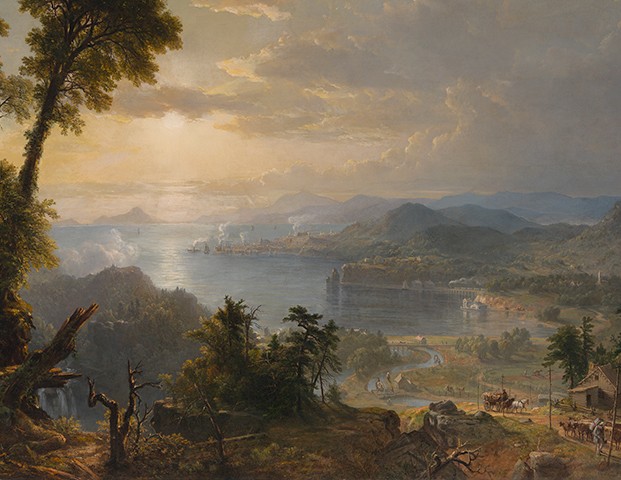
Near road and telegraph route
A road, figures, building and poles enter the right foreground. The crop shows their relationship with the larger panorama.
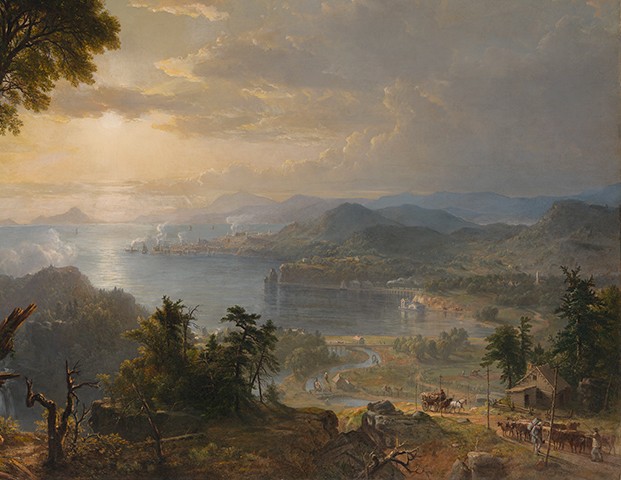
Woodland and Indigenous figures at the left
Large trunks and irregular foliage establish a shaded zone on the left. The trees overlap and rise at different angles; one tall crown stands out against the sky. Lower down, exposed roots, fallen wood and a small cascade make the foreground feel uneven. These near objects require a kind of attention different from the regular road on the opposite side.
A bare, forked piece of wood rises near the middle foreground against the water beyond. Its thin, irregular branches repeat the neighbouring living trees in a reduced form. Nearby fallen trunks expose further changes in the woodland. Together these forms make the near forest a place of growth, breakage and varied surfaces, giving it an internal history before the eye reaches the settlement.
Three Indigenous figures occupy this wooded area, according to the interpretation published by VMFA curators Siera Hyte and Leo Mazow. Their 2026 essay examines the place assigned to them within the painting’s account of historical change.[3]
The figures are small in relation to the trees and the panorama. Their place is within the foreground woodland, with the developed landscape extending across and beyond the water. This positioning makes a question visible: whose presence belongs to the near forest, and whose activity is given room throughout the more distant terrain?
Nothing in an ordinary reproduction establishes the figures’ particular Nation or individual identities. Their generalised role within the composition can be discussed without turning them into representatives of one named community. The scene’s broad historical organisation is clearer than any specific biographical account of the people represented.
The left area is also a place of considerable visual interest. Its alternating light and shade, broken forms and small watercourse can hold the eye on their own. Viewing the painting from that side makes the distant city an object seen from the woods. Following the right road produces a different relationship to the same destination.
Roads, water and the distant city
The lower right contains a road used by people and animals beside a cabin. Thin vertical poles continue its direction. Beyond that near stretch, a curving channel leads the eye toward further construction and the far shore. Rebecca Bedell’s account identifies a canal, a railway viaduct and telegraph poles among the painting’s technologies.[1]
These elements differ in the kinds of movement they suggest. A road carries traffic over land; a canal makes water part of a built route; a railway introduces another line across the terrain. Telegraph poles add a means of communication whose effect extends beyond the people physically visible beside them. The painting gathers these systems into one panorama.
The human scale varies accordingly. Near the road, travellers and animals can be distinguished as separate forms. Across the water, the city is read through its concentration of buildings and activity. The movement from one level to the other turns individual travel into a larger pattern of settlement and exchange.
Trees remain on the developed side, but they occupy a more open landscape. Around the road and cabin, their intervals allow ground and structures to show through. Compared with the crowded left woodland, the right side makes the passage of people and the reach of built routes easier to follow.
The sky connects these different uses of land. Cloud passes over the forest and the distant settlement alike, and light creates openings across the whole view. The technologies receive their place within that larger atmosphere. Their appearance is shaped by the landscape’s depth and light as well as by their individual forms.
Gould’s commission and the 1853 painting
VMFA’s acquisition announcement identifies the commissioner as Charles Gould, a financier and industrialist. The commission places the painting within a relationship between an artist and a patron whose activities were connected with the developing economy represented in the scene.[2]
Bedell notes that correspondence initiating the commission has not survived. She discusses later letters between Gould and Durand and proposes that the subject may have originated with the patron. The evidence allows the commission to be stated securely while leaving the degree of Gould’s direction open.[1]
That gap gives the title and finished composition particular importance. They are the surviving public form of the work’s argument, although they cannot supply a complete account of the conversations that preceded it. A patron’s occupation provides context for a commissioned picture; it does not by itself record every decision that the painter made.
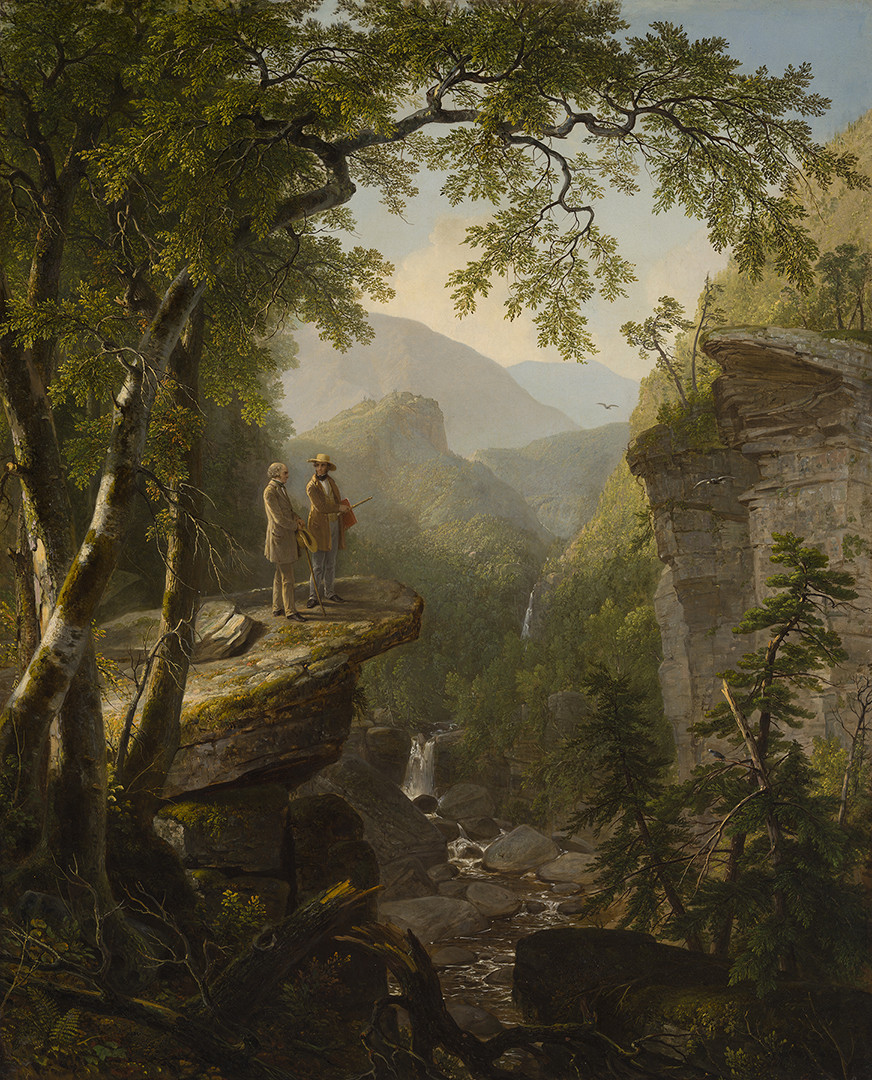
The 1853 date also belongs to the middle of Durand’s mature landscape career. His Kindred Spirits had placed named friends within a composed Catskill landscape in 1849.[6] Progress takes a broader view of human activity, distributing figures, buildings and routes across a panoramic setting. The different arrangements suggest how much a landscape’s emphasis can change with its purpose.
Watch: Asher Brown Durand
Choose a film to explore the artist’s work, its interpretation and its wider setting.
Friendship and landscape, Asher B Durand's Kindred Spirits
Smarthistory and Crystal Bridges discuss friendship, memory and landscape in Kindred Spirits.
Watch on YouTubeBedell’s 2019 reconsideration
In 2019 Rebecca Bedell challenged readings of Progress as an uncomplicated celebration of development. She considered the fate of trees, alternative entrances into the picture and Durand’s wider preference for wooded and pastoral subjects. Her argument places regret alongside the apparent promise of the technological panorama.[1]
This is a scholarly interpretation of the work, with reasons drawn from its composition and historical context. It encourages the viewer to notice what survives beside the road as well as where the road goes. The balance between the two sides becomes a subject for inquiry rather than a settled instruction to move from one to the other.
An important chronological distinction accompanies that inquiry: Durand’s documented railroad-bond purchase was in 1856, after the painting. It cannot explain the 1853 commission as a pre-existing investment by the artist.[1]
Looking closely can keep several questions in play at once. The distant city may appear bright and extensive, while the near trees offer a more intimate place of attention. The road provides access and order, while the foreground woodland retains irregularity and depth. We can compare the attractions assigned to each without making either a complete statement of Durand’s personal beliefs.
The work’s importance partly comes from this capacity to sustain rereading. An apparently clear title invites a first account of movement toward civilisation. A longer encounter with the picture reveals where that account directs attention and what remains beside it. Interpretation develops through the relation between the title and the visual choices on the canvas.
Entering the museum collection in 2018
VMFA announced the painting’s anonymous gift on 13 December 2018, following approval by its trustees the previous day. The announcement describes its entry into public ownership after a history in private collections.[2]
The gift gave the work a permanent public institutional home. A museum collection also permits continuing comparison with other artists and periods. Progress can be considered within nineteenth-century landscape painting and placed in conversation with works that challenge the historical relationships it depicts.
The painting’s public life therefore continues beyond the argument first suggested by its title. Exhibitions, scholarship and new displays can ask different questions of the same physical canvas. Its foreground, distant settlement and Indigenous figures remain available to viewers who bring new concerns about land, history and representation.
A 2026 Indigenous dialogue at VMFA
In their 2026 essay, Hyte and Mazow describe placing Jaune Quick-to-See Smith’s Making Medicine: Coyote (Going Forward, Looking Back), 2024–25, in front of Progress, giving Indigenous and American art equal prominence.[3]
They read Durand’s Indigenous figures as assigned to a past displaced by an industrial future. Smith foregrounds Coyote, a figure in Salish creation stories, amid colonial and environmental debris filling a monumental canoe. The curators emphasise living Indigenous cultures, sovereign nations and resistance.[3]
The installation makes an Indigenous artist an active participant in interpreting the panorama. The essay documents that curatorial dialogue at its publication date; Durand’s commissioning conversations remain unrecorded.
Comparing cultivation across Durand’s landscapes
The First Harvest in the Wilderness, 1855, offers a closer view of changed land. A family, cabin, stumps and cultivated clearing occupy a landscape still surrounded by forest. Brooklyn Museum curator Karen Sherry relates it to James John Graham’s memorial commission and to the cultural meaning of the pioneer.[4]
The contrast concerns scale as much as subject. In First Harvest, work is organised around a small clearing and household. In Progress, multiple systems extend through a broad region, connecting a near road with a far urban shore. The first invites close attention to a beginning; the second places beginnings within a sweeping account of change.
Dover Plains, Dutchess County, New York, 1848, provides another form of inhabited country. Its fields and foreground spectators belong to a specific regional title, while Progress builds a panorama around historical and technological relationships. The Smithsonian identifies the 1848 canvas as a separate work in its collection, accession 1978.126.[5]
Taken together, these pictures make human occupation a varied part of Durand’s landscape art. Cultivation can appear as a settled valley, an initial clearing or a network of transport and industry. Progress gives that network an unusually expansive form, and its arrangement continues to raise questions about who is allowed to inhabit its imagined future.
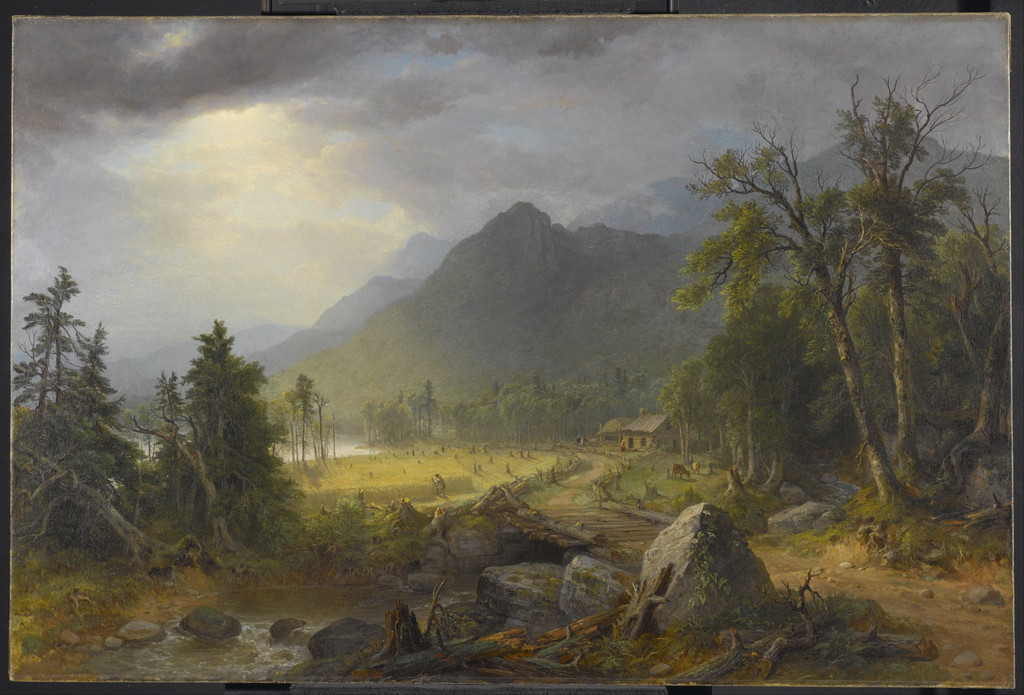
Asher Brown Durand, The First Harvest in the Wilderness, 1855. Oil on canvas. Brooklyn Museum, 97.12. Graham memorial commission. Brooklyn Museum / Google Art Project. Image source. Public domain. Resized only; native appearance, complete carrier and margins preserved.
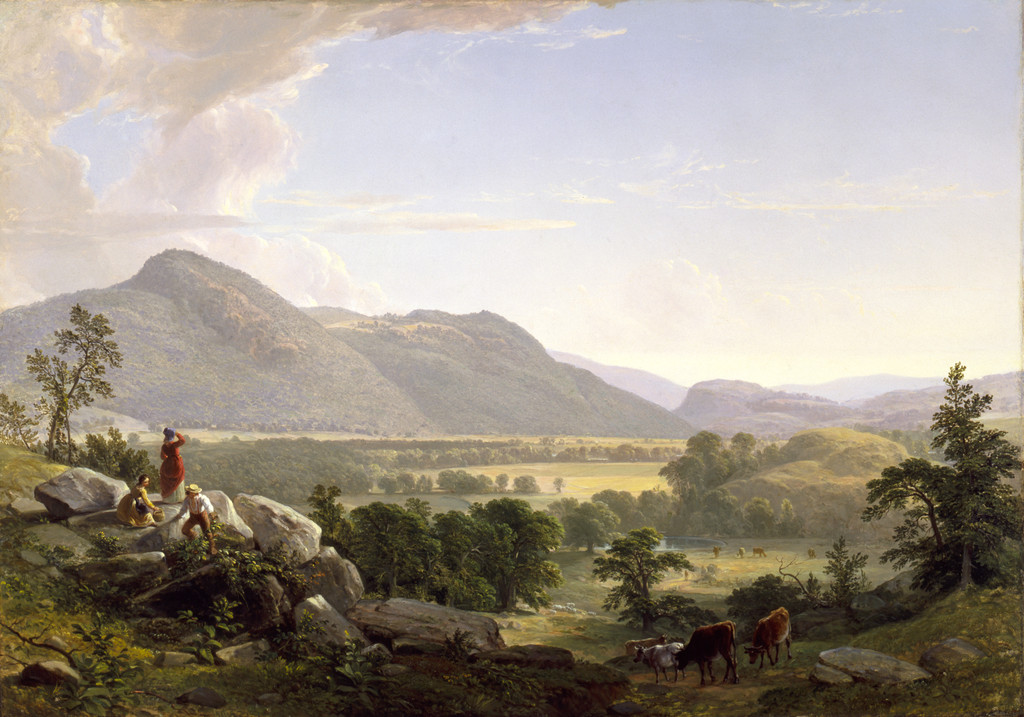
Asher Brown Durand, Dover Plains, Dutchess County, New York, 1848. Oil on canvas. Smithsonian American Art Museum, 1978.126. Image source. CC0 / Public domain. Resized only; native appearance, complete carrier and margins preserved.
Artworks directory
A collected selection of 19 individually identified paintings, prints and a graphite study, including fifteen dedicated artwork articles. This directory is not a complete catalogue raisonné. Links lead to a companion article where available, otherwise the consulted institutional record. Progress is identified by title, date and museum; an unverified accession is omitted. Unillustrated objects remain searchable.
Frequently Asked Questions
It belongs to the Virginia Museum of Fine Arts in Richmond, following an anonymous gift announced in December 2018. Collection membership does not guarantee a particular current display location.[2]
Discussion
Look again at the images and ideas explored in Progress (The Advance of Civilization) by Asher Brown Durand. These editorial prompts invite your observations.
Reader Insights
Which side of the painting offers the strongest invitation to enter, and why?
How do the road and the wooded foreground offer different positions for viewing the distant settlement?
What changes when a contemporary Indigenous artwork participates in the interpretation of this panorama?
Join the Conversation
Share a detail, comparison or question about Progress (The Advance of Civilization) by Asher Brown Durand below.
References
- Rebecca Bedell, “Asher Durand’s Progress Reconsidered,” Panorama 5, no. 1, Spring 2019. Complete ten-page article and notes consulted. DOI 10.24926/24716839.1688. Commission uncertainties and interpretive arguments distinguished from recorded artist intention; 1856 investment postdates the painting. View source
- Virginia Museum of Fine Arts, Progress acquisition announcement, 13 December 2018. Main primary museum announcement consulted through indexed text; direct PDF currently redirects. Public ownership refers to collection history. View source
- Siera Hyte and Leo Mazow, “American and Indigenous American Art at the Virginia Museum of Fine Arts, Richmond,” Panorama 12, no. 1, Spring 2026. Full main essay and citation consulted. DOI 10.24926/24716839.21029. VMFA curators’ account of the installation and interpretation; contemporary sculpture and installation photographs are not reproduced. View source
- Karen Sherry, “First Harvest,” Brooklyn Museum. Complete accessible essay and notes consulted; Graham commission, pioneer imagery and memorial interpretation. View source
- Smithsonian American Art Museum, Dover Plains, Dutchess County, New York, accession 1978.126. Complete current object record consulted. View source
- Crystal Bridges Museum of American Art, Kindred Spirits, accession 2010.106. Complete current object record and commemorative narrative consulted for the 1849 comparison. View source
- Splash image source.
Asher Brown Durand, Progress (The Advance of Civilization), 1853. Oil on canvas. Virginia Museum of Fine Arts; gift of an anonymous donor. Whole museum-origin reproduction, retained at its native size. Virginia Museum of Fine Arts; museum-origin public-domain reproduction via Wikimedia Commons. Public domain. Resized only; native appearance, complete carrier and margins preserved.
View source