 by Tom Gurney
Tom Gurney BSc (Hons) is an art history expert with over 20 years experience
Email: tomgurney1@gmail.com / Phone: +44 7429 011000
Durand, Thomas Cole and William Cullen Bryant: Introduction
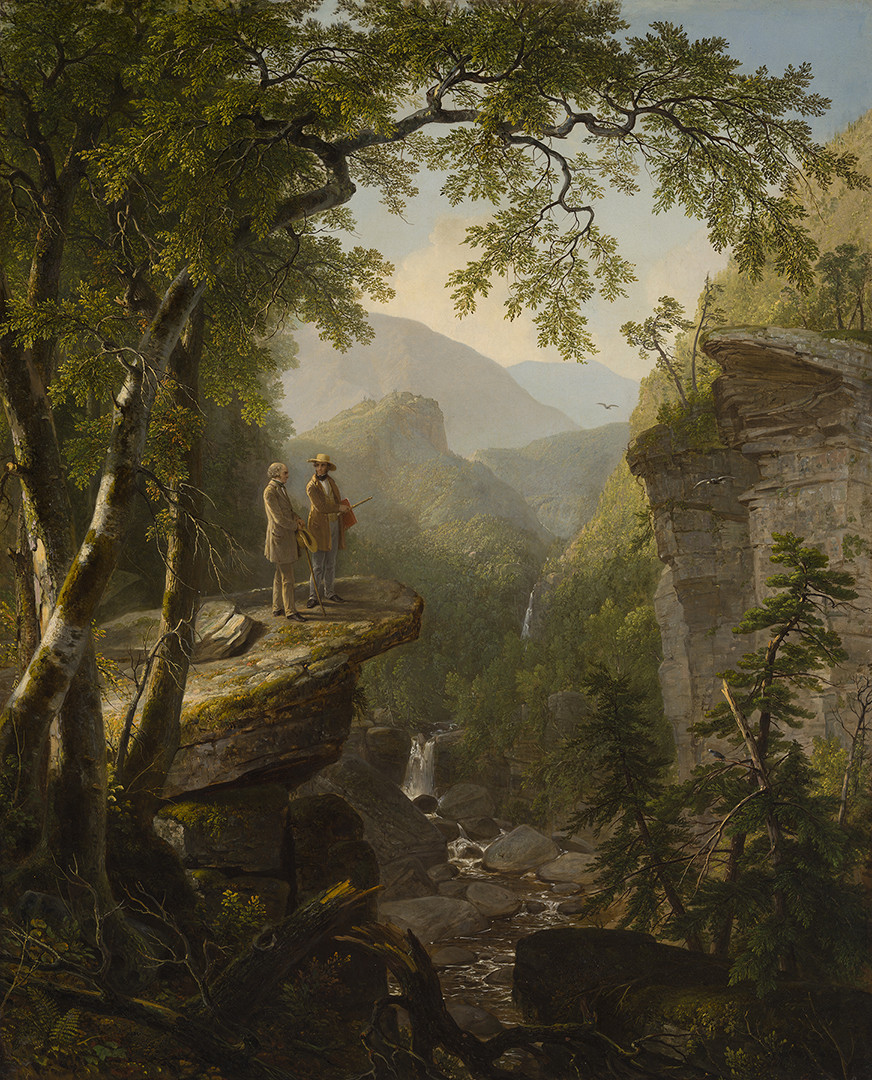
Asher Brown Durand’s Kindred Spirits brings Thomas Cole and William Cullen Bryant together on a rocky ledge within a wooded gorge. One was a painter, the other a poet, and both were connected with Durand’s artistic life. The landscape around them turns their imagined conversation into a memorial whose meaning extends beyond the two small portraits.[3]
Durand painted the work in 1849 after Cole’s death. Jonathan Sturges commissioned it and gave it to Bryant. Friendship, patronage and the shared attention of writers and painters to nature all contributed to the picture’s purpose.[2]
At a Glance
- Asher Brown DurandPainter and printmaker, 1796–1886
- Thomas ColePainter and Durand’s friend, 1801–1848
- William Cullen BryantPoet, writer and recipient of the memorial, 1794–1878
- Jonathan SturgesCommissioner of Kindred Spirits
- Main workKindred Spirits, 1849, Crystal Bridges Museum of American Art
- Related workLandscape—Scene from Thanatopsis, 1850, Metropolitan Museum of Art
- Earlier collaborationBryant’s text and Durand’s involvement in The American Landscape, 1830
Contents
- Cole and Durand as travelling artists
- Bryant’s writing and the circulation of landscape
- Cole’s death and Sturges’s gift
- Two figures within an extensive gorge
- A constructed place and a shared title
- Thanatopsis: poetry without Bryant’s portrait
- Patronage and the movement into public collections
- Annotated details
Cole and Durand as travelling artists
Cole and Durand’s relationship included a shared sketching journey to the Adirondacks in 1837. Olson connects this episode with Durand’s growing commitment to landscape and his studies of individual trees. The trip belongs to a specific region and practice, preceding the later memorial canvas.[1]
Travelling together provided opportunities to encounter forms at close range. Trees, rocks and water could be examined before becoming parts of a finished picture. The relationship between the artists therefore concerned work and observation as well as personal association.
Durand’s later reputation should nevertheless retain its own character. A shared interest in nature did not require the two painters to organise every landscape alike. Their association can be understood without turning Durand into a studio pupil whose work simply repeated Cole’s.
The memorial’s painted conversation looks back on that friendship after Cole’s death. It gives the artist a place within the landscape he valued, while placing Bryant beside him as another person who found meaning in the same country.
Annotated Details from Durand, Thomas Cole and William Cullen Bryant
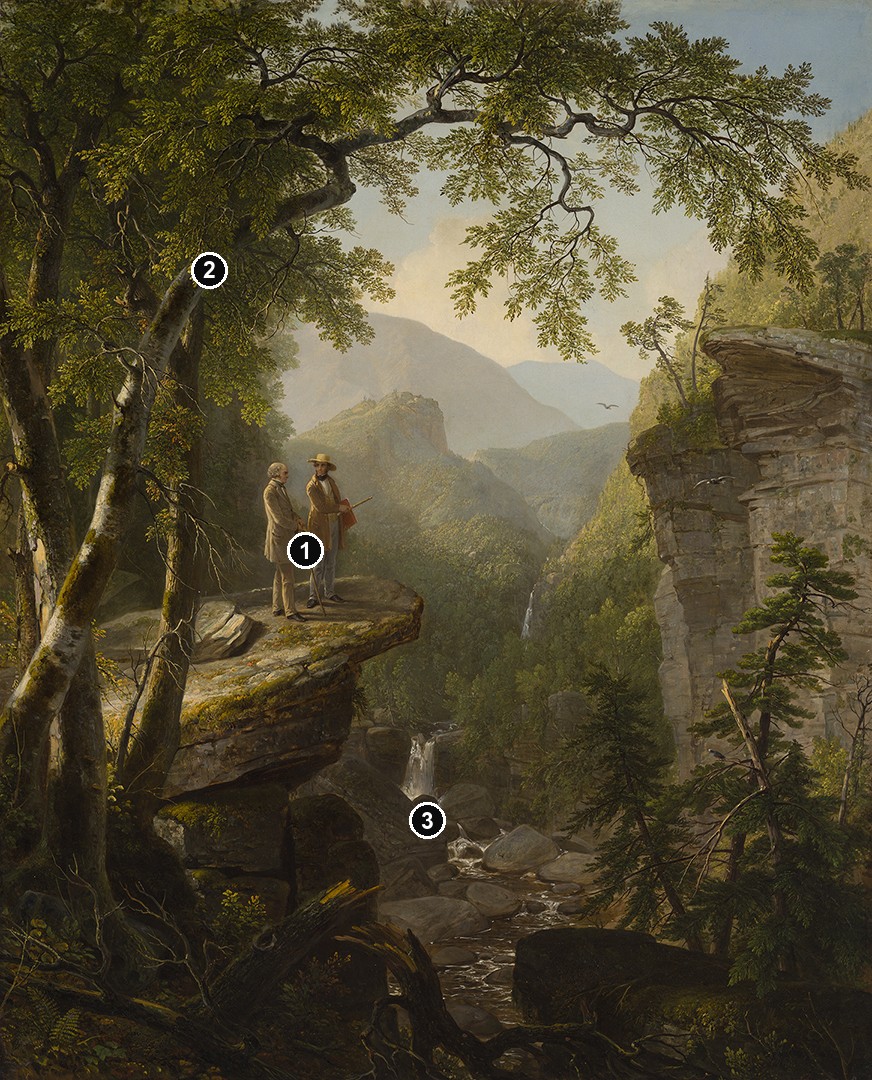
The numbered points identify visible features discussed in this article. Return from each detail to the whole composition. Asher Brown Durand, Kindred Spirits, 1849. Crystal Bridges Museum of American Art, 2010.106. Commissioned by Jonathan Sturges as a memorial to Thomas Cole and given to William Cullen Bryant. Broad composition shown at its available native resolution. Crystal Bridges Museum of American Art; museum-uploaded open-access reproduction. Image source. CC0 / Public domain. Resized only; native appearance, complete carrier and margins preserved.
Details from DURAND, THOMAS COLE AND WILLIAM CULLEN BRYANT
Compare the cropped details with the complete images above. Notice how their colours, shapes and positions contribute to the larger compositions.
Two men on the ledge
Two small standing figures occupy an open rock ledge above the gorge. The broad crop retains their relationship with the surrounding landscape; tiny facial details are not inferred.
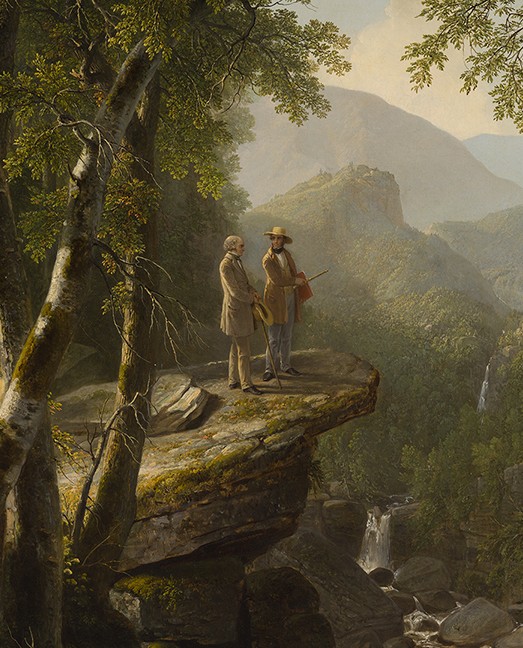
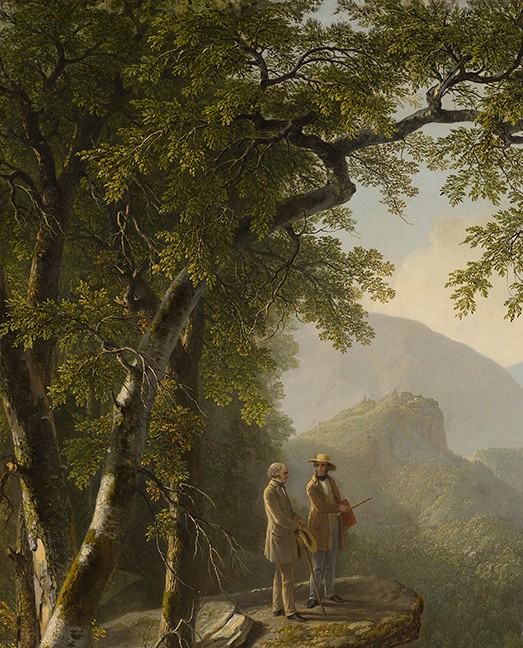
Enclosing tree and branches
A large near trunk and spreading branches enclose the figures’ space. Their darker forms frame the brighter distant opening.
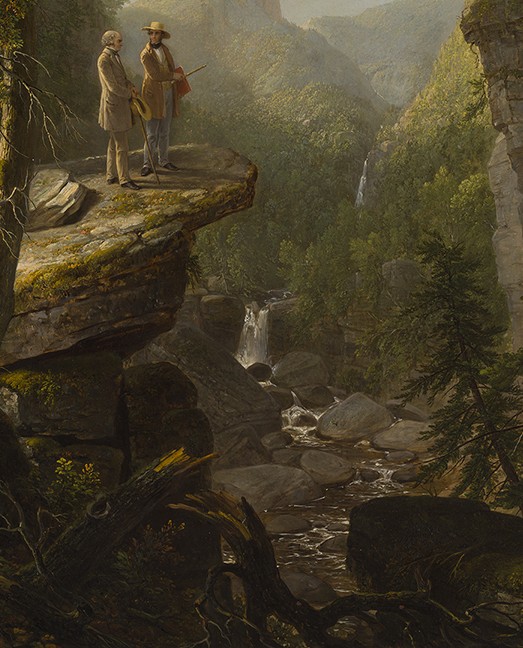
Water descending through the gorge
A pale fall and rocky watercourse continue below the ledge. The broad view connects water with the depth of the gorge.
Bryant’s writing and the circulation of landscape
Bryant’s relation to Durand extended beyond his appearance in Kindred Spirits. John Durand’s memoir records the poet’s descriptive text and prospectus for The American Landscape, 1830. The publication joined engraved scenery with historical and topographical writing.[2]
The prospectus sought readers who would value well-made views of American country. Its argument gave the selection of scenery a cultural purpose, while the publication’s pictures offered a means of circulating those places beyond the people who had visited them.
This collaboration places painting, printmaking and writing within a shared undertaking. An image could show a view, while text helped identify and interpret its setting. Durand’s early landscape interests belonged partly to this world of printed objects and their readers.
John records that only one number appeared and describes its commercial failure. The disappointment did not erase the connection between landscape images and literary attention. It remains an earlier episode in a relationship that later took the form of a painted memorial.
Cole’s death and Sturges’s gift
Crystal Bridges identifies Kindred Spirits as a tribute to Cole, who died in 1848. Its current provenance records Sturges’s commission and the gift to Bryant in 1849. John’s memoir also lists the painting under that year and names its commissioner and recipient.[3][2]
The gift’s direction matters. Durand made the picture, Sturges enabled the commission and Bryant received it. These roles place the object within a network rather than making it solely a private expression by its painter.
Sturges’s involvement also continued elsewhere in Durand’s career. John names him in connection with God’s Judgment Upon Gog and In the Woods. The memoir describes those works under different subjects and circumstances, showing a patron interested in more than one kind of landscape.[2]
The memorial’s particular purpose should remain distinct from those later commissions. Its two figures and commemorative setting address the relationship between Cole and Bryant. Another Sturges painting need not carry the same meaning simply because it shared a patron.
Two figures within an extensive gorge
In Kindred Spirits, the men occupy a projecting rock above the wooded depth. The ledge provides enough open space for their small forms to remain readable. Large trees and branches surround them, while water and distant mountains extend the scene beyond their immediate position.
The museum-authored account on Google Arts & Culture identifies Cole with a sketchbook and a flute or recorder. Bryant faces him within the imagined exchange. These details relate the portraits to artistic and literary activity without supplying words for their conversation.[4]
The arrangement gives the men both prominence and modest scale. They stand where the viewer can locate them, yet the landscape remains far larger. Their relationship with the environment is made visible through this balance.
The painting’s inscriptions also preserve their identities. Crystal Bridges records the names Bryant and Cole separately from Durand’s lower-left signature and date. The written names and the portraits contribute different forms of recognition.[3]
The reproduced native image is sufficient for the broad composition. Its limited size should not encourage an invented reading of every tiny mark or facial expression. The current museum’s inscription record supplies the stronger evidence for the names.
Watch: Asher Brown Durand
Choose a film to explore the artist’s work, its interpretation and its wider setting.
Friendship and landscape, Asher B Durand's Kindred Spirits
Smarthistory and Crystal Bridges discuss friendship, memory and landscape in Kindred Spirits.
Watch on YouTubeA constructed place and a shared title
The scene’s rocks, trees and waterfall establish a recognisable mountain environment, but the painting also has the structure of a designed memorial. Its foreground ledge and distant opening place the two men within an extensive prospect rather than a narrowly documented location.
Crystal Bridges’ museum-authored account describes the work as an elegy and relates its movement from darker enclosure toward open sky to cycles of nature and human life. This is an institutional interpretation of the composition, not a surviving instruction from Sturges dictating every feature.[4]
The title directs attention toward affinity. Cole and Bryant appear together, while the commission also connects Durand and Sturges with their shared interest in nature. The picture can be read through this broader association without requiring its landscape to reproduce one actual gathering.
The consulted evidence here does not establish a particular literary quotation as the title’s direct origin. The article therefore keeps the title’s meaning attached to the documented relationships and the painted scene rather than claiming an unverified derivation.
Thanatopsis: poetry without Bryant’s portrait
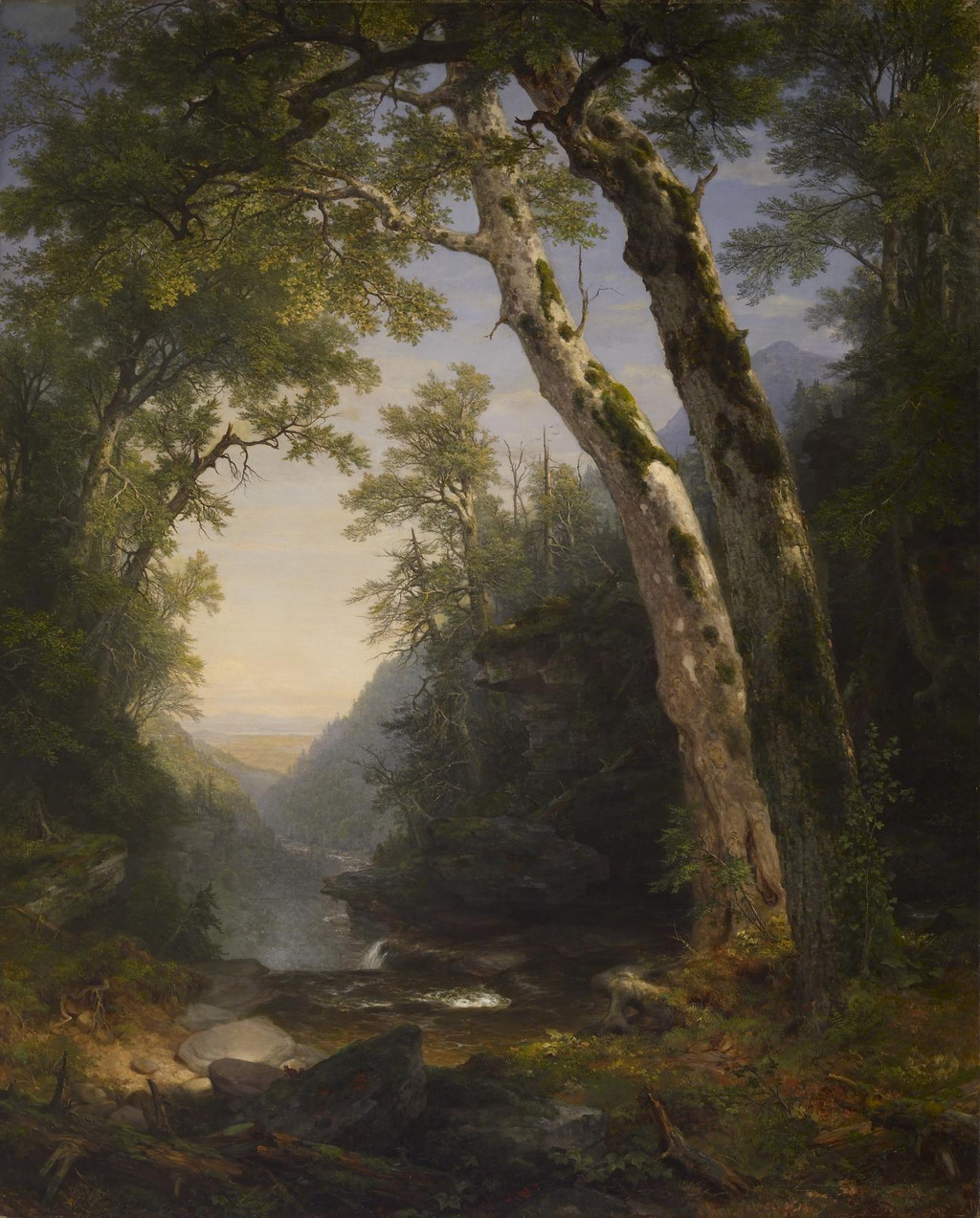
Landscape—Scene from Thanatopsis, 1850, offers a different connection with Bryant. The Met identifies the painting as inspired by his poem and relates its funeral, agricultural work and historical ruins to nature and the inevitability of death.[5]
Bryant’s 1821 poem considers mortality through the earth, trees, water and successive generations of people. The complete consulted transcription gives this meditation a much greater extent than any one landscape can illustrate literally.[6]
Durand’s painting brings different activities into one continuous setting. Agricultural work occupies the near ground, while a funeral proceeds elsewhere and remains of earlier structures add another measure of time. The landscape contains these elements without requiring Bryant himself to stand within it.
The contrast with Kindred Spirits is useful. One work presents a poet as a figure in a memorial; the other communicates a relationship with his writing through its activities and forms. Literature can enter a painting by several routes.
The consulted poem is the 1821 version, presented through a transcription. That source does not prove which edition Durand used when making the canvas. The comparison concerns the broad meditation and the museum’s documented identification of the painted subject.
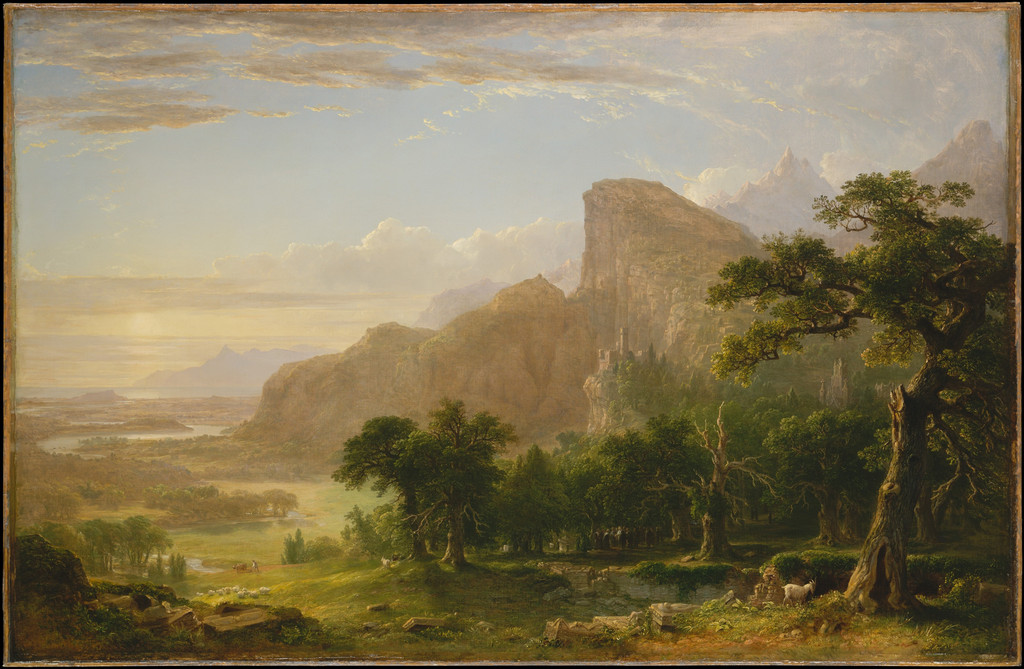
Asher Brown Durand, Landscape—Scene from Thanatopsis, 1850. Metropolitan Museum of Art, 11.156. Gift of J. Pierpont Morgan, 1911. Its literary relationship with Bryant is conveyed through the landscape’s activities and ruins. The Metropolitan Museum of Art. Image source. CC0 / Public domain. Resized only; native appearance, complete carrier and margins preserved.
Patronage and the movement into public collections
The two paintings also followed different collecting histories. Crystal Bridges records Kindred Spirits passing from Bryant to his daughter Julia in 1878, then to the New York Public Library in 1904. Its provenance includes the 2005 sale and acquisition through a private foundation for Crystal Bridges.[3]
The Met records Thanatopsis as a gift of J. Pierpont Morgan in 1911. Its account also places the painting earlier within the American Art-Union’s distribution of works to subscribers.[5]
These histories changed the circumstances of viewing. A gift made for one recipient could become part of a public collection, while a landscape distributed through an art organisation could acquire new owners and eventually a museum setting.
The movement does not remove the original relationships. It gives later readers and viewers access to pictures shaped by friendship, writing and patronage. Keeping the exact objects and their histories distinct allows those relationships to remain clear even as both works become part of a broader public account of American landscape art.
Artworks directory
A collected selection of 19 individually identified paintings, prints and a graphite study, including fifteen dedicated artwork articles. This directory is not a complete catalogue raisonné. Links lead to a companion article where available, otherwise the consulted institutional record. Progress is identified by title, date and museum; an unverified accession is omitted. Unillustrated objects remain searchable.
Frequently Asked Questions
Thomas Cole and William Cullen Bryant. The museum records their names within the painting’s inscriptions and identifies its memorial purpose.[3]
Its relationship with Bryant concerns the poem. The museum explains the landscape’s funeral, work and ruins through that literary subject.[5]
Discussion
Look again at the images and ideas explored in Durand, Thomas Cole and William Cullen Bryant. These editorial prompts invite your observations.
Reader Insights
How does the men’s small scale affect the memorial’s relationship with nature?
What changes when a poet appears as a figure rather than through the subject of his writing?
How do the commissioner, painter and recipient each contribute to the history of a gift?
Join the Conversation
Share a detail, comparison or question about Durand, Thomas Cole and William Cullen Bryant below.
References
- Roberta J. M. Olson, “A Magnificent Obsession”: Durand’s Trees as Spiritual Sentinels of Nature (2010). Consulted printed pp.151–158 and notes; 1837 Adirondack journey with Cole. View source
- John Durand, The Life and Times of A. B. Durand (1894). Selected printed pp.72–74 and 173–175: Bryant’s landscape publication, memorial gift and Sturges commissions. View source
- Crystal Bridges Museum of American Art, Kindred Spirits, 2010.106. Current object record, inscriptions and provenance; Bryant’s death date follows the provenance’s 1878 entry. View source
- Crystal Bridges museum-authored Kindred Spirits entry on Google Arts & Culture. Figure attributes and institutional interpretation of the memorial landscape. View source
- Metropolitan Museum of Art, Landscape—Scene from Thanatopsis, 11.156. Actually consulted current primary indexed record and narrative; literary subject, Academy exhibition, Art-Union distribution and acquisition. View source
- William Cullen Bryant, Thanatopsis, in Poems (1821), Wikisource transcription. Complete consulted 1821 text; no assertion that Durand used this exact edition. View source
- Splash image source.
Asher Brown Durand, Kindred Spirits, 1849. Crystal Bridges Museum of American Art, 2010.106. Commissioned by Jonathan Sturges as a memorial to Thomas Cole and given to William Cullen Bryant. Broad composition shown at its available native resolution. Crystal Bridges Museum of American Art; museum-uploaded open-access reproduction. CC0 / Public domain. Resized only; native appearance, complete carrier and margins preserved.
View source