


 by Tom Gurney
Tom Gurney BSc (Hons) is an art history expert with over 20 years experience
Email: tomgurney1@gmail.com / Phone: +44 7429 011000
Asher Brown Durand Paintings: Introduction
Asher Brown Durand’s paintings range from open valleys and historical panoramas to woodland interiors dominated by individual trees. Some respond to poetry or commemorate a friend; others organise cattle, fields, streams and distant mountains into scenes of everyday life. Their differences give a fuller account of his work than a single familiar image.[1]
This selection follows thirteen exact landscape paintings with dedicated articles. It offers routes through their subjects and compositions, while the linked records distinguish related titles, dates and collections. Durand’s prints and figure paintings belong to other parts of his career and receive separate treatment.
Selected Asher Brown Durand paintings
At a Glance
- ArtistAsher Brown Durand, 1796–1886
- Main medium hereOil painting
- MemorialKindred Spirits, 1849
- Historical panoramaProgress, 1853
- Tree landscapesThe Beeches, 1845, and In the Woods, 1855
- Literary subjectLandscape—Scene from Thanatopsis, 1850
- Regional subjectsDover Plains, High Point and the Catskills
- ScopeSelected works, with an object directory; not a complete catalogue
Contents
- A selection rather than a complete catalogue
- Memorial and literary landscapes
- Cultivated valleys and regional views
- Trees and enclosed woodland
- Progress and a clearing in the wilderness
- Pastoral scenes and Sunday rest
- Biblical landscape and the range of Durand’s art
- Where the prints belong
- Annotated details
A selection rather than a complete catalogue
Durand’s landscape career developed alongside portraits, printmaking and drawings. Avery’s Met biography describes the growth of painting during the 1830s and the importance of European travel, native scenery and Academy activity. This history helps explain why the mature landscapes contain both close observation and carefully organised forms.[1]
The selected pictures also entered collections through different routes. Commissions, gifts and purchases are part of their histories, rather than incidental information beneath an image. A memorial commissioned for a named recipient and a pastoral landscape made for a collector could address different expectations.
The directory identifies objects by title, date and collection. It includes additional comparison records where suitable images or detailed articles are unavailable. That distinction keeps the displayed selection useful without turning it into an unsupported inventory of everything Durand painted.
Annotated Details from Asher Brown Durand Paintings
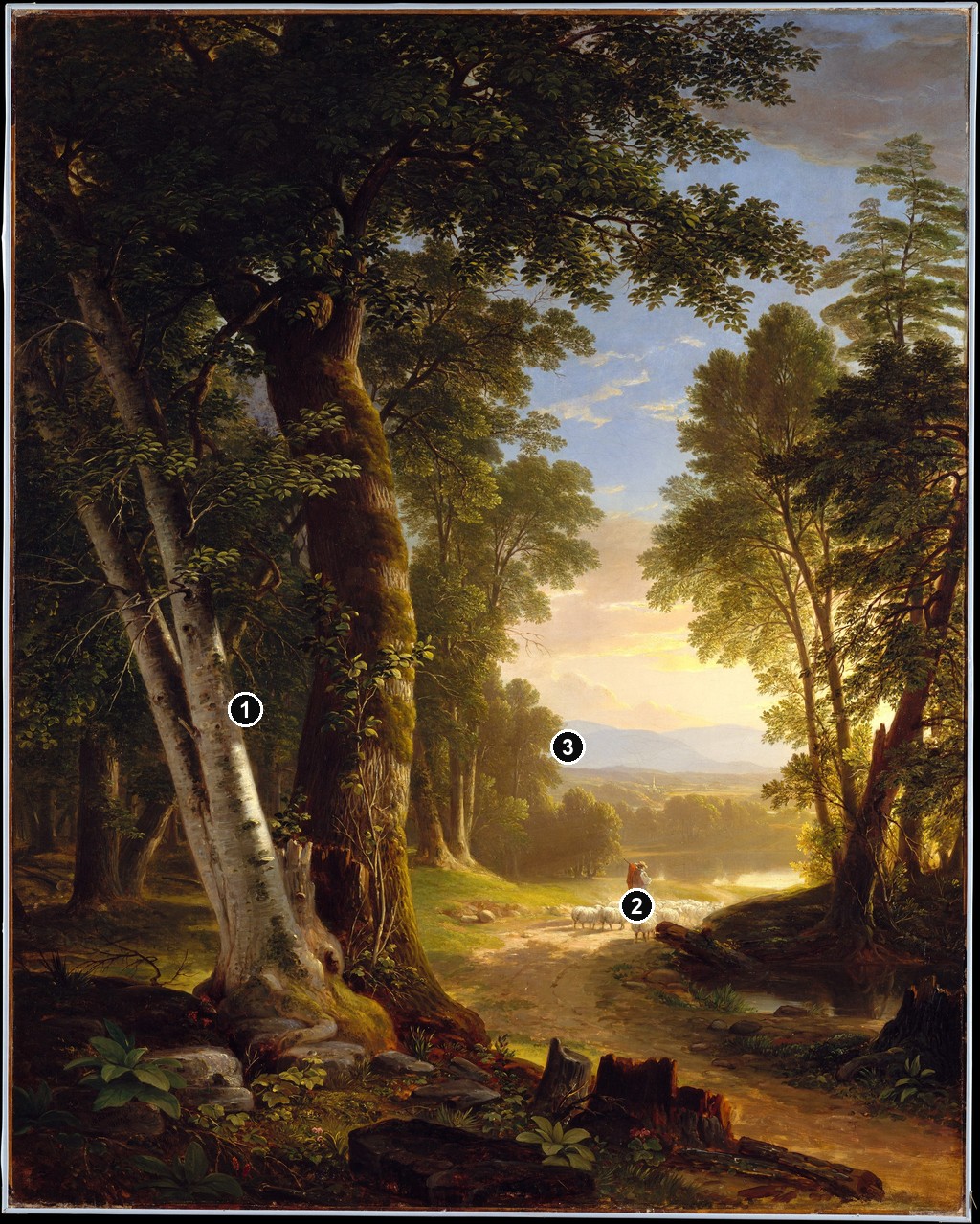
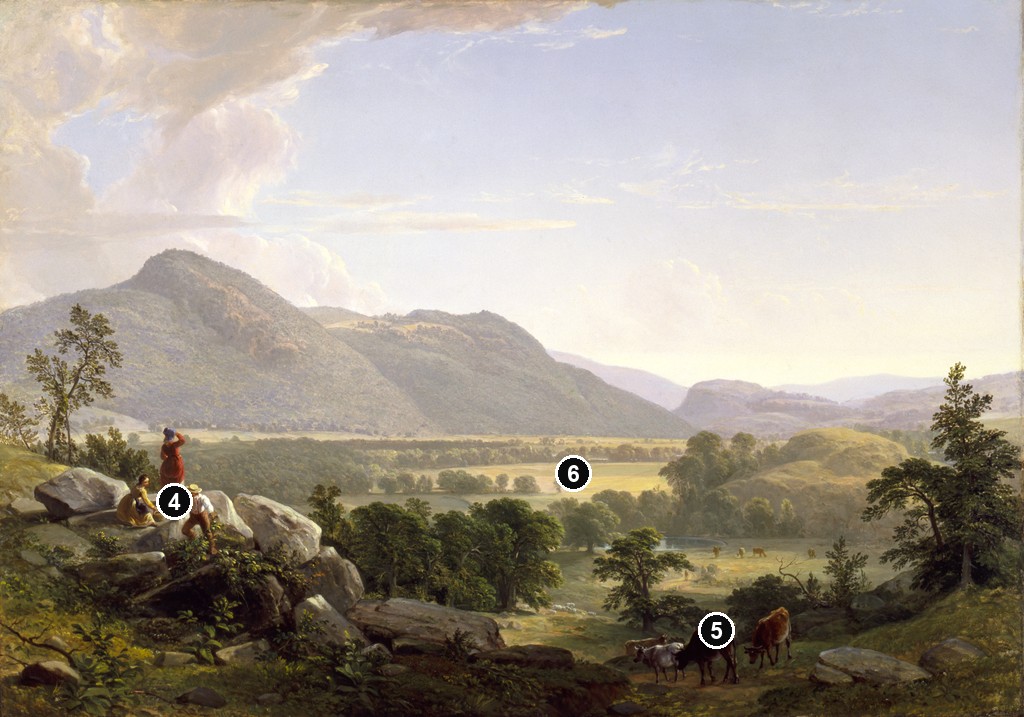
The numbered points identify visible features discussed in this article. Return from each detail to the whole composition. The captions keep each work’s identity, date and medium separate.
The Beeches
Asher Brown Durand, The Beeches, 1845. Oil on canvas, 153.4 × 122.2 cm. Metropolitan Museum of Art, 15.30.59. The Metropolitan Museum of Art. Image source. CC0 / Public domain. Resized only; native appearance, complete carrier and margins preserved.
Dover Plains
Asher Brown Durand, Dover Plains, Dutchess County, New York, 1848. Oil on canvas. Smithsonian American Art Museum, 1978.126. Image source. CC0 / Public domain. Resized only; native appearance, complete carrier and margins preserved.
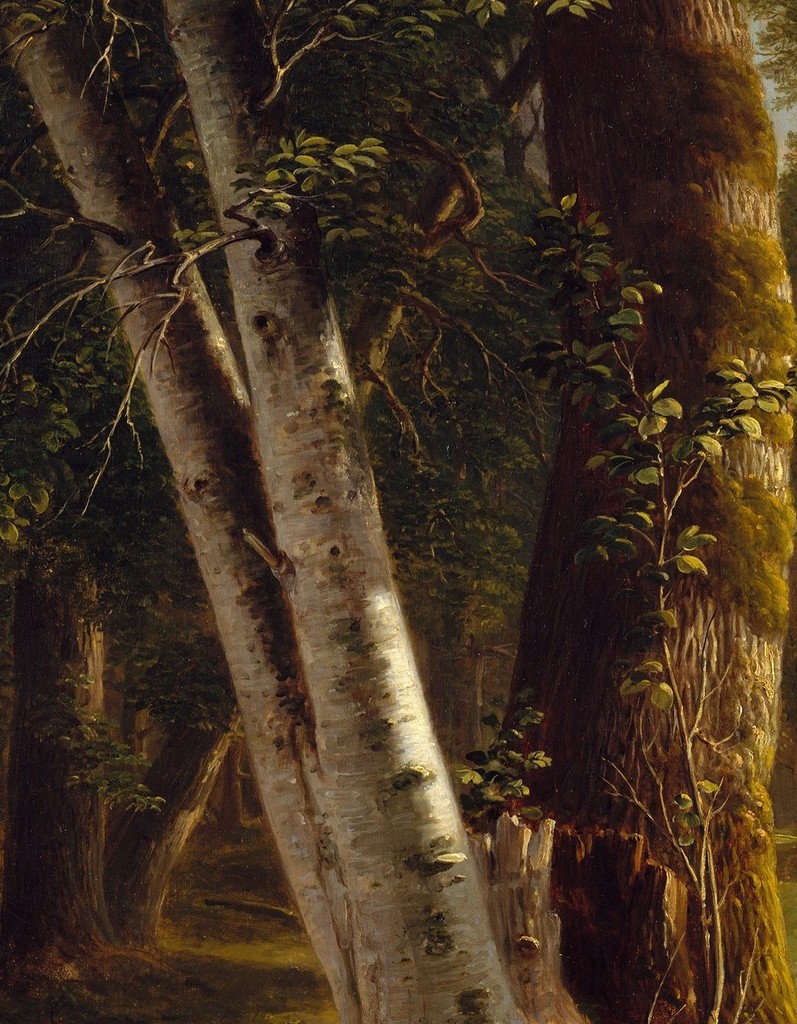
Details from ASHER BROWN DURAND PAINTINGS
Compare the cropped details with the complete images above. Notice how their colours, shapes and positions contribute to the larger compositions.
The Beeches
Pale slanting trunk
A pale trunk slopes across the darker group at the left. Bark marks and neighbouring foliage make its particular form readable.
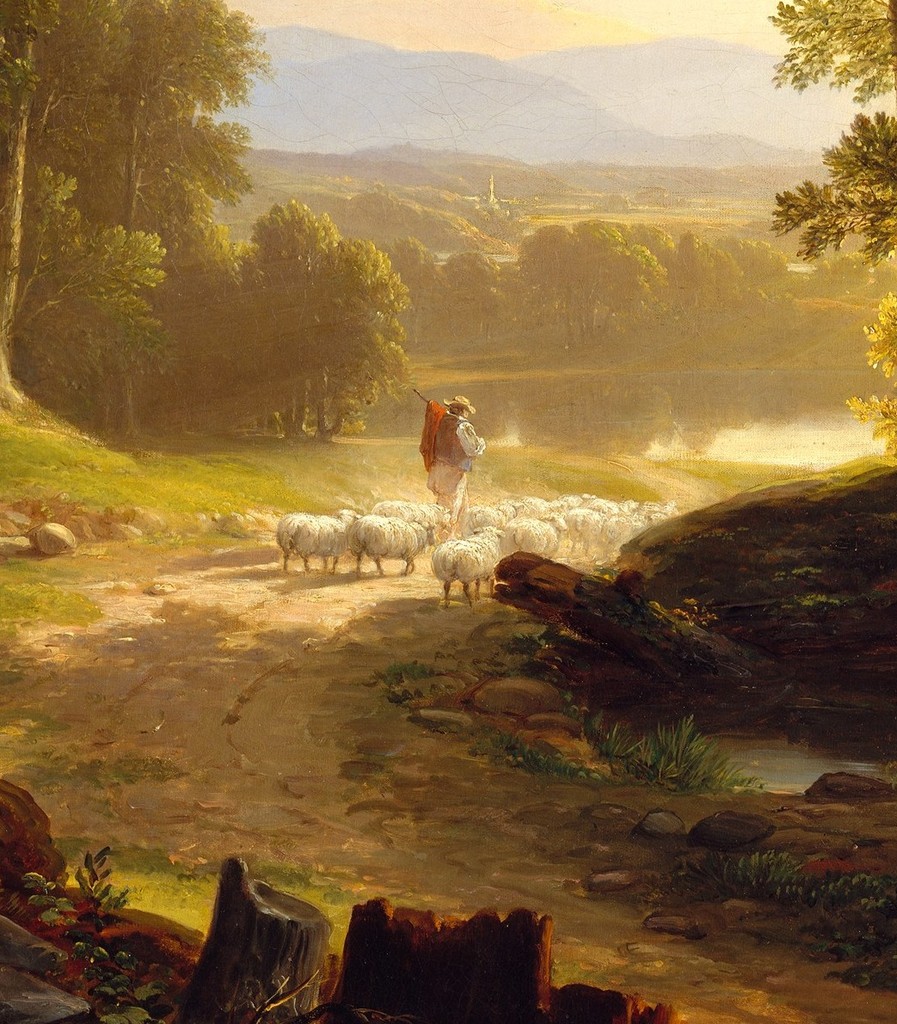
Shepherd and flock on the path
A shepherd and pale sheep occupy the winding path. Their scale provides a comparison with the large trees.
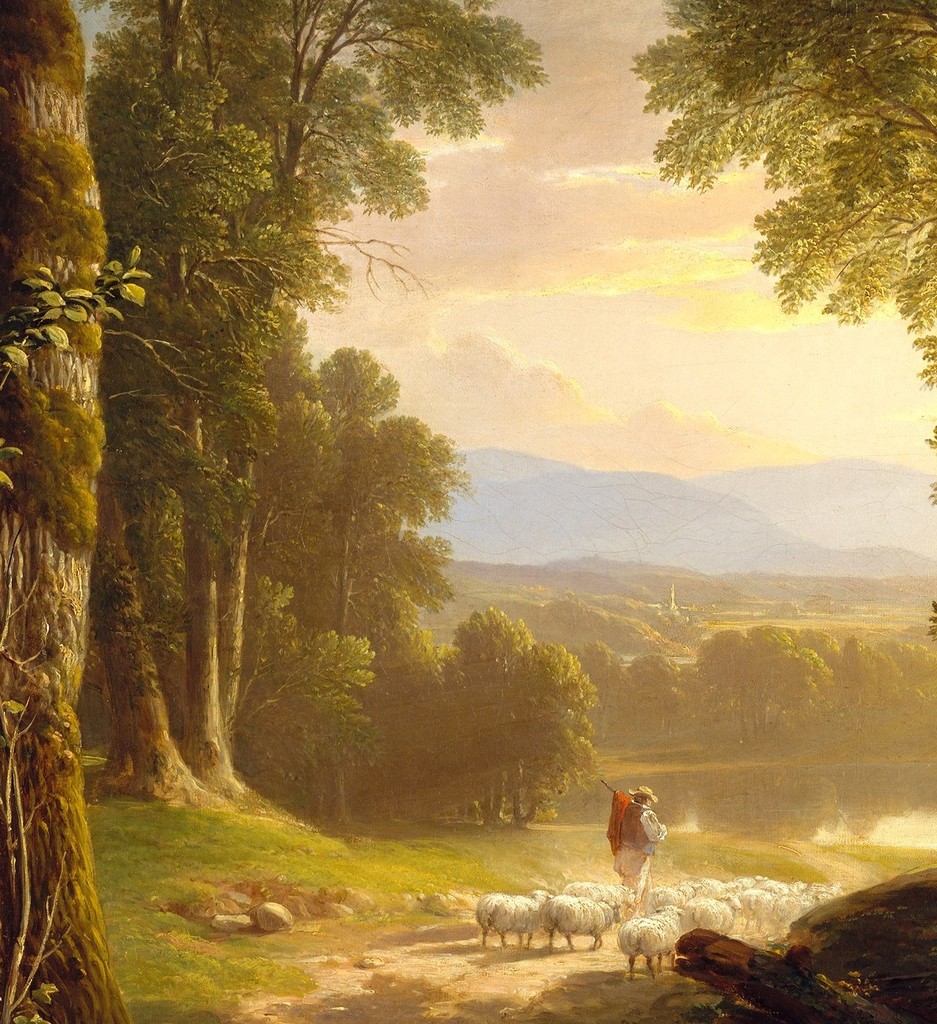
Opening towards the distant valley
The brighter opening leads past the nearby trunks towards water and a distant valley. Trees control the passage between near and far space.
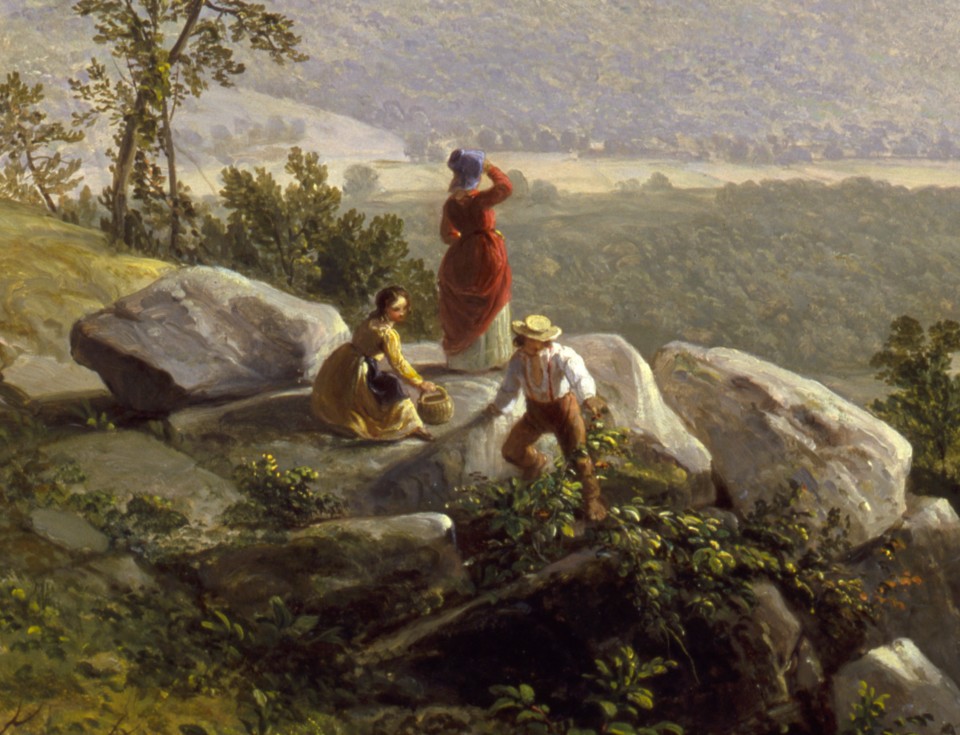
Dover Plains
Three figures on the ledge
Three figures occupy the near left ledge, looking across the valley. Their clothing and poses remain distinct within the group.
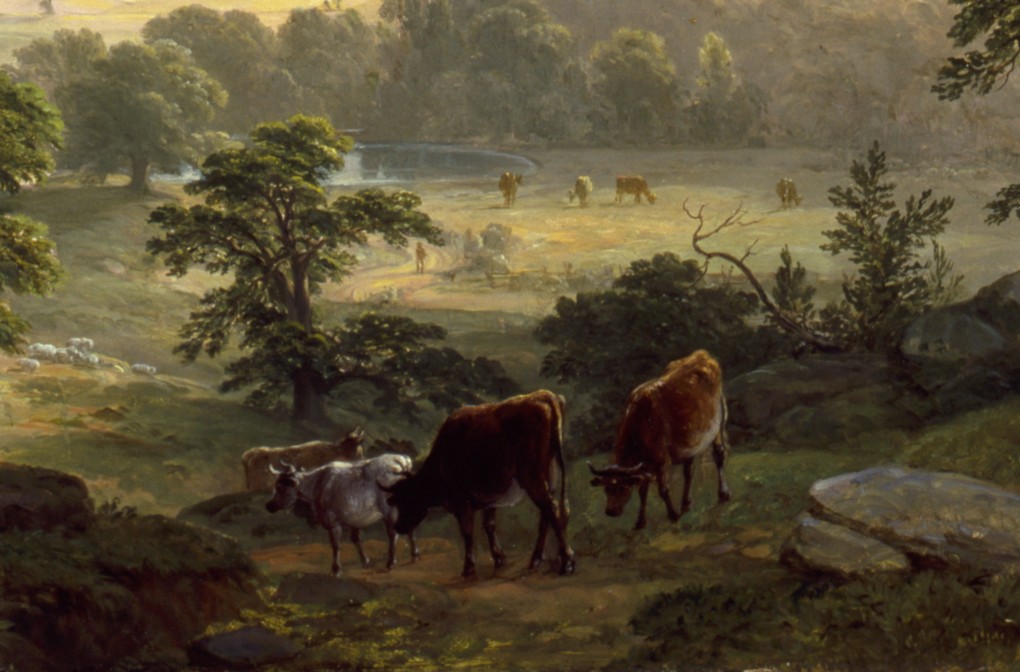
Cattle beside the descending ground
Near cattle stand on the right-hand descending ground. Smaller animals farther away help establish distance.
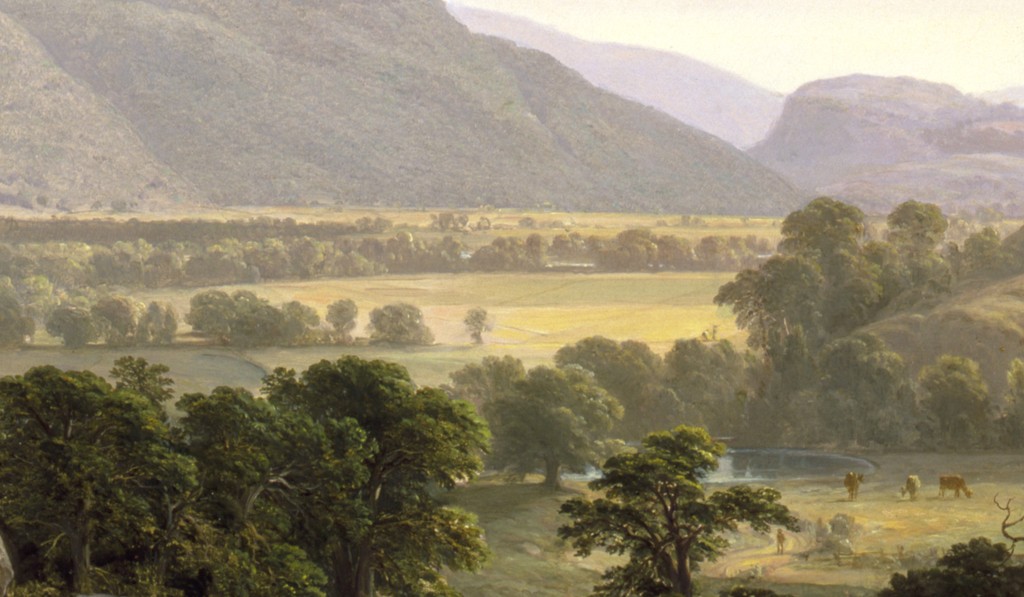
Fields within the enclosing hills
Light fields and darker trees extend beneath the enclosing hills. The crop connects cultivated ground with the broad regional view.
Memorial and literary landscapes
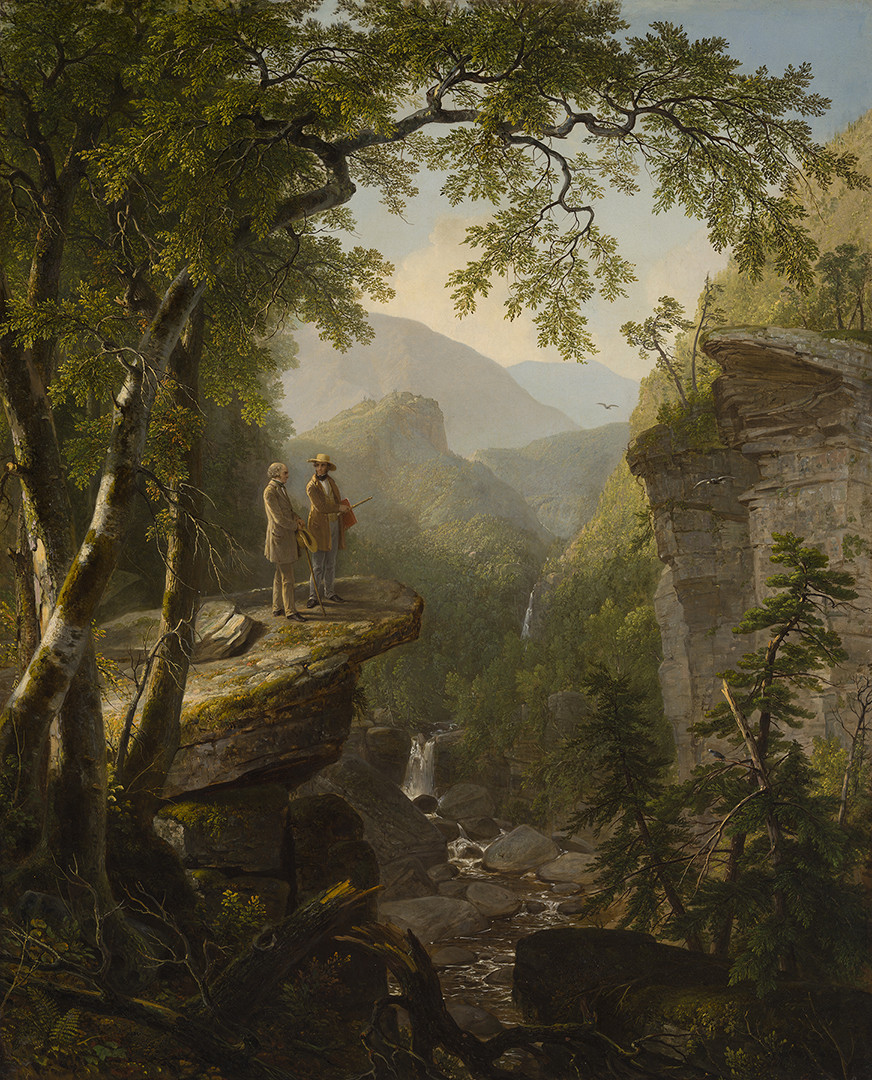
Kindred Spirits, 1849, places Thomas Cole and William Cullen Bryant together on a rocky ledge. Crystal Bridges records Jonathan Sturges’s commission and his gift of the work to Bryant after Cole’s death. The two men’s small scale allows the wooded gorge to become an extensive setting for their association.[2]
The scene offers a meeting within nature, but the figures’ identities and the gift’s purpose make it more specific than an anonymous mountain view. Trees enclose the ledge, water descends through the depth, and the distant opening draws attention beyond the immediate conversation.
Landscape—Scene from Thanatopsis, 1850, connects with Bryant through his poem rather than through a portrait. The Met relates its funeral, agricultural work and ruins to mortality and the continuity of nature. Activities separated across the canvas belong to a shared meditation on human time.[3]
These pictures make a useful pair. One identifies a poet within the landscape; the other draws on his writing to shape the subject. Their literary relationships remain distinct even though both use open space, trees and water.
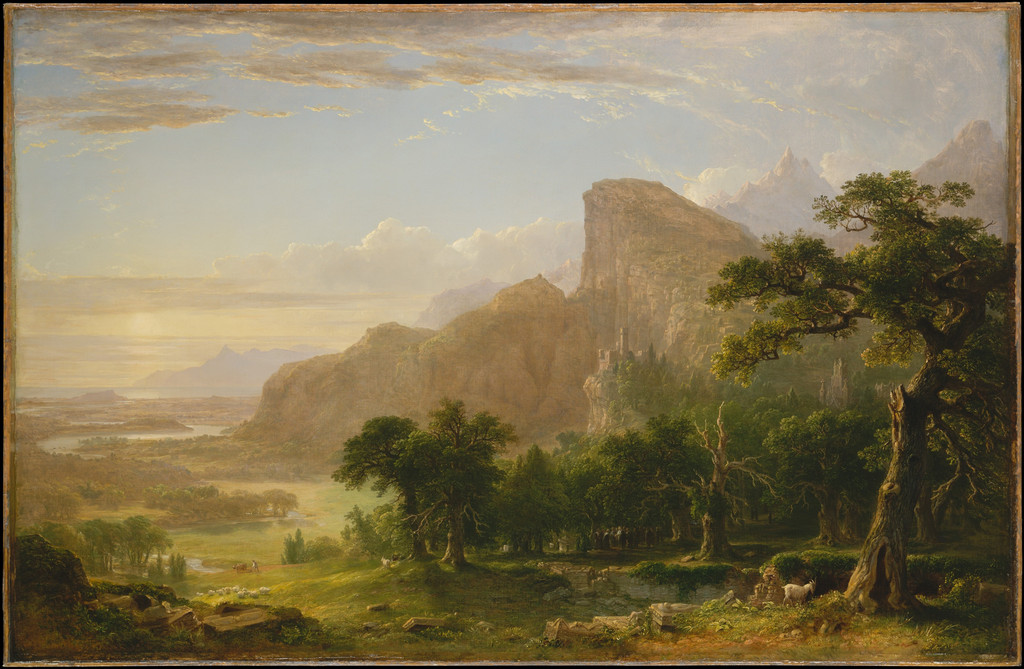
Asher Brown Durand, Landscape—Scene from Thanatopsis, 1850. Metropolitan Museum of Art, 11.156. Gift of J. Pierpont Morgan, 1911. The Metropolitan Museum of Art. Image source. CC0 / Public domain. Resized only; native appearance, complete carrier and margins preserved.
Cultivated valleys and regional views
Dover Plains, 1848, gives fields and settlement a place within a broad valley. Foreground figures look outward while cattle occupy another part of the near ground. The Smithsonian identifies the Dutchess County subject and places the painting within Durand’s increasing national recognition.[4]
Its view joins human activity with an extensive landscape. The mountains establish an enclosing boundary, but the centre remains accessible through fields and inhabited ground. The picture offers space for looking across the valley rather than moving through a confined woodland.
High Point: Shandaken Mountains, 1853, gives a prominent mountain a different relationship with near water and figures. The Met connects it with studies made in 1847 and records its exhibition before Durand’s later summer returns. Those later studies should not all be treated as preparation for the already exhibited canvas.[5]
The Catskills, 1859, narrows the passage between large pale trunks and a rocky stream. The Walters identifies Plattekill Clove and records William T. Walters’s 1858 commission. Compared with Dover Plains, this work brings the viewer nearer to trees and rock before offering a distant opening.[6]
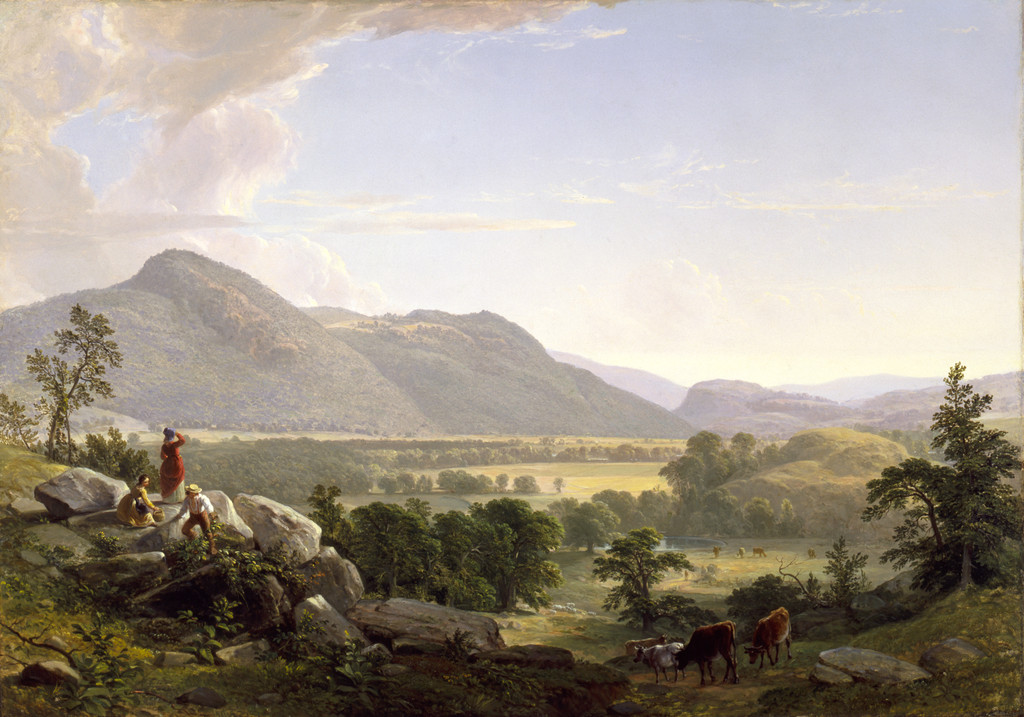
Asher Brown Durand, Dover Plains, Dutchess County, New York, 1848. Smithsonian American Art Museum, 1978.126. Gift of Thomas M. Evans and museum purchase through the Smithsonian Institution Collections Acquisition Program. Image source. CC0 / Public domain. Resized only; native appearance, complete carrier and margins preserved.
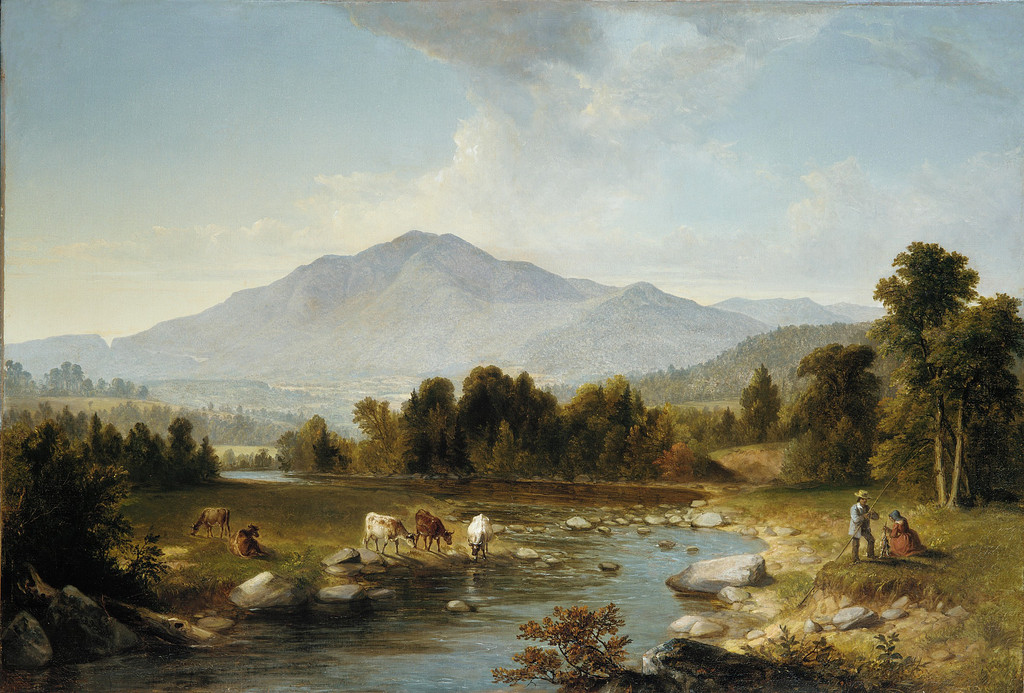
Asher Brown Durand, High Point: Shandaken Mountains, 1853. Metropolitan Museum of Art, 77.3.1. Bequest of Sarah Ann Ludlum, 1877. The painting was exhibited before the later summer return studies discussed by the museum. The Metropolitan Museum of Art. Image source. CC0 / Public domain. Resized only; native appearance, complete carrier and margins preserved.
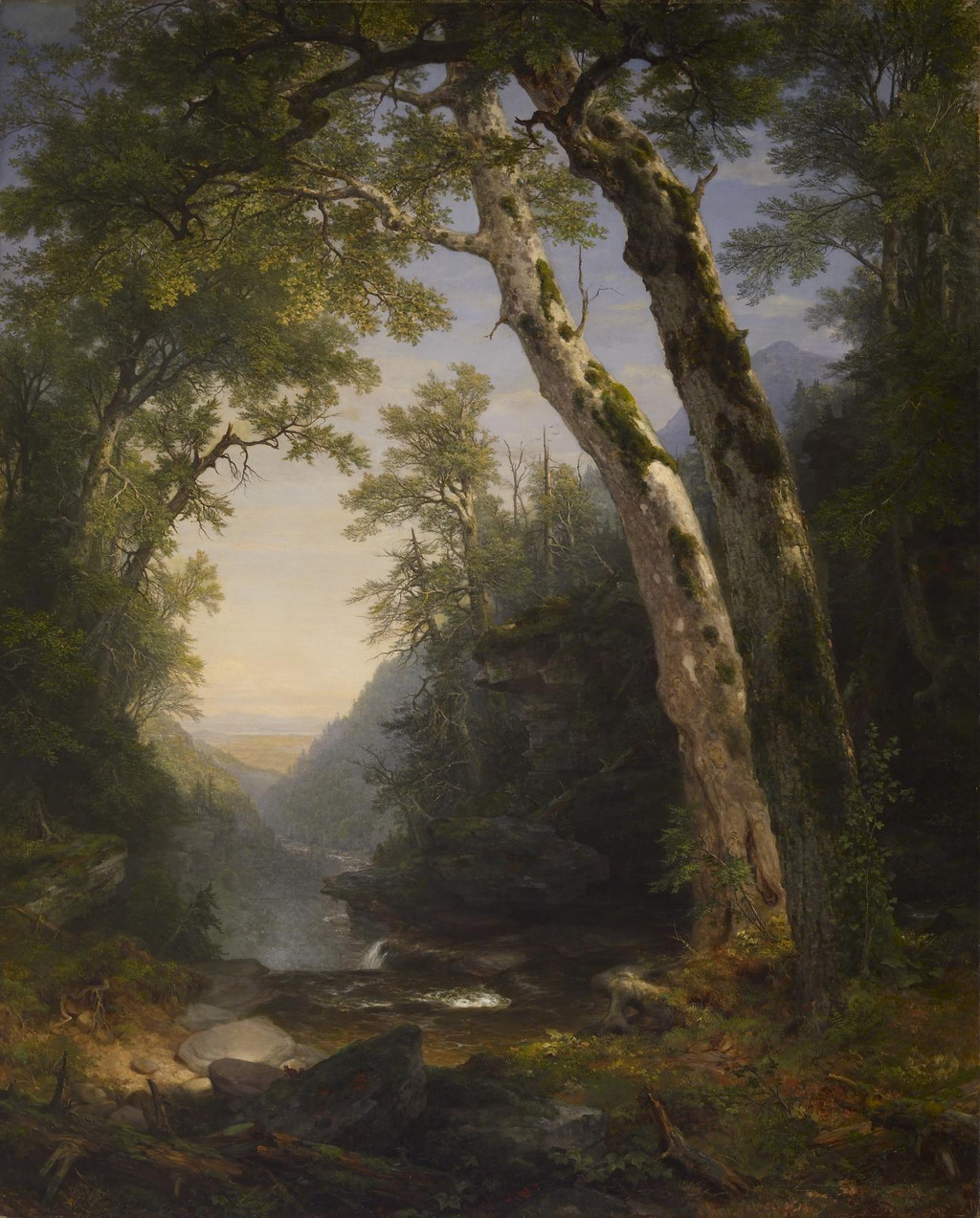
Asher Brown Durand, The Catskills, 1859. Walters Art Museum, 37.122. Commissioned by William T. Walters in 1858. The museum identifies the represented region as Plattekill Clove. Image source. Public domain. Resized only; native appearance, complete carrier and margins preserved.
Trees and enclosed woodland
The Beeches, 1845, uses tall trunks to organise a path, shepherd and flock. The Met’s collection catalogue relates it to Durand’s outdoor tree study and to Constable’s landscape example. It also records the work’s earlier exhibition title, Landscape Composition, rather than assuming the modern title was used from the start.[7]
Its trees are major structures within the picture. Their trunks create intervals through which the path and more distant ground can be followed. Individual forms remain readable while contributing to a larger arrangement of enclosure and opening.
In the Woods, 1855, places greater weight on the forest interior. Dense foliage, pale trunks, fallen timber and a lower stream occupy the composition. The current Met record dates the exact canvas to 1855; a later scholarly essay’s 1857 date does not establish another version of this object.[8]
Olson’s research on Durand’s tree studies helps explain this attention to individual forms. It also cautions against assigning every surviving study to a particular finished painting. Looking closely at a trunk could develop an artist’s understanding without producing a drawing made expressly for one canvas.[9]
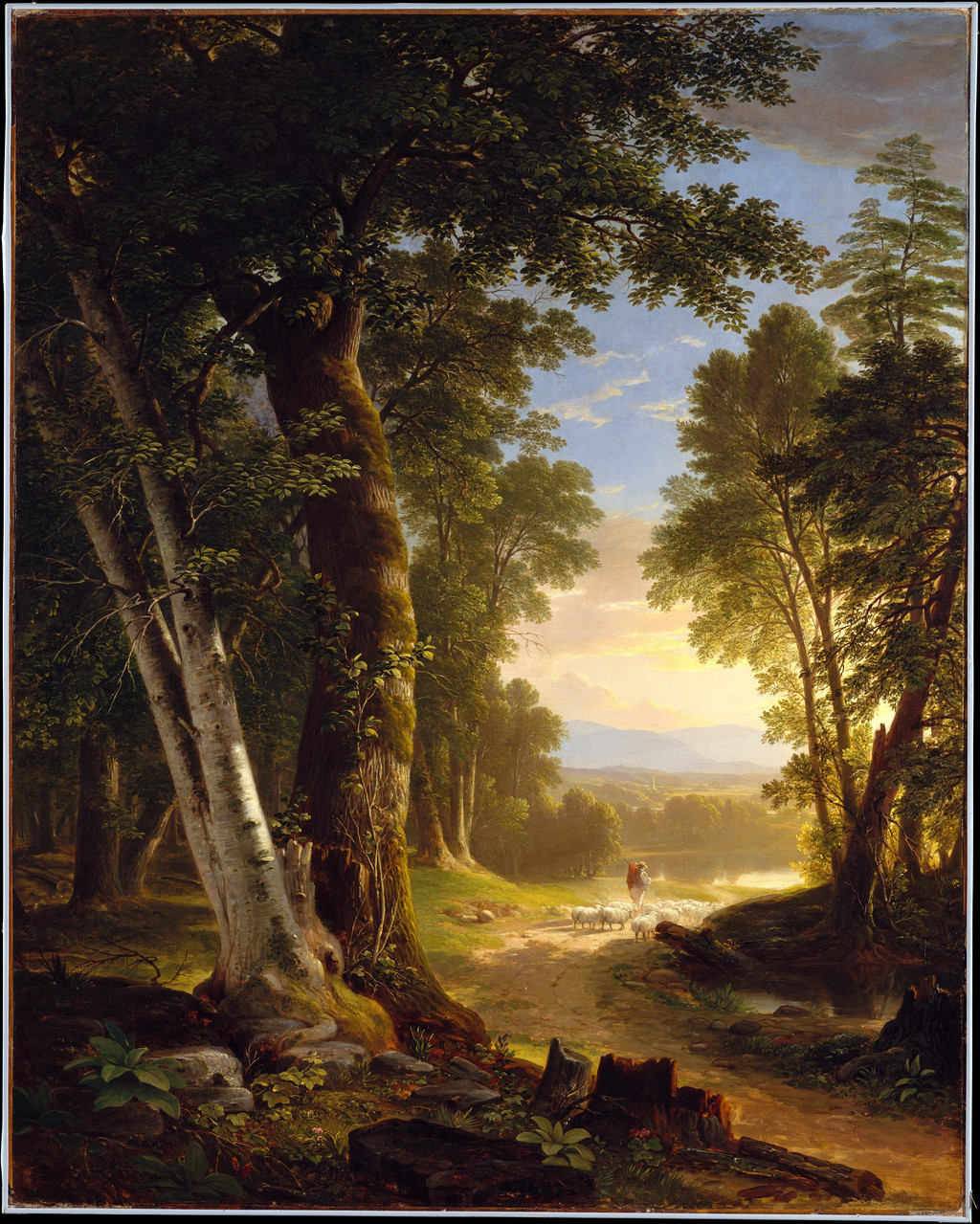
Asher Brown Durand, The Beeches, 1845. Metropolitan Museum of Art, 15.30.59. The museum catalogue relates it to an 1844 outdoor oil study; the small graphite sheet discussed in the drawings and studies article has no documented direct connection to this canvas. The Metropolitan Museum of Art. Image source. CC0 / Public domain. Resized only; native appearance, complete carrier and margins preserved.
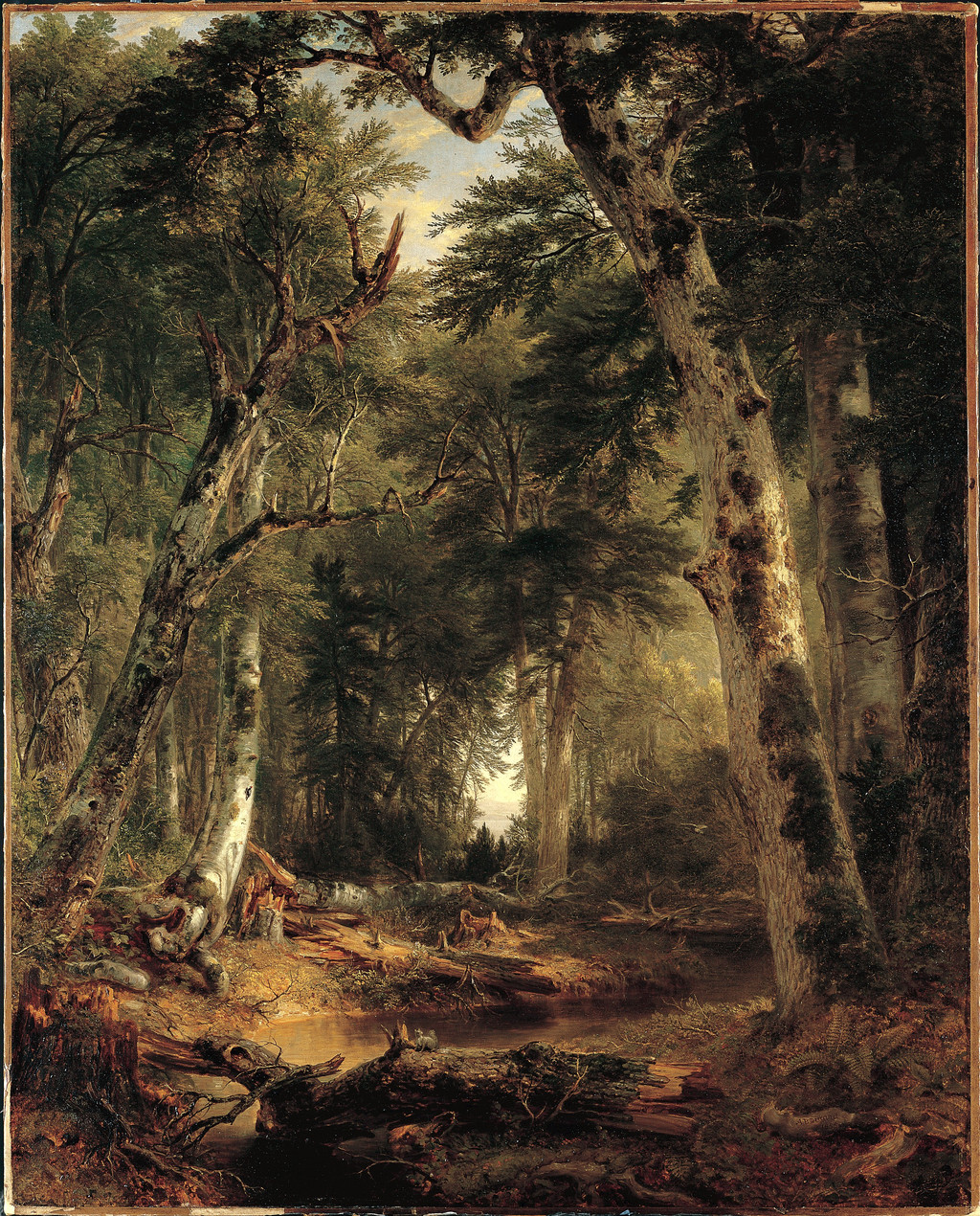
Asher Brown Durand, In the Woods, 1855. Metropolitan Museum of Art, 95.13.1. A comparison of individual tree forms within a composed woodland; no direct preparatory link with the displayed graphite sheet is claimed. The Metropolitan Museum of Art. Image source. CC0 / Public domain. Resized only; native appearance, complete carrier and margins preserved.
Watch: Asher Brown Durand
Choose a film to explore the artist’s work, its interpretation and its wider setting.
Friendship and landscape, Asher B Durand's Kindred Spirits
Smarthistory and Crystal Bridges discuss friendship, memory and landscape in Kindred Spirits.
Watch on YouTubeProgress and a clearing in the wilderness
Progress, 1853, spreads different uses of land across a wide panorama. Woodland and Native figures appear toward the left, while transport, settlement and industry become prominent elsewhere. Rebecca Bedell’s study reconsidered the work’s relationship with Charles Gould’s commission and later railroad history.[10]
The painting invites attention to how its transitions are arranged. A path, bridge and waterways connect areas, while the distribution of figures affects the viewer’s movement through them. The work’s implications should be discussed without assigning a specific nation to its generalised Native figures or treating a modern interpretation as Durand’s recorded intention.
First Harvest in the Wilderness, 1855, approaches land transformation through a clearing, family activity and remaining woodland. The contemporary notice consulted for its dedicated article connects the commission with the late Augustus Graham and the Brooklyn Institute.[11]
The two pictures differ in scale and emphasis. One develops an extensive panorama; the other concentrates attention on a particular clearing and its inhabitants. Comparing them makes the treatment of work, settlement and remaining trees easier to see.
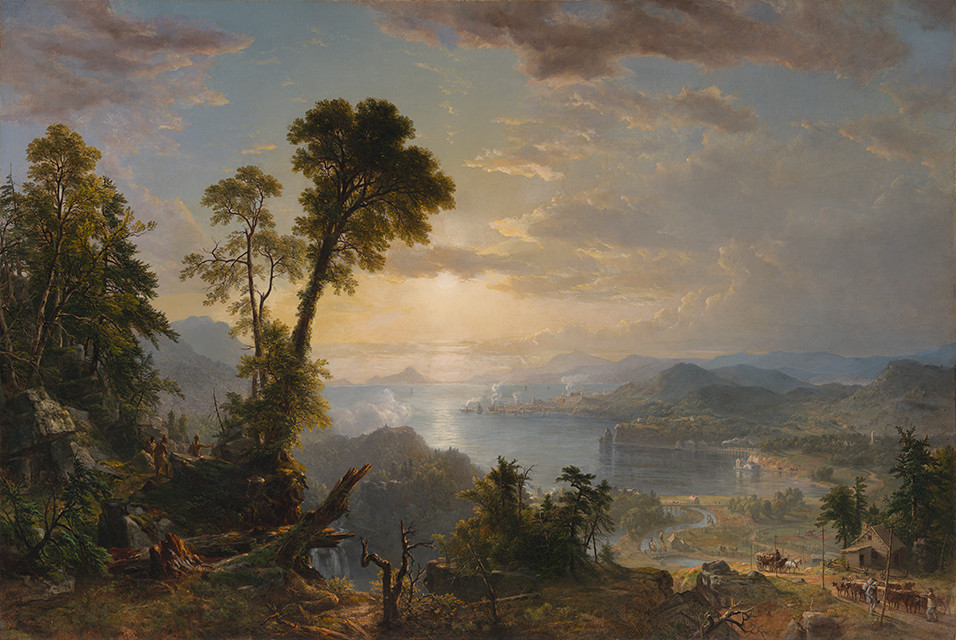
Asher Brown Durand, Progress, 1853. Oil on canvas. Virginia Museum of Fine Arts. Museum-origin public-domain reproduction; native size retained. Virginia Museum of Fine Arts; museum-origin public-domain reproduction via Wikimedia Commons. Image source. Public domain. Resized only; native appearance, complete carrier and margins preserved.
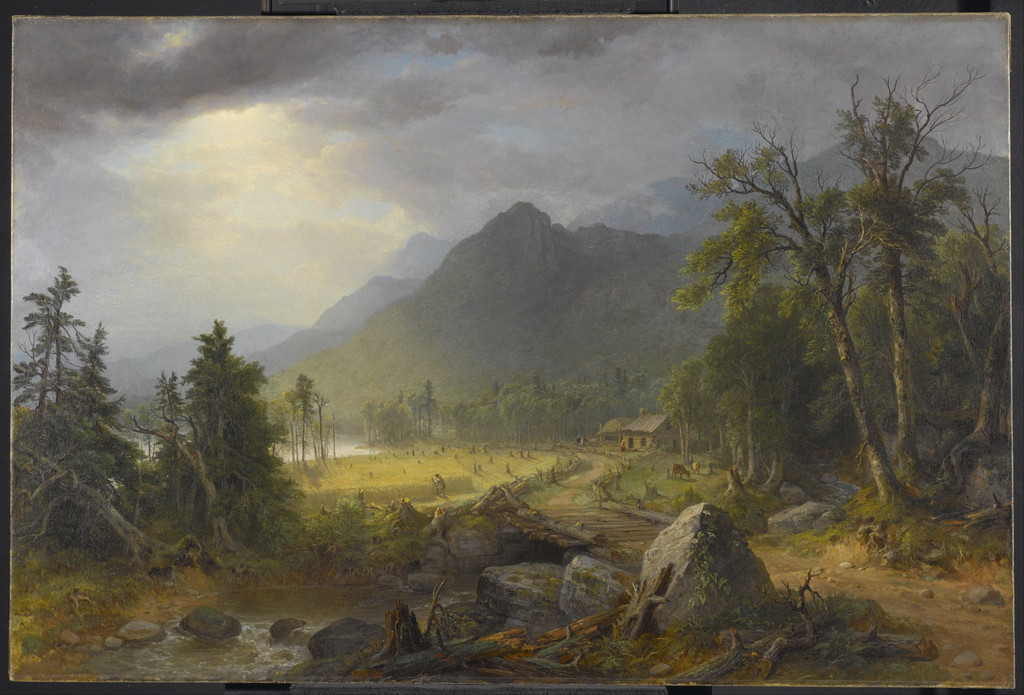
Asher Brown Durand, The First Harvest in the Wilderness, 1855. Oil on canvas, 80.3 × 122 cm. Brooklyn Museum, 97.12. Transferred from the Brooklyn Institute of Arts and Sciences. Supplied support edges and narrow mounting surround retained. Brooklyn Museum / Google Art Project. Image source. Public domain. Resized only; native appearance, complete carrier and margins preserved.
Pastoral scenes and Sunday rest
River Scene, 1854, and Summer Afternoon, 1865, place cattle and water within warm, open landscapes. Their current Met records identify separate objects and collecting histories. The latter is the Jesup commission, rather than the different Summer listed for Whiting in 1855.[12][13]
Sunday Morning, 1860, gives rest and religious association a more explicit place. The New Britain museum discusses the Walters commission, church and outdoor groups, while distinguishing earlier paintings carrying the same title.[14]
Across these works, figures and animals help establish pace. Cattle descending toward water or people resting beneath trees can give different rhythms to otherwise related landscape elements. A shared pastoral vocabulary does not make the pictures interchangeable.
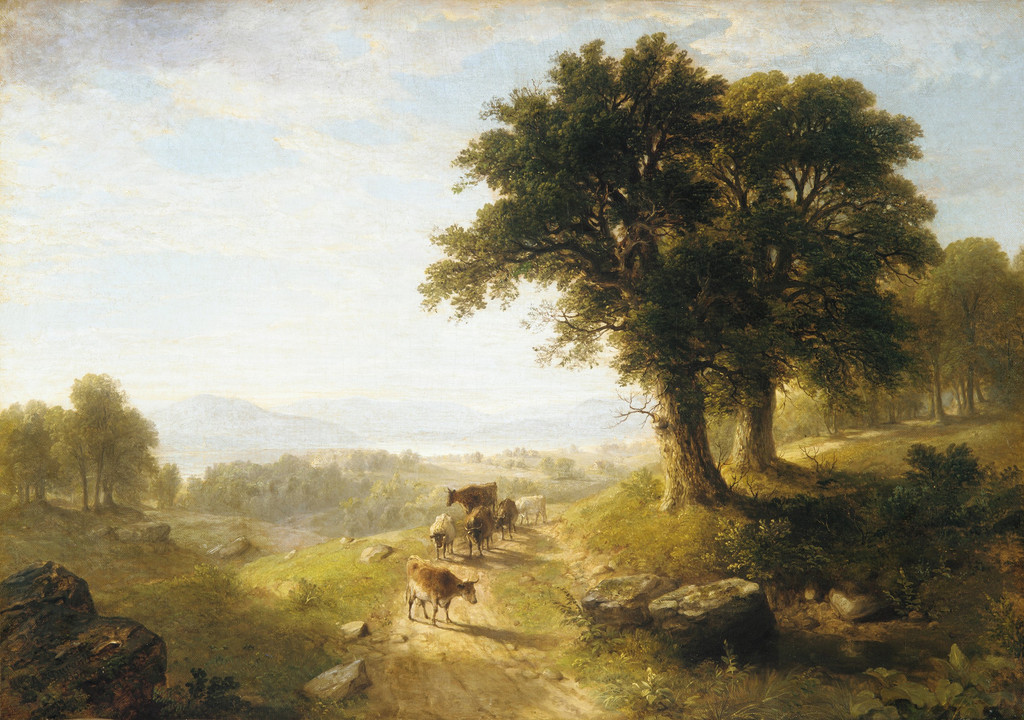
Asher Brown Durand, River Scene, 1854. Metropolitan Museum of Art, 1970.58. Bequest of Mary Starr Van Winkle, 1970. The Metropolitan Museum of Art. Image source. CC0 / Public domain. Resized only; native appearance, complete carrier and margins preserved.
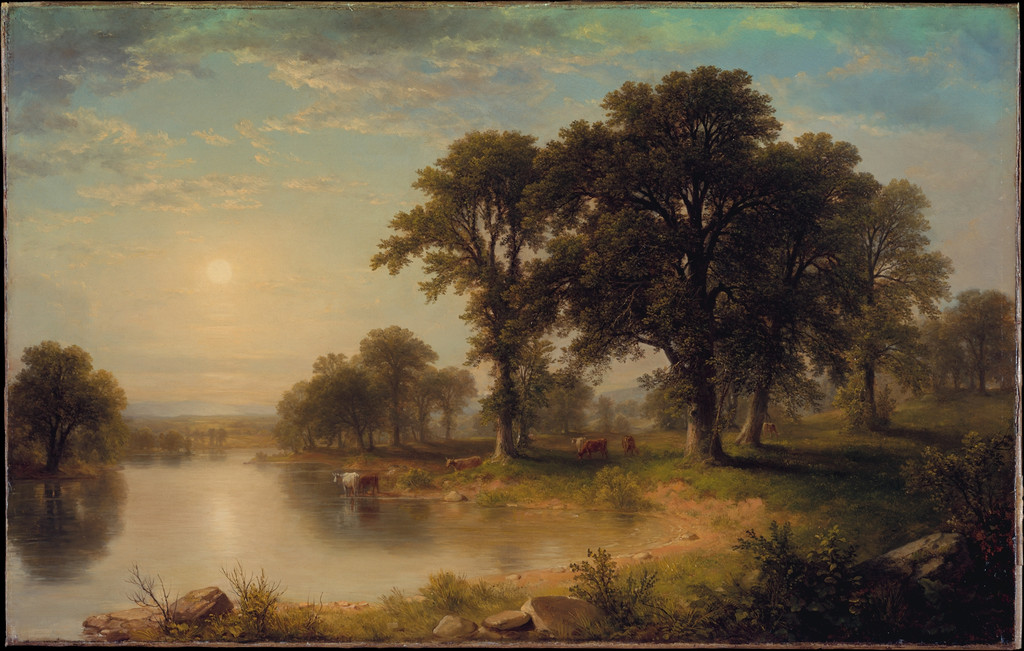
Asher Brown Durand, Summer Afternoon, 1865. Oil on canvas, 57.2 × 88.9 cm. Metropolitan Museum of Art, 15.30.60. Bequest of Maria DeWitt Jesup, from the collection of her husband, Morris K. Jesup, 1914. Supplied canvas rim and dark surround retained. The Metropolitan Museum of Art. Image source. CC0 / Public domain. Resized only; native appearance, complete carrier and margins preserved.
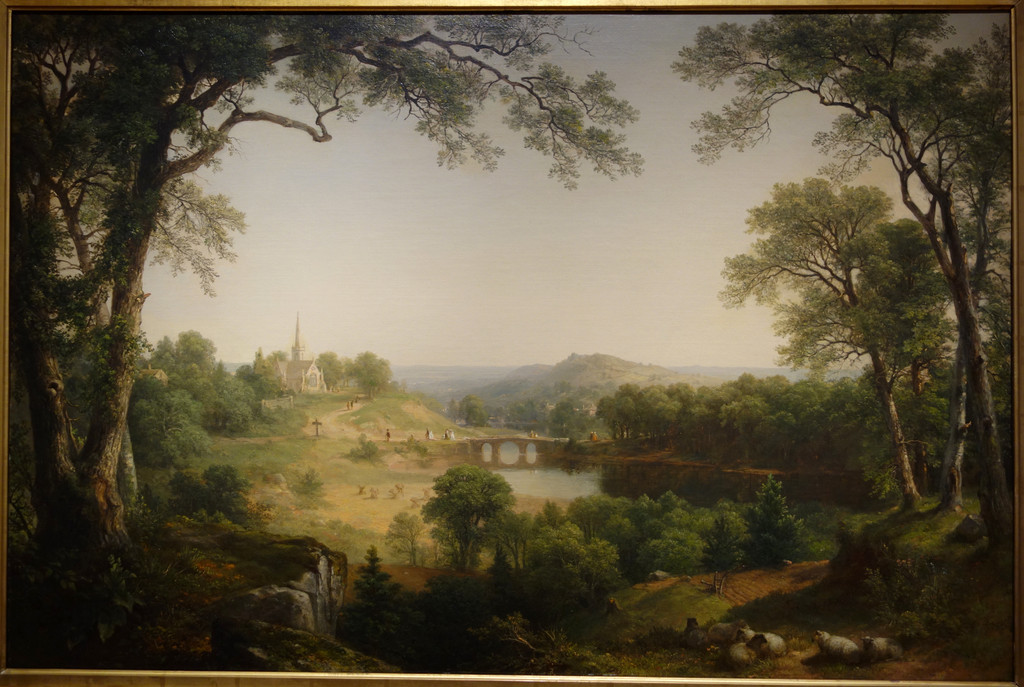
Asher Brown Durand, Sunday Morning, 1860. Oil on canvas, 71.4 × 107 cm. New Britain Museum of American Art, 1963.4, Charles F. Smith Fund. Gallery photograph by Daderot; complete supplied frame and perspective retained. New Britain Museum of American Art; gallery photograph by Daderot, released to the public domain. Image source. Public domain. Resized only; native appearance, complete carrier and margins preserved.
Biblical landscape and the range of Durand’s art
God’s Judgment Upon Gog, 1852, brings a prophet, army, animals and dramatic weather into a tall mountain setting. The Chrysler’s record identifies the exact biblical landscape. Its storm and crowded depth extend beyond the quieter associations of woodland and pastoral scenes.[15]
This work makes it difficult to reduce Durand to one mood. Close tree study, literary reflection, cultivated scenery and historical or biblical subjects all belong to the selection. Following the dedicated articles allows those differences to emerge through exact objects and their documented histories.
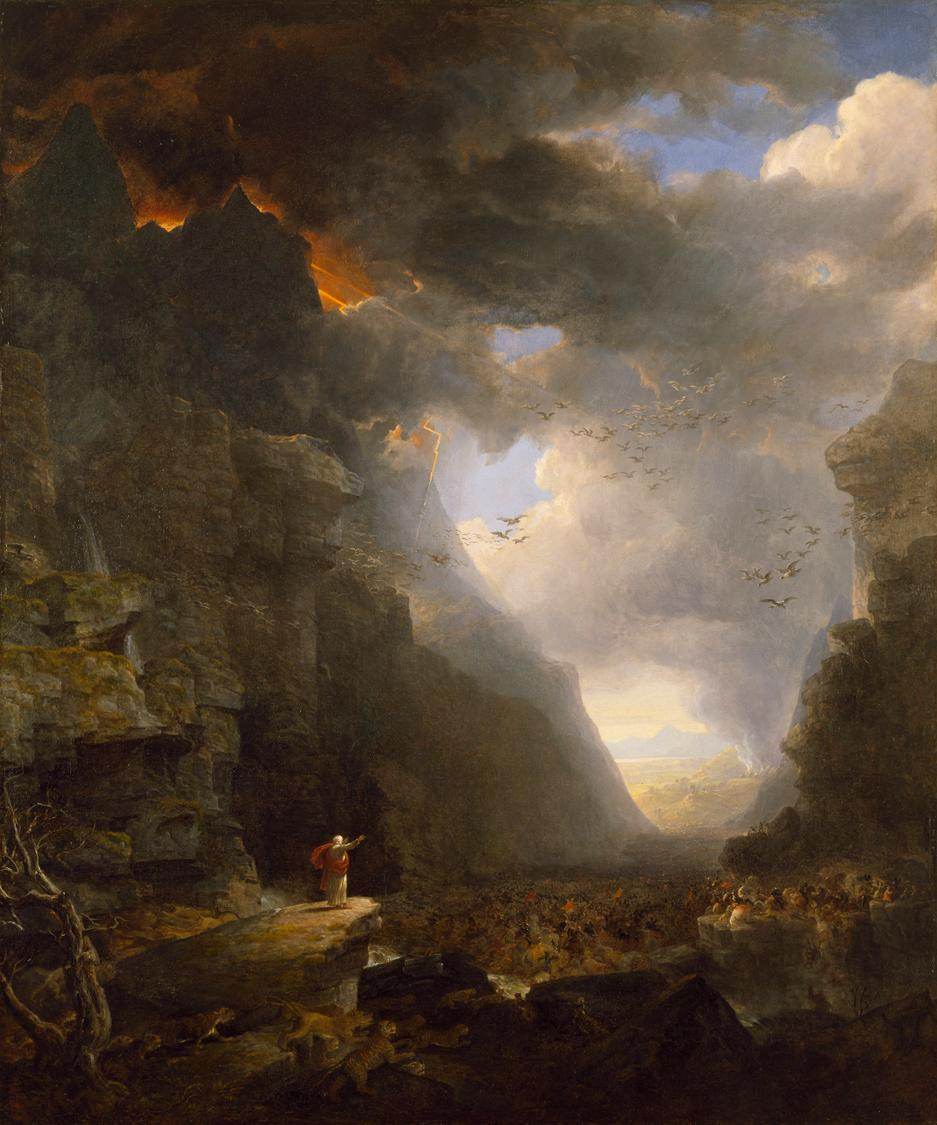
Asher Brown Durand, God’s Judgment Upon Gog, about 1851–52. Oil on canvas, 154.3 × 128.3 cm. Chrysler Museum of Art, 71.499. Gift of Walter P. Chrysler, Jr. Native image size retained. Image source. Public domain. Resized only; native appearance, complete carrier and margins preserved.
Where the prints belong
Durand’s engraved Declaration of Independence and Ariadne are important routes into his early career. They translate other artists’ paintings into printed images, with the sheet and its lettering contributing to the object’s identity. Their dedicated articles explain those relationships and distinguish the selected impressions from the painted models.[1]
A reader looking for these familiar images can follow the engravings overview. Keeping their medium visible helps comparisons with the landscapes: a printed sheet can preserve a title and publisher’s information around the scene, while the selected oil paintings organise colour directly across a painted surface.
Artworks directory
A collected selection of 19 individually identified paintings, prints and a graphite study, including fifteen dedicated artwork articles. This directory is not a complete catalogue raisonné. Links lead to a companion article where available, otherwise the consulted institutional record. Progress is identified by title, date and museum; an unverified accession is omitted. Unillustrated objects remain searchable.
Frequently Asked Questions
Kindred Spirits introduces Durand’s memorial landscape and relationships with Cole and Bryant. The Beeches and In the Woods provide complementary starting points for his tree compositions.
No. It is a bounded introduction and directory, with thirteen dedicated landscape articles and separate routes into prints and studies.
Discussion
Look again at the images and ideas explored in Asher Brown Durand Paintings. These editorial prompts invite your observations.
Reader Insights
How does an open valley change your attention compared with a forest interior?
Which painting gives human figures the greatest role in its meaning?
What do titles, commissions and collection histories add to a visual comparison?
Join the Conversation
Share a detail, comparison or question about Asher Brown Durand Paintings below.
References
- Kevin J. Avery, Asher Brown Durand (1796–1886), Met, 2009. Complete consulted essay; career and landscape development. View source
- Crystal Bridges, Kindred Spirits, 2010.106. Memorial, commission and gift. View source
- Met, Landscape—Scene from Thanatopsis, 11.156. Consulted current primary indexed narrative and record. View source
- Smithsonian American Art Museum, Dover Plains, 1978.126. Exact regional painting and institutional account. View source
- Met, High Point: Shandaken Mountains, 77.3.1. Studies, exhibition and subsequent visits. View source
- Walters Art Museum, The Catskills, 37.122. Exact object, subject and commission. View source
- Met, American Paintings in The Metropolitan Museum of Art, volume I, The Beeches. Actually consulted printed pp.414 and 416. View source
- Met, In the Woods, 95.13.1. Current object and 1855 date. View source
- Roberta J. M. Olson, Durand’s Trees as Spiritual Sentinels of Nature, 2010. Consulted printed pp.151–158 and notes. View source
- Rebecca Bedell, Asher Durand’s Progress Reconsidered, Panorama, 2019. Complete article and notes; interpretation and commission limits. View source
- The Crayon, Domestic Art Gossip, January 1856. Actually consulted p.30; Graham memorial commission. View source
- Met, River Scene, 1970.58. Current exact object record. View source
- Met, Summer Afternoon, 15.30.60. Current Jesup commission record. View source
- New Britain Museum of American Art, Sunday Morning. Complete consulted essay and notes; distinct versions. View source
- Chrysler Museum of Art, God’s Judgment Upon Gog. Current exact object and subject record. View source
- Splash image source.
Asher Brown Durand, Kindred Spirits, 1849. Crystal Bridges Museum of American Art, 2010.106. Commissioned by Jonathan Sturges as a memorial to Thomas Cole and given to William Cullen Bryant. Broad composition shown at its available native resolution. Crystal Bridges Museum of American Art; museum-uploaded open-access reproduction. CC0 / Public domain. Resized only; native appearance, complete carrier and margins preserved.
View source