 by Tom Gurney
Tom Gurney BSc (Hons) is an art history expert with over 20 years experience
Email: tomgurney1@gmail.com / Phone: +44 7429 011000
Sunday Morning by Asher Brown Durand: Introduction
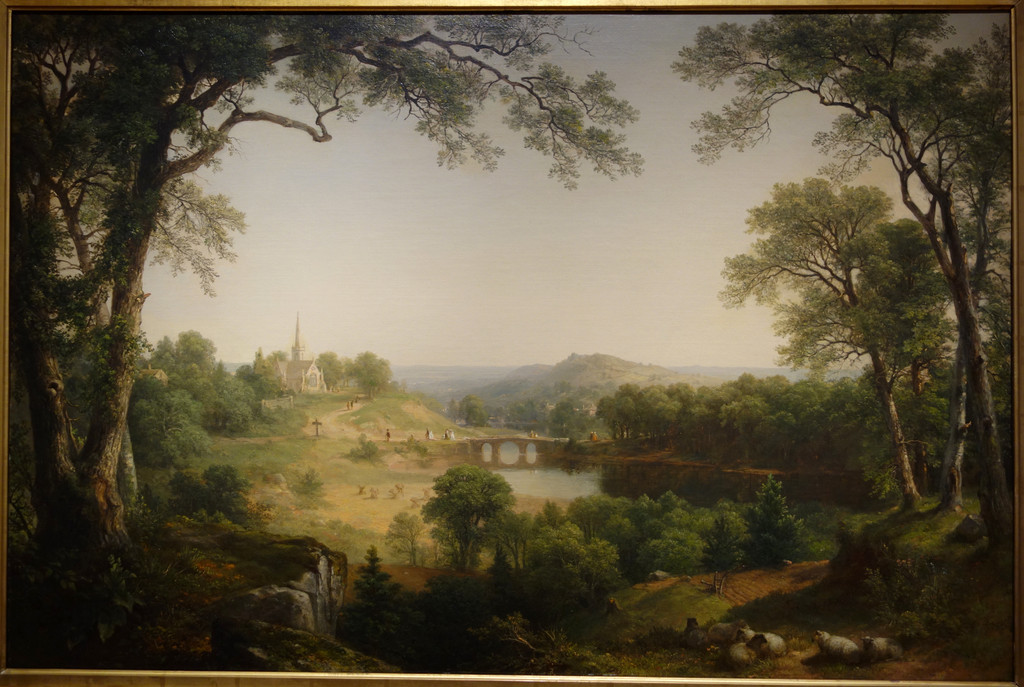
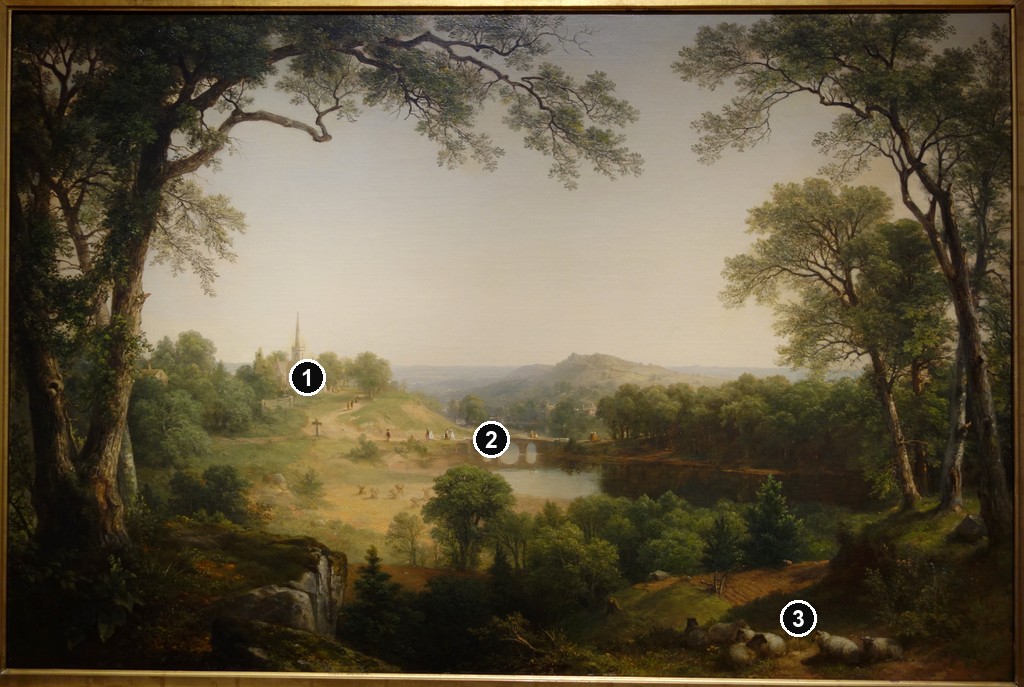
A church rises beyond a bridge and quiet water in Asher Brown Durand’s Sunday Morning. People approach the building through a landscape of trees, pasture and resting sheep, while a plough stands unused in the foreground. Painted in 1860 for William T. Walters, the canvas now belongs to the New Britain Museum of American Art. Its subject joins rural life with the experience of a day set aside from ordinary work.[1]
At a Glance
- ArtistAsher Brown Durand (1796–1886)
- TitleSunday Morning
- Date1860
- MediumOil on canvas
- Dimensions71.4 × 107 cm
- CollectionNew Britain Museum of American Art, Connecticut
- Accession1963.4
- Museum creditCharles F. Smith Fund
This work across Asher Brown Durand’s career
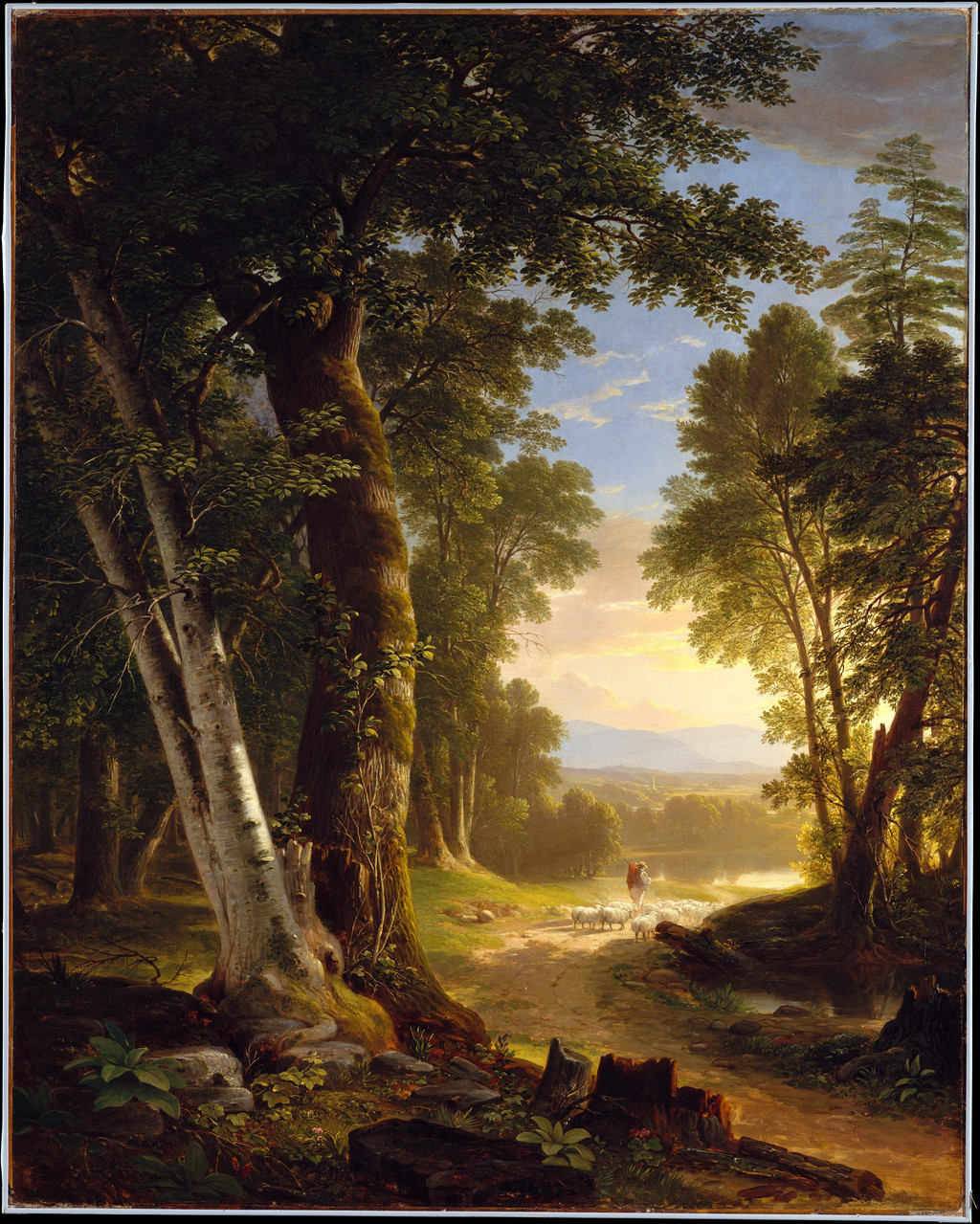
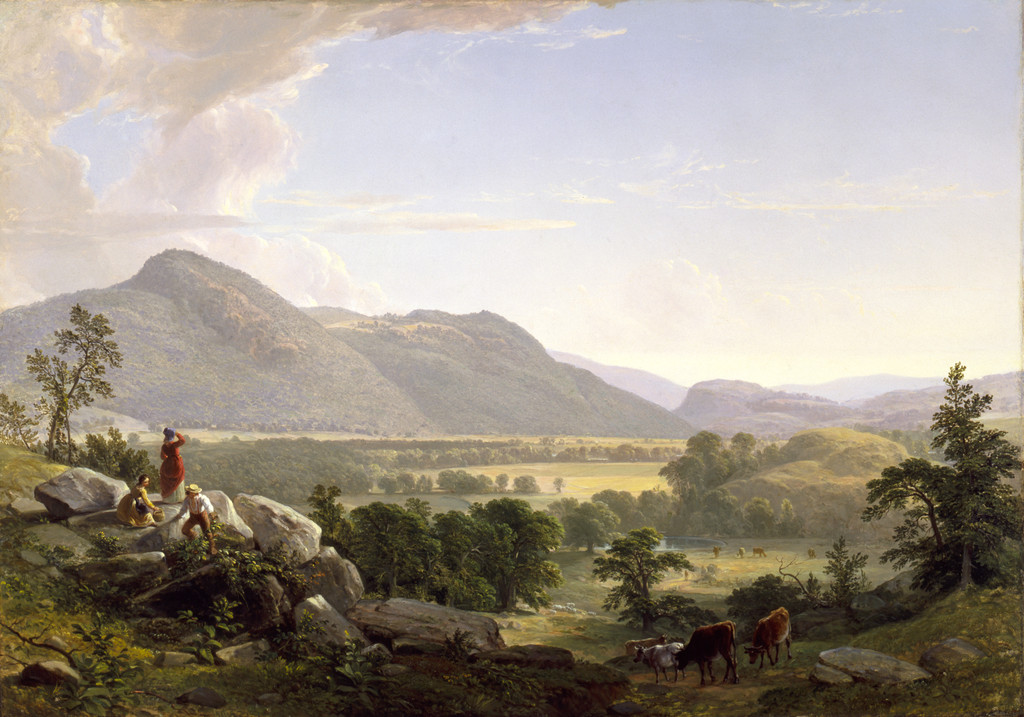
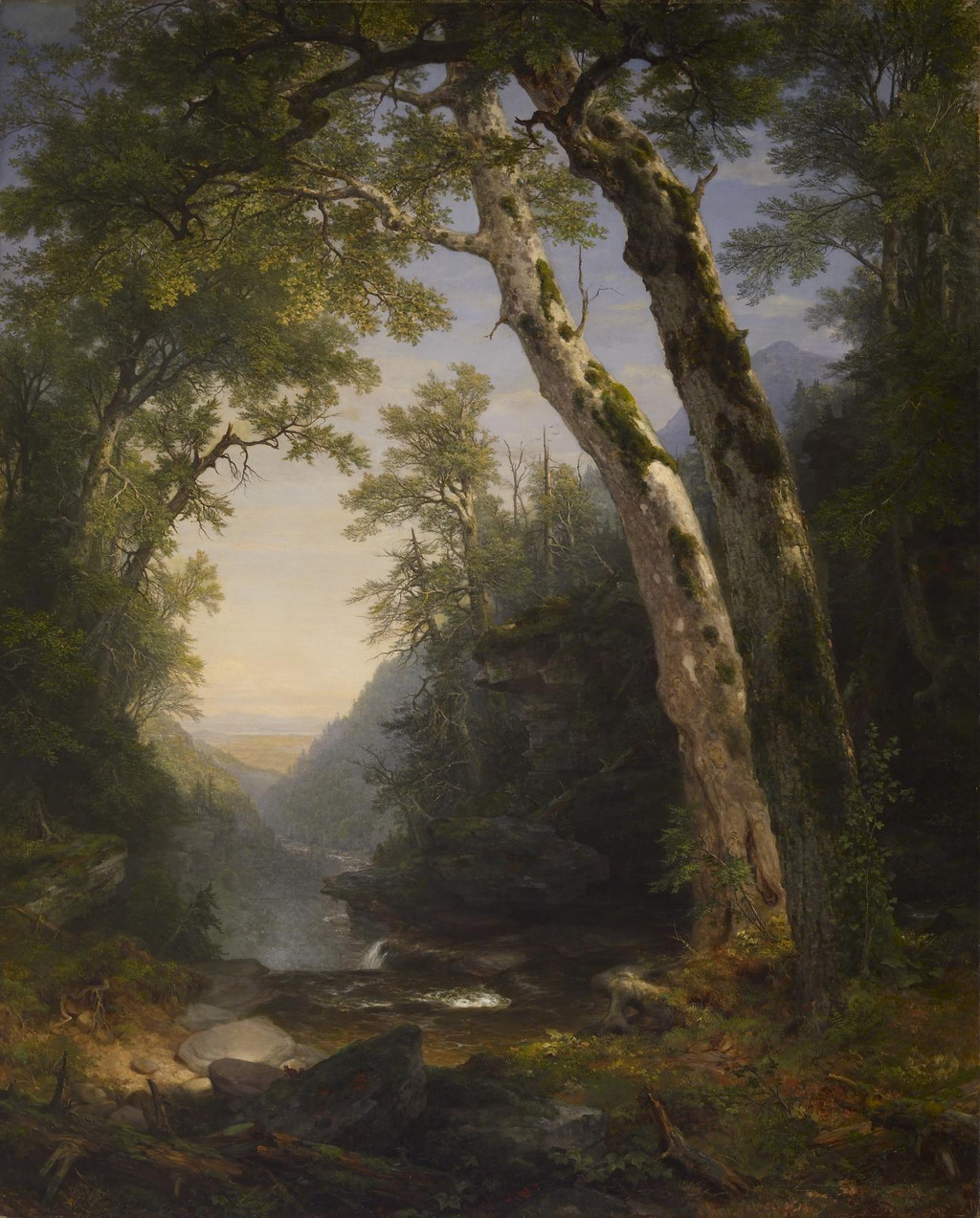
The Beeches
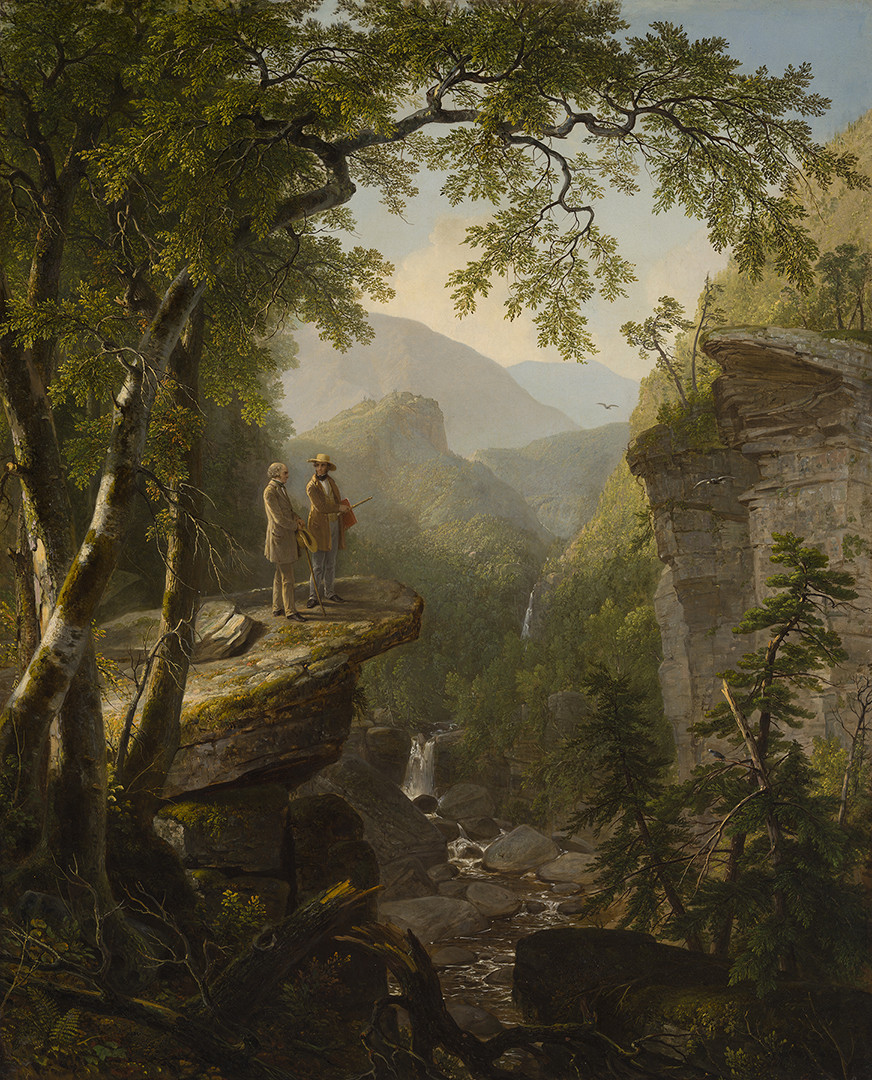
1845Kindred Spirits
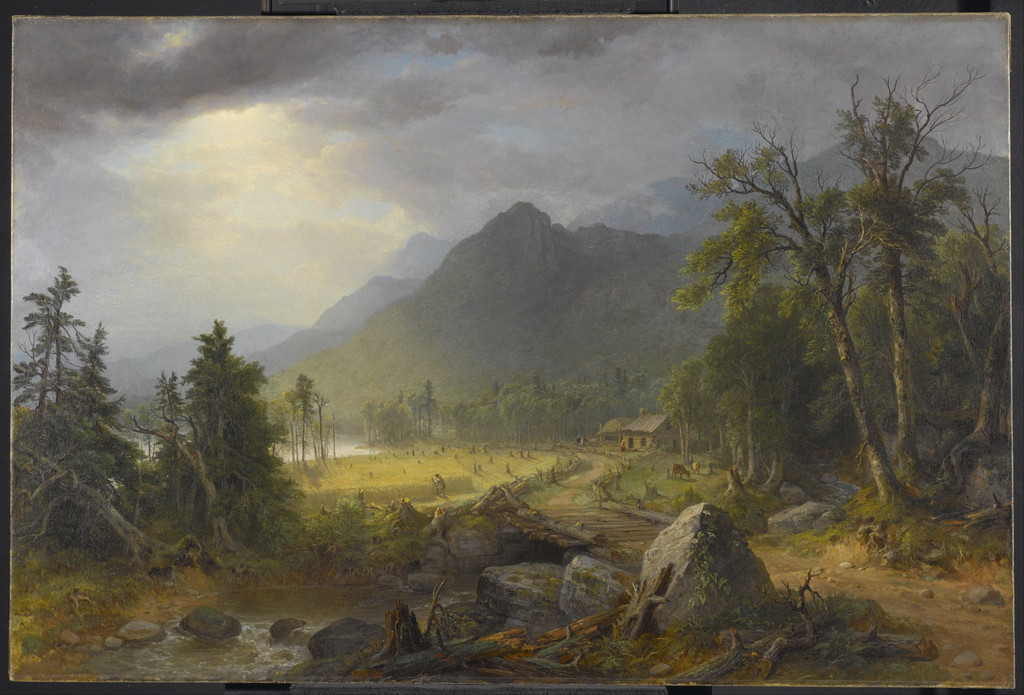
1849God’s Judgment Upon Gog
ca.1851–52River Scene
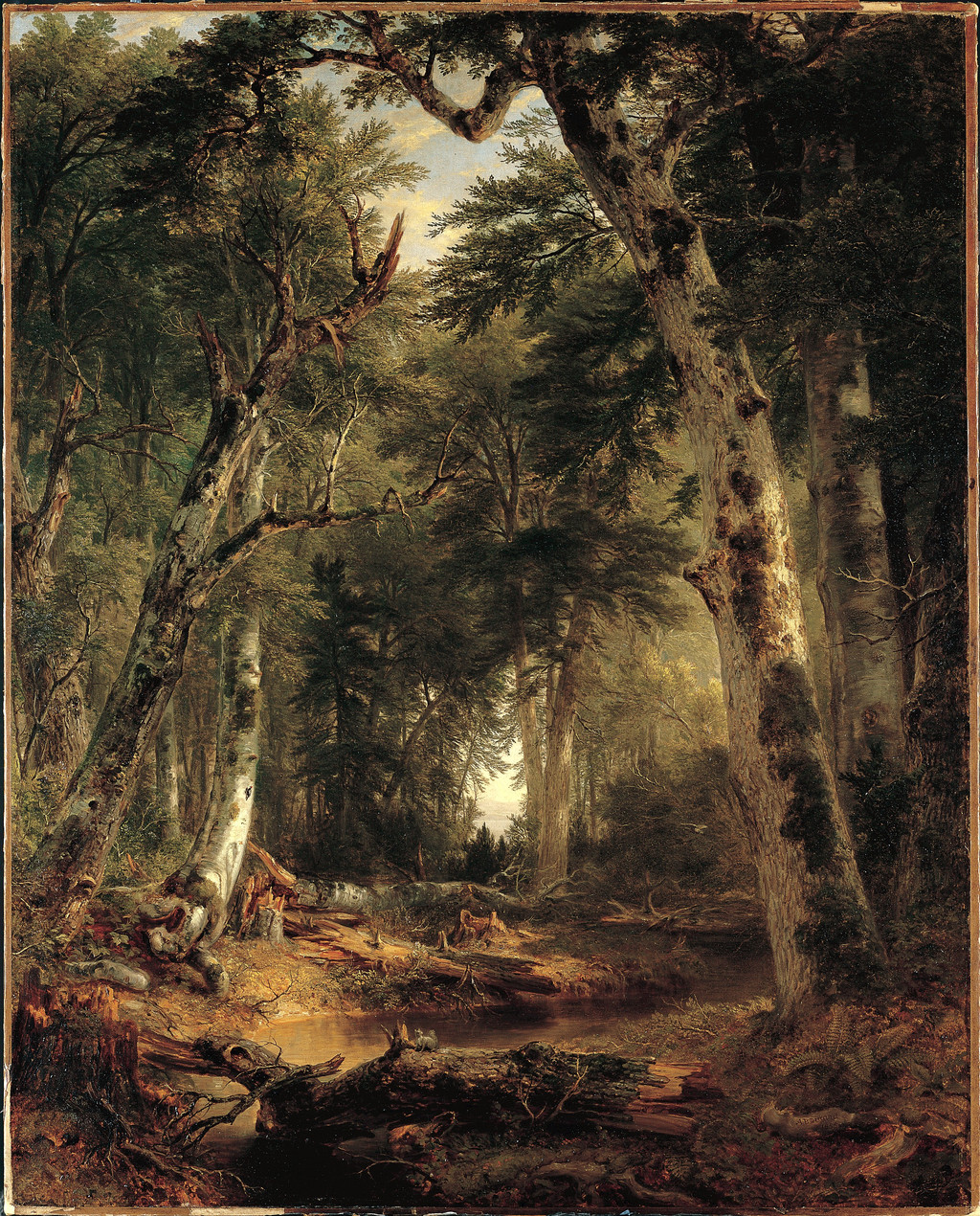
1854In the Woods
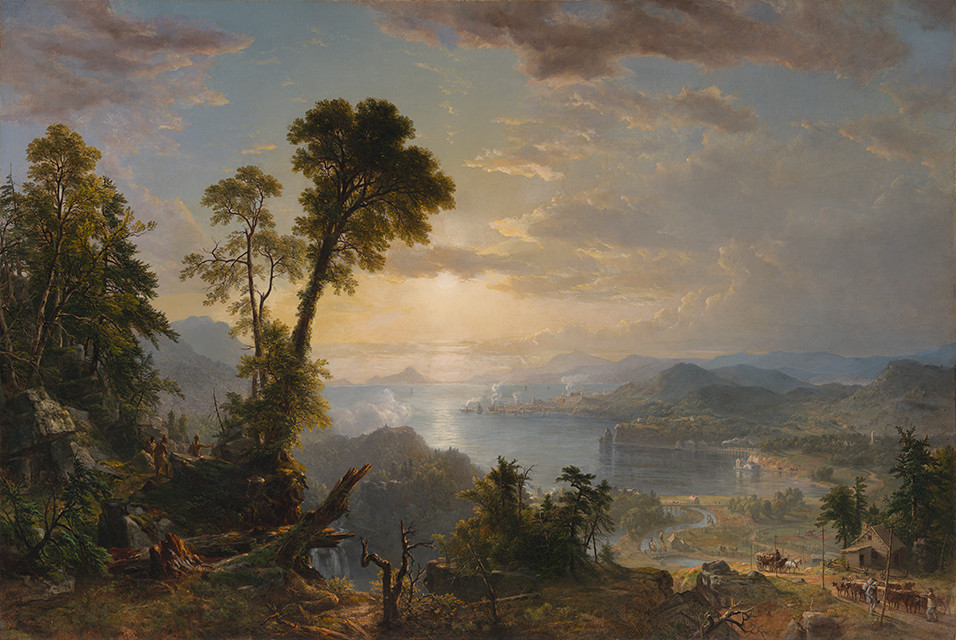
1855The Catskills
1859Summer Afternoon
1865Contents
- A landscape around still water
- The bridge, cross and church
- Sheep and the idle plough
- Two forms of Sunday attention
- Walters’s commission and the early response
- Royal Taft and Huntington’s memorial account
- Three different Sunday subjects
- A comparison with Thanatopsis
- Annotated details
A landscape around still water
Large trees occupy both sides of the painting. Their trunks rise near the edges, while branches extend across portions of the upper sky. Together, they establish a wooded foreground from which the viewer looks toward more open ground.
The arrangement leaves a broad central interval. Within it, a bridge crosses the water, the church stands on a low rise at the left and hills extend farther away. The landscape develops through these successive distances rather than through a single spectacular mountain or cascade.
Water occupies the middle ground, reflecting dark trees along the far bank and lighter sky toward the left. Its relatively unbroken surface contributes to the painting’s stillness. Small figures crossing above it remain legible because the bridge separates their route from the surrounding foliage.
The nearest ground is rougher. Rocks, plants, tree roots and small changes of level give it irregular substance. This foreground provides a place for close inspection, even while the central opening makes the distance easy to follow.
The tall side trees therefore have two related functions. They shelter the viewer’s imagined position and give the more open country a frame. The setting can feel intimate and extensive at the same time.
Annotated Details from Sunday Morning
The numbered points identify visible features discussed in this article. Return from each detail to the whole composition. Asher Brown Durand, Sunday Morning, 1860. Oil on canvas, 71.4 × 107 cm. New Britain Museum of American Art, 1963.4, Charles F. Smith Fund. Gallery photograph by Daderot; complete supplied frame and perspective retained. New Britain Museum of American Art; gallery photograph by Daderot, released to the public domain. Image source. Public domain. Resized only; native appearance, complete carrier and margins preserved.
Details from SUNDAY MORNING
Compare the cropped details with the complete images above. Notice how their colours, shapes and positions contribute to the larger compositions.
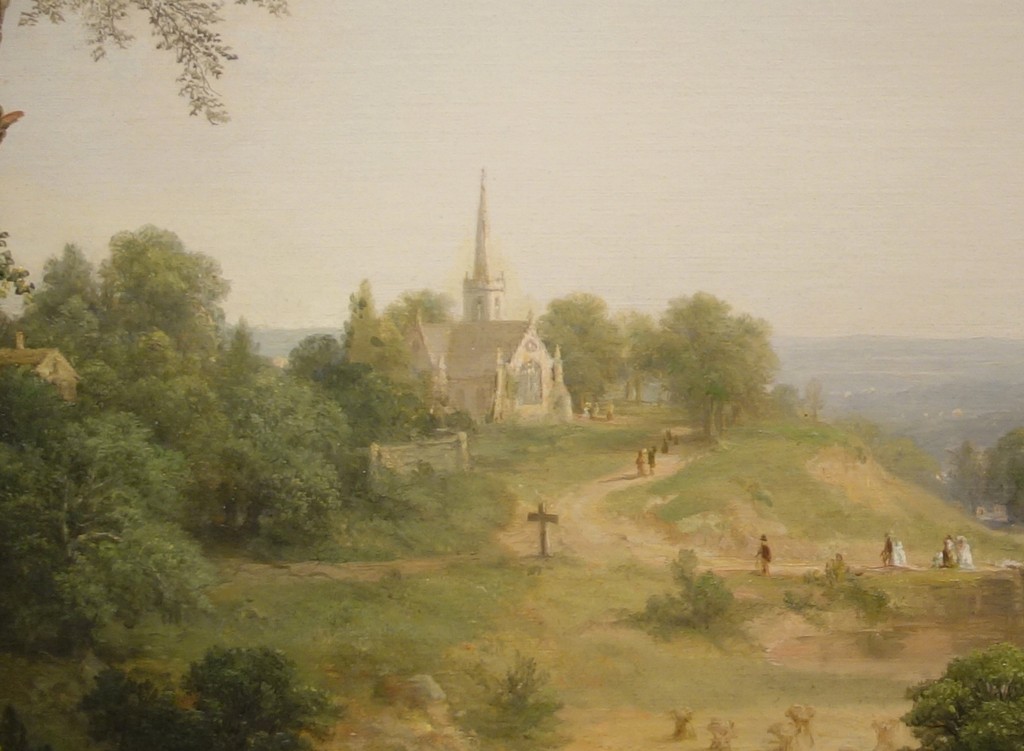
Church and cross on the hill
A church rises above the left hill, with a cross nearer the descending path. The two forms retain their different positions.
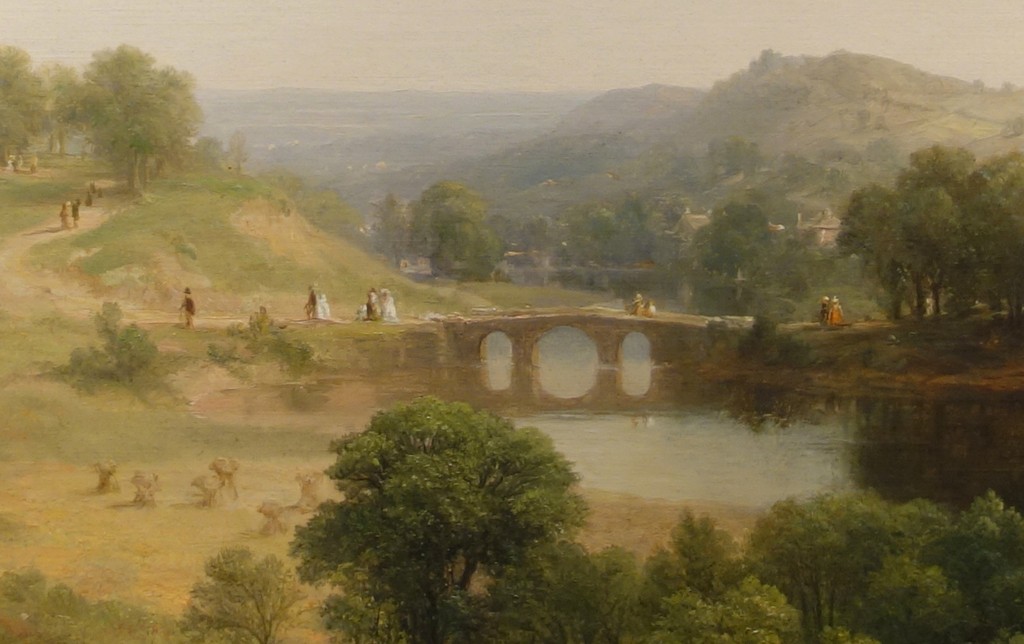
Walkers crossing the bridge
Small walkers cross the bridge above the still water. Its pale arches provide a middle-distance link across the composition.
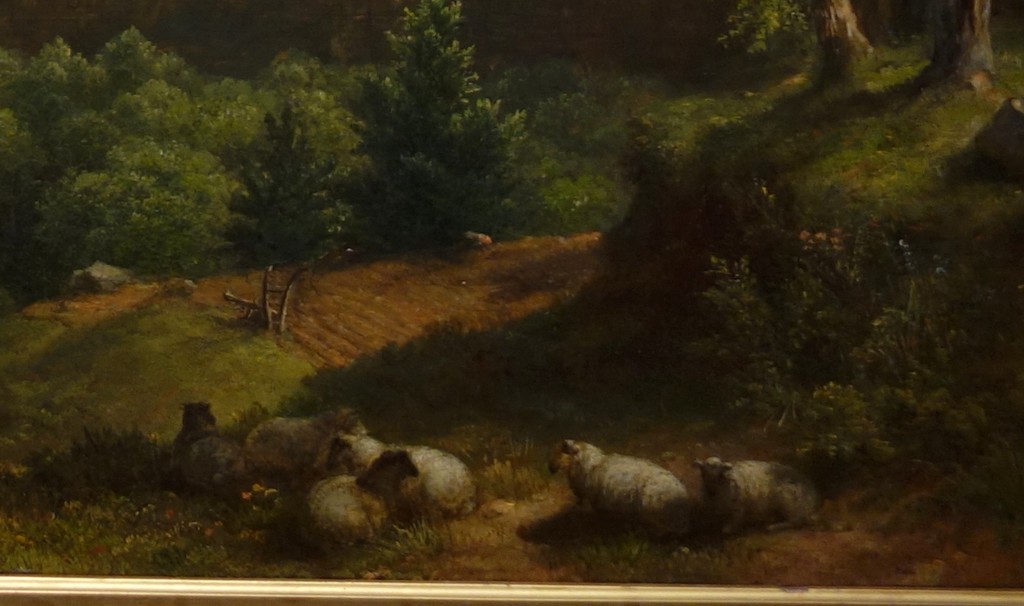
Sheep and idle plough
Sheep rest near the lower-right edge and a plough stands farther up the ground. The two details contribute to the painting’s Sunday rest.
The bridge, cross and church
The bridge provides the principal route between the right-hand bank and the rise supporting the church. Its arches make a clear repeated pattern above the water. That constructed form contrasts with the irregular branches and rocks surrounding it.
Small walkers occupy the route. Their clothing creates pale and warm accents along the bridge and farther path. Each figure remains slight in relation to the landscape, but together they make the movement toward the church understandable.
A cross stands beside the ascending way. The church’s slender spire rises higher behind it, reinforcing the destination suggested by the path. These features give the landscape a specific devotional setting without bringing the interior worship service into view.
The distance between viewer and church matters. We can look toward the congregation’s destination while remaining among foreground trees and grass. The canvas offers an outward view of religious observance and a nearer experience of the surrounding country.
The New Britain Museum discusses this relation between churchgoing and attention to nature. Its interpretation recognises both activities within the picture, rather than reducing the landscape to scenery placed behind the building.[1]
Sheep and the idle plough
Sheep occupy the lower right, close to the viewer’s side of the water. Some rest low in the grass, with their pale coats distinguishing them from the shaded ground. Their quiet presence gives the nearest landscape an activity quite different from the walkers’ progress.
A plough stands in a patch of worked earth above them. The furrows retain evidence of cultivation, while the tool’s stillness suggests an interruption to that labour. The day’s meaning is therefore expressed partly through work that has been set aside.
The museum identifies six sheep in this foreground group. Their proximity to the plough joins grazing, rest and cultivation within one small area of the canvas.[1]
The scene does not make rural life disappear in order to establish calm. Water, pasture, agricultural equipment and a crossing remain part of the setting. The quiet arises from how these activities and objects are arranged on this particular day.
The sheep also help measure the trees and near ground. Their small bodies make the trunks seem substantial, while their pale coats give the viewer something to locate amid darker vegetation. They contribute to spatial structure as well as to the devotional interpretation.
Two forms of Sunday attention
The churchgoers occupy a visible path with a destination. The viewer’s own attention can take a less directed course, lingering over the foreground trees, water and animals before reaching the church. The painting accommodates both kinds of encounter.
In its institutional essay, the New Britain Museum relates the resting sheep and smooth water to Psalm 23. This is an interpretation of familiar pastoral imagery, rather than proof that the canvas illustrates one particular verse in a literal sequence.[1]
Rebecca Bedell’s study of Durand’s landscapes places their calm and expansiveness within nineteenth-century ideas about spiritual and emotional restoration. She discusses how a picture could invite a viewer to become absorbed in an imagined outdoor environment.[2]
That historical framework helps explain the time the scene asks of its viewer. Looking can move between near detail and extensive distance without being driven by a dramatic action. The painting creates opportunities to pause at several points along the way.
The plough and sheep make this pause concrete. Their presence supplies ordinary rural counterparts to the larger idea of rest. The church, meanwhile, gives a recognisable social and religious destination to the people who continue across the bridge.
Watch: Asher Brown Durand
Choose a film to explore the artist’s work, its interpretation and its wider setting.
Friendship and landscape, Asher B Durand's Kindred Spirits
Smarthistory and Crystal Bridges discuss friendship, memory and landscape in Kindred Spirits.
Watch on YouTubeWalters’s commission and the early response
The New Britain Museum identifies William T. Walters as the commissioner and records that the painting was exhibited at the National Academy of Design in 1860. Its essay reports favourable contemporary responses to the scene’s quiet rural atmosphere.[1]
The museum’s account brings together original press responses, but those historical articles remain distinct from the modern essay through which they are consulted here. Their reported reception supports the work’s public history without establishing that every viewer experienced it in exactly the same way.
John Durand’s 1894 memoir also names Walters under its 1860 entry. It praises the picture as an especially successful culmination of the artist’s landscape practice. That ranking belongs to the son’s retrospective assessment.[3]
The commission can be compared with the Walters family’s The Catskills, 1859. Both works offer a substantial encounter with tree-framed scenery, but Sunday Morning gives the landscape a more explicit pattern of human observance and interrupted work.
Royal Taft and Huntington’s memorial account
John records that Walters passed the picture to his partner and that it later belonged to Royal C. Taft in Providence. These are stages reported in the memoir’s 1894 account, rather than a statement of the painting’s present ownership.[3]
Daniel Huntington’s 1887 memorial address provides another direct historical connection with Taft. He records the owner’s loan of Sunday Morning from Providence to the memorial exhibition at Ortgies. The landscape therefore formed part of the public remembrance of Durand soon after his death.[4]
Huntington describes its effect through “stillness and feeling of sacred rest.” These words are his critical response to the picture, recorded in the original address, rather than a quotation from Durand explaining its commission.[4]
The response gives the foreground’s quiet animals, unused plough and smooth water a place within the painting’s reception history. It also shows that the work’s consoling atmosphere mattered to a fellow artist, not only to its commissioner and later collectors.
The New Britain Museum’s current record identifies the canvas as accession 1963.4, acquired through the Charles F. Smith Fund. This exact identification keeps the older collecting testimony attached to the correct 1860 object.
Three different Sunday subjects
Durand returned to Sunday scenery in more than one painting. The New Britain Museum distinguishes its canvas from Sunday Morning, 1839, in the New-York Historical Society, and Early Morning at Cold Spring, 1850, in the Montclair Art Museum.[1]
The latter also circulated under the title Sabbath Bells. The museum’s account discusses its lone contemplative figure, distant church and upright arrangement. These features give it a different emphasis from the broad 1860 canvas.
The earlier works help place the theme within a continuing artistic interest. Their dates, formats and collecting histories should remain attached to their individual identities, even where the titles and devotional subjects overlap.
The 1860 work offers an especially broad opening between side trees. Its church, bridge, water and foreground rest can be encountered within one continuous prospect. That arrangement lets private contemplation and social observance remain visible together.
A comparison with Thanatopsis
Landscape—Scene from Thanatopsis, 1850, also places different human activities within an extensive setting. The Met relates its funeral, agricultural work and historical remains to Bryant’s poem.[5]
The comparison concerns how a landscape can contain more than one kind of time. Thanatopsis joins mortality with continuing labour; Sunday Morning gives movement toward worship and the suspension of work a shared day. Here, trees and water hold those activities within a scene whose measured pace invites the viewer to remain.
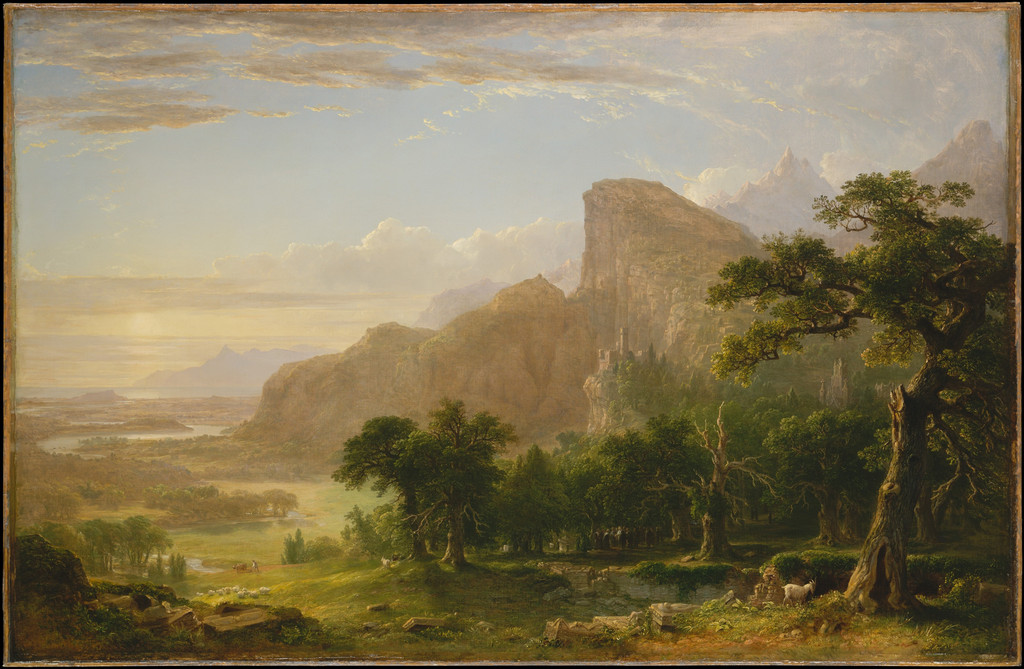
Asher Brown Durand, Landscape—Scene from Thanatopsis, 1850. Metropolitan Museum of Art, 11.156. Gift of J. Pierpont Morgan, 1911. The Metropolitan Museum of Art. Image source. CC0 / Public domain. Resized only; native appearance, complete carrier and margins preserved.
Artworks directory
A collected selection of 19 individually identified paintings, prints and a graphite study, including fifteen dedicated artwork articles. This directory is not a complete catalogue raisonné. Links lead to a companion article where available, otherwise the consulted institutional record. Progress is identified by title, date and museum; an unverified accession is omitted. Unillustrated objects remain searchable.
Frequently Asked Questions
The 1860 canvas in the New Britain Museum of American Art, accession 1963.4. Durand’s 1839 Sunday Morning and 1850 Early Morning at Cold Spring are separate works.[1]
It makes the pause in ordinary agricultural work visible alongside the resting sheep and churchgoing figures. The museum discusses these features in its devotional reading.[1]
Discussion
Look again at the images and ideas explored in Sunday Morning by Asher Brown Durand. These editorial prompts invite your observations.
Reader Insights
Does the bridge direct your eye immediately toward the church?
How do the sheep and unused plough affect your sense of the day’s pace?
Can you experience the foreground as a place of contemplation while following the walkers’ route?
Join the Conversation
Share a detail, comparison or question about Sunday Morning by Asher Brown Durand below.
References
- New Britain Museum of American Art, Sunday Morning, accession 1963.4, and Durand biography. Complete essay and notes actually read; exact object, Walters commission, exhibition, imagery, variants and current credit. Historical press excerpts consulted through this institutional essay. View source
- Rebecca Bedell, “Nature is a Sovereign Remedy: Durand and the Therapeutic Landscape,” in Asher B. Durand (1796–1886): American Landscapes, Fundación Juan March (2010), printed pp.195–200. Complete selected main essay consulted, including the Sunday Morning discussion; the notes’ continuation on p.201 is not claimed as read. Historical restorative beliefs are interpreted as period context. View source
- John Durand, The Life and Times of A. B. Durand (1894), printed p.177. Selected chapters actually consulted; complete relevant entry reread for Walters, later Royal C. Taft ownership and the son’s ranking. View source
- Daniel Huntington, Asher B. Durand: A Memorial Address (1887), printed pp.36–37. Both original pages actually displayed and read; Taft’s memorial-exhibition loan and the exact six-word quotation. Other passages of the address remain separately bounded in the research record. View source
- Metropolitan Museum of Art, Landscape—Scene from Thanatopsis, accession 11.156. Complete current primary indexed object record and narrative actually read for the exact 1850 comparison; direct capture unavailable. View source
- Splash image source.
Asher Brown Durand, Sunday Morning, 1860. Oil on canvas, 71.4 × 107 cm. New Britain Museum of American Art, 1963.4, Charles F. Smith Fund. Gallery photograph by Daderot; complete supplied frame and perspective retained. New Britain Museum of American Art; gallery photograph by Daderot, released to the public domain. Public domain. Resized only; native appearance, complete carrier and margins preserved.
View source