 by Tom Gurney
Tom Gurney BSc (Hons) is an art history expert with over 20 years experience
Email: tomgurney1@gmail.com / Phone: +44 7429 011000
River Scene by Asher Brown Durand: Introduction
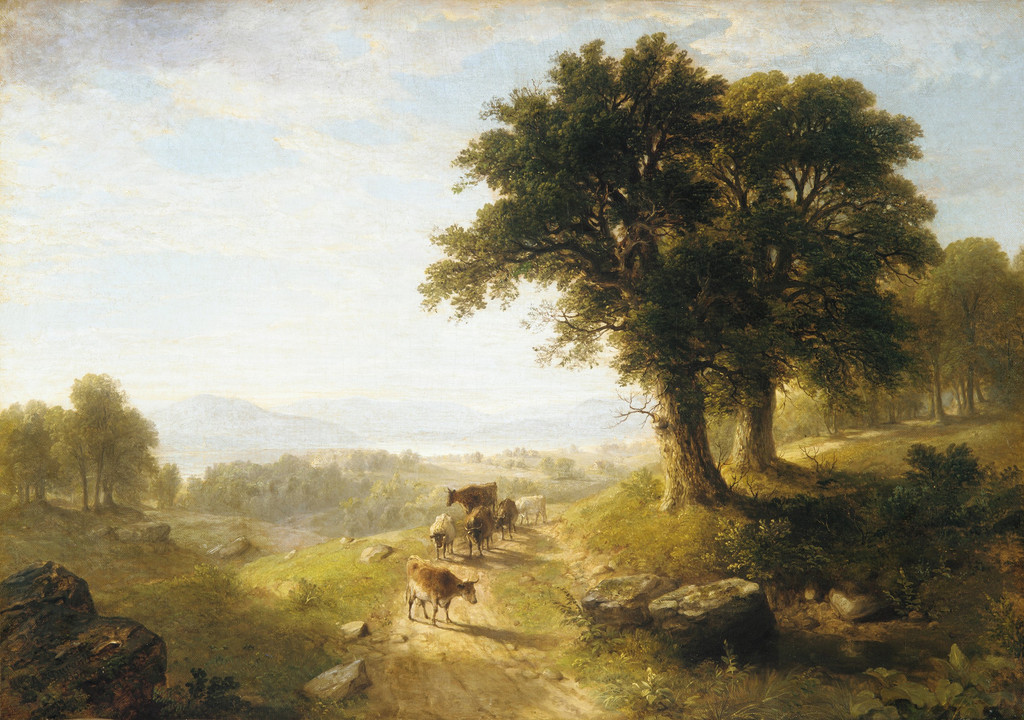
Cattle descend a sunlit road beside two large trees in Asher Brown Durand’s River Scene, painted in 1854. Water opens across the left distance, where low hills and small buildings soften into pale air. The Metropolitan Museum of Art holds this landscape, a work whose principal interest lies in the relation between an ordinary rural passage and an expansive setting.[1]
At a Glance
- ArtistAsher Brown Durand (1796–1886)
- TitleRiver Scene
- Date1854
- MediumOil on canvas
- Dimensions61 × 86.7 cm
- CollectionMetropolitan Museum of Art, New York
- Accession1970.58
- Museum creditBequest of Mary Starr Van Winkle, 1970
This work across Asher Brown Durand’s career
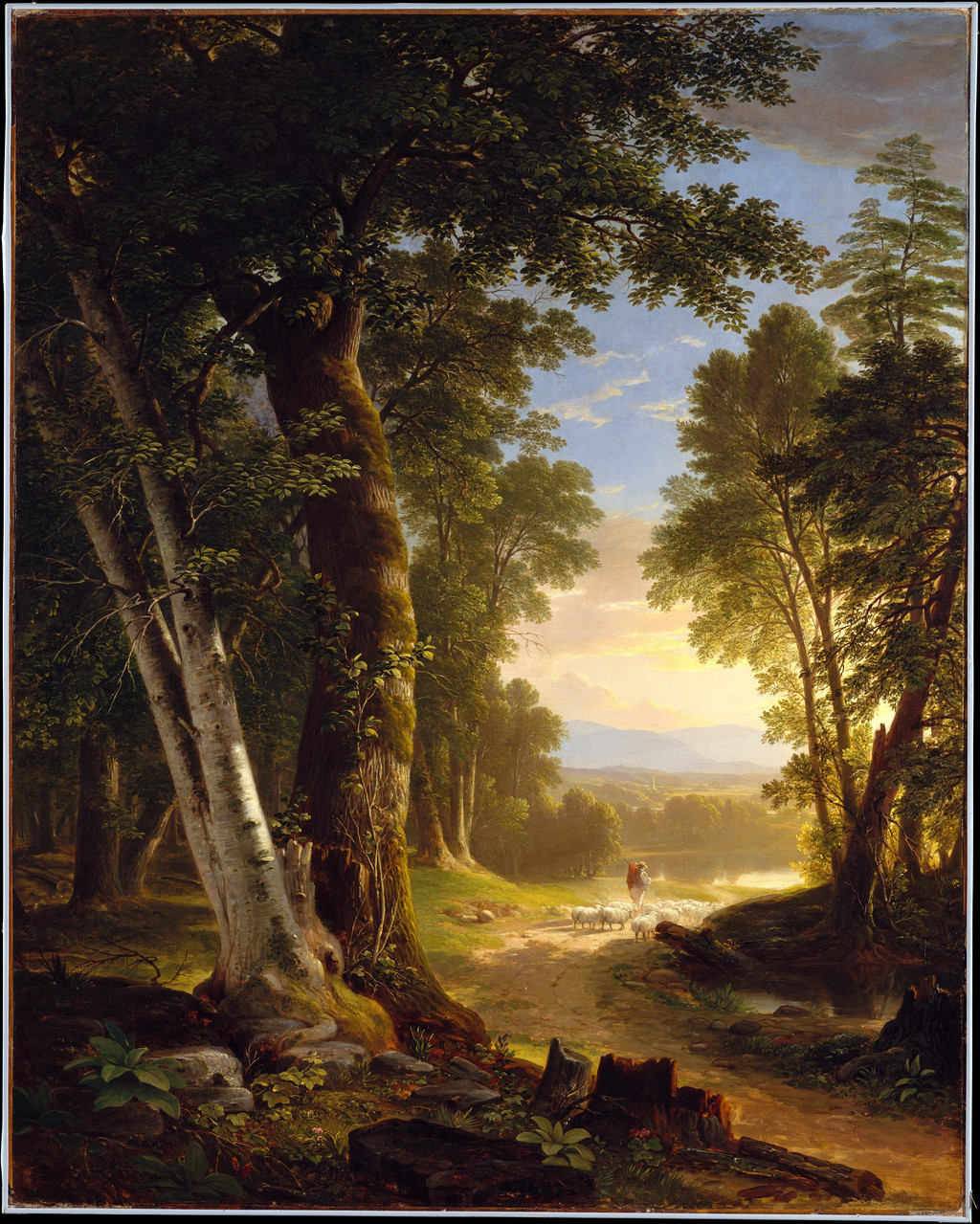
The Beeches
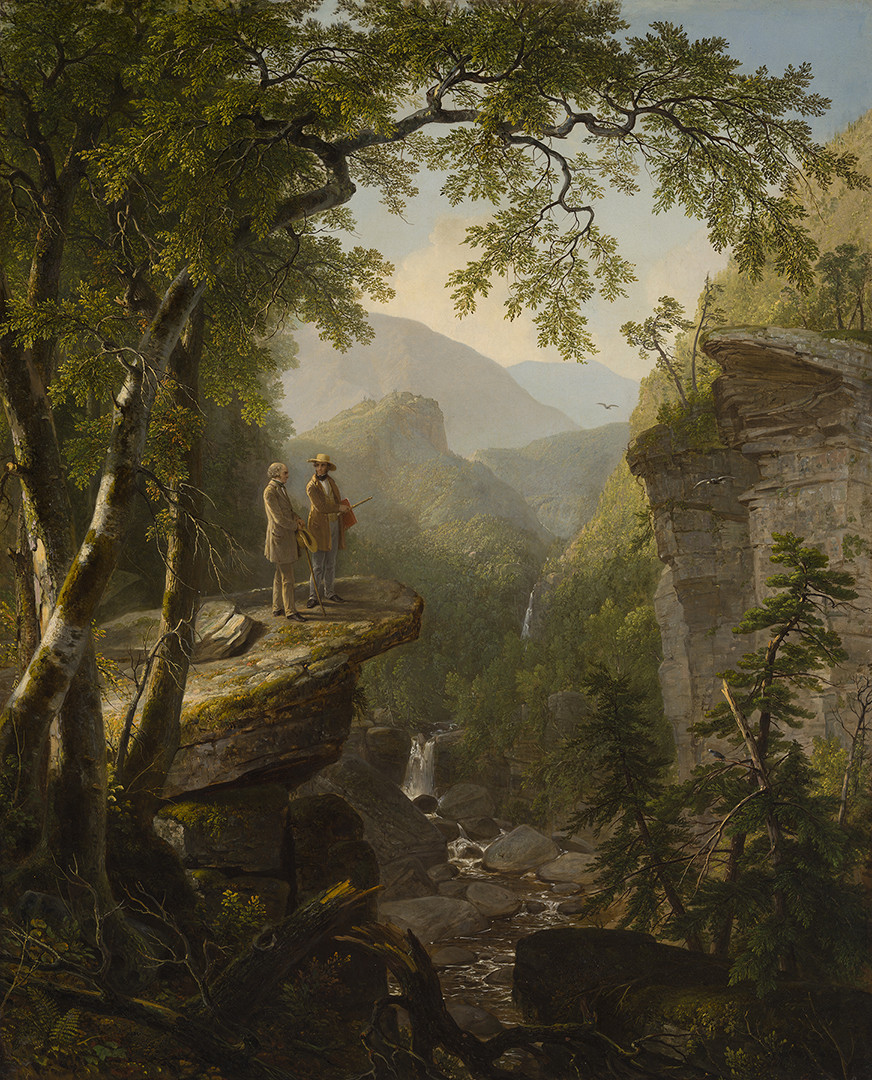
1845Kindred Spirits
1849God’s Judgment Upon Gog
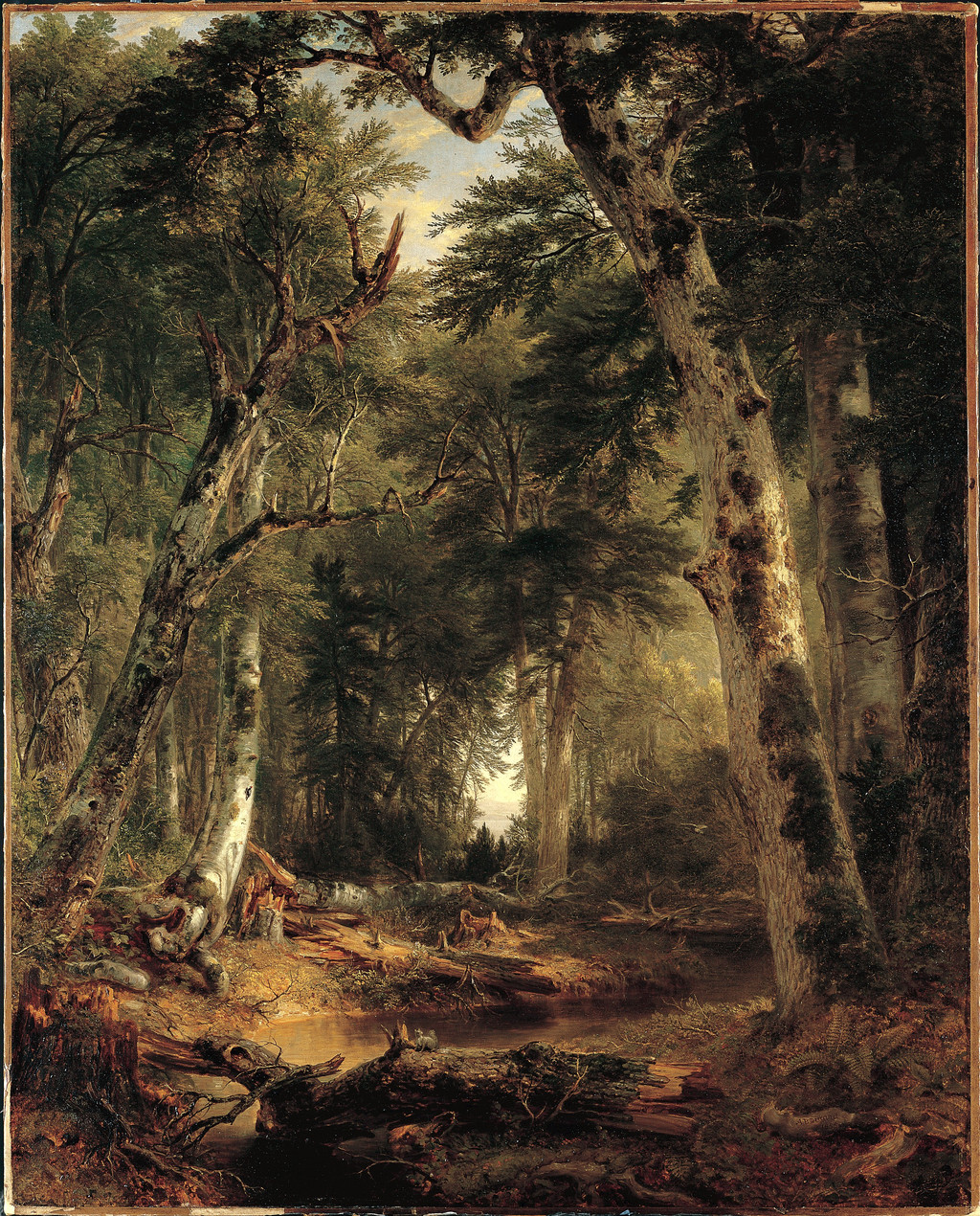
ca.1851–52In the Woods
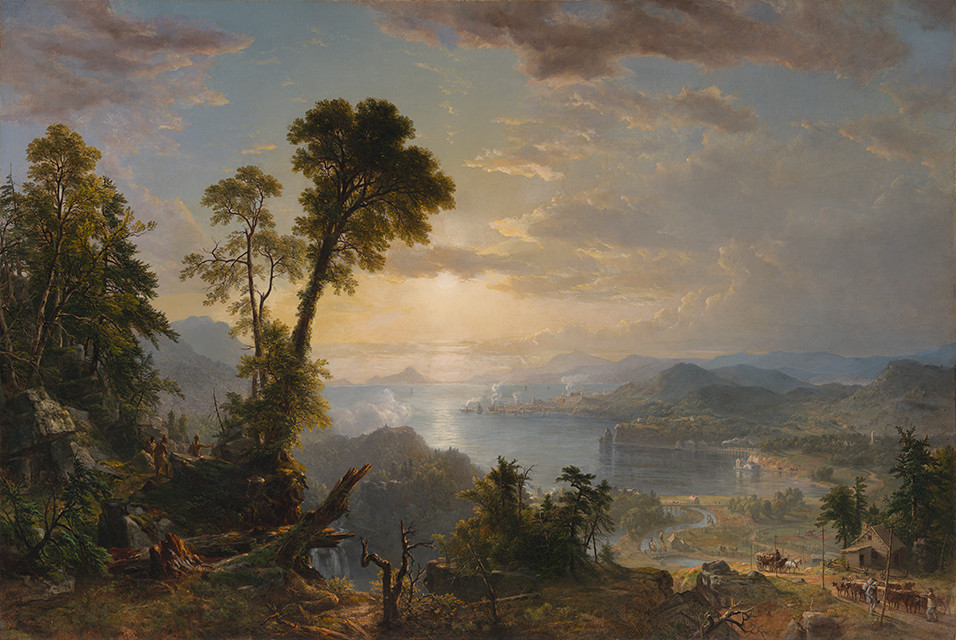
1855The Catskills
1859Sunday Morning
1860Summer Afternoon
1865Contents
- The trees and the open distance
- Cattle on the descending road
- Near shade and distant water
- English landscape and an unspecified place
- The collection and a later comparison
- Annotated details
- Looking from the painted trees to a drawing
The trees and the open distance
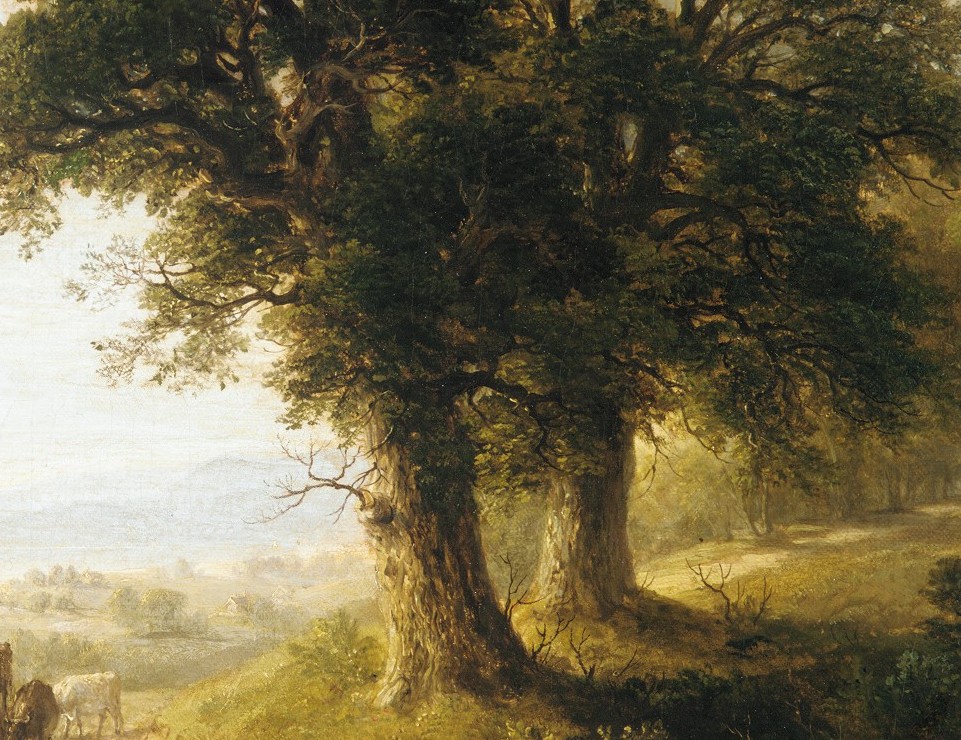
The nearer trees occupy the right side of the canvas. Their broad, dark crowns extend over a large part of the sky, while their trunks remain clearly visible against lighter ground. Branches divide and overlap within the foliage, giving the trees substantial internal structure.
The nearest trunk stands above the cattle road. Its scale can be judged against the animals and the stones below it. That relationship makes the tree imposing without isolating it as a specimen detached from the rest of the country.
Durand balances this wooded mass with open space on the left. A pale sky, distant hills and water create a much lighter area. The composition therefore presents two kinds of looking at once: close attention to the large trees and a longer view through relatively open atmosphere.
The tree crowns reach toward this opening but leave it accessible. Their irregular outline helps connect the dark right-hand forms with the surrounding sky. Small projections of foliage soften the boundary between the near objects and the distance.
Additional trees follow the slope behind the two main trunks. These smaller forms extend the wooded ground toward the right edge. The painting gives the nearer trees prominence while keeping them part of a larger landscape.
Annotated Details from River Scene
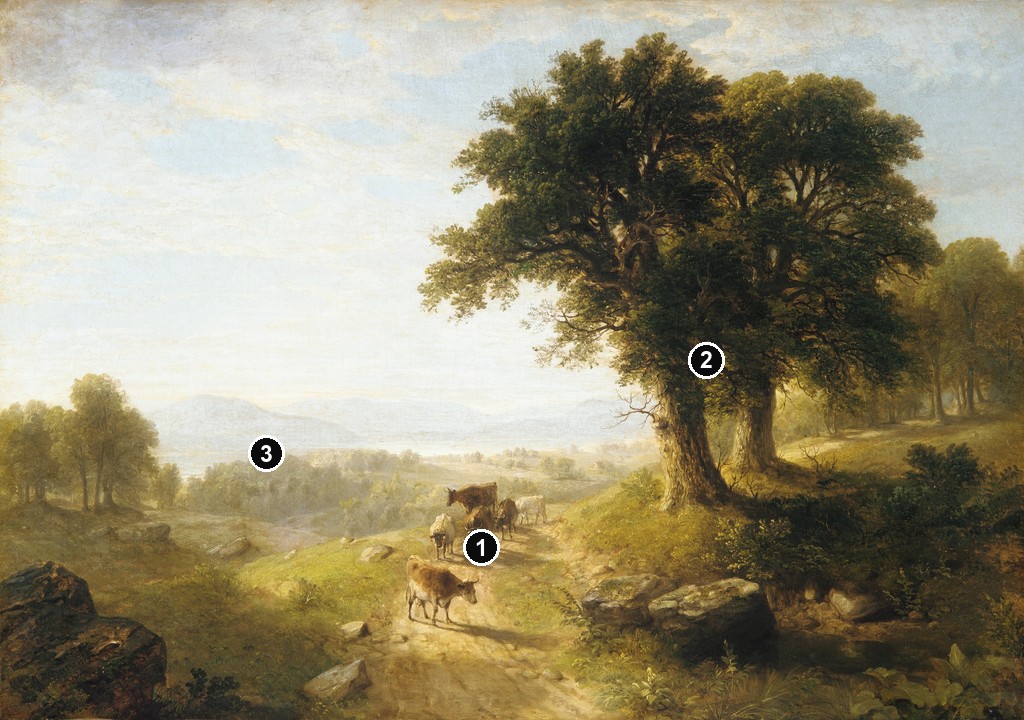
The numbered points identify visible features discussed in this article. Return from each detail to the whole composition. Asher Brown Durand, River Scene, 1854. Metropolitan Museum of Art, 1970.58. Bequest of Mary Starr Van Winkle, 1970. The Metropolitan Museum of Art. Image source. CC0 / Public domain. Resized only; native appearance, complete carrier and margins preserved.
Details from RIVER SCENE
Compare the cropped details with the complete images above. Notice how their colours, shapes and positions contribute to the larger compositions.
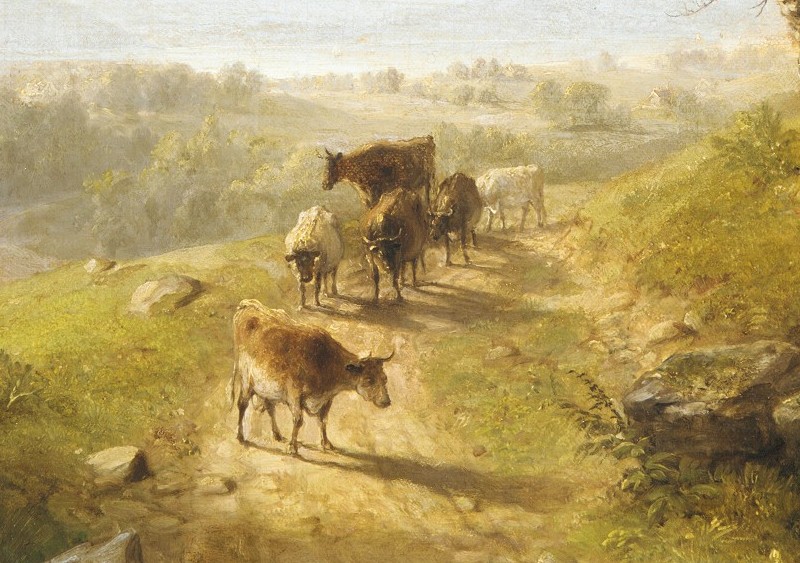
Cattle descending the road
A line of cattle follows the descending road towards the nearer ground. The pale track connects them with the opening beyond.
Trees above the road
Large right-hand trees spread their canopy above the road. Their dark mass balances the lighter left side.
Water and distant open country
Pale water and distant ground open beyond the near vegetation. Their quieter tones distinguish distance from the stronger foreground forms.
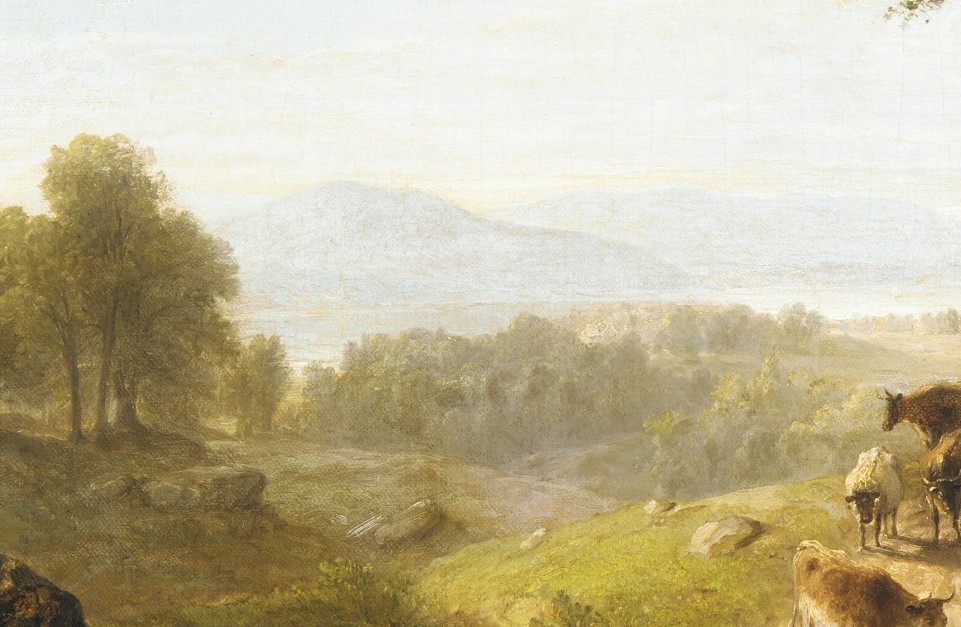
Cattle on the descending road
The road begins near the lower centre and curves uphill toward the animals and trees. Its pale surface stands out against the surrounding grass. Rocks beside it make the ground uneven, while the worn route suggests repeated passage through this country.
A brown animal occupies the nearest part of the road, with others spaced farther away. Differences in coat colour and position distinguish the animals within the group. Their forms provide a sequence of scales as the route bends through the landscape.
Long shadows cross the road. They make the light’s direction especially legible here, where the pale ground supplies a clear surface on which to see them. The cattle contribute to the landscape’s atmosphere as well as to its rural subject.
The Met interprets the herd as returning toward a barn beyond the visible scene. This supplies a possible ordinary destination for the animals, while the barn itself remains outside the picture.[1]
The path invites the viewer to imagine continuing through the country, but the nearest animal slows that movement. Its position and the road’s bend keep attention in the foreground before it reaches the more distant fields. The experience of depth develops through these successive interruptions.
Near shade and distant water
Rocks anchor both lower corners. At the left, a dark outcrop rises close to the edge; at the right, stones lie among plants below the trees. These forms give the foreground weight and prevent the lighter road from becoming the picture’s only near feature.
Grass catches the sunlight between the shaded corners. Its brightness makes the path and animals seem part of a continuous illuminated slope. The foreground alternates between sun and shelter, rather than presenting one uniform level of light.
Beyond it, fields and trees become less distinct. The river occupies a broad, pale band farther away, with low hills rising on the opposite side. The shift from near rock to soft distance creates the painting’s sense of extension.
The picture does not need a high mountain or a dramatic waterfall to make that distance meaningful. Its interest develops through ordinary differences: rough stone and soft air, dense foliage and open water, the nearest animal and the farthest land.
Watch: Asher Brown Durand
Choose a film to explore the artist’s work, its interpretation and its wider setting.
Friendship and landscape, Asher B Durand's Kindred Spirits
Smarthistory and Crystal Bridges discuss friendship, memory and landscape in Kindred Spirits.
Watch on YouTubeEnglish landscape and an unspecified place
The Met relates the canvas’s diagonal arrangement, trees and measured pace to English landscape painting. Its interpretation draws attention to formal affinities rather than assigning this river view to a named English location.[1]
Durand’s interest in English art has a documented background. John Durand’s memoir reproduces his father’s account of admiring Constable’s landscape painting in 1840 and seeing studies of familiar scenery, clouds and weather at Charles Robert Leslie’s home.[2]
That account helps explain why ordinary subjects and changing outdoor effects could matter to Durand. It does not identify a particular Constable painting as the direct model for River Scene. Similarities of arrangement should be distinguished from a demonstrated act of copying.
A more specific comparison exists for The Beeches, 1845. The Met’s catalogue relates that painting’s composition to Constable’s The Cornfield and discusses the role of Durand’s outdoor study.[3] In River Scene, the wider opening gives water and distant hills a different part in the arrangement, even though trees and a rural route again provide substantial near forms.
The collection and a later comparison
The painting entered the Met through Mary Starr Van Winkle’s bequest in 1970. This is the museum’s acquisition credit, distinct from an undocumented account of who commissioned the canvas in 1854. The consulted current record does not establish its exact landscape location.[1]
Summer Afternoon, 1865, also joins cattle, trees and water, with a stronger concentration of brightness near the low sun. The Met identifies that later painting as a commission for Morris K. Jesup.[4]
The comparison reveals how a familiar group of elements can produce different experiences. River Scene gives the cattle a road and a suggested destination. Summer Afternoon brings them beside luminous water. Here, the descent through near trees toward a broad distance makes rural movement itself the centre of attention.
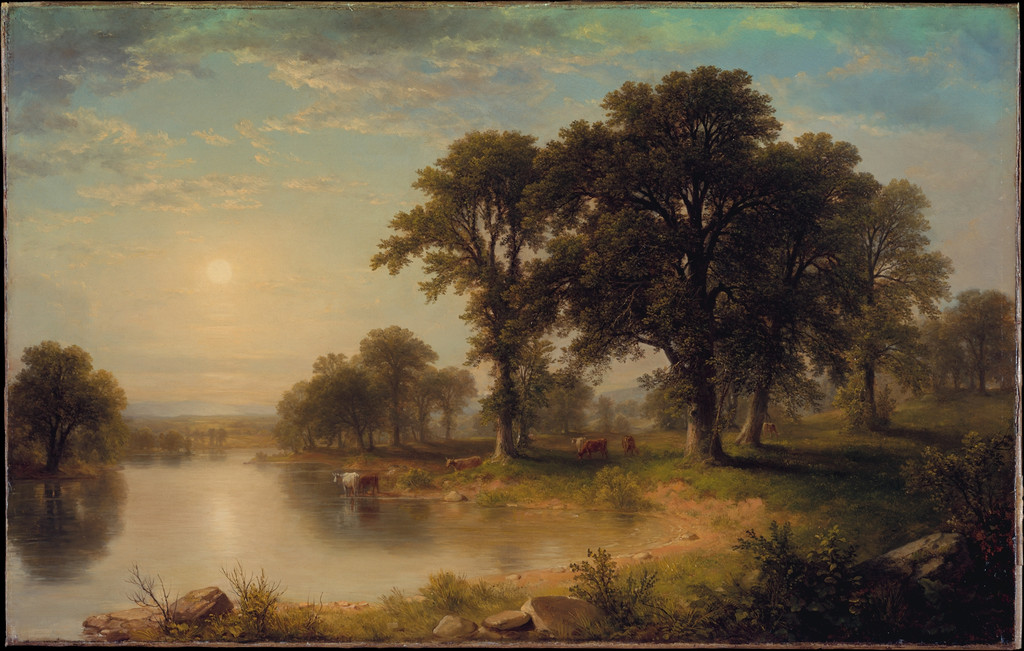
Asher Brown Durand, Summer Afternoon, 1865. Metropolitan Museum of Art, 15.30.60. Bequest of Maria DeWitt Jesup, from the collection of her husband, Morris K. Jesup, 1914. Supplied canvas rim and dark surround retained. The Metropolitan Museum of Art. Image source. CC0 / Public domain. Resized only; native appearance, complete carrier and margins preserved.
Looking from the painted trees to a drawing
A related way to approach these trees is through Durand’s drawing practice. The Met’s Sketch from Nature, dated about 1855, is a graphite study on grey-green wove paper. In discussing that sheet, the museum connects his close observation with the importance he assigned to drawing in his 1855 Letters on Landscape Painting. Roots, bark and changes in a trunk’s direction become subjects of sustained attention. [5]
The comparison gives the finished landscape a second scale of interest. From across a room, the two painted trees divide the canvas and shelter the cattle road. Closer viewing makes their individual irregularities more apparent. A broad composition can depend on natural forms that remain particular rather than interchangeable.
The drawing is not a documented preparatory sheet for River Scene. Its value here is comparative: it helps connect the prominence of trees in Durand’s landscapes with the patient attention to their structure that he practised in another medium.
Artworks directory
A collected selection of 19 individually identified paintings, prints and a graphite study, including fifteen dedicated artwork articles. This directory is not a complete catalogue raisonné. Links lead to a companion article where available, otherwise the consulted institutional record. Progress is identified by title, date and museum; an unverified accession is omitted. Unillustrated objects remain searchable.
Frequently Asked Questions
The consulted Met record does not name an exact location. The title alone does not establish which river is represented.[1]
The Met describes the cattle as heading toward a barn beyond the visible scene. It is an interpretation of their movement, not a building shown in the image.[1]
Through the 1970 bequest of Mary Starr Van Winkle; the museum’s object number is 1970.58.[1]
Discussion
Look again at the images and ideas explored in River Scene by Asher Brown Durand. These editorial prompts invite your observations.
Reader Insights
Do the cattle’s shadows or the distant water first establish the light for you?
How would the view change if the two large trees were removed?
Does imagining an unseen destination change the way you follow the road?
Join the Conversation
Share a detail, comparison or question about River Scene by Asher Brown Durand below.
References
- Metropolitan Museum of Art, River Scene, accession 1970.58. Complete current record and interpretation consulted; identity, bequest, unseen barn and English landscape affinities. View source
- John Durand, The Life and Times of A. B. Durand (1894). Selected chapters actually consulted; printed p.151 records the 1840 response to Constable and the visit to Leslie. Edited family testimony, not an original manuscript newly consulted. View source
- Metropolitan Museum of Art, The Beeches, in American Paintings in The Metropolitan Museum of Art, volume I, printed pp.414 and 416. Both relevant scans actually displayed and read; the specific Cornfield comparison and study history. View source
- Metropolitan Museum of Art, Summer Afternoon, accession 15.30.60. Complete current record and narrative consulted for the exact 1865 comparison and Jesup commission. View source
- Metropolitan Museum of Art, Sketch from Nature, about 1855, accession 36.63.1. Collection description consulted for graphite on grey-green wove paper, close observation of trees and the relation to the 1855 Letters on Landscape Painting; no preparatory relationship with River Scene is asserted. View source
- Splash image source.
Asher Brown Durand, River Scene, 1854. Oil on canvas, 61 × 86.7 cm. Metropolitan Museum of Art, 1970.58. Bequest of Mary Starr Van Winkle, 1970. The Metropolitan Museum of Art. CC0 / Public domain. Resized only; native appearance, complete carrier and margins preserved.
View source