 by Tom Gurney
Tom Gurney BSc (Hons) is an art history expert with over 20 years experience
Email: tomgurney1@gmail.com / Phone: +44 7429 011000
Signing the Declaration of Independence: Durand’s Print: Introduction
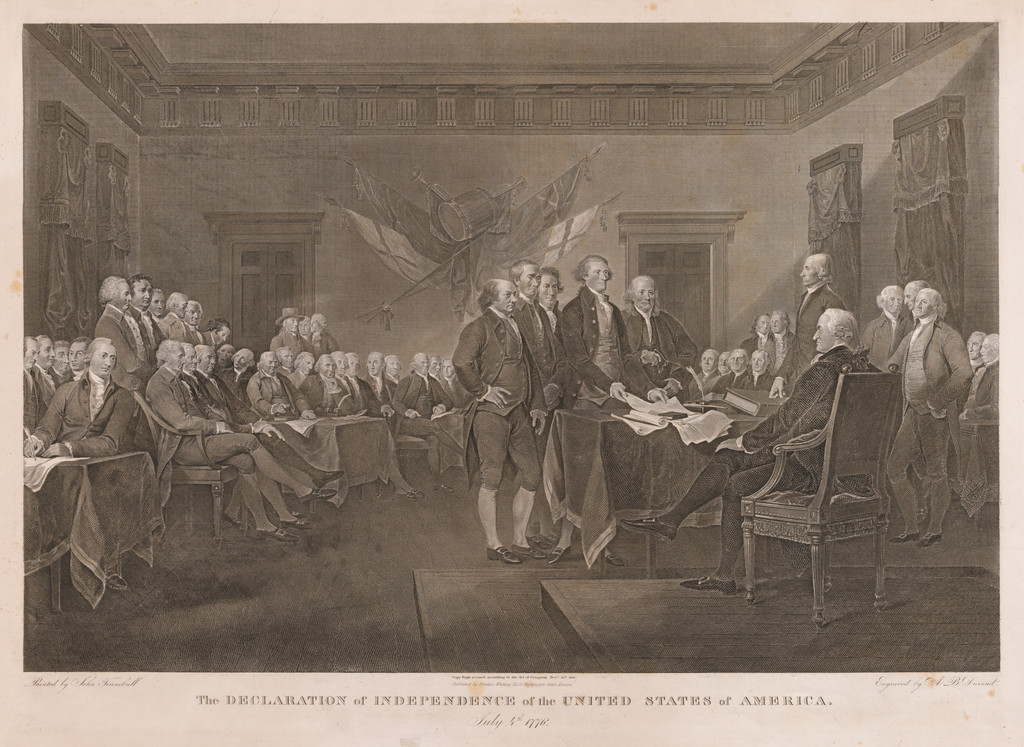
A committee stands before a seated president while delegates gather around the room in Asher Brown Durand’s 1823 print after John Trumbull. Papers on the central table provide the focus of the action. Durand translated a familiar painted account of the founding generation into a reproducible image that became an important achievement of his early career.[3]
The Cleveland Museum of Art calls its impression Signing the Declaration of Independence. The historical scene, however, represents the presentation of the draft on June 28, 1776. Distinguishing that event from the Declaration’s adoption and later signing makes the people, document and printed title easier to understand.[1][2]
At a Glance
- PrintmakerAsher Brown Durand (1796–1886), after John Trumbull
- Museum titleSigning the Declaration of Independence
- Date1823
- Museum mediumEtching
- CollectionCleveland Museum of Art
- Accession1919.675
- Museum creditGift of George A. Goddard
- Depicted eventPresentation of the draft, June 28, 1776
This work across Asher Brown Durand’s career
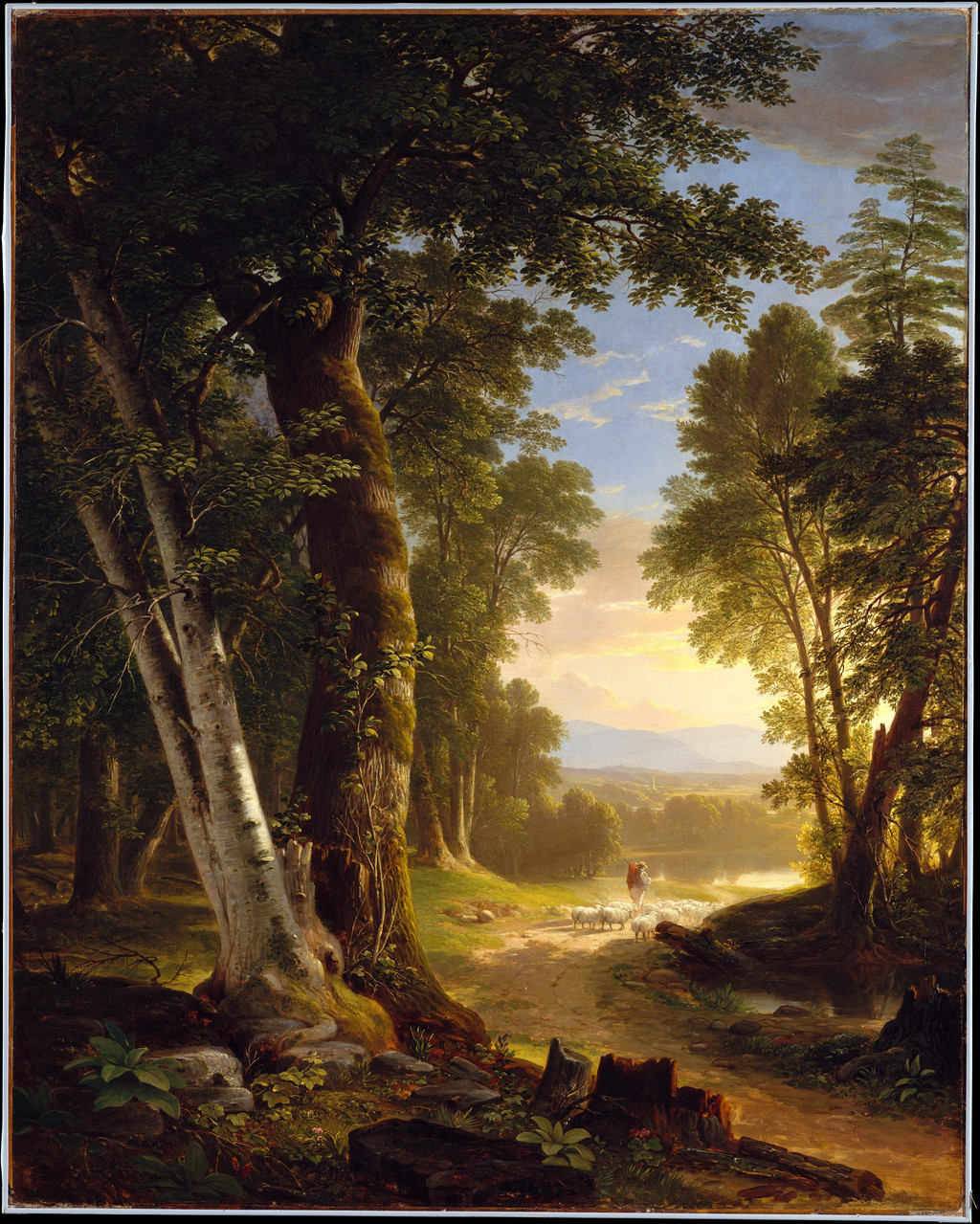
The Beeches
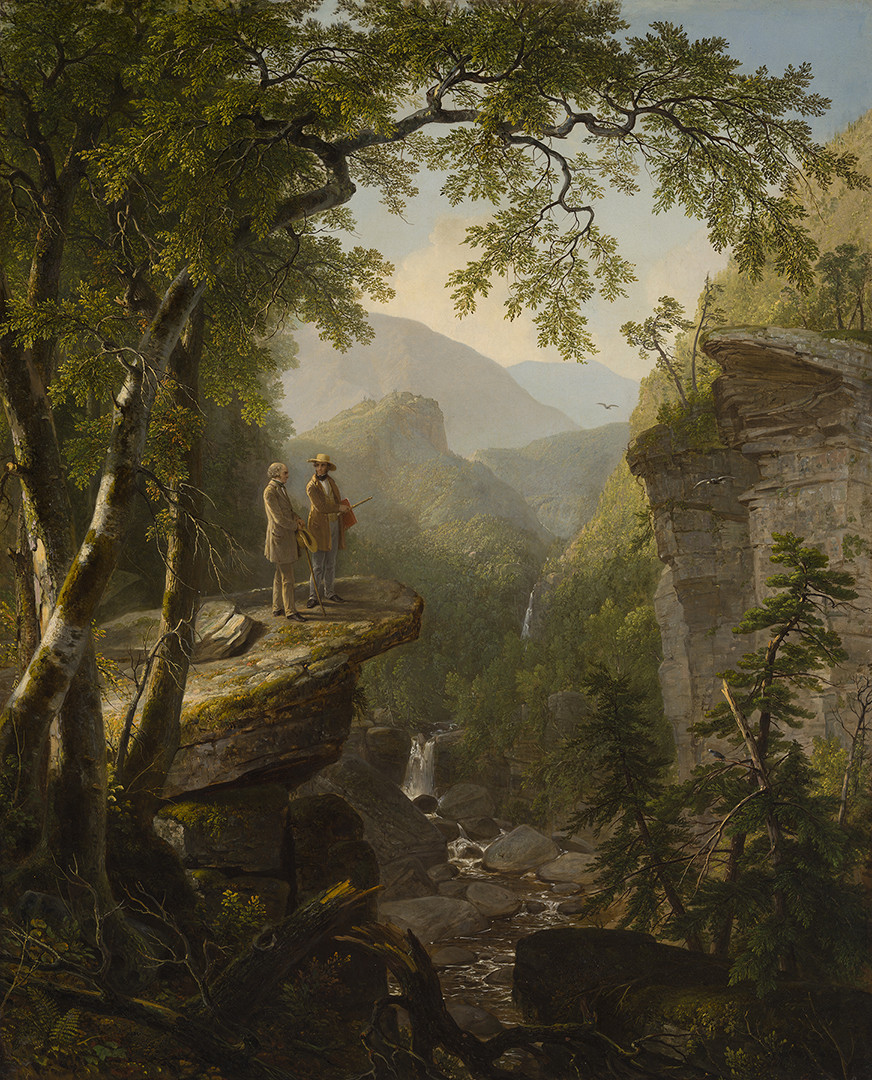
1845Kindred Spirits
1849God’s Judgment Upon Gog
ca.1851–52River Scene
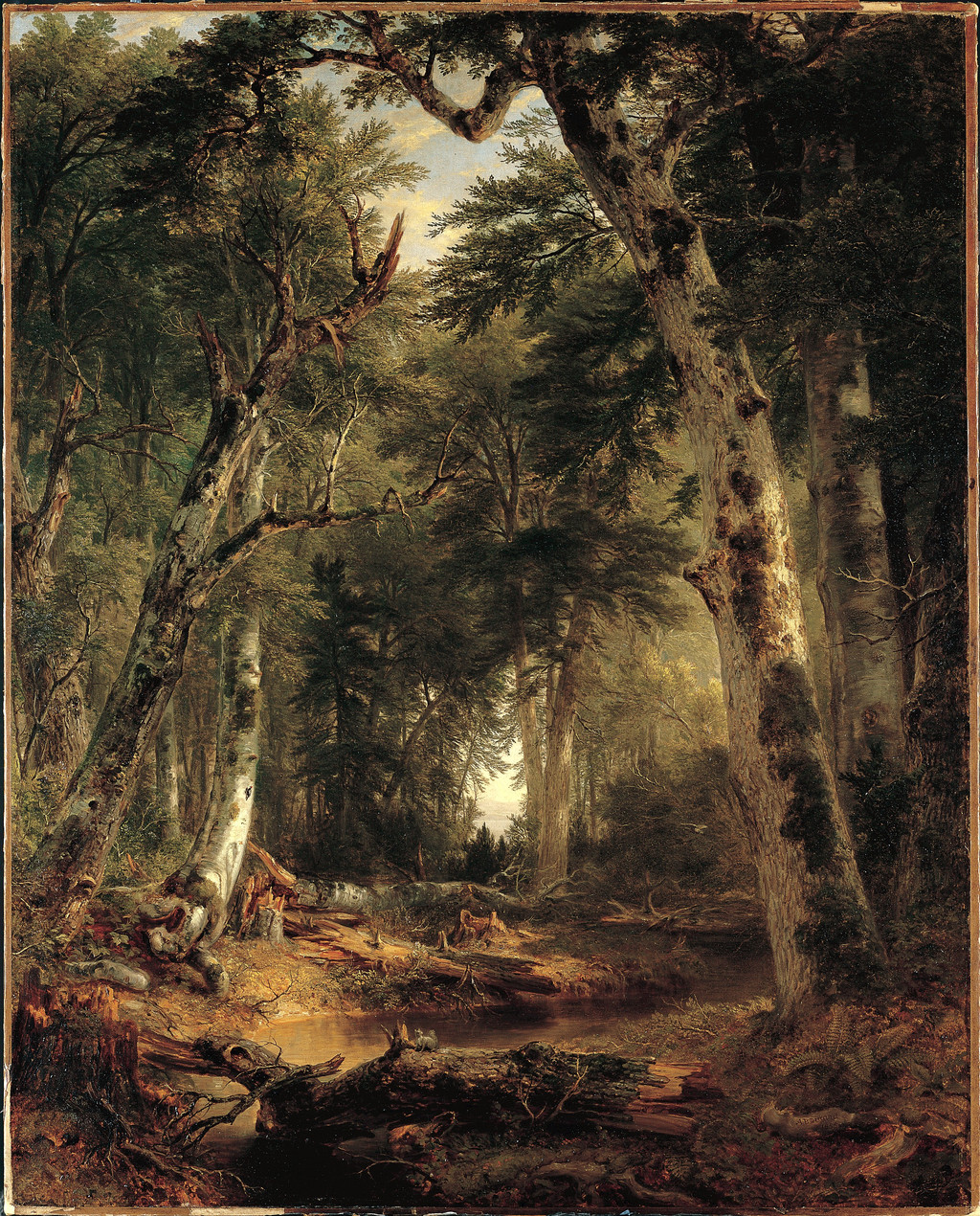
1854In the Woods
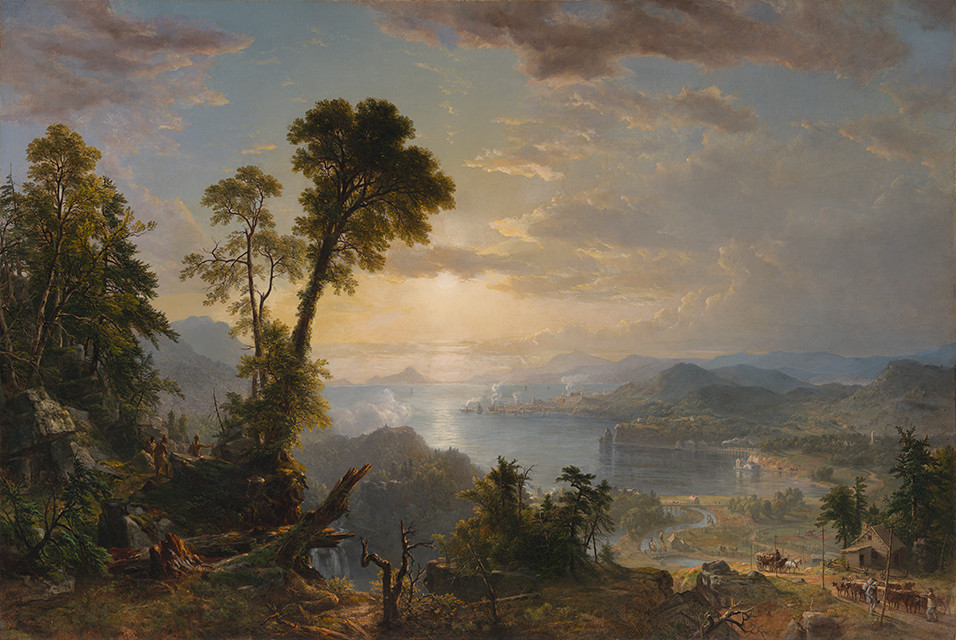
1855The Catskills
1859Sunday Morning
1860Summer Afternoon
1865Contents
- A presentation in the assembly room
- June 28, July 4 and August 2
- Portraits arranged for national remembrance
- The painted source and the larger Capitol version
- The 1820 commission and 1823 completion
- Line, cloth and the room’s light
- Printing and the language of American achievement
- Annotated details
A presentation in the assembly room
The central standing figures form a compact group, set apart from the seated delegates on either side. The document reaches toward the table at the right, where the presiding figure sits in a prominent chair. This arrangement gives the picture an action that can be located even before individual faces are identified.
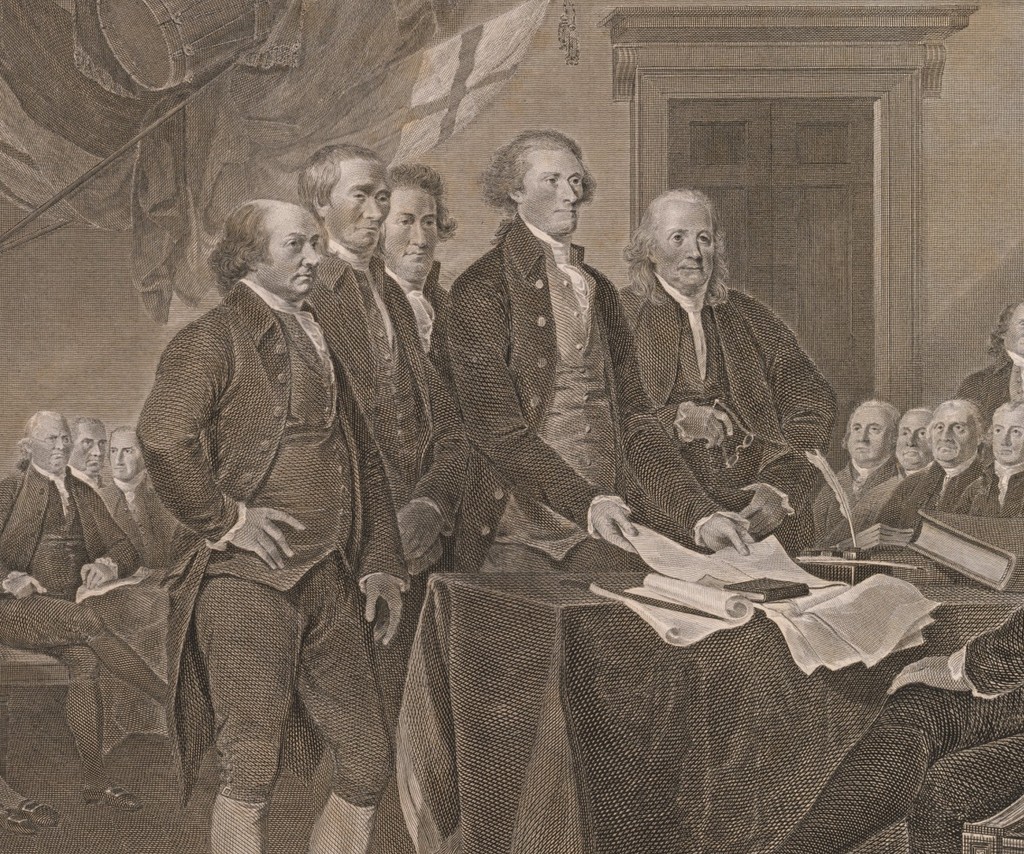
The Architect of the Capitol identifies Thomas Jefferson presenting the draft to John Hancock. John Adams, Roger Sherman, Robert Livingston and Benjamin Franklin join Jefferson as members of the drafting committee. The setting represents the Pennsylvania State House in Philadelphia, now Independence Hall.[2]
The group’s upright bodies interrupt the lower sequence of seated figures. Faces turn in different directions, giving the room a variety of small encounters rather than a single row of portraits. The participants surround an open foreground that keeps the principal action visible.
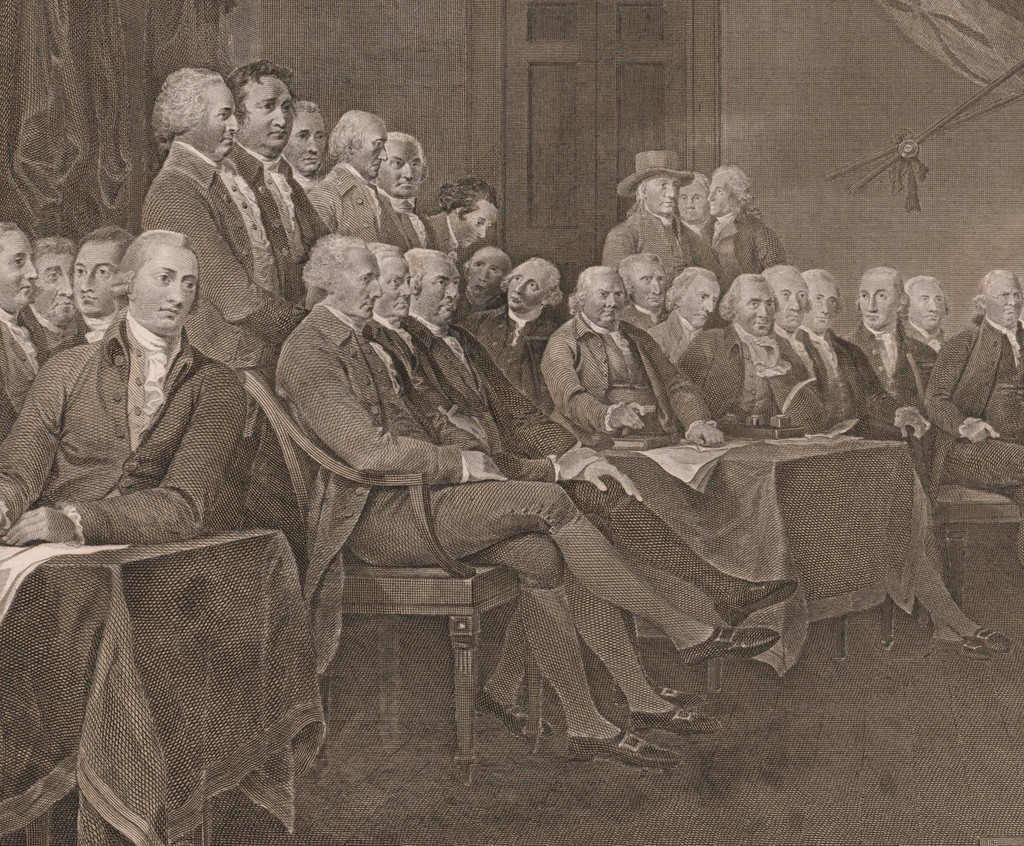
At the left, a long table carries papers and a hanging cloth. Chairs, legs and coat folds create repeated diagonals through this area. At the right, the presiding chair and nearby standing figures provide a more concentrated boundary to the scene.
The print’s architecture holds these groups together. Tall walls, doors and windows establish the room’s enclosure, while flags above the central group give the upper wall a separate arrangement of diagonal forms. The human action occupies only the lower part of this large interior.
Annotated Details from Signing the Declaration of Independence: Durand’s Print
The numbered points identify visible features discussed in this article. Return from each detail to the whole composition. Asher Brown Durand after John Trumbull, Signing the Declaration of Independence, 1823. Cleveland Museum of Art, 1919.675. Gift of George A. Goddard. The composition depicts the draft’s presentation on June 28, 1776; the historical sheet preserves its July 4 inscription. Cleveland Museum of Art; gift of George A. Goddard. Image source. CC0 / Public domain. Resized only; native appearance, complete carrier and margins preserved.
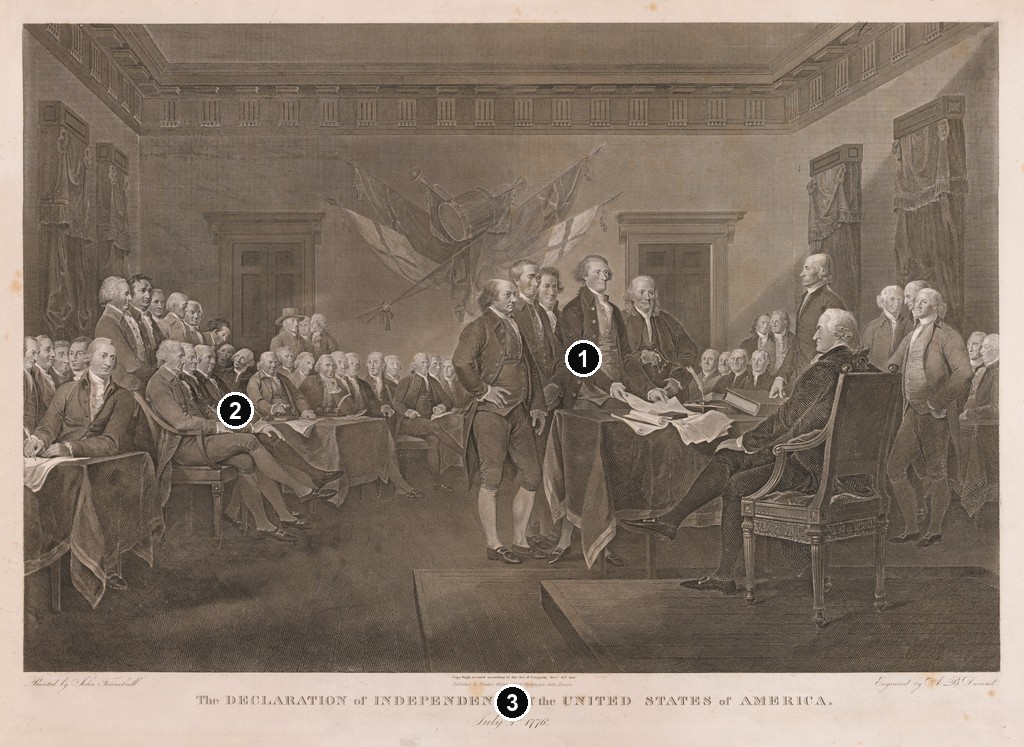
Details from SIGNING THE DECLARATION OF INDEPENDENCE: DURAND’S PRINT
Compare the cropped details with the complete images above. Notice how their colours, shapes and positions contribute to the larger compositions.
Committee before the table
Standing members of the drafting committee approach the table. The presented document establishes the central action rather than a simultaneous signing.
Seated assembly at the left
Seated and standing figures occupy the left side. Repeated chairs, coats and faces organise the assembled portraits.
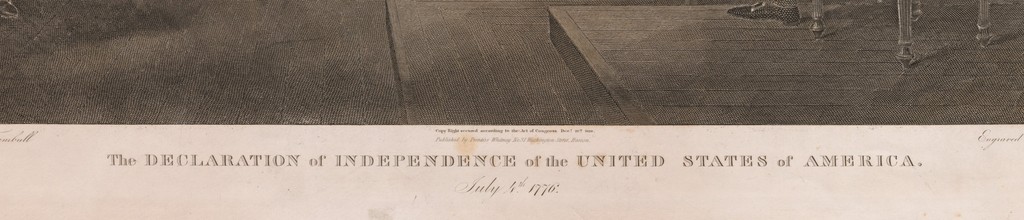
Title and July date below the scene
The sheet’s title and July 4 date appear beneath the image. That printed date does not mean that the represented action shows all signatures made on that day.
June 28, July 4 and August 2
Three dates concern different stages of the Declaration’s history. The draft was presented on June 28, adopted on July 4, and signed by most delegates on August 2, 1776. The Capitol’s account states these distinctions explicitly.[2]
The complete Cleveland sheet nevertheless prints July 4 beneath the title. That date is part of the historical publication itself. Preserving the sheet makes its association with the celebrated anniversary visible, while an explanatory caption can clarify the event represented within the picture.
The distinction changes how the document is read. The central action concerns its introduction to an assembly; the print does not show every delegate signing a completed document in succession. The papers on the table and the movement of the committee establish a more specific scene.
The current museum title is useful for locating the exact impression in Cleveland’s collection. Retaining it also acknowledges the name through which many viewers encounter the print. The accompanying explanation supplies the history needed to look beyond that familiar label.
Portraits arranged for national remembrance
Trumbull assembled a group of founding figures rather than a literal record of everyone present at one instant. The Capitol’s account identifies 47 portraits: 42 signers and five other participants. Its discussion also notes alterations to the room’s architecture and furnishings.[2]
That approach joins a recognisable assembly with the preservation of individual likenesses. Durand’s task consequently involved both the distribution of the room’s light and the smaller distinctions that make its many faces readable.
The number of portraits does not turn the image into a complete list of signers. Nor does a figure’s appearance prove attendance at the draft’s presentation. These limits matter because the print’s convincing interior can make its arrangement seem more documentary than the painted source was intended to be.
In the visible image, individual portraits remain subordinate to the larger grouping. The central committee is made legible through its position and scale, while seated clusters extend the gathering into both sides of the room. Each person contributes to a collective scene as well as to a set of likenesses.
This relationship helps explain the print’s usefulness for remembrance. A viewer can recognise an event and then return to inspect particular faces. The arrangement gives a crowded subject a clear overall structure without flattening the gathering into a uniform procession.
The painted source and the larger Capitol version
The monumental Trumbull painting in the Capitol is closely associated with this composition. It is an enlarged version of a smaller painting now at Yale University Art Gallery. Durand’s direct model was that smaller work, as Kushner and Ferber explain in their study’s endnote on the commission.[4]
Keeping the two painted versions distinct avoids transferring the Capitol canvas’s dimensions or physical history to the source Durand actually used. A shared composition does not make the objects interchangeable.
The print is another object again. Its medium, scale, paper and lower inscriptions give it a form different from either painted version. The image could be encountered within a print collection or another setting quite separate from the monumental room in which the Capitol canvas hangs.
The complete Cleveland sheet makes that difference especially clear. The pictorial room ends above a lower publication area, where artist credits and the title identify the image for its reader. Those words belong to the print’s presentation of the composition.
Watch: Asher Brown Durand
Choose a film to explore the artist’s work, its interpretation and its wider setting.
Friendship and landscape, Asher B Durand's Kindred Spirits
Smarthistory and Crystal Bridges discuss friendship, memory and landscape in Kindred Spirits.
Watch on YouTubeThe 1820 commission and 1823 completion
John Durand’s memoir records that Trumbull commissioned the plate in 1820 and that the work was finished, printed and published in 1823. The distinction separates the beginning of a substantial undertaking from the date attached to the resulting print.[3]
John places the commission at an important professional change. Durand had trained with Peter Maverick and become his partner; the Trumbull project accompanied the dissolution of that partnership. It gave the young printmaker responsibility for a demanding work under his own name.
The memoir describes approximately three years devoted chiefly to the large plate. Its account stresses the preservation of likenesses and the breadth of light and shade. These qualities correspond to two demands visible in the image: maintaining the room’s collective effect while describing many individual people.
Kushner and Ferber likewise identify the print’s critical success as a foundation of Durand’s professional reputation. They place the undertaking within an early career whose portraits and commercial work are often less familiar than his later landscapes.[4]
The Cleveland record’s date of 1823 agrees with the memoir’s account of completion. This is the date used here for the exact collection object, while 1820 remains the date of the commission.
Line, cloth and the room’s light
The print presents a broad range of tones within one monochrome surface. Pale faces and papers stand out against darker coats, while the walls retain quieter, more even passages. The central group becomes prominent without requiring every surrounding figure to be equally bright.
Folds in the tablecloth and clothing offer different patterns of change. Fabric hanging toward the foreground produces long lines and broad tonal intervals. The coats worn by the central figures require smaller shifts around arms, shoulders and bent legs.
Faces present a more concentrated problem. Their limited size leaves less room for marks, yet they must remain distinguishable within a crowded assembly. The visible image balances these smaller descriptions with the more extensive light of the interior.
The Cleveland Museum of Art catalogues its impression as an etching. Historical accounts discuss the project as an engraving. The museum’s term is retained in the object summary, while the broader career discussion follows the terminology of the consulted historical and scholarly sources.[1][3]
The visible linework supports a discussion of tone and form, but does not by itself establish every stage used to prepare this plate. The article therefore describes what the surviving impression makes available to the viewer rather than proposing an unrecorded production sequence.
Printing and the language of American achievement
John reproduces an account of Trumbull sending a proof impression to Lafayette in October 1823. Trumbull celebrated the work as an American artistic achievement. His praise belongs to the project’s early reception and to the cultural ambitions surrounding it.[3]
The same memoir names an English printer, Neale, whom Trumbull brought to America for the work. This practical detail shows that the project combined Durand’s local engraving achievement with specialist printing assistance. Trumbull’s patriotic assessment concerns the accomplishment as a whole.
The claim that the print established Durand’s position also belongs to John’s retrospective narrative, supported by the later scholarly account. It should remain distinguishable from an exact sales total or a complete record of where all impressions circulated.
A comparison with Ariadne, 1835, shows the range of Durand’s reproductive practice. The Declaration required a crowded historical interior and many portraits; Ariadne concentrated attention on one sleeping figure and a woodland setting. Both demanded a translation of another painter’s composition into the structure of a print, before landscape painting became Durand’s principal professional focus.
Artworks directory
A collected selection of 19 individually identified paintings, prints and a graphite study, including fifteen dedicated artwork articles. This directory is not a complete catalogue raisonné. Links lead to a companion article where available, otherwise the consulted institutional record. Progress is identified by title, date and museum; an unverified accession is omitted. Unillustrated objects remain searchable.
Frequently Asked Questions
It represents the presentation of the draft on June 28, 1776. July 4 was the adoption date, and most delegates signed on August 2.[2]
Kushner and Ferber identify the smaller Trumbull painting at Yale as his model. The Capitol canvas is an enlarged version of the composition.[4]
Discussion
Look again at the images and ideas explored in Signing the Declaration of Independence: Durand’s Print. These editorial prompts invite your observations.
Reader Insights
How does the central group remain distinct within the crowded assembly?
What changes when you understand the image as a presentation of the draft?
How do the lower title and credits affect your reading of the room above them?
Join the Conversation
Share a detail, comparison or question about Signing the Declaration of Independence: Durand’s Print below.
References
- Cleveland Museum of Art, Signing the Declaration of Independence, 1919.675. Exact 1823 impression, medium, credit and public-domain image. View source
- Architect of the Capitol, Declaration of Independence. Depicted event, committee, separate historical dates and Trumbull’s composite arrangement. View source
- John Durand, The Life and Times of A. B. Durand (1894). Selected Chapter II, especially printed pp.25–26: commission, publication, specialist printer and Trumbull’s early response. View source
- Marilyn S. Kushner and Linda S. Ferber, A Master Engraver: Founding Fathers, Banknotes, and the Great American Nude (2010). Printed pp.53–55 and notes; endnote 5 identifies the smaller Yale painting as the print’s model. View source
- Splash image source.
Asher Brown Durand after John Trumbull, Signing the Declaration of Independence, 1823. Etching, Cleveland Museum of Art, 1919.675. Gift of George A. Goddard. The scene depicts the draft’s presentation on June 28, 1776; the complete sheet preserves its historical July 4 title and date. Cleveland Museum of Art; gift of George A. Goddard. CC0 / Public domain. Resized only; native appearance, complete carrier and margins preserved.
View source