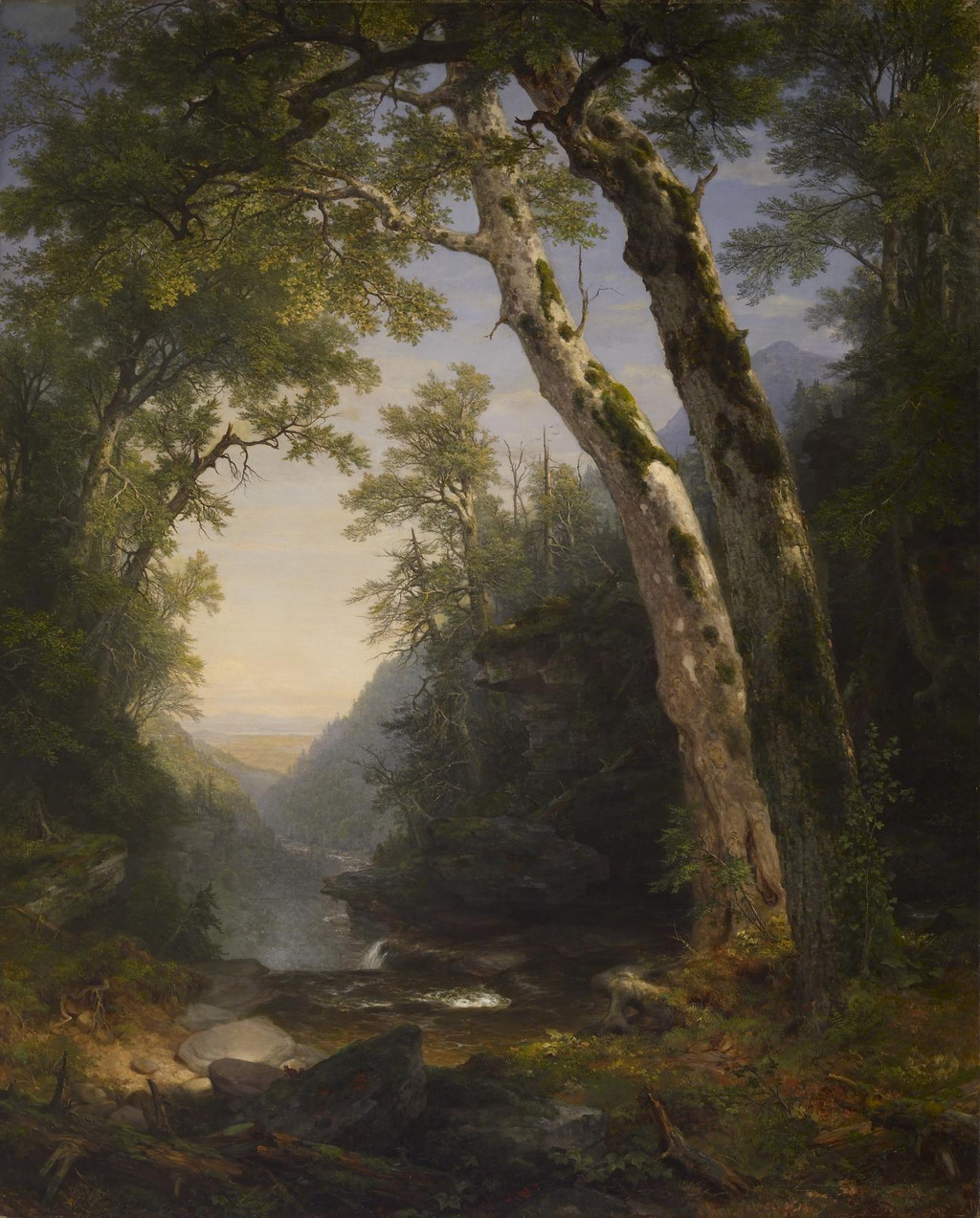
 by Tom Gurney
Tom Gurney BSc (Hons) is an art history expert with over 20 years experience
Email: tomgurney1@gmail.com / Phone: +44 7429 011000
The Beeches by Asher Brown Durand: Introduction
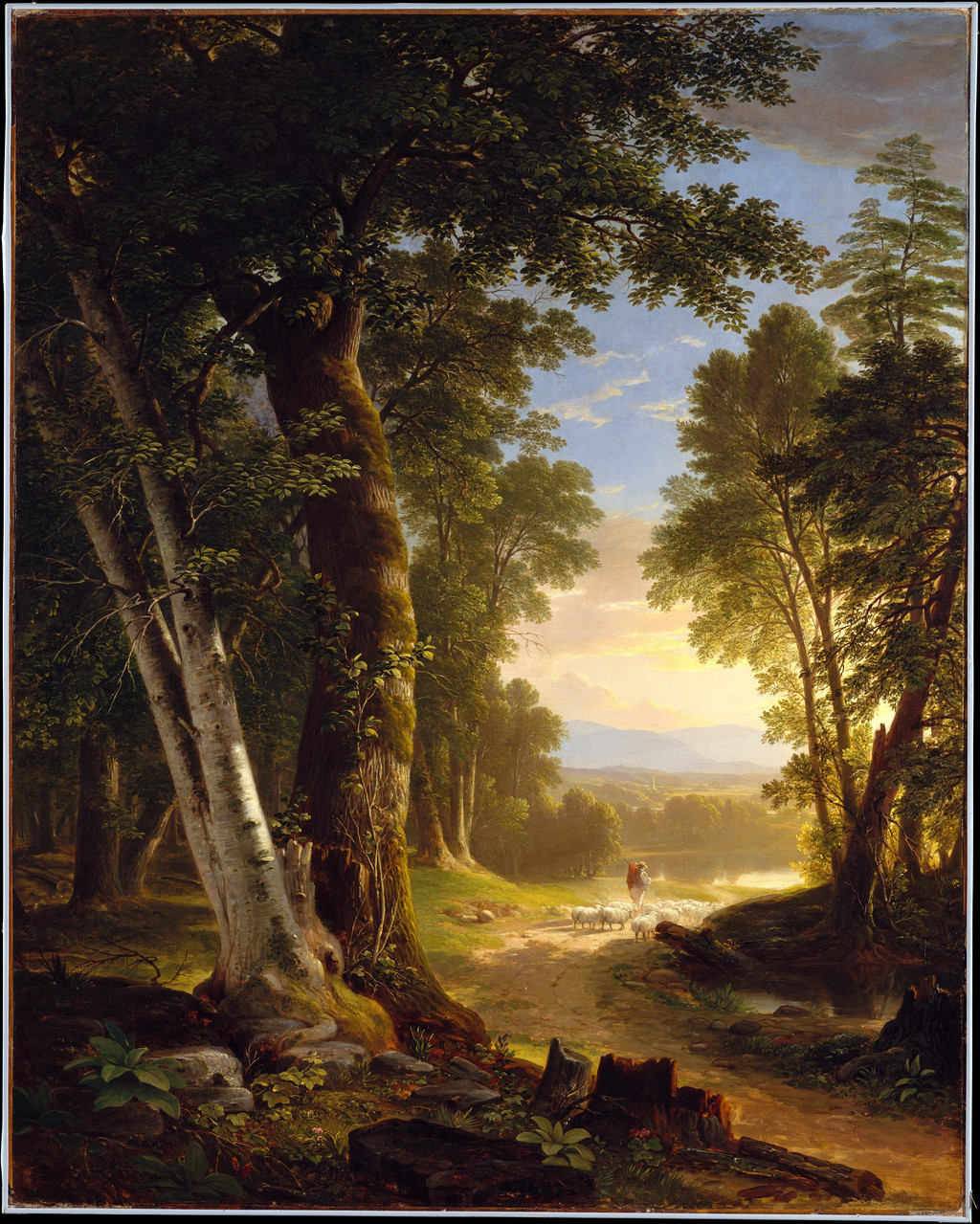
Asher Brown Durand’s The Beeches makes large foreground trees the principal actors in a pastoral landscape. A shepherd and flock follow a road beneath their branches, while distant hills and a small church steeple appear through a warm opening. Painted in 1845 for the collector Abraham M. Cozzens, it was exhibited the following year as Landscape Composition. Its present title came later, helping to give a composed view the intimacy of a portrait of trees.[1]
At a Glance
- ArtistAsher Brown Durand (1796–1886)
- TitleThe Beeches
- Date1845
- MediumOil on canvas
- Dimensions153.4 × 122.2 cm
- CollectionMetropolitan Museum of Art, New York
- Accession15.30.59
- Original commissionerAbraham M. Cozzens
- 1846 exhibition titleLandscape Composition
This work across Asher Brown Durand’s career
Kindred Spirits
1849God’s Judgment Upon Gog
ca.1851–52River Scene
1854In the Woods
1855The Catskills
1859Sunday Morning
1860Summer Afternoon
1865Contents
- Trees before the road
- The shepherd and the flock
- Outdoor study and European pictures
- The 1845 painting and its 1846 exhibition
- How The Beeches became its title
- Scale, attention and tree studies
- Comparisons with In the Woods and Kindred Spirits
- Annotated details
Trees before the road
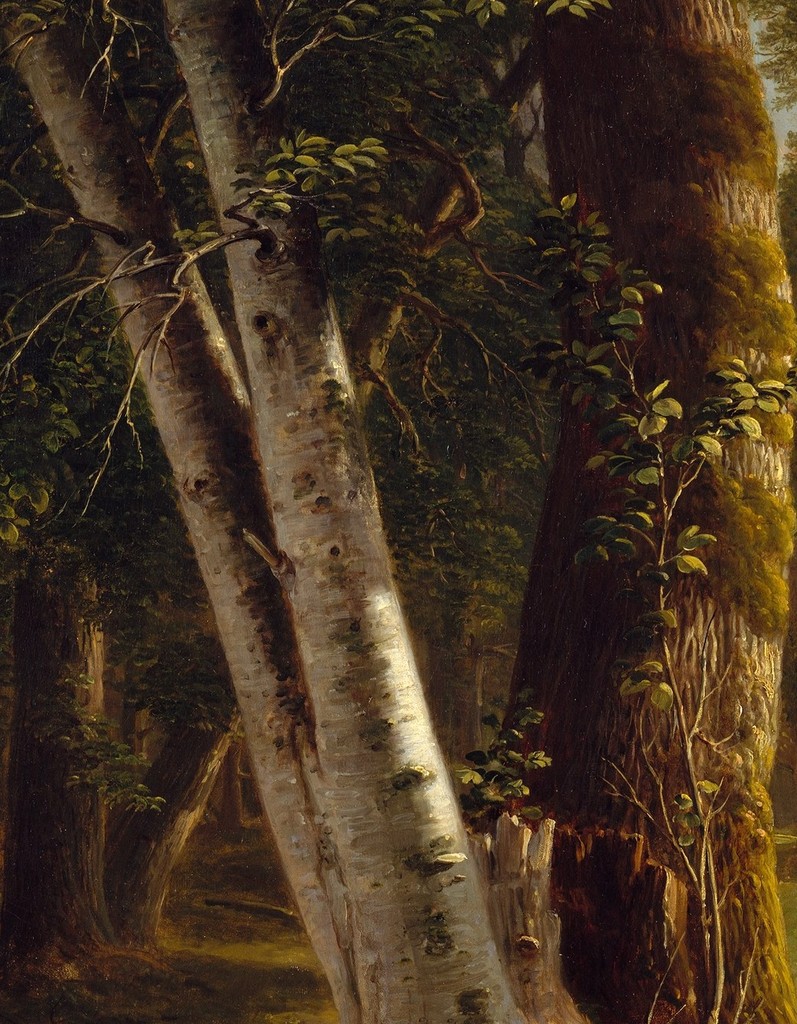
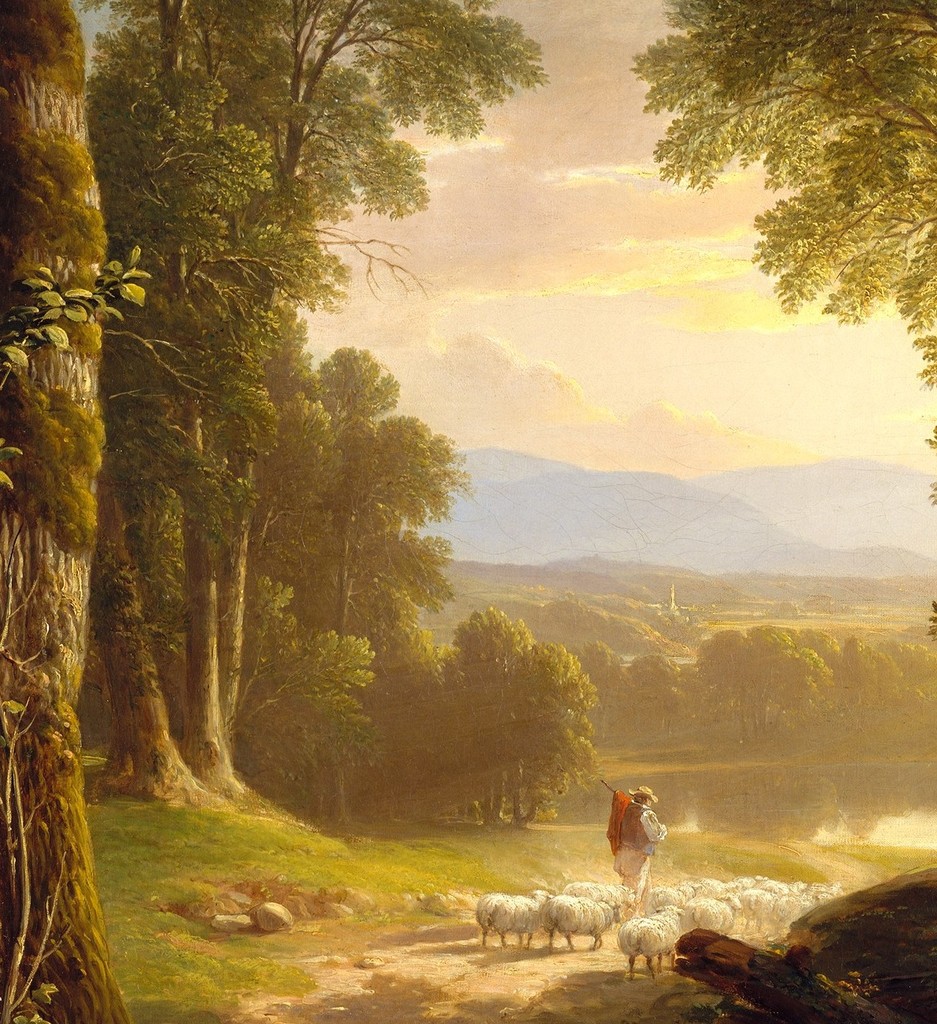
The foreground trees occupy much of the painting’s height. On the left, a pale trunk leans beside a darker, heavier one covered with patches of moss. Their roots spread across uneven ground, where smaller leaves and plants fill the intervals between stone, wood and soil. The tree nearest the viewer is substantial enough to be experienced as a body within the landscape.
The trunks have distinct surfaces. The pale one is relatively smooth, with darker markings that interrupt its lightness. The neighbouring trunk carries denser, rougher-looking passages and green growth. These differences give the viewer separate things to notice before following the road toward the middle distance.
The Met’s catalogue identifies basswood and beech among the foreground trees. That distinction is useful because the title can otherwise encourage us to treat them as one uniform group. Durand gives neighbouring trees different proportions, textures and relationships to light.[1]
Branches form a canopy overhead. Their outlines reach toward the right-hand trees, partly enclosing the sky between them. The uppermost growth extends beyond the painted boundary, so the viewer encounters the trunks and lower branches at close range. The tall format lets the trees command the image without requiring every crown to be shown.
At ground level, a cut stump and fallen timber introduce forms of wood that no longer grow upward. Their angular edges differ from the spreading foliage above. The foreground includes living plants, exposed roots and broken material together, giving close observation a varied subject rather than a single ideal tree.
Annotated Details from The Beeches
The numbered points identify visible features discussed in this article. Return from each detail to the whole composition. Asher Brown Durand, The Beeches, 1845. Oil on canvas, 153.4 × 122.2 cm. Metropolitan Museum of Art, 15.30.59. The Metropolitan Museum of Art. Image source. CC0 / Public domain. Resized only; native appearance, complete carrier and margins preserved.
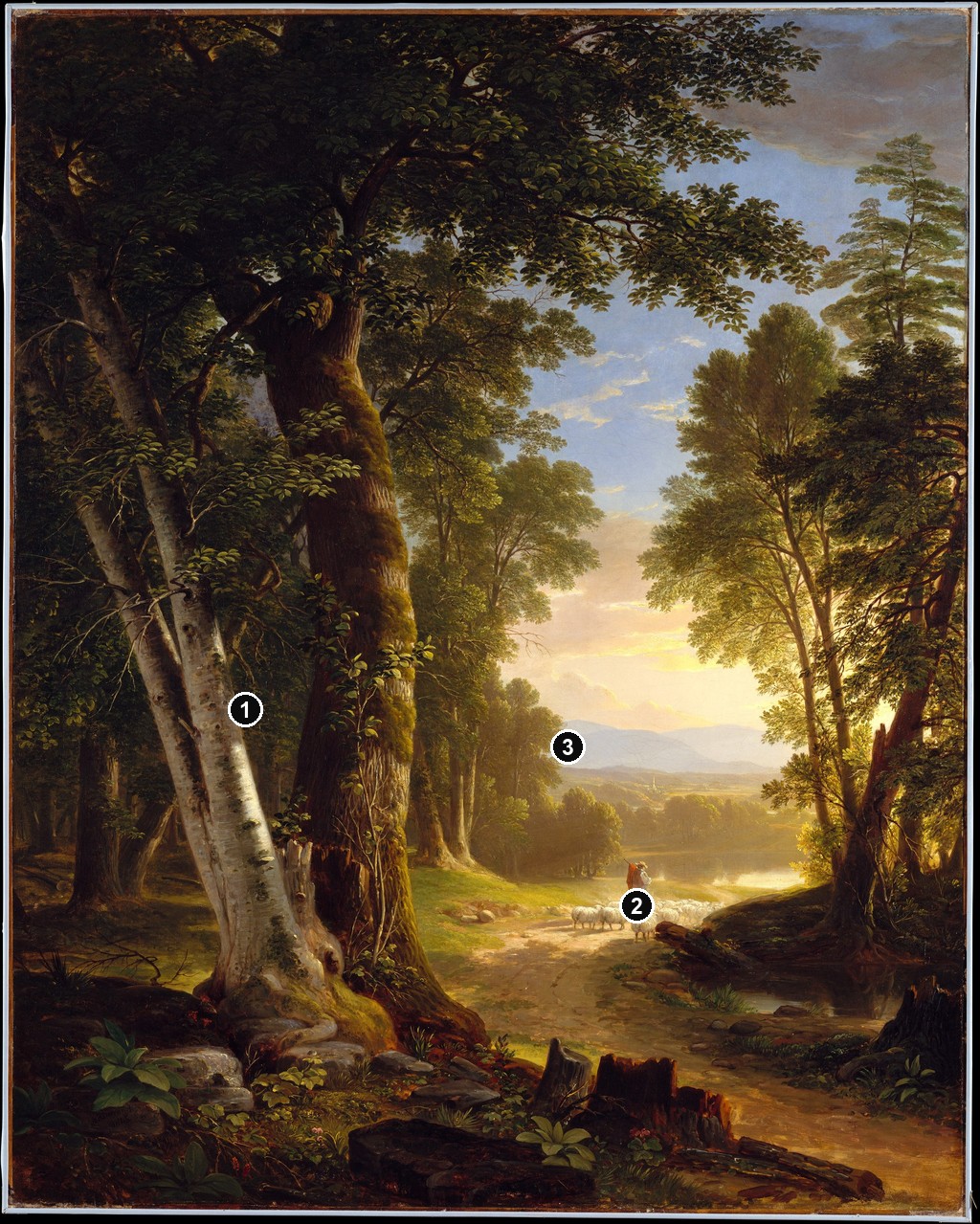
Details from THE BEECHES
Compare the cropped details with the complete images above. Notice how their colours, shapes and positions contribute to the larger compositions.
Pale slanting trunk
A pale trunk slopes across the darker group at the left. Bark marks and neighbouring foliage make its particular form readable.
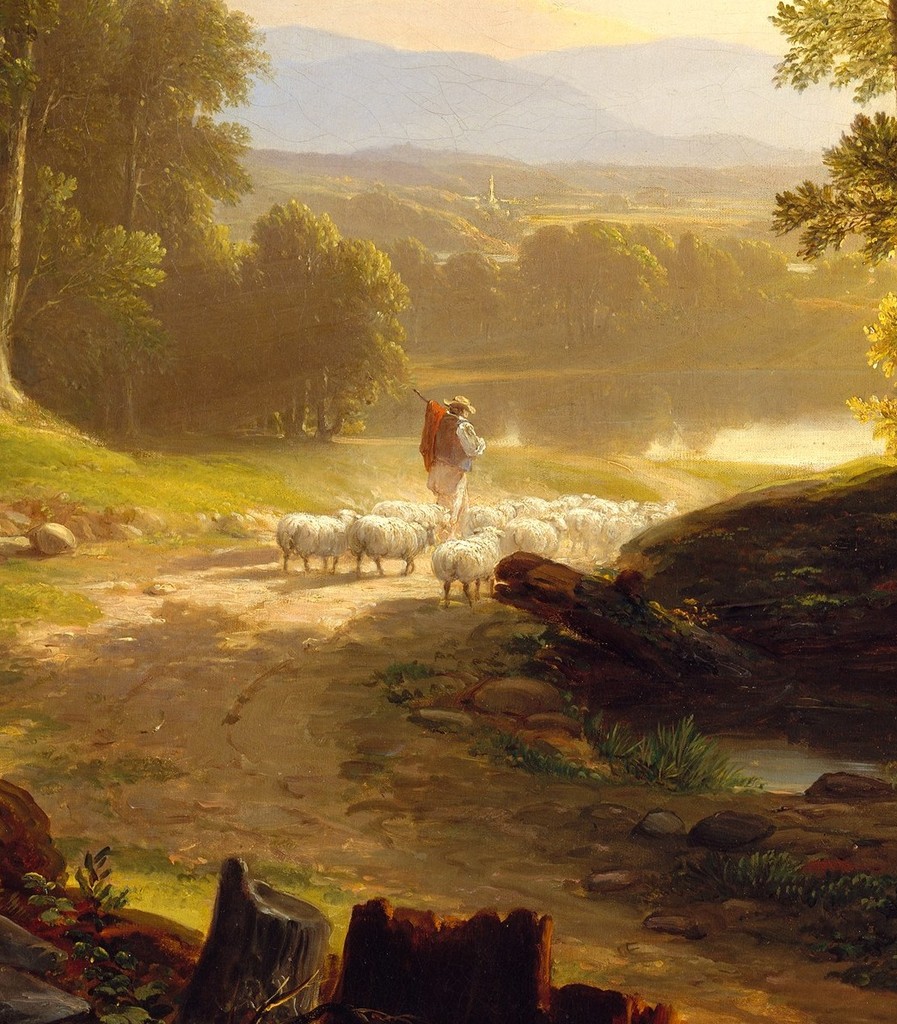
Shepherd and flock on the path
A shepherd and pale sheep occupy the winding path. Their scale provides a comparison with the large trees.
Opening towards the distant valley
The brighter opening leads past the nearby trunks towards water and a distant valley. Trees control the passage between near and far space.
The shepherd and the flock
The road enters from the lower right and curves through the trees toward the shepherd. Its light surface is broken by small shadows and scattered stones, making it a distinct route through the darker near ground. The flock occupies the bend, where pale animal bodies stand out against the grass.
The shepherd’s red clothing supplies a concentrated accent near the middle of the view. At this scale he is a small figure, yet the colour makes him easy to find after the large trees have drawn the eye. His position joins the foreground road to the brighter country beyond.
The animals establish a different rhythm from the trunks. Their low, repeated forms move across the road while the trees rise vertically around them. Looking between these two scales makes the foreground feel large and the pastoral activity ordinary. The shepherd and sheep belong to the space sheltered by the trees.
The path does not run directly to the far horizon. Its curve allows the near roots, flock, grassy opening and distant view to unfold in stages. There is room to pause at each level. The experience of depth comes through a sequence of partly overlapping places rather than a single uninterrupted avenue.
Water at the right catches some of the sky’s light, creating another opening beneath the foliage. Together, road and water prevent the foreground from becoming a closed wall of trunks. They allow the eye to move around the trees and toward the comparatively expansive landscape beyond.
Outdoor study and European pictures
The finished painting connects two parts of Durand’s practice: looking closely at nature and learning from existing art. The Met relates its foreground to Landscape with a Beech Tree, an outdoor oil study of 1844 now at New York Historical. The catalogue cautiously describes The Beeches as his first landscape known to have been based on such an on-site oil sketch.[1]
The study’s importance lies in the transition from an observed tree to a public composition. A tree examined at close range could supply structure and surface information, while the final canvas organised that material within a road, flock, canopy and distant country. The result asks the viewer to recognise particularity within an arranged landscape.
The Met also identifies Constable’s The Cornfield, 1826, as a compositional model. It points to the large trees at the sides, sheep on a winding road, the red accent in a figure’s clothing and the upright format. These are relationships within the design, distinct from the individual surfaces Durand studied outdoors.[1]
Durand encountered Constable’s work during his 1840–41 European journey. John Durand’s later memoir prints his father’s gallery observations from England, including his enthusiasm for Constable’s natural effects and studies. This account places the European comparison within a documented period of looking and learning.[2]
The finished view brings these kinds of attention together. Its organisation makes the pastoral scene legible at a distance; close tree surfaces reward a nearer look. Recognising a European model does not exhaust the picture, because the carefully differentiated trunks and vegetation remain substantial objects of interest in their own right.
The warm sky supplies a further contrast with the darker foreground. Pale blue, yellow and pink passages appear through the foliage and above the distant hills. The catalogue connects this colour to Durand’s European study of Claude Lorrain. Such comparisons explain sources for the effect without turning an ordinary reproduction into evidence of a particular pigment mixture.[1]
The 1845 painting and its 1846 exhibition
The canvas is signed and dated 1845 at the lower left. The Met records that it was painted for Cozzens, a collector associated with the executive committee of the American Art-Union. That commission places the landscape within the world of collecting and public exhibition rather than leaving it as a private outdoor exercise.[1]
Durand exhibited it at the National Academy of Design in 1846. The museum’s catalogue draws on contemporary reviews that responded to its quiet, everyday character and compared it with Cole’s more overtly romantic landscapes. Those critical responses help identify what early viewers found distinctive in the painting.[1]
Its scale is relevant to that response. At approximately 153 centimetres high, the canvas gives ordinary landscape details a commanding public presence. A shepherd, a road and foreground trees could carry a large painting even when the subject did not depend on a spectacular catastrophe or a heroic narrative.
The scene’s apparent calm is carefully arranged. Close trunks establish a strong near plane, their branches enclose a bright interval and the road draws the flock into that interval. The quiet character noticed by critics depends on these relationships, which let modest activity remain intelligible within a substantial landscape.
Watch: Asher Brown Durand
Choose a film to explore the artist’s work, its interpretation and its wider setting.
Friendship and landscape, Asher B Durand's Kindred Spirits
Smarthistory and Crystal Bridges discuss friendship, memory and landscape in Kindred Spirits.
Watch on YouTubeHow The Beeches became its title
At the 1846 exhibition the painting was called Landscape Composition. The Met records The Beeches as its title at the Metropolitan Sanitary Fair in 1864 and notes its repetition in Henry T. Tuckerman’s 1867 discussion.[1]
The change places different emphasis on the same work. Landscape Composition directs attention to an arranged scene. The Beeches gives priority to its most immediate natural subjects, inviting the viewer to begin with the trees. The title’s history therefore offers two useful ways to approach the painting’s balance of selection and close observation.
An older name can also produce confusion in accounts of Durand’s work. John’s 1894 memoir describes a Passage through the Woods dated 1846; the Met’s catalogue identifies that discussion with this painting. The signed 1845 canvas and its 1846 exhibition provide the firmer distinction between making and showing the work.[1][2]
Following the object through its changing titles prevents the creation of an unnecessary second picture. It also preserves a useful historical fact: the emphasis on beeches was not the first public name attached to the canvas. Its identity developed through collecting, exhibition and later writing.
Scale, attention and tree studies
Roberta J. M. Olson’s study of Durand’s trees describes the sustained attention he gave to branching, trunks and individual growth. Her account considers trees as substantial subjects within his drawings and paintings, with spiritual and artistic significance extending beyond their use as background scenery.[3]
The Beeches makes that attention visible through scale. Small leaves cluster around roots nearest the viewer, while the trunks rise through most of the picture. These different levels of detail give the eye a reason to move slowly. A viewer can inspect near vegetation and then return to the larger structure that shelters it.
The tree tops are cut by Durand’s original composition. This makes the viewer’s position relatively close to the trunks, with their upper growth continuing beyond the frame. The complete reproduction retains that deliberate boundary; the effect belongs to the painted arrangement itself.[1]
For the practice behind these choices, see Durand’s drawings and studies. A public landscape can draw on outdoor observation while selecting what the viewer encounters first, where the scene opens and how far the eye can travel.
Comparisons with In the Woods and Kindred Spirits
In the Woods, 1855, creates a more enclosed forest interior. The Met identifies it as the painting later given by Jonathan Sturges’s children in his memory. Its fallen wood, stream and dense ranks of trunks provide a different setting for the viewer’s attention.[4]
Here, the shepherd’s route and the distant country maintain contact with an inhabited pastoral world. In In the Woods, the forest itself fills the experience of the picture. The comparison shows how trees can organise a view outward or hold the viewer within a closely enclosed space.
Kindred Spirits, 1849, gives the tree-framed landscape a particular commemorative purpose. Its two figures are Cole and Bryant, and its setting was made as a memorial gift. Their named identities add a personal history to the scale established by the surrounding gorge and canopy.[5]
The shepherd in The Beeches works differently. His ordinary activity helps make the road a used place and the trees a sheltering presence. The painting’s changing title, outdoor-study connection and European comparisons all return attention to the same balance: individually observed trees within a composed landscape that people can inhabit.
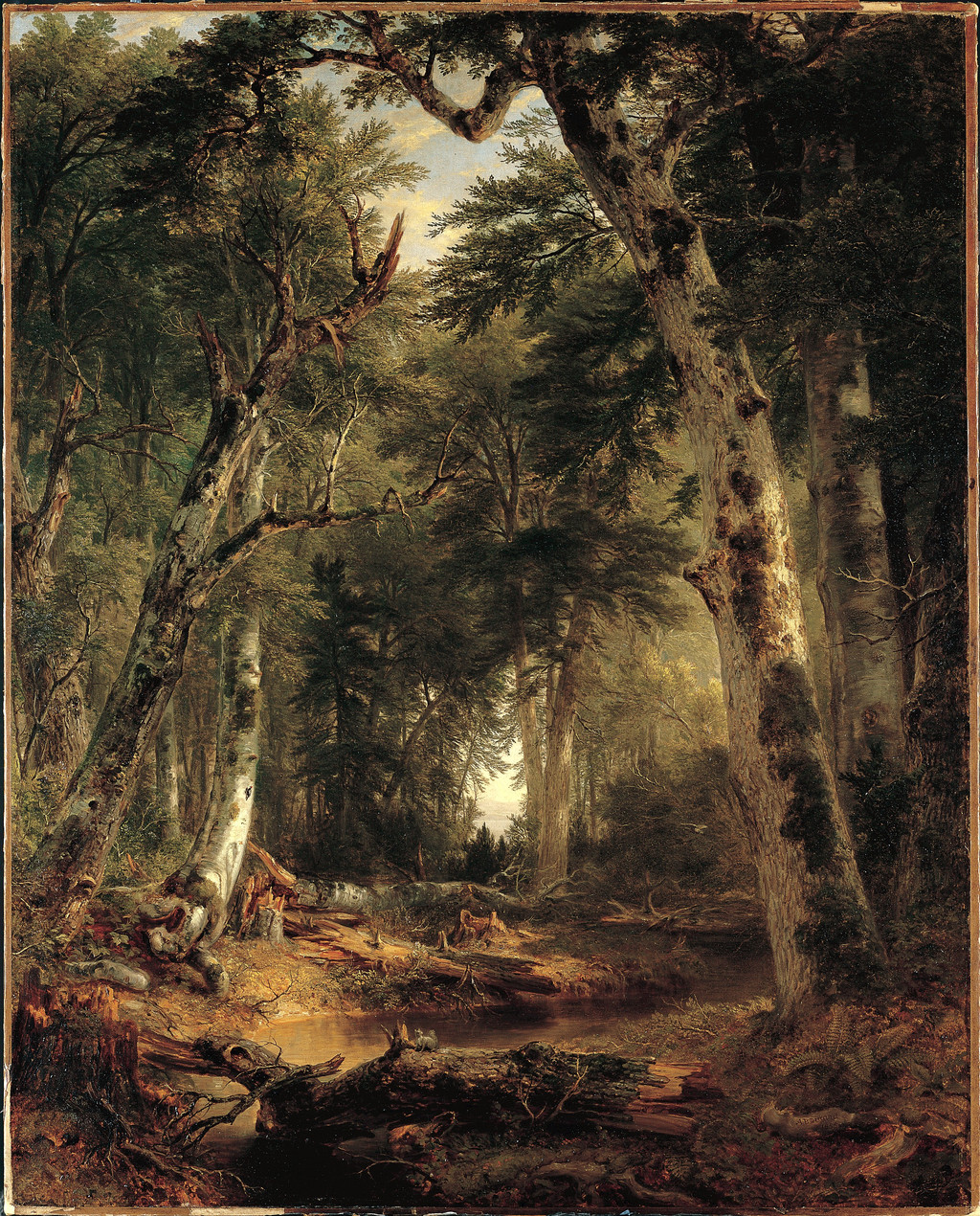
Asher Brown Durand, In the Woods, 1855. Oil on canvas. Metropolitan Museum of Art, 95.13.1. The Metropolitan Museum of Art. Image source. CC0 / Public domain. Resized only; native appearance, complete carrier and margins preserved.
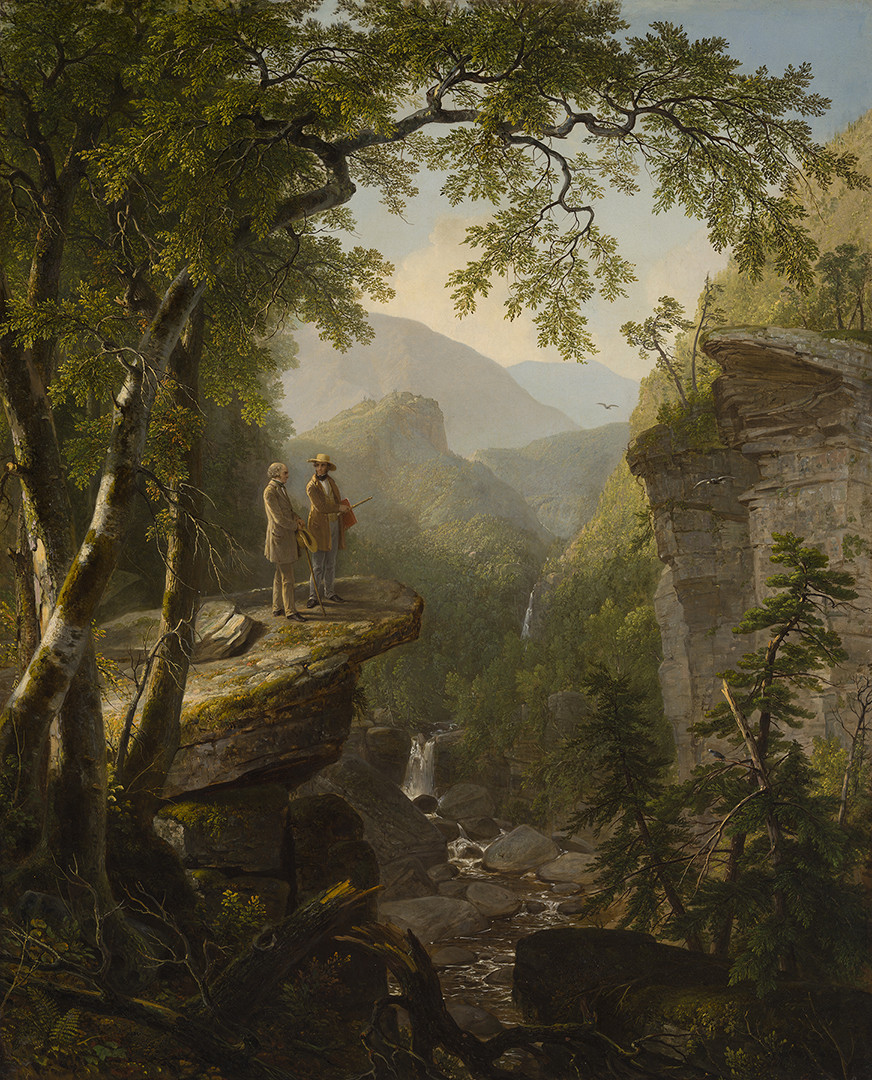
Asher Brown Durand, Kindred Spirits, 1849. Oil on canvas. Crystal Bridges Museum of American Art, 2010.106. Crystal Bridges Museum of American Art; museum-uploaded open-access reproduction. Image source. CC0 / Public domain. Resized only; native appearance, complete carrier and margins preserved.
Artworks directory
A collected selection of 19 individually identified paintings, prints and a graphite study, including fifteen dedicated artwork articles. This directory is not a complete catalogue raisonné. Links lead to a companion article where available, otherwise the consulted institutional record. Progress is identified by title, date and museum; an unverified accession is omitted. Unillustrated objects remain searchable.
Frequently Asked Questions
The canvas is signed and dated 1845. It was exhibited at the National Academy of Design in 1846 under the title Landscape Composition.[1]
The Met’s catalogue identifies both beech and basswood among the foreground trees. Their different surfaces and forms are an important part of the painting.[1]
The catalogue links it to an outdoor oil study of 1844. That establishes a source for the finished composition, not that the whole large canvas was completed on location.[1]
Discussion
Look again at the images and ideas explored in The Beeches by Asher Brown Durand. These editorial prompts invite your observations.
Reader Insights
Which trunk or group of roots holds your attention before you follow the road?
How do the shepherd and sheep change your sense of the trees’ size?
Does *Landscape Composition* suggest a different first approach from the later title *The Beeches*?
Join the Conversation
Share a detail, comparison or question about The Beeches by Asher Brown Durand below.
References
- Metropolitan Museum of Art, The Beeches, American Paintings in The Metropolitan Museum of Art, volume I, printed pp.414, 416. Both one-page scans actually displayed and consulted; commission, title history, study/model links, contemporary reviews and physical data. Critical comments are consulted through the museum catalogue rather than the original journals. View source
- John Durand, The Life and Times of A. B. Durand (1894). Selected chapters actually consulted, including the 1840 English gallery account, printed pp.143–154, and the later Passage through the Woods reference in Chapter XI. Family memoir title/date checked against the museum catalogue. View source
- Roberta J. M. Olson, “‘A Magnificent Obsession’: Durand’s Trees as Spiritual Sentinels of Nature,” in The American Landscapes of Asher B. Durand (2010). Printed pp.151–158 main essay and notes consulted, with selected captions. Original paraphrase; catalogue plates not reproduced. View source
- Metropolitan Museum of Art, In the Woods, accession 95.13.1. Complete current 1855 object narrative consulted. View source
- Crystal Bridges Museum of American Art, Kindred Spirits, accession 2010.106. Complete current 1849 object record and commemorative narrative consulted. View source
- Splash image source.
Asher Brown Durand, The Beeches, 1845. Oil on canvas, 153.4 × 122.2 cm. Metropolitan Museum of Art, 15.30.59. The Metropolitan Museum of Art. CC0 / Public domain. Resized only; native appearance, complete carrier and margins preserved.
View source