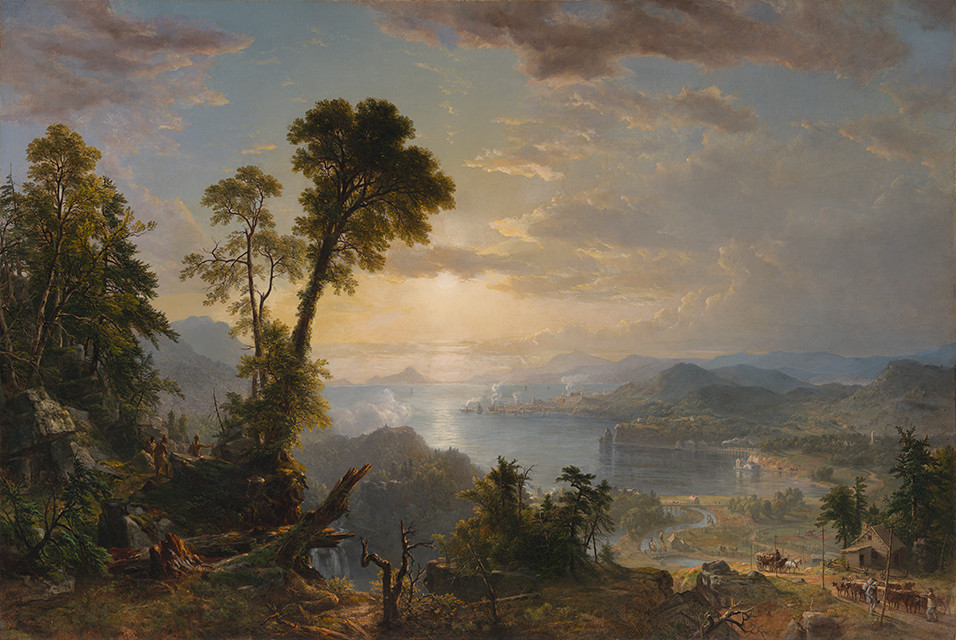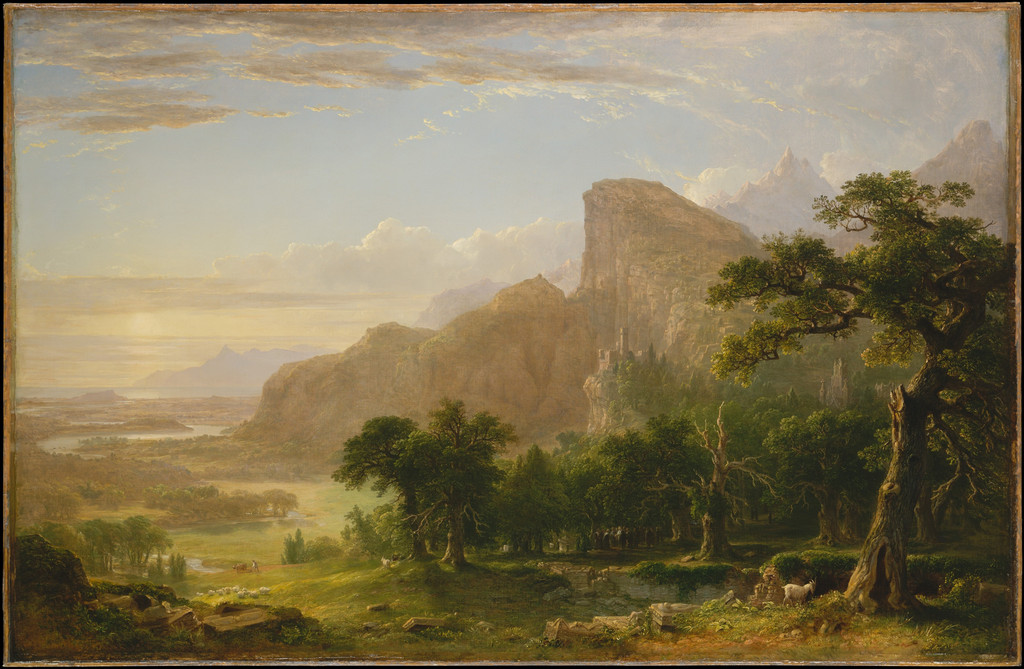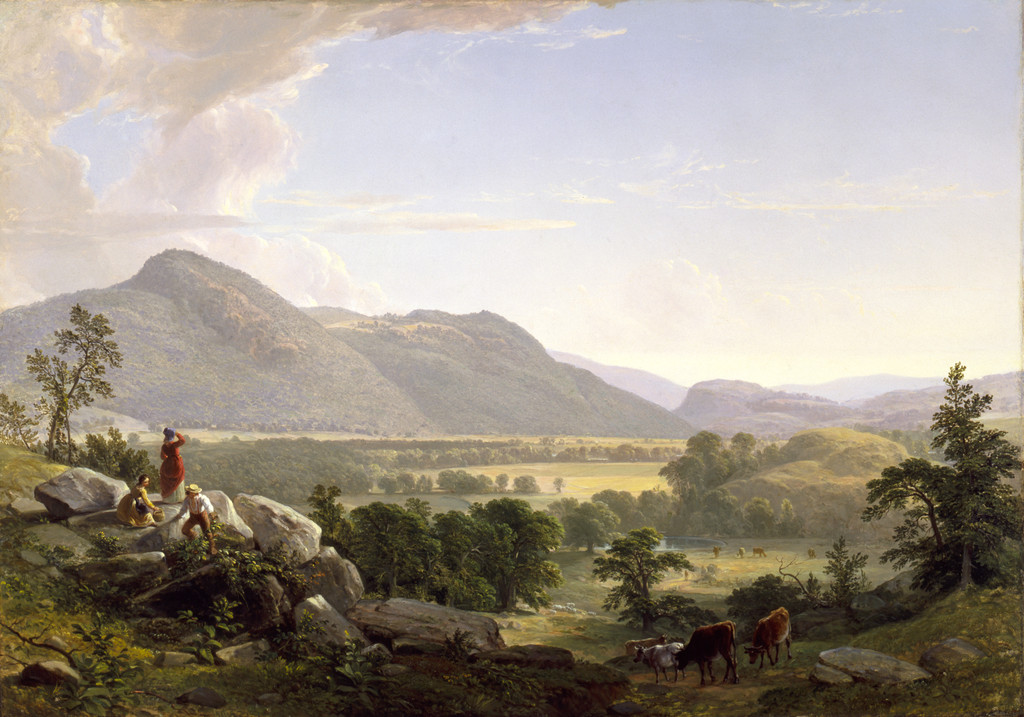
 by Tom Gurney
Tom Gurney BSc (Hons) is an art history expert with over 20 years experience
Email: tomgurney1@gmail.com / Phone: +44 7429 011000
Asher Brown Durand’s Drawings and Studies: Introduction
Asher Brown Durand’s finished landscapes give trees a remarkable sense of individuality. A trunk can lean, twist, branch or rise upright in ways that determine the space around it. His drawings and outdoor studies help explain the sustained observation behind those painted forms, while revealing works made for purposes different from a large public canvas.
Durand’s own advice placed drawing early in a landscape painter’s education. He asked students to examine the forms of real objects before relying on colour or a conspicuous manner of handling paint. The surviving studies make that attention tangible, from a faint leaf outline to more substantial examinations of trunks and branches.[1]
Selected Durand study
At a Glance
- ArtistAsher Brown Durand (1796–1886)
- PracticesGraphite drawing and painted studies, alongside finished compositions
- Recurring subjectsTrees, branches, rocks and landscape forms
- Drawing shown hereLeaf and Tree Study (from Sketchbook), undated
- Drawing collectionMetropolitan Museum of Art, 33.176.11 recto
- Related paintingsThe Beeches, 1845, and In the Woods, 1855
- Key written evidenceSelected passages from the 1855 Letters on Landscape Painting
Contents
- Looking at form before colour
- A small leaf and trunk on one sheet
- Trees as individual subjects
- Studies and finished paintings have different relationships
- Outdoor painting and The Beeches
- Careful studies and broad colour sketches
- From a trunk to a wooded space
- Annotated details
Looking at form before colour
In the excerpts preserved by John Durand, the artist advises a beginner to take pencil and paper and study an object’s contour. For trees, he identifies the shape of the foliage against the sky, the trunk and the direction in which branches leave the main stem. These are practical observations that help distinguish one tree from another.[1]
The sequence matters. Durand warns that attractive colour cannot compensate adequately for weak drawing. He treats the ability to understand form as a foundation on which a painter can build more complex relationships of colour, light and atmosphere.
His advice also concerns variety. Looking closely at different branching patterns protects the artist from repeating a convenient formula. A tree becomes a specific form with particular proportions and movements, rather than a general symbol inserted wherever a composition needs vegetation.
The emphasis does not make drawing merely a preliminary outline that must always be discarded after painting begins. Repeated studies can develop knowledge that remains useful across many pictures. The drawings can also retain their own interest as concentrated encounters with an individual subject.
Annotated Details from Asher Brown Durand’s Drawings and Studies
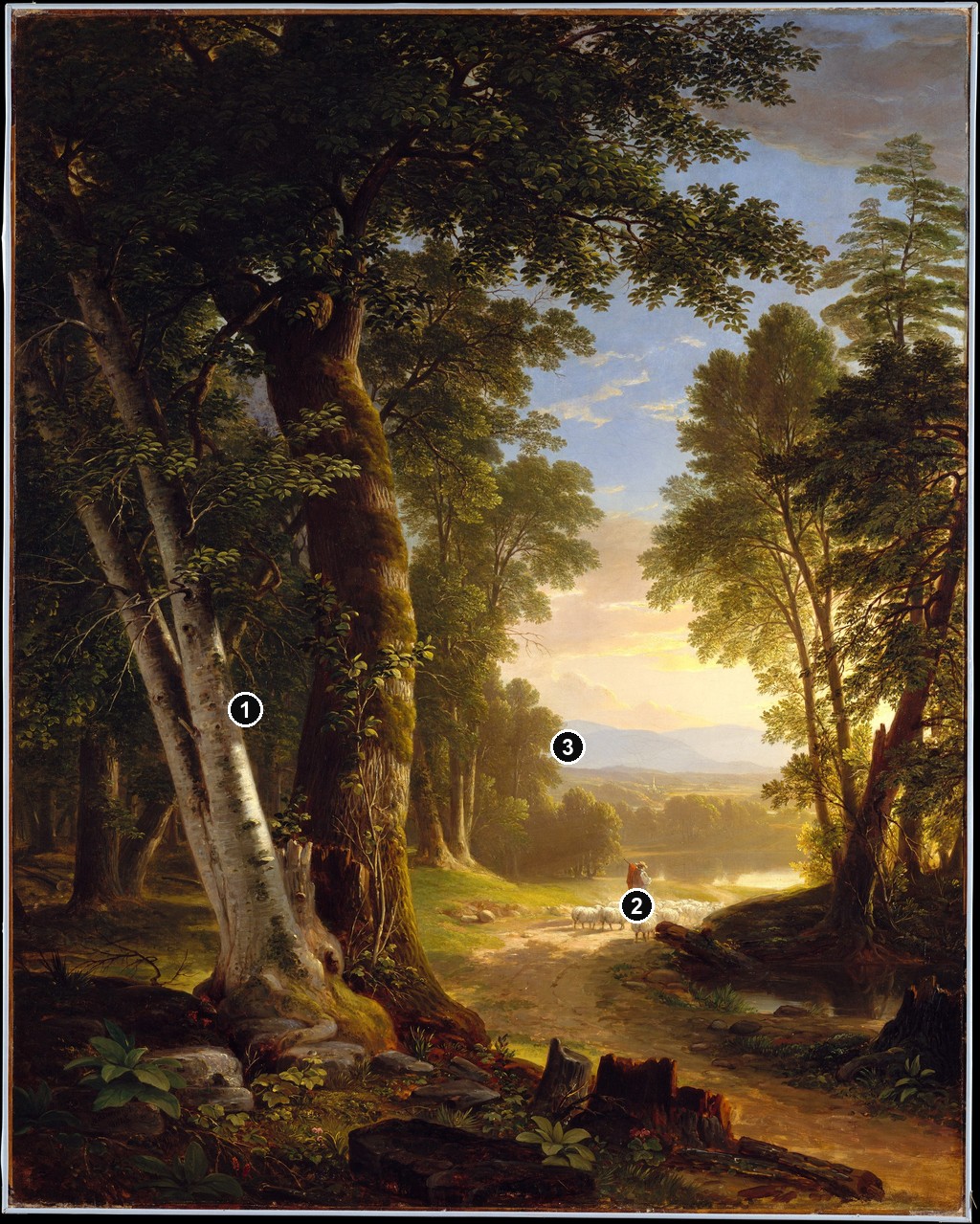
The numbered points identify visible features discussed in this article. Return from each detail to the whole composition. Asher Brown Durand, The Beeches, 1845. Oil on canvas, 153.4 × 122.2 cm. Metropolitan Museum of Art, 15.30.59. The Metropolitan Museum of Art. Image source. CC0 / Public domain. Resized only; native appearance, complete carrier and margins preserved.
Details from ASHER BROWN DURAND’S DRAWINGS AND STUDIES
Compare the cropped details with the complete images above. Notice how their colours, shapes and positions contribute to the larger compositions.
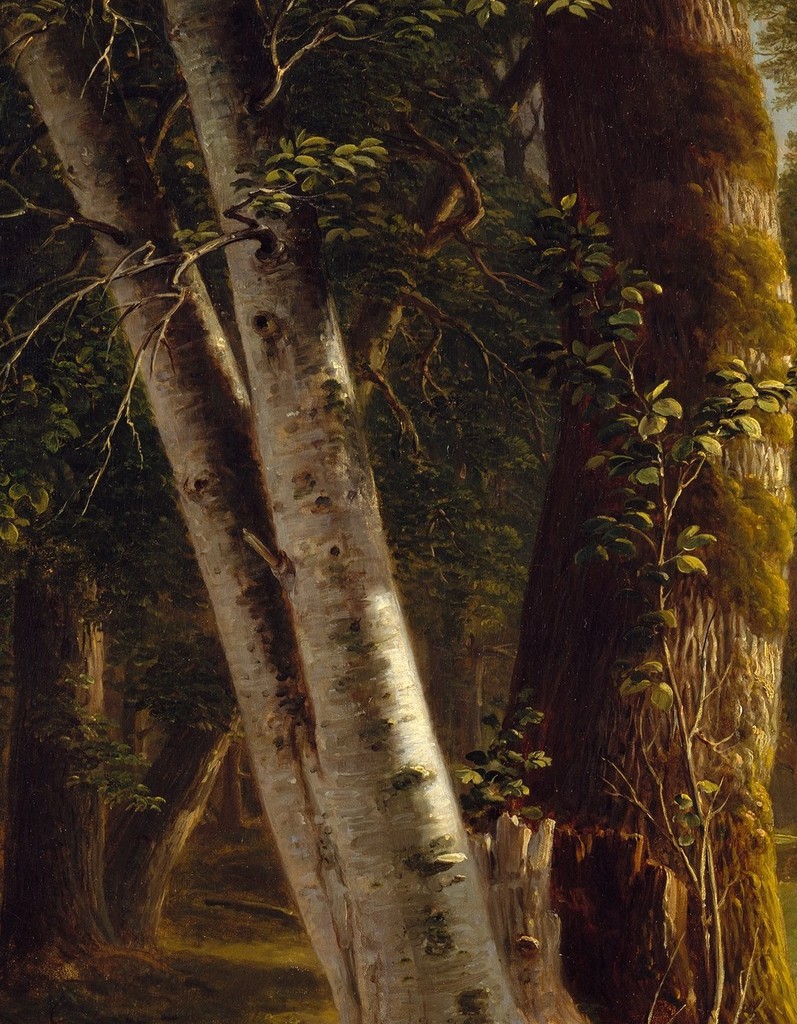
Pale slanting trunk
A pale trunk slopes across the darker group at the left. Bark marks and neighbouring foliage make its particular form readable.
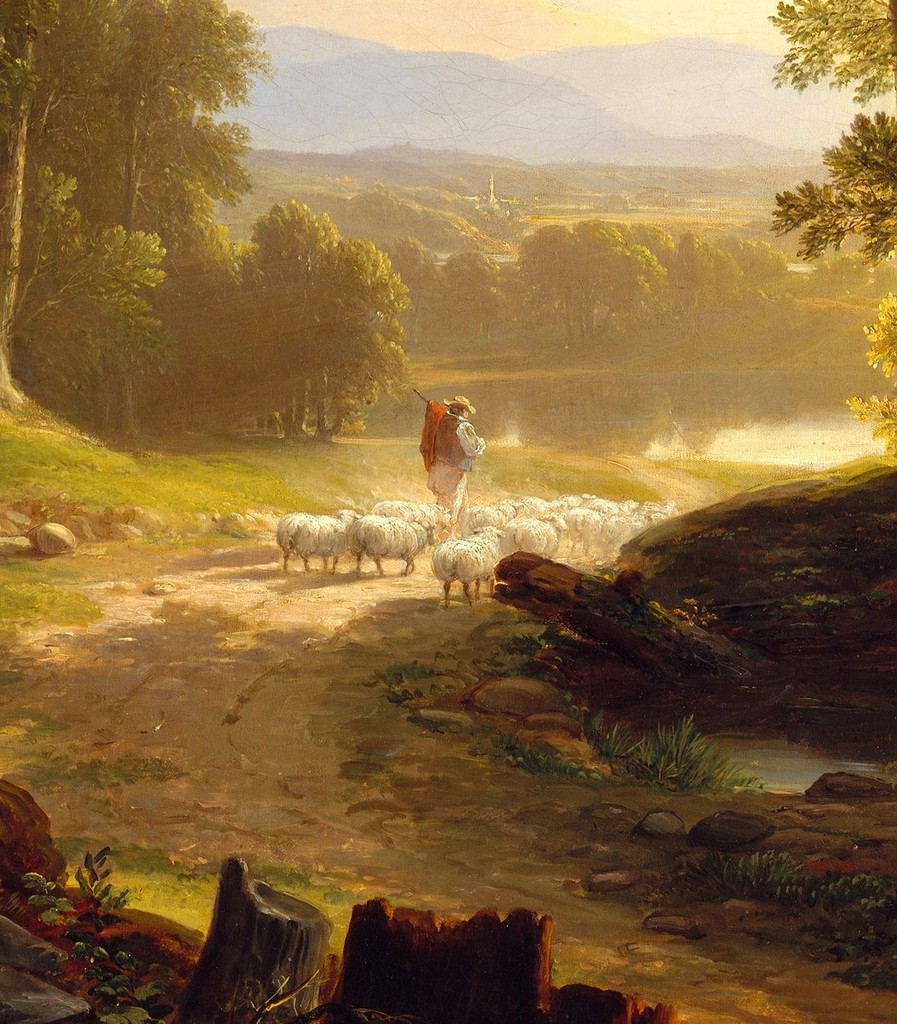
Shepherd and flock on the path
A shepherd and pale sheep occupy the winding path. Their scale provides a comparison with the large trees.
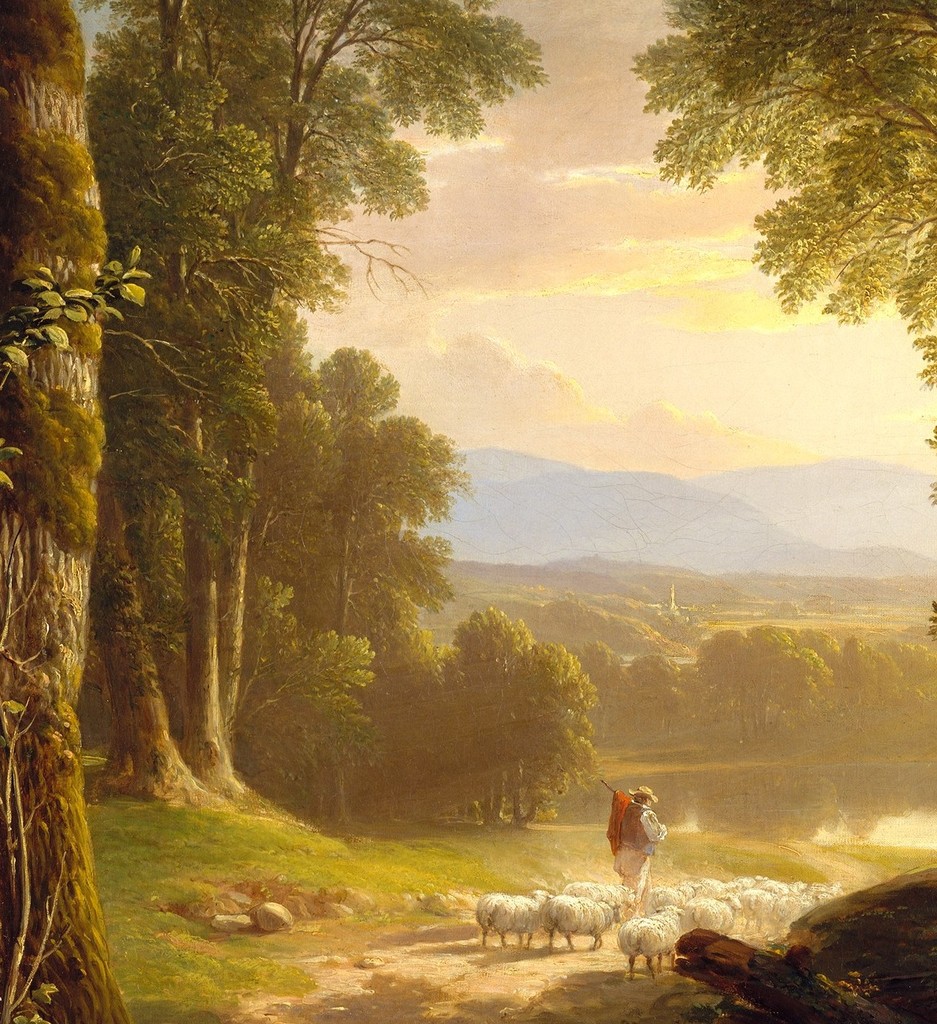
Opening towards the distant valley
The brighter opening leads past the nearby trunks towards water and a distant valley. Trees control the passage between near and far space.
A small leaf and trunk on one sheet
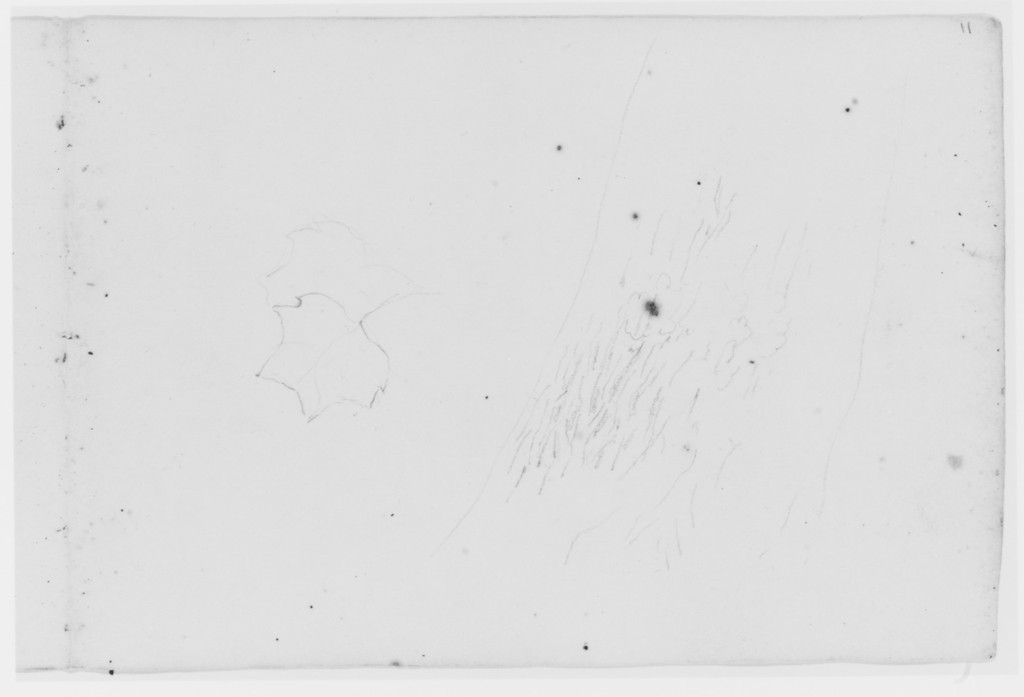
The Met’s Leaf and Tree Study (from Sketchbook) is an especially modest example. The museum identifies it as graphite on paper, 11.7 × 17.5 cm, accession 33.176.11 recto. Mrs. Frederic F. Durand gave it to the collection in 1933; the current record supplies no date for its making.[3]
A leaf outline appears toward the left of the sheet. Its irregular boundary and short stem occupy only a small part of the available paper. At the right, a leaning trunk carries light indications of surface and changes of direction.
The two studies do not combine into a finished landscape. They remain separated by open paper, each presenting a different scale of attention. The leaf invites inspection of a small contour; the trunk asks how a larger form extends and how its surface can be suggested.
The marks are faint in the supplied museum image. Dark spots and the paper’s edges remain visible, as does a small page number near the upper right. That number belongs to the sheet’s appearance and supplies no date for the drawing.
The image is shown with this pale character preserved. Increasing its contrast might make the graphite easier to see, but would change the supplied appearance. Looking at it as a quiet, lightly marked page is part of understanding the surviving object.
The title gives the subject a broad identity. The consulted record does not name a location, assign a species or connect this leaf to a particular finished painting. Those questions remain open rather than being resolved by the resemblance of a few lines.
Trees as individual subjects
Roberta J. M. Olson studies Durand’s drawings as a sustained engagement with trees. Her essay discusses how graphite can register differences in contour, texture and the movement of branches. She treats the individual tree as a subject worthy of close attention in its own right.[2]
This approach helps distinguish the tree study from a general landscape sketch. A study may concentrate on one trunk or branching system without providing a horizon or an extensive surrounding prospect. The subject’s identity comes from its visible structure.
A trunk also contains more than its outside boundary. Changes in surface, a knot, an interruption or the point at which a branch begins can make the form appear substantial. Short marks and longer contours contribute different kinds of information.
Pairs and groups of trees raise another problem. The artist must follow each tree while understanding the intervals between them. Open spaces, crossings and overlaps become as important as the solid forms themselves.
Olson’s account places this practice within Durand’s broader reverence for nature. That interpretation adds a historical dimension to the repeated study of forms. It should remain distinct from a claim that every individual drawing was made with an explicitly recorded spiritual intention.
Studies and finished paintings have different relationships
A drawing can prepare a specific part of a painting, record a subject for future use or develop the artist’s powers of observation. These purposes need not be identical. A resemblance between a drawn tree and a painted tree therefore invites investigation, rather than automatically establishing a direct preparatory link.
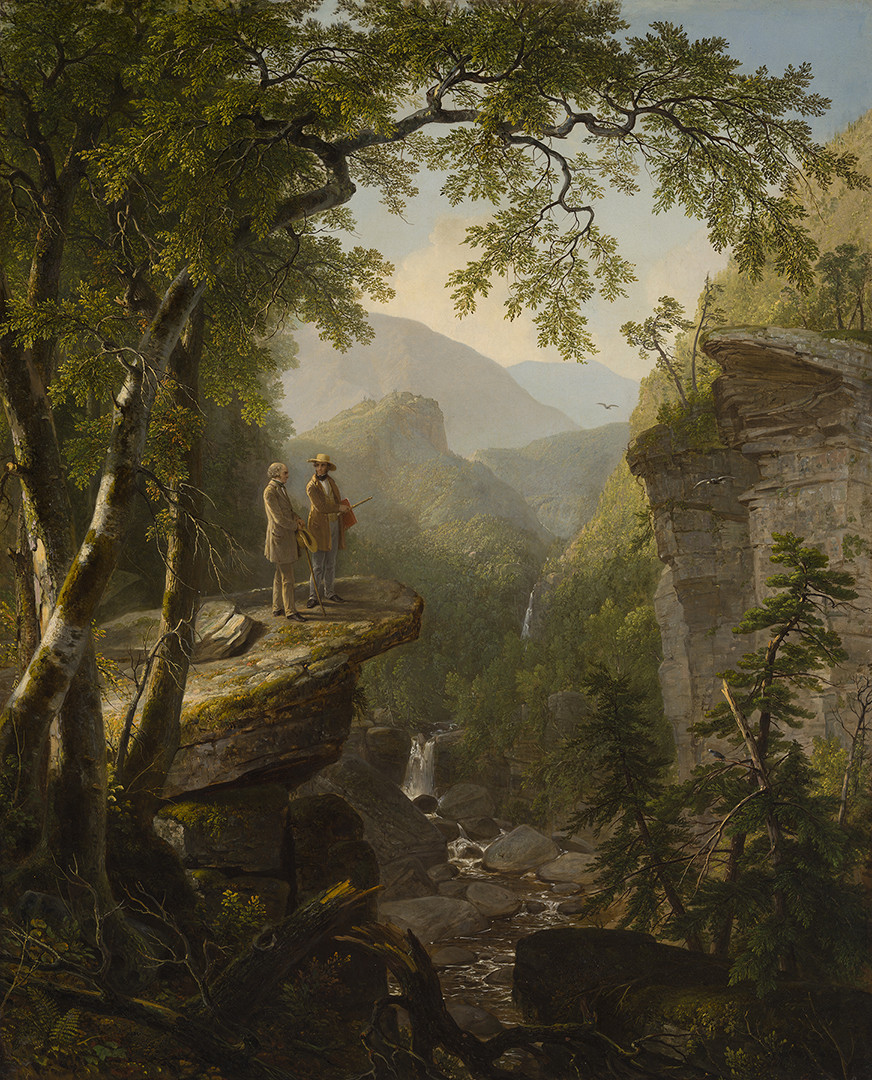
Olson makes this distinction in her discussion of Durand’s arboreal work. She identifies a particular branch study associated with Kindred Spirits while cautioning that many other similarities are more general. Most tree studies should not be assigned to a named canvas without stronger evidence.[2]
This caution is especially useful when looking at the small Met sheet. A lightly drawn trunk belongs to the artist’s recurring interests, but the current object record does not connect it with The Beeches or In the Woods. The comparisons here concern the attention to form visible across different works.
The distinction also preserves the drawings’ independence. A study need not serve a celebrated painting in order to matter. It can reveal an act of selection, a concentrated investigation or a particular way of organising marks on paper.
Watch: Asher Brown Durand
Choose a film to explore the artist’s work, its interpretation and its wider setting.
Friendship and landscape, Asher B Durand's Kindred Spirits
Smarthistory and Crystal Bridges discuss friendship, memory and landscape in Kindred Spirits.
Watch on YouTubeOutdoor painting and The Beeches
Drawing was one part of Durand’s study practice; painting outdoors supplied another. The Met’s catalogue relates The Beeches, 1845, to an 1844 oil study, Landscape with a Beech Tree. It identifies this as his first landscape based on an on-site oil sketch as far as was known to the catalogue’s authors.[4]
That qualification matters to the historical claim. It identifies a documented relationship rather than proving that no earlier outdoor study could ever have existed. The study and the finished painting also remain separate objects with different dates and purposes.
In The Beeches, tall trunks stand near the viewer, with branches extending across the upper field. A road and small rural figures lead toward a lighter opening. The composition gives individual trees a dominant scale while joining them to a continuous passage into the distance.
The catalogue also discusses Constable’s The Cornfield as a compositional source. Outdoor observation therefore worked alongside the artist’s study of other paintings. The finished canvas brings these kinds of experience into one designed arrangement.
Its tree tops pass beyond the upper edge of the painted composition. That framing brings the nearest trunks close to the viewer and lets them exceed the available field. It is a feature of Durand’s picture, rather than a crop introduced into the reproduction shown here.
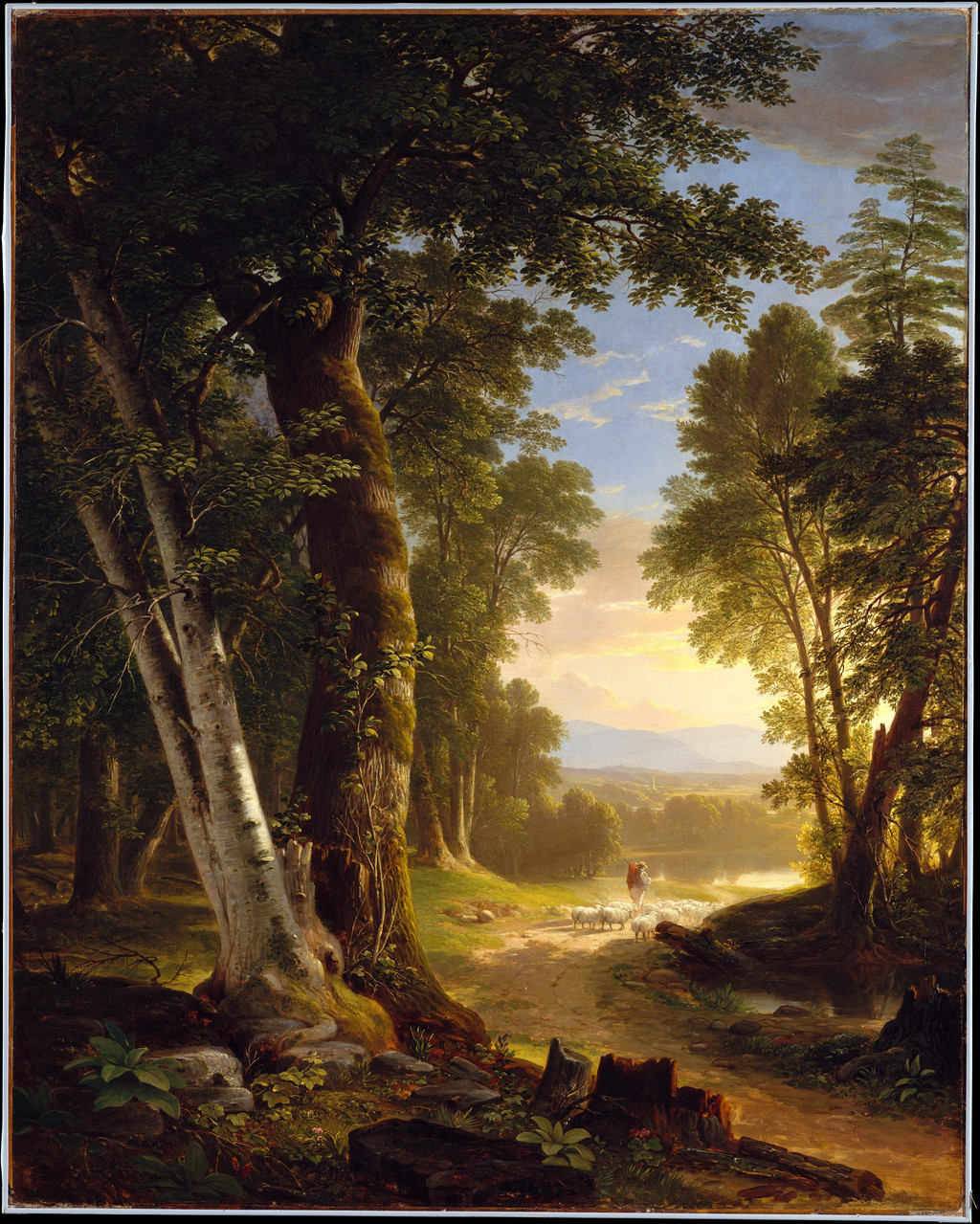
Asher Brown Durand, The Beeches, 1845. Metropolitan Museum of Art, 15.30.59. The museum catalogue relates it to an 1844 outdoor oil study; the small graphite sheet shown above has no documented direct connection to this canvas. The Metropolitan Museum of Art. Image source. CC0 / Public domain. Resized only; native appearance, complete carrier and margins preserved.
Careful studies and broad colour sketches
Durand’s advice treats different kinds of study according to the artist’s experience. In the excerpts from the letters, he warns a beginner against relying on broad colour sketches too soon. He nevertheless recognises their value to a mature painter as suggestions that can recall a larger effect.[1]
This is a distinction about learning and use. It does not establish that he rejected every loosely handled study or required every outdoor oil to look like a finished exhibition painting. A shorthand that can assist an experienced artist may leave a beginner without enough knowledge of the forms being represented.
The passages also distinguish close imitation from representation. Studying a solid foreground object in detail can teach the artist its structure, while a completed painting must communicate the scene’s larger meaning. The knowledge gained from detail supports choices about what a later picture needs.
Durand notes that rocks, trunks and substantial leaves offer different possibilities from running water or masses of foliage. A painter cannot describe each kind of subject in precisely the same way. The study practice consequently involves adapting attention and marks to the thing being observed.
From a trunk to a wooded space
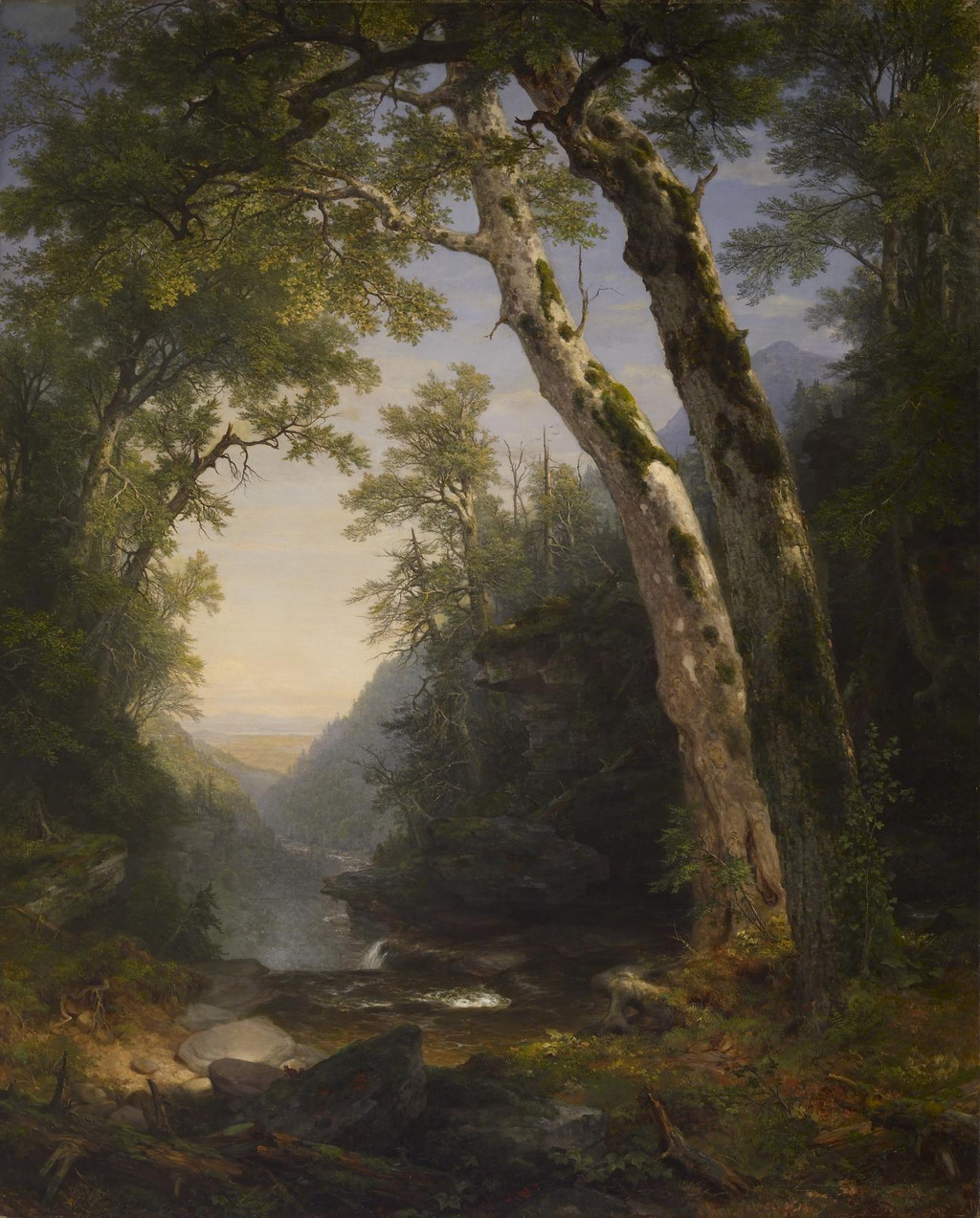
In the Woods provides a useful visual comparison. Its tall pale trunks rise within a dense enclosure, while darker vegetation fills the intervals around them. A stream and fallen wood give the nearest ground another pattern of forms.
The picture asks for more than a collection of separate tree portraits. Trunks overlap, branches interrupt openings and changes of light establish distances within the woodland. Individual forms need to contribute to an environment through which the viewer’s attention can move.
The small graphite sheet and the large oil therefore pose different questions. The drawing isolates a contour and a section of trunk. The painting joins comparable kinds of attention to a much broader arrangement of colour, shadow and space.
Their connection lies in a practice of observation rather than a documented direct transfer. Seeing them together shows how the investigation of one form can contribute to an artist’s ability to make a convincing forest, while each surviving work retains its own identity.
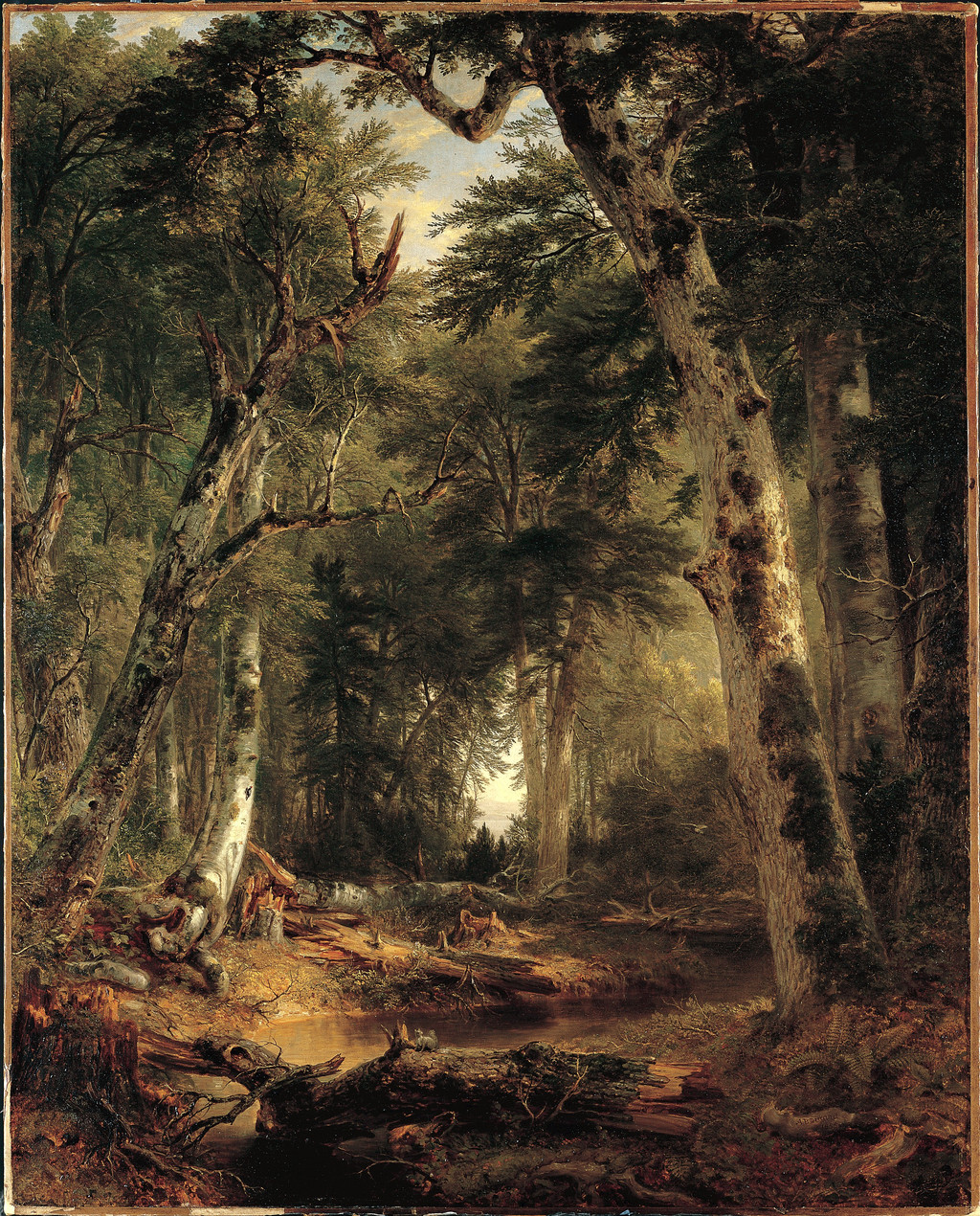
Asher Brown Durand, In the Woods, 1855. Metropolitan Museum of Art, 95.13.1. A comparison of individual tree forms within a composed woodland; no direct preparatory link with the displayed graphite sheet is claimed. The Metropolitan Museum of Art. Image source. CC0 / Public domain. Resized only; native appearance, complete carrier and margins preserved.
Artworks directory
A collected selection of 19 individually identified paintings, prints and a graphite study, including fifteen dedicated artwork articles. This directory is not a complete catalogue raisonné. Links lead to a companion article where available, otherwise the consulted institutional record. Progress is identified by title, date and museum; an unverified accession is omitted. Unillustrated objects remain searchable.
Frequently Asked Questions
No. Olson distinguishes specific links from more general similarities across Durand’s studies. Many drawings developed observation or recorded individual subjects without a proven connection to a named canvas.[2]
The consulted museum record gives no date. Its 1933 acquisition and visible page number should not be used as the drawing’s date.[3]
His advice distinguishes a beginner’s need for careful drawing from the mature artist’s use of broad colour studies as reminders of an effect.[1]
Discussion
Look again at the images and ideas explored in Asher Brown Durand’s Drawings and Studies. These editorial prompts invite your observations.
Reader Insights
What can you learn from the open paper separating the leaf and trunk studies?
Which branching patterns make the painted trees feel individual?
How does your attention change between an isolated study and a complete wooded space?
Join the Conversation
Share a detail, comparison or question about Asher Brown Durand’s Drawings and Studies below.
References
- John Durand, The Life and Times of A. B. Durand (1894). Appendix I, printed pp.211–217: selected extracts from the 1855 Letters on Landscape Painting, including form, study, colour and representation. View source
- Roberta J. M. Olson, “A Magnificent Obsession”: Durand’s Trees as Spiritual Sentinels of Nature (2010). Printed pp.151–158 and notes; tree drawing and distinctions between specific preparation and general resemblance. View source
- Metropolitan Museum of Art, Leaf and Tree Study (from Sketchbook), 33.176.11 recto. Undated graphite sheet, dimensions and acquisition credit. View source
- Metropolitan Museum of Art, The Beeches, American Paintings in The Metropolitan Museum of Art, volume I. Actually reviewed printed pp.414 and 416: outdoor-study relationship and compositional sources. View source
- Splash image source.
Asher Brown Durand, Leaf and Tree Study (from Sketchbook), undated. Graphite on paper, 11.7 × 17.5 cm. Metropolitan Museum of Art, 33.176.11 recto. Gift of Mrs. Frederic F. Durand, 1933. The supplied image’s faint graphite and paper edges are preserved. The Metropolitan Museum of Art; gift of Mrs. Frederic F. Durand,1933. CC0 / Public domain. Resized only; native appearance, complete carrier and margins preserved.
View source