 by Tom Gurney
Tom Gurney BSc (Hons) is an art history expert with over 20 years experience
Email: tomgurney1@gmail.com / Phone: +44 7429 011000
Asher Brown Durand’s Engravings: Introduction
Before Asher Brown Durand became a leading landscape painter, he made his reputation through prints. His work ranged from crowded historical scenes to portraits, small book illustrations and banknote designs. Engraving gave him both a livelihood and sustained practice in translating forms into line, long before his forest paintings became the best-known part of his career.[2]
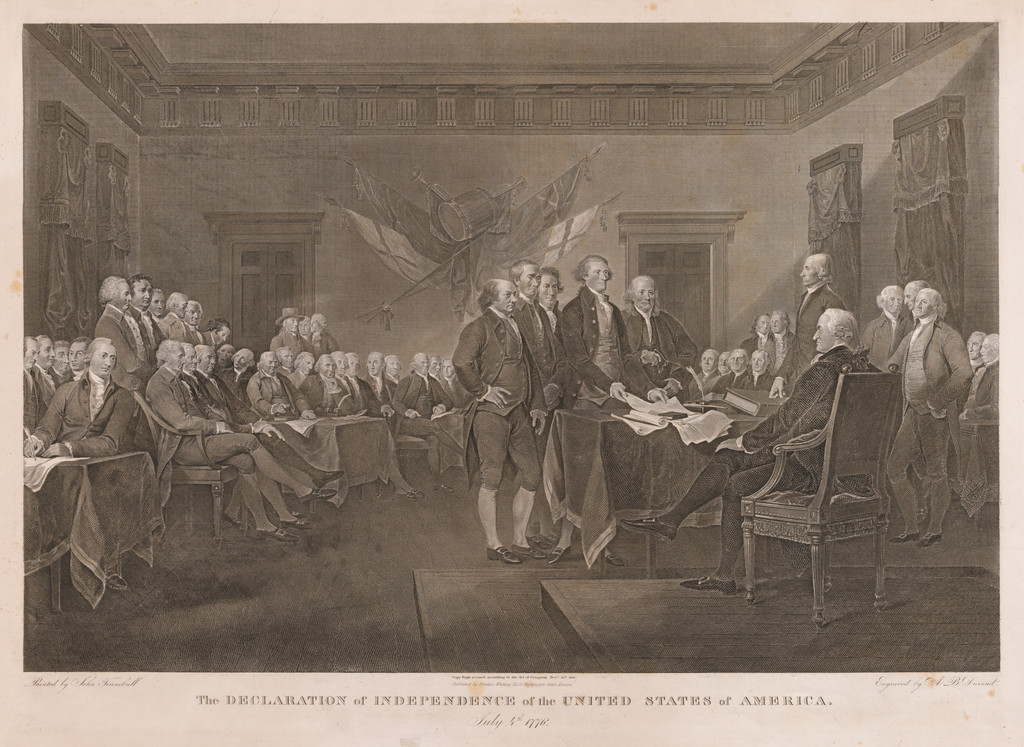
Two surviving works provide useful starting points. Signing the Declaration of Independence, 1823, brings a large assembly into a single interior. Ariadne, 1835, concentrates on one sleeping figure within a shaded coastal setting. Between them lies a varied professional practice whose commercial and artistic purposes frequently overlapped.
Selected Durand engravings
At a Glance
- ArtistAsher Brown Durand (1796–1886)
- ApprenticeshipPeter Maverick, 1812–17
- Early partnershipMaverick and Durand, from 1817
- Major historical printDeclaration of Independence, commissioned 1820, published 1823
- Landscape publicationThe American Landscape, 1830
- Major later engravingAriadne, 1835, after John Vanderlyn
- Continuing interestPrint collecting remained part of Durand’s later life
Contents
- Learning the craft in New Jersey
- A demanding historical commission
- Portraits, books and repeated encounters with images
- Banknotes and the division of work
- The American Landscape and Bryant’s text
- Musidora and the ambition of the figure print
- Ariadne from oil to engraved line
- What continued into the landscape years
- Annotated details
Learning the craft in New Jersey
Durand’s account of his childhood connects engraving with his father’s watchmaking and metalworking shop. Family members cut monograms and other devices on manufactured objects. The young artist began by examining printed images and trying to imitate their marks with tools he made himself.[1]
In the autobiographical fragment preserved by John Durand, small illustrations and watchmakers’ cards were especially important. They showed how a compact arrangement of figures or landscape could be carried by lines on a plate. Banknote vignettes offered another example of intricate pictures circulating through ordinary life.
Durand also recalled recognising that some marks came from etching, a process different from cutting directly with a graver. His earliest attempts did not give him a practical mastery of that method. The recollection describes discovery and experimentation rather than an already complete command of every printmaking process.
Formal training began with Peter Maverick in October 1812. Durand’s first assigned work included copying an engraved head in pencil and lettering a copper plate. The fragment then describes work for Maverick’s customers, including illustrated publications with small passages of landscape.
The five-year apprenticeship ended in 1817, when Durand became Maverick’s partner. Learning, employment and partnership therefore belong to different phases. This distinction gives the early career a clearer sequence than a single broad date range for his association with the workshop.
Annotated Details from Asher Brown Durand’s Engravings
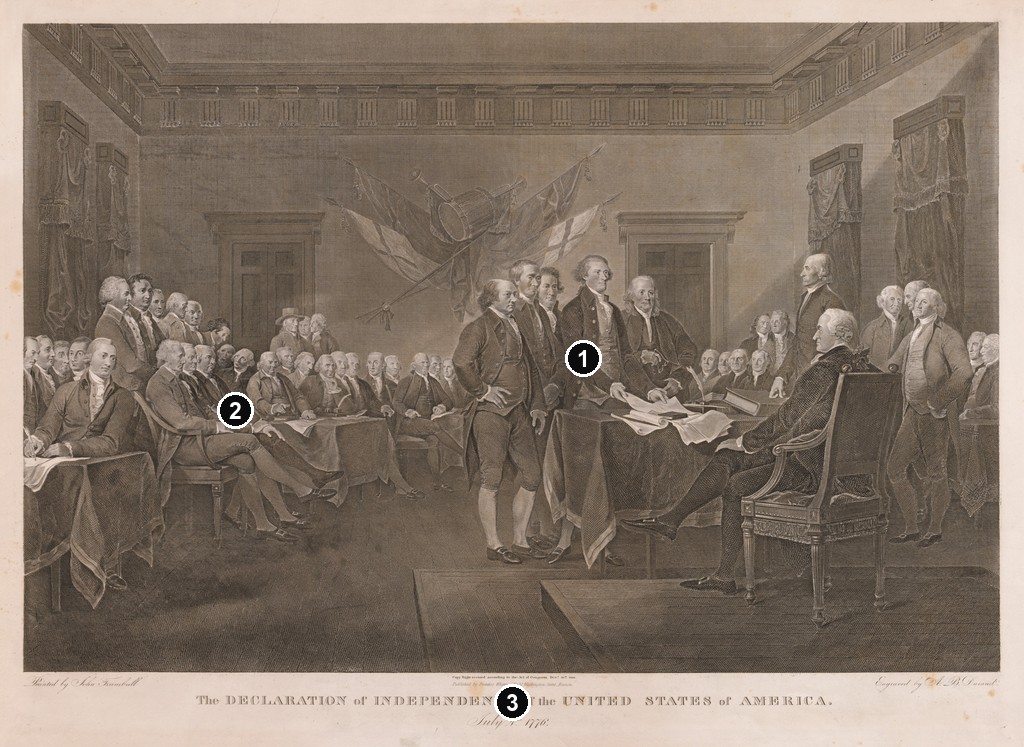
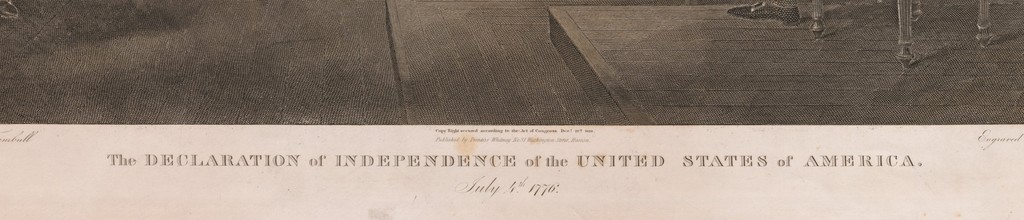
The numbered points identify visible features discussed in this article. Return from each detail to the whole composition. Asher Brown Durand after John Trumbull, Signing the Declaration of Independence, 1823. Cleveland Museum of Art, 1919.675. Gift of George A. Goddard. The composition depicts the draft’s presentation on June 28, 1776; the historical sheet preserves its July 4 inscription. Cleveland Museum of Art; gift of George A. Goddard. Image source. CC0 / Public domain. Resized only; native appearance, complete carrier and margins preserved.
Details from ASHER BROWN DURAND’S ENGRAVINGS
Compare the cropped details with the complete images above. Notice how their colours, shapes and positions contribute to the larger compositions.
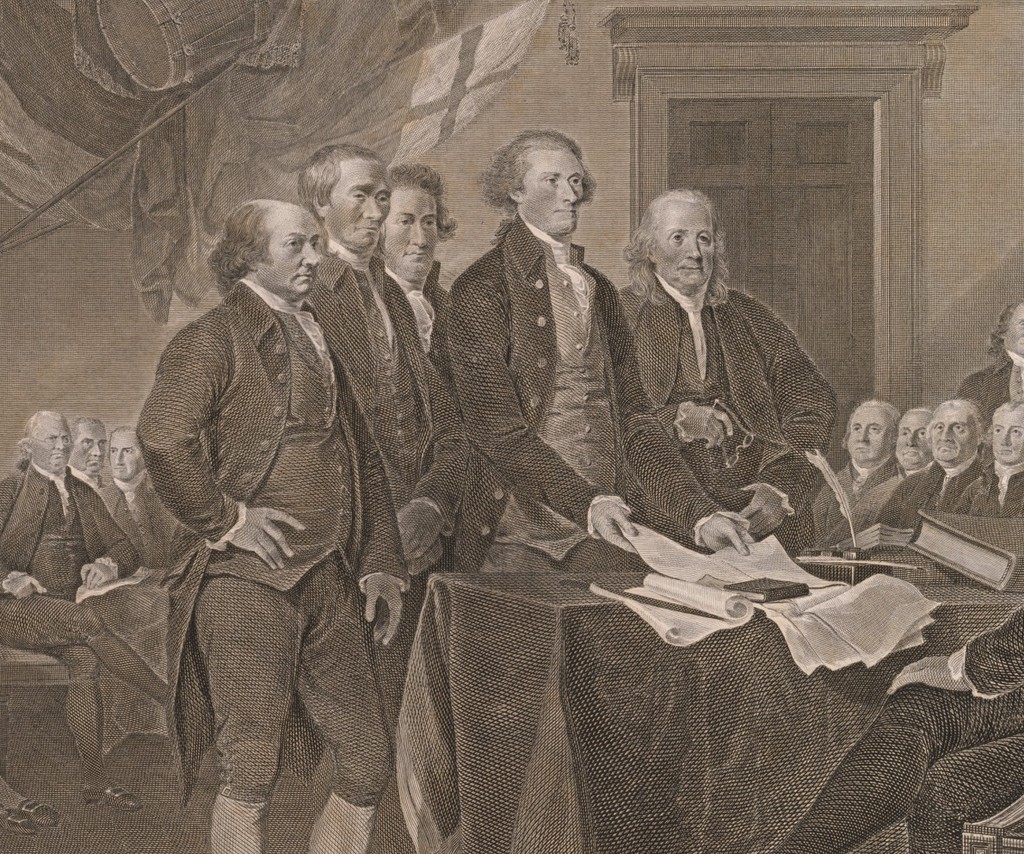
Committee before the table
Standing members of the drafting committee approach the table. The presented document establishes the central action rather than a simultaneous signing.
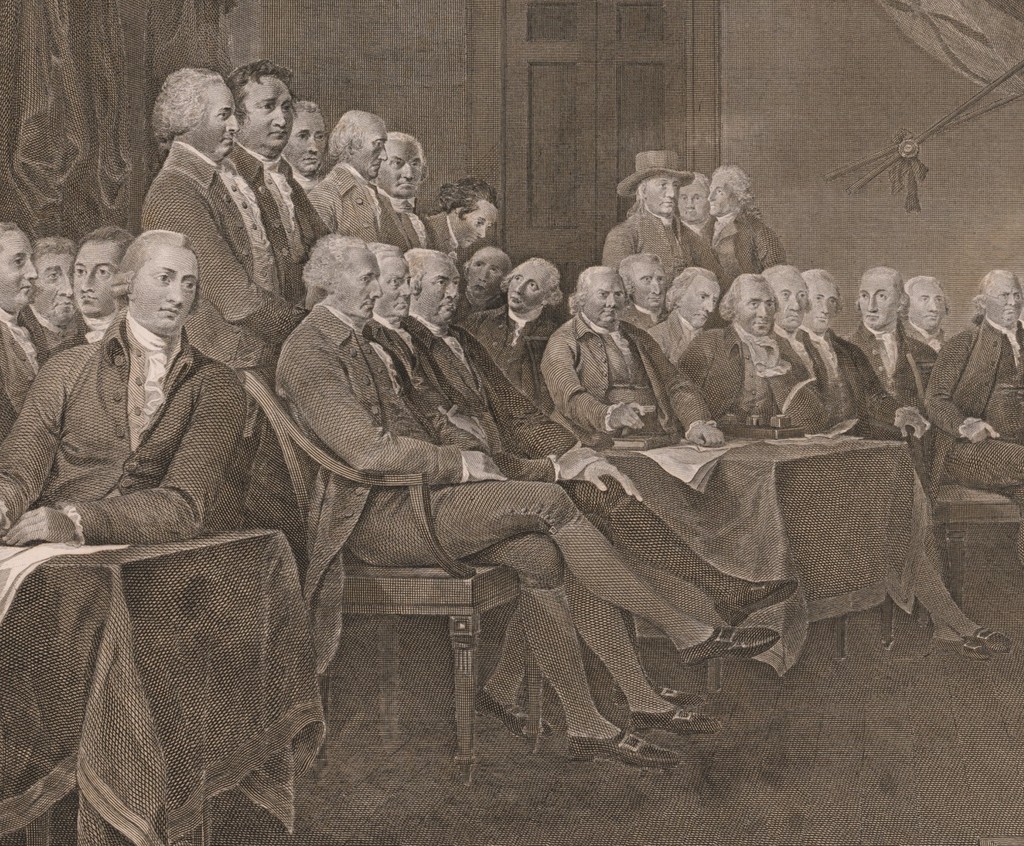
Seated assembly at the left
Seated and standing figures occupy the left side. Repeated chairs, coats and faces organise the assembled portraits.
Title and July date below the scene
The sheet’s title and July 4 date appear beneath the image. That printed date does not mean that the represented action shows all signatures made on that day.
A demanding historical commission
Trumbull’s Declaration of Independence offered a much larger undertaking. John Durand records a commission in 1820 and completion, printing and publication in 1823. He places the project alongside the dissolution of the Maverick partnership and the beginning of Durand’s independent professional position.[1]
The composition contains a central presenting committee surrounded by seated and standing delegates. Its principal action depends on the group’s position and the papers on the table. Its smaller demands include individual faces, clothing and the many changes of light across an enclosed room.
The exact Cleveland impression shown here is accession 1919.675, a gift of George A. Goddard. The museum dates it to 1823 and catalogues its medium as etching. Historical accounts discuss the undertaking as an engraving; the exact collection label remains attached to this surviving sheet.[3]
The familiar title also requires care. The subject is the draft’s presentation on June 28, 1776, preceding the July 4 adoption and most delegates’ August 2 signing. The historical sheet’s July 4 inscription remains visible beneath the picture.[4]
Kushner and Ferber identify Trumbull’s smaller Yale painting as Durand’s model in their endnote on the commission. The monumental Capitol version shares the composition but is a separate object. Their study places the print’s success at the foundation of Durand’s reputation.[2]
Portraits, books and repeated encounters with images
Much of Durand’s professional work concerned subjects smaller than the Declaration. His prints could be encountered in books, portrait publications and other formats that brought an image together with written information. These settings placed different demands on the engraver from a single ambitious exhibition painting.
John’s account lists illustrated literary works, encyclopaedia plates, diplomas and banknote vignettes among the workshop’s activities. This mixture shows how picture-making belonged to a wider trade in designed and printed objects. A portrait or scene could accompany a text, certify membership or occupy only a small part of a larger sheet.[1]
The selected 2010 catalogue entries preserve concrete examples. They include literary illustrations, the New-York Historical Society certificate and portraits after other painters. Their inscriptions distinguish roles such as drawing, painting and engraving, which can otherwise disappear beneath a publication’s collective name.[7]
A print made after another artist’s painting required interpretation as well as careful copying. Colour relationships had to become tonal relationships. Marks needed to describe faces, cloth or landscape at the scale appropriate to the intended sheet.
Durand’s own images also became models for prints. The boundaries between engraver, draughtsman and painter could therefore overlap within one career. The later move toward painting grew out of a practice that already involved looking at paintings, preparing drawings and judging the expressive possibilities of different media.
Banknotes and the division of work
Banknote production formed another important part of Durand’s livelihood. Kushner and Ferber describe his 1824 entry into his brother Cyrus’s business and departure from that partnership in 1831. Cyrus’s geometrical lathe work supplied intricate patterned designs, while Asher contributed pictorial vignettes.[2]
The selected catalogue entries distinguish geometrical proofs by Cyrus from banknote sheets and vignettes associated with the firms. They preserve these separate attributions rather than treating every banknote element as Asher’s individual design.[7]
This division matters to the visual work. A small figure, vessel or allegorical scene might occupy an area within a patterned framework. The object combines pictorial description with repeated line structures serving a different purpose.
The commercial format also changes the circumstances of viewing. A banknote is handled and circulated as currency; its images accompany another immediate use. Durand’s contribution reached people through such everyday objects as well as through prints sought primarily for their art.
These activities are part of his professional history without being substitutes for the later landscapes. They show a sustained capacity to work at small scales and to collaborate within complex production arrangements. They also make the economic foundation of the engraving career easier to see.
Watch: Asher Brown Durand
Choose a film to explore the artist’s work, its interpretation and its wider setting.
Friendship and landscape, Asher B Durand's Kindred Spirits
Smarthistory and Crystal Bridges discuss friendship, memory and landscape in Kindred Spirits.
Watch on YouTubeThe American Landscape and Bryant’s text
The American Landscape appeared in 1830, combining six engraved views with historical and topographical writing. John Durand preserves Bryant’s prospectus and records that only one number was published. His account presents the undertaking as a commercial disappointment.[1]
The prospectus sought an audience for American scenery through well-made views. It connected local subjects with a print format familiar from European landscape publications. The project therefore joined the selection of places with the practical business of circulating their images.
The selected catalogue identifies sources by William James Bennett, Thomas Cole, Robert W. Weir and Durand himself. Bennett supplied Weehawken and The Falls of the Sawkill; Cole supplied the Lake Winnipesaukee subject; Weir supplied Fort Putnam. Durand’s own subjects included the Catskill Mountains and Delaware Water Gap.[7]
Collaboration extended to the plate work. The catalogue credits Smillie with the cover after Durand and gives separate etching and finishing credits for Fort Putnam. John’s narrative also describes Smillie’s contribution. The publication should consequently remain a collaborative undertaking rather than a set attributed to Durand alone at every stage.
The views bring landscape into the early career before its later dominance in his painting. They also establish a working relationship between pictures and Bryant’s writing. The poet’s later presence in Kindred Spirits belongs to a much wider history of artistic and literary association.
Musidora and the ambition of the figure print
Durand’s engraving practice included subjects undertaken for artistic ambition as well as commercial demand. Musidora, 1825, concerned a nude figure preparing to bathe. John links the design to James Thomson’s The Seasons and discusses the difficulties his father faced in drawing and modelling the body.[1]
The 2010 catalogue records the sheet as designed and engraved by Durand. This distinguishes it from a reproductive work based directly on another painter’s composition. Its literary source gave the image a narrative circumstance, while its design required Durand to construct the visible figure himself.[7]
John’s assessment is mixed: he criticises aspects of the figure while praising the landscape and overall arrangement. Those judgements belong to his retrospective account. They reveal the standards he brought to the work without becoming a universal verdict on its artistic value.
Ariadne presented a different route. Durand could study Vanderlyn’s painted figure and prepare a reduced coloured copy before working on the print. The comparison shows two ways of approaching a demanding figure subject: original design and translation from an existing painting.
Ariadne from oil to engraved line
Princeton’s Ariadne, 1835, is a complete published sheet, printed by Albert B. King and credited to the Mather Collection. Its broad margins carry the title and production inscriptions. These details preserve the work’s identity as an impression made and circulated through several roles.[5]
Durand’s preparatory oil copy belongs to the Met. The museum dates it to about 1831–35 and explains the artist’s usual practice of making a small painted copy before engraving. It is distinct from Vanderlyn’s original painting.[6]
In the oil, red fabric supports the pale sleeping body against a darker woodland. In the print, relationships between those areas are established through tone and line. Folded cloth, rounded limbs and rough vegetation require different patterns within the same monochrome medium.
John reports difficulties in printing satisfactory impressions and disappointing sales. These remain attributed historical observations, with no inference that the Princeton sheet shown here is defective. They make clear that the engraver’s accomplishment and a publisher’s commercial outcome were separate questions.[1]
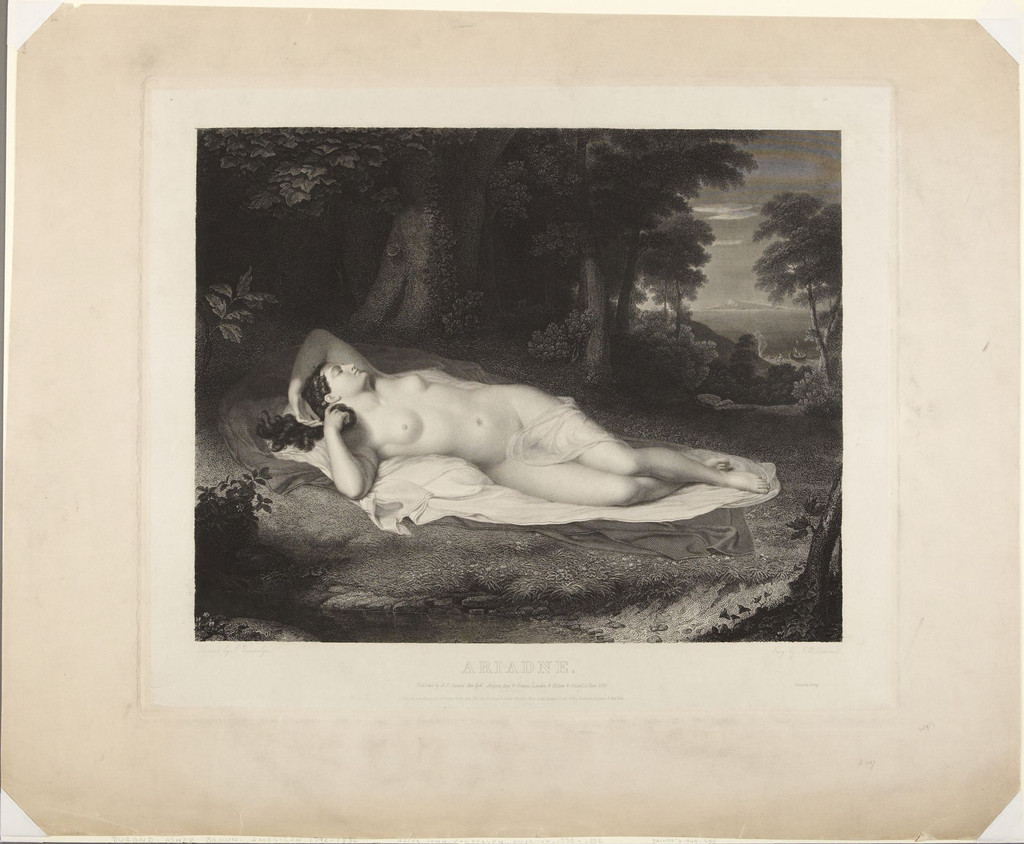
Asher Brown Durand after John Vanderlyn, Ariadne, 1835. Engraving, printed by Albert B. King. Princeton University Art Museum, Mather Collection, x1949-255. Princeton University Art Museum; Mather Collection. Image source. Public domain. Resized only; native appearance, complete carrier and margins preserved.
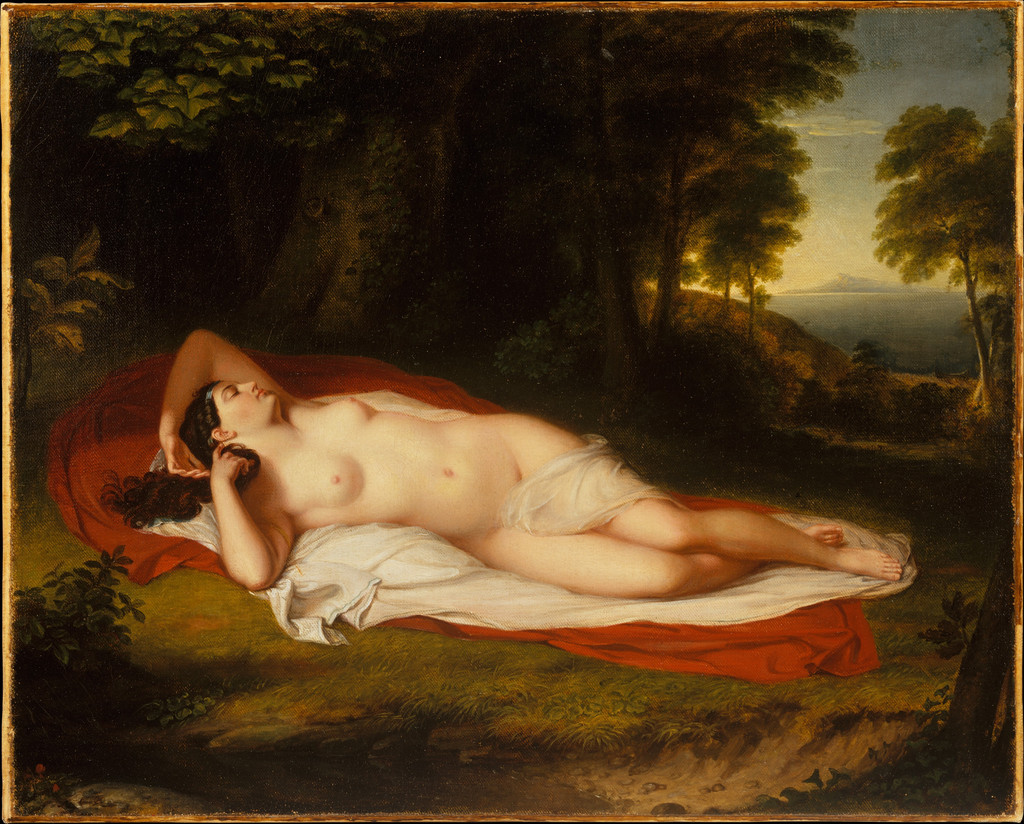
Asher Brown Durand after John Vanderlyn, Ariadne, about 1831–35. Metropolitan Museum of Art, 97.29.2. Gift of Samuel P. Avery, 1897. Durand’s preparatory oil copy, distinct from Vanderlyn’s original. The Metropolitan Museum of Art; gift of Samuel P. Avery,1897. Image source. CC0 / Public domain. Resized only; native appearance, complete carrier and margins preserved.
What continued into the landscape years
Ariadne stands near the major change in Durand’s professional emphasis. Kushner and Ferber nevertheless describe a continuing interest in prints later in his life. Painting increasingly defined his public reputation without ending his engagement with graphic art.[2]
The relationship with later landscapes can be considered through visible demands shared by the media. A tree trunk requires form and surface; foliage requires patterns that vary without losing their larger mass; foreground and distance require different degrees of description. Durand had long practised such judgements in printmaking.
The paintings also offer possibilities that a monochrome print cannot supply in the same way. Colour, the visible painted surface and the scale of a canvas alter the encounter. The engraving years provide a substantial background to that practice while retaining their own objects, purposes and achievements.
Artworks directory
A collected selection of 19 individually identified paintings, prints and a graphite study, including fifteen dedicated artwork articles. This directory is not a complete catalogue raisonné. Links lead to a companion article where available, otherwise the consulted institutional record. Progress is identified by title, date and museum; an unverified accession is omitted. Unillustrated objects remain searchable.
Frequently Asked Questions
Yes. He trained with Maverick from 1812 to 1817, became his partner and established an independent reputation through works including the 1823 Declaration print.[1]
Kushner and Ferber identify a major professional transition around the 1835 print, while describing his continued interest in print collecting later in life.[2]
Discussion
Look again at the images and ideas explored in Asher Brown Durand’s Engravings. These editorial prompts invite your observations.
Reader Insights
How do the demands of the Declaration’s many portraits differ from Ariadne’s single figure?
What changes when a picture is designed for a book or a banknote?
Which forms in Durand’s landscapes invite comparison with the tonal work of his prints?
Join the Conversation
Share a detail, comparison or question about Asher Brown Durand’s Engravings below.
References
- John Durand, The Life and Times of A. B. Durand (1894). Selected printed pp.17–29 and 72–77: training, commission, collaborative publication and figure prints. View source
- Marilyn S. Kushner and Linda S. Ferber, A Master Engraver: Founding Fathers, Banknotes, and the Great American Nude (2010). Printed pp.53–55 and notes: professional practice and later print interest. View source
- Cleveland Museum of Art, Signing the Declaration of Independence, 1919.675. Exact 1823 impression, medium and credit. View source
- Architect of the Capitol, Declaration of Independence. Distinction between presentation, adoption and signing. View source
- Princeton University Art Museum, Ariadne, x1949-255. Exact 1835 impression, printer and publication inscriptions. View source
- Metropolitan Museum of Art, Ariadne, 97.29.2. Durand’s preparatory oil copy after Vanderlyn. View source
- Catalogue of works, The American Landscapes of Asher B. Durand (2010). Selected printed pp.259–262, especially entries 12–23 and 36–44; banknote distinctions and landscape collaboration. View source
- Splash image source.
Asher Brown Durand after John Trumbull, Signing the Declaration of Independence, 1823. Cleveland Museum of Art, 1919.675. Gift of George A. Goddard. The composition depicts the draft’s presentation on June 28, 1776; the historical sheet preserves its July 4 inscription. Cleveland Museum of Art; gift of George A. Goddard. CC0 / Public domain. Resized only; native appearance, complete carrier and margins preserved.
View source