 by Tom Gurney
Tom Gurney BSc (Hons) is an art history expert with over 20 years experience
Email: tomgurney1@gmail.com / Phone: +44 7429 011000
The First Harvest in the Wilderness by Asher Brown Durand: Introduction
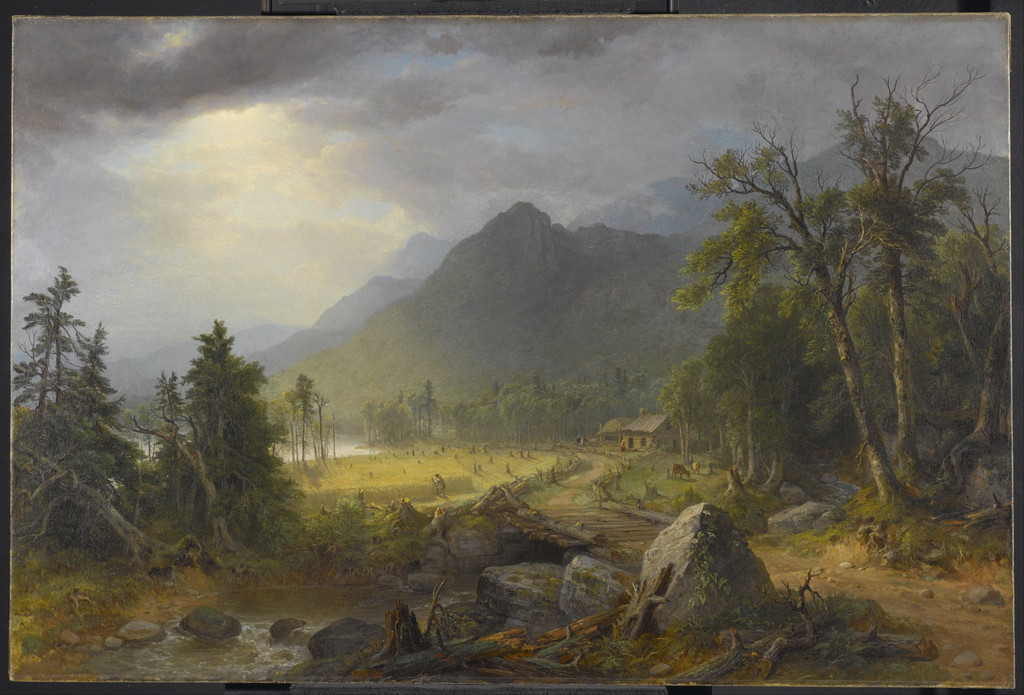
Sunlight falls on a small cultivated clearing surrounded by forest and mountains in Asher Brown Durand’s The First Harvest in the Wilderness. A log cabin, grain field, cut stumps and rough bridge show the beginnings of settlement. Painted in 1855 for the Brooklyn Institute, the work also commemorates Augustus Graham, whose name appears on a foreground rock. It is now in the Brooklyn Museum.[1]
At a Glance
- ArtistAsher Brown Durand (1796–1886)
- TitleThe First Harvest in the Wilderness
- Date1855
- MediumOil on canvas
- Dimensions80.3 × 122 cm
- CollectionBrooklyn Museum, New York
- Accession97.12
- Museum creditTransferred from the Brooklyn Institute of Arts and Sciences to the Brooklyn Museum
This work across Asher Brown Durand’s career
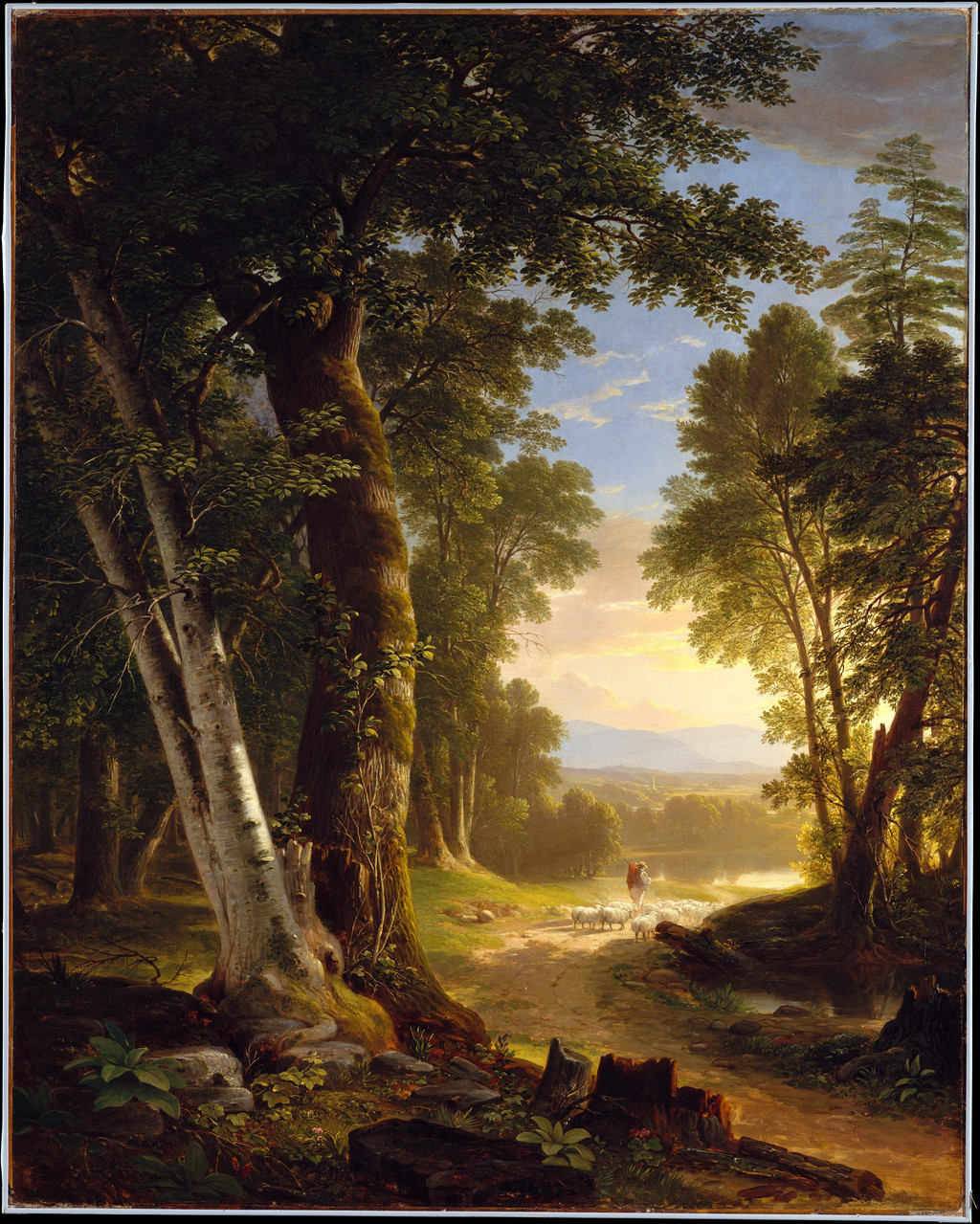
The Beeches
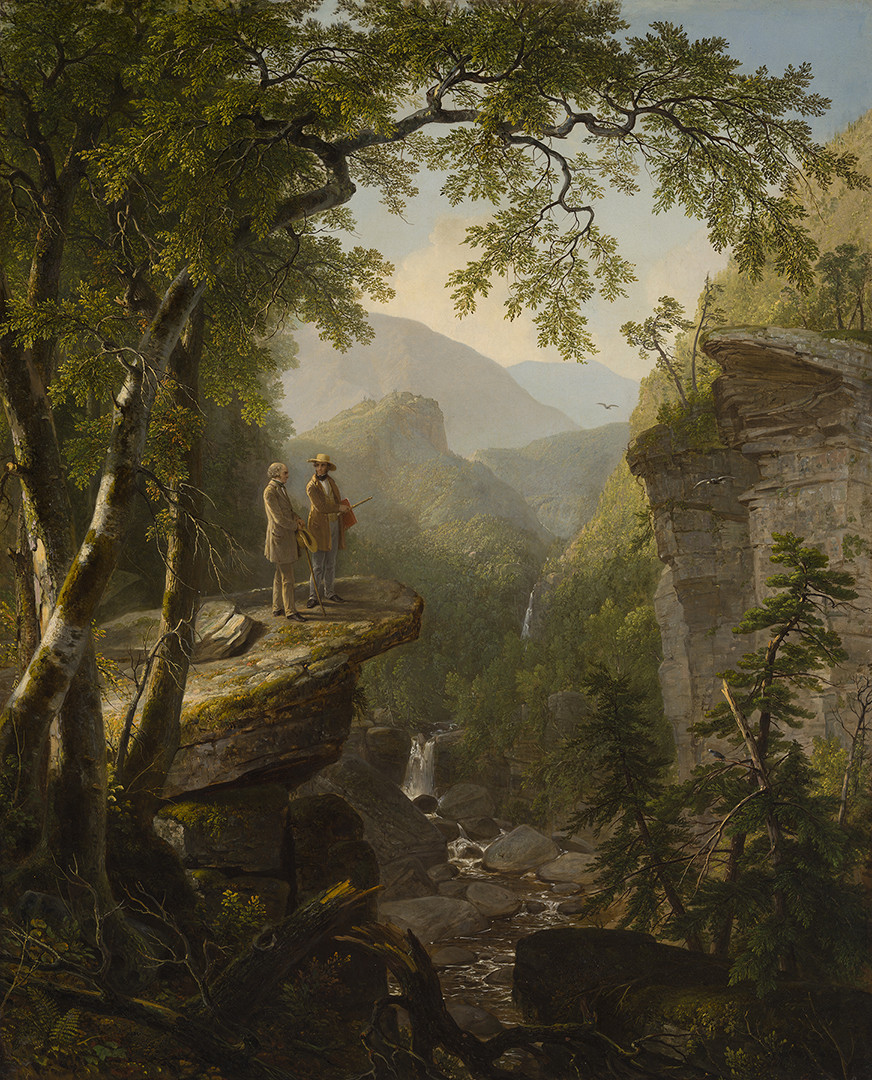
1845Kindred Spirits
1849God’s Judgment Upon Gog
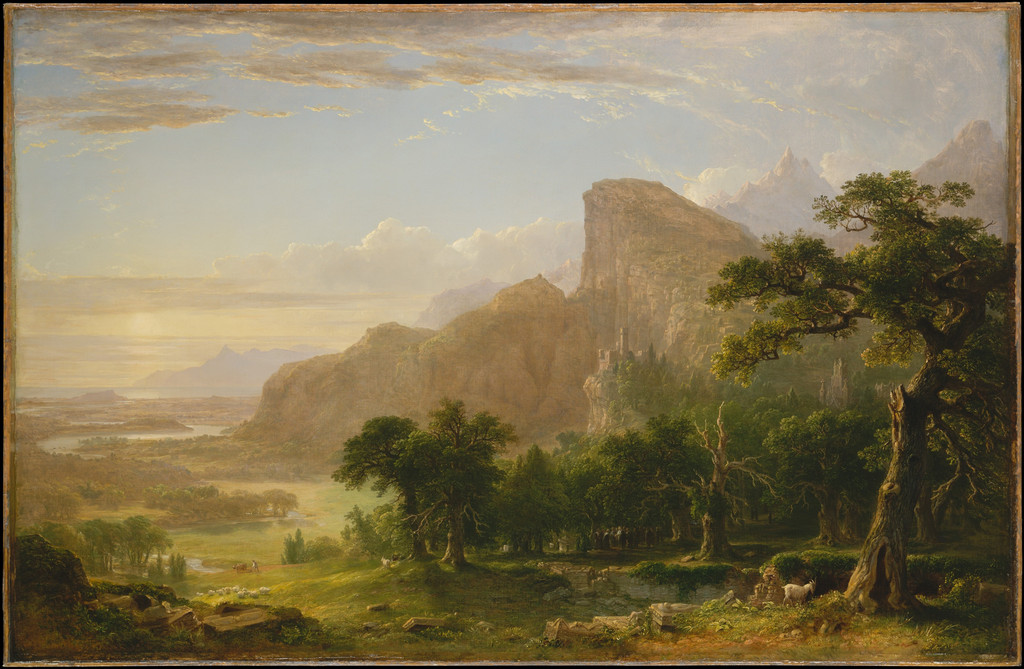
ca.1851–52River Scene
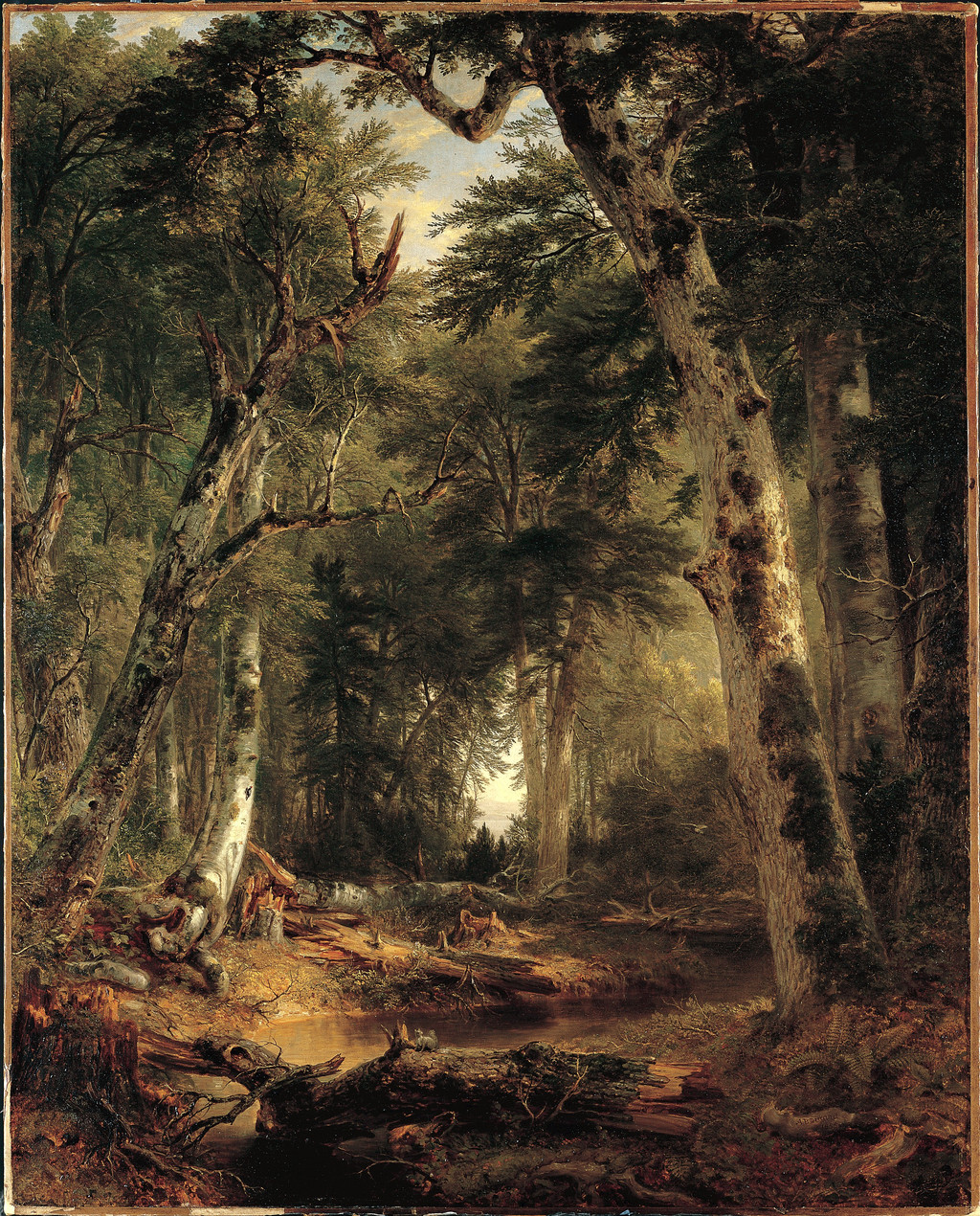
1854In the Woods
1855The Catskills
1859Sunday Morning
1860Summer Afternoon
1865Contents
- A clearing within a larger landscape
- Cabin, crop and cut trees
- The stream, bridge and road
- The Graham rock
- A bequest and the 1855 commission
- What the first viewers found in the clearing
- Settlement and the questions it leaves open
- Comparisons with Progress and Dover Plains
- Annotated details
A clearing within a larger landscape
The cultivated field occupies the middle distance, set between the near stream and the distant mountains. It is the canvas’s brightest area of ground. Against the darker surroundings, its warm light makes a small human settlement immediately noticeable.
The mountains rise well above the cabin. Their extensive slopes establish the scale of the country in which the clearing sits. The settlement occupies only a limited part of that terrain, with forest continuing around and beyond it.
Cloud covers much of the sky, opening enough at the left to admit a concentrated brightness. This illumination reaches the field while leaving substantial portions of the landscape in shade. The painting gives the harvest visual emphasis without making the whole setting uniformly sunny.
At the right, tall trunks retain living foliage as well as bare branches. Their irregular forms make the forest substantial and varied. Some reach almost to the top of the canvas, establishing a close vertical presence beside the broad, more distant mountain mass.
The clearing interrupts this continuity of trees. Its relatively open surface creates a place where a person, animals and buildings can be distinguished. The surrounding woodland helps the viewer understand what has changed in the cultivated area, rather than functioning only as a scenic frame.
Annotated Details from The First Harvest in the Wilderness
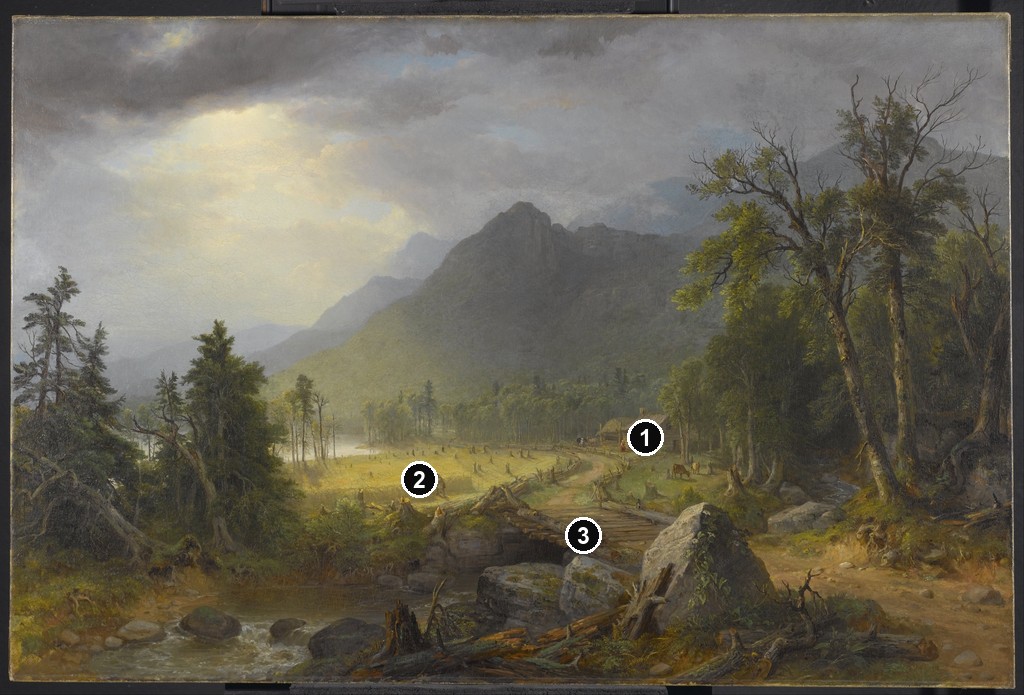
The numbered points identify visible features discussed in this article. Return from each detail to the whole composition. Asher Brown Durand, The First Harvest in the Wilderness, 1855. Oil on canvas. Brooklyn Museum, 97.12. Graham memorial commission. Brooklyn Museum / Google Art Project. Image source. Public domain. Resized only; native appearance, complete carrier and margins preserved.
Details from THE FIRST HARVEST IN THE WILDERNESS
Compare the cropped details with the complete images above. Notice how their colours, shapes and positions contribute to the larger compositions.
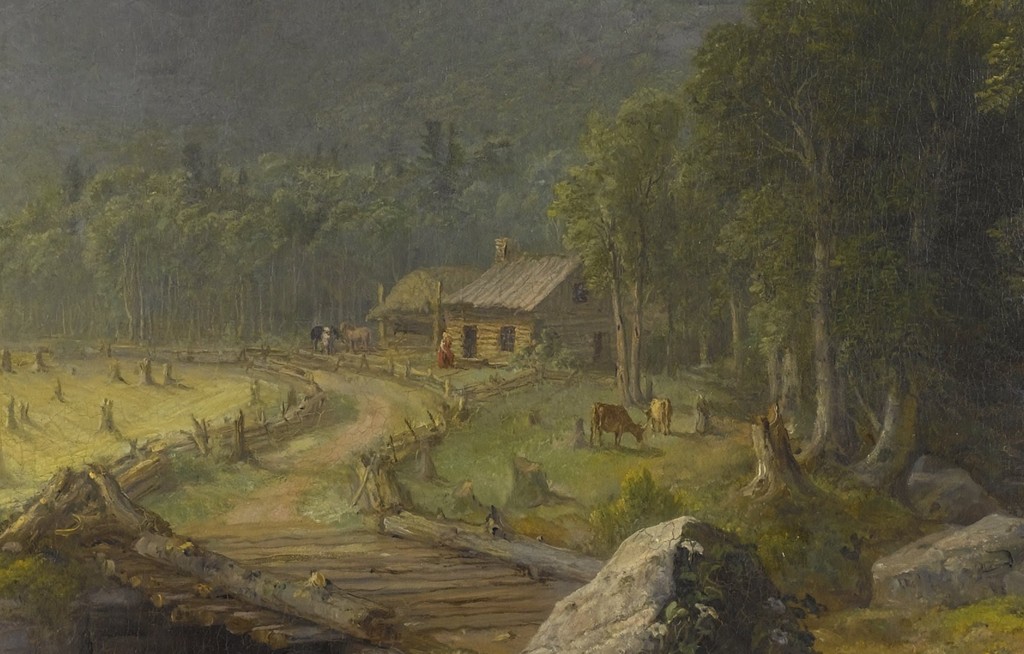
Cabin beside the woodland
A cabin stands beside the remaining trees, with small figures nearby. The clearing meets the woodland rather than filling the entire view.
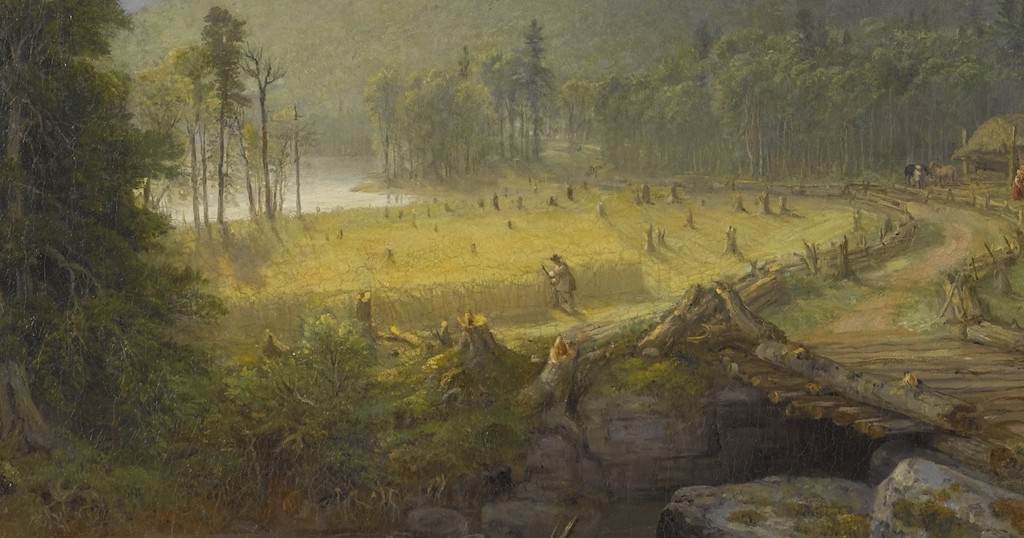
Crop and cut stumps
A crop occupies part of the clearing while cut stumps remain visible around it. The near remnants make the change in land use apparent.
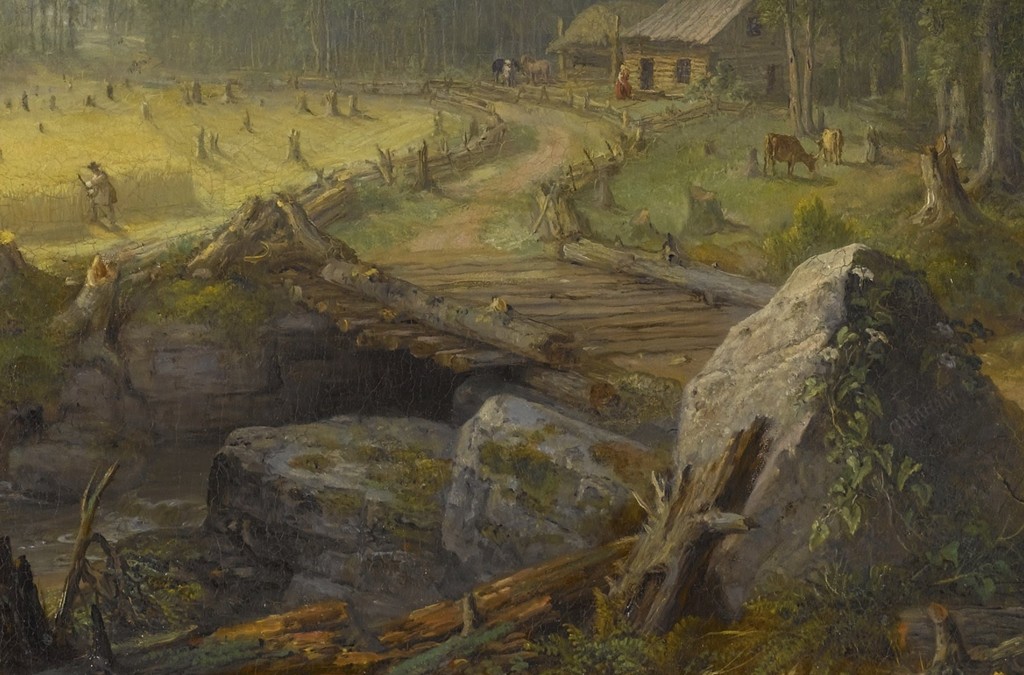
Bridge across the near stream
A low wooden bridge crosses the stream beneath the curving road. It links the near rocky watercourse with the cabin and clearing.
Cabin, crop and cut trees
A log cabin stands at the back of the clearing, beside the curving road. Its low roof and small scale make it a modest structure within the extensive landscape. Nearby figures and grazing animals bring attention to life around the dwelling.
A worker appears in the field, where cut stumps interrupt the grain. Their presence connects harvest with the earlier labour of clearing land. The title’s first harvest can therefore be understood through the visible relationship between a new crop and the remains of felled trees.
The stumps are scattered rather than gathered at the edge. Their distribution makes the change to the land pervasive within the field itself. Cultivation is taking place amid traces of the forest that occupied the same ground.
Fences divide portions of the settlement. They make the land’s new organisation visible on a smaller scale than the contrast between clearing and surrounding woods. Paths, enclosed areas and the cabin contribute to the scene’s sense of an emerging domestic order.
The people remain small. Their activities can be understood in relation to field and house without being turned into individually named settlers. The picture gives ordinary labour an extensive landscape setting, while the painting’s memorial purpose belongs to a different, documented individual: Graham.
The stream, bridge and road
Water crosses the nearer ground among dark stones and broken timber. The stream retains a rougher appearance than the cultivated field beyond it. Its irregular banks make the foreground an area to inspect before looking toward the sunlit crop.
A simple timber bridge carries the road across the water. Its boards form a horizontal passage between rocks, tree remains and the curving route beyond. The bridge is a small intervention in a foreground still crowded with natural forms.
The road then bends toward the cabin. It links the viewer’s near position with the settlement, giving the picture a route through successive spaces. The grain field lies beside that route, close enough to be encountered as part of the passage toward the house.
Fallen wood and stumps occupy the lower edge. These objects are signs of change as well as textured foreground forms. They bring the clearing’s history close to the viewer, rather than leaving tree cutting implied only by the distant open field.
The stream and road make two different movements through the canvas. Water travels between the nearer stones, while the road crosses it and proceeds into the settlement. Their intersection makes the bridge a useful point from which to consider how human activity has adapted this ground.
The Graham rock
The large rock at the lower right bears the name GRAHAM. Vegetation trails over its surface, and fallen timber lies nearby. Its substantial scale gives the memorial inscription a place within the painting’s nearest landscape forms.
The name creates a different kind of attention from that invited by the crop. A viewer can follow the road toward the harvest, then return to the rock and recognise the landscape’s commemorative purpose. The memorial is integrated into the setting rather than placed on a separate plaque outside it.
A contemporary account in The Crayon, January 1856, explicitly notices the name and the vine around the rock. It connects the painting to the Brooklyn Institute’s commission, confirming that this commemorative element was recognised soon after the work’s completion.[2]
The inscription should not make Graham the literal identity of the painted field worker. It refers to the benefactor whose support helped bring the picture into existence. The rock joins an imagined landscape of settlement to a specific history of cultural patronage.
Watch: Asher Brown Durand
Choose a film to explore the artist’s work, its interpretation and its wider setting.
Friendship and landscape, Asher B Durand's Kindred Spirits
Smarthistory and Crystal Bridges discuss friendship, memory and landscape in Kindred Spirits.
Watch on YouTubeA bequest and the 1855 commission
Karen Sherry’s Brooklyn Museum account identifies Graham’s 1851 bequest as the funding behind the commission. Durand accepted $175, and the picture was displayed by September 1856. The price was the artist’s payment, not the full amount of Graham’s bequest.[1]
The commission also belonged to Graham’s support for a gallery buying work by living American artists. It brought a leading contemporary painter into a civic collecting project. The painting’s later transfer to the Brooklyn Museum preserves that institutional origin in its acquisition credit.
Durand’s position in 1855 gives the choice of artist further context. Linda S. Ferber places him at the height of his public career during his presidency of the National Academy of Design, when he published his Letters on Landscape Painting.[3]
The work therefore joined a developing collection with an established artist. Its quiet rural subject did not prevent it from carrying an ambitious idea about what support for American art could achieve.
What the first viewers found in the clearing
The January 1856 journal account describes the stream, makeshift bridge, road, grain field and reaper, paying particular attention to light concentrated on the crop. It interprets that brightness as encouragement to agricultural work and hope for the settler.[2]
The writer then turns the landscape into an analogy for the arts. American artistic activity is presented as an emerging clearing, with encouragement reaching it through surrounding shadows. Graham’s patronage becomes the cultural equivalent of making land available for cultivation.
That analogy is a contemporary critical response, not a surviving written instruction from the commissioner. It shows how a viewer in 1856 could connect the painting’s field and memorial inscription with the circumstances of its production.
The reading also helps explain why the brightest ground belongs to the crop rather than to the foreground rock. The field can carry the idea of newly supported activity, while the inscribed rock recalls the person honoured for enabling it. These two parts of the picture work together across different distances.
The journal announces Daniel Huntington as the painter of the Institute’s next picture. Its notice situates Durand’s canvas at the beginning of an ongoing collecting programme, giving the clearing metaphor an institutional consequence beyond this single commission.[2]
Settlement and the questions it leaves open
Sherry also discusses the scene in relation to Manifest Destiny, the nineteenth-century belief in continental expansion. Her interpretation connects the attractive settlement imagery with the exploitation and violence accompanying that expansion.[1]
Looking closely can preserve both the painting’s beauty and the questions raised by its selection of subject. The field is fruitful and brightly lit; cut timber and stumps make the transformation of land visible. The scene does not show the full social history behind such changes.
The phrase wilderness in the title belongs to the painting’s historical framing of the land. It should not establish that an actual place was previously unoccupied, or that the figures represent a documented settlement. The canvas offers a composed image through which a particular cultural idea could be expressed.
Rebecca Bedell’s later reconsideration of Progress, 1853, provides another way to ask what Durand’s landscapes imply about development. She challenges a simple assumption that its technologies express uncomplicated approval.[4] That argument does not automatically assign the same attitude to every painting. It encourages attention to the different forms of change each work actually presents.
Comparisons with Progress and Dover Plains
Progress collects transport and industry into a panorama. First Harvest concentrates on a small clearing, cultivation and a dwelling. The different scales of development make their comparison useful without treating the works as illustrations of one fixed message.
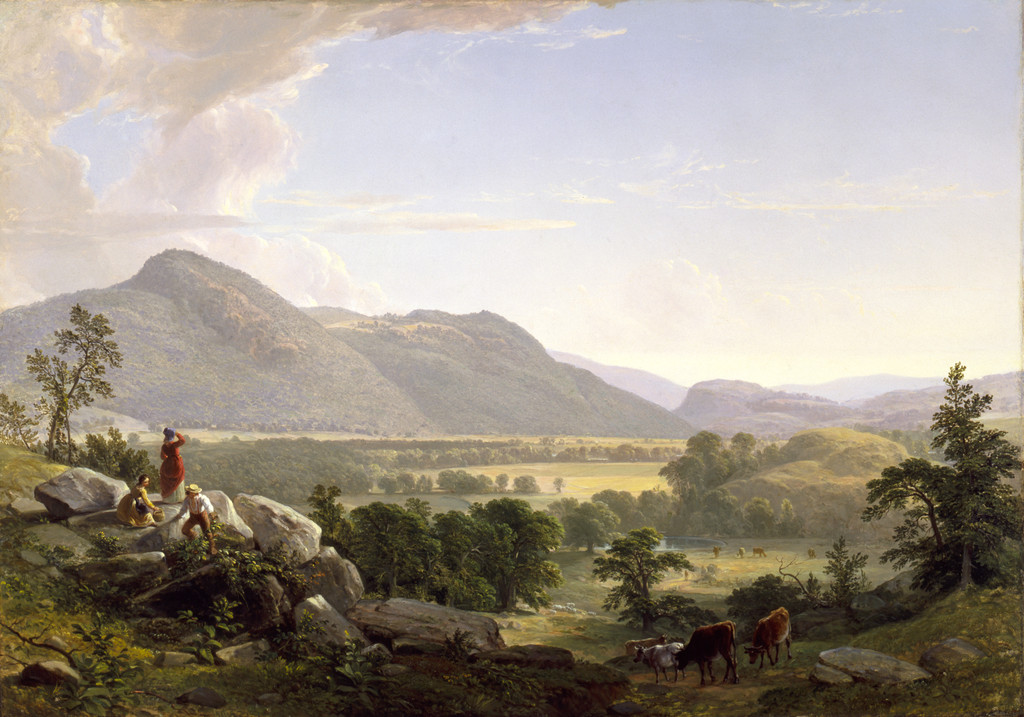
Dover Plains, 1848, gives a named region a broad cultivated prospect, with foreground figures looking across the valley.[5] In First Harvest, the viewer approaches a settlement through a rough streamside foreground. The change in position brings the traces of land clearing closer, while the Graham rock gives this particular landscape its memorial purpose.
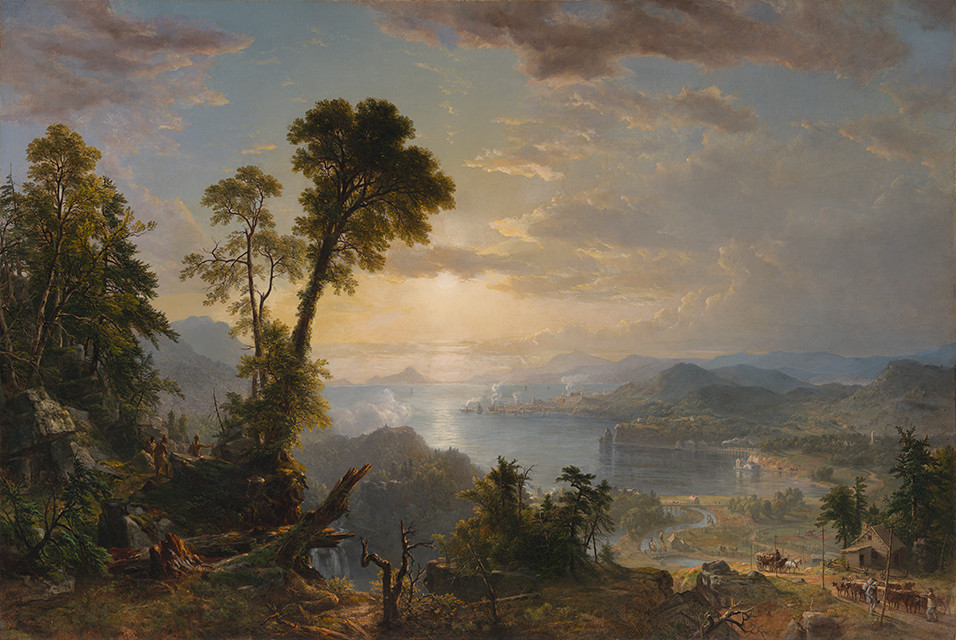
Asher Brown Durand, Progress, 1853. Oil on canvas. Virginia Museum of Fine Arts. Museum-origin public-domain reproduction; native size retained. Virginia Museum of Fine Arts; museum-origin public-domain reproduction via Wikimedia Commons. Image source. Public domain. Resized only; native appearance, complete carrier and margins preserved.
Artworks directory
A collected selection of 19 individually identified paintings, prints and a graphite study, including fifteen dedicated artwork articles. This directory is not a complete catalogue raisonné. Links lead to a companion article where available, otherwise the consulted institutional record. Progress is identified by title, date and museum; an unverified accession is omitted. Unillustrated objects remain searchable.
Frequently Asked Questions
Augustus Graham, the Brooklyn Institute benefactor whose bequest supported the commission. His surname appears on the foreground rock.[1]
No. It was the price Durand accepted for this painting. Graham’s wider bequest funded cultural and institutional purposes.[1]
No. An anonymous January 1856 Crayon account explicitly compared encouragement of American art with the clearing represented in the painting.[2]
Discussion
Look again at the images and ideas explored in The First Harvest in the Wilderness by Asher Brown Durand. These editorial prompts invite your observations.
Reader Insights
How does the bridge change your imagined route toward the field and cabin?
Does finding Graham’s name alter your understanding of the landscape?
What do the stumps contribute to a scene whose central field is brightly lit?
Join the Conversation
Share a detail, comparison or question about The First Harvest in the Wilderness by Asher Brown Durand below.
References
- Karen Sherry, “The First Harvest in the Wilderness,” Brooklyn Museum, 3 February 2010. Complete essay and source note consulted; exact object, Augustus Graham, commission price, collecting project and expansion interpretation. Copyrighted contemporary artworks illustrated there are not reused. View source
- Anonymous, “Domestic Art Gossip,” The Crayon 3, no.1, January 1856, printed p.30, in the JSTOR “Sketchings” grouping. Actual p.30 facsimile displayed and full text read, including the complete First Harvest notice. Flake White signs the preceding unrelated text; this notice is anonymous. Other pages of the grouping are not claimed as read. View source
- Linda S. Ferber, “Introduction. Durand: A Life in Art,” in Asher B. Durand (1796–1886): American Landscapes, Fundación Juan March (2010), printed pp.13–17. Selected introduction actually consulted; 1855 public standing and the Letters. Modern catalogue plates are not reused. View source
- Rebecca Bedell, “Asher Durand’s Progress Reconsidered,” Panorama 5, no.1, Spring 2019. Complete article and notes consulted; qualified comparison of landscape and development. View source
- Smithsonian American Art Museum, Dover Plains, Dutchess County, New York, accession 1978.126. Complete current record and interpretation consulted for the exact 1848 regional comparison. View source
- Splash image source.
Asher Brown Durand, The First Harvest in the Wilderness, 1855. Oil on canvas, 80.3 × 122 cm. Brooklyn Museum, 97.12. Transferred from the Brooklyn Institute of Arts and Sciences. Supplied support edges and narrow mounting surround retained. Brooklyn Museum / Google Art Project. Public domain. Resized only; native appearance, complete carrier and margins preserved.
View source