 by Tom Gurney
Tom Gurney BSc (Hons) is an art history expert with over 20 years experience
Email: tomgurney1@gmail.com / Phone: +44 7429 011000
Dover Plains, Dutchess County, New York by Asher Brown Durand: Introduction
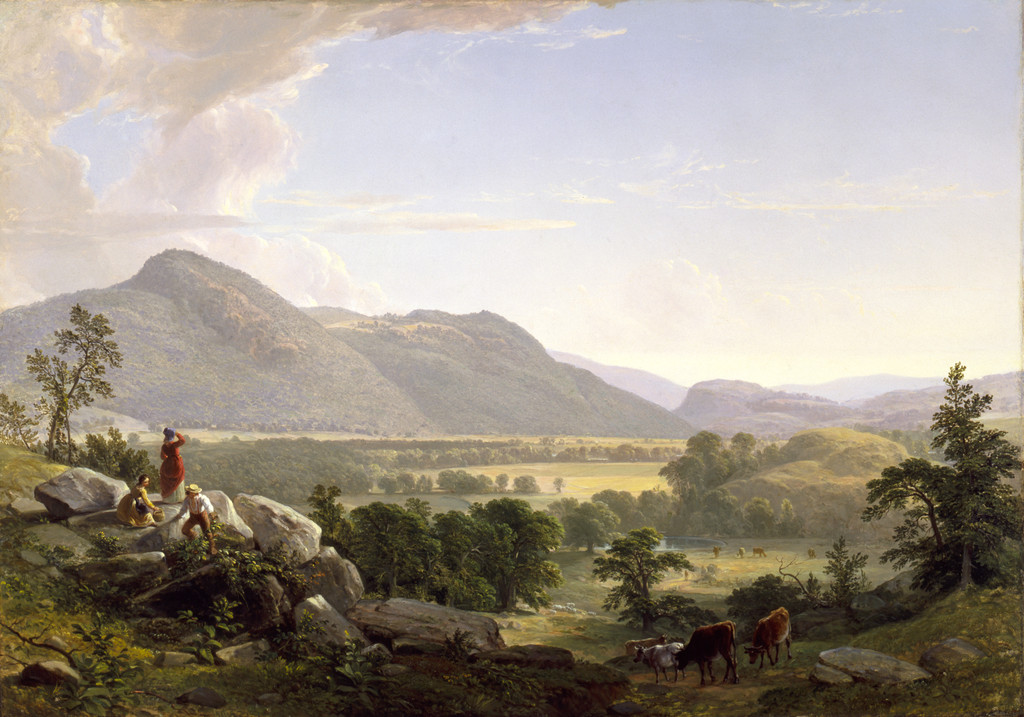
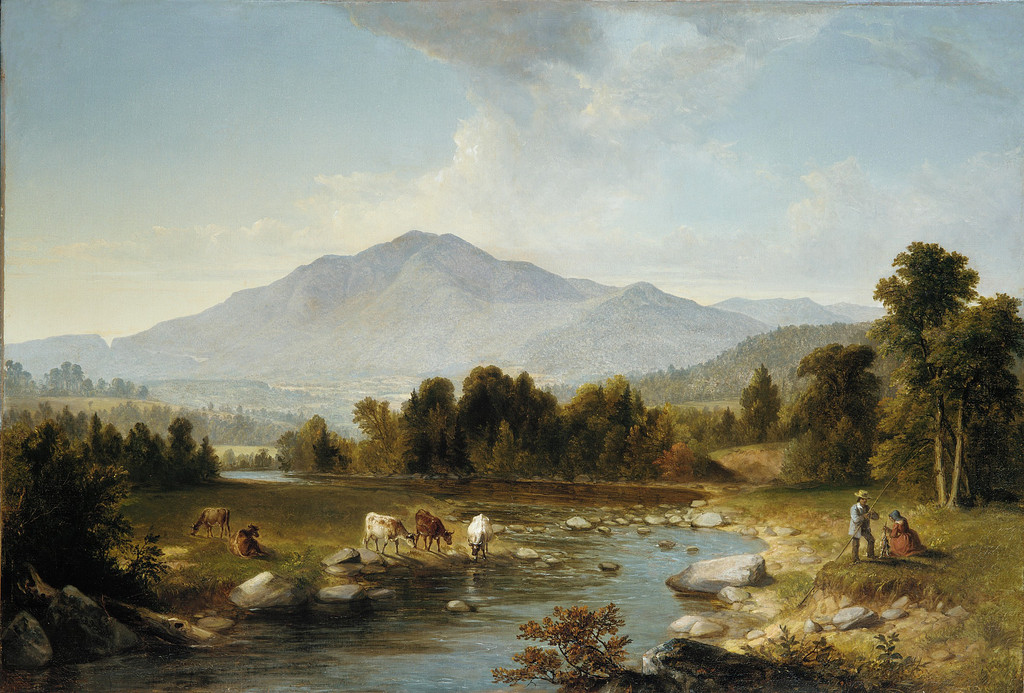
Asher Brown Durand’s Dover Plains, Dutchess County, New York places three foreground figures above a broad, cultivated valley. Trees, fields and distant buildings lie between enclosing hills, while cattle occupy the nearer slope. Painted in 1848, it belongs to the Smithsonian American Art Museum. The work combines a named region with an arrangement that gives the viewer several positions from which to experience the country.[1]
At a Glance
- ArtistAsher Brown Durand (1796–1886)
- TitleDover Plains, Dutchess County, New York
- Date1848
- MediumOil on canvas
- Dimensions107.9 × 153.7 cm
- CollectionSmithsonian American Art Museum, Washington, D.C.
- Accession1978.126
- Museum creditGift of Thomas M. Evans and museum purchase through the Smithsonian Institution Collections Acquisition Program
This work across Asher Brown Durand’s career
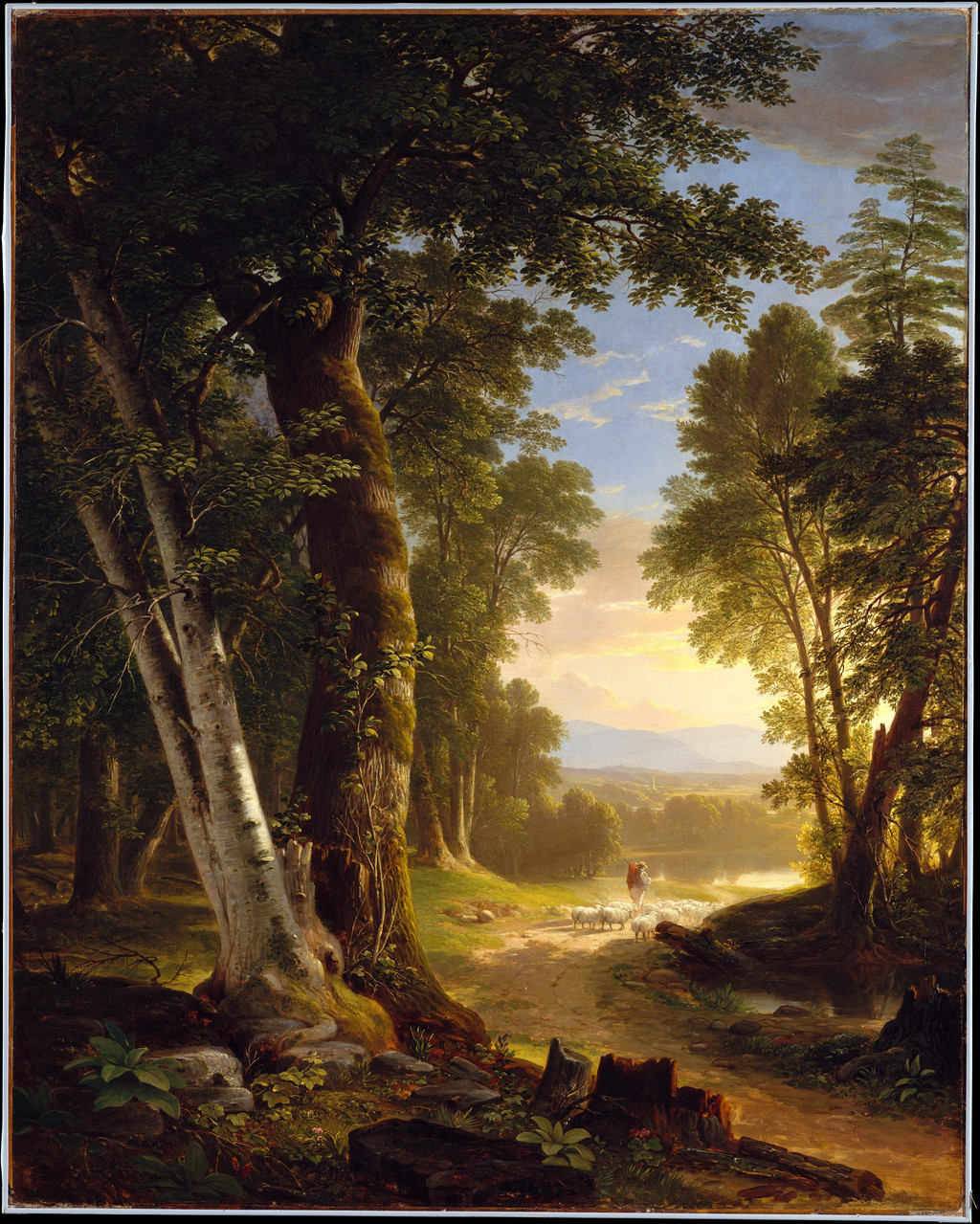
The Beeches
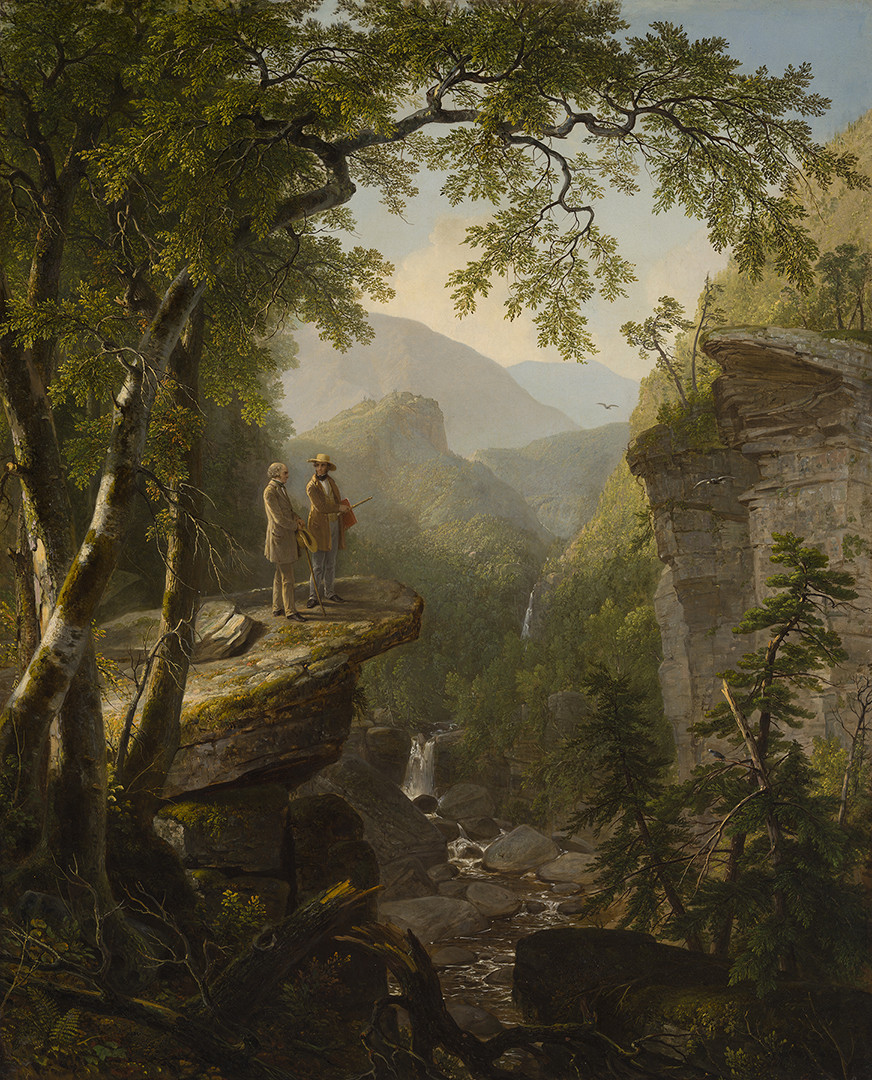
1845Kindred Spirits
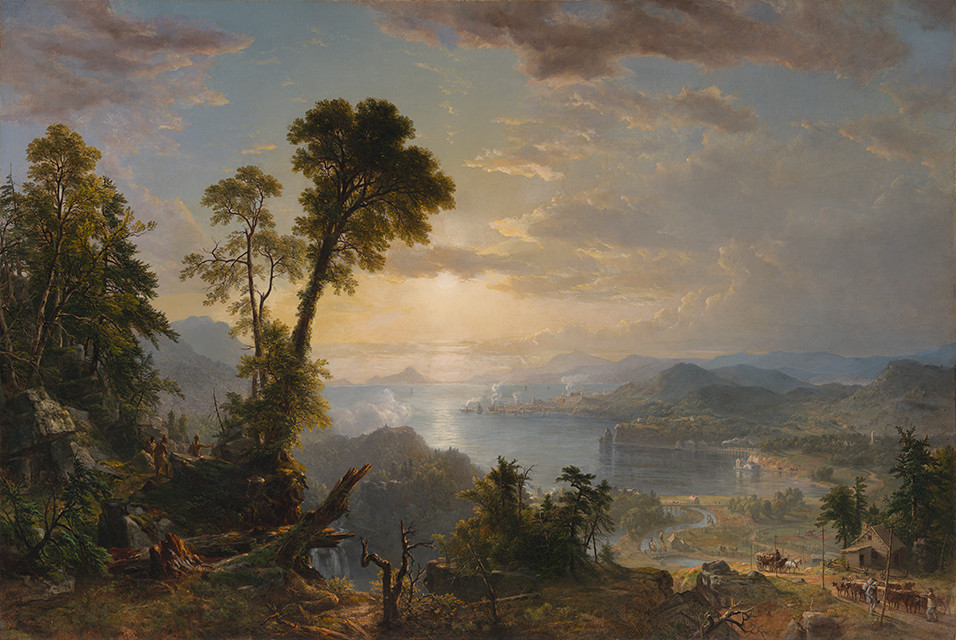
1849God’s Judgment Upon Gog
ca.1851–52River Scene
1854In the Woods
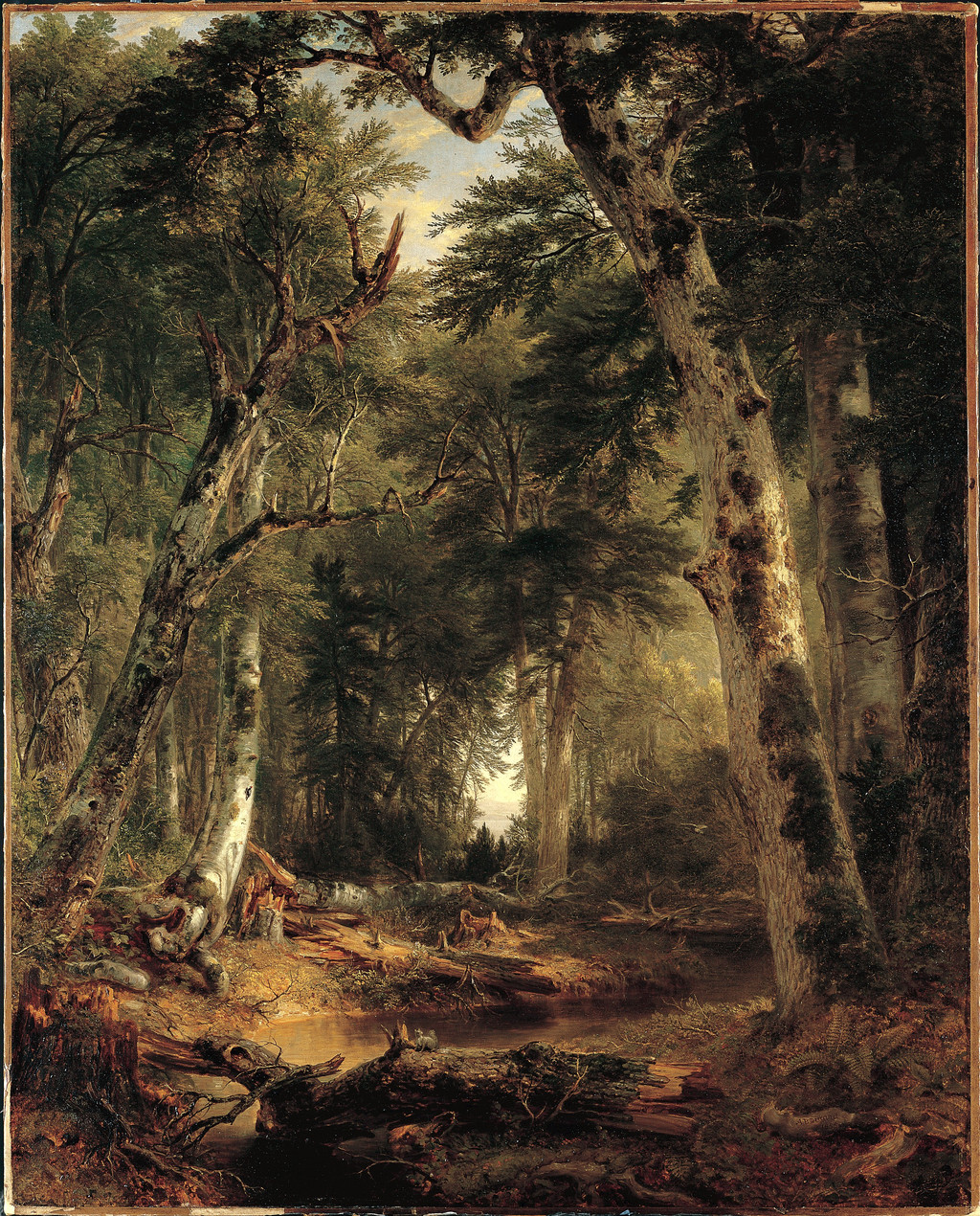
1855The Catskills
1859Sunday Morning
1860Summer Afternoon
1865Contents
- A view from a near ledge
- Cattle, fields and enclosing hills
- Dover and the 1847 visit
- The 1848 painting and its printed circulation
- Comparisons with High Point and Progress
- Annotated details
A view from a near ledge
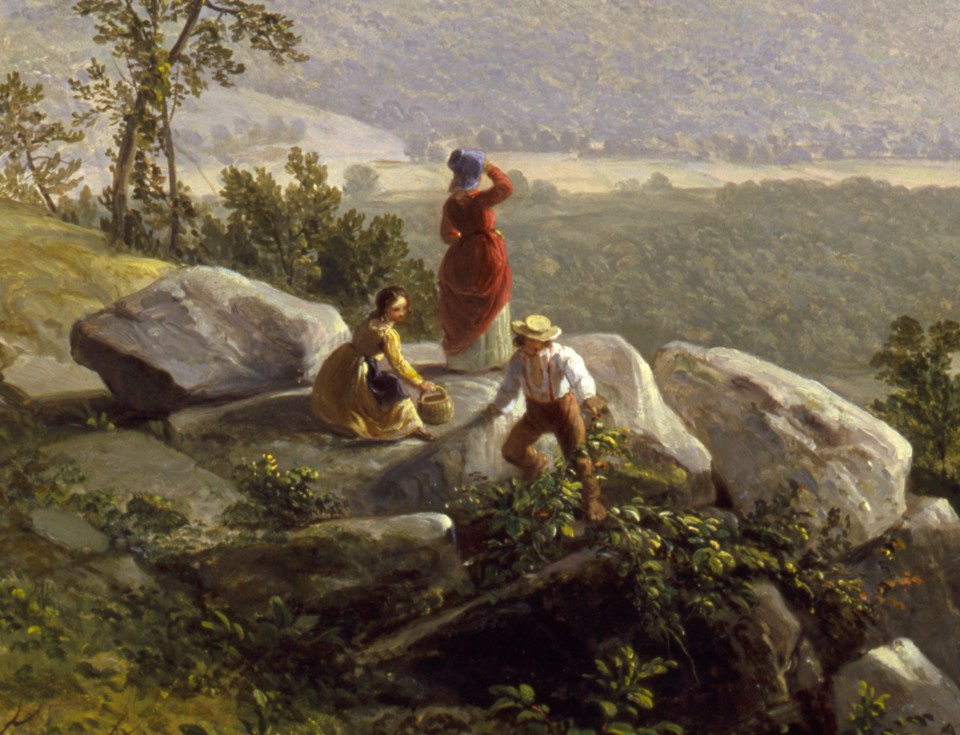
The foreground is uneven and substantial. Rocks rise at the left, plants grow between them and a shaded slope runs across the lower edge. This near ground supplies a place from which to look into the valley, while also offering objects worth attending to before the distance is reached.
The three figures occupy a ledge at the left. One stands in red clothing; the other two sit or lean close to the rocks. Their differing positions create a small group within the much larger landscape. We can recognise the act of pausing at a view without needing to know the people’s names.
Their clothing gives this area a concentration of pale and warm accents. Those accents hold the eye against the darker vegetation and grey stone. The figures are prominent enough to locate the viewer’s imagined encounter with the landscape, yet small enough to leave the valley its commanding scale.
The ledge is elevated above the nearer fields. That difference in height permits a broad view while keeping foreground plants close. The painting offers both the immediate experience of rock and vegetation and a more expansive understanding of the inhabited country beyond.
Annotated Details from Dover Plains, Dutchess County, New York
The numbered points identify visible features discussed in this article. Return from each detail to the whole composition. Asher Brown Durand, Dover Plains, Dutchess County, New York, 1848. Oil on canvas. Smithsonian American Art Museum, 1978.126. Image source. CC0 / Public domain. Resized only; native appearance, complete carrier and margins preserved.
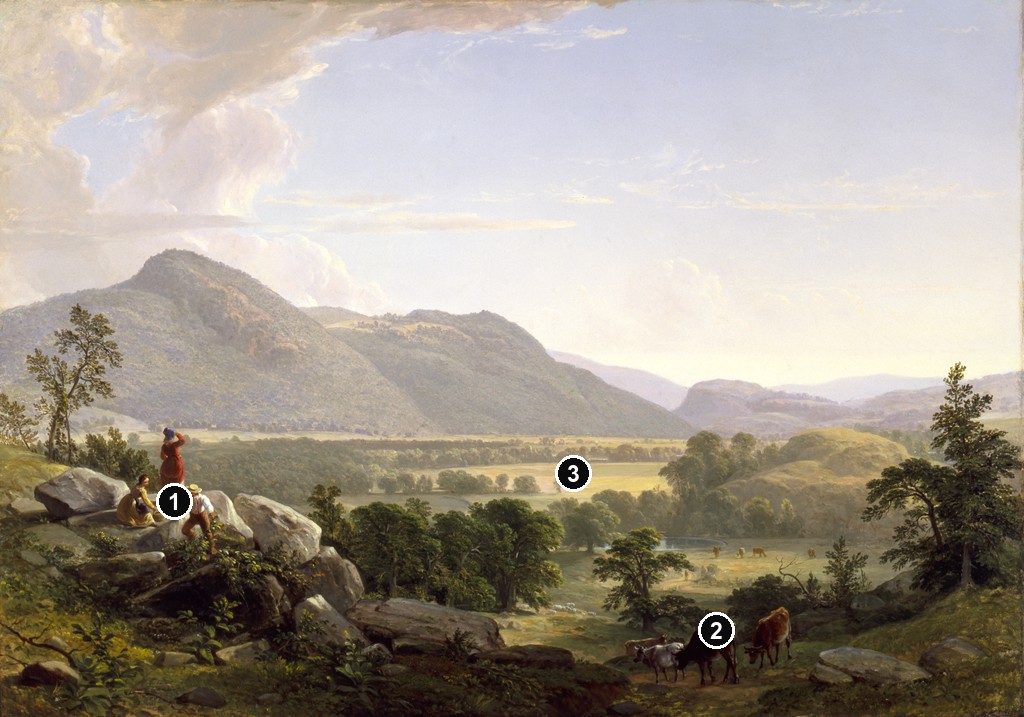
Details from DOVER PLAINS, DUTCHESS COUNTY, NEW YORK
Compare the cropped details with the complete images above. Notice how their colours, shapes and positions contribute to the larger compositions.
Three figures on the ledge
Three figures occupy the near left ledge, looking across the valley. Their clothing and poses remain distinct within the group.
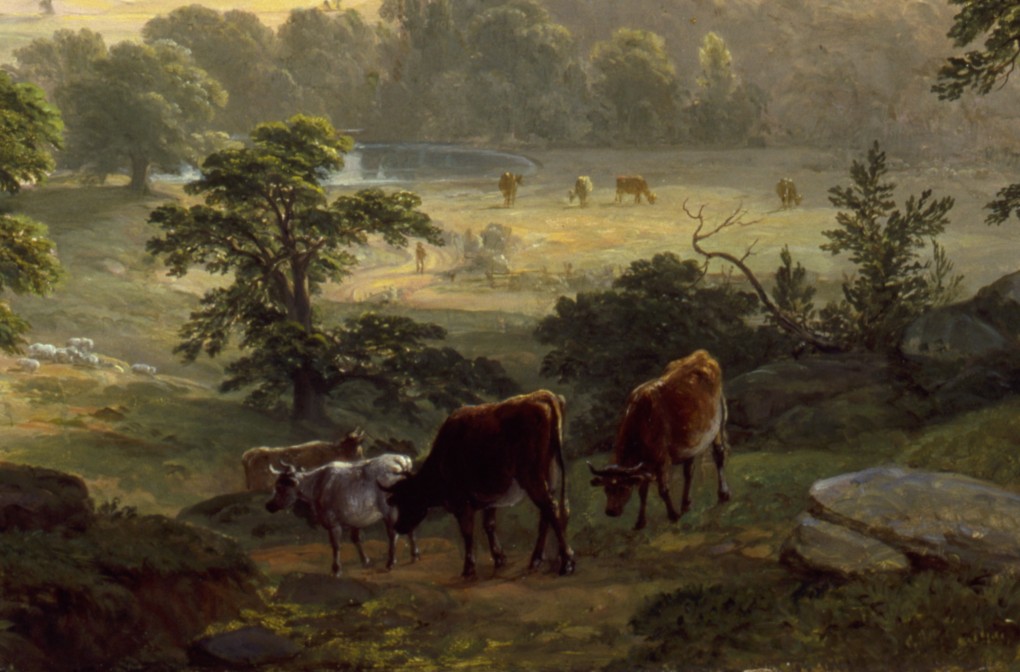
Cattle beside the descending ground
Near cattle stand on the right-hand descending ground. Smaller animals farther away help establish distance.
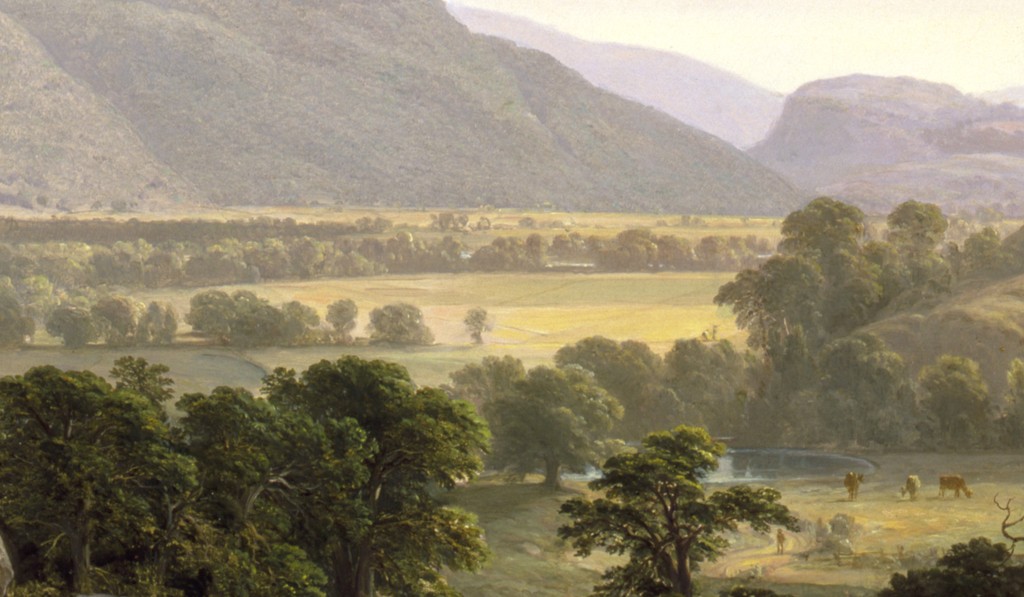
Fields within the enclosing hills
Light fields and darker trees extend beneath the enclosing hills. The crop connects cultivated ground with the broad regional view.
Cattle, fields and enclosing hills
Cattle appear toward the lower right, partly silhouetted against lighter ground behind them. Their placement balances the figures on the opposite side. People and animals therefore provide near points of attention around the open centre, giving the valley an inhabited frame.
Beyond them, fields lie at different levels between groups of trees. Their lighter and darker passages make the ground legible through successive intervals. Small buildings and cultivated areas allow human occupation to be seen throughout the middle distance, rather than confined to the foreground spectators.
The large hill on the left establishes a strong boundary to the valley. Farther ridges soften and grow paler as they approach the brighter right-hand distance. The landscape’s depth develops through these changes in definition, with nearer landforms retaining greater weight than those beyond them.
Much of the upper canvas is sky. Pale cloud leaves room above the hills and prevents their enclosure from becoming visually oppressive. The view has an extensive atmosphere as well as substantial terrain. Its apparent calm depends partly on that balance between open air and the pattern of land beneath it.
The cattle also affect how the terrain is read. Their ordinary presence connects rocky foreground with managed country. The picture accommodates viewing, grazing and cultivation together, making everyday uses of land part of the broad prospect.
Dover and the 1847 visit
Margaret Stenz’s Brooklyn Museum guide records Durand’s visit to Dover Plains in 1847. She places it after the village became the last station on the railroad from New York and suggests that he may have visited the Stone Church, a natural rock cavern that attracted tourists.[2]
The visit supplies a regional context for the 1848 painting. It also shows that landscape study could take place within country connected to travel and tourism. A rural-looking view could be reached through the transport networks of Durand’s own period.
Stenz considers the painting largely faithful to the area while noting an enlargement of the mountains. Her account makes observation and adjustment parts of the same work. The title identifies a place, while the proportions chosen for its representation contribute to the canvas’s effect.[2]
Her guide also records a later change to the terrain: the small rounded landform at the right, described as a drumlin, had been removed for road gravel before the guide’s 2007 publication. The observation adds another reason for treating the painting as a historical landscape. Differences between its appearance and a later view can arise through physical changes to the country as well as through Durand’s adjustments on canvas.[2]
The named Stone Church remains a proposed stop in Durand’s travels, rather than an identified structure in this painting. Likewise, the historical guide’s directions should be understood as part of its 2007 publication. The image provides evidence of Durand’s selected landscape, not a current itinerary.
For more on his regional study, see Durand in the Catskills and American landscape. That wider history includes both enclosed tree studies and broad views whose final arrangement developed from repeated attention to different places.
Watch: Asher Brown Durand
Choose a film to explore the artist’s work, its interpretation and its wider setting.
Friendship and landscape, Asher B Durand's Kindred Spirits
Smarthistory and Crystal Bridges discuss friendship, memory and landscape in Kindred Spirits.
Watch on YouTubeThe 1848 painting and its printed circulation
John Durand’s memoir records Dover Plains under the year 1848. He identifies Daniel Seymour as its purchaser and James Smillie as the engraver who reproduced it for the American Art-Union. This published family account supplies an early collecting and circulation history for the landscape.[3]
The engraving extended the image beyond the single painted canvas. A landscape could reach viewers through a reproductive print as well as through its exhibition or ownership. Smillie’s role should therefore be distinguished from Durand’s authorship of the painting.
The Smithsonian’s current interpretation also discusses the response when the work was first shown in 1848. It reports a critic’s sense that the scenery was recognisably characteristic of the country and relates Durand’s landscape art to national ideals. That account concerns how a particular regional view could acquire a broader public meaning.[1]
The painting itself keeps that meaning attached to ordinary country features. Fields, cattle, figures and hills provide the scene’s substance. Its ideal quality can arise through arrangement, atmosphere and the relationship between near and far rather than through a separate emblem inserted into the landscape.
Comparisons with High Point and Progress
High Point: Shandaken Mountains, 1853, also joins a broad mountain view with cattle and small people. The Met’s record identifies fishing figures in its foreground and relates the scene to Durand’s regional studies. There, a stream gives the near country a particularly clear route across the canvas.[4]
The two pictures organise human scale differently. Dover Plains places its most conspicuous people at an elevated lookout, with the cultivated valley spread below. High Point brings leisure and grazing closer to the water, while the mountain remains a broad presence across the background.
Progress, also painted in 1853, makes transport and industry central to its panorama. Rebecca Bedell’s study identifies roads, canal, railway and telegraph among its distinctive elements and reconsiders the apparent promise of development.[5]
Comparing these works helps keep the human uses of land specific. Dover Plains gives cultivation and spectatorship a quiet regional form. Progress concentrates multiple technologies into an imagined historical landscape. Here, the near ledge and the carefully spaced valley let the viewer encounter inhabited country through an act of looking.
Asher Brown Durand, High Point: Shandaken Mountains, 1853. Oil on canvas. Metropolitan Museum of Art, 77.3.1. Bequest of Sarah Ann Ludlum, 1877. The Metropolitan Museum of Art. Image source. CC0 / Public domain. Resized only; native appearance, complete carrier and margins preserved.
Artworks directory
A collected selection of 19 individually identified paintings, prints and a graphite study, including fifteen dedicated artwork articles. This directory is not a complete catalogue raisonné. Links lead to a companion article where available, otherwise the consulted institutional record. Progress is identified by title, date and museum; an unverified accession is omitted. Unillustrated objects remain searchable.
Frequently Asked Questions
John Durand identifies James Smillie as its engraver for the American Art-Union. Durand made the painting.[3]
Stenz describes the picture as largely true to the area while noting that Durand enlarged the mountains. The painting combines regional observation with compositional choices.[2]
Discussion
Look again at the images and ideas explored in Dover Plains, Dutchess County, New York by Asher Brown Durand. These editorial prompts invite your observations.
Reader Insights
Do the figures on the ledge encourage you to look outward or first to inspect the near rocks?
How does the placement of the cattle balance the group on the left?
What changes in the experience of a landscape when you know it also circulated as a print?
Join the Conversation
Share a detail, comparison or question about Dover Plains, Dutchess County, New York by Asher Brown Durand below.
References
- Smithsonian American Art Museum, Dover Plains, Dutchess County, New York, accession 1978.126. Complete current object record and interpretation consulted; date, dimensions, credit and reported 1848 reception. View source
- Margaret Stenz, Following in the Footsteps of Asher B. Durand: A Walker’s Guide, Brooklyn Museum (2007). All five pages’ text consulted, including Dover Plains: 1847 visit, possible Stone Church stop and adjusted mountain proportions. Historical travel information, not current directions. View source
- John Durand, The Life and Times of A. B. Durand (1894). Selected chapters actually consulted; printed p.173 identifies Seymour and Smillie in the 1848 entry. Retrospective family testimony. View source
- Metropolitan Museum of Art, High Point: Shandaken Mountains, accession 77.3.1. Complete current 1853 object record and narrative consulted for the exact comparison. View source
- Rebecca Bedell, “Asher Durand’s Progress Reconsidered,” Panorama 5, no. 1, Spring 2019. Complete article and notes consulted; technologies and interpretive distinction. View source
- Splash image source.
Asher Brown Durand, Dover Plains, Dutchess County, New York, 1848. Oil on canvas, 107.9 × 153.7 cm. Smithsonian American Art Museum, 1978.126. Gift of Thomas M. Evans and museum purchase through the Smithsonian Institution Collections Acquisition Program. CC0 / Public domain. Resized only; native appearance, complete carrier and margins preserved.
View source