 by Tom Gurney
Tom Gurney BSc (Hons) is an art history expert with over 20 years experience
Email: tomgurney1@gmail.com / Phone: +44 7429 011000
God’s Judgment Upon Gog by Asher Brown Durand: Introduction
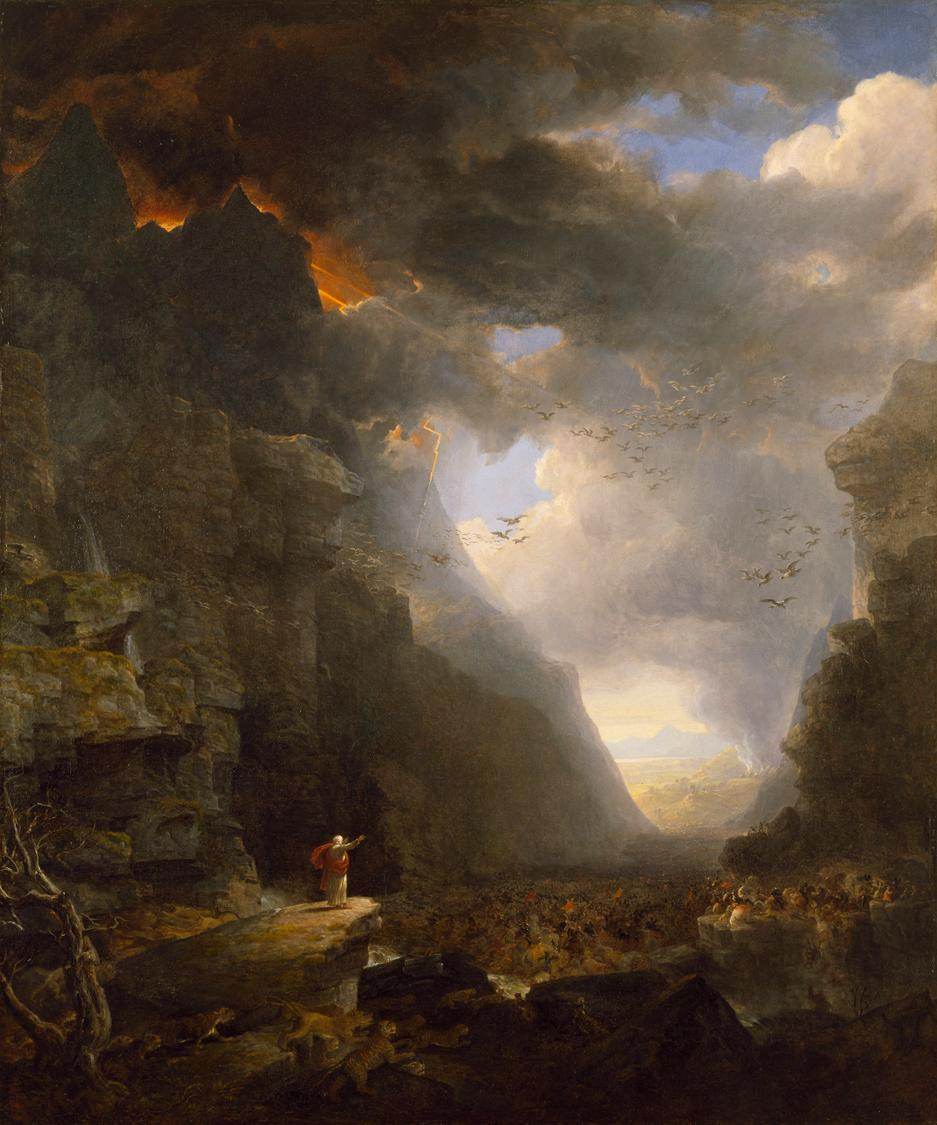
A prophet stands on a projecting rock above an army in Asher Brown Durand’s God’s Judgment Upon Gog. Lightning breaks through dark clouds, birds cross the ravine and wild animals occupy the foreground. The Chrysler Museum of Art dates the painting to about 1851–52 and identifies its subject as Ezekiel calling forth divine judgment upon Gog. Durand uses the landscape itself to give the biblical event its force.[1]
At a Glance
- ArtistAsher Brown Durand (1796–1886)
- TitleGod’s Judgment Upon Gog
- DateAbout 1851–52
- MediumOil on canvas
- Dimensions154.3 × 128.3 cm
- CollectionChrysler Museum of Art, Norfolk, Virginia
- Accession71.499
- Museum creditGift of Walter P. Chrysler, Jr.
This work across Asher Brown Durand’s career
The Beeches
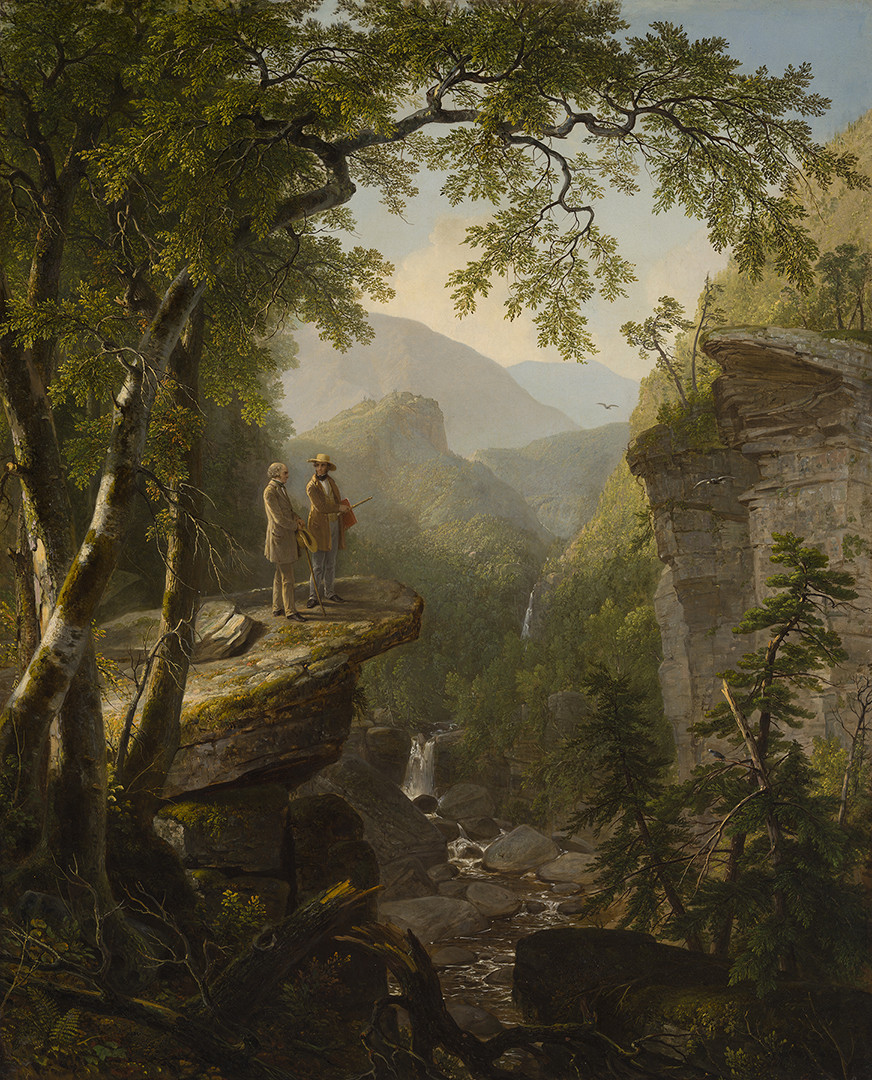
1845Kindred Spirits
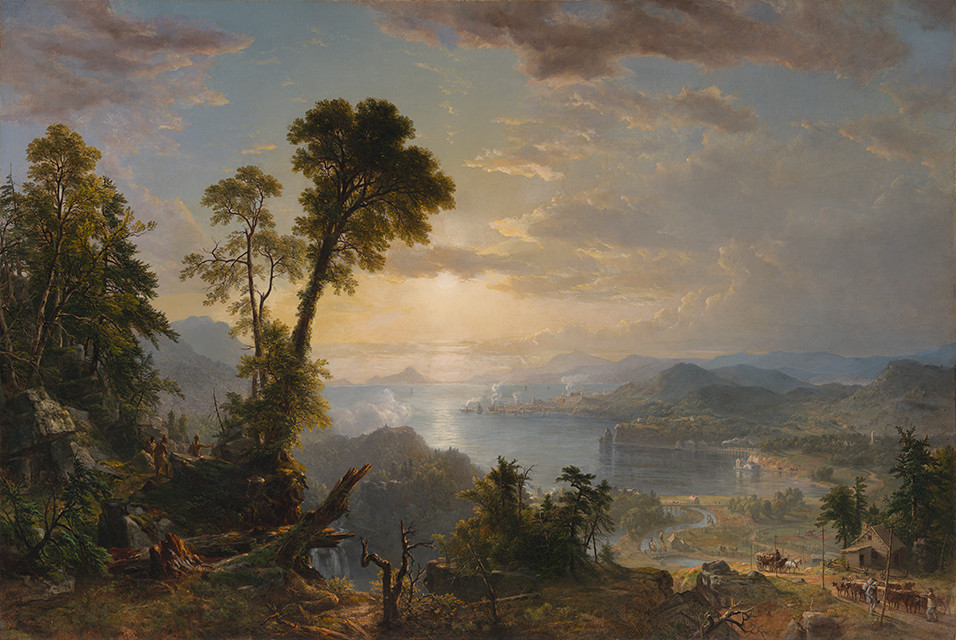
1849River Scene
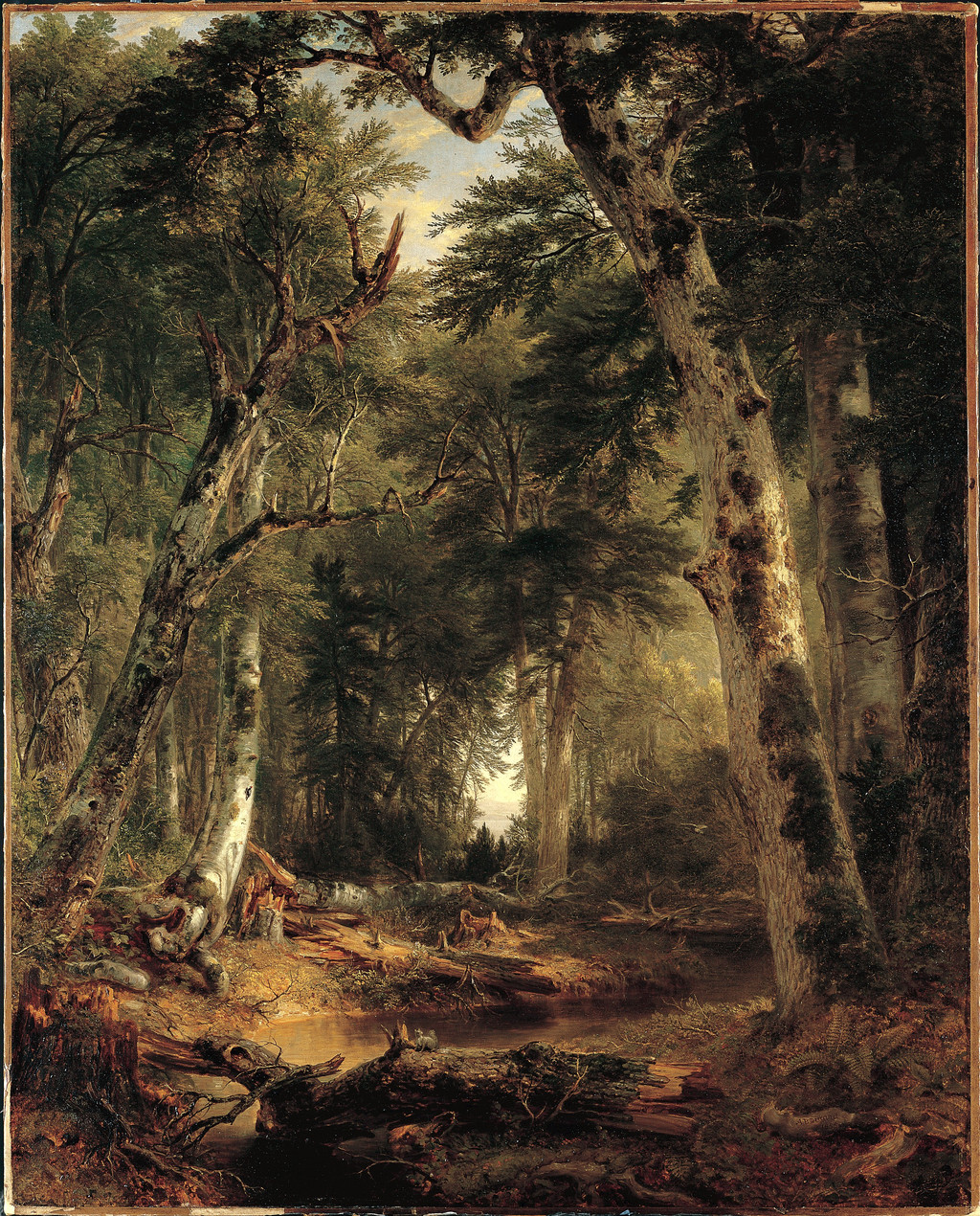
1854In the Woods
1855The Catskills
1859Sunday Morning
1860Summer Afternoon
1865Contents
- The prophet on a rock platform
- An army and a vengeful natural world
- Dark peaks and a bright opening
- Sturges’s biblical commission
- The 1852 critical exchange
- Huntington’s later reservation
- A changing collection history
- Comparisons with quieter landscapes
- Annotated details
The prophet on a rock platform
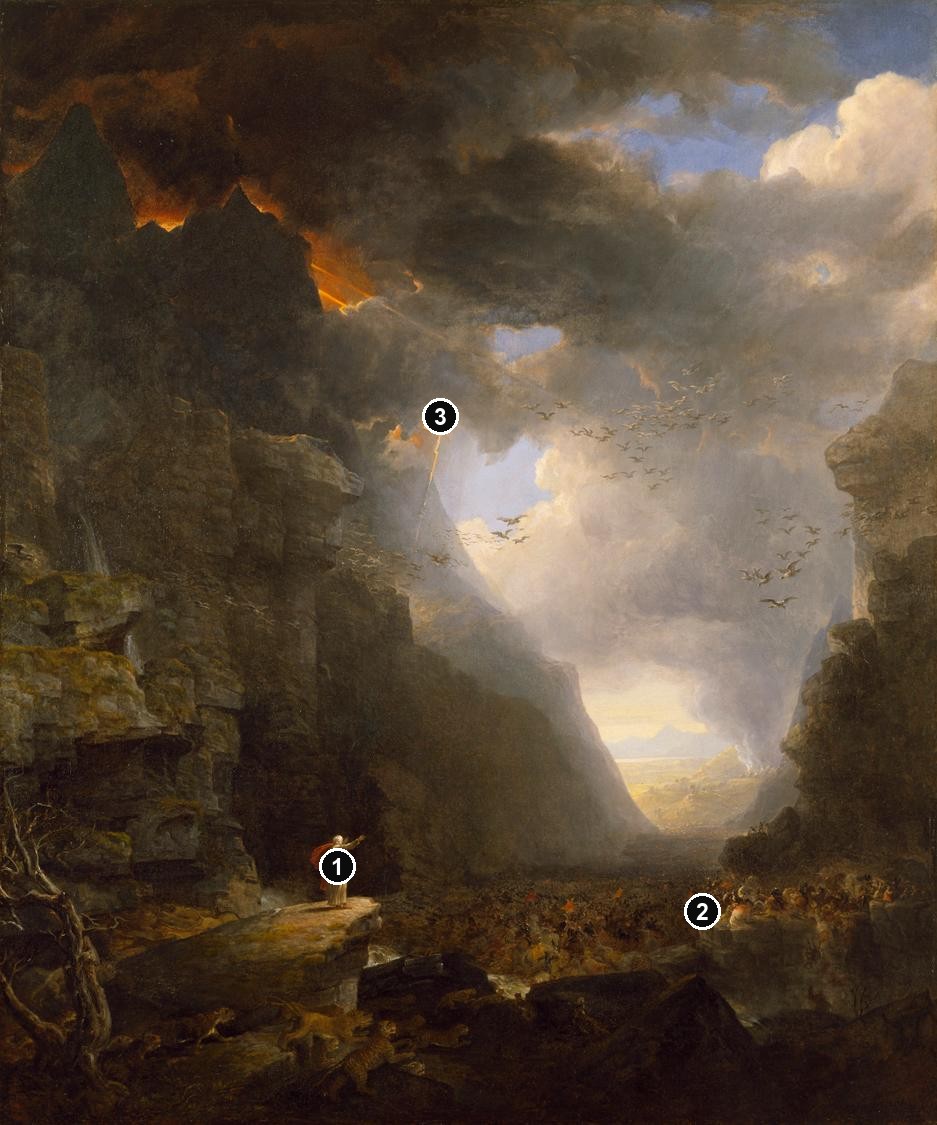
The most clearly isolated figure stands on a ledge at the lower left. Pale clothing and a red-orange mantle distinguish him from the dark cliff behind. An extended arm directs attention outward into the ravine.
The projecting rock makes his position emphatic. Its horizontal surface reaches toward the centre, leaving the figure visible against a darker opening. Below and beyond him, smaller forms gather within the valley, establishing a difference between the prophet’s separated position and the army’s crowded ground.
The Chrysler identifies this figure as Ezekiel. Its interpretation describes his rocky position as a place from which divine vengeance is called forth.[1] The gesture and setting therefore contribute to a named biblical subject, rather than presenting an anonymous traveller admiring a mountain view.
The figure is nevertheless small in relation to the cliffs. His prominence comes from placement, colour and isolation more than from physical size. The painting joins a human act with a landscape whose scale far exceeds the person performing it.
Annotated Details from God’s Judgment Upon Gog
The numbered points identify visible features discussed in this article. Return from each detail to the whole composition. Asher Brown Durand, God’s Judgment Upon Gog, about 1851–52. Oil on canvas, 154.3 × 128.3 cm. Chrysler Museum of Art, 71.499. Gift of Walter P. Chrysler, Jr. Native image size retained. Image source. Public domain. Resized only; native appearance, complete carrier and margins preserved.
Details from GOD’S JUDGMENT UPON GOG
Compare the cropped details with the complete images above. Notice how their colours, shapes and positions contribute to the larger compositions.
Prophet on the left platform
A robed figure stands on a projecting rock above the ravine. The broad native crop retains his position within the dramatic landscape.
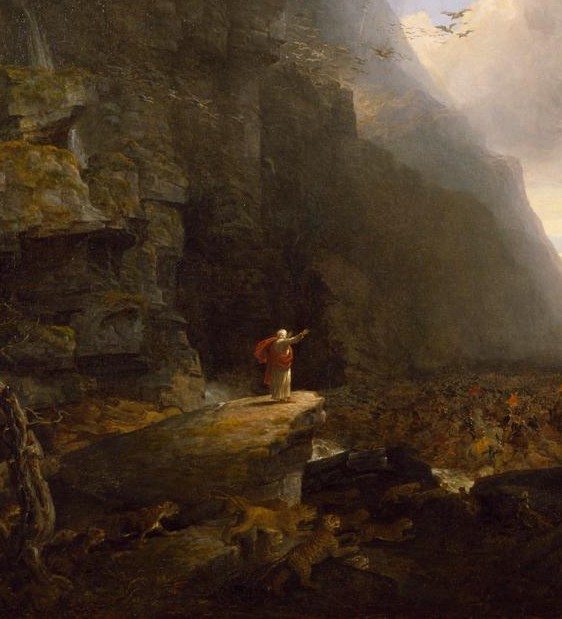
Army within the lower ravine
A crowded army occupies the lower ravine beneath the high cliffs. Individual faces remain small in this available source.
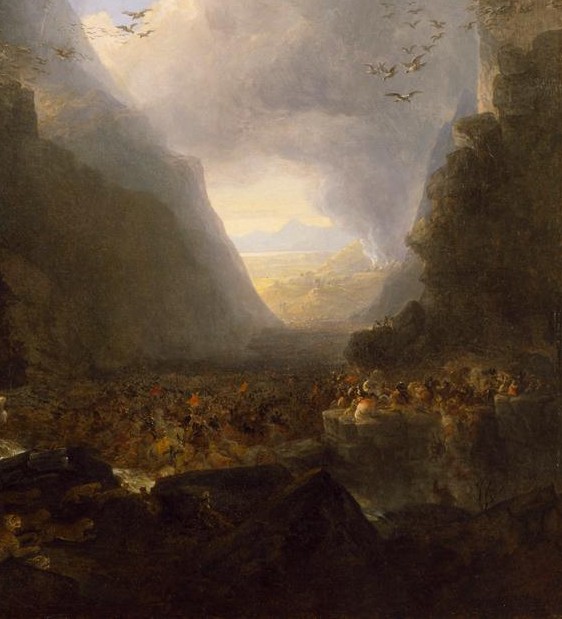
Lightning and the changing sky
Lightning appears beside dark left peaks while brighter clouds open towards the right. The broad crop preserves that contrast.
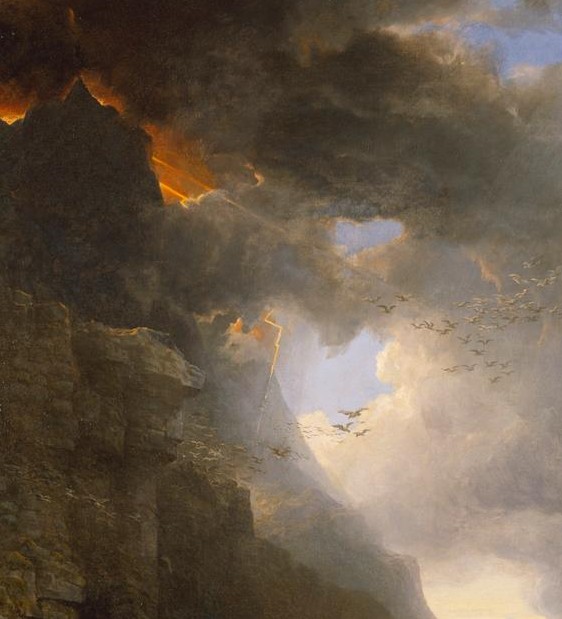
An army and a vengeful natural world
The army occupies the lower valley, where numerous small figures and warm accents collect beneath the darker rocks. At this scale, the mass is more readily understood than any single person. Its density contrasts with the lone prophet on the ledge.
Birds form a broad movement across the brighter sky. Their scattered silhouettes connect different parts of the ravine, giving the atmosphere an activity absent from the still mountain walls. They are most conspicuous where pale cloud provides a clear background.
Animals appear among the nearer rocks. Their low position brings the violence of the subject close to the viewer’s imagined place. The foreground remains a landscape of stone and vegetation, but its occupants change the experience from contemplative shelter to threat.
The museum interprets the birds and beasts as agents consuming Gog’s army. Daniel Huntington’s memorial address likewise connects the scene with Ezekiel’s prophecy and describes these forces in his recollection of the work.[1][3]
The natural world therefore has an active role in the narrative. Cloud, lightning, animals and jagged terrain make the judgment visible throughout the painting. The event extends beyond the actions of human figures at the valley floor.
Dark peaks and a bright opening
The steepest peaks rise at the upper left beneath heavy cloud. Warm flashes appear between their dark silhouettes, and a sharp lightning stroke descends nearer the centre. These abrupt changes of brightness give the upper landscape an unsettled character.
On the right, pale cloud and blue sky remain visible. Lower down, the ravine opens toward a much brighter distance. The contrast creates a deep passage through the painting, while the near cliffs retain their weight and darkness.
The opening also makes the foreground drama easier to distinguish. A uniformly dark valley would conceal much of its activity; here, light beyond the nearer masses separates cliffs, flying birds and the direction of the ravine.
Durand’s upright format gives the storm considerable space above the army. The viewer encounters threatening sky before reaching the crowded lower ground. The land and atmosphere establish the narrative’s scale, with the small prophet functioning as its most clearly placed human point of attention.
Sturges’s biblical commission
John Durand’s memoir lists the painting under 1852 and states that Jonathan Sturges prescribed its subject. This retrospective account identifies a patron’s role in the choice of a biblical landscape.[2]
The Chrysler records the work’s exhibition at the National Academy of Design in 1852. Its current approximate date, 1851–52, allows the preparation and completion history to be understood without reducing every stage to the exhibition year.[1]
A requested subject could take Durand beyond the quieter rural scenery familiar from many of his paintings. The commission demonstrates the range of narrative demands that landscape painting could accommodate, even where a particular work departed from an artist’s best-known manner.
Huntington later suggested that Sturges wished to test his friend’s capacity for an ambitious imaginative work. That suggestion is the memorial speaker’s interpretation of the patron’s motive, not a surviving commission instruction.[3]
Watch: Asher Brown Durand
Choose a film to explore the artist’s work, its interpretation and its wider setting.
Friendship and landscape, Asher B Durand's Kindred Spirits
Smarthistory and Crystal Bridges discuss friendship, memory and landscape in Kindred Spirits.
Watch on YouTubeThe 1852 critical exchange
The work prompted a debate about Durand’s artistic reputation. In Appendix II of his memoir, John reproduces Horatio Greenough’s response to a May 1852 criticism attributed to George William Curtis. The exchange is consulted through that later published transcription.[2]
The passage reproduced by Greenough presents Durand as an accomplished painter of pastoral calm, then questions whether his achievement continued to advance. Greenough objects to the critic’s manner and to measuring an artist primarily against the kinds of greatness associated with other painters.
This disagreement extends beyond whether one canvas succeeded. It asks how an established artist should be judged: by the qualities of the work under consideration, by expectations of perpetual development or by comparison with different artistic ambitions.
The memoir’s transcription does not supply the complete original newspaper review. Greenough’s response is itself a forceful, interested intervention. It provides evidence of a dispute, while leaving the critic’s full argument distinct from the selected words reproduced against him.
Huntington’s later reservation
In his 1887 memorial address, Huntington treated God’s Judgment Upon Gog as a marked departure from Durand’s usual subjects. He offered a qualified negative assessment, while explicitly acknowledging that his recollection of the picture was vague.[3]
Both parts of that testimony matter. The judgment belongs to a fellow artist recalling the work many years later; the stated uncertainty prevents his description from becoming an unquestioned inventory of every detail.
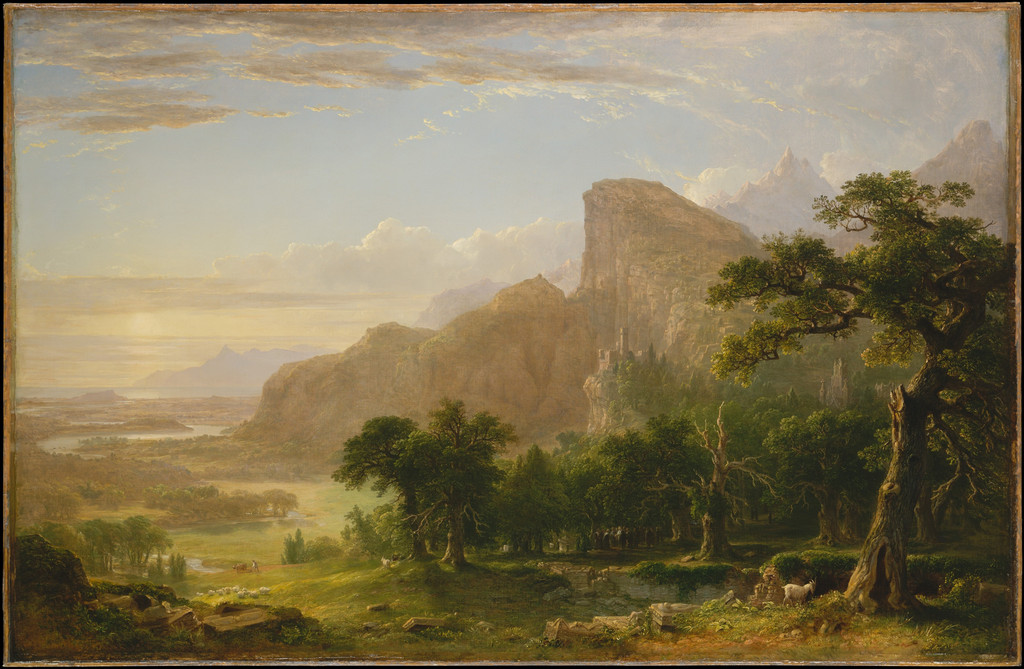
His response can be compared with his praise of Sunday Morning. The contrast helps explain the strength of Durand’s association with calm scenery, while the Gog painting remains an actual example of his willingness to undertake a more violent subject.
A changing collection history
The Chrysler’s provenance follows the painting from Sturges’s collection to the Met through a gift by his children in 1895. It then records a 1956 Plaza Art Gallery sale, Padawer Galleries and Walter P. Chrysler, Jr.’s ownership, before its 1971 gift in Norfolk.[1]
Those stages explain why a former Met painting is now associated with the Chrysler. The current accession 71.499 and gift credit identify this exact canvas, keeping the collecting history separate from Durand’s other Sturges commissions.
Comparisons with quieter landscapes
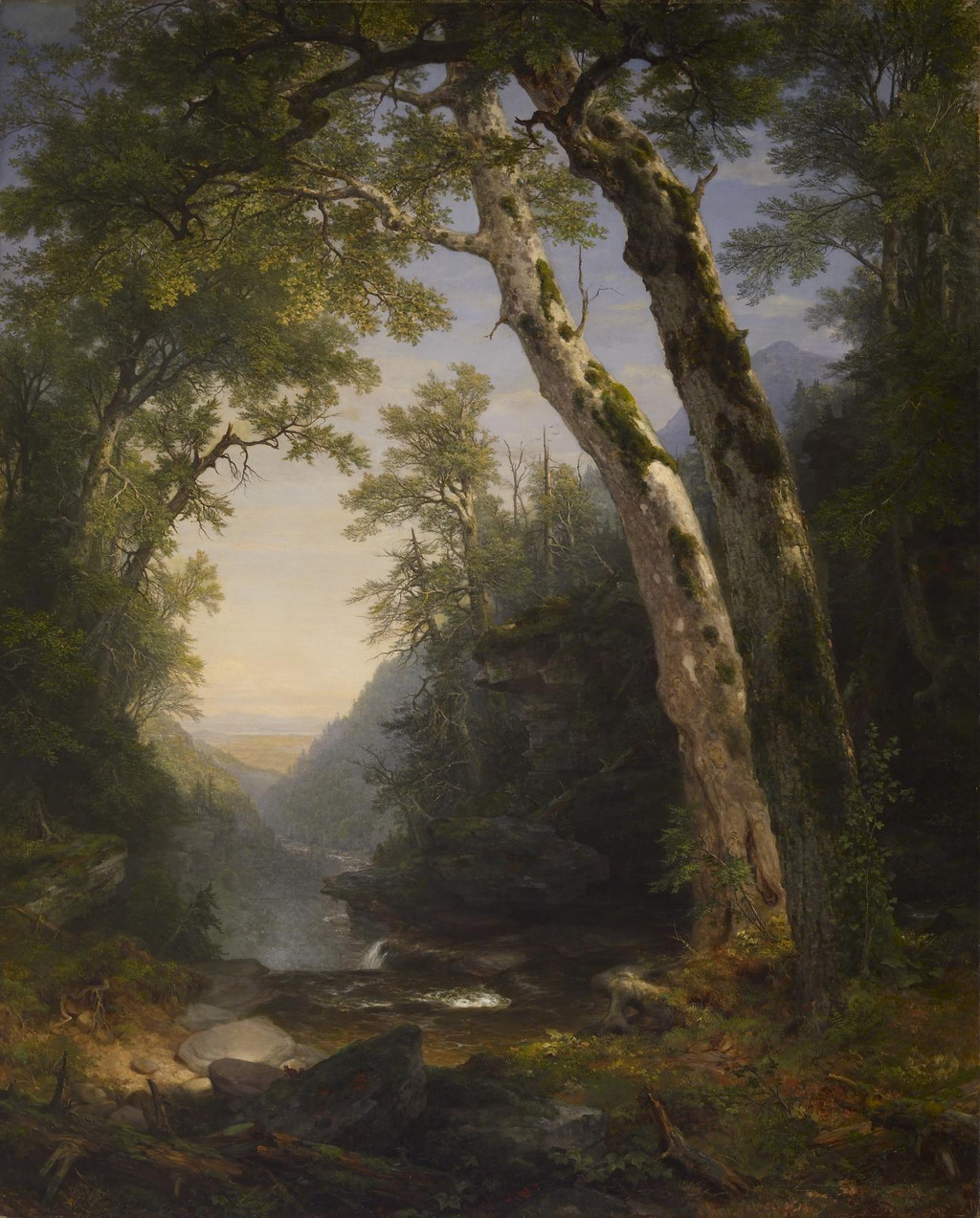
The Beeches, 1845, also gives large trees, shade and small figures an imposing upright setting. The Met’s catalogue discusses its ordinary rural subject and compositional history.[4] There, a road and open atmosphere support a measured passage into the country.
In the Woods, 1855, was another Sturges commission and places close forest forms at the centre of attention.[2] Compared with those pictures, the Gog landscape gives weather and terrain a more forceful narrative role. Its significance lies partly in this change of purpose: familiar skills of arranging rock, distance and light are directed toward an event of judgment.
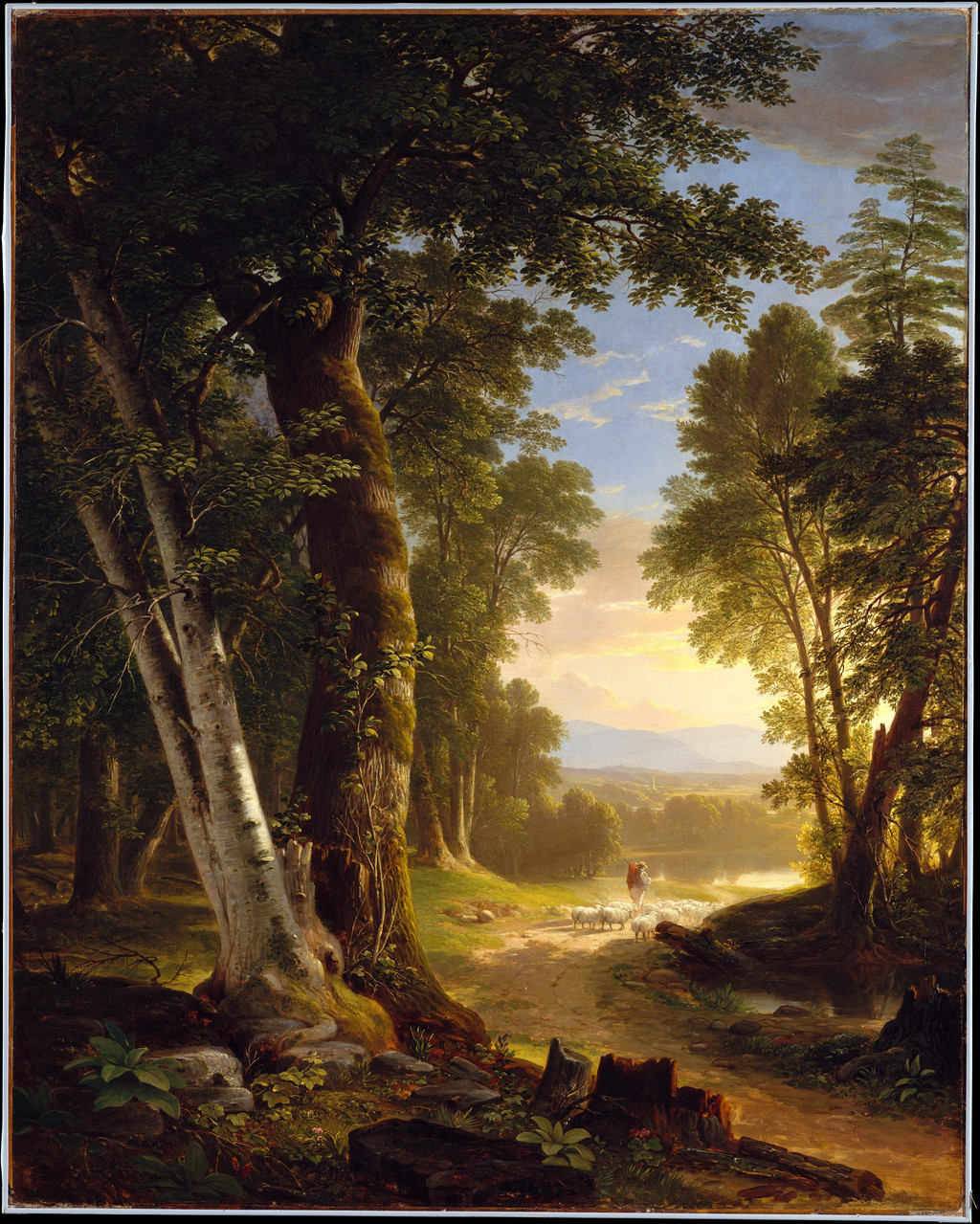
Asher Brown Durand, The Beeches, 1845. Metropolitan Museum of Art, 15.30.59. Bequest of Maria DeWitt Jesup, from the collection of her husband, Morris K. Jesup, 1914. The Metropolitan Museum of Art. Image source. CC0 / Public domain. Resized only; native appearance, complete carrier and margins preserved.
Artworks directory
A collected selection of 19 individually identified paintings, prints and a graphite study, including fifteen dedicated artwork articles. This directory is not a complete catalogue raisonné. Links lead to a companion article where available, otherwise the consulted institutional record. Progress is identified by title, date and museum; an unverified accession is omitted. Unillustrated objects remain searchable.
Frequently Asked Questions
The Chrysler Museum identifies him as the prophet Ezekiel, calling forth judgment upon Gog.[1]
Discussion
Look again at the images and ideas explored in God’s Judgment Upon Gog by Asher Brown Durand. These editorial prompts invite your observations.
Reader Insights
Does the prophet’s placement or the lightning first establish the drama for you?
How does the bright distance alter your experience of the dark foreground?
Should a departure from an artist’s usual subjects change how you assess the work?
Join the Conversation
Share a detail, comparison or question about God’s Judgment Upon Gog by Asher Brown Durand below.
References
- Chrysler Museum of Art, God’s Judgment Upon Gog, accession 71.499. Complete current indexed primary record, label, provenance and exhibition history actually read; direct capture unavailable. Approximate date, subject, dimensions and gift credit. View source
- John Durand, The Life and Times of A. B. Durand (1894), printed pp.174–175 and Appendix II, pp.218–220. Selected chapters and the complete first Greenough response actually read. The original newspaper review is not claimed as independently consulted. View source
- Daniel Huntington, Asher B. Durand: A Memorial Address (1887), printed pp.37–38. Both original pages actually displayed and read; complete Gog passage, expressly vague recollection, proposed patron motive and qualified assessment. Biblical extract paraphrased through this consulted primary text. View source
- Metropolitan Museum of Art, The Beeches, in American Paintings in The Metropolitan Museum of Art, volume I, printed pp.414 and 416. Both relevant scans actually displayed and read for the exact calmer landscape comparison. View source
- Splash image source.
Asher Brown Durand, God’s Judgment Upon Gog, about 1851–52. Oil on canvas, 154.3 × 128.3 cm. Chrysler Museum of Art, 71.499. Gift of Walter P. Chrysler, Jr. Native image size retained. Public domain. Resized only; native appearance, complete carrier and margins preserved.
View source